
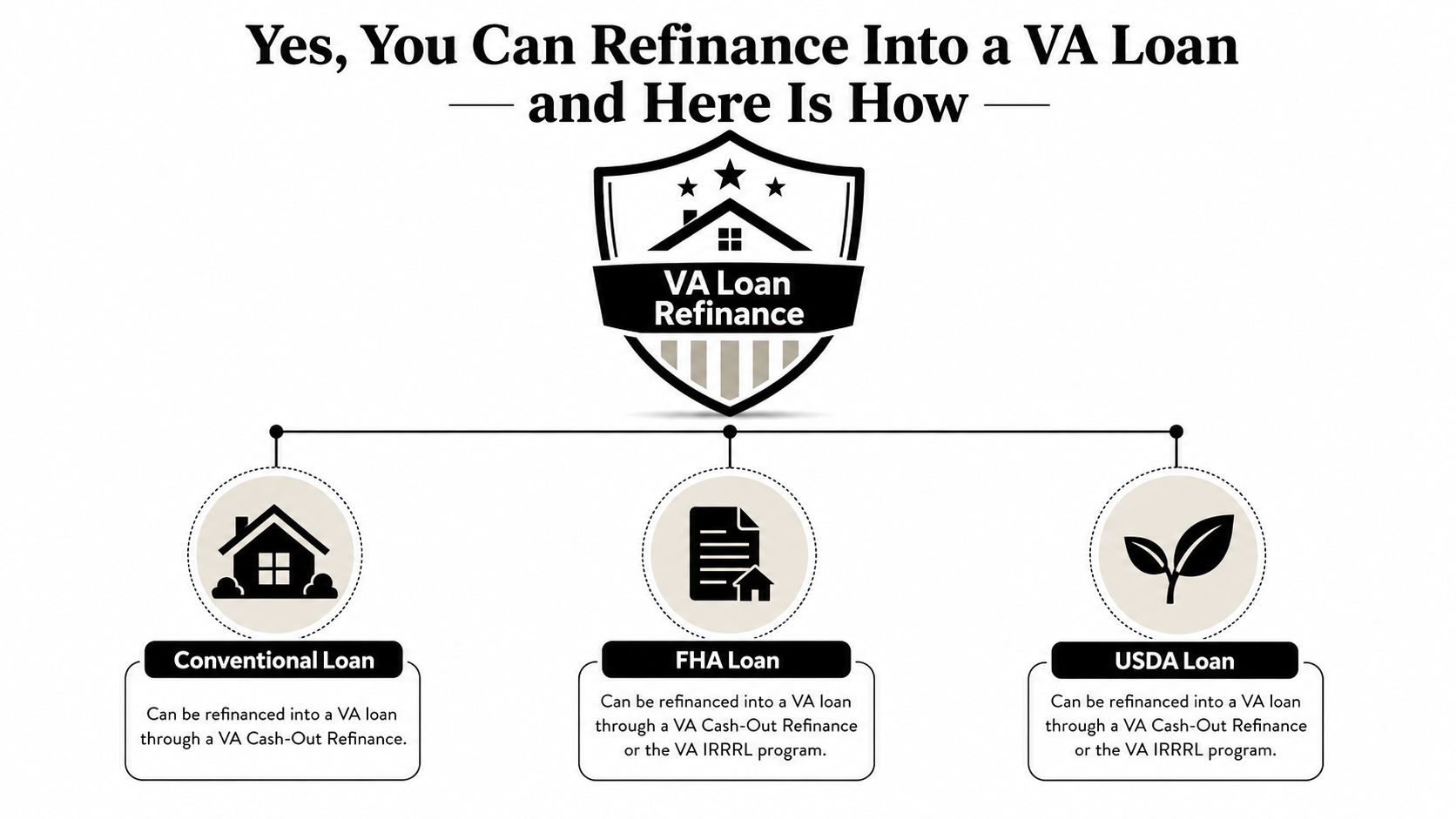
What most borrowers ask is not whether the rate can move lower, it's whether they're trying to refinance the right way. Yes, you can refinance into a VA loan if you're eligible for VA home loan benefits, but the path changes depending on the loan you already have and what you want the new loan to do for you.
Yes, You Can Refinance Into a VA Loan and Here Is How
The answer is straightforward. If you qualify for VA benefits, you can refinance into a VA loan through one of two lanes, either the Interest Rate Reduction Refinance Loan (IRRRL) or the VA cash-out refinance. The first is for borrowers who already have a VA loan and want a lower rate or a switch from adjustable to fixed. The second is the tool for replacing a non-VA mortgage with VA financing, or pulling equity out at closing.
The important part is this. Refinancing is not a side feature of the VA program. The VA reported that all refinanced loans made up 38.7% of total volume in FY2025, and interest-rate-reduction refinancing accounted for 22.6% of total loan volume in that same year, so this is a major part of the program, not a niche exception. VA loan types and refinance data
Start by matching the refinance to the loan you already have
If you already have a VA loan and your goal is a lower payment or better rate, the IRRRL is usually the cleanest path. If you're sitting in a conventional, FHA, USDA, or other non-VA loan and want to move into VA financing, the cash-out refinance is the lane that matters.
Practical rule: Don't start with the rate sheet. Start with the loan type you already have, because that determines whether you're even in the right program.
California borrowers get tripped up when they assume every refinance is just a rate move. It isn't. The VA looks at occupancy, seasoning, benefit, and those rules decide whether the file closes or dies in underwriting.
The Two VA Refinance Paths at a Glance
The IRRRL is the option without stripping equity. It's limited to an existing VA loan and is designed to reduce the interest rate, lower the monthly payment, or convert an adjustable-rate mortgage into a fixed-rate mortgage. It also doesn't create a new entitlement charge against the veteran's VA benefit. The VA cash-out refinance is broader. It can replace a VA loan or a non-VA loan, and it can be used to access equity at closing. The VA's refinance program has grown fast enough that these two paths now matter to a lot of borrowers, not just edge cases. VA lender statistics
Here's the decision rule I give borrowers: if you already have a VA loan and want a cleaner payment, look at the IRRRL first. If you want to convert an FHA or conventional loan into VA financing, or you need cash from the property, the cash-out refinance is the one to evaluate.
| Feature | IRRRL | VA Cash-Out Refinance |
|---|---|---|
| Who it's for | Existing VA borrowers | Borrowers moving into VA financing or tapping equity |
| Main purpose | Lower rate, lower payment, or fixed-rate conversion | Replace another loan or pull cash out |
| Existing VA loan required | Yes | No |
| Entitlement charged again | No new entitlement charge | Uses VA refinance rules for the new loan |
| Typical use case | Streamline rate reduction | Convert a conventional, FHA, USDA, or other loan into VA financing |
That's the cleanest way to separate them. The IRRRL is the “I already have VA and want better terms” path. The cash-out refinance is the “I want VA benefits on a new loan, or I need equity” path.
For rate shopping, use a calculator before you sign anything. A real refinance decision needs the actual payment math, not just the headline note rate, so the VA refinance rates calculator is the right place to pressure-test the numbers.
Who Qualifies to Refinance Into a VA Loan
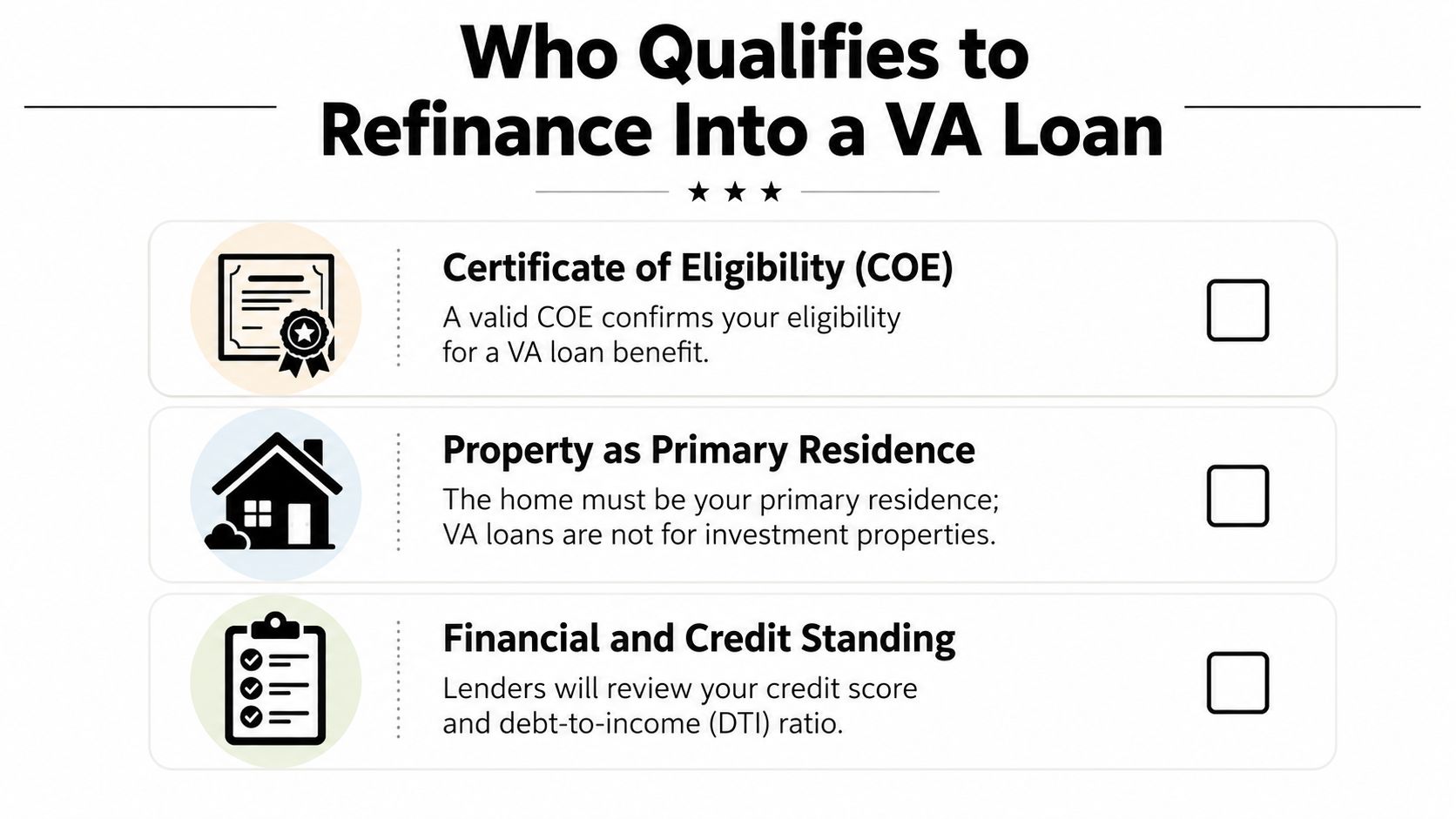
Eligibility is the gatekeeper. If the file does not clear the VA rules, the refinance stops there, no matter how strong the payment story looks. For a VA refinance, lenders usually check service eligibility, occupancy, and current loan fit before they spend real time on the file.
Your service record still has to support the file
The service rules are straightforward. The basic thresholds for VA home loan eligibility are 90 consecutive days of active duty during wartime, 181 days during peacetime, or at least six years in the National Guard or Selected Reserve. Surviving spouses can also qualify if they meet VA survivor rules and have not remarried. Refinance approval starts with entitlement, not with equity or credit score alone. VA refinance eligibility thresholds
The home has to be your primary residence
For a VA cash-out refinance, the property has to be your primary residence. That cuts out rentals and vacation homes. The VA program is built for owner-occupied housing, and lenders enforce that line without exception.
A cash-out refinance also requires a valid Certificate of Eligibility, and you still have to meet VA and lender credit and income standards. The file gets treated like a real eligibility review, not a simple loan substitution. If the income is shaky or the occupancy paperwork does not match what the borrower is claiming, the lender will slow the file down fast. VA cash-out refinance requirements
The loan type determines which refinance path is available
An IRRRL only works if you already have a VA loan. A cash-out refinance is broader, and it can replace a VA, conventional, FHA, USDA, or other eligible obligation depending on how the deal is structured.
Lenders do not care what you call the refinance. They care whether the entitlement, occupancy, and loan history line up cleanly.
That is also why lender overlays matter. A lender can set stricter credit or debt-to-income rules than the VA baseline, even when the loan still fits the program rules.
If you are checking fee exposure while you sort out eligibility, use the VA funding fee chart before you lock the loan. Borrowers miss the savings picture when they ignore the fee structure.
Seasoning Rules and the Net Tangible Benefit Test
A refinance file can look clean on paper and still die at underwriting. The two usual killers are simple: the loan is not seasoned enough, or the new terms do not give the borrower a real benefit.
The waiting period is not optional
VA guidance and lender practice commonly require 210 days before a refinance can move forward. For an IRRRL, the borrower must wait 210 days after the first payment due date on the original loan. For a VA cash-out refinance, the wait is 210 days after the first payment is made on the loan being refinanced. Many sources also point to six consecutive monthly on-time payments before a refinance can proceed. VA refinance seasoning rules
That timeline is not a suggestion. If a borrower applies too early, the file stops there. Underwriting does not bend seasoning rules because the rate looks attractive.
The refinance has to improve the borrower's position
The VA also requires a net tangible benefit. Plainly stated, the new loan has to leave the borrower better off in a measurable way, such as a lower rate, a lower payment, a move from adjustable to fixed, or stronger residual income. The point is not to replace one loan with another for no reason. The point is to make the new loan clearly better. VA cash-out refinance rules
The trade-off is where borrowers get tripped up. A lower rate does not automatically mean a better deal if the fees are too high or the recoupment period drags on. VA guidance also says the recoupment period for fees and closing costs must be no more than 36 months, and for VA cash-out refinances the loan-to-value ratio can't exceed 100% of the property's reasonable value. If the new loan goes above that value, the borrower has to pay the excess at closing. VA circular on seasoning, LTV, and recoupment
Use the math before you use the pitch
That 36-month recoupment cap is the critical break-even test. If the refinance takes too long to recover its costs, the note rate may look better while the borrower still loses money. The same applies to value. If the appraisal or value estimate does not support the loan amount, the lender cuts the loan back or the borrower brings cash to closing.
A smart California borrower asks two direct questions before applying. First, does the seasoning window already fit? Second, does the new loan improve monthly cash flow after fees, not just before them?
A Realistic California VA Refinance Scenario
A recently separated California veteran calls me with an existing VA loan at 7.25% and asks whether the better move is an IRRRL or a cash-out refinance. That's the right question, because the answer depends on the goal. If the goal is to lower the payment and the borrower already has a VA loan, the IRRRL is usually the first file I'd run. If the goal is to turn equity into usable cash, then the cash-out refinance deserves the look.
What actually gets pulled together
The file starts with the Certificate of Eligibility, the current mortgage statement, proof of income, and a clean picture of property occupancy. For an IRRRL, the lender usually focuses on the existing VA history and whether the new terms create a genuine benefit. For a cash-out, the borrower should expect more document review, because the lender has to verify the new property value, and standard credit/income conditions.
The appraisal path can be different too. On an IRRRL, the file may move on a simpler underwriting track if the lender can document the refinance benefit cleanly. On a cash-out, the borrower should expect the process to behave more like a full refinance. Either way, the cleanest files are the ones with income docs ready before the file hits underwriting.
California costs change the real savings picture
California borrowers also need to think past the coupon rate. County recording fees, title insurance, and special assessments can change the bottom line, especially when a property sits in a district with recurring charges. That's why I don't judge a refinance by the rate alone. I judge it by the actual cash flow after closing costs, fees, and any local overlays.
If the monthly savings look good only because somebody ignored closing costs, the deal isn't good. It's dressed up.
A realistic timeline for a well-prepared refinance is often measured in weeks, not months, but the faster file is the one with clean documents and realistic expectations. Borrowers who line up the paperwork early usually avoid the churn that slows everyone else down.
VA Refinance Compared to Conventional and FHA Options
A VA refinance is strong, but it is not always the best move. Borrowers should hear that up front, because the wrong refinance can cost more than it saves.
Where VA wins
The VA loan structure gives eligible borrowers 100% financing and no private mortgage insurance, which matters when equity is thin or when the monthly payment matters more than chasing a slightly lower note rate. If a borrower is moving from a high-rate FHA loan into VA financing, the VA path can be the better long-term fit because it removes the monthly PMI-style drag that conventional borrowers often face. For a veteran who already holds a VA loan, the IRRRL is often the cleanest way to lower payment friction without rebuilding the whole loan structure.
Where another refinance can beat VA
A conventional refinance can make more sense when the borrower no longer occupies the home as a primary residence or wants a loan structure that fits a non-VA use case. That is the straightforward reason some homeowners exit the VA program entirely. Once the loan is conventional, VA-specific occupancy rules no longer apply.
The trade-off is cost. Conventional loans often bring their own insurance costs, tighter equity expectations, or different underwriting friction. VA loans bring a VA funding fee unless the borrower is exempt, so the refinance has to earn its keep. I do not recommend a VA cash-out just because the borrower can get cash. The cash adds balance, and the balance adds interest over time.
My blunt recommendation
If you still qualify for VA benefits and the home is your primary residence, start with the VA option first. If the new loan improves the payment, preserves the benefit, and passes the fee test, it is usually the stronger move. If the property use has changed, or if another program better fits the borrower's long-term plan, compare it instead of forcing the VA structure to do a job it was not built to do.
California-Specific Tips and Your Next Steps
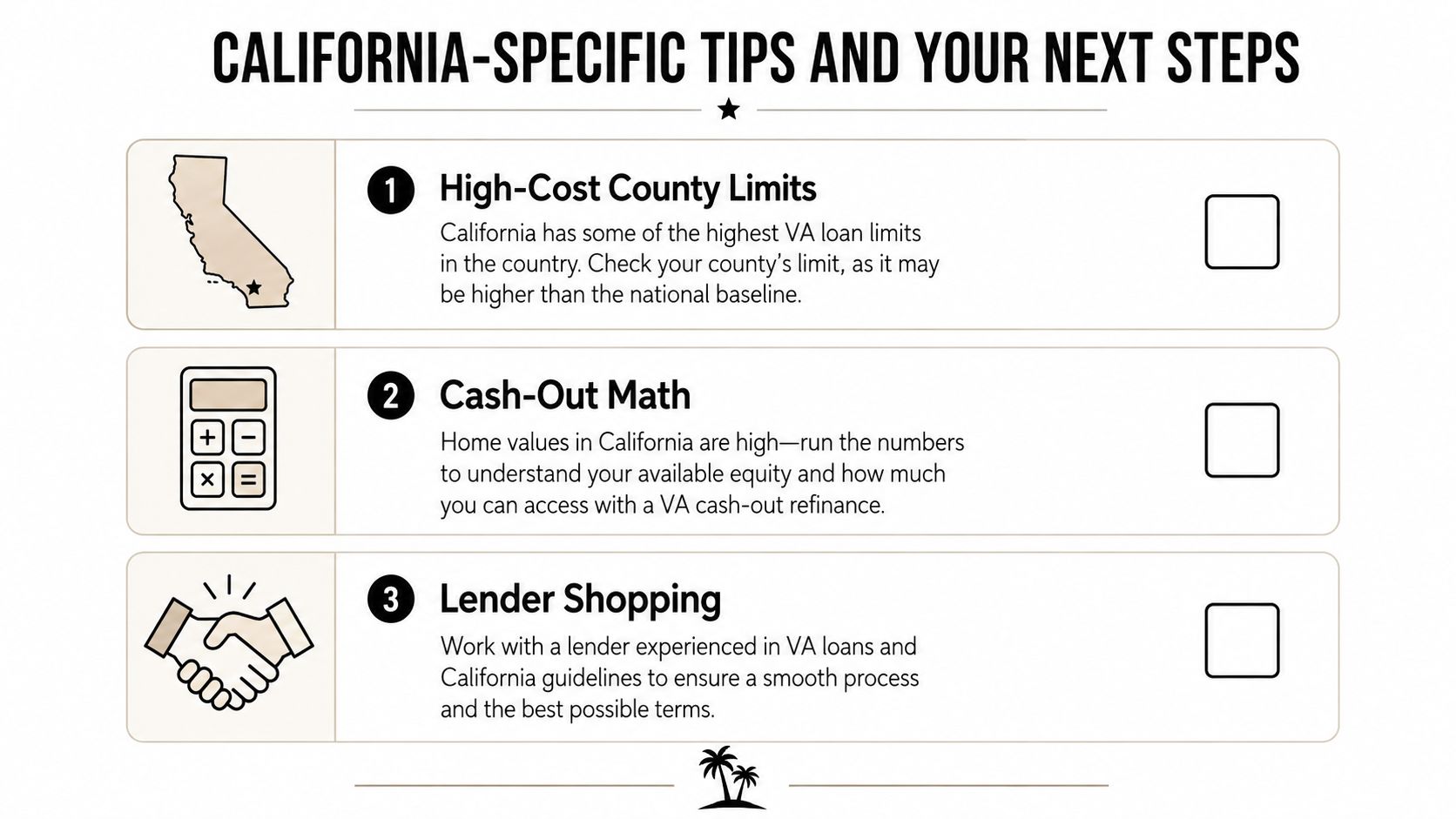
California changes the math. High-cost counties can affect how you think about loan limits and equity, and property charges can change the cost of a refinance even when the note rate looks attractive. That's why a refinance in this state has to be evaluated on the full payment picture, not just the rate quote.
What to do this week
- Pull your Certificate of Eligibility so you know the entitlement side is real before you spend time on rate quotes.
- Request a Loan Comparison Disclosure and compare the all-in APR, not just the teaser note rate.
- Check appraisal timing and turn times early, because delay at the property stage can stall the whole file. The VA appraisal turn times resource is a useful place to sanity-check the process.
- Talk to a HERO-trained loan officer who understands California property taxes, title fees, and the local cost stack.
If you want to refinance into VA the right way, move fast on paperwork and slow on promises. The file should prove the benefit, not just advertise it.
If you're a California HERO borrower and you want a straight answer on whether a VA refinance makes sense for your home, reach out to California Loans for Heroes and compare your options before you lock anything. Visit California Loans for Heroes to see how the HERO Home Loan and Buyer Rewards Program can support your refinance, then get a file review from a team that works these loans every day.