
Your mortgage payment probably feels heavier than it should right now. If you're a California veteran, firefighter, teacher, or other public service professional, you may be carrying a rate that no longer fits your budget or your long-term goals. That's where a VA refinance rates calculator becomes useful. Not as a gimmick, but as a decision tool.
Used the right way, it helps you answer the only questions that matter. Will this lower your payment? Will it save you money after fees? And if you're in an expensive California market, will the refinance still make sense once the actual costs show up?
Generic calculators usually miss the details that matter most to heroes in California. They often skip lender pricing differences, gloss over funding fees, and give a clean-looking estimate that falls apart when you apply. You deserve better than that.
Is a VA Refinance Right for You in 2026
A lot of California homeowners are in the same spot. You bought or refinanced when the timing made sense, then rates shifted, expenses climbed, and now you want to know whether keeping your current loan still makes sense. If you're checking your mortgage statement every month and thinking, "I need this payment to work harder for me," you're asking the right question.
For eligible borrowers, the VA refinance program isn't just another loan option. It's a benefit you earned. And right now, it's worth reviewing with real numbers, not guesses. As of Friday, July 3, 2026, the national average 30-year VA refinance interest rate was 6.14%, while conventional 30-year fixed refinance rates were 6.72%, making VA options significantly more affordable for eligible heroes, according to Bankrate's VA refinance rate update.
That spread matters in California, where mortgage balances are often larger and even a modest rate difference can change your monthly cash flow in a meaningful way.
When a refinance deserves a serious look
You should pay attention if any of these sound familiar:
- Your current rate feels high: If your loan was closed in a different rate environment, a refinance may improve the terms.
- Your monthly budget is tight: Lowering the payment can create breathing room.
- You need a cleaner loan structure: Some homeowners want a simpler path, a shorter term, or access to equity for a specific purpose.
- You haven't reviewed your mortgage in a while: That's a mistake. Mortgage strategy should change when your life changes.
Practical rule: Don't refinance because a calculator says the payment is lower. Refinance because the total benefit is better after fees, timing, and your actual goals are accounted for.
Who should keep reading
This guide is especially relevant if you're:
| Borrower type | Why this matters in California |
|---|---|
| Veterans and active-duty households | VA refinance options can beat conventional pricing and preserve cash flow |
| Firefighters and first responders | Shift work and rising household costs make payment relief especially valuable |
| Teachers and educators | Stable income helps, but budget pressure is still real in high-cost markets |
If you're a veteran using your VA benefit, a calculator can be the fastest way to test whether refinancing is worth pursuing. If you're a teacher or first responder married to a veteran borrower on the loan, it's still a household decision with real California consequences.
Choosing Your Refinance Path IRRRL vs Cash Out
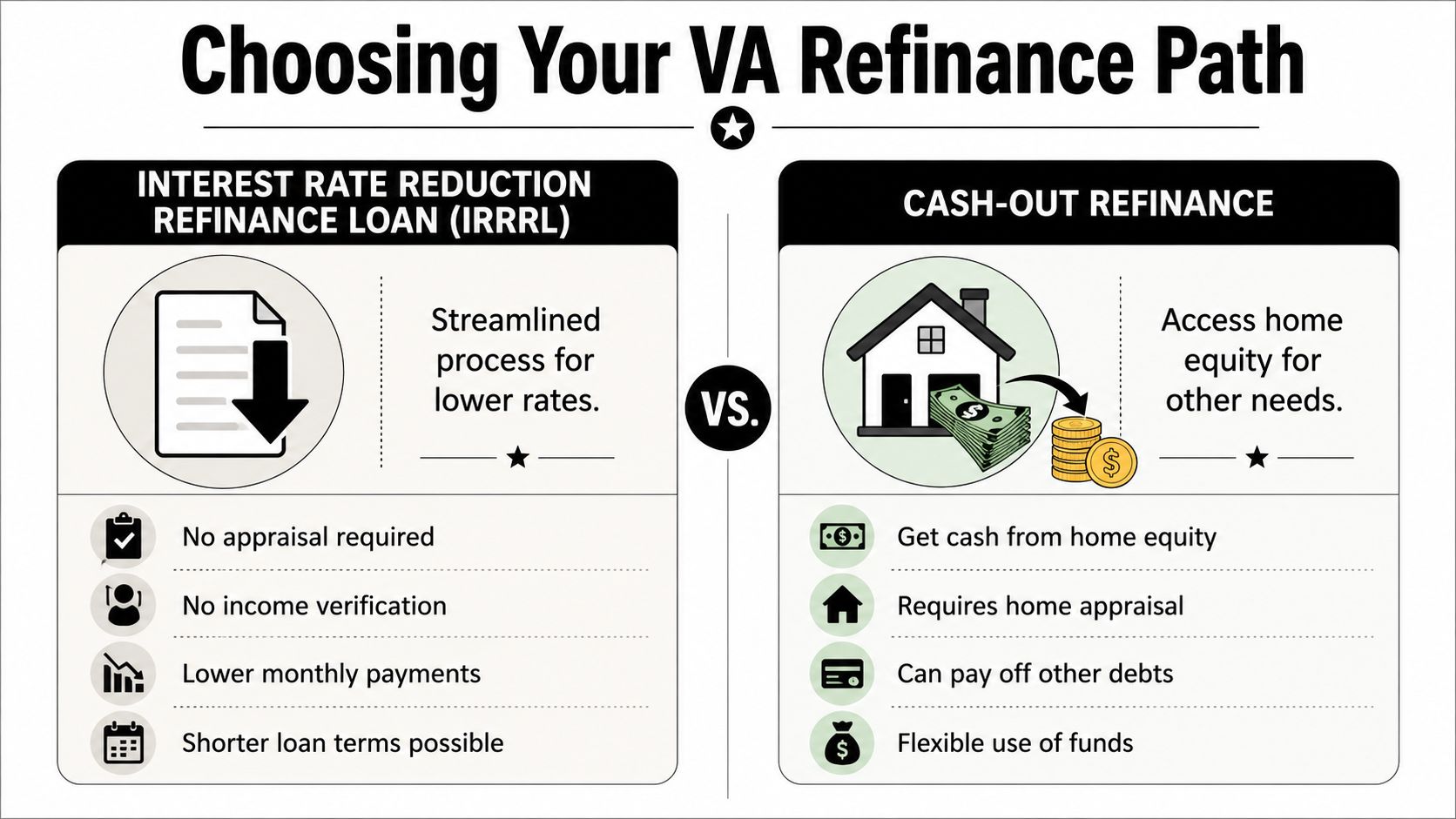
Before you use any calculator, pick the right lane. Most VA refinance decisions come down to two options. IRRRL if you want a cleaner, lower-rate VA-to-VA refinance. Cash-out refinance if you want to pull equity from the home and use it for another purpose.
IRRRL works best when the goal is efficiency
The Interest Rate Reduction Refinancing Loan, often called the streamline refinance, is built for borrowers who already have a VA loan and want to improve the terms without turning the process into a full-scale rebuild.
It's usually the better fit when your goal is simple. Lower the rate, lower the payment, or adjust the term.
Common reasons California homeowners choose an IRRRL:
- Payment relief: You're trying to reduce monthly outflow.
- Less friction: The process is generally simpler than a cash-out refinance.
- No equity access needed: You don't need cash back. You just want a better mortgage.
Cash-out works when equity has a job to do
A VA cash-out refinance is a different move. You replace the existing mortgage and pull equity out at closing. In California, that can be useful if you're funding a home improvement project, consolidating debt, or restructuring household finances around one larger goal.
That doesn't mean it's automatically smart. Cashing out equity increases the amount you're borrowing, so the purpose has to justify the new loan.
Use a cash-out refinance when:
- You need funds for a defined purpose: Home repairs, renovations, or debt payoff are common examples.
- Your equity position is strong: California appreciation can create opportunity, but only if you use it carefully.
- You can handle the bigger picture: More cash today can mean a different payment profile tomorrow.
The best refinance path isn't the one with the flashiest quote. It's the one that matches the reason you're refinancing in the first place.
The funding fee difference is not small
Generic calculators frequently fall short. They treat VA refinance options like they're basically the same. They're not.
The VA funding fee for an IRRRL is a flat 0.5% of the loan amount, whereas the fee for a VA Cash-Out refinance is much higher, typically 2.15% for first-time use and 3.3% for subsequent use, based on Veterans United's VA refinance calculator guidance.
That one difference can reshape the math fast.
| Refinance type | Best use | Fee structure |
|---|---|---|
| IRRRL | Lowering rate or payment on an existing VA loan | 0.5% of the loan amount |
| VA Cash-Out | Accessing equity for cash needs | 2.15% first-time use, 3.3% subsequent use |
If your goal is savings, don't start with cash-out just because you can. Start with the option that preserves the most value.
Mastering the VA Refinance Calculator Inputs
A VA refinance rates calculator is only as good as the numbers you feed it. If the inputs are sloppy, the result is fantasy. Many borrowers stumble at this point. They estimate too loosely, ignore VA-specific costs, and trust a payment output that isn't tied to the loan they'll get.

Start with the non-negotiable inputs
Pull together the basics before you touch the calculator:
- Current loan balance: This drives the size of the refinance.
- Current interest rate: You need this to compare your old loan against the new one.
- Loan type: Make sure you're clear on whether this is VA-to-VA or a different structure.
- Estimated home value: This matters more for cash-out than for an IRRRL, but don't guess wildly.
- Loan goal: Lower payment, shorter term, or pull equity. Pick one primary objective.
If you're unsure about your credit profile, don't skip it. Rate calculators often display an average, but your real quote will reflect your file. If you need help understanding how lenders look at that piece, review this guide on how mortgage credit score factors affect refinance options.
The VA-specific input that changes everything
The funding fee needs to be entered correctly. A lot of online tools either bury it or apply the wrong assumption.
For a VA-to-VA refinance, the Interest Rate Reduction Refinancing Loan (IRRRL) program uses a specific, fixed funding fee of 0.50% of the loan amount, a critical variable needed for an accurate calculation, as outlined by Calculator.net's VA mortgage calculator explanation.
If you're using an IRRRL and the calculator doesn't clearly account for that fixed fee, don't trust the savings estimate.
A refinance calculator should help you test reality. If it skips the VA funding fee, it's giving you a marketing estimate, not a planning estimate.
What to verify before you trust the result
Run through this short checklist:
- Is the loan amount accurate? Use your actual unpaid principal balance, not a rough memory.
- Did you choose the right refinance type? IRRRL and cash-out aren't interchangeable.
- Did the calculator include fees? A payment-only output is incomplete.
- Are you using a realistic rate assumption? Average rates are a starting point, not a promise.
- Does the term match your goal? A lower payment on a longer clock isn't always a win.
Inputs California borrowers should treat carefully
California homeowners often have larger balances and stronger equity positions than national averages imply. That makes every input more sensitive. A small mistake on a bigger loan amount can produce a large error in projected savings.
Be strict with your numbers. Use mortgage statements, not memory. Use a recent property estimate, not wishful thinking. And if the calculator gives you a result that looks almost too clean, assume it's missing something until proven otherwise.
How to Interpret Your Refinance Savings
A calculator result means nothing if you only look at the new payment. That's the fastest way to approve a refinance that feels good in the short term but doesn't hold up over time.
You need to read the output the way an advisor would. Focus on payment change, upfront cost, and how long it takes for the refinance to earn back what you spent to get it.

The monthly payment is only the first screen
Yes, the payment matters. It affects your budget immediately. But don't stop there.
A strong calculator result should help you assess:
- Monthly savings: What changes in your cash flow each month
- Total upfront cost: What you'll pay to complete the refinance
- Break-even timing: When the savings finally offset those upfront costs
- Long-term direction: Whether the new loan supports your broader financial plan
A lower payment can still be a bad deal if the closing costs are too high or if you're restarting the loan in a way that erodes the benefit.
Calculate the true break-even point
This is the discipline most borrowers skip. They see a lower payment and move forward without asking how long it takes to recover the cost of the refinance.
Beyond the VA funding fee, average refinance closing costs from third parties can range from 2% to 6% of the loan amount. This full cost must be used to calculate the true breakeven point where your monthly savings outweigh your upfront expenses, according to Zillow's refinance calculator guidance on closing costs and breakeven.
That means your break-even point should include all actual costs, not just the VA-specific fee.
If you may sell, relocate, or refinance again before you hit break-even, the refinance may not be worth doing.
For a fuller view of what gets charged and why, review this closing costs breakdown for refinance planning.
Read the result like a decision, not a headline
Use this quick framework:
| Calculator output | What it really tells you |
|---|---|
| Lower monthly payment | Good start, but not a complete decision |
| Higher total loan cost upfront | You need a realistic breakeven test |
| Long breakeven timeline | The refinance only works if you keep the home long enough |
| Cash-out result | Measure the benefit of the cash against the cost of the larger loan |
A practical way to judge the result
Ask yourself three blunt questions:
- Will I stay in this home long enough to recover the costs?
- Does this refinance solve the actual problem I'm trying to solve?
- Would I still do this if the final numbers came in a little worse than the estimate?
If the answer to any of those is no, stop and reassess before you sign anything.
California Hero Refinance Examples
The best way to understand a VA refinance rates calculator is to see how different borrowers use it. Not with made-up promises about massive savings, but with realistic decision logic based on what each homeowner is trying to accomplish.
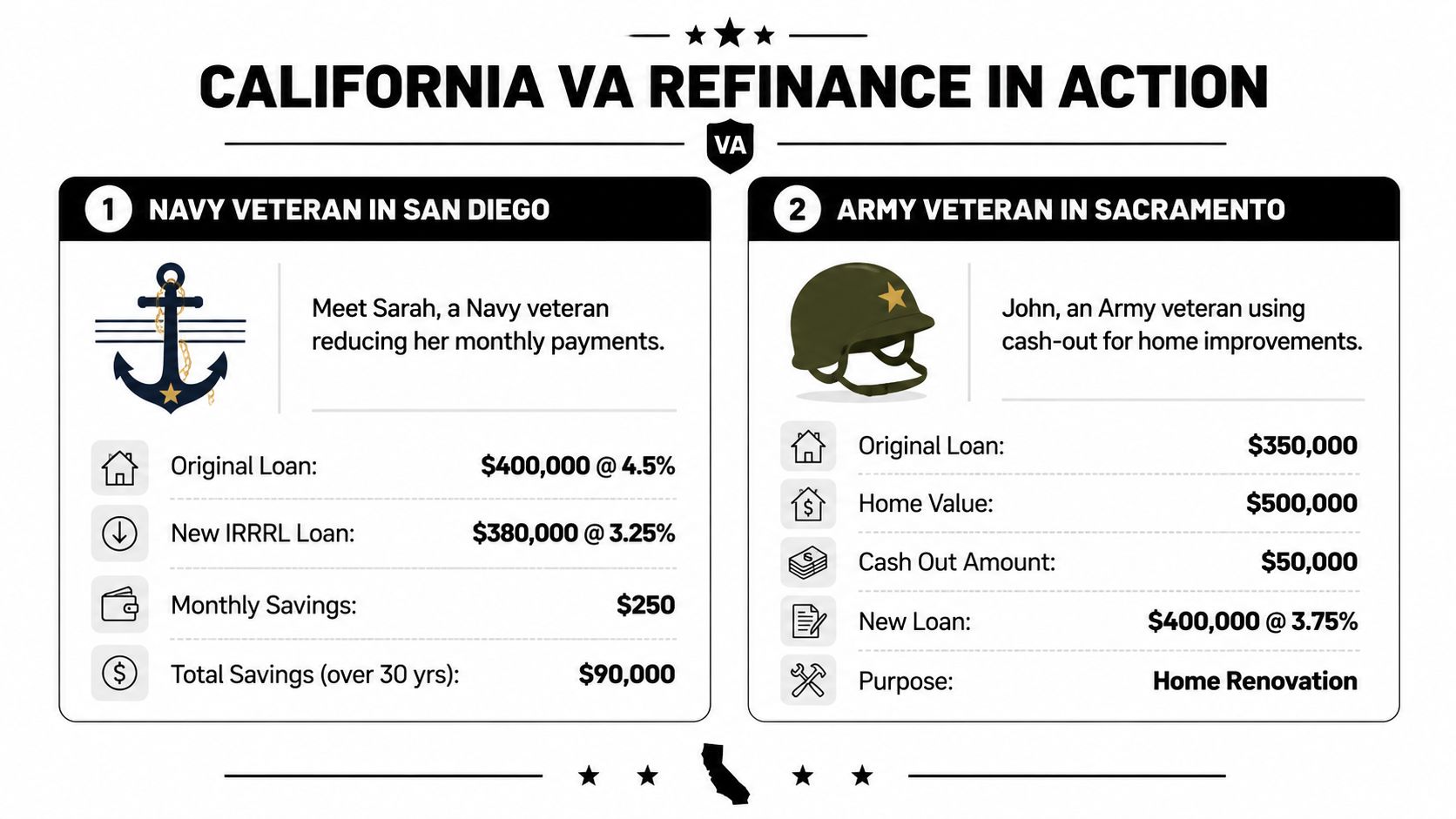
San Diego veteran using an IRRRL
A Navy veteran in San Diego already has a VA loan and wants one thing. A more efficient mortgage. No cash back, no complicated restructuring, just a serious look at whether a streamline refinance can improve the payment and reduce friction.
She opens a calculator and enters her current balance, present rate, proposed new rate, and expected term. She also makes sure the tool accounts for the IRRRL funding fee, because that's where many online estimates go wrong.
What matters in her review isn't just the lower payment. She studies how long it takes to recover the upfront cost. If the break-even point fits her plan to stay in the home, the refinance can make sense. If she expects a move or job transfer sooner, even a decent-looking estimate may not be worth it.
Los Angeles firefighter considering cash-out
A firefighter in Los Angeles has a different goal. He wants to use home equity for a home addition and to clean up other expensive debt. The calculator helps him test the effect of a larger loan amount, a different payment structure, and the higher cost profile that comes with cash-out.
His decision isn't about chasing the lowest rate. It's about whether the new loan improves the full household picture. If the cash-out funds are being used for something that strengthens the property or simplifies his finances, it may be justified. If the cash is just a temptation, it probably isn't.
A cash-out refinance should have a mission. Home improvement, debt restructuring, or a targeted need. "Because the equity is there" isn't a good enough reason.
Teacher household with a veteran borrower on title
This is common in California. One spouse is the eligible veteran borrower, and the household income depends heavily on a teacher's paycheck. In that setup, the calculator isn't just testing a VA benefit. It's testing whether the new mortgage creates more stability for the family budget.
A teacher household often values predictability over aggressive loan moves. That makes the refinance question simpler. Does the new loan produce cleaner monthly cash flow and a reasonable recovery period on costs? If yes, it deserves a closer look. If no, keep the existing mortgage and revisit later.
What these examples have in common
Each borrower starts in a different place, but the decision process is the same:
- Clear goal first: Lower payment or access equity. Don't blend the two.
- Accurate inputs: Use actual balances, realistic estimates, and full cost assumptions.
- Break-even discipline: No refinance gets approved without it.
- California context: Bigger balances raise the stakes on small mistakes.
These examples matter because they show the truth. A VA refinance rates calculator doesn't decide for you. It helps you pressure-test the move before you commit.
Tips to Maximize Your VA Refinance Savings
The biggest mistake borrowers make is trusting the advertised rate instead of preparing for the rate they're likely to be offered. That's where savings are won or lost.
While calculators show average rates, VA lenders apply tiered pricing. Data shows veterans with credit scores under 640 are often quoted rates 0.75% higher than the advertised national average, a nuance public calculators do not model, based on Veterans United's explanation of VA mortgage rate pricing differences.
That means your next move should be practical, not passive.
What to do before you lock anything
- Check your credit profile first: Don't assume you're pricing into the same bucket as the advertised average.
- Run the calculator conservatively: Use a realistic rate assumption, not the best-looking one.
- Compare lenders carefully: Use this guide on how to compare mortgage rates the smart way before you choose a lender.
- Match the loan to the goal: If you only need payment relief, don't default to cash-out.
- Review the full closing picture: The note rate alone never tells the whole story.
My blunt advice
If your credit needs work, fix that first if timing allows. If your goal is simple, keep the refinance simple. If a lender's quote looks dramatically better than everyone else's, read the fees twice.
And if you're in California, don't settle for a generic online estimate. High-cost markets punish sloppy math.
If you're ready to move beyond a generic calculator and get a tailored refinance analysis built around your goals, talk with California Loans for Heroes. Their team helps California veterans, active-duty families, first responders, teachers, healthcare professionals, and other public service heroes review refinance options with one-on-one guidance, competitive solutions, and a clear focus on savings that prove sustainable in practice.