
A lot of California heroes start in the same place. A nurse in Riverside who had a bankruptcy after a medical leave. A firefighter in Orange County who got through a divorce and wiped out old debt. A veteran in the Central Valley who assumed the word “bankruptcy” meant “no mortgage for years, maybe forever.”
That fear is understandable. It's also usually incomplete.
Bankruptcy changes the path, but it doesn't end it. For many public service professionals, there's still a workable route to buying a home in California, especially when you line up the right loan type, the right timing after discharge or dismissal, and the right local assistance program. The mistake I see most often isn't bad intent or lack of discipline. It's acting on old information, or assuming every lender and every hero program treats a past financial setback the same way.
Your California Dream Home Is Still Possible
Take a common situation. A teacher in Sacramento filed bankruptcy during the worst stretch of inflation, child care costs, and credit card pressure. She's back at work, paying everything on time, and watching rents stay high. She assumes a mortgage is off the table because her credit history has a scar on it.
That assumption keeps a lot of good borrowers on the sidelines longer than they need to be.
For California heroes, the key question usually isn't “Can I ever qualify?” It's which loan program matches my timeline now, and which state or local benefit fits the kind of work I do. Veterans may have one set of options. Peace officers may have another. A healthcare worker may need to lean on broader down payment help rather than a narrow profession-based program.

The good news is that mortgage approval after bankruptcy is usually about seasoning, documentation, and credit recovery, not perfection. If your income is stable, your recent payment history is clean, and you choose a program that fits your file, homeownership can move from “someday” to a real plan.
Practical rule: Don't let a past bankruptcy answer a present mortgage question. Loan type, discharge date, current credit behavior, and occupation all matter.
California also has a layer that many national articles miss. Hero-focused and assistance-based programs here can make a major difference in cash needed at closing, but they also come with occupancy, profession, and repayment rules that need to be read carefully.
Understanding Mortgage Waiting Periods After Bankruptcy
Lenders don't look at bankruptcy as one single event. They look at what type of bankruptcy you filed, whether it was discharged or dismissed, and how you've handled credit since then.
The difference between Chapter 7 and Chapter 13
Chapter 7 usually means debts were discharged after liquidation rules were applied. In mortgage planning, the key date is often the discharge date.
Chapter 13 works differently. It involves a repayment plan. For mortgage purposes, lenders may care about either the discharge date or the dismissal date, depending on the loan type and how the case ended.
That's why borrowers get confused. Two people can both say, “I had a bankruptcy,” and still have completely different mortgage timelines.
Why waiting periods exist
A waiting period, sometimes called a seasoning period, gives the lender time to see whether the financial hardship has passed and whether your recent credit behavior is stable. It's less about punishment and more about risk review.
You'll also want to separate two things in your mind:
- Program rules decide when a file may be eligible.
- Lender overlays decide how strict a particular lender may be even after the waiting period has passed.
That second part matters. A borrower may technically fit one loan category and still need stronger compensating factors to get approved.
Mortgage waiting periods after bankruptcy 2026
Because waiting periods can vary by loan program and lender interpretation, the safest way to use a comparison table is as a planning tool, not a final approval promise.
| Loan Type | Chapter 7 Discharge | Chapter 13 Discharge | Chapter 13 Dismissal |
|---|---|---|---|
| VA | Varies by lender and current underwriting review | Varies by lender and current underwriting review | Varies by lender and current underwriting review |
| FHA | Varies by lender and current underwriting review | Varies by lender and current underwriting review | Varies by lender and current underwriting review |
| USDA | Varies by lender and current underwriting review | Varies by lender and current underwriting review | Varies by lender and current underwriting review |
| Conventional | Varies by lender and current underwriting review | Varies by lender and current underwriting review | Varies by lender and current underwriting review |
That may look less precise than you expected, but it's the honest answer here. If you're reading mortgage content online, you'll often see exact year counts thrown around with confidence. If those figures aren't backed by the lender's current guidelines and your specific file, they can send you in the wrong direction.
Some borrowers are closer than they think. Others need more time than a quick internet answer suggests. The discharge or dismissal paperwork decides that timeline, not guesswork.
What to confirm before you do anything else
Start with the records, not the rate.
- Pull your bankruptcy papers and confirm whether the case was discharged or dismissed.
- Verify the exact date tied to that outcome.
- Review your current credit report to make sure the bankruptcy is reporting accurately.
- Check for any late payments after bankruptcy, because those often create more trouble than the bankruptcy itself.
- Match your occupation to possible hero programs before assuming you qualify.
That last point is important in California. Some hero-oriented assistance options are broad. Others are very narrow.
Key Mortgage Options for California Heroes
If you're a California public service professional with a past bankruptcy, most of the decision-making comes down to VA, FHA, and conventional financing. Each can work. Each solves a different problem.
VA loans for eligible veterans and military families
For eligible borrowers, VA financing is often the strongest post-bankruptcy path because the structure is so borrower-friendly. The federal Department of Veterans Affairs offers a VA Home Loan program with up to 100% financing with zero down payment for eligible veterans, active-duty military, and surviving spouses. It also eliminates the need for private mortgage insurance and caps closing costs, and it enabled over 500,000 home purchases annually as of 2023 according to the VA Home Loan overview cited in Florida's Hometown Heroes announcement.
That matters even more after a bankruptcy because cash reserves are often the issue. A borrower may have rebuilt income and payment history but still not have a large down payment saved.
A VA loan won't erase the need for underwriting. You'll still need a clean explanation of the hardship, solid recent credit behavior, and complete documentation. But if you're eligible, it's usually the first path I'd evaluate because the program removes two major barriers at once: down payment pressure and PMI.
If you want to understand how veteran benefits can pair with additional support, review these VA home loan down payment assistance options.
FHA loans for broader access
FHA often becomes the fallback path for heroes who aren't VA-eligible and need more flexible credit treatment than conventional lending typically offers.
What works well with FHA after bankruptcy is the program's practical fit for borrowers who are still rebuilding. If your file shows stable employment, reasonable debt management, and no fresh credit issues, FHA can be a sensible bridge from financial recovery into ownership.
What doesn't work is assuming FHA automatically means easy approval. Underwriters still look closely at whether the bankruptcy resulted from a one-time event or a pattern of financial instability. They also want the file to make sense now, not just on paper.
Conventional loans for stronger rebound files
Conventional financing tends to fit the borrower who has moved further past the bankruptcy event and rebuilt more fully. In practice, that usually means stronger credit, more reserve strength, and a cleaner overall profile.
For some California heroes, conventional is worth pursuing because it may offer better long-term fit depending on the property, income structure, and overall pricing. But this is usually not the first route for someone just coming out of a financial setback.
How to choose the right lane
Use a simple filter:
- Choose VA first if you're eligible and your file is otherwise mortgage-ready.
- Use FHA if you need a more forgiving structure while your credit profile is still recovering.
- Consider conventional if your rebound has been strong enough to support tighter underwriting.
The best loan after bankruptcy isn't the one with the best headline. It's the one your file can actually carry from preapproval to closing.
For California heroes, the loan program is only half the strategy. The other half is whether local assistance can reduce the upfront cash burden without creating a conflict with occupancy or program rules.
Exclusive California Hero Programs and Assistance
A California firefighter or nurse can clear the bankruptcy waiting period, qualify for a first mortgage, and still get stuck for one simple reason. The down payment and closing costs are still sitting in their way.
That is where California-specific assistance matters. For public service professionals who have done the hard work of recovering after bankruptcy, the right local program can make the purchase possible. The wrong one can create a last-minute denial because the fine print does not match your occupancy, income, or job classification.
Local programs can change the numbers
Some California programs are designed to solve the cash problem, not the credit problem. That distinction matters. If your bankruptcy is already seasoned enough for FHA or VA, local assistance may be the piece that gets you from approval to actual closing.
One example is the Housing Economic Recovery Ownership State program. It offers deferred-payment assistance for eligible lower-income buyers in participating areas, which can help a household that has re-established income but has not fully rebuilt savings after a financial setback.
Another niche option is built specifically for law enforcement. The Police Credit Union's HERO Mortgage Loan exclusively serves active full-time sworn or reserve peace officers in California and offers a fixed or variable rate first mortgage combined with a fixed second mortgage, with a maximum combined loan limit of $2,000,000 for qualified applicants according to the Police Credit Union HERO loan details.
That kind of program is highly specific. For the borrower who fits it, that specificity can be useful. For everyone else, it is a reminder that California hero programs are never one-size-fits-all.
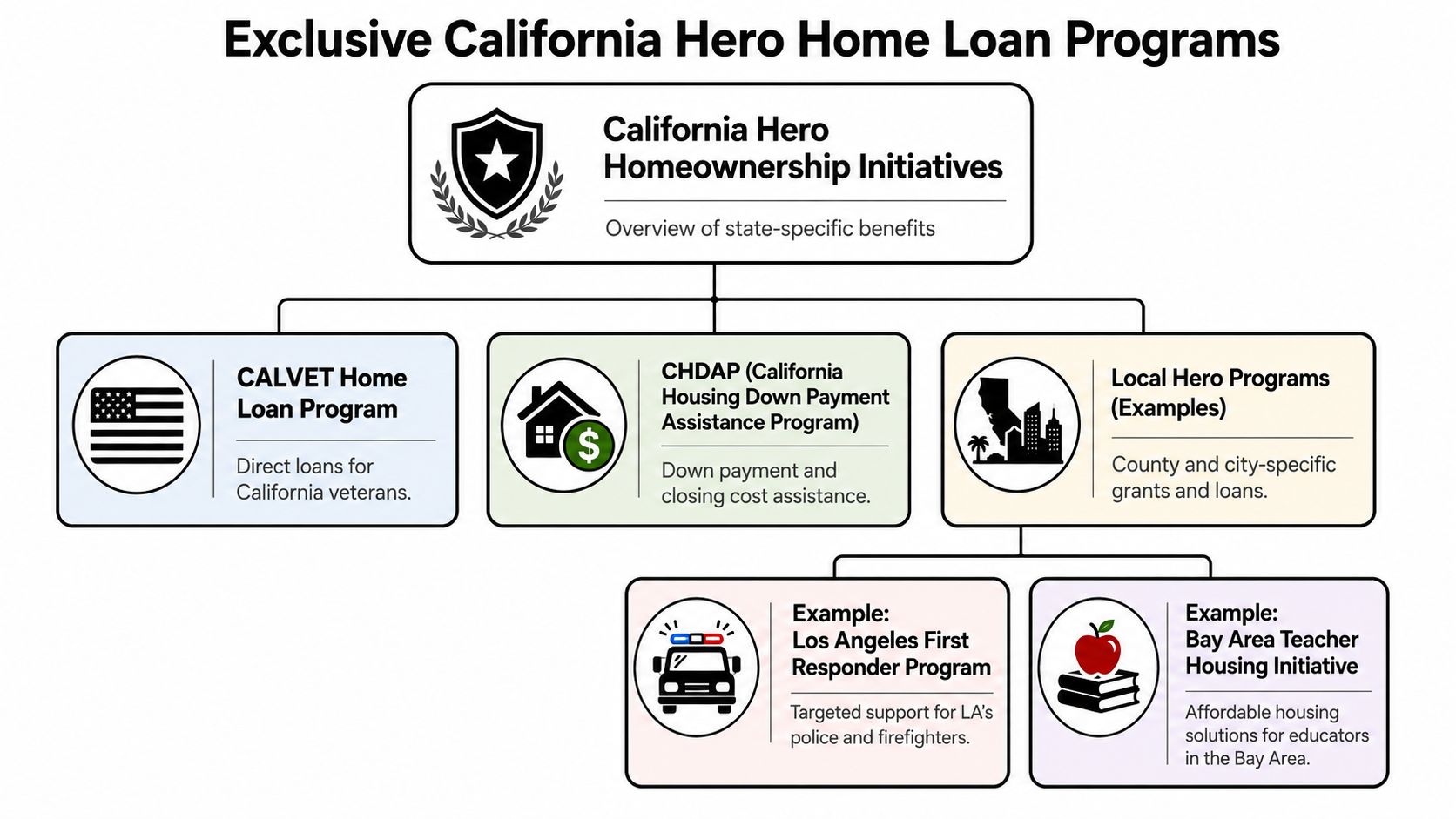
Program stacking needs an underwriting review, not a guess
California buyers often hear that assistance can be stacked. Sometimes it can. I have also seen files run into trouble because two valid programs did not work well together once underwriting, title, and occupancy rules were reviewed side by side.
The conflict is usually not obvious at first. One program may require first-time buyer status. Another may cap income differently. A deferred second mortgage may come due if you refinance, transfer title, or stop occupying the home within the program period. If a buyer is coming out of bankruptcy, there is less room for error because cash reserves are often thinner and backup options are limited.
Ask direct questions early:
- Does each program allow the same property type?
- Do the owner-occupancy rules match?
- Are the income calculations based on borrower income, household income, or county limits?
- Does the assistance affect how much you can refinance later?
- Will the first mortgage investor allow that second lien structure?
Occupation matters more than buyers expect
“Hero” is marketing language. Program guidelines are legal definitions.
A teacher may qualify under one city program and be excluded under another. A healthcare worker may need a specific license, employer type, or full-time status. A public safety employee may assume eligibility, then find out the program only covers sworn officers, not civilian staff or contractors.
That matters even more after a bankruptcy because the file has to stay clean and predictable. If you are counting on assistance funds to close, verify your profession category before you write offers, not after appraisal is ordered.
California buyers who need to reduce upfront cash should compare profession-based benefits with other forms of closing cost assistance for veterans and eligible hero buyers so the final structure fits both the mortgage and the assistance rules.
What tends to work best
The best results usually come from a simple order of operations:
- Choose the first mortgage first, based on your post-bankruptcy file strength.
- Add assistance second, only after confirming occupation, income, property, and occupancy eligibility.
- Read the deferred second mortgage terms carefully so you know what triggers repayment.
- Treat every stacked program like a compliance issue, not a marketing benefit.
A good assistance plan lowers cash to close without creating a new problem later. That is the standard.
Preparing Your Application and Rebuilding Credit
Once you know your likely loan lane, the work becomes very practical. Borrowers usually make the biggest gains here, not by doing anything flashy, but by getting organized and staying consistent.
Rebuild credit with boring habits
After bankruptcy, strong mortgage files are usually built on repetitive habits.
- Use one or two small revolving accounts carefully. A secured card can help if you manage it conservatively and pay on time.
- Keep every payment current. The bankruptcy itself is often survivable. Fresh late payments are what stall approvals.
- Watch your balances. If cards are maxed out again, the underwriter will question whether the financial reset held.
- Review your credit reports for errors. Bankruptcy reporting mistakes, duplicate accounts, and wrong balances do happen.
If you're trying to improve your position before applying, this guide to refinance mortgage credit score factors is also useful because many of the same credit fundamentals affect purchase underwriting.
Build the file before the lender asks
The cleanest applications are rarely the ones with perfect histories. They're the ones with complete paperwork.
Gather these early:
- Income documents such as recent pay stubs and tax returns.
- Asset statements so the lender can verify funds available for closing and reserves.
- Bankruptcy documents, especially the discharge or dismissal papers.
- Employment records if your work history includes recent changes, overtime, or variable pay.
- A written explanation letter that clearly states what happened, why it happened, and what has changed.
Keep that letter factual. Don't over-defend yourself. Underwriters want a coherent timeline and evidence of recovery.
Know when a special program fits your plan
If you work in law enforcement, education, fire service, or EMS, federal hero options may also be part of the conversation. The U.S. Department of Housing and Urban Development's Good Neighbor Next Door program offers a 50% discount on the price of a HUD-owned home for law enforcement officers, teachers, firefighters, and EMTs, with a 3-year occupancy requirement as a primary residence, according to Rocket Mortgage's Good Neighbor Next Door summary.
That can be attractive, but it's not a universal fix. HUD inventory is limited, and the occupancy rule needs to align with any other assistance you're considering.
Keep your application simple where you can. The more moving parts you add, the more important timing and documentation become.
Your California Hero Home Buying Checklist
You get off a 24-hour shift, open a mortgage app, and wonder whether the old bankruptcy on your credit report just ended the conversation. It usually does not. For California teachers, nurses, firefighters, law enforcement officers, veterans, and other public service buyers, the better question is whether the timing, loan choice, and assistance program fit together.
That is what this checklist is for.
Start by confirming what is true today
Do not start with home listings. Start with your file.
A buyer who had a bankruptcy three or four years ago, has steady California public service income, and has re-established credit can be far closer to approval than they assume. A buyer with strong income but unresolved credit reporting errors or missing bankruptcy papers can lose weeks fixing problems that should have been handled upfront.
Check these items first:
- Your bankruptcy status and dates. Confirm whether the case was discharged or dismissed, and verify the filing and completion dates.
- Your credit reports. Look for accounts that should show included in bankruptcy, zero balance, or closed status but do not.
- Your employment picture. Stable hours, predictable pay, and a clear job history matter, especially if you rely on overtime, shift differentials, or multiple public service roles.
- Your available funds. Separate what you have for down payment, closing costs, reserves, and any money you may receive from assistance or family support.
Choose the loan before you choose the house
Buyers save themselves from bad assumptions.
VA can be the strongest option for eligible veterans and active-duty buyers because it often gives more room after a past financial hit. FHA can be a better fit for many non-VA heroes who are back on stable footing but still rebuilding. Conventional may make sense if the bankruptcy is well behind you, your scores have recovered, and you want stronger pricing without the long-term cost structure that can come with FHA.
Then layer in California assistance carefully. Down payment assistance can solve a cash problem, but it can also add income limits, homebuyer education requirements, property rules, or a second lien that affects your long-term plan. The right structure is the one you can qualify for, close on time, and live with for several years.
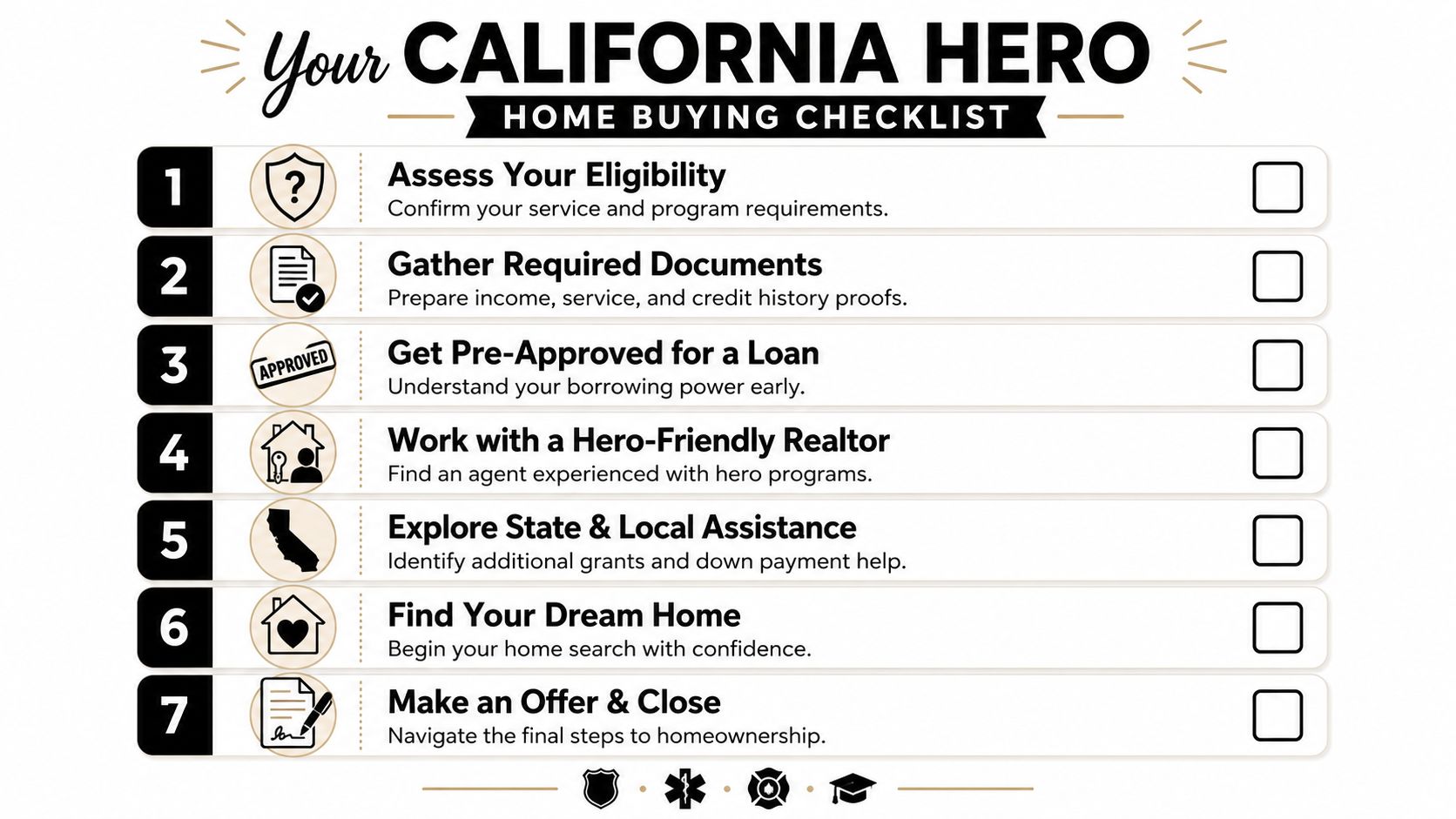
Use this checklist in order
- Confirm basic eligibility. Verify your occupation or service category, occupancy plans, income, and whether your bankruptcy waiting period has already been met.
- Review your credit for errors. Dispute incorrect reporting before preapproval, not during escrow.
- Estimate your true payment. Include taxes, insurance, HOA dues, mortgage insurance, and any repayment terms tied to assistance.
- Get preapproved with a lender who understands hero programs and bankruptcy timing. A generic preapproval is not enough if your file needs manual review or program matching.
- Compare first mortgage options with assistance options together. Do not pick a loan in isolation and hope the assistance works later.
- Choose a Realtor who understands program restrictions. Occupancy rules, property condition issues, and seller timelines can affect whether your financing works.
- Keep paperwork current through closing. Updated pay stubs, bank statements, and any large deposit documentation should be ready at all times.
- Read the fine print before signing. Pay attention to recapture terms, deferred payment triggers, refinance limits, and owner-occupancy requirements.
One more point matters here. Do not measure your chances by what happened at the lowest point in your finances. Measure them by what your file shows now, whether the waiting period is satisfied, and whether your California hero benefits or assistance options support the loan you are using.
If you're ready to turn a past setback into a workable homeownership plan, California Loans for Heroes helps veterans, first responders, teachers, healthcare professionals, law enforcement, pilots, and public service employees work through California mortgage options with one-on-one guidance. Whether you're sorting out post-bankruptcy timing, comparing hero programs, or looking for down payment and closing cost support, their team can help you map the next step with clarity.