
For most VA purchase loans, the funding fee is 2.15% on first use with less than 5% down, 1.5% with 5% or more down, and 1.25% with 10% or more down. On a subsequent VA purchase, that jumps to 3.3% with less than 5% down, while the 5% and 10% tiers stay the same.
That's the part most borrowers need to know right away, because the wrong percentage can throw your closing numbers off by thousands. If you're buying in California and trying to keep cash in your pocket, the va funding fee chart is not trivia, it's a closing-cost decision you have to get right.
You're usually looking at this fee when you've already picked a home, run your payment, and now the lender is asking about prior VA use, down payment, and whether the loan is a purchase or refinance. That's where people get burned. They see a generic chart online, assume every VA loan follows the same rules, and then miss the special categories that change the bill.
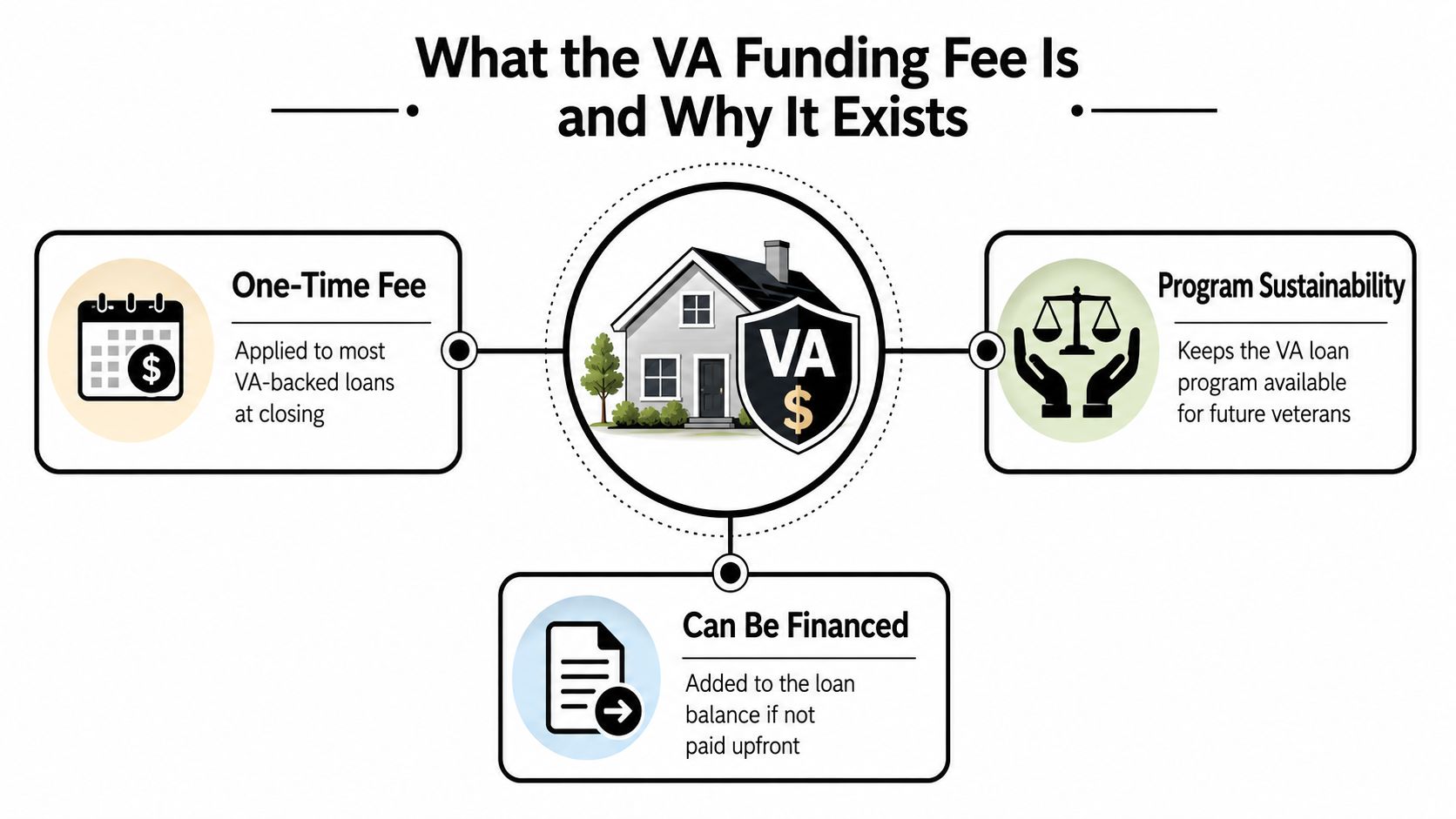
What the VA Funding Fee Is and Why It Exists
The VA funding fee is a one-time closing cost on most VA-backed loans. The VA's own funding-fee and closing-cost guidance explains that the fee helps keep the loan program self-sustaining, while still preserving a big advantage of VA financing, no private mortgage insurance for the borrower. The fee is set by the VA, not by the lender, so if you're comparing quotes, the loan officer doesn't get to invent a better rate or waive it at will. VA funding fee and closing costs
How borrowers usually handle it
You can usually pay it at closing or finance it into the loan balance. Either way, it belongs in your numbers from day one, because it changes how much cash you need and what your payment looks like after closing.
Practical rule: If you're serious about a VA loan, ask for the funding fee before you focus on rate. A low rate doesn't help much if you misread the closing costs.
The fee is not optional for most borrowers, and the structure is simple once you strip away the marketing fluff. The VA uses three inputs to determine the rate, prior VA loan use, down payment size, and loan type. That's why one buyer can owe a much smaller percentage than another buyer buying the same house on the same street.
A good va funding fee chart should help you do one thing, read your own scenario fast. If it doesn't separate purchase, refinance, and special borrower categories, it's too vague to trust.
How the VA Funding Fee Chart Is Built
The chart works like a decision tree, not a flat fee schedule. First, ask whether this is your first VA loan use or a subsequent use. Then ask how much you're putting down, less than 5%, 5% or more, or 10% or more. Finally, confirm the loan type, because purchase, construction, refinance, and special categories do not all share the same pricing.
The most common mistake is assuming a larger down payment reduces every VA fee. That is true for purchase and construction loans, but not for refinance loans. If you try to apply the purchase rules to an IRRRL or cash-out refinance, you'll quote the wrong number and probably underbudget your closing costs.
Read the chart in this order
- Identify prior use. First use and subsequent use are not the same.
- Check the loan purpose. Purchase, construction, IRRRL, cash-out refinance, assumption, or another special category.
- Match the down payment band. The fee only drops with larger down payments on the loan types where the VA allows that break.
The VA also publishes separate paths for Reservist and National Guard borrowers, manufactured-home loans not permanently affixed, assumptions, Native American Direct Loans, and IRRRLs. That matters because a chart that only shows the standard purchase rows leaves out real borrowers.
Standard Purchase and Construction Fee Rates
This is the core table most borrowers need first. For standard VA purchase or construction loans, the fee is 2.15% for first use with less than 5% down, 1.5% with 5% or more down, and 1.25% with 10% or more down. On subsequent use, the fee rises to 3.3% with less than 5% down, while the 5% and 10% tiers remain 1.5% and 1.25%. VA funding fee and closing costs
VA Funding Fee for Purchase and Construction Loans
| Prior VA Loan Use | Down Payment | Funding Fee |
|---|---|---|
| First use | Less than 5% | 2.15% |
| First use | 5% or more | 1.5% |
| First use | 10% or more | 1.25% |
| Subsequent use | Less than 5% | 3.3% |
| Subsequent use | 5% or more | 1.5% |
| Subsequent use | 10% or more | 1.25% |
The pattern is blunt. A small down payment on a second VA loan can cost you much more than the same property would cost on first use. That is why I tell buyers not to think in abstract percent terms, think in dollars.
For a $400,000 first-use purchase, 2.15% equals $8,600. At 1.25%, the fee would be $5,000. Same house, same borrower, different down payment band, and the fee changes by $3,600.
My take: If you're already putting a meaningful amount down, don't ignore the funding-fee drop. On a VA purchase, the fee reward for a larger down payment is real, and it shows up immediately at closing.
Refinance Loan Rates Including IRRRLs and Cash-Out
Refinances are where generic charts fall apart. IRRRLs, also called streamline refinances, use a 0.5% funding fee. Cash-out refinances are different. The rate is 2.15% for first use and 3.3% for subsequent use, and the down-payment breaks that apply to purchases do not carry over here. VA funding fee and closing costs
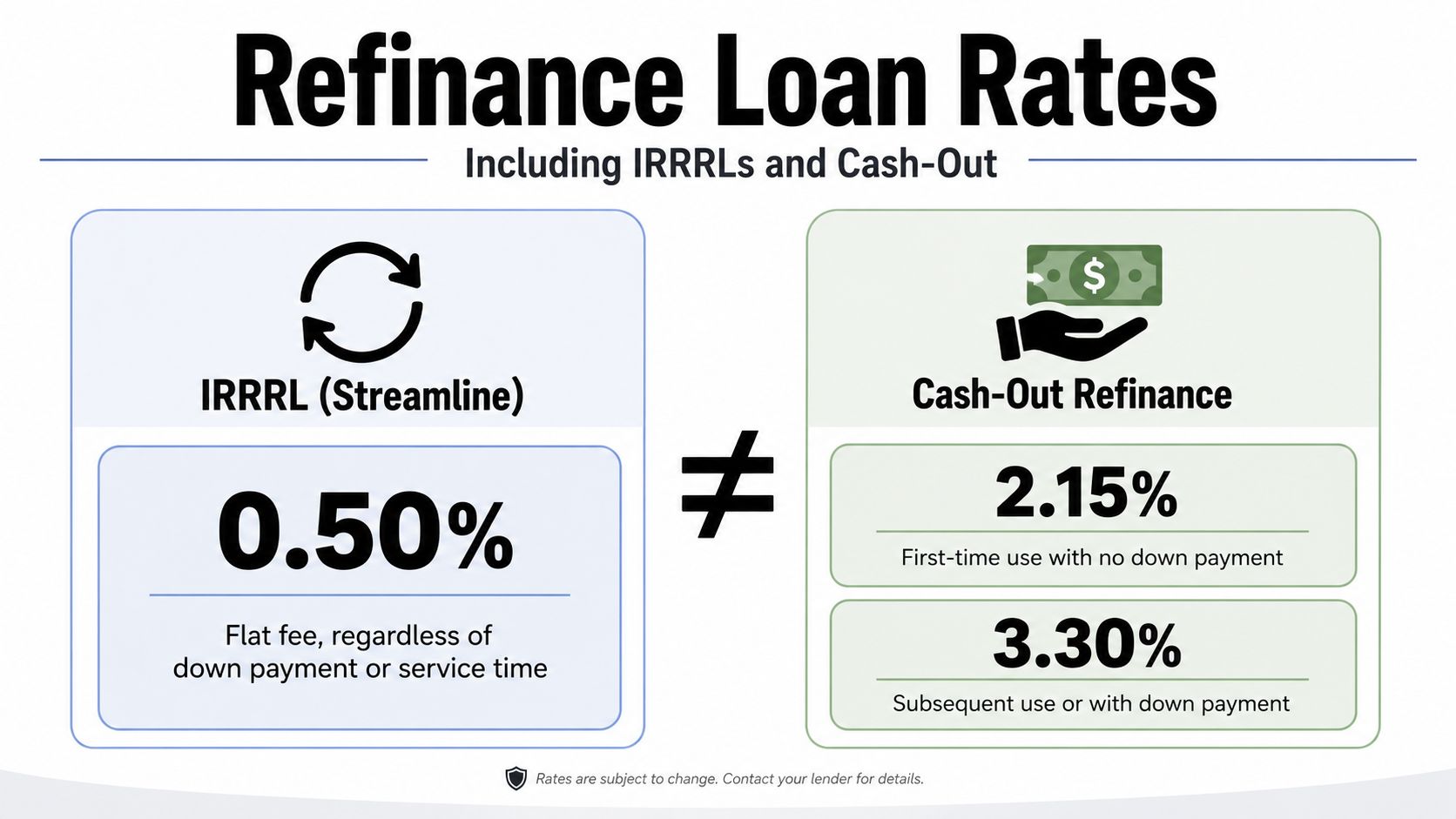
If you're comparing refinance options in California, don't let anyone hand you a purchase chart and call it close enough. That's lazy, and it will misstate your closing costs.
Refinance rates at a glance
- IRRRLs: flat 0.5%, regardless of down payment
- Cash-out refinance, first use: 2.15%
- Cash-out refinance, subsequent use: 3.3%
Use the right rate for the right loan purpose. A streamline refinance is priced differently because it's a narrower refinance path than a cash-out transaction. If you're running refinance numbers, use the loan-specific calculator and not a generic VA purchase estimate, or you'll overstate or understate the fee.
For a refinance estimate built around that distinction, use the VA refinance rates calculator.
Reservists, National Guard, and Other Special Categories
A Guard or Reserve borrower can get tripped up fast by a generic va funding fee chart. The standard active-duty schedule is not the whole story. The VA also sets separate rates for Reservist and National Guard purchase loans, plus special treatment for manufactured-home loans not permanently affixed, loan assumptions, and Native American Direct Loans that are not IRRRLs. VA funding fee exhibit
Here is the part that matters in real life. Reservist and National Guard purchase loans use 2.40%, 1.75%, and 1.50% tiers at the same down-payment breakpoints. If you are in one of those categories, the active-duty chart is the wrong starting point, and the fee will be off if you quote it that way.
Special-category rates that get missed
- Reservist and National Guard purchase loans: 2.40%, 1.75%, 1.50% tiers
- Non-permanently affixed manufactured-home loans: 1%
- Loan assumptions: 0.5%
- Native American Direct Loans, not IRRRLs: 1.25%
California borrowers see these rows matter in dollars, not theory. On a larger loan, a missed category can change the cash needed to close enough to throw off the whole estimate. On a smaller loan, the error still causes confusion, and nobody wants to discover that at signing.
For a borrower who is Guard, Reserve, or using a special loan type, the right move is simple, check the row that matches the loan before you talk about cash to close. If you want the broader loan conversation after you confirm your status, start with California veteran home loans.
Who Pays Zero Funding Fee and How to Confirm Exemption
A qualifying exemption is the cleanest break in VA lending, because the 0.00% funding fee wipes the charge off the table entirely. The VA fee card shows 0.00% for service-connected disabled borrowers across usage and down-payment categories, and that is the row I want every eligible borrower to verify first. VA funding fee card
That exemption is not a side note. It is the biggest closing-cost break available to a qualifying borrower, and I push clients to confirm it before anyone builds an estimate. If you qualify, do not let the fee get baked into your numbers by mistake.
What lenders usually need
A lender usually wants proof that is easy to verify and hard to dispute. Start with the VA disability rating letter, then make sure the Certificate of Eligibility shows exempt status, and add proof tied to service-connected compensation when that applies.
The right document at application can keep a borrower from paying a fee they did not owe.
The VA also recognizes other exempt categories in its guidance, including certain surviving spouses and other qualifying edge cases. If there is any chance you fall into one of those buckets, tell the lender to verify exemption before underwriting locks the file.
For California borrowers who want the broader veteran-loan conversation after they confirm status, the California veteran home loans page is the right next step.
Worked Examples on California Loan Amounts
A funding fee looks abstract until you put it against a real California purchase price. Start with a $500,000 first-time purchase at less than 5% down. That falls under the 2.15% tier, so the fee is $10,750. Put the same $500,000 loan into a subsequent-use file at less than 5% down, and the fee jumps to 3.3%, or $16,500.
That gap is $5,750 on the same house price. In a California closing file, that is real money. It can decide whether your lender credit covers the bill, whether your cash reserves stay intact, and whether the seller has to step in with concessions.
The pattern gets clearer once you look at a few other loan sizes.
- $500,000 first use, 10% down: 1.25%, or $6,250
- $450,000 IRRRL: 0.5%, or $2,250
- $600,000 subsequent-use cash-out refinance: 3.3%, or $19,800
Here is the part borrowers miss. Prior VA use and down payment size can change the fee by a lot, especially on larger California loan amounts. A borrower who assumes the fee from memory usually gets the estimate wrong. That mistake shows up fast at the closing table.
For California buyers in a high-cost market, the funding fee belongs in the budget from day one. A clean offer can still get strained if the fee was never worked into the cash plan. If you are comparing lender credits against paying cash, the cleanest next step is to review what a lender credit is before you decide how to cover the fee.
Financing, Paying Upfront, or Rolling Into the Loan
A veteran buyer in California usually has three real options for the VA funding fee. Roll it into the loan, pay it upfront, or use seller concessions where the loan rules allow it. Each choice changes your cash at closing, and the best one depends on how much liquidity you need to protect.
Rolling the fee into the loan is the move I see most often when the rest of the file is already tight. It keeps cash in your pocket, which matters when you are also covering earnest money, inspections, moving costs, and the rest of the closing stack. The cost is straightforward, you finance the fee and pay interest on it over time. Paying it upfront avoids that extra financed balance, but it asks for real cash on signing day.
A lender credit can also change the math. If the credit is large enough, it can absorb part of the fee or free up cash for other closing costs. If you want a plain explanation of what a lender credit is, start there before you decide how to structure the file.
My rule of thumb
Buyers with tight cash usually do better rolling the fee into the loan. That keeps the deal alive without draining reserves. If seller help is available, push that first, because every dollar the seller covers is a dollar you do not have to bring in.
Borrowers with a larger fee and comfortable reserves should pay it upfront if the numbers still leave them with enough cushion after closing. That is the cleaner choice when you do not want the fee increasing the loan balance. In practical terms, financing protects cash now, paying upfront reduces the amount you carry later.
Seller concessions can help, but only within the loan rules tied to the specific transaction. Do not assume every VA file gives you the same room to use them. The contract and program structure decide how far those concessions can go, and a sloppy setup here can leave you short at the table.
How the Funding Fee Fits Into California HERO Home Loans
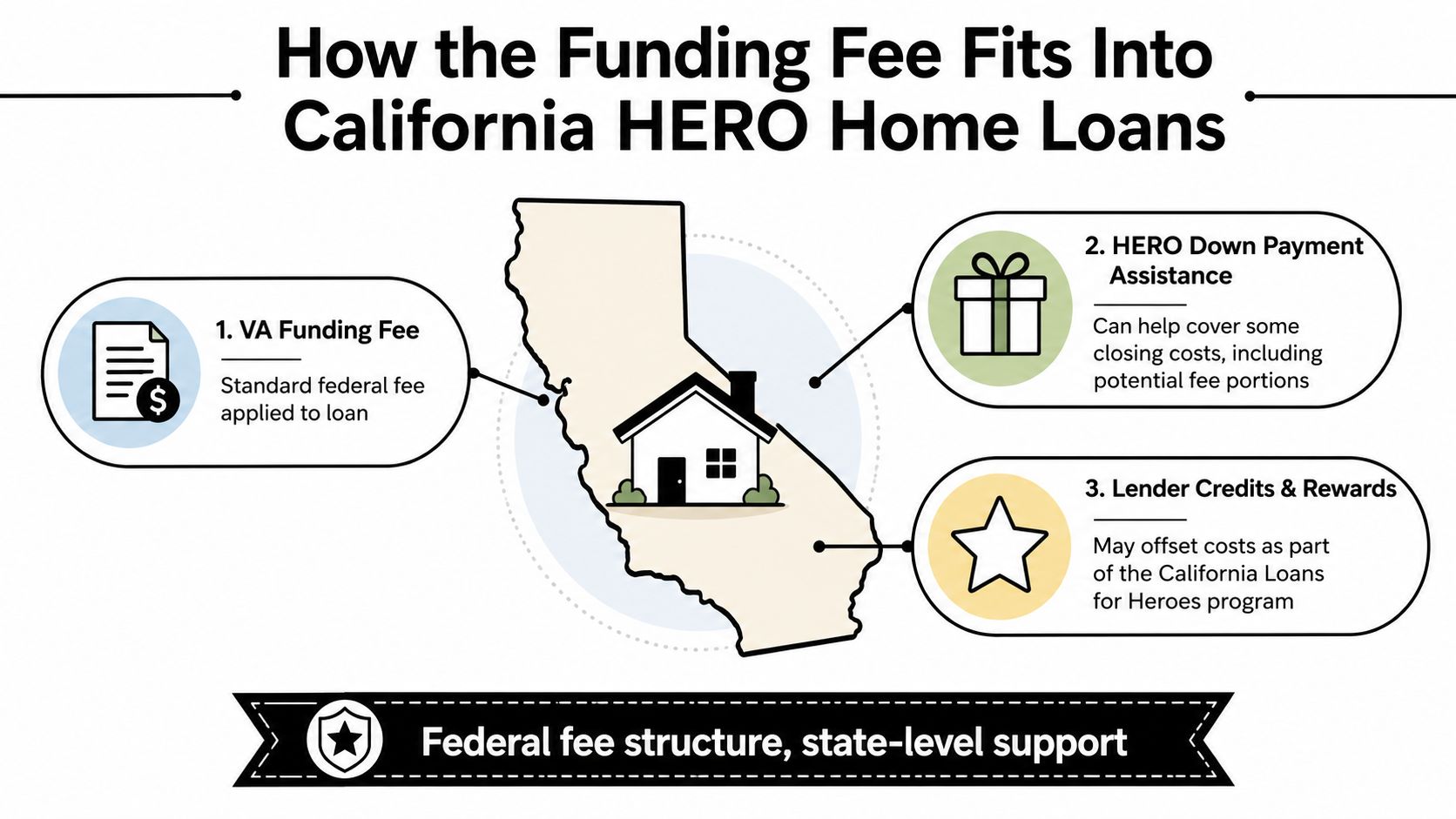
A VA loan file in California rarely stands alone. The funding fee usually sits beside seller credits, lender credits, and any down payment help, and the order you apply those pieces changes the cash you need at closing. Run the fee on the base loan amount first, then layer assistance on top. If you reverse that order, your numbers will be off.
For HERO Home Loan borrowers, that matters because the final cash-to-close figure is built from more than one source. A buyer can use VA eligibility and still owe the fee unless an exemption applies, even if other credits reduce the amount due on signing day.
What to have ready for a clean quote
Bring the loan purpose, the prior VA use status, the down payment amount, and any exemption documents if you have them. That is the cleanest way to get a quote that reflects the actual cash you will need, not a rough estimate that falls apart at closing.
If you are using VA benefits in California, treat the funding fee as part of the full closing-cost plan. Seller help, lender credits, and assistance programs can soften the hit, but none of them erase the need to price the fee correctly from the start.
California Loans for Heroes can still help you line up the fee, assistance, and credits before you write the offer, so the numbers make sense before you commit to them.
Quick Reference and Common Funding Fee Questions
For standard VA purchase or construction loans, the key rates are 2.15% for first use with less than 5% down, 1.5% with 5% or more down, 1.25% with 10% or more down, and 3.3% for subsequent use with less than 5% down. IRRRLs use 0.5%, and service-connected disabled borrowers can qualify for 0.00%. VA funding fee and closing costs, VA funding fee card
A few edge cases come up all the time:
- Does prior VA use still count if I sold the old home? Yes. Prior use still matters, even if the old loan is paid off.
- Can an IRRRL funding fee be refunded? No. IRRRL fees are not refundable.
- Does a 100% service-connected disability rating waive the fee? Yes, across loan types.
That's the version worth saving. If your situation is anything other than a plain first-time purchase, read the chart with the loan type first and the down payment second.
California Loans for Heroes can help you pressure-test your VA numbers, compare closing-cost options, and decide whether financing the fee or paying it upfront makes more sense for your deal. If you're buying or refinancing in California and want a straight answer on your funding fee, visit California Loans for Heroes and get your loan scenario reviewed before you make your next move.