
You got the FHA pre-approval. That part took discipline. You pulled documents together, answered underwriting questions, and worked through credit, income, and down payment planning. For a lot of California buyers, especially teachers, firefighters, nurses, law enforcement, and military families, that pre-approval feels like the hard part.
It isn't.
The next decision carries more weight than most buyers expect. In California, the agent you choose can either protect your FHA approval path or put it at risk with bad property selection, weak offer strategy, or simple process mistakes. That matters even more when your schedule is packed, your housing budget is tight, and you need a home that works for real life, not just a clean listing photo set.
I've seen this often with hero buyers. A teacher has limited time to tour during the week. A firefighter works a rotating shift. A VA family is relocating on a deadline. A nurse wants to stay near a hospital corridor but needs monthly payment clarity before writing an offer. They're all pre-approved, but they're not all equally prepared to choose the right agent. With FHA, that choice affects the homes you pursue, how your offers are written, and how smoothly you get to closing.
Your FHA Journey Begins After Pre-Approval
A lot of buyers think pre-approval means they're ready to shop with any decent local agent. With FHA loans in California, that's where people lose momentum.
A common scenario looks like this. A first-time buyer gets approved because FHA allows borrowers with a credit score of 580 or higher to often qualify with 3.5% down, while borrowers in the 500 to 579 range may need 10% down (California FHA down payment basics). That flexibility is exactly why FHA remains a practical path for buyers who serve their communities and haven't had years to stack cash in an expensive state.
Then the search starts, and the confusion begins. One agent says, “FHA is fine on any normal house.” Another says, “We should avoid condos.” A third wants to write fast offers but can't explain how FHA appraisal issues could affect negotiations. None of that inspires confidence when you're already trying to balance work, family, commute, and budget.
What changes after approval
Pre-approval tells you what a lender may be able to do. Your agent decides how well that financing performs in the market.
That means your agent should know how to:
- Screen homes early so you don't waste time on listings likely to create FHA appraisal or condition problems
- Set realistic expectations around competition, timing, and seller concerns
- Coordinate with your lender before issues turn into delays
- Guide first-time buyers through the actual sequence of buying, not just opening doors
If you're still mapping the process, this guide on steps to buying your first home is a useful companion. It helps put the agent decision in the right place, early enough to matter.
Practical rule: Your lender gets you approved. Your agent helps you buy the right home without wrecking that approval.
For FHA buyers in California, those are two different jobs. You need both done well.
Why an FHA-Savvy Agent is Non-Negotiable in California
California punishes generic advice. That's true with pricing, neighborhoods, insurance costs, property condition, and especially financing strategy.
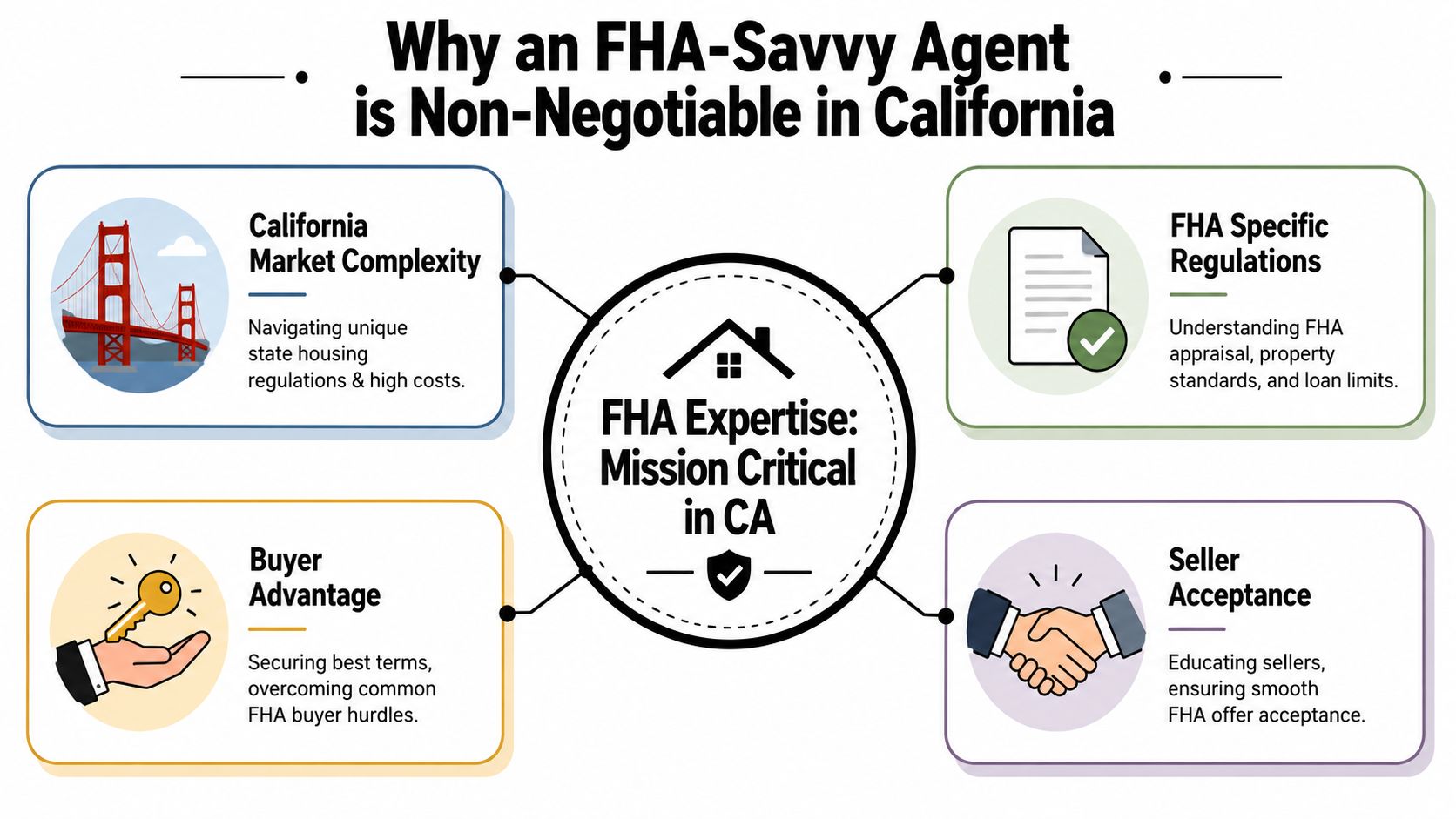
An agent who handles mostly conventional move-up buyers may still be competent. That doesn't mean they're the right fit for FHA loans in California. FHA adds a different layer of property standards, seller education, and payment analysis. In California, local market conditions make that layer more important, not less.
County limits change the conversation
One of the biggest mistakes buyers make is assuming FHA works the same everywhere in the state. It doesn't. For 2026, California's one-unit FHA loan limits range from $541,287 to $1,249,125, depending on county, with high-cost areas such as Los Angeles and the Bay Area at the top end (2026 California FHA loan limits).
That single fact changes home search strategy. An FHA-savvy agent understands that your target city, commute pattern, and county line can change what's realistic. A buyer shopping in Fresno faces a very different financing ceiling than a buyer shopping in Los Angeles. If your agent doesn't know that before showing property, you can waste weekends looking at homes that don't fit the actual loan structure.
FHA offers need better presentation
Some sellers hear “FHA” and assume the deal will be slower, harder, or more likely to fall apart. A capable agent knows how to address that head-on.
They don't just submit an offer. They explain strength. They coordinate with your lender. They make sure timelines, documentation, and property fit are aligned before the seller starts looking for reasons to prefer another buyer.
A weak FHA agent tends to do three things:
- They chase the wrong inventory.
- They fail to prepare the listing side for FHA requirements.
- They react late when appraisal or condition issues show up.
An experienced one does the opposite.
Sellers don't reject FHA because of the letters alone. They reject uncertainty.
Payment strategy matters more than rate shopping alone
California buyers often focus on interest rate first. That's understandable, but it's incomplete. FHA buyers also need to understand the full monthly cost. That includes mortgage insurance, taxes, and insurance, especially in higher-cost areas where the payment can shift quickly.
That's why comparing financing paths matters. This overview on how to compare mortgage rates is helpful, but the right agent should go beyond rate talk and help you think like an owner. If they can't discuss total payment impact in practical terms, they're not ready to guide an FHA buyer in California.
Sourcing Agents Who Understand Hero Programs
Most buyers find agents the same way they find a pizza place. They search online, skim reviews, and pick the name that appears most often. That's not a strong method for FHA buyers.
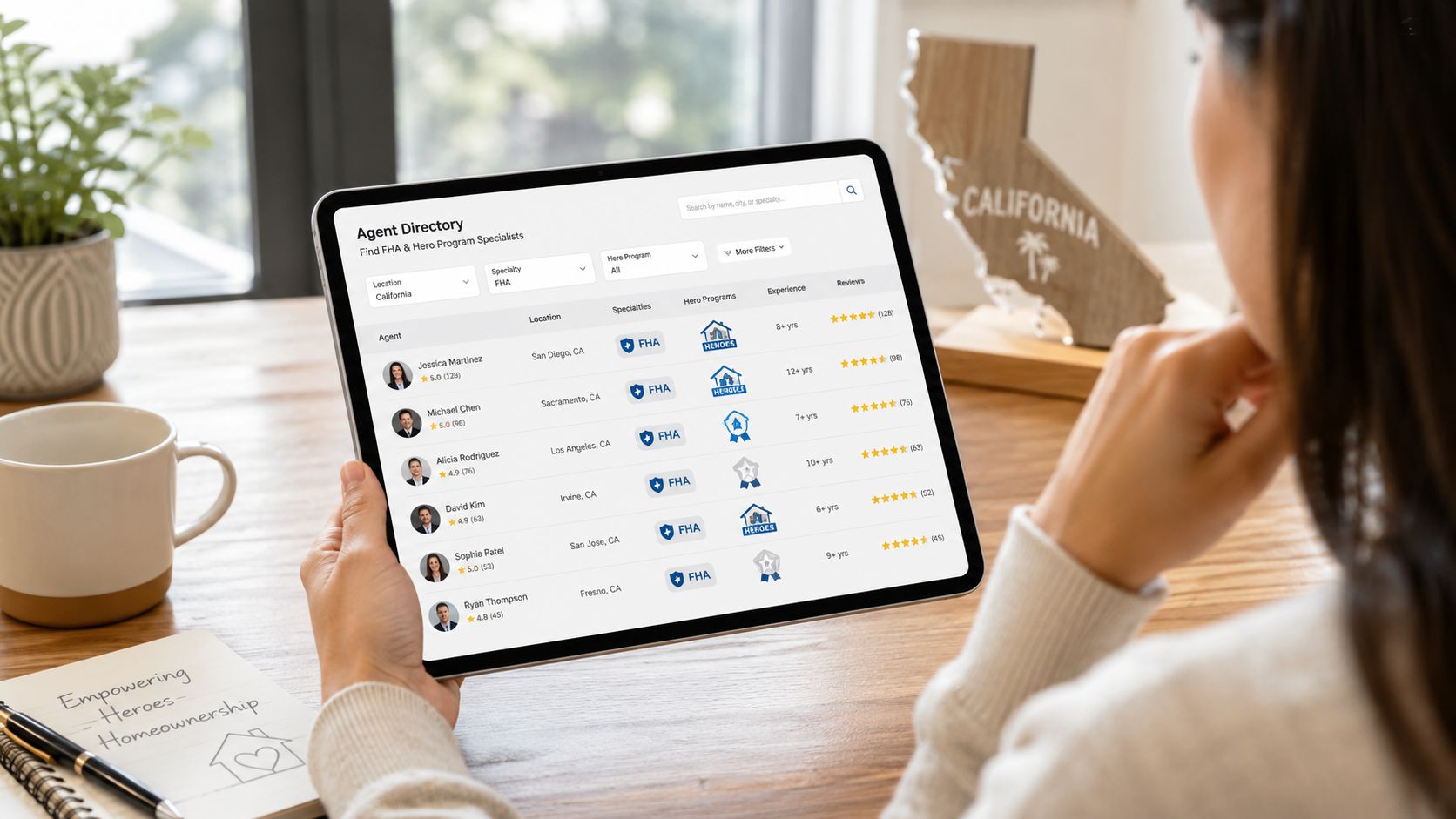
If you're using FHA and you're also trying to access hero-focused help, your sourcing process should be tighter. You're not looking for the loudest agent. You're looking for someone who understands financed buyers, timing pressure, and programs that may involve extra steps.
Start with your lender's referral network
This is usually the strongest first move.
A lender who works with FHA buyers every week knows which agents communicate well, write clean offers, and understand financing guardrails. That doesn't mean you should blindly accept one name. It does mean lender referrals tend to expose problems faster than online browsing does.
Ask for more than one referral if possible. Then ask why each agent made the list. The answer matters. You want to hear things like strong FHA experience, good listing-side communication, clean contract execution, and familiarity with first-time buyer support. You don't want vague praise.
One option buyers may review while building that list is California Loans for Heroes, which focuses on California buyers in public service roles and works around hero-related home loan and assistance pathways. It's useful as a starting point if you want a lender ecosystem that already serves teachers, military families, first responders, and healthcare professionals.
Use search portals, but read them differently
Zillow, Realtor.com, and brokerage sites can help, but most buyers use them poorly. They look at headshots, star ratings, and salesy taglines. FHA buyers should look for specifics.
Scan for signs the agent works with:
- First-time buyers
- Low down payment financing
- CalHFA or assistance programs
- Neighborhoods where you want to buy
- Buyers with schedules like yours, especially shift work or relocation timelines
If the profile sounds polished but never mentions financing complexity, keep moving.
Check local community ties
Many hero buyers often find the right fit. Local brokerages and agents involved with schools, veterans groups, public safety communities, hospital networks, or city employee circles often understand the practical realities of service-based careers.
That doesn't automatically make them FHA experts. But it can point you toward agents who know why:
- commute reliability matters,
- school-year timing matters,
- deployment or transfer timing matters,
- and monthly payment clarity matters more than flashy home tours.
Field note: Buyers in service professions usually need an agent who respects time constraints as much as financing constraints.
Build a short list from all three channels. Then narrow it down before you start taking calls.
Vetting Credentials and Spotting Critical Red Flags
Once you have names, do your screening before any interview. This saves time and filters out agents who talk well but aren't equipped for FHA work.
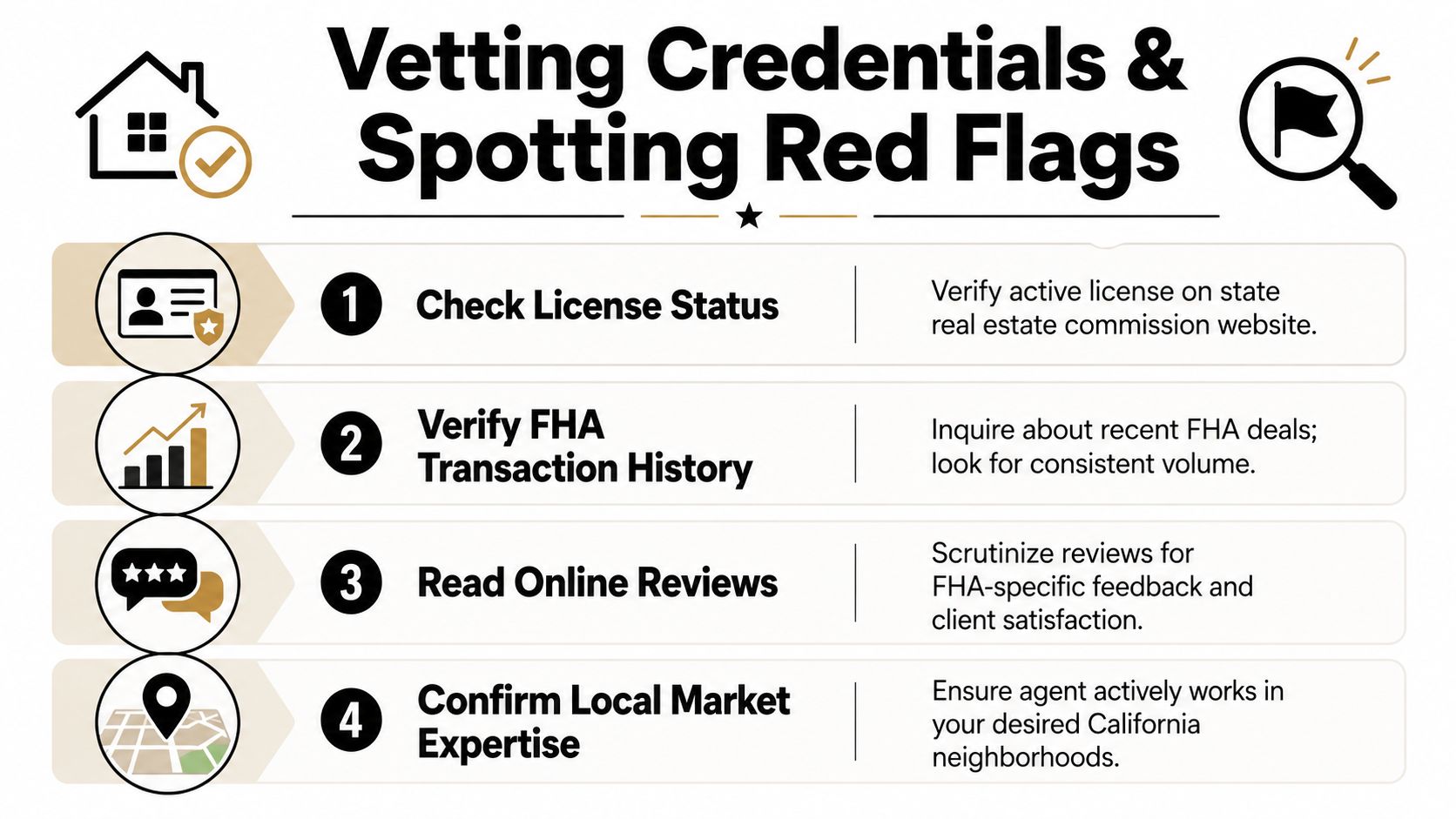
You're not looking for a perfect online presence. You're looking for evidence that the agent is active, organized, locally relevant, and comfortable with financed buyers.
Green flags worth noticing
Start with basics. Verify the agent's California license status through the California Department of Real Estate. Then look at how they describe their work.
Strong signs include:
- They mention FHA naturally rather than treating it like a backup option.
- They reference CalHFA or buyer assistance programs without sounding unsure.
- They work the neighborhoods you want, not just the broad metro area.
- They show patience with first-time buyers, especially around education and process.
- They hold relevant designations, such as military-focused credentials, if your household is active-duty or veteran.
Online reviews can help if they mention actual experiences. Look for comments about communication, problem-solving, and whether financed deals closed smoothly. Generic praise like “great personality” doesn't tell you much.
Red flags that should end the conversation
Some issues are minor. Others are disqualifying.
Walk away if you hear any version of the following:
- “FHA is basically the same as conventional.”
- “Don't worry about the program steps, we'll figure it out later.”
- “I haven't really done CalHFA, but it should be easy.”
- “Let's just write offers and see what sticks.”
For CalHFA's FHA products, the borrower must complete homebuyer education counseling and obtain a certificate before closing, and the loan officer must be CalHFA-approved (CalHFA FHA program requirements). An agent who doesn't understand that can create preventable delays, especially if they push the search or contract timeline without checking that the buyer has completed the required steps.
Some agents lose FHA deals without realizing it. They create sequencing problems, not just negotiation problems.
A fast at-home screening checklist
Use this before you schedule interviews:
| Screening Item | What to Look For |
|---|---|
| License status | Active California license and no obvious issues |
| Area focus | Regular activity in your target communities |
| Financing familiarity | Clear mention of FHA, first-time buyers, or assistance programs |
| Review quality | Comments about follow-through, clarity, and smooth closings |
| Buyer fit | Experience with military, teachers, first responders, or healthcare buyers |
You only need a few solid candidates. More than that usually creates noise.
The Interview Questions That Reveal True Expertise
Credentials help. Conversation reveals competence.

A real FHA specialist won't sound rehearsed. They'll answer with specifics. They'll talk about property condition, seller communication, local inventory patterns, and how they work alongside the lender. A generalist usually stays at the slogan level.
Ask questions that force practical answers
Don't ask, “Are you good with FHA?” Every agent will say yes.
Ask questions that expose process:
| Question Category | Question to Ask |
|---|---|
| FHA experience | What kinds of FHA buyers do you work with most often in California? |
| Property selection | How do you help buyers avoid homes that are more likely to create FHA appraisal or condition issues? |
| Offer strategy | When we compete with conventional buyers, how do you present an FHA offer so the seller feels confident? |
| Local fit | Which neighborhoods do you think fit my budget, commute, and financing approach, and why? |
| Payment analysis | How do you help buyers evaluate the full monthly FHA payment, not just the down payment? |
| Hero programs | What experience do you have helping teachers, first responders, military families, or healthcare workers use assistance programs? |
| Coordination | How often do you communicate with the lender during escrow, and when do you pull them in early? |
| Problem solving | Tell me about a transaction where a financed buyer hit an issue with the property or timeline. How did you handle it? |
| Availability | How do you handle touring and negotiations for buyers who work shifts, nights, or long hours? |
| Expectations | What do you expect from me as a buyer so we can move quickly when the right home appears? |
Listen for how they think
The best answers usually sound calm and specific. They might explain how they pre-screen listings, call the listing agent before writing, or flag condition concerns before you spend money on inspections and appraisal.
The weak answers usually sound broad. They rely on confidence instead of process.
One question matters more than buyers realize: how the agent helps you understand the total monthly FHA payment. That's critical because FHA mortgage insurance can last for the life of the loan if the down payment is under 10%, which can change long-term affordability (FHA mortgage insurance and payment analysis).
A good FHA agent doesn't sell you the lowest entry cost. They help you decide whether the monthly payment still works after the excitement wears off.
Use their answers to test real-world fit
If you're a firefighter, ask how they handle sudden schedule changes. If you're a teacher, ask how they manage a purchase during the school year. If you're military, ask how they coordinate around relocation timing. If you're in healthcare, ask how responsive they are outside standard daytime hours.
You're not interviewing for charm. You're hiring for execution.
A strong agent should leave you with the sense that they can do three things well: protect your financing path, help you compete realistically, and keep the process organized when life gets messy.
Making Your Final Choice and Defining Next Steps
By the time you finish interviews, the answer is usually clearer than buyers think. One agent tends to combine local knowledge, financing awareness, responsiveness, and calm judgment better than the rest.
Don't choose based on personality alone. Plenty of friendly agents create expensive mistakes. Choose the person who made you feel more prepared, not more sold.
Weigh the answers, not the pitch
Review your notes and compare candidates on a few practical points:
- Did they understand FHA without oversimplifying it?
- Did they speak clearly about local inventory and neighborhoods?
- Did they respect your work schedule and communication needs?
- Did they understand hero-specific program pathways or at least know how to coordinate around them?
- Did they sound organized enough to keep the lender, escrow, and listing side aligned?
If two agents seem close, use references to break the tie. Ask former clients what happened when something went wrong. Smooth deals are easy. You want to know how the agent handled pressure, delays, repairs, or communication gaps.
Check references with useful questions
Most buyers ask references, “Did you like working with them?” That doesn't help much.
Ask:
- Did the agent communicate clearly and quickly when timing mattered?
- Did they understand your financing, or did your lender carry the file alone?
- Were there surprises you think the agent should have caught earlier?
- Did they push you into homes or help you rule out bad fits?
- Would you hire them again for the same loan type?
Those answers usually tell you more than online reviews ever will.
Decision test: If a problem shows up after your offer is accepted, which agent would you trust to get everyone pointed in the same direction by the same day?
Define the working relationship early
Once you choose, formalize expectations before the house hunt gets serious. In California, that includes reviewing the buyer-broker agreement carefully.
Focus on:
- Term length so you know how long the agreement lasts
- Geographic scope so it matches where you plan to search
- Communication expectations including evenings, weekends, and urgent offer windows
- Compensation terms so there's no confusion later
- Cancellation language so you understand your options if the fit breaks down
Also set practical norms right away. Decide how listings will be shared, how quickly you'll tour, how you'll discuss payment comfort, and when the lender gets looped in on property-specific questions. Buyers who set this rhythm early tend to shop with more confidence and less chaos.
A good final choice isn't just the agent who knows FHA loans in California. It's the one who can apply that knowledge to your life, your county, your schedule, and your budget.
If you're a teacher, firefighter, nurse, veteran, active-duty service member, law enforcement officer, pilot, or other California public service professional, California Loans for Heroes can help you map out your FHA options, connect financing with the right home search strategy, and understand what assistance paths may fit your situation before you make an offer.