
As of September 3, 2026, mortgage rates currently average 6.71% for a 30-year fixed loan and 6.04% for a 15-year fixed loan. For California buyers, that means financing is more expensive than it was during the pandemic, but still far below the extraordinary rates of the early 1980s.
Those figures give you the national benchmark. Your actual California quote will depend on the loan program, county, credit profile, down payment, property type, points, and whether the loan falls within the conforming limit or requires jumbo financing. The practical question isn't whether rates are perfect. It's whether the payment works, whether the property fits your long-term plan, and whether locking now protects your transaction.
Where Mortgage Rates Currently Stand in 2026
The September 3, 2026 national benchmark was 6.71% for a 30-year fixed mortgage and 6.04% for a 15-year fixed mortgage. Those averages included 0.7 points and 0.6 points, respectively. Compare the interest rate and upfront points together, because a lower rate can require a larger payment at closing.
The previous week's averages were 6.69% for the 30-year loan and 5.98% for the 15-year loan, a modest weekly increase. The 30-year average near 7.20% in mid-2025 was higher, so pricing has eased. California buyers should still plan around a mid-6% market, not a return to pandemic-era rates.
For California borrowers, the national figure is only the starting point. Your quote also reflects the county's conforming loan limit, loan size, credit profile, down payment, occupancy, property type, points, and underwriting adjustments. Bay Area and coastal purchases may move into jumbo pricing sooner, while a HERO program borrower needs to review program costs and eligibility separately from the headline rate.
Practical rule: Treat the national average as a direction marker, not a guaranteed offer. Ask your lender to price your specific scenario in writing.
A working rate checkpoint
| Loan Product | Current Rate | Prior Week | One Year Ago | Average Points |
|---|---|---|---|---|
| 30-year fixed | 6.71% | 6.69% | Near 7.20% | 0.7 |
| 15-year fixed | 6.04% | 5.98% | Not specified | 0.6 |
Rates can change during the day. Request a same-day estimate listing the rate, points, lender credits, APR, projected payment, and quote expiration. Compare equivalent offers. A zero-point quote is not directly comparable with a lower rate that requires substantial discount points.
Before you are under contract, waiting can be reasonable if the payment is not yet workable. Once your offer is accepted and closing deadlines are set, lock when the loan is approved, the timeline is clear, and the payment fits your budget. Certainty usually beats chasing a small market improvement.
Current Rates by Loan Product and Term
Different loan programs solve different borrower problems. The lowest advertised rate isn't automatically the best financing choice, especially when mortgage insurance, reserve requirements, loan limits, or future payment changes are part of the picture.
The verified September benchmarks support a 30-year fixed rate around 6.71% and a 15-year fixed rate around 6.04%, with the shorter term carrying a meaningful rate advantage. Market snapshots also show that ARM pricing can sit close to fixed-rate pricing, so borrowers shouldn't assume an adjustable loan will always provide an upfront discount. Compare mortgage rates by loan type and structure before choosing based on the headline number alone.
| Product | Current Rate Range | Best For | Key Tradeoff |
|---|---|---|---|
| 30-year fixed conforming | Around 6.65% to 6.75% | Buyers who need predictable payments | More total interest over the full term |
| 15-year fixed conforming | Around 5.95% to 6.10% | Households prioritizing interest savings | Higher required monthly payment |
| 30-year FHA | Around 6.25% to 6.50% | First-time buyers with less than 20% down | Mortgage insurance increases the total payment |
| 30-year VA | Around 6.15% to 6.40% | Eligible veterans and service members | Eligibility and guaranty rules apply |
| 30-year jumbo | Around 6.75% to 6.95% | Larger Bay Area and coastal purchases | Tighter underwriting and different pricing |
| 5/6 ARM | Around 5.85% to 6.10% | Buyers expecting to move within seven years | The payment can change after the initial period |
Match the product to the borrower
A 30-year conforming loan remains the default choice for many California households because it spreads repayment over a longer period and creates a predictable principal-and-interest payment. A 15-year mortgage can reduce the interest rate and shorten the payoff period, but only choose it if the higher payment leaves adequate room for taxes, insurance, maintenance, and emergency savings.
FHA financing can help a buyer who has a smaller down payment or a less established credit profile. VA financing deserves an early review for eligible borrowers because the program can provide strong purchase flexibility, subject to current eligibility and lender requirements.
Jumbo financing matters when the requested loan exceeds the applicable conforming limit. ARM financing may fit a buyer with a clear relocation plan, but it isn't a safe substitute for affordability. If you need the initial payment to remain manageable for the full ownership period, a fixed loan is usually the more disciplined choice.
What Is Driving Mortgage Rates Right Now
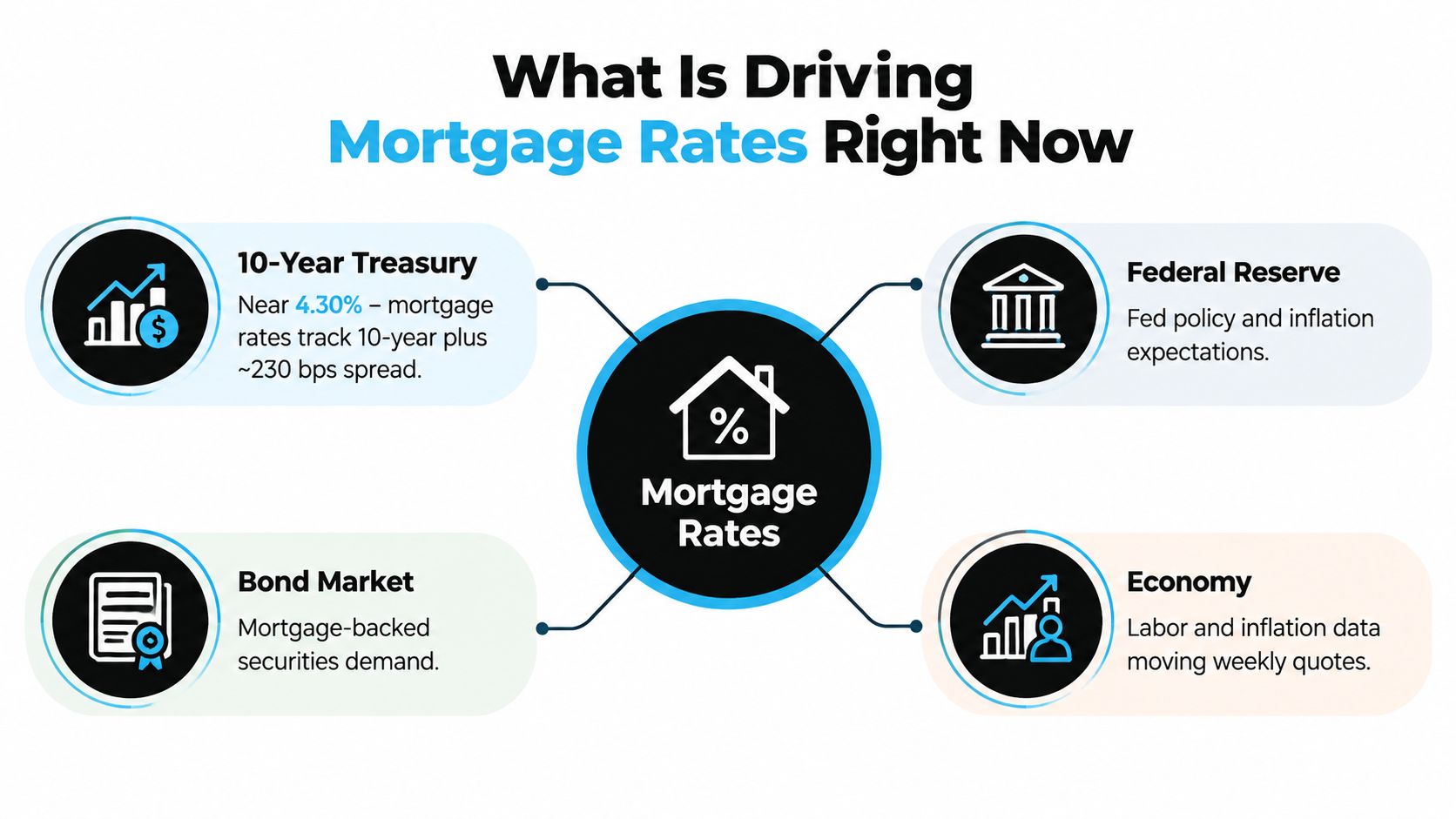
Mortgage lenders don't set rates from one number. Weekly quotes respond to the interaction between Treasury yields, Federal Reserve policy, inflation expectations, and demand for mortgage-backed securities.
The 10-year Treasury yield is near 4.30%, and mortgage rates generally trade above that benchmark with a spread of roughly 230 to 260 basis points. A 10-basis-point Treasury move can translate into roughly a 7 to 8 basis-point mortgage-rate move, although the relationship isn't mechanical. Freddie Mac's mortgage market data provides the borrower-facing rate reference, while daily lender pricing reacts to bond-market movement.
Four levers to watch
Treasury yields: When investors demand higher returns on longer-term government debt, mortgage pricing often faces upward pressure.
Federal Reserve policy: The federal-funds rate is near 4.00% to 4.25% after the Fed held through summer 2026. Mortgage rates respond more to expectations about future policy and inflation than to the overnight rate alone.
Inflation: August CPI was near 3.4% year over year, a level that keeps policymakers cautious and can prevent mortgage spreads from narrowing quickly.
Mortgage-backed securities: Lenders sell many mortgages into the MBS market. Investor demand, supply, and credit conditions influence the spread between Treasury yields and mortgage rates. Current coupon MBS spreads are near 175 basis points, wider than the near-100-basis-point levels associated with 2021.
These factors can compound. A single inflation surprise, Treasury auction, or change in rate expectations can move mortgage quotes sharply during a lock window. Borrowers shouldn't build a purchase plan around predicting the next economic release. They should build a plan that works if rates stay near the current range.
Historical Context for Today's Rate Environment
Today's 6% to 7% mortgage market feels expensive because many current homeowners remember pandemic-era financing below 3%. That comparison is relevant for household budgeting, but it doesn't describe the full history of mortgage borrowing.
Freddie Mac's 30-year fixed series reached an all-time weekly high of 18.63% on October 9, 1981, and the annual average for 1981 was 16.63%. The same historical series recorded a 2021 low of 2.65% for the 30-year fixed mortgage. The September 2026 reading of 6.71% sits between those extremes, well above the recent low but dramatically below the early-1980s peak. Historical mortgage-rate context shows why both statements can be true: current rates are high by post-2008 standards, yet not historically extreme.
| Period | 30-Year Fixed Average | Why It Matters |
|---|---|---|
| 1981 | 16.63% annual average, with an 18.63% weekly peak | Demonstrates how severe inflation-driven borrowing costs became |
| 2021 | 2.65% low | Explains why today's payment feels unusually high to recent buyers |
| September 3, 2026 | 6.71% | Establishes the current working benchmark |
What history means for a California decision
Don't wait solely for a return to the 2021 low. That may happen someday, but it isn't a responsible assumption for a purchase decision today. Base the decision on the payment you can carry, the cash you need to close, and how long you expect to own the property.
California affordability also depends on more than the note rate. Property taxes, homeowners insurance, wildfire coverage, HOA dues, maintenance, and commuting costs can materially change the monthly budget. A slightly lower rate won't rescue a purchase that leaves you financially stretched.
The right target isn't the market's perfect bottom. It's a payment that remains comfortable if rates don't improve soon.
California Loan Options Side by Side
California borrowers should select financing by eligibility, loan size, property use, and payment tolerance, not by the lowest rate in an advertisement. A quote that looks attractive can become less useful after mortgage insurance, points, reserve requirements, or a different loan limit enters the analysis.
For 2026, the conventional conforming loan limit for a single-family home is $832,750 in most California counties, while high-cost counties can reach the federal ceiling of $1,249,125. California's 2026 loan-limit guidance is especially important in Los Angeles, Orange County, and Bay Area markets, where the same purchase price can fit a conforming structure in one county and require jumbo financing in another.
| Option | Best Fit | Key Consideration |
|---|---|---|
| Conventional conforming | Buyers whose loan fits the applicable county limit | Broad eligibility and generally predictable pricing |
| Jumbo | Buyers exceeding the county conforming limit | Tighter underwriting, reserve expectations, and pricing |
| FHA | Buyers with a lower down payment or less established credit | Mortgage insurance adds to the total housing cost |
| VA | Eligible veterans and service members | Program eligibility, entitlement, and lender rules apply |
| CalHFA-aligned programs | Eligible California buyers seeking education or assistance | Income, property, and first-buyer requirements must be verified |
| HERO or PACE assessment | Property owners financing qualifying improvements through a property-secured assessment | Compare total cost, payment structure, lien position, and tax treatment |
Don't confuse a mortgage with HERO financing
California HERO financing is a separate property-secured assessment product, not a conventional mortgage. Its payment structure and lien position can affect a later sale or refinance, so compare the complete obligation rather than the nominal rate.
CalHFA-aligned programs may combine homebuyer education, down-payment assistance, or other support for eligible households. Those programs can be valuable, but current income caps, property rules, and first-buyer requirements must be confirmed before you rely on them.
A licensed loan officer should verify the county limit, loan category, property occupancy, program availability, and any required subordination or payoff documentation before you submit an offer.
How Rate Changes Hit California Monthly Payments
A quarter-point rate change can affect both qualification and long-term interest. On a $600,000, 30-year mortgage, a 6.71% rate produces an estimated principal-and-interest payment of about $3,879 per month. At 6.46%, the payment is about $3,765, a reduction of roughly $114 per month. At 6.96%, the payment rises to approximately $3,994, or about $115 more.
| Interest Rate | Estimated Monthly Payment | Difference From 6.71% |
|---|---|---|
| 6.46% | About $3,765 | About $114 lower |
| 6.71% | About $3,879 | Baseline |
| 6.96% | About $3,994 | About $115 higher |
These estimates isolate principal and interest. Your actual housing payment can also include property taxes, homeowners insurance, mortgage insurance, HOA dues, and any property-secured assessment. Loan fees, credit score, down payment, and rate structure can change the final quote.
Use the payment difference correctly
The lower rate can save tens of thousands of dollars in interest over the full loan term if the borrower keeps the same loan amount and makes no prepayments. But don't let a payment comparison push you into a larger loan than your budget supports. California's higher purchase prices make even modest rate movement relevant, but a lower purchase price can be more powerful than waiting for a small rate improvement.
For a refinance, calculate the break-even point:
- Add the costs: Include lender fees, appraisal, title work, escrow charges, and any HERO-related payoff or documentation costs.
- Find the savings: Compare the old and new principal-and-interest payments using identical assumptions.
- Divide costs by savings: The result shows how long the monthly savings take to recover the closing expenses.
- Check the time horizon: Refinance only when you expect to keep the loan beyond that recovery point.
Request Loan Estimates with matching loan amounts, terms, points, credits, and escrow assumptions. A lower advertised rate isn't an apples-to-apples comparison if it carries a different fee structure.
Should You Refinance in the Current Rate Market
At a 6.71% 30-year fixed rate, my recommendation is direct: refinance now only if the new loan solves a specific problem and clears a realistic break-even period. Don't refinance a homeowner sitting on a much lower existing rate just because a lender presents a new payment without showing the total cost.
On a $600,000 California loan, a rate drop of 100 basis points saves roughly $360 per month. With closing costs of $6,000 to $10,000, the estimated recovery period is about 17 to 28 months. A rate-and-term refinance can make sense when the borrower expects to remain in the home well beyond that point and isn't restarting the loan in a way that creates unnecessary interest.
| Rate Drop | New Payment | Monthly Savings | Closing Costs | Break-Even |
|---|---|---|---|---|
| 100 basis points | About $3,519 | About $360 | $6,000 to $10,000 | About 17 to 28 months |
When holding is the right call
A homeowner with 22 years remaining at 3.2% should generally hold that loan rather than replace it with current market financing. A refinance may still deserve review for cash-flow needs, a term change, mortgage-insurance removal, or debt restructuring, but the replacement loan must justify giving up the existing rate.
Rate-and-term refinancing changes the rate, term, or both without taking substantial cash from the property. Cash-out refinancing can provide funds, but it also increases the secured debt and may replace a favorable first mortgage. Extending the remaining balance back to a new 30-year term can lower the payment while increasing the total interest and slowing equity growth.
HERO or PACE assessments require additional care. A property-secured assessment can complicate a standard refinance because the new lender may require subordination, payoff, or specific documentation. Ask lenders that understand HERO-related refinance transactions to review the assessment balance, lien position, reconveyance requirements, and total closing cost before choosing a path.
Wait when the break-even is too long, the new rate barely improves the existing loan, or the refinance only works by ignoring fees. Act when the savings are clear, the paperwork is manageable, and you expect to keep the property and loan beyond the recovery period. Don't make the decision based on a forecast alone.
Rate Locks and How to Time Them
A rate lock protects the quoted interest rate for a defined period while the lender completes underwriting and closing. California purchase transactions often use 30- to 60-day lock periods, depending on the contract timeline and loan complexity. The lock can protect you from a market increase, but it also limits your ability to benefit from lower pricing unless the lender offers a float-down.
Some lenders charge for longer locks, extensions, or float-down features. The cost can vary with market volatility and the lender's pricing policy, so ask for the fee in writing rather than assuming the feature is free. A float-down can be useful when the market improves during escrow, but its eligibility rules may require a specific rate improvement, a limited time window, or an additional charge.

Lock decisions for a California escrow
Lock when your income, assets, appraisal, and property documents are ready and the closing date is approaching. If the payment already fits and a higher rate would damage qualification, protection is more valuable than speculation.
Float before you're under contract when you have time to watch pricing and can tolerate movement. Once you lock, understand the expiration date, extension cost, permitted changes to the loan, and whether the lender can reprice the file after a credit or property change.
HERO borrowers need a more detailed conversation. Ask:
- PACE subordination: Will the mortgage lender accept the HERO assessment in its current lien position, or must it be subordinated?
- Reconveyance fees: What documentation and charges apply if the assessment must be paid off?
- Lock coverage: Does the rate lock account for the HERO payoff, subordination, and timing of the required documents?
Locking rule: If you're under contract and the payment works, lock when the lender can deliver the required loan on schedule. Float only when you have time, financial flexibility, and a written plan for absorbing a worse quote.
California Regional Rate and Pricing Differences
The national 6.71% 30-year conforming benchmark doesn't translate into one identical California quote. County loan limits, property value, insurance availability, taxes, HOA dues, occupancy, and loan size can change the effective cost even when two borrowers see the same note rate.
The 2026 conforming limit is $832,750 in most counties, with a high-cost ceiling of $1,249,125. That distinction matters most in expensive regions. A borrower whose requested loan fits the applicable high-cost conforming limit may avoid jumbo underwriting, while a slightly larger loan may move into a different pricing category.
| Region | Purchase-Price Pattern | Loan Category | Pricing Consideration |
|---|---|---|---|
| Bay Area | Frequently high-value purchases | High-balance conforming or jumbo | Loan size can push borrowers above the county limit |
| Los Angeles and Orange County | Expensive coastal markets | High-balance conforming or jumbo | County limit and property type can change pricing |
| Inland Empire | More conforming-oriented transactions | Conforming, FHA, or VA when eligible | Loan amount often determines the main pricing path |
| Central Valley | Broad range of purchase prices | Conforming, FHA, or VA when eligible | Program eligibility may matter more than jumbo pricing |
| San Diego | Mix of conforming and higher-balance purchases | Conforming, high-balance, or jumbo | Purchase price and county limit should be checked early |
Look beyond the note rate
A California quote can carry different insurance costs depending on wildfire exposure and the availability of coverage. Property taxes and HOA dues also affect the payment and may influence qualification, even though they don't change the interest rate itself.
Ask the lender for the APR, total monthly payment, cash to close, reserves, and loan category. If the quote is jumbo, confirm the reserve requirements and documentation before assuming the lender's approval will match a conforming file.
The best comparison is regional and property-specific. A borrower in the Central Valley shouldn't use a Bay Area jumbo quote as a benchmark, and a Bay Area buyer shouldn't assume a conforming rate applies to a larger loan just because the purchase price looks similar to another transaction.
Quick Reference for HERO Borrowers in 2026
HERO borrowers should review the first mortgage and the property-secured assessment as one payment. A lower first-mortgage rate may still produce a poor refinance if the combined payment, assessment terms, lien position, and closing costs do not improve the household's position.
The working checklist
Confirm the loan category: Check whether the requested loan fits the county's conforming limit or requires jumbo financing. County limits and regional pricing can change the available rate.
Pull the benchmark: Review the weekly Freddie Mac survey, then compare it with the lender's rate, points, APR, and credits. Use the benchmark to identify pricing differences, not to expect an identical quote.
Review the assessment: Obtain the current HERO or PACE balance, payment schedule, lien information, payoff terms, and any subordination requirements before approving the refinance structure.
Set the lock strategy: Ask whether a 30- to 60-day lock, float-down, or extension is available, and get the cost of each option in writing.
Stress-test the payment: Model a 25-basis-point rate change. Include taxes, insurance, HOA dues, mortgage insurance, and the HERO assessment in both payment scenarios.
For a HERO refinance, I would refinance when the new first-mortgage payment plus the HERO assessment improves the existing payment by at least $150 per month, provided the closing-cost break-even fits the expected time in the home. I would consider locking while the 10-year Treasury remains within a 20-basis-point band. Stable pricing is more valuable than chasing a marginal improvement. I would not float through the next two CPI releases if a rate increase could jeopardize qualification or closing.
Monitor the weekly Freddie Mac survey, Federal Reserve FOMC statements, the 10-year Treasury yield, the MBA refinance index, and California conforming loan-limit updates each November. Use these indicators to prepare lender questions, not to attempt perfect market timing.
California Loans for Heroes offers eligibility review and loan options for California purchases and refinances. Its support includes veterans, active-duty military, first responders, healthcare professionals, teachers, and other public-service employees. Request a California HERO home-loan review and set a rate alert at 6.50%. Revisit the plan if rates move more than 15 basis points in either direction.