
You're probably doing what most first-time buyers do. You scroll listings after work, save a few homes, maybe send one to your spouse or a friend, and then immediately wonder if any of it is realistic in California.
That anxiety is normal. It's also fixable.
If you're a police officer, firefighter, teacher, nurse, veteran, or other public service professional, you need a homebuying plan that fits your income, your schedule, and the way California works. Generic advice won't cut it. The essential steps to buying first home in this state start with cash planning, smart loan setup, and the right people around you.
The Financial Foundation for Your California Home
Most buyers think the first step is browsing homes. It isn't. The first step is deciding what payment still lets you sleep at night.
California's Department of Financial Protection and Innovation says housing costs should generally stay below 31 to 40% of gross monthly income, and it also notes that for conventional loans in California the minimum down payment can be 3% while the average down payment is 13%. It also advises buyers to plan for property taxes, homeowner insurance, and other ownership costs, and to use a mortgage calculator based on income and obligations. Read that guidance directly in the California DFPI first-time homebuyer tips.
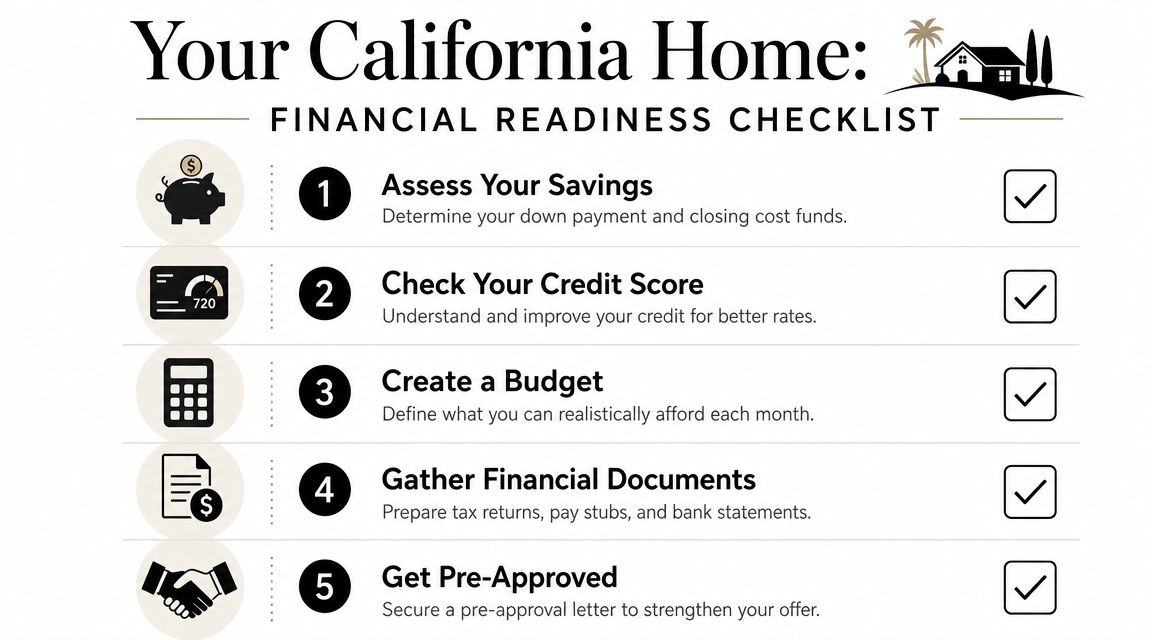
Start with the payment, not the price
A lot of first-time buyers ask, “How much house can I buy?” The better question is, “What monthly payment still leaves room for real life?”
If you're a teacher paying for commuting costs, a firefighter working long shifts, or a law enforcement officer supporting a family, your budget has to reflect your actual routine. Your mortgage payment is only one part of homeownership. Insurance, taxes, utilities, maintenance, and day-to-day life all compete for the same paycheck.
Use this three-part approach:
- Set a monthly comfort number. Pick a payment that works on an ordinary month, not your best month.
- List every recurring debt. Car loans, credit cards, student loans, and support obligations all matter.
- Protect your reserves. If buying drains every dollar you have, the house owns you.
Practical rule: If the monthly payment only works when everything goes perfectly, it doesn't work.
Review your credit before a lender does
You don't need perfect credit to buy a home. You do need clean, current, accurate information.
Pull your credit report, review every account, and look for mistakes. Then focus on the basics that move the needle in the right direction:
- Pay on time: Late payments hurt more than most buyers realize.
- Avoid new debt: Don't finance furniture, a car, or appliances while preparing to buy.
- Lower revolving balances: High credit card utilization can hurt your file even if you make minimum payments.
- Keep old accounts open when appropriate: Length of credit history can help your overall profile.
Small improvements before pre-approval can give you more options. More options mean better decision-making when you're under pressure.
Save in separate buckets
This is where first-time buyers in California get tripped up. They save for the down payment and ignore everything else.
Create separate savings buckets for:
- Down payment
- Closing-related cash
- Emergency reserves after move-in
- Immediate home setup costs
If you're exploring help with upfront funds, review the available down payment assistance options for California homebuyers. Don't treat assistance as a shortcut. Treat it as part of a complete plan.
Buyers who win in California don't just save enough to get in. They save enough to stay comfortable after they get the keys.
Unlocking Your Mortgage and HERO Loan Benefits
Pre-approval isn't paperwork theater. It's the point where homeownership shifts from wishful thinking to a real buying strategy.
In California, sellers and listing agents want to know whether you can close. A serious pre-approval tells them you've already had your income, assets, and debts reviewed. That matters even more if you're buying in a neighborhood where good homes move quickly.
Pre-approval is your starting line
Don't go house-hunting with a vague online estimate. Get fully reviewed by a loan advisor who knows how to structure a file for a first-time buyer and who understands public service income patterns.
That means you should be ready to provide:
- Income documents
- Asset statements
- Employment information
- Identification and residency documentation
- Explanations for anything unusual in the file
A weak pre-approval wastes time. A strong one gives you a price range, likely loan paths, and a cleaner game plan before you fall in love with a house.
Choose the right loan instead of chasing the lowest down payment
Most first-time buyers hear three loan names over and over: Conventional, FHA, and VA. The right choice depends on your credit profile, available cash, eligibility, and long-term plan.
| Feature | Conventional Loan | FHA Loan | VA Loan (For Veterans) |
|---|---|---|---|
| Who it fits | Buyers with solid credit and stable finances | Buyers who need more flexible qualification | Eligible veterans and qualified military borrowers |
| Down payment approach | Can allow a lower minimum down payment depending on qualification | Often used by buyers who want a more flexible path | Built for eligible borrowers using VA benefits |
| Mortgage insurance or funding structure | Depends on loan structure and borrower profile | Includes FHA-specific insurance structure | Uses VA program rules instead of standard mortgage insurance |
| Property and condition expectations | Common fit for many standard purchases | More sensitive to certain property issues | Depends on VA guidelines and appraisal standards |
| Best use case | Buyers who want a strong conventional financing path | Buyers rebuilding or strengthening a file | Veterans who want to use earned home loan benefits |
Here's my blunt advice. Don't pick a loan because someone on the internet said it was the “best first-time buyer loan.” Pick the loan that gives you the right mix of approval strength, monthly affordability, and cash preservation.
HERO buyers should look at assistance early
Public service professionals often qualify for programs that reduce upfront strain. That can include assistance with down payment needs, buyer support, lender credits, and guidance tied to occupation-based eligibility.
California Loans for Heroes offers programs for eligible California HERO homebuyers that can help qualifying buyers review assistance options, loan choices, and pre-approval pathways. That's useful if you're trying to connect your profession to available homebuying benefits instead of piecing everything together on your own.
The mistake is waiting until the end to ask about this. Assistance and loan strategy should be discussed before you shop, not after you're in escrow.
Know what “buy now or wait” really means
A lot of first-time buyers ask me whether they should buy now or wait. That's the wrong frame.
Recent market commentary highlighted by Homes.com notes that the National Association of Realtors' 2025 housing outlook projected existing-home sales improving only modestly, while mortgage rates remain a major affordability constraint and inventory recovery is uneven across major U.S. markets. Read that discussion in this buyer guide covering the buy now versus wait question. The takeaway isn't that timing is impossible. It's that you should buy when your budget, reserves, and loan setup are ready for real-world pressure.
The right time to buy is when you can handle the payment, compete without panic, and still keep savings after closing.
Assembling Your Team and Starting the Hunt
The wrong real estate agent can cost you a house. Or worse, push you into the wrong one.
If you're a police officer on rotating shifts, a firefighter with unusual availability, or a teacher buying around the school calendar, you need an agent who understands your schedule and your financing. A generalist agent might be perfectly nice and still be the wrong fit.

Hire for local judgment, not personality
You're not hiring an agent to open doors. You're hiring someone to protect your time and sharpen your offers.
Ask direct questions:
- Have you worked with first-time public service buyers before?
- Do you understand how assistance programs affect timelines and paperwork?
- How do you handle fast-moving listings?
- What neighborhoods fit my commute and payment target?
- How do you advise buyers on seller credits, repairs, and contingency strategy?
If the answers are vague, move on.
Build a search that reflects real life
First-time buyers waste energy by searching too wide. That creates confusion and bad decisions.
Use three lists:
Must-haves
These are essential. Think commute range, bedroom count, parking, or school considerations.
Nice-to-haves
These are upgrades, not requirements. A bigger yard, updated kitchen, or extra flex room might be great, but they shouldn't derail the search.
Hard no items
Busy road, unsafe area, impossible commute, major deferred maintenance, or HOA restrictions that don't fit your lifestyle.
The buyers who stay disciplined during the search usually make better offers because they know exactly what matters.
Treat open houses like field work
Don't walk through a property and focus only on paint colors and staging. Pay attention to layout, condition, noise, natural light, storage, parking, and any signs that repairs are being covered up rather than addressed.
If you're serious about the steps to buying first home, every showing needs a quick written review right after you leave. Pros, cons, concerns. Do that every time. Homes start blending together fast, especially when you're touring after long workdays.
Making an Offer and Navigating Contingencies
Emotional decisions often prove costly.
A lot of first-time buyers think the goal is simple. Find a home, offer a number, hope the seller says yes. In reality, the offer is a negotiation package. Price matters, but so do timing, contingencies, credits, and your ability to stay protected if something goes sideways.
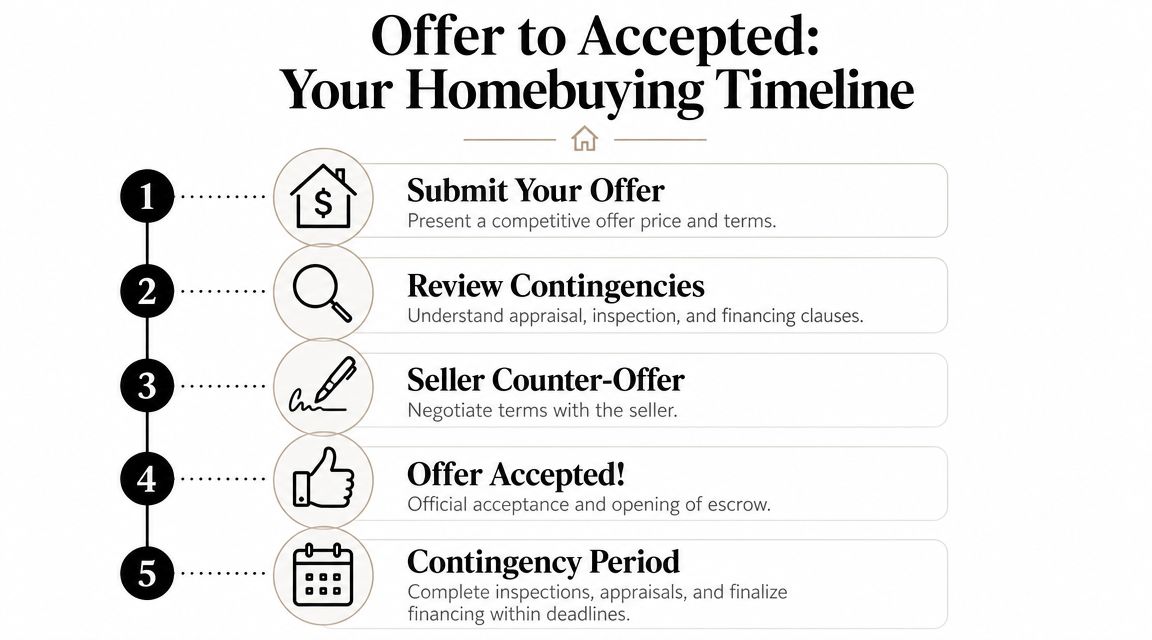
A strong offer is more than price
A clean offer usually includes the proposed purchase price, deposit terms, closing timeline, requested credits if any, and the contingencies that protect you during escrow.
Your agent should help you shape an offer that is competitive without being reckless. That means knowing when to be aggressive on price and when to push on terms instead. Sometimes a better closing timeline matters more to the seller than a small bump in price. Sometimes it doesn't. That's why local market knowledge matters.
Keep the three core contingencies unless you can truly absorb the risk
First-time buyers hear bad advice in competitive markets. “Waive everything.” “Show confidence.” “You can't win unless you strip protections.” That advice is often coming from people who won't pay your bills if the deal goes bad.
The big three are worth keeping whenever possible:
- Inspection contingency: This gives you a path to evaluate the home's condition and negotiate repairs, credits, or a clean exit if major issues appear.
- Appraisal contingency: This protects you if the property value comes in lower than the contract price and the financing no longer fits cleanly.
- Financing contingency: This gives you room if loan approval hits an issue that wasn't obvious at the start.
If you waive these without the cash, experience, and risk tolerance to handle the fallout, you're not being competitive. You're gambling.
Buyer protection: Contingencies aren't signs of weakness. They're the legal tools that keep a first purchase from becoming a financial mess.
Expect the process to take time
Consumer guidance summarized by SD Housing notes that accepted offers can take 45+ days to reach closing, based on First Bank guidance, which is exactly why buyers need to preserve contingencies and cash buffers instead of draining savings on the down payment alone. See that discussion in SD Housing's article on common first-time buyer mistakes.
That timeline matters. It means a lot can happen between acceptance and closing. Appraisals can come in late. Inspections can uncover problems. Underwriting can request more documentation. Insurance shopping can take longer than expected.
Negotiate with discipline
When the seller counters, don't react like every term is life or death. Some issues matter. Some don't.
A disciplined response usually looks like this:
- Reconfirm your ceiling. Know the highest price and monthly payment you'll accept.
- Separate emotional wants from financial risk. Don't overpay because you're tired of searching.
- Ask what problem you're solving. Are you trying to win the house, reduce cash to close, or preserve protections?
- Keep your lender informed. Loan structure and offer strategy should work together, not compete with each other.
The offer stage is where a lot of buyers confuse urgency with wisdom. Stay calm. Strong buyers aren't the ones who move fastest. They're the ones who know where not to bend.
The Final Stretch to Closing and Getting Your Keys
Most first-time buyers obsess over the down payment and then get blindsided by cash-to-close. That's backwards.
The down payment gets the attention. Closing costs often come as a shock, especially in California where buyers are already stretching to make the purchase work. If you don't plan for them early, the last stretch of escrow gets ugly fast.
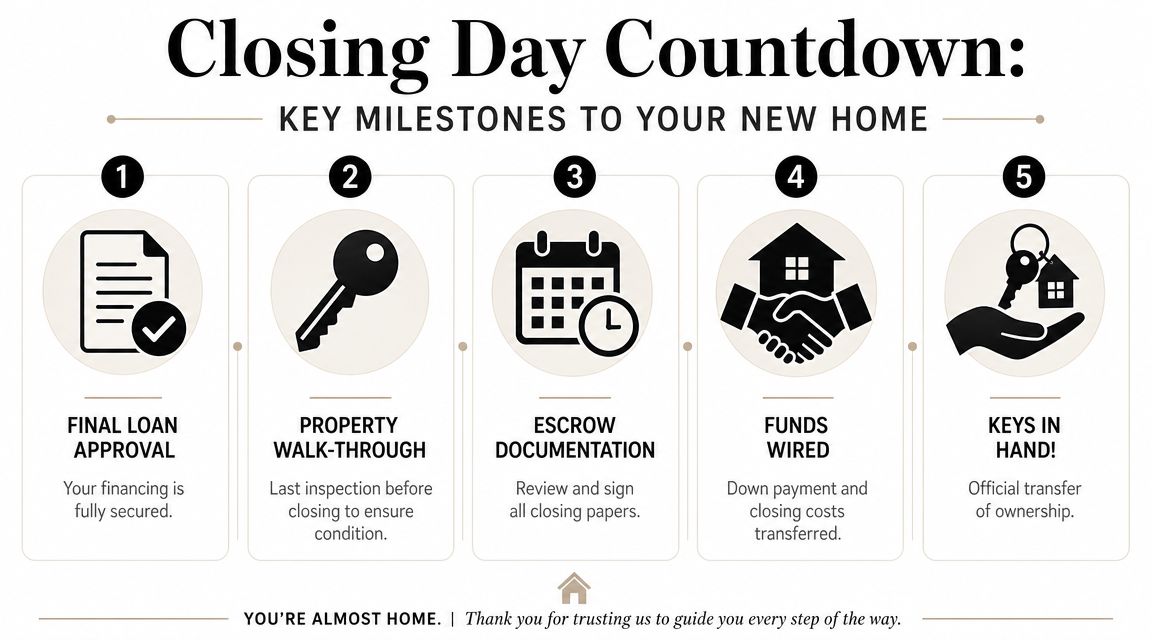
Closing costs are not a side note
One major wealth-management guide says closing costs can run about 2 to 5% of the home's purchase price, on top of the down payment. For a buyer purchasing a $500,000 home, that would mean needing roughly $10,000 to $25,000 for closing costs alone. Review that estimate in Baird's guide to buying a house in eight steps.
That's why I push buyers to stop saying, “I have my down payment saved.” That sentence means very little unless you also know your likely total cash needed to close.
What happens during escrow
Escrow is the final operational phase of the purchase. A lot is happening at once, and delays are common if you go quiet or move slowly.
Expect these milestones:
- Appraisal gets completed: The lender verifies value for the transaction.
- Underwriting reviews the file: You may be asked for updated documents or explanations.
- Title work is handled: The title company checks ownership history and legal issues tied to the property.
- Insurance gets finalized: Homeowners insurance must usually be in place before closing.
- Closing disclosure is reviewed: Your final figures now become very real.
Read every page. Ask questions. Buyers get in trouble when they assume the numbers will sort themselves out.
Focus on liquidity, not just approval
Approval is not the finish line. You need funds available when the transaction asks for them.
That means you should know:
- What funds are needed before signing
- What amount must be wired
- Whether any credits are already reflected
- What your remaining reserves look like after closing
HUD guidance for homebuyers also separates the down payment from other costs and emphasizes shopping for homeowners insurance and reading closing paperwork carefully. If you're eligible for occupation-based or veteran-related help, it's worth reviewing options such as closing cost assistance resources for veterans in California.
Don't walk into signing day hoping the numbers are manageable. Know them early, review them carefully, and keep enough cash left over for life after move-in.
Beyond the Purchase Your First Year as a Homeowner
The keys feel great on day one. Then real life starts on day two.
In the first week, you'll handle utilities, mailing address changes, internet setup, and all the little tasks nobody talks about when they post “just bought our first home.” If you moved while balancing shift work or a school schedule, get organized fast. Put every new bill, account login, warranty, and service contact in one place.
By the first month, the house starts talking to you. Maybe it's a small leak under a sink, a garage door that sounds rough, or a fence that needs attention sooner than expected. Don't panic and don't ignore it. Make a running homeowner list with three categories: urgent, soon, later.
California buyers also need to stay alert to property-tax paperwork and any notices that arrive after closing. A lot of first-time owners assume the mortgage payment handles every tax issue automatically. That assumption can get expensive. Open every mailer tied to the property and ask questions early if something doesn't look familiar.
A simple first-year routine works well:
- Monthly check: Review bills, set aside maintenance money, and inspect for small problems.
- Seasonal check: Look at drainage, exterior wear, filters, safety devices, and anything exposed to weather.
- Annual review: Revisit insurance, loan documents, and your broader budget.
Owning your first home isn't about doing everything immediately. It's about staying steady, fixing problems while they're still small, and learning the rhythm of the property.
California homeownership is still achievable for public service professionals who prepare the right way. If you want help understanding loan options, buyer assistance, and the path forward, talk with California Loans for Heroes and get clarity before you start guessing.