Maya had been renting in Sacramento long enough to know that buying a home wouldn't be simple. Then a CalHFA flyer arrived in her mailbox, and one question stood out: was the required homebuyer education course just another hoop before closing, or could it help her avoid an expensive mistake?
That question matters across California. A certificate may be required for a CalHFA loan or another assistance program, but completing a course doesn't guarantee approval, funding, or a comfortable payment. The useful way to view it is as preparation for decisions about credit, financing, contracts, ownership costs, and the paperwork your lender must accept.
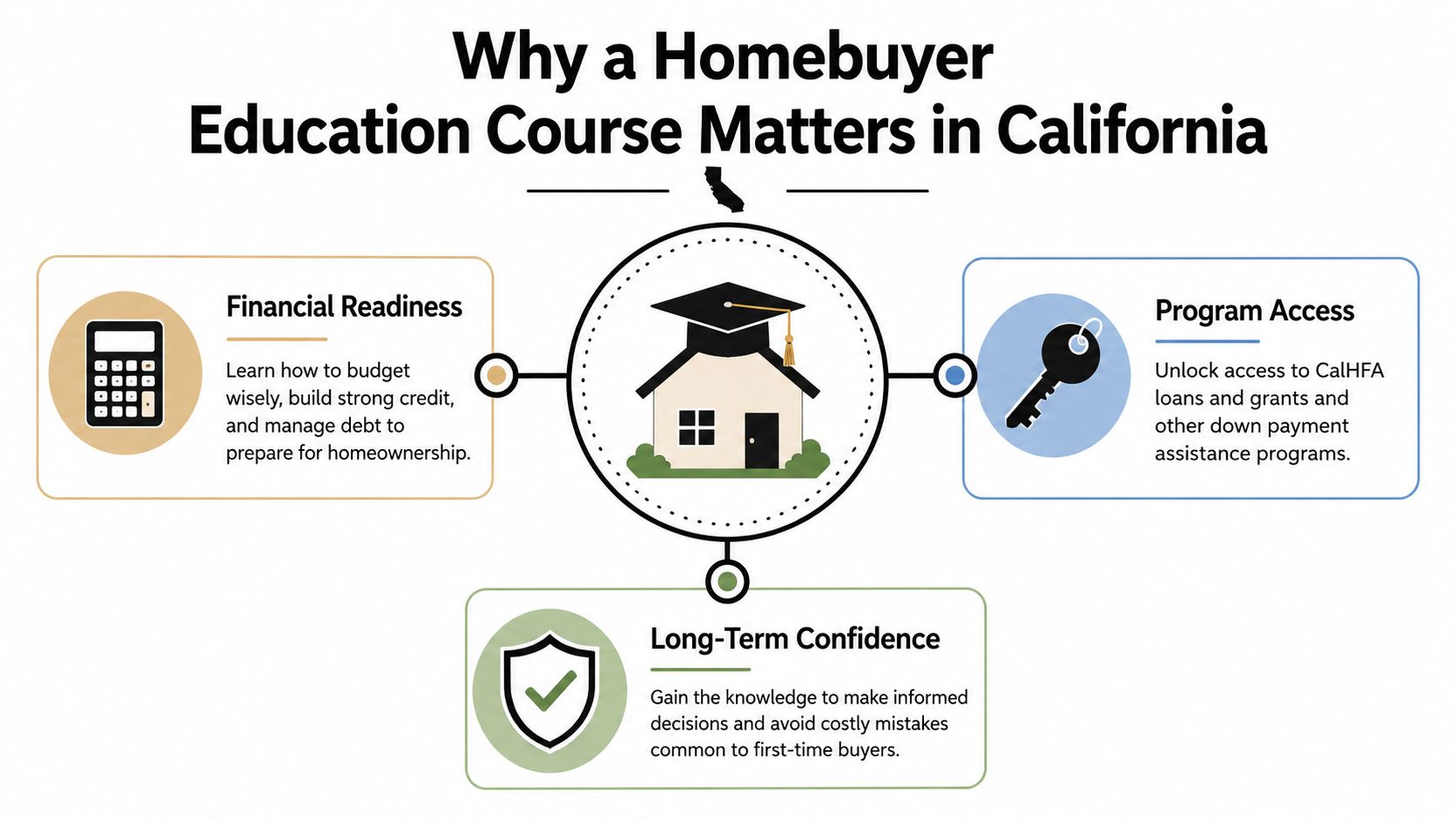
Why a Homebuyer Education Course Matters in California
At a kitchen table, a buyer may see a certificate as one more item before closing. In California, it can also serve as a checklist for decisions that affect the loan, the property, and the budget after move-in.
CalHFA programs connect education requirements to eligibility. CalHFA states that first-time homebuyers using a CalHFA program must complete homebuyer education and counseling, with only one occupying first-time borrower on each loan transaction required to complete it (CalHHA's borrower requirements). Local down payment assistance programs may set different rules, so acceptance in one city or county does not automatically carry over to another.
View the course as preparation for decisions about credit, financing, contracts, ownership costs, and the paperwork your lender must accept. You can review income, recurring debts, credit history, savings, and expected expenses before choosing a lender or making an offer. That timing matters. It is easier to correct a budget assumption before you are under contract.
The mortgage payment is only one part of ownership. A course may prompt questions about property taxes, supplemental tax bills, HOA dues, special assessments, Mello-Roos charges, escrow items, maintenance, and earthquake insurance premiums. Costs vary by property and location. A counselor cannot replace your lender, insurance professional, tax adviser, or real estate agent, but can help you identify which questions each professional should answer.
Practical rule: Treat the certificate as both a program document and a decision-making tool. It proves completion, while the lessons can help you spot problems before they become closing problems.
The realistic payoff is more limited than a promise of homeownership. HUD's randomized demonstration found small improvements in mortgage literacy, lender contact behavior, and credit positioning, but no overall increase in home purchases. Longer-term findings showed selective benefits for some groups, not a universal improvement for every participant (HUD's first-time homebuyer study).
What the Course Actually Covers
A strong course connects general housing education to choices you'll make in California. California regulations for HOME-funded mortgage assistance require education covering preparing for homeownership, financing and credit analysis, loan closing and borrower responsibilities, maintenance and budgeting, and the long-term impact of refinancing (California's homebuyer education regulation).
A typical course usually includes about 8 hours of instruction, delivered through a group workshop or online format, according to HUD's baseline report (HUD's homebuyer education baseline findings). The exact curriculum and delivery rules still depend on the provider and loan program.
| Module | Topic | California Decision It Informs |
|---|---|---|
| Financial preparation | Budgeting and affordability | Whether the full monthly cost fits your income, not just the advertised mortgage payment |
| Credit and financing | Credit analysis and loan options | Which questions to raise about credit history, debt, and available mortgage paths |
| Down payment and closing | Savings, settlement charges, and borrower funds | How to distinguish the down payment from closing costs and prepaid items |
| Homeownership responsibilities | Taxes, insurance, repairs, and ongoing obligations | Whether a property remains affordable after closing |
| Home search | Selecting a suitable property | How location, property type, HOA rules, and assistance eligibility affect the search |
| Purchase and closing | Contracts, inspections, disclosures, and settlement | What to review before signing and what documents your lender needs |
| Financial protection | Reserves, payment planning, and risk management | How to prepare for repairs, emergencies, and payment changes |
| Long-term ownership | Maintenance and refinancing decisions | Whether a future refinance supports or harms long-term financial health |
The course won't decide whether an FHA, conventional, VA, USDA, or CalHFA option is right for you. It should help you compare those paths without assuming the lowest upfront cost is the lowest total cost.
The practical lesson is simple: education works best when you use each topic to make a decision. If the budget exercise shows that a proposed payment leaves no room for repairs, that's useful information before you submit an offer.
Finding an Approved California Course
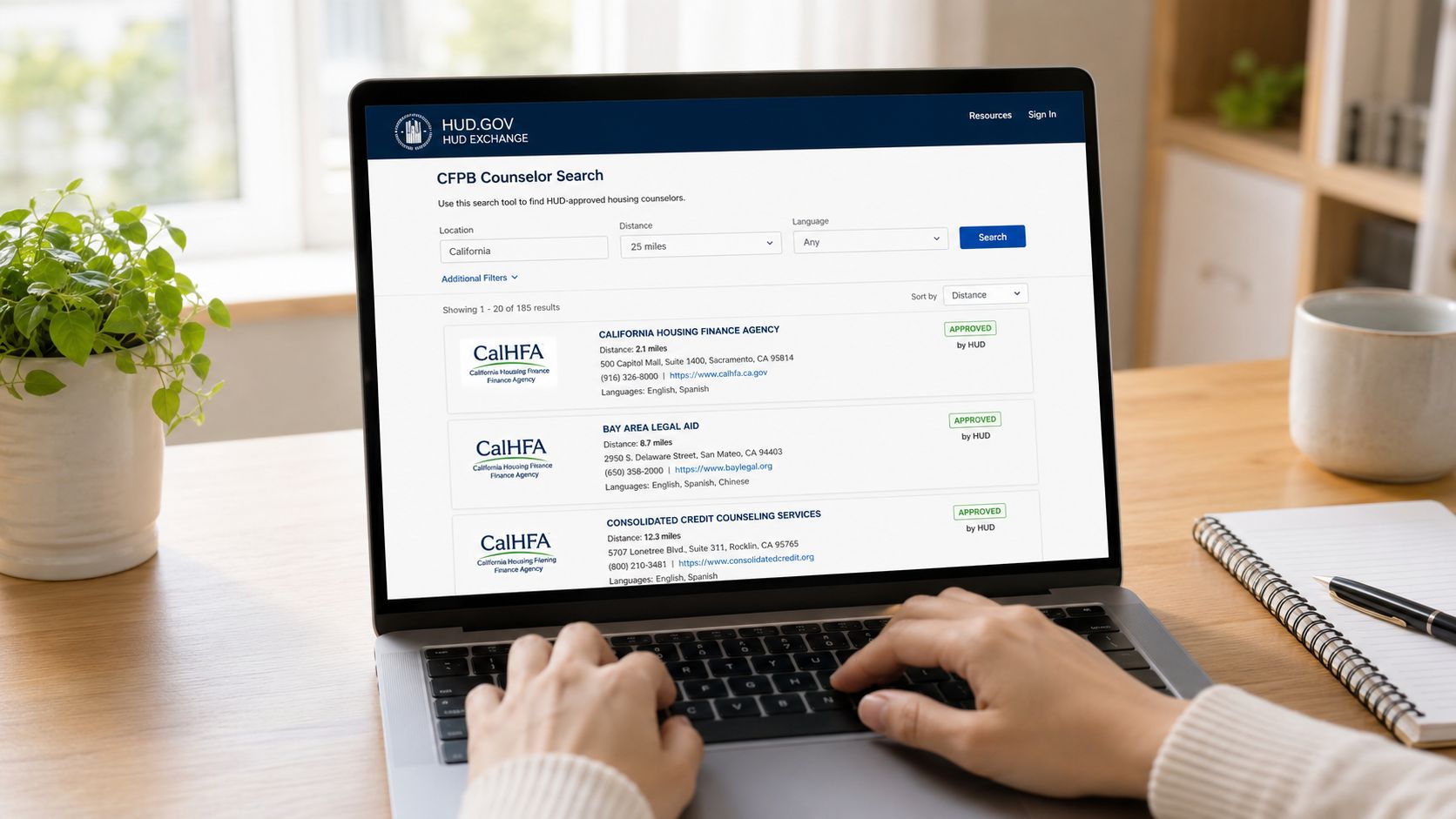
Start with the approval question, not the course advertisement. Use the HUD housing counselor search tool to locate counseling agencies, then check whether the provider appears on the appropriate CalHFA participating approved education and counseling list for your loan product.
A pre-purchase education course generally teaches the group curriculum and produces a completion certificate. Counseling can be more individualized, with a counselor reviewing your circumstances, budget, or readiness. Some programs accept one format, while others require a particular combination of education and counseling.
Confirm the certificate before enrolling
Your lender should tell you which provider and format are acceptable. Ask these questions before paying or starting:
- Provider approval: Is the agency HUD-approved and eligible for the specific CalHFA or local assistance program?
- Delivery format: Does the loan require a live classroom, live virtual session, one-on-one counseling, or an approved online course?
- Certificate details: Will the document show your legal name, completion date, provider information, and any required approval or certificate number?
- Lender delivery: Will the provider transmit completion through an approved portal, or must you send the certificate yourself?
- Timing: How long will the lender and assistance program treat the certificate as current?
Don't rely on a search result alone. A HUD-approved agency may offer several services, and not every class it lists will necessarily satisfy every loan path. Give the lender the course description and provider details before enrollment.
You may also hear claims that one format is always better. HUD's longer-term findings found no detectable difference between in-person and remote services, which makes curriculum quality, timing, access, and borrower fit more important than choosing a channel based on assumptions (HUD's long-term impact report).
Enrolling and Completing the Course
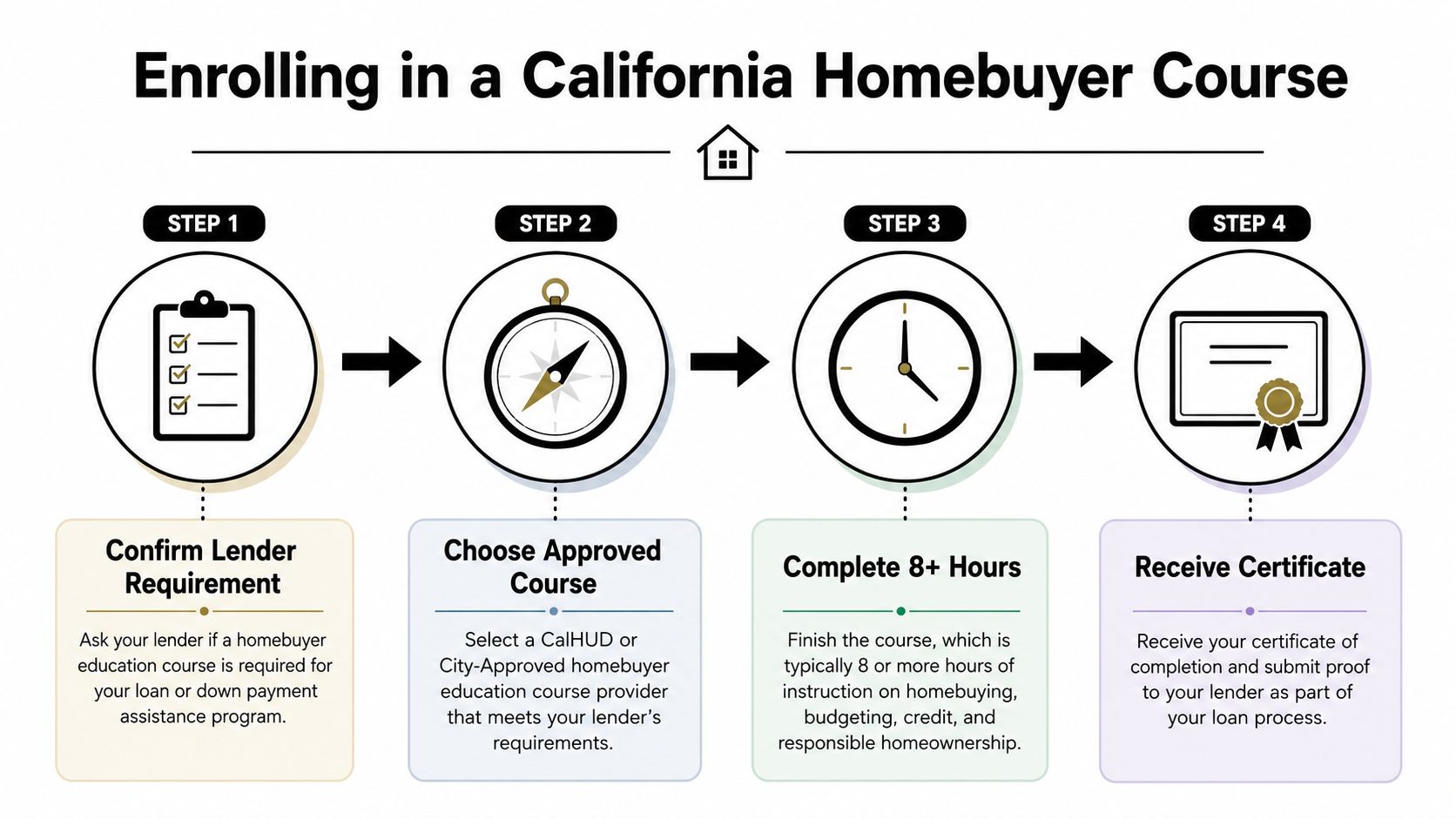
A buyer planning to purchase should begin early, often 6 to 18 months before the intended purchase, because education is more useful before lender deadlines, contract negotiations, and underwriting pressure. That timing is a planning benchmark, not a universal expiration rule. CalHFA, a city program, or a lender may impose a different deadline.
Start with a short conversation with the loan officer. Ask for the approved provider list, acceptable format, expected course length, certificate delivery method, and whether one or all borrowers must complete the program. CalHFA's rule is specific for its first-time borrower requirement, but another program may apply a different standard.
A practical enrollment sequence looks like this:
- Confirm the loan path. Identify whether you're pursuing CalHFA, a local grant, FHA, conventional financing, or another option.
- Choose the provider. Verify approval before paying for a class.
- Prepare your information. Have identification and basic income, debt, housing, and household information available.
- Complete every requirement. Attend required sessions, finish assessments, and answer documentation requests.
- Review the certificate. Check your legal name, course date, provider details, completion status, and any identifying number.
- Send and confirm. Deliver the official certificate to the lender, then ask the loan officer to confirm receipt and acceptance.
If you're applying with a spouse or another borrower, ask whether the program requires both people to participate. Don't assume that one certificate covers everyone, even if one occupying first-time borrower may satisfy a CalHFA requirement.
Online education can be convenient, but a self-paced course may not satisfy a live-instructor requirement. Before you take a final quiz or request a certificate, confirm that the format matches the loan. The steps to buying your first home can help you place the course within the larger purchase timeline.
Keep a digital copy and a separate backup. If a local assistance application needs proof, you may need to submit the same official document to that program as well as to the lender.
Using Your Certificate for Assistance Programs
A certificate documents course completion. It does not provide assistance, approve your mortgage, or reserve program funds. Assistance programs may still review income, credit, occupancy, property location, property type, first-time-buyer status, and available funding.
CalHFA requires education and counseling for first-time homebuyers using a CalHFA program, as described in its official borrower guidance earlier in the article. Local programs in places such as Los Angeles, San Francisco, Alameda, and Riverside may add their own requirements. Treat the certificate like one key in a key ring: it may open the education requirement, while other eligibility rules still determine whether the program can provide assistance. Confirm the rules for the exact product rather than relying on a general statement that a course is “accepted.”
Federal and conventional loan paths can be more conditional. Fannie Mae requires homeownership education in defined situations, including certain manually underwritten purchase transactions when all borrowers lack a credit score, some HomeReady purchase transactions when all occupying borrowers are first-time homebuyers, and certain high-loan-to-value purchase transactions involving first-time buyers. The lender must retain the completion certificate in the loan file (Fannie Mae's education and counseling requirements).
| Program or loan path | Typical education rule | Buyer action |
|---|---|---|
| CalHFA | Required for first-time homebuyers using a CalHFA program | Ask which approved provider and format satisfy the selected CalHFA product |
| Local assistance | May require pre-purchase education or counseling | Request the program's current certificate and eligibility rules in writing |
| FHA | Education requirements can apply in defined risk or borrower circumstances | Ask the lender whether your FHA file triggers an education or counseling rule |
| Fannie Mae HomeReady | Education can be required for specified first-time-buyer and underwriting situations | Confirm whether the lender-approved course meets the exact selling-guide condition |
| Other conventional financing | Requirements depend on the transaction and underwriting profile | Have the lender review the provider before enrollment |
Fannie Mae may permit lender-approved education and may offer a pricing benefit in certain circumstances, but the lender must confirm whether your transaction qualifies. For a broader explanation of California assistance options, review this guide to down payment assistance in California.
Before paying for a course, send the provider name or certificate information to the lender. Ask whether the certificate must be current at closing, whether both applicants must complete it, and whether the same certificate can be reused for another program. A quick confirmation can prevent a completed course from becoming a document problem later.
What the Course Realistically Changes
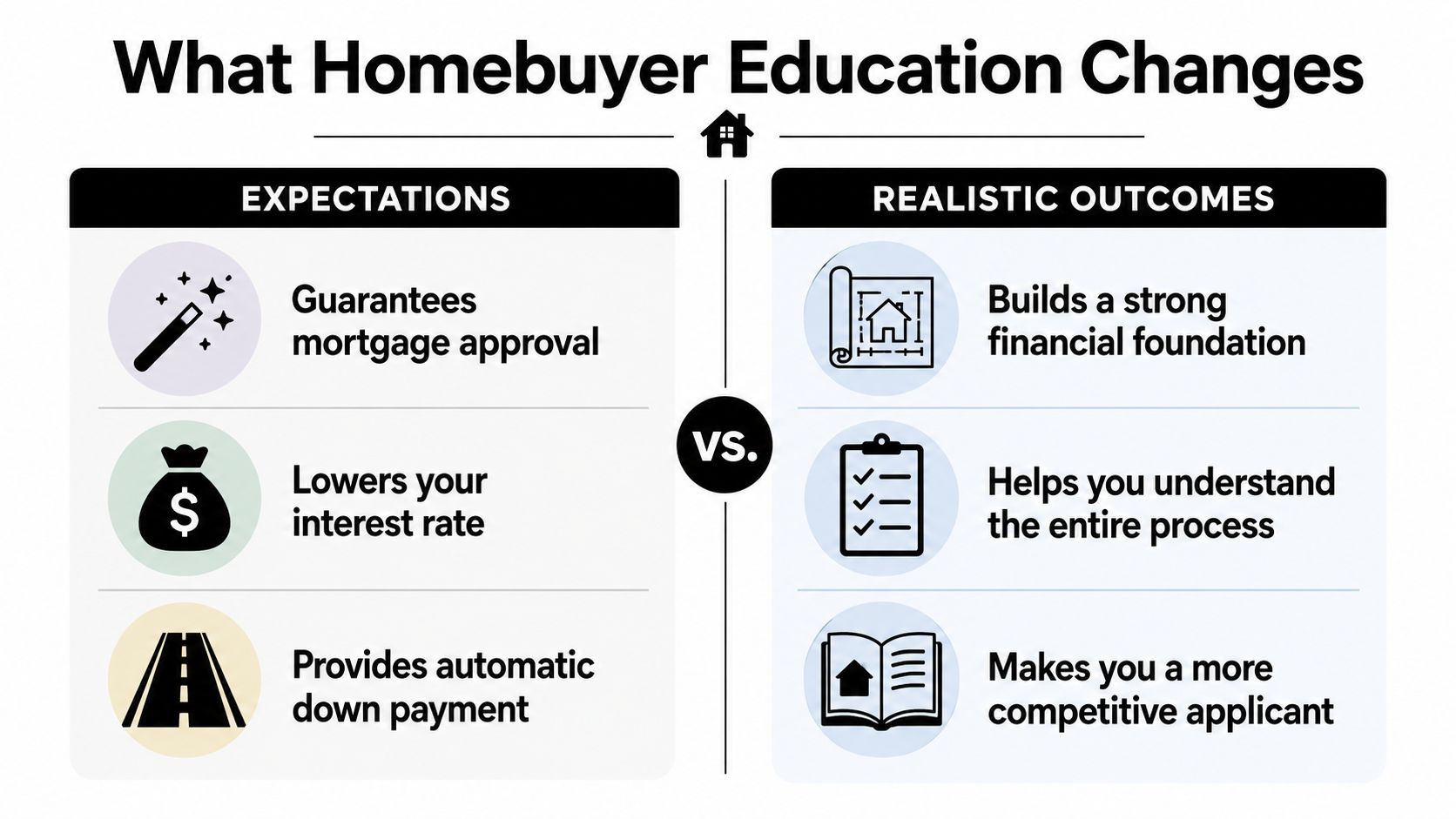
A homebuyer education course can improve preparation, but it doesn't guarantee approval or a lower interest rate. It also doesn't automatically create down payment assistance. The course's most dependable benefit is that it gives you a structured way to test the purchase before the lender tests your application.
HUD's randomized demonstration found a 2.8% improvement on a mortgage-literacy quiz, a 10.4% increase in the likelihood that participants contacted a lender before missing a payment, and a 2.7% increase in the likelihood of having a credit score at or above 620 (HUD's research summary). The same demonstration found no overall change in home-purchase rates, which remained 62% for both treatment and control groups in the study.
Those findings describe measured group effects, not a promise for one buyer. The study also found that budgeting behavior didn't improve, so completing a class doesn't mean your budget automatically becomes workable. You still need to make the trade-off between purchase price, monthly payment, reserves, debt, taxes, insurance, and maintenance.
Historical evidence does show stronger mortgage performance in some programs and markets. Freddie Mac's review of 40,000 Affordable Gold Loans participants reported that classroom counseling reduced serious delinquency by 26%, home-study counseling by 21%, and individual counseling by 34%; HUD's evidence summary also reported lower delinquency or default outcomes among some counseling participants (HUD's evidence summary). These results shouldn't be presented as a guaranteed savings rate for your loan.
The useful payoff comes before the signature
The course may reveal that your purchase is premature, that a property type doesn't fit an assistance program, that a debt needs attention, or that funding isn't available. That can feel disappointing, but learning it before signing is better than discovering it during underwriting or just before closing.
HUD's long-term findings showed no overall impact on average credit scores or 60-day delinquency rates, while identifying selective benefits for younger adults and women, along with greater confidence in finding homebuying information and some improved financial measures. The reasonable conclusion is balanced: education can support better decisions and early action, but it isn't a substitute for underwriting, savings, stable income, or sound property selection.
Common Mistakes and a Quick Readiness Checklist
Most course problems aren't caused by difficult material. They happen because the buyer treats the certificate as an afterthought.
- Enrolling too late: Waiting until you're under contract can leave little time to correct a format or approval problem and may delay closing.
- Choosing the wrong format: An online-only class may not satisfy a lender that requires live education or counseling.
- Ignoring the date: A certificate that no longer meets the lender or assistance program's timing rule may need to be replaced.
- Sending a screenshot: A screenshot may not contain the official certificate information the loan file requires.
- Assuming completion replaces underwriting: Education doesn't remove income, credit, debt, property, or appraisal review.
- Skipping the lender confirmation: A provider's statement that its course is “approved” doesn't guarantee acceptance for your exact loan.
A checklist for this week
- Ask the loan officer: Confirm the program, provider, format, course length, and certificate requirements.
- Verify approval: Search the HUD counselor directory and compare the provider with the relevant CalHFA or local program list.
- Choose timing: Schedule the course early in your purchase plan, using the 6-to-18-month window as a planning guide rather than assuming every program uses the same validity period.
- Ask about cost: Confirm the provider's current fee before enrollment. Don't rely on an unverified fee estimate.
- Protect the document: Save the official digital certificate and any mailed copy in a location your loan officer can access.
- Confirm receipt: Get written confirmation that the lender accepted the certificate before you move toward closing.
For a broader document and planning reference, use this checklist for the home-buying process. A few minutes of verification can prevent a certificate dispute from becoming a last-minute escrow problem.
California Loans for Heroes helps veterans, active-duty military members, first responders, healthcare professionals, teachers, pilots, and other public service employees review homebuyer education, mortgage, and assistance options across the state. Visit California Loans for Heroes to connect with a team that can help you confirm course requirements, compare eligible programs, and move toward homeownership with clearer paperwork and one-on-one guidance.