
You've found a California home, submitted an offer, and started thinking about moving day. Then your lender asks for updated pay stubs, explanations for deposits, employment records, and a credit check that seems to open new questions every time you answer one. For many veterans, first responders, teachers, and healthcare workers, the mortgage loan approval process feels less like a single decision and more like a long series of document requests.
That feeling is understandable, but approval isn't mysterious. A lender is verifying credit, income, assets, employment, debt obligations, and the property itself. The strongest files make those facts easy to confirm. The files that stall usually contain a gap, inconsistency, or late change that could have been addressed before submission.
Introduction to the Mortgage Approval Journey in California
Consider a California firefighter whose income includes a regular salary, overtime, and shift differentials. On paper, the household income may support the desired payment. During underwriting, however, the lender still has to determine which income is stable, how it should be documented, and whether the employment pattern can reasonably continue. A missing pay stub or unexplained deposit can slow the file even when the borrower is financially sound.
The same issue appears in other HERO professions. A nurse may change facilities, a teacher may receive seasonal or supplemental pay, and a law enforcement officer may have fluctuating overtime. A veteran or active-duty military borrower may have income composed of base pay, allowances, and other documented sources. The lender does not accept a verbal summary. The lender verifies each qualifying component under the selected loan program.
Practical rule: Being ready to shop and being ready to close are different milestones.
Being ready to shop means you have a realistic estimate of buying power and a plan for your down payment and monthly obligations. Being ready to close means the lender has reviewed the relevant documentation, the property satisfies collateral requirements, and every condition has been cleared. A preapproval can help you compete with other buyers, but it isn't the same as final approval.
California's competitive housing environment makes early preparation especially valuable. Sellers and agents generally want confidence that a buyer can perform, while lenders need enough information to assess repayment ability and the property securing the loan. The mortgage loan approval process connects those two needs through a structured review rather than a simple bright-line answer.
Modern underwriting also reflects decades of changing technology and regulation. The FICO score was introduced in 1989, and automated underwriting systems from government-sponsored enterprises became increasingly central during the 1990s, helping lenders evaluate large volumes of applications more consistently. Federal Reserve Bank of St. Louis analysis of mortgage denial determinants describes this broader movement from manual judgment toward data-driven review of credit, income, collateral, and documentation.
This guide focuses on the practical reality. You'll see what lenders verify, where HERO borrower files commonly slow down, how DTI affects the decision, and which actions can clear conditions before they become closing problems.
Prequalification Preapproval and What Lenders Really Verify
Prequalification, preapproval, and conditional approval aren't interchangeable. They answer different questions and require different levels of evidence.
Prequalification is usually an informal estimate based partly or entirely on information you provide. It can help you understand a rough price range, but it may not include a full credit review, verified income calculation, or detailed asset analysis. Treat it as a starting conversation, not a promise that a lender will fund the loan.
Preapproval is more useful when you're preparing to make offers. The lender typically reviews a formal application, credit information, income records, and assets, then issues a letter subject to stated conditions. Sellers often view it more seriously because it reflects actual file review rather than an unverified estimate.
Conditional approval goes further. An underwriter has evaluated the file and issued a decision subject to specific requirements, such as an acceptable appraisal, updated employment verification, proof of funds, or explanations for transactions. Conditional approval means the file has cleared a major decision point, but the loan still isn't ready to fund.
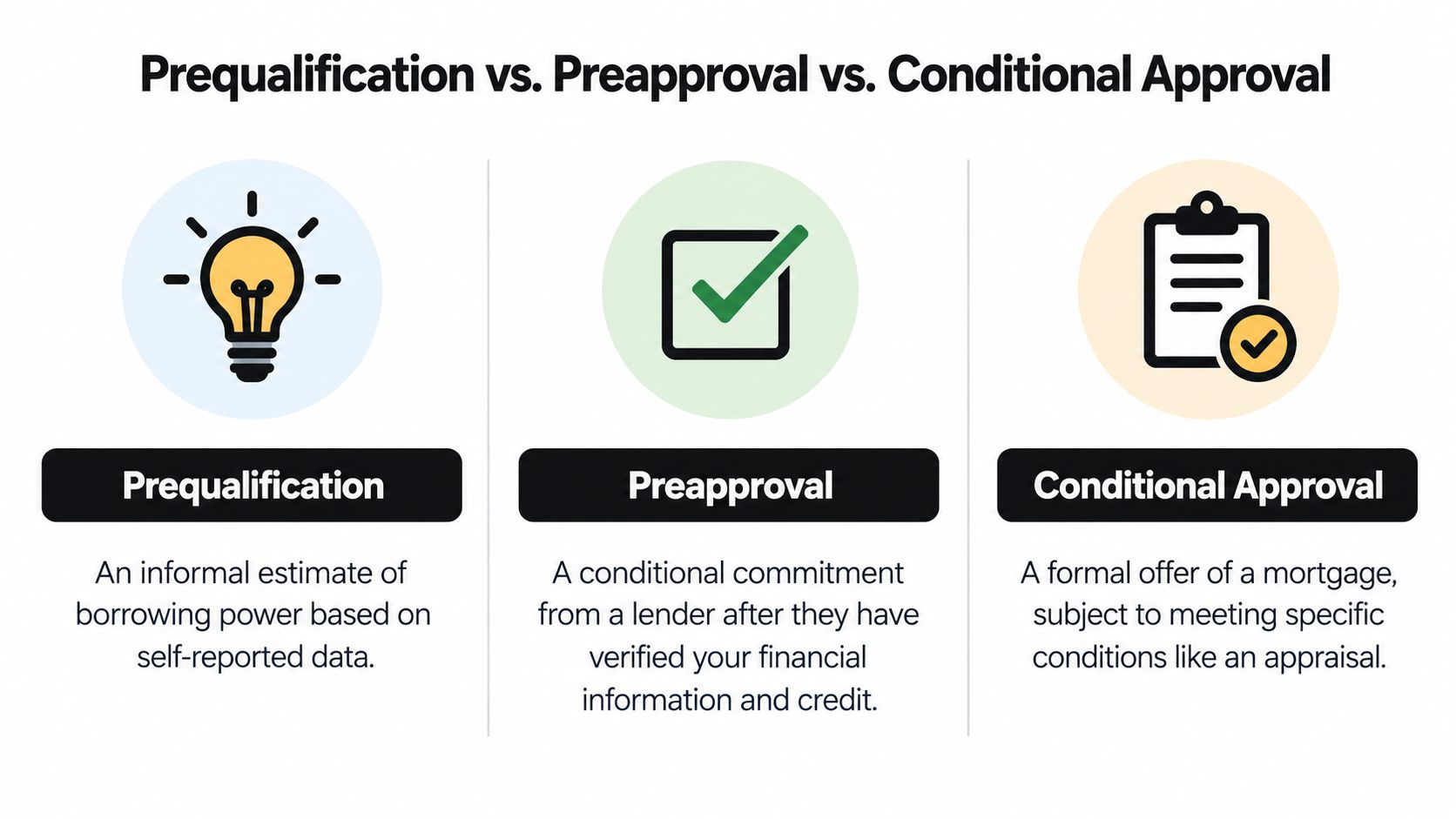
Choosing the right starting point
| Status | What it uses | Best use | What it doesn't prove |
|---|---|---|---|
| Prequalification | Self-reported financial information | Early budgeting | That income, assets, credit, or property will satisfy underwriting |
| Preapproval | Application data, credit review, and supporting documents | Making a credible offer | That the selected property will appraise or that all final conditions are cleared |
| Conditional approval | Underwriter-reviewed file with listed conditions | Moving toward closing | That the loan can fund before every condition is satisfied |
For a meaningful preapproval, gather recent pay stubs, tax records when applicable, employment details, bank statements, identification, and information about current debts. HERO eligibility should be discussed at this stage too, because military service, public service employment, and the selected assistance or reward structure can affect which loan options deserve review.
A two-minute eligibility check can help identify whether a HERO-focused conversation makes sense, but it shouldn't replace a complete review of income, credit, debts, assets, and the property. Buyers who want a practical preparation list can use this home-buying process checklist before speaking with an advisor.
Choose prequalification when you're still exploring. Choose preapproval when you expect to compete for a home. Treat conditional approval as a working loan file that requires prompt, accurate responses.
Inside the Mortgage Approval Workflow from Application to Closing
The mortgage loan approval process begins formally when you submit an application and authorize the lender to obtain and review the required information. You'll receive disclosures and estimates that describe the proposed loan structure, costs, and responsibilities. Review the payment assumptions carefully, especially if the loan has a changing rate or payment structure.
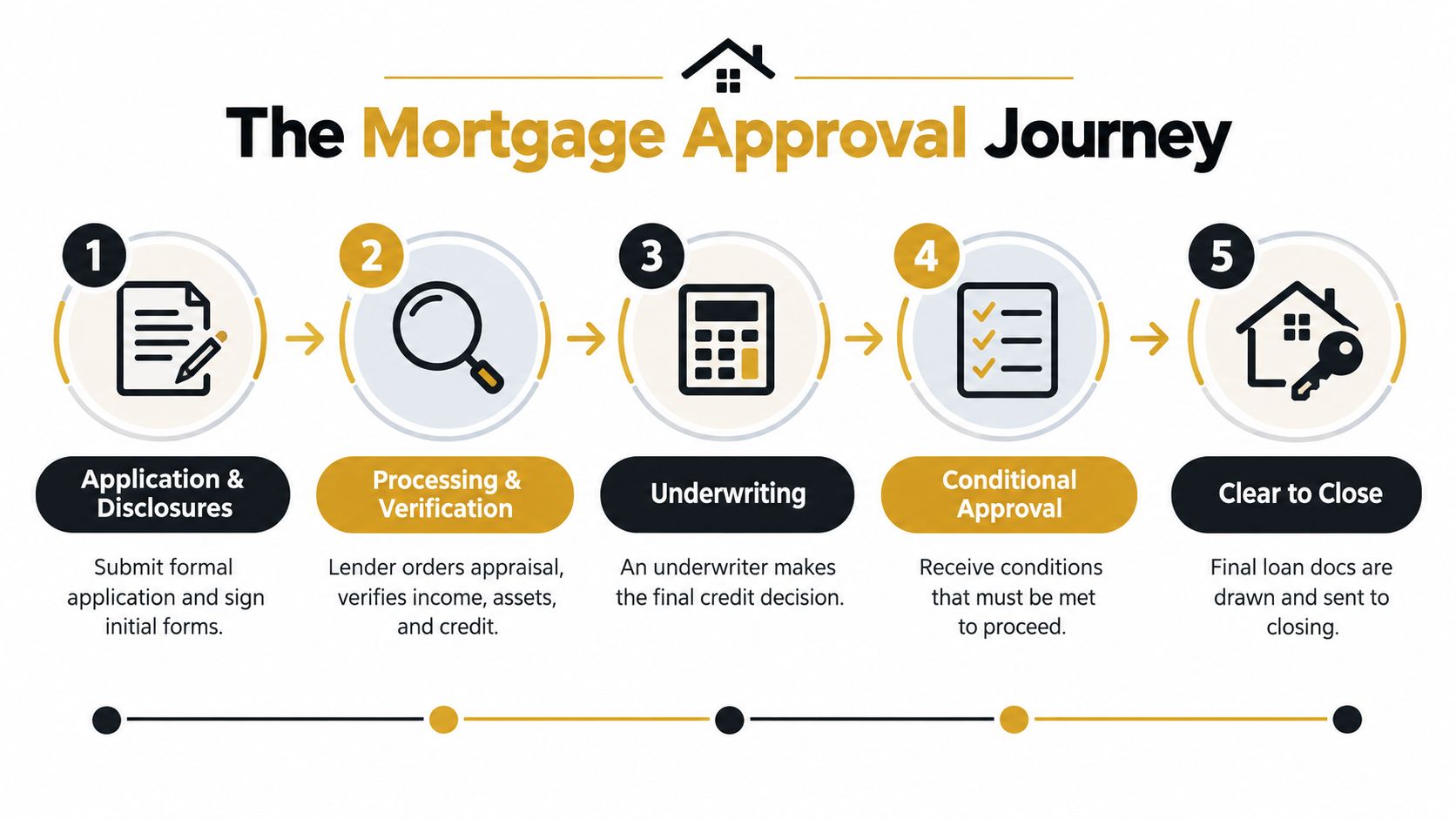
Application and initial disclosures
At application, provide the information exactly as it appears in your records. Employment dates, addresses, debts, marital obligations, and income sources should be consistent across the application and supporting documents. If something is unusual, explain it early rather than waiting for the processor to discover it.
A shift worker can keep the file moving by uploading the complete pay history requested instead of sending only the latest regular paycheck. An educator should identify supplemental compensation and clarify whether it is recurring. A VA borrower should disclose all relevant obligations and provide the documents needed to establish eligibility and income.
Processing and verification
The processor assembles the file and checks whether the submitted information can be verified. This may include employment confirmation, income calculations, bank statement review, credit analysis, title work, and an appraisal order. The lender may request clarifying documents when records don't align.
FHA guidance illustrates how specific this review can be. It requires employment and income documentation, including a written Verification of Employment covering two years or an acceptable electronic verification, along with supporting records such as federal tax returns and recent pay stubs. FHA-related operating guidance shows why stated income alone doesn't carry a file through approval.
Responding quickly matters, but accuracy matters more. Don't upload a document with handwritten changes, cropped pages, or missing account identifiers if the lender needs the complete record. Ask what period and format are required before sending replacements.
Underwriting and property review
The underwriter evaluates repayment ability and the collateral. The review includes credit history, income, assets, current obligations, the proposed mortgage payment, and property value. The appraisal addresses whether the home provides adequate collateral for the loan, while title and insurance work address other closing requirements.
For an educator buying a home in a competitive market, an offer may be accepted before the lender has completed the property review. That doesn't mean the appraisal will support the contract price. If the value comes in lower than expected, the buyer, seller, and lender may need to determine how to address the gap under the contract and loan terms.
Conditional approval and condition clearing
The underwriter may approve the file subject to conditions. Conditions aren't automatically bad news. They identify the remaining items required before the lender can issue a final decision.
Common examples include an updated pay stub, a letter explaining a credit inquiry, proof that a debt was paid, documentation for a large deposit, or evidence of insurance. Send complete responses in one organized package whenever possible. Partial uploads often create another review cycle.
Clear to close and signing
Once the lender verifies that conditions are satisfied, the file can receive clear-to-close status. Final loan documents are prepared and sent to the closing team, and you review and sign the documents required for funding.
Don't change jobs, open new credit, transfer large sums, or make major purchases while waiting to close without discussing the move with your loan advisor. The lender may need to verify that the financial picture used for approval remains accurate through closing.
How Underwriting Decisions Are Made and Why Files Get Delayed
A firefighter may have strong income, clean credit, and an accepted offer, yet the file can still stall over one unexplained deposit or an appraisal issue. Underwriting is a documented risk assessment. Lenders compare the application with program rules, investor requirements, internal overlays, and the evidence in the loan file. Automated underwriting can issue an initial recommendation, but variable income, unusual deposits, recent employment changes, or property concerns may require manual review.
HMDA denial categories include debt-to-income ratio, employment history, credit history, collateral, insufficient cash for down payment or closing costs, unverifiable information, incomplete application, mortgage insurance denied, and other. Lenders may report up to four reasons. Credit history, DTI, and collateral appear frequently in HMDA-based analyses, so those areas deserve review before submission. The FFIEC HMDA guide explains the official denial-reason framework.
The three decision drivers that deserve early attention
Credit history covers payment patterns, outstanding accounts, utilization, disputes, and recent inquiries. The score is only one part of the review. A late payment, undisclosed collection, or dispute that must be removed can generate conditions and delay the decision.
DTI compares monthly debt payments with gross monthly income. The CFPB definition and Qualified Mortgage regulation identifies the historic 43% QM benchmark, while later rule changes removed the fixed General QM ceiling and shifted qualification toward a price-based standard. Lenders still assess DTI or residual income, and program overlays may be stricter.
DTI deserves particular attention for HERO buyers whose income includes overtime, shift differentials, hazard pay, or other variable compensation. A lender may not count every dollar at face value. The St. Louis Fed analysis of mortgage denial thresholds reviewed more than 30 million applications and found denial rates were roughly flat at 8% to 10% for DTI ratios between 20% and 50%, then rose sharply above 50% and exceeded 80% above 60%. Denial rates also increased by 15 to 17 percentage points at the 50% DTI mark. A file near that level should be tested before the borrower commits to a payment.
Collateral is the property-side test. The appraisal must support the lender's security interest, and the home must meet the selected program's requirements. Strong borrower documentation cannot cure inadequate value or unresolved property defects. Appraisal timing can also hold up underwriting, so review California VA appraisal turn times and common underwriting delays early, especially when a contract has a tight closing schedule.
What the underwriter is required to consider
Ability-to-Repay review includes at least eight factors:
- Current or reasonably expected income or assets
- Current employment status
- The mortgage payment
- Simultaneous loans
- Mortgage-related obligations
- Current debt obligations
- Alimony and child support
- DTI or residual income
- Credit history
The CFPB Ability-to-Repay rule requires monthly payment calculations to use the highest payment that applies during the first five years. An adjustable-rate or step-rate loan may therefore qualify using a payment higher than its initial payment.
| Underwriting Finding | What Lender Evaluates | Action to Resolve |
|---|---|---|
| High DTI | Required monthly obligations against qualifying income | Reduce revolving balances, document obligations, or review another loan structure |
| Credit concern | Payment history, utilization, collections, disputes, and inquiries | Pull credit early, correct errors, and avoid new accounts |
| Collateral issue | Appraised value and property eligibility | Review the appraisal, address required repairs, or evaluate contract options |
| Unverifiable income | Employer records, pay history, tax documentation, and consistency | Provide complete verification and explain variable compensation |
| Incomplete application | Missing pages, signatures, disclosures, or requested records | Submit a complete package and confirm receipt |
| Asset question | Account ownership, deposits, reserves, and source of funds | Trace deposits and provide statements showing the paper trail |
A 2024 review of 37.3 million applications found 15.2% were withdrawn before a credit decision, 13.2% of decided applications were denied, and 3.8% of approved borrowers later rejected the loan offer. Approval is therefore not always a simple yes-or-no outcome. Documentation gaps, changing terms, or a borrower decision can stop a file before closing, even after substantial underwriting work is complete.
Proven Ways to Strengthen Your Approval Odds and Avoid Setbacks
Approval preparation works best before you make an offer. The objective isn't to make your finances look different. It's to make the true financial picture easier for the lender to verify and less exposed to avoidable risk.
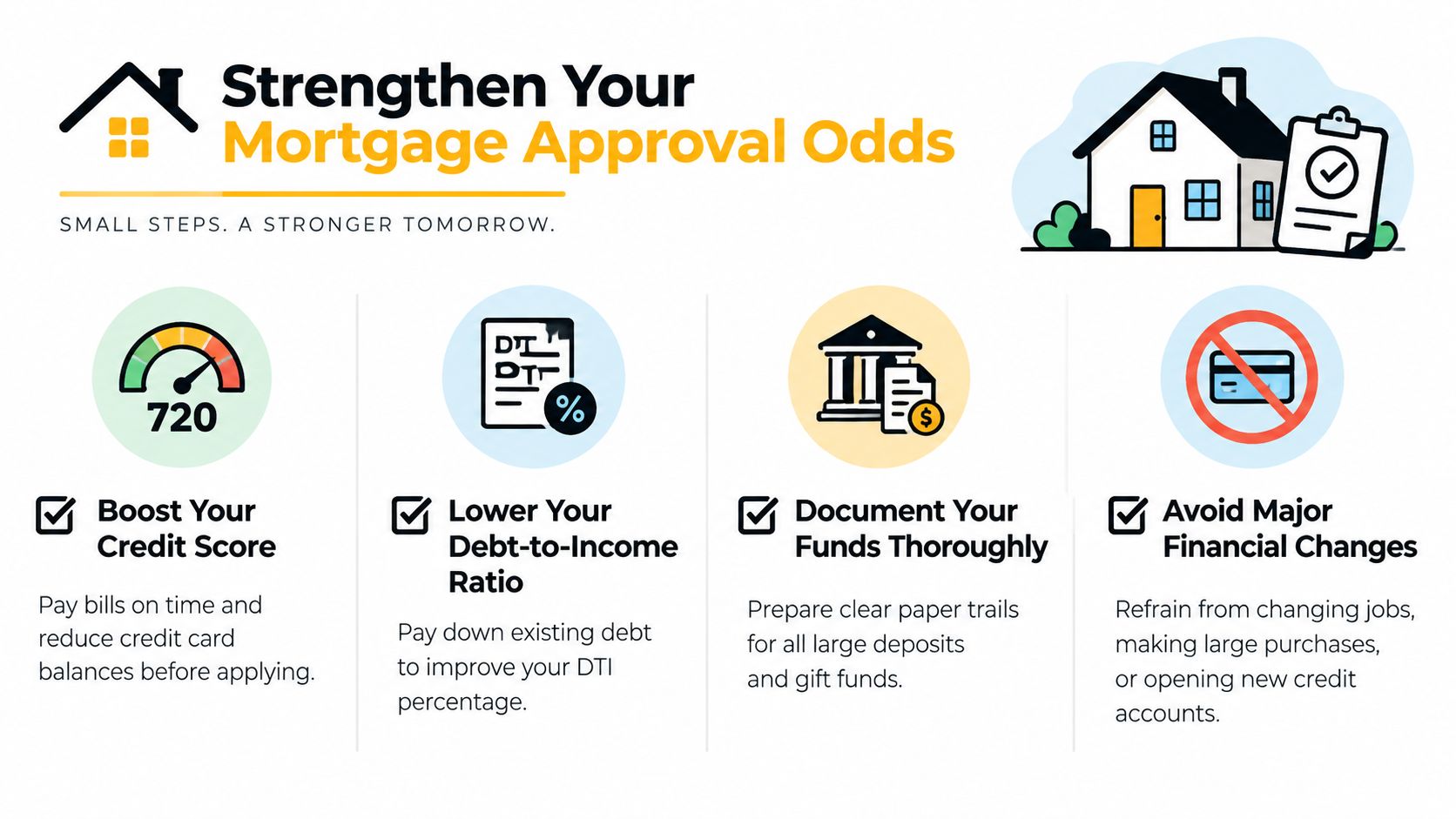
- Lower revolving balances: A nurse carrying balances across several credit cards may improve the file by paying down revolving debt before application. Coordinate the timing with the lender, because the credit report and account statements must reflect the change.
- Trace every deposit: Keep statements and transfer records for funds used toward closing. Gift funds, transfers between accounts, and unusually large deposits need a clear source and acceptable documentation.
- Preserve employment continuity: A firefighter should document the history and pattern of overtime rather than assume every extra shift will count. A teacher changing districts should explain the transition and provide records that establish continuing employment.
- Build a clean income record: Shift differentials, bonuses, and supplemental pay can require careful review. Give the lender the underlying pay documentation instead of relying on a verbal estimate.
- Avoid new financial commitments: Don't finance a vehicle, open a store card, move money between institutions without records, or make a large purchase during underwriting. Even a transaction that seems manageable can change DTI or create a new documentation request.
- Prepare for property questions: Review the offer and appraisal strategy with your advisor. If the appraisal doesn't support the contract price, understand in advance which options may be available under the transaction terms.
A clean paper trail beats a last-minute explanation. Keep statements, payroll records, tax documents, and transfer confirmations together before the lender asks.
The same discipline applies to your credit. Pay accounts on time, avoid closing established accounts without advice, and don't dispute information casually while a mortgage is in process. A dispute can require additional review, particularly if the lender can't determine the account's effect on repayment.
For California buyers comparing affordability strategies, this guide to lowering a mortgage payment in California can help frame the conversation around loan structure, assistance options, and monthly obligations. The right choice depends on verified income, credit, assets, property type, and the program's requirements.
Your Confident Next Steps Toward a Successful Closing
A successful closing starts with a file that tells one consistent story. Your application should match your pay records. Your bank statements should explain the funds. Your debts should be included in the DTI calculation, and the property should support the loan amount. When those pieces are prepared early, conditions become manageable tasks rather than surprises.
California HERO buyers should gather income and employment records, recent asset statements, identification, current debt information, and any documents related to military or public-service eligibility. Veterans, first responders, teachers, healthcare professionals, and other public-service employees may also want to compare assistance, lender-credit, rate, and reward options before choosing a structure. California Loans for Heroes describes a workflow that includes an eligibility check, a loan-advisor consultation, application completion, document upload, preapproval, and final approval.
Approval isn't complete when you receive a preapproval letter, and it isn't safe to assume the loan is finished at conditional approval. Keep your employment and finances stable, answer condition requests precisely, and confirm with your advisor before making a significant change. At closing, review the final documents, sign the required paperwork, and make sure the lender and closing team have everything needed for funding.

The clearest next move is to stop guessing about eligibility and let a qualified advisor review the actual file. A focused review of credit, DTI, income, assets, and collateral can show which conditions deserve attention before you write an offer.
California Loans for Heroes helps veterans, active-duty military members, first responders, law enforcement officers, firefighters, nurses, healthcare professionals, teachers, pilots, and other public-service employees review home loan and refinance options through dedicated advisor support. Visit California Loans for Heroes to check eligibility, prepare your documents, and start a mortgage approval conversation built around your California homeownership goals.