
A San Diego firefighter finds two homes that look similar on paper. One is priced at $1.05 million, the other at $1.15 million. The difference isn't only the purchase price. It may determine whether the mortgage stays within the 2026 conforming loan limits California borrowers rely on or moves into a different loan category with different underwriting, pricing, and cash requirements.
That line matters to veterans, first responders, nurses, teachers, and government employees because a small change in loan structure can affect the entire purchase plan. Before you compare neighborhoods, calculate monthly payments, or make an offer, identify the county limit, property unit count, and final base loan amount.
Why Conforming Loan Limits Matter to California Heroes
A conforming loan is often the cleaner path for a California homebuyer. It can provide access to standard underwriting and broad investor demand, while a loan above the applicable limit may require jumbo or another specialized structure. That shift can change the rate, down payment expectation, reserve requirement, and documentation burden.
For a San Diego firefighter comparing the two homes above, the practical question isn't just, “Can I qualify for the price?” The better question is, “What loan amount will I need, and will that amount fit the county's 2026 limit?” A home can be within reach under one structure and materially harder under another.
Start with the loan amount
The limit applies to the mortgage amount, not the purchase price. Down payment, seller credits, closing costs, subordinate financing, and existing liens can all affect the final structure. A property priced above a limit may still qualify for conforming financing if the borrower brings enough funds to reduce the first mortgage.
California's geography makes this especially important. The 2026 baseline conforming limit for a one-unit property in most U.S. counties is $832,750, while the Federal Housing Finance Agency set the high-cost ceiling at $1,249,125, equal to 150% of the baseline. The FHFA published those values in December 2025, and the baseline rose from $806,500 in 2025, an increase of 3.26%. Those figures are documented in the FHFA 2026 conforming loan limit announcement.
In California, many inland counties remain at the baseline. Major high-cost markets, including Los Angeles, Orange, San Francisco, San Mateo, Santa Clara, Alameda, Contra Costa, and Marin, qualify for the top ceiling under the 2026 grid.
Practical rule: Check the county limit before you fall in love with the house. It gives you a financing target before emotions take over the negotiation.
Why the category affects heroes
A veteran may be evaluating VA financing. A teacher may be using conventional financing with down payment assistance. A first responder may have strong income but limited liquid reserves. Each borrower has a different profile, yet the conforming threshold can influence which products remain available at the best pricing.
Ignoring the limit can cost thousands over the life of a mortgage through higher borrowing costs, added cash requirements, or a less flexible approval process. Understanding the limit is step one of a California home search.
What a Conforming Loan Actually Is
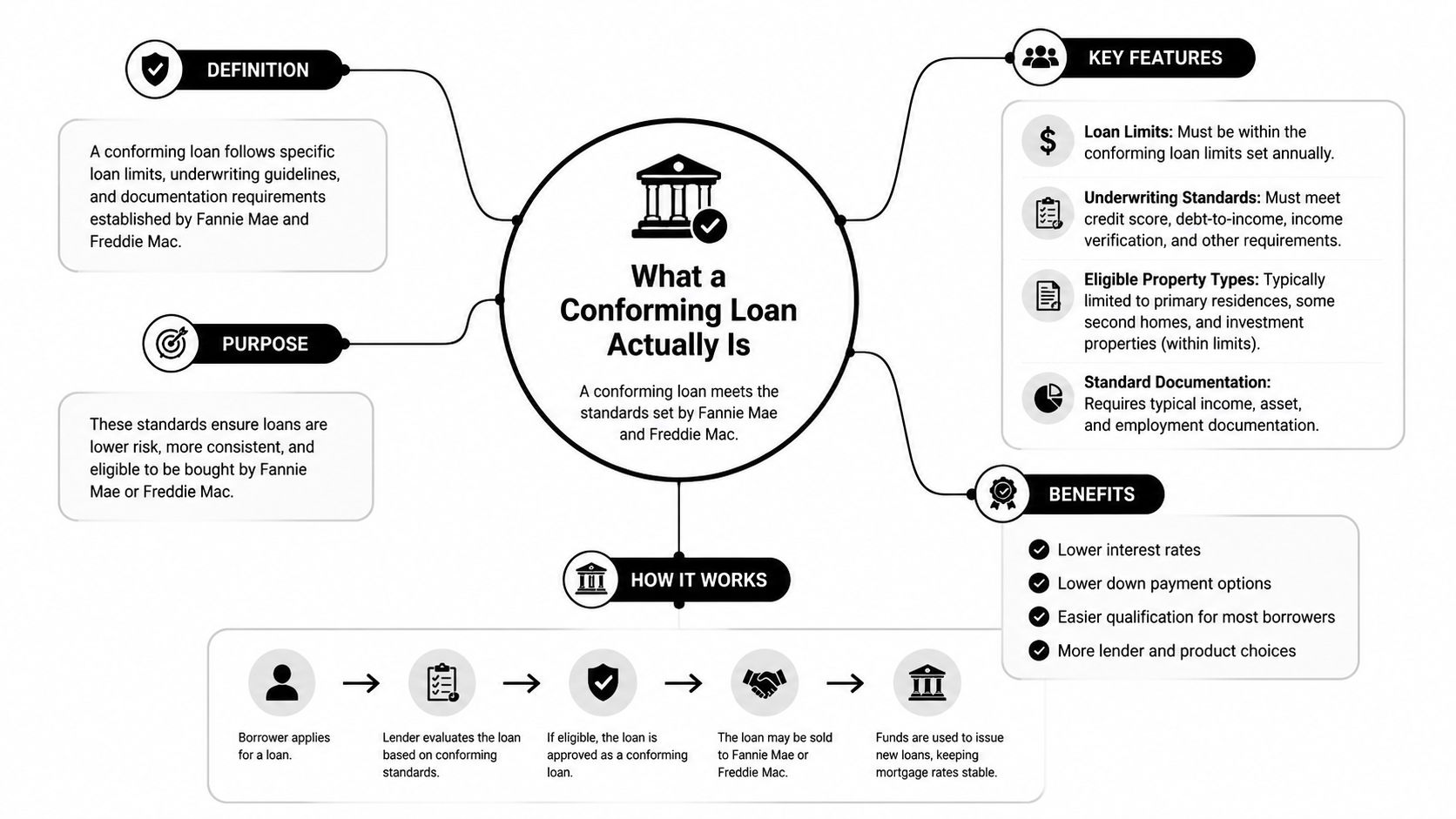
A conforming loan is a mortgage that meets the underwriting and eligibility requirements used by Fannie Mae or Freddie Mac and stays at or below the annual loan-size limit established by the Federal Housing Finance Agency. The loan must satisfy more than a dollar threshold. The borrower, property, documentation, and repayment structure must also fit the applicable agency rules.
Think of the mortgage market as a shipping network. A standard carrier accepts containers within a defined size and specification. Fannie Mae and Freddie Mac purchase or securitize eligible mortgages that fit their standards. When a loan exceeds the permitted size, the lender may need a specialty buyer or may keep the loan in a portfolio. That usually creates a smaller financing market and more lender-specific requirements.
The limit has two parts
The FHFA establishes a baseline for most counties and a higher ceiling for designated high-cost areas. For 2026, the baseline one-unit limit is $832,750, and the high-cost ceiling is $1,249,125, according to the FHFA's published conforming loan limit data.
The distinction between conforming and conventional causes frequent confusion. Conventional generally means a loan isn't insured or guaranteed by a government agency. Conforming describes whether the loan fits the Fannie Mae or Freddie Mac rules and size limits. A conventional loan can be conforming or nonconforming.
VA and FHA loans follow separate program rules. A VA loan isn't defined solely by the FHFA grid, and FHA uses its own statutory framework. That doesn't mean the FHFA limits are irrelevant to a veteran. A lender still needs to determine which product, loan amount, entitlement rules, underwriting standards, and property requirements apply.
Why agency eligibility matters
A conforming mortgage gives lenders access to a standardized resale channel. That can support more consistent underwriting and product availability. It doesn't guarantee approval, the lowest possible rate, or a specific down payment.
For a California HERO, the useful takeaway is simple: identify the agency limit, then compare the complete loan structure against it. Don't assume a product is conforming because the lender calls it conventional, and don't assume a loan is jumbo solely because the purchase price looks high.
2026 California Conforming Loan Limits by County
A veteran buying in San Mateo County and a teacher buying in Placer County cannot use the same conforming assumption. The 2026 California grid is county-specific, and the verified county values are published in the FHFA 2026 county loan-limit data. Check the county before you price the loan, especially if the property has multiple units.
The California county tiers
Many inland counties use the baseline tier. High-cost counties receive the higher one-unit limit. The practical question for a California HERO is whether the proposed loan amount fits the county assigned to the property, not whether the purchase price appears high.
| Tier | One-Unit Conforming Limit | Example California Counties |
|---|---|---|
| Baseline | $832,750 | Many inland California counties |
| High-cost ceiling | $1,249,125 | Los Angeles, Orange, San Francisco, San Mateo, Santa Clara, Alameda, Contra Costa, and Marin |
The FHFA limits apply to the mortgage amount, not the property's sale price. A home may sell above the county limit if the borrower brings enough funds to keep the loan within that limit or chooses a different financing structure.
Do not apply a high-cost county figure to an inland purchase. Confirm the property address, unit count, and proposed loan amount with your lender before writing an offer.
Unit count changes the answer
A duplex, triplex, or fourplex uses a different limit from a one-unit home. Fannie Mae's published 2026 table lists $1,066,250 for two units, $1,288,800 for three units, and $1,601,750 for four units in contiguous states, Washington, D.C., and Puerto Rico. Designated high-cost areas, including qualifying California counties, have higher caps. Review the Fannie Mae 2026 loan-limit table before evaluating a multi-unit property.
That distinction matters for HERO borrowers using rental income, house-hacking plans, or a property intended for extended family. A buyer in Placer County should not use a San Mateo County assumption, and a duplex buyer should not use a one-unit figure.
For veterans comparing agency limits with a VA strategy, review this VA home loan maximum guidance before choosing the financing structure. Your lender should confirm how the county, unit count, entitlement, income, and property rules work together.
Conforming vs Jumbo Loans Side by Side
Crossing the conforming line can change more than the interest rate. Jumbo financing may require stronger credit, more reserves, a larger down payment, and deeper review of income and assets. The exact terms vary by lender and borrower, but the comparison below shows why California HEROES should test the structure before accepting a jumbo quote.
| Factor | Conforming | Jumbo |
|---|---|---|
| Interest rate | Often offers standard agency pricing | May be priced higher, commonly by 0.25% to 0.75% |
| Minimum down payment | Can allow as little as 3% | Often requires 10% to 20% |
| Credit score threshold | May qualify at 620 or higher, subject to the full file | Often targets 700 or higher |
| Reserves | Commonly two months | Commonly six to twelve months |
| Underwriting | Standard agency rules, with possible manual review | More extensive income, asset, and liability scrutiny |
| Resale liquidity | Broad Fannie Mae and Freddie Mac investor market | Smaller buyer and investor pool |
The rate difference matters because it applies to the outstanding balance for years. The down payment difference matters immediately, especially for a firefighter, nurse, or teacher who has stable income but wants to preserve cash for repairs, moving expenses, and emergency reserves.
Compare the complete cost
A conforming loan isn't automatically better. A jumbo loan may offer a suitable structure for a borrower with substantial assets, strong credit, and a preference for keeping more money invested. But a borrower shouldn't choose jumbo financing only because the purchase price exceeds the county limit.
The right comparison includes rate, points, cash to close, reserves, mortgage insurance, closing costs, and the possibility of a second mortgage. Ask the lender to quote both structures using the same property and borrower profile. Then compare the long-term cost rather than focusing only on the advertised rate.
For borrowers who need to evaluate a VA-specific jumbo option, the jumbo VA loan resource can help frame the conversation.
Borrower rule of thumb: If the difference between the rate and down payment costs less than 25 basis points of long-term savings, stay conforming.
That rule is a decision prompt, not a substitute for a loan estimate. The lender must calculate the actual payment and cash requirement for your file.
How to Check Whether Your Loan Will Be Conforming
You can perform a useful first-pass calculation before speaking with a lender. It won't replace underwriting, but it will tell you whether the property deserves a conforming review or a broader financing conversation.
Follow the four checks
1. Identify the county. The limit follows the property's county, not the city name or ZIP code alone. A city can sit near a county boundary, and neighboring counties can have different limits. Start with the official 2026 county table from the FHFA conforming loan limit data.
2. Confirm the unit count. A single-family residence, condominium, duplex, triplex, and fourplex can fall under different loan limits. Confirm whether the property is one unit before applying the standard one-unit figure.
3. Calculate the base loan amount. Start with the proposed first mortgage, then account for funds used to pay off liens or a HELOC at closing. The loan amount that matters is the final base loan, not a rough estimate based only on the purchase price.
4. Compare the result with the county limit. If the base loan is at or below the applicable limit, request a conforming quote. If it's above the limit, ask for a larger down payment comparison, a second-lien structure, VA analysis, or jumbo pricing.
A practical example
Consider a $950,000 purchase in Placer County with 10% down. The estimated first mortgage is $855,000. If the applicable 2026 one-unit conforming limit is $832,750, that loan sits above the baseline by $22,250, so it doesn't fit the baseline conforming limit without changing the structure. The borrower could increase the down payment, use eligible subordinate financing, or compare another loan type.
Now use the same purchase price and down payment in San Mateo County. San Mateo is among the California counties qualifying for the $1,249,125 high-cost ceiling, so the $855,000 base loan falls below that one-unit ceiling. The county changes the answer even though the purchase price, down payment, and estimated first mortgage remain the same.
Don't finalize the calculation until the lender verifies the property classification, lien payoff, and applicable county entry.
Smart Strategies to Stay Within the Limits
Staying conforming usually gives a California HERO more financing flexibility, but the goal isn't to force every purchase into one category. The goal is to structure the transaction deliberately. A modest change in cash, property type, or lien arrangement can keep the first mortgage within the applicable limit.
Use cash strategically
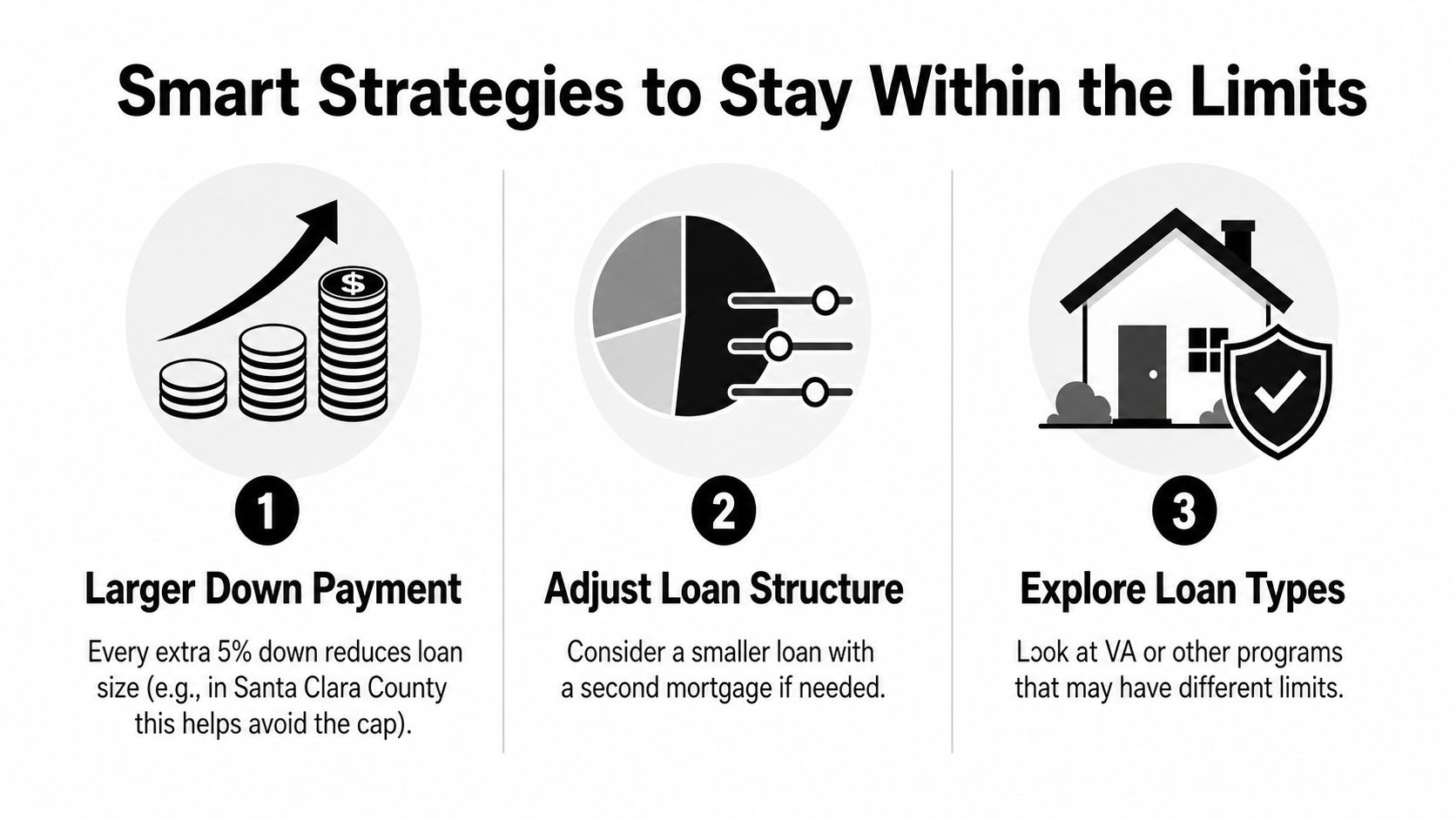
A larger down payment is the most direct tool. In a high-cost county such as Santa Clara or San Mateo, each additional contribution reduces the first mortgage and can move the loan below the cap. Don't decide on a down payment by habit. Ask the lender to show the exact amount needed to reach the conforming threshold, then compare that cash requirement with the cost of jumbo financing.
Seller credits and lender credits can also affect the structure. If the transaction includes closing-cost assistance, you may be able to direct eligible funds toward a temporary 2-1 buydown or use your own cash more efficiently toward principal. The lender must confirm program and agency rules, because credits generally can't be used however the buyer chooses.
Handle secondary liens carefully
A HELOC payoff deserves special attention. If a small existing line is paid at closing, the lender should model whether it needs to be incorporated into the new first mortgage or handled separately. Adding that balance to the first mortgage can push the base loan above the county limit, while a properly structured payoff may preserve the target first-mortgage amount.
Piggyback structures, including 80-10-10 and 80-15-5, can split financing between a first mortgage and a second lien. A family member's silent second may be possible in some circumstances, but it must be fully disclosed, documented, and approved. Hidden debt can jeopardize the loan and create legal problems.
Let the property work for you
Property selection can change the financing analysis. A one-unit condominium may fit a different lending profile than a townhome-style property, and a multi-unit property has its own limit schedule. Confirm the legal unit count, occupancy, project eligibility, and appraisal treatment before assuming a property will qualify.
A HERO Home Loan can also change how you allocate available funds. If buyer rewards or eligible assistance can be applied to closing costs, the borrower may preserve more cash for the down payment and keep the first mortgage below the limit. The conventional loan with down payment assistance options may be relevant for eligible borrowers, but the lender must match the program with the property's county and the borrower's qualifications.
Best practice: Ask for three written scenarios, conforming with a larger down payment, conforming with a second lien if available, and jumbo. Choose after reviewing the full cash-to-close and payment picture.
Next Steps With California Loans for Heroes
Loan limits become useful only when they guide a real purchase decision. A veteran, active-duty service member, firefighter, law enforcement officer, nurse, teacher, pilot, or government employee needs more than a generic preapproval. The financing review should connect eligibility, county, unit count, loan amount, cash position, and product rules.
The HERO Home Loan and Buyer Rewards Program is designed around that specialist audience. Relevant features can include low or zero down payment options, flexible credit overlays, lender credits that help absorb closing costs, and a Buyer Rewards Program that returns cash after closing. Availability depends on eligibility, property, underwriting, and program terms, so get the details in writing before relying on a benefit.
Build the file before you shop
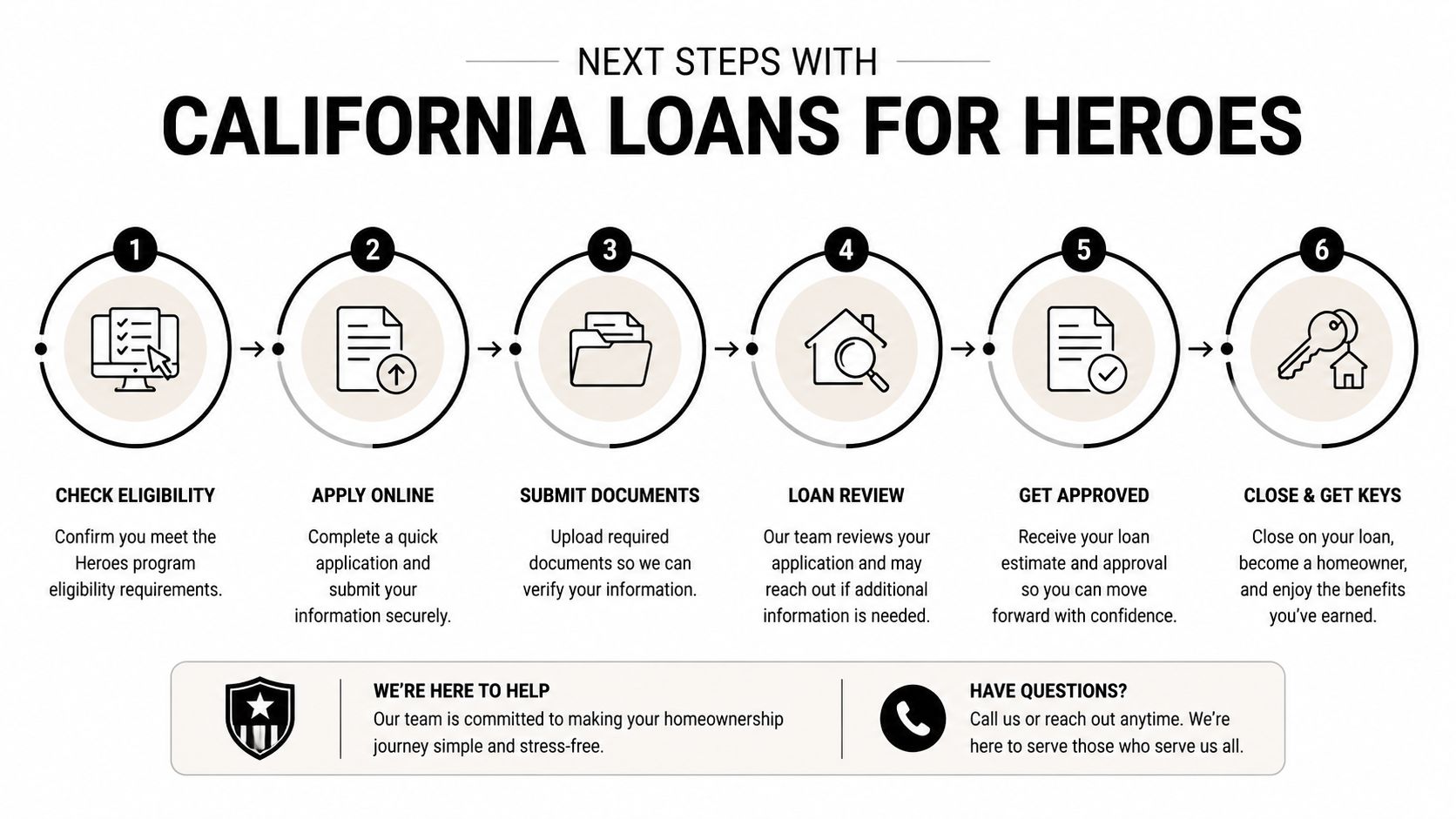
Start by gathering the documentation that establishes your HERO status. A veteran may need a DD-214 or service record. A public employee may need an employer letter or other employment documentation. Income records, asset statements, current debts, and housing history complete the financial picture.
Then request a county-specific conforming limit quote tied to the property unit count. Don't accept a statewide estimate. Ask the lender to state the county, property type, base loan amount, applicable 2026 limit, and whether any subordinate financing or lien payoff changes the calculation.
Structure before you lock
Once the lender confirms the options, compare the payment, cash to close, reserves, rate, points, and total cost. If staying conforming requires a larger down payment, calculate the opportunity cost. If jumbo financing preserves cash, calculate the long-term payment difference. If VA financing is under consideration, request a separate VA analysis rather than assuming the conventional grid answers the question.
The final step is to lock a rate, document the conforming structure, and capture any eligible HERO reward at closing. A good lender should explain the decision in plain English and show you where the loan crosses or stays below the county line.
California Loans for Heroes focuses daily on veterans, active-duty military, first responders, nurses, teachers, and government employees. Use that specialization to turn the 2026 conforming loan limits California borrowers face into an actual purchase plan, not a number you discover after your offer is accepted.
Visit California Loans for Heroes to request a county-specific loan review, compare conforming, VA, and jumbo structures, and learn how the HERO Home Loan and Buyer Rewards Program may fit your purchase. Start your application or schedule a call before you make an offer, so your loan amount and financing strategy are clear from the beginning.