
A California first time home buyer often starts with the wrong question. It's usually not “Can I qualify?” It's “Does my income line up with the kind of home I'm trying to buy?” In Q2 2026, only 34% of California households could afford a typical entry-level single-family home, where the median price was $779,240, the monthly payment was $5,000, and the minimum qualifying income was $150,000 according to the California Association of Realtors First-Time Buyer Housing Affordability Index.
For HERO professionals like nurses, firefighters, teachers, law enforcement officers, veterans, and other public service workers, that reframes the whole conversation. Many buyers are financially responsible, steady in their careers, and fully capable of handling a mortgage. The harder part is that California's starter-home math often pushes solid buyers to rethink location, property type, loan structure, and assistance strategy all at once.
Why Buying Your First Home in California Feels Different
A California HERO buyer can have the kind of profile lenders usually like. Steady paycheck. Manageable debt. Years in public service. Then the numbers change once the search moves from preapproval to actual homes for sale.
That is the part that feels different here.
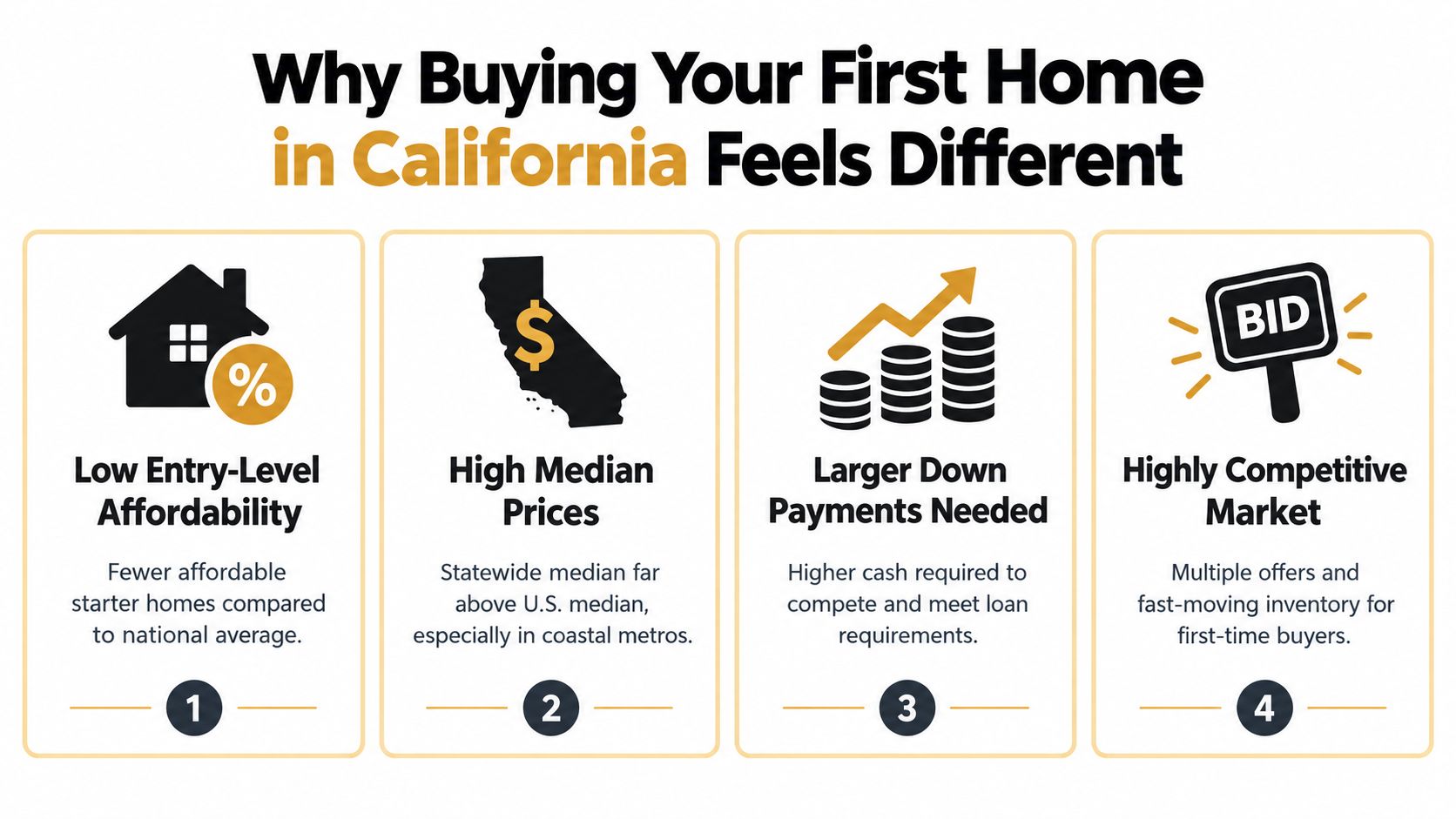
The first shock is usually payment, not qualification
Many first-time buyers assume the biggest hurdle is getting approved. In California metros, the bigger issue is often whether approved financing produces a payment that still fits real life after taxes, insurance, HOA dues, and commuting costs.
A teacher in Los Angeles, a firefighter in Riverside County, and a nurse in San Jose may all earn solid incomes for their professions. Yet each one can run into the same problem. Their income may support homeownership in a general sense, but not in the exact city, property type, or monthly budget they first had in mind.
Buying here works less like stepping onto a starter rung and more like trying to reach a shelf that keeps getting placed higher. You may be qualified. You still need the right stool.
California buyers often face a location mismatch before anything else
For HERO households, the decision is often not "buy or wait." It is "where does my income stretch far enough to create a stable monthly payment?"
That can mean shifting from a single-family search to a condo or townhome. It can mean looking one city farther out. It can also mean comparing a higher-rate option with lower cash needed against a lower-rate option that requires more money upfront.
This is why assistance matters so much in California. It does not erase high prices. It helps you choose which part of the gap to solve first.
State programs and local programs solve different problems
Many buyers lump all assistance into one bucket. That creates confusion.
State programs often help with broad financing needs such as down payment support or a junior loan that reduces cash to close. Local programs are more targeted. A city or county program may focus on buyers who work nearby, stay under area income limits, or purchase within a specific ZIP code or census tract.
For HERO buyers, the best strategy is often layered. State help can lower the upfront burden. Local help can close the remaining gap if you fit the area rules. The challenge is less about finding one perfect program and more about matching the right stack to your metro, your income, and your job-based schedule.
What to focus on before you tour too many homes
Clarity usually comes from four practical questions:
- Where does my income fit best? Compare your target payment across a few cities, not just one dream neighborhood.
- Which problem is bigger for me? Some buyers need help with down payment cash. Others need a lower monthly payment.
- What does the full payment look like? Taxes and insurance can change the picture quickly. A quick review of how California property taxes are calculated can prevent surprises.
- Can I combine state and local help? Many California HERO buyers get further by stacking programs instead of relying on a single source.
That shift in mindset helps. You are not just asking whether you qualify. You are matching your income to a California market that often asks buyers to solve price, payment, and cash-to-close at the same time.
Understanding California First Time Buyer Assistance at a Glance
Most California first-time buyer assistance works like layered financing. That means you don't usually replace your mortgage with a special program. You combine a first mortgage with another source of help, such as a junior loan, a grant, or a shared-appreciation program.
Carrying groceries: the first mortgage is the main bag. Assistance is the second bag that helps you get everything inside without dropping something at the door.
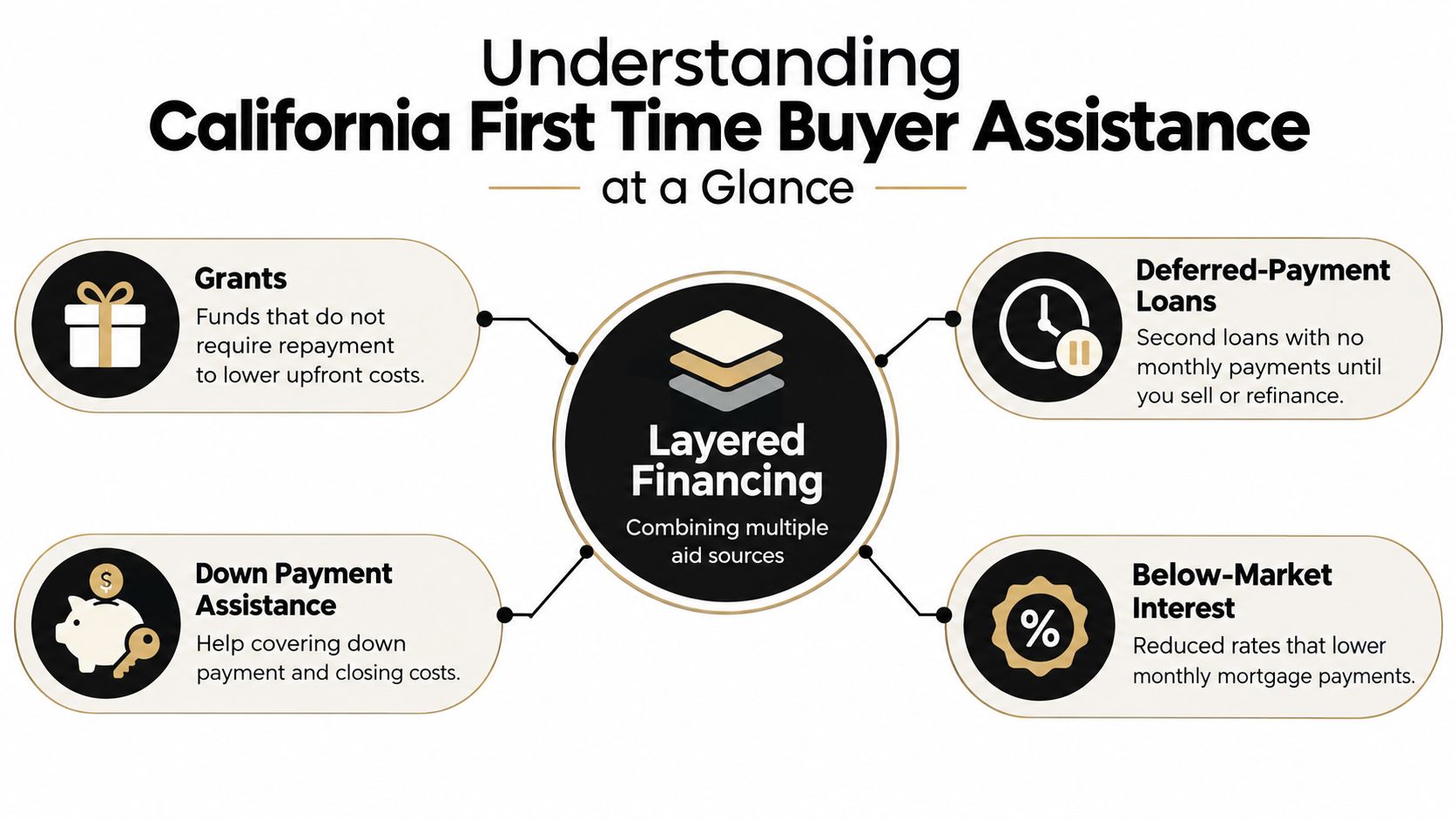
Most programs reduce cash to close
This point trips buyers up. Assistance often helps with the down payment or closing costs, but it usually doesn't make the home itself cheaper. It changes how you fund the purchase.
California's flagship MyHome program is a good example. CalHFA states that MyHome requires the borrower to be a first-time homebuyer, occupy the home as a primary residence, complete approved homebuyer education, and meet program income limits. The assistance is a deferred-payment junior loan of up to the lesser of 3.5% of purchase price or appraised value, according to the CalHFA MyHome program page.
That's helpful, but notice what it does. It lowers the cash you need at closing. It doesn't lower the first mortgage balance in the same way a huge extra down payment would.
Why this matters more in California
Many buyers spend too much time hunting for a perfect credit-based solution when the issue is an income-to-price mismatch in expensive metros. In Q2 2026, California's first-time buyer affordability index was 34 statewide, 33 in Los Angeles, and 30 in the San Francisco Bay Area. The minimum qualifying income for a median-priced single-family home was about $150,000 statewide, $140,700 in Los Angeles, and $232,200 in the Bay Area, according to the California Realtors affordability breakdown.
That's why a California first time home buyer may be fully lendable and still need to pivot.
Many buyers aren't underprepared on credit. They're underestimating how far local prices have pulled away from local incomes.
The three basic assistance structures
Here's the simple version:
- Deferred-payment help: A second loan sits in the background and may not require monthly payments while you own the home.
- Shared-appreciation help: You get larger support up front, but you give up part of future appreciation based on the program terms.
- Local grants or second loans: City and county programs may add another layer for buyers who meet local rules.
When buyers understand that assistance is stacked, not substituted, they make better decisions about loan type, target price, and location.
State and Local Programs Every California First Time Buyer Should Compare
California buyers often hear a few state program names and assume that's the whole menu. It isn't. State options matter, but local city and county programs can sometimes make the bigger difference, especially for HERO buyers who are trying to reduce cash to close without stretching the monthly payment too far.
The smartest approach is usually comparison first, application second.
State programs solve different problems
Some programs are built for broad access. Others are built for bigger assistance but tighter entry rules.
CalHFA's Dream For All Shared Appreciation Loan can provide up to 20% of a home's value for down payment or closing costs, capped at $150,000, and access requires a voucher selected through a randomized drawing. CalHFA also says that at least one borrower must be a first-generation homebuyer, one borrower must be a current California resident, and all borrowers must be first-time homebuyers, according to the Dream For All program page.
The OpenDoors Program takes a different path. California's Department of Real Estate states that it provides up to 7% of the first mortgage loan amount to low-to-moderate income buyers as a second mortgage that can be used for a down payment or closing costs, as described on the First Home California assistance overview.
Then there's MyHome, which is smaller in amount but often easier for buyers to understand because it's a traditional deferred-payment junior loan.
Local help can be larger than state help
Many California first time home buyer searches get too generic. Buyers focus only on state pages and miss the local layer.
Independent lender guidance notes that some California city and county programs offer much larger assistance amounts than many state programs, including grants or loans of up to 4% of the first mortgage amount in Los Angeles and Orange County, up to $30,000 in El Dorado County, and up to $150,000 in Alameda County, all tied to eligibility and income rules, according to Redfin's California first-time buyer program guide.
For HERO households, that can change the strategy. A county program may pair better with your target area than a statewide option that sounds stronger on paper.
California First Time Buyer Assistance Compared
| Program | Assistance Amount and Structure | Key Access Requirement |
|---|---|---|
| CalHFA MyHome | Deferred-payment junior loan of up to the lesser of 3.5% of purchase price or appraised value | Must be a first-time buyer, occupy as primary residence, complete approved education, and meet income limits |
| CalHFA Dream For All Shared Appreciation Loan | Up to 20% of home value for down payment or closing costs, capped at $150,000, with shared appreciation | Requires voucher from randomized drawing, first-generation homebuyer rule for at least one borrower, California residency for one borrower, and all borrowers must be first-time buyers |
| OpenDoors Program | Up to 7% of the first mortgage loan amount as a second mortgage for down payment or closing costs | Designed for low-to-moderate income buyers and structured as layered financing |
| Local city and county programs | May include grants or loans, with examples ranging from a share of first mortgage amount to fixed-dollar support in certain counties | Eligibility depends on local income rules, location, and program availability |
How HERO buyers should compare options
A firefighter in Alameda County, a nurse in Orange County, and a teacher in El Dorado County may all need different combinations even if their incomes look similar. One may need a stronger local down payment layer. Another may benefit more from a first mortgage paired with smaller deferred assistance.
If you're comparing options with a lender, California Loans for Heroes is one example of a California-focused resource that helps eligible HERO professions explore homebuyer assistance, down payment assistance options, lender credits, and mortgage choices in one process.
Eligibility and Readiness for California First Time Buyer Programs
Many buyers want a list of programs before they want a readiness check. That order usually creates frustration. A California first time home buyer gets farther by checking fit first, then shopping program combinations.
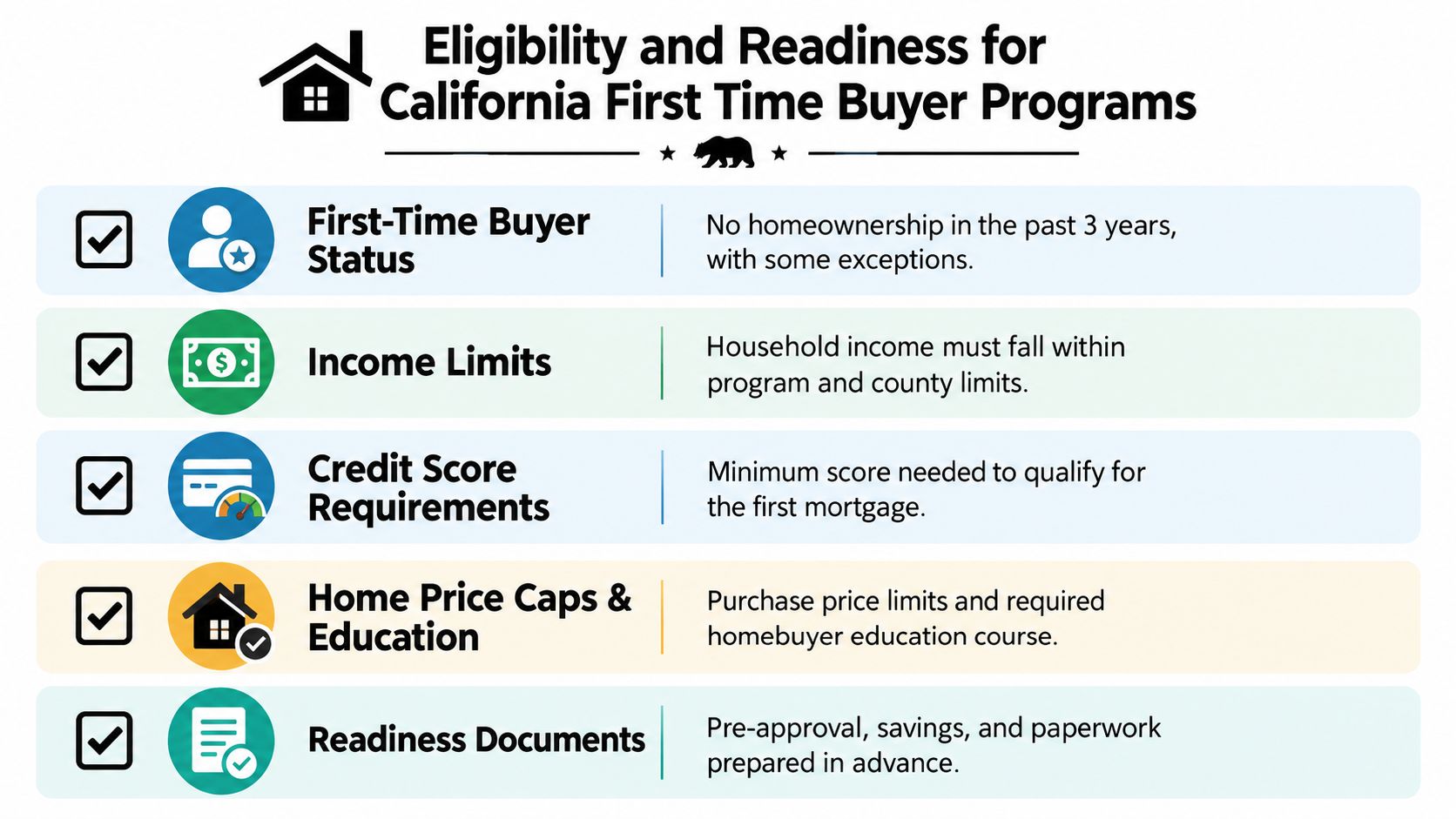
The image below captures the big pieces buyers should have in mind before they apply.
The eligibility checklist that matters most
Program rules vary, but these themes come up again and again:
- First-time buyer status: Many programs require first-time homebuyer status. Some programs also add special definitions or exceptions.
- Primary residence use: Assistance is commonly tied to owner occupancy, not investment property plans.
- Homebuyer education: State programs can require an approved education course before closing.
- Income limits: Assistance is often aimed at households within program limits for the area.
- Special program rules: Some options add residency requirements or first-generation requirements.
That last category is easy to miss. Dream For All, for example, has rules that go beyond basic first-time buyer status, so buyers shouldn't assume every CalHFA option works the same way.
Readiness is broader than eligibility
A buyer can technically qualify for a program and still not be purchase-ready.
What usually separates smooth closings from stressful ones is organization. Your lender will want a clear view of income, assets, debts, and the source of funds you plan to use. If assistance is layered on top, paperwork discipline matters even more because multiple approvals may need to line up.
Checklist mindset: Treat readiness like packing for a long shift. If one key item is missing, the whole day gets harder.
A practical readiness list
Use this as a working pre-application filter:
- Income clarity: Know your current base pay and any stable qualifying income your lender can document.
- Savings map: Separate what you'll use for earnest money, closing costs, reserves, and any gap not covered by assistance.
- Education timing: Finish any required course early so it doesn't become a closing-week problem.
- Property flexibility: Stay open to condos, townhomes, or different neighborhoods if single-family pricing doesn't fit.
- Document file: Keep pay stubs, tax documents, bank statements, and ID easy to access.
The biggest readiness question in high-cost metros
In expensive California markets, the most important question may be whether the property type matches your current income reality. A buyer who keeps chasing a single-family home that sits above their sustainable range can waste months proving they're “qualified” for a target that still doesn't work.
That's why readiness isn't only about approval. It's also about choosing a goal that your financing can support.
Loan Options and Down Payment Strategies That Pair With Assistance
A lot of California buyers still think the only “safe” path is saving 20% down. In this state, that can keep people on the sidelines for years longer than they planned.
A lower-down-payment mortgage paired with assistance is often the more realistic route.
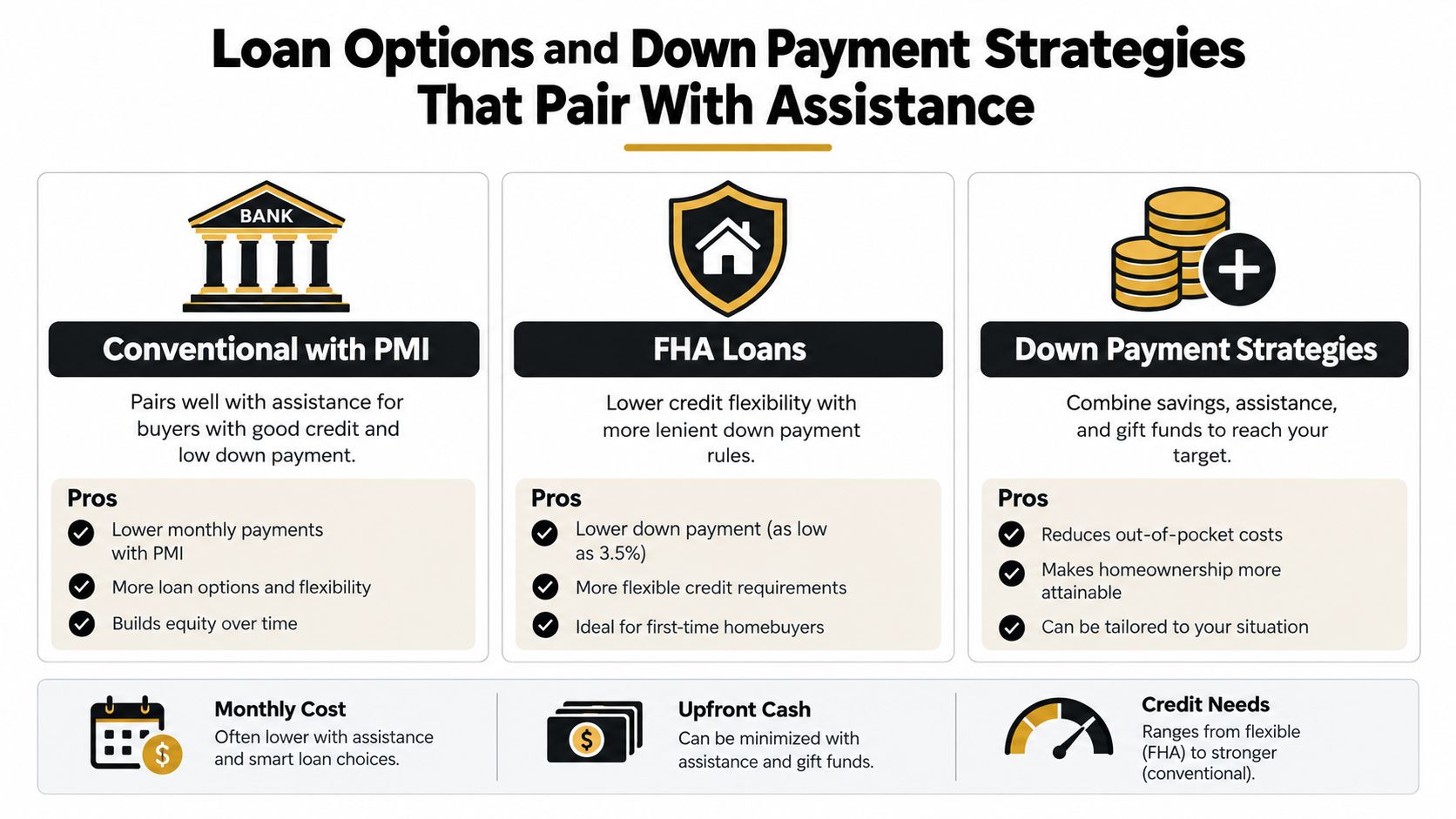
Why low-down-payment financing is common
A 2024 industry analysis found that nearly 43,000 California homebuyers used private mortgage insurance to purchase a home with a low down payment in 2023, and 72% of those borrowers were first-time buyers. The same analysis estimated that a California household earning the state median income of $85,300 could need about 49 years to save for a 20% down payment plus closing costs on the state's median single-family home price of $812,100, according to the U.S. Mortgage Insurers report on California buyers.
That's the practical case for combining financing tools instead of waiting for a perfect down payment target.
How different loan paths pair with assistance
Some pairings are especially common:
- Conventional with PMI: Often a strong fit for buyers with solid credit who want a lower down payment and the option to combine that first mortgage with assistance. If you want a plain-language breakdown, this guide to a conventional loan with down payment assistance shows how the pieces can work together.
- FHA loans: These can help buyers who need more flexibility on qualification and still want down payment support layered in where allowed.
- VA loans: For eligible veterans, active-duty service members, and some surviving spouses, a VA loan can be a major advantage because it can reduce the upfront burden. Buyers still need to evaluate payment, property fit, and closing costs.
- USDA loans: In eligible rural or certain suburban areas, these can open a path for buyers who are willing to trade commute or location for affordability.
Build a strategy, not just a loan file
The strongest plan usually mixes several buckets of money:
- Your own savings for earnest money and part of closing.
- Program assistance for down payment or closing costs.
- Gift funds or credits if allowed and documented properly.
- A first mortgage whose payment still feels sustainable after you move in.
Don't choose a loan only because it gets you through underwriting. Choose the one you can live with on an ordinary month.
For HERO buyers, that's especially important. Shift work, overtime patterns, family schedules, and commuting demands all affect what “affordable” really means.
Your Step by Step Path From Preapproval to Closing in California
A California first time home buyer usually feels better once the process becomes a sequence instead of a fog. The steps overlap, but they're manageable when handled in order.
A nurse or teacher using assistance won't just “get preapproved and shop.” They'll usually coordinate education, lender review, assistance matching, property search, and closing deadlines at the same time.
Step 1 through Step 3
Start with education. If a program requires homebuyer education, do it early. Waiting until you're under contract creates avoidable stress.
Get preapproved with your full plan in mind. Tell the lender you want to explore assistance from the beginning. A clean preapproval should reflect not just what you might borrow, but how assistance, taxes, insurance, and your target payment fit together.
Choose a realistic search box. Many buyers improve their odds. Instead of searching the broadest dream scenario, narrow by payment comfort, commute tolerance, and property type.
Step 4 through Step 6
Once you're shopping seriously, the process becomes more tactical:
- Work with participating professionals: Some assistance programs require approved or participating lenders.
- Confirm assistance timing: Ask when funds are reserved, when documents are due, and what could delay approval.
- Write offers that match your financing: Your agent and lender should understand how your assistance structure affects timing, cash to close, and documentation.
A buyer using layered financing needs stronger coordination than a buyer using only a standard first mortgage. Not harder. Just more organized.
Step 7 through closing
After offer acceptance, the file moves through appraisal, underwriting, and final approval. During this stretch, buyers should avoid major financial changes, keep documents moving quickly, and watch every deadline.
A practical way to stay organized is to use a detailed home buying process checklist so you can track lender requests, escrow milestones, and final walk-through items in one place.
When assistance is part of the transaction, silence causes delays. Buyers who answer requests quickly usually keep more control over the timeline.
A simple way to think about the timeline
The first half of the journey is about preparation and matching. The second half is about coordination and follow-through.
That distinction matters. Buyers often assume the hard part is finding the home. In California, the hard part is often finding the home that fits both your life and your financing structure, then keeping every moving part aligned until closing.
Moving Forward With Confidence as a California HERO Buyer
For a California first time home buyer, the clearest path usually isn't “wait until everything feels perfect.” It's “match the right property target with the right financing structure and the right assistance layer.”
That matters even more for HERO professionals. You may have stable work, strong responsibility, and a long-term reason to put down roots. The challenge often isn't commitment. It's that California prices force sharper trade-offs than buyers expect.
The decision framework that works
If you're sorting through options, keep it simple:
- Start with income reality: Choose a target payment and location that respect your day-to-day life.
- Compare state and local assistance together: Don't assume the biggest state name is your best fit.
- Pick the mortgage that supports the full budget: Upfront savings matter, but monthly sustainability matters more.
- Stay flexible on property type: A condo or townhome can be a strategic first step, not a compromise that means you failed.
What confidence looks like in practice
Confidence doesn't mean knowing every mortgage term from memory. It means knowing your range, your likely assistance paths, and your next step.
For many buyers, that next step is talking with a lender who understands California programs, completing any education requirement early, and checking for city or county help before writing offers. That approach gives you a cleaner plan and fewer surprises.
You don't need a perfect market to buy well. You need a realistic strategy and a team that can help you apply it.
California Loans for Heroes helps eligible California HERO professionals explore mortgage options, homebuyer assistance, down payment support, lender credits, and purchase planning in one place. If you want help matching state and local programs to your loan options and your real budget, visit California Loans for Heroes.