
You're serving your community on hard shifts, chasing calls, and still trying to make sense of California's housing market after hours. That's a reality for a lot of EMS buyers, and it's exactly why home loans for EMS need to be filtered through California programs, not generic mortgage advice. The right loan can cut your cash to close, lower your payment, or both, but the wrong program can look great on paper and still miss the mark once you price in insurance, lender fees, and local home prices.
California buyers in EMS don't need a long theory lesson. You need the programs that matter most in this state, how they work, and which ones are worth your time first. The strongest options are the ones that combine down payment assistance, reduced lender costs, and statewide or local availability. You also need to know which programs are real fits for California, which are national tools with useful benefits, and which are too narrow to move the needle in this market.
1. California Loans for Heroes
California Loans for Heroes is the strongest California-first option on this list because it was built around the people who keep the state running, including firefighters and EMS. It is not a generic mortgage site dressed up with first-responder language. It's a California program with a dedicated HERO Home Loan and Buyer Rewards structure, plus local support that's meant to make buying or refinancing feel manageable instead of chaotic. California Loans for Heroes is the right starting point when you want a statewide program that's specifically designed for California buyers.

Why this ranks first for California EMS
The program's value is breadth. It includes down payment assistance options, buyer incentives, lender credits, reduced fees, and refinance solutions, which matters in California because the cheapest path to ownership is rarely just the lowest rate. A home buyer in Los Angeles, San Diego, the Inland Empire, or the Bay Area often needs several savings levers at once, not one small discount.
California Loans for Heroes also stands out because it works with a participating local realtor network and offers one-on-one support. That combination is useful when your work schedule is unpredictable and you need a team that can move fast, answer direct questions, and keep the file from stalling. The site also presents itself as statewide, with licensing details and equal housing lender status, which gives buyers a clear place to start.
Practical rule: For California EMS, the best program is the one that lowers both cash to close and monthly payment, not just the one with the flashiest headline benefit.
Pros
- Made for California service professionals, including EMS and family members.
- Multiple affordability levers in one place, including assistance, credits, and refinance support.
- Local support that fits busy schedules and first-time buyer needs.
- Participating realtor network that can add extra incentives when the program rules allow it.
- Statewide reach with clear licensing information.
Cons
- Savings aren't fixed, so exact terms depend on borrower eligibility and lender guidelines.
- Some benefits depend on partner participation, so not every transaction will look the same.
2. HUD Good Neighbor Next Door
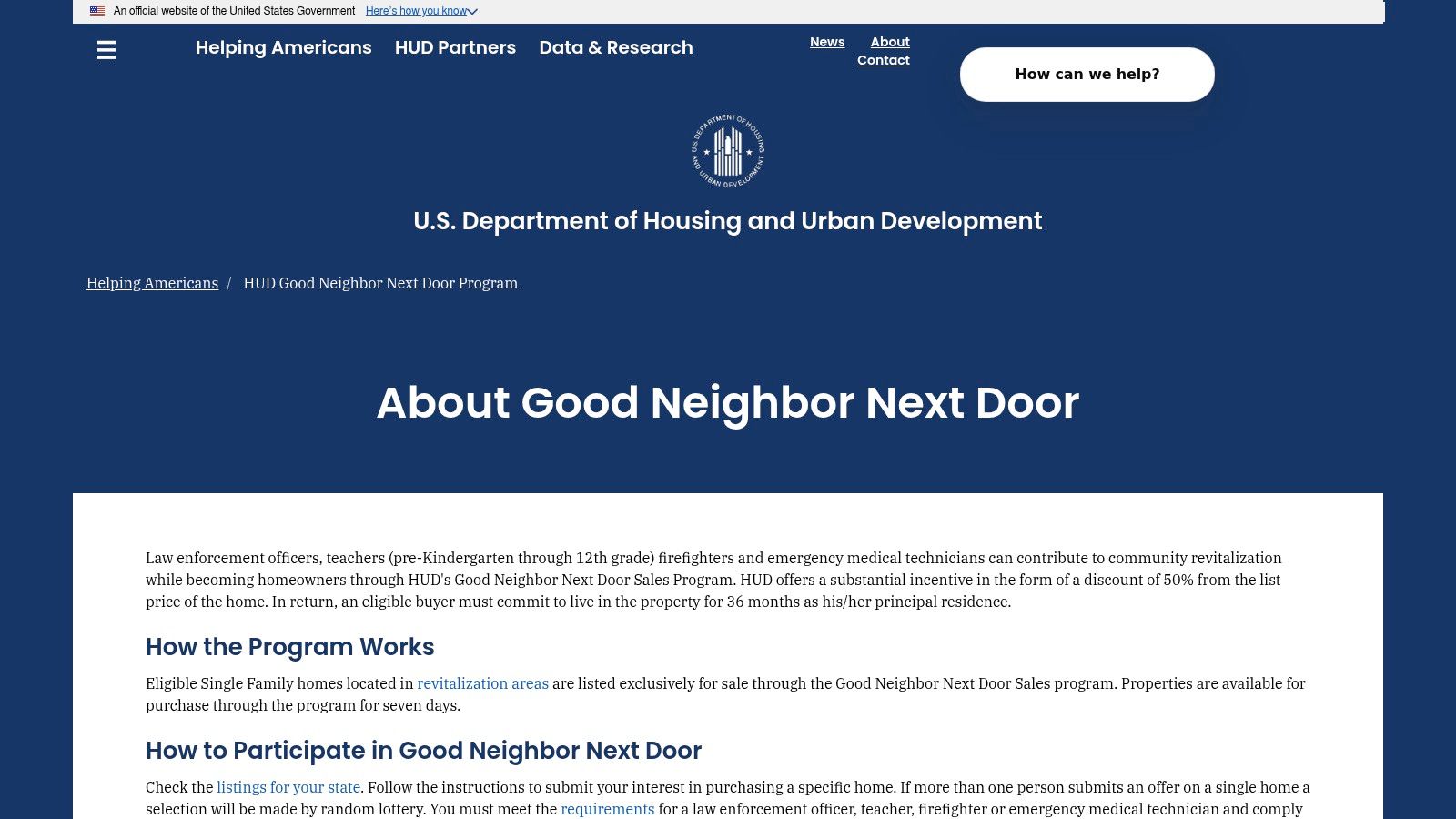
HUD's Good Neighbor Next Door program can create immediate equity on day one, and that is why it deserves attention from California EMS buyers. Eligible full-time EMTs, firefighters, law enforcement officers, and PK–12 teachers can receive 50% off the list price on qualifying homes in designated revitalization areas. The discount is real, but the program is narrow. Homes are tied to specific locations and inventory is limited, so this works as a targeted purchase strategy, not a broad search tool. Learn more on the official HUD program page for Good Neighbor Next Door.
Why this matters in California
California affordability is tight, so a 50% discount can change the numbers fast. The tradeoff is flexibility. You have to shop within HUD-approved areas and accept the property choices that come with that inventory, which may include homes that need repairs or sit outside your first-choice neighborhood. For an EMS buyer willing to widen the search, the equity benefit can be significant.
The rules are strict. You need to meet employment verification requirements at closing and commit to 36 months of owner-occupancy. That makes this a fit for an EMS buyer who wants a primary residence and plans to stay in it for the long haul. It is a poor fit for short-term plans, and it does not help much if you need multiple options in a specific school district.
The California lens matters here. In a market where every dollar counts, this program can cut the purchase price in a way that few other options can match, but only if you are willing to follow the occupancy rules and wait for the right HUD property.
This is a commitment program. If you want the discount, you have to accept the occupancy rules that come with it.
Pros
- Very deep equity upside through the 50% price reduction.
- Can work with common loan types when the guidelines allow it.
- Useful for buyers focused on primary residence affordability.
Cons
- Inventory is limited and the properties are highly competitive.
- Owner-occupancy rules are strict.
- Employment verification is part of the process.
3. Homes for Heroes
Homes for Heroes fits California EMS buyers who want closing-cost relief without getting tangled in a complicated loan structure. The program serves EMTs, AEMTs, and paramedics through its partner agents and lenders, so the savings are tied to the transaction itself. You usually see the benefit after closing, which does little for earnest money pressure but can put real cash back in your pocket once the sale is done. Visit Homes for Heroes for their national hero rewards program.

Best use case for California buyers
Use this as a partner savings program, not as the mortgage itself. The reward pairs with VA, FHA, USDA, and conventional financing, letting you combine the benefit with the loan type that fits your credit and income profile. That matters in California, where buyers often have to balance payment size, property price, and underwriting flexibility at the same time.
The tradeoff is control. To earn the reward, you typically have to work with the assigned partner agent and lender, so this is a poor fit if you already have a trusted team outside the network. For first-time buyers who want guidance and a meaningful post-closing rebate, the structure works well. For buyers who want full control over every piece of the transaction, it does not.
Practical rule: If you are already planning to use a partner realtor and lender, put the reward structure on the table before you choose a loan.
Pros
- Straightforward rebate-style savings after closing.
- Pairs with common mortgage products.
- Helpful for first-time buyers who want guided support.
Cons
- Partner restrictions apply.
- Benefits are usually paid after closing, not upfront.
- Savings vary by transaction and location.
4. Teacher/First Responder Next Door Firefighter and EMT Track
If you want one intake point for California-first responder and teacher assistance, the Teacher/First Responder Next Door firefighter and EMT track is worth a look. It routes buyers toward participating lenders and agents, which is useful when you want a faster way to find local programs instead of sorting through scattered offers on your own. Its teacher-focused path also points buyers toward broader options, including home loan programs for teachers via California Loans for Heroes home loan programs for teachers.
Where it helps, and where it falls short
The main value is discovery. California is full of local programs, county-level assistance, and partner credits that are easy to miss if you only shop lender by lender. A centralized intake can surface grants, down-payment help, and other benefits that fit your file, especially if you are buying in a smaller market or a county where local aid exists but is not advertised well.
The limitation is control. Benefits depend on the market, the funding, and the partner network, so you should expect variation from one area to another. Use this platform to identify options and compare them, then make your mortgage choice based on the loan structure, pricing, and lender terms that fit your California purchase.
Pros
- Helps surface local assistance that can be hard to find on your own.
- Single intake point for screening and placement.
- Can connect with multiple loan types.
Cons
- Benefits vary by location and funding.
- You still have to use partner providers.
- It is a matching platform, not a direct lender.
5. Golden State Finance Authority Platinum Program
A California buyer who needs help with upfront cash should look at GSFA Platinum early. It pairs a first mortgage with down-payment assistance up to 5.5% of the first mortgage loan amount, and it runs through participating California lenders. For EMS borrowers trying to cover both down payment and closing costs, that can matter more than a small lender credit that barely touches the total. Review the state program details on the GSFA Platinum Program.

Why California EMS should pay attention
GSFA Platinum is designed specifically for California buyers, drawing on the state's housing model and local lender network. It works with Conventional, FHA, VA, and USDA first mortgages, so you can align the assistance with the loan type that fits your file. Some versions of the program also allow repeat buyers, which gives EMS households another route back into the market when they are not starting from scratch.
If you are shopping in a high-cost county, this program can make the difference between barely qualifying and closing. California buyers should also compare it with other California down payment assistance options before they commit, because the right fit depends on income limits, purchase price limits, and how much cash you need to bring in. Work with a lender who knows the program rules and can place it against the property and loan structure you are using.
Practical rule: In California, the right DPA program is the one that survives underwriting, not just the one that sounds generous on a flyer.
Pros
- Strong assistance amount relative to many programs.
- California-wide lender access through participating providers.
- Works with major first-mortgage types.
Cons
- Income, credit, and purchase price limits apply.
- Program rules can change, so current eligibility matters.
- Funding and occupational perks may be time-limited.
6. Florida Hometown Heroes Housing Program
A Florida EMT can use the Hometown Heroes program to cover part of the upfront cost of buying a home, while a California buyer should treat it as a clean example of how state-backed assistance can work. The program gives eligible first responders a 0% deferred second for down payment and closing cost help, sized at up to 5% of the first mortgage amount, with a minimum $10,000 and maximum $35,000. Review the state program page for Hometown Heroes.
What California EMS borrowers should take from it
Florida's program is useful because it spells out the rules in plain language. You get clear occupation standards, published assistance terms, and a defined structure for the second loan. California buyers should use that as a baseline when they compare local hero programs and private lender offers, especially in a market where the fine print often decides whether a deal closes.
Repayment structure matters just as much as the grant amount. A deferred second is still debt, so you need to know what happens if you sell, refinance, or lose the property before the loan term runs its course. California EMS buyers should ask that question on every assistance program they review, including state and lender-backed options, because the cost shows up later if the terms are loose or the exit rules are unclear.
Pros
- Published assistance amounts make the benefit easy to understand.
- Statewide rules reduce guesswork for eligible borrowers.
- Participating lenders handle the loans through an established process.
Cons
- Florida-only.
- Funding can disappear when demand is high.
- The second lien is deferred, not forgiven automatically.
7. Texas State Affordable Housing Corporation Homes for Texas Heroes
Texas gives you a clean example of how a state hero program should be structured. Homes for Texas Heroes pairs 30-year fixed mortgages with either a grant or a forgivable second-lien DPA, and it also offers a Mortgage Credit Certificate for buyers who want tax relief in addition to down payment help. It is aimed at Texas heroes, including EMS, through approved lenders. Review the state program at TSAHC.
How California EMS borrowers should use this comparison
Start with the structure. A grant is cleaner than a second lien because you are not carrying another repayment layer after closing. A forgivable second can still be a strong option if the forgiveness timeline fits your plans, but a deferred loan leaves you with a balance to manage later. California EMS buyers should ask lenders which form of assistance matches their cash flow, their expected time in the home, and their exit plan before they decide.
The other takeaway is lender execution. State programs only help if the lender knows how to process them correctly and keep the file moving. California buyers should insist on the same standard from California Loans for Heroes, GSFA, and any private lender offer, because weak program knowledge causes delays, extra conditions, and missed savings. The best program on paper is worthless if the lender cannot close it cleanly.
Pros
- Grant or forgivable second-lien options.
- Potential tax savings through MCCs.
- Strong statewide lender network.
Cons
- Texas-only.
- Program rules can change annually.
- Eligibility depends on approved lenders and underwriting.
8. Heroes Home Advantage
An EMS buyer who wants help on the closing side can use Heroes Home Advantage to cut out some of the usual costs tied to buying a home. The program offers cash-back and closing-cost credits through participating agents and lenders, which can reduce what you need to bring to the table. For California buyers, that matters when escrow fees, inspections, and moving expenses are already eating into your budget. Review the program at Heroes Home Advantage.
Best fit and tradeoff
Use this program only if the partner network works for you. If you already have a participating agent and lender, the credit can help lower closing pain without changing your mortgage structure. That makes it a practical fit for California buyers who want relief on the front end and do not want to add another loan layer.
The tradeoff is control. Benefits vary by market, and you have to work within the assigned network to qualify. If you want to compare it against California-specific options like California Loans for Heroes, this program is more of a rebate channel than a loan program, so it should sit beside your mortgage search, not replace it.
Pros
- Closing-cost relief that can reduce cash needed at closing.
- Broad hero eligibility for qualifying public-safety buyers.
- Can help with buy, sell, or refinance transactions.
Cons
- Partner participation is required.
- Benefits vary by market.
- Not every agent or lender will be in the network.
9. Firefighters First Credit Union Mortgage Loans
Firefighters First Credit Union is worth a close look if your EMS work overlaps with the fire service, or if your household can qualify through firefighter-based membership. The credit union offers conventional, FHA, VA, and jumbo mortgage options across several states, including California, and select loans may include a Rate Drop feature. Review the mortgage page at Firefighters First Credit Union mortgages.
Why some EMS buyers use this route
The appeal is straightforward. This lender already works with firefighters and related public-safety households, so it understands variable shifts, overtime income, and the document trail those files often create. For California buyers, that can mean fewer back-and-forth requests during underwriting.
Membership is the filter. If you do not fit the eligibility lane cleanly, this is not the program to force. California buyers should also confirm the lender's current service area and compare it against firefighter mortgage options through California Loans for Heroes before deciding which route fits the file.
A specialized credit union works well for borrowers who qualify cleanly. Buyers who do not meet the membership criteria should move on and compare other California-first options instead.
Pros
- Firefighter-friendly underwriting experience.
- Multiple loan types.
- California availability.
Cons
- Membership rules are narrow.
- State coverage is limited to listed markets.
- Not every EMS worker will qualify through the firefighter pathway.
10. Island Federal Credit Union Heroes Mortgage
Island Federal Credit Union offers a regional Heroes Mortgage for first responders, including EMTs and paramedics, with waived underwriting fees, a free credit report at closing, and the possibility of up to 100% financing for primary residences. For an EMS borrower, that mix matters because it attacks two of the biggest cash hurdles at once, lender fees and down payment. Review the details at Island Federal Credit Union Heroes Mortgage.
California buyers should read this as a pricing benchmark, not a direct option. A credit union can build first responder terms that remove some closing friction, and that is the standard California EMS buyers should press local lenders to match. If a California program still charges full underwriting fees and asks for a full down payment, it is not competing on the same level.
The catch is location. This product is tied to Long Island and New York, so California EMS buyers cannot use it directly. Even so, it earns a place in this comparison because it shows what a focused first responder mortgage can include when the lender designs the terms for public-safety borrowers.
Pros
- Published fee waivers.
- Potential zero-down financing.
- Dedicated support for first responders.
Cons
- Not a California program.
- Regional membership and service limits.
- Primary residence rules apply.
Top 10 EMS Home Loan Programs Comparison
| Program | Target audience | Key benefits | Limitations / eligibility | Availability & price (typical) |
|---|---|---|---|---|
| California Loans for Heroes | Veterans, active‑duty, first responders, nurses, teachers, pilots, public‑service employees & families | Down‑payment assistance, agent & lender credits, competitive rates, dedicated one‑on‑one support, buyer education | Specific rates/credits not public; some incentives require partner agent; subject to lender rules | California statewide; pricing varies by borrower, incentives promote “savings of thousands”; call for personalized pricing |
| HUD Good Neighbor Next Door (GNND) | Full‑time EMTs, firefighters, law enforcement, PK–12 teachers | 50% off qualifying HUD homes, can pair with FHA/VA/USDA/conventional financing | Very limited inventory, highly competitive, 36‑month owner‑occupancy & employment verification | Nationwide but only on designated HUD revitalization properties; 50% discount on qualifying listings |
| Homes for Heroes | EMS, firefighters, paramedics, first responders (nationwide) | Post‑closing rebate (~0.7% typical), partner lender/title discounts, stackable with some assistance | Must use assigned partner agent/lender; rebate paid after closing; market availability varies | Most U.S. markets; typical reward ≈0.7% of purchase price (varies by market) |
| Teacher/First Responder Next Door (Firefighter/EMT track) | Firefighters, EMTs, first‑time & repeat buyers | Centralized intake, finds local grants/DPA, connects to participating lenders/agents | Benefits vary widely by market; must use partner providers; lead‑gen model | Nationwide partners; DPA varies by area (site lists up to ~$24,000 in some markets) |
| GSFA – Platinum Program | California buyers including first responders | Up to 5.5% DPA (grant or forgivable second), works with Conventional/FHA/VA/USDA | Income/credit/purchase price limits; program terms can change | California statewide via participating lenders; DPA up to 5.5% of first mortgage |
| Florida Hometown Heroes | Florida frontline workers incl. EMTs/paramedics | Competitive first‑mortgage rates + 0% deferred second for DPA, predictable DPA amounts | Funds limited each year; deferred second repaid on sale/refinance/move | Florida statewide; DPA commonly 5% (min ~$10k, max ~$35k); county limits apply |
| TSAHC – Homes for Texas Heroes | Texas heroes (firefighters, EMS, etc.) | 30‑yr fixed mortgages, grant or forgivable second DPA, Mortgage Credit Certificate option | Texas‑only; approved lender required; credit/income limits | Texas statewide via approved lenders; DPA format and amounts vary by program year |
| Heroes Home Advantage | First responders & healthcare professionals nationwide | Agent commission credits to lower closing costs, partner discounts (lender/title/inspector) | Must register and use assigned partners; amounts vary by market | Nationwide in many metros; credits vary (often quoted per $100k of price) |
| Firefighters First Credit Union – Mortgage loans | Firefighters and family members (members only) | Firefighter‑familiar underwriting, conventional/FHA/VA/jumbo options, “Rate Drop” features | Membership limited; lending footprint limited to listed states | Multi‑state (AZ, CA, CO, FL, HI, ID, MT, NV, NM, OR, TN, TX, UT, WA); rates vary by product |
| Island Federal Credit Union – Heroes Mortgage | Long Island / NY first responders including EMTs | Waived underwriting fees, free credit report at closing, up to 100% financing (subject to credit/membership) | Regional membership required; terms apply; offer for new applications only | Long Island / NY region; potential zero‑down financing subject to credit & membership eligibility |
Your Next Step Towards Homeownership in California
California real estate is tough, but EMS buyers have better tools than many realize. The smartest move is to start with California Loans for Heroes and GSFA Platinum, then compare those options against programs that reduce closing costs or reward you after closing. That order matters because California buyers need help with cash to close, monthly affordability, and lender support, not just a headline discount.
If you're buying in California, don't let a generic national loan search waste your time. Focus on programs that fit your job, your county, and your budget, then get a lender to run the numbers against the actual home you want. The best home loans for EMS in California are the ones that survive underwriting and still leave you enough room to live comfortably after closing.
You should also push for clear answers on fees, credits, and assistance structure before you fall in love with a property. Ask whether the savings are upfront or after closing, whether the program works with your loan type, and whether the lender has closed these files before. That's how you avoid surprises and turn a good benefit into real savings.
For California EMS buyers, the goal isn't just approval. The goal is a home that fits your life, your schedule, and your paycheck without draining every reserve you've built.
California Loans for Heroes helps EMS professionals compare home loan options, down payment assistance, and refinance paths built for California buyers. If you're ready to narrow your choices and see what you may qualify for, visit California Loans for Heroes and start with a program designed for California heroes.