
A VA appraisal typically takes 10 business days in many markets, but that's only a baseline. In California, the official timeliness requirement is 7 business days in standard areas, yet real closing timelines can still stretch when access, repairs, workload, or value disputes get in the way.
You're probably in the part of the transaction where your phone feels louder than usual. A veteran under contract in San Diego, a firefighter buying in Orange County, a teacher trying to close in Sacramento. Everyone reaches the same point and asks the same question. How long is this appraisal going to take, and is my closing date still realistic?
That anxiety is normal because the appraisal sits right in the middle of the deal. You can have a clean file, solid income, and a willing seller, and still feel stuck waiting for one report. National averages help, but they don't tell the full story for California buyers competing in fast-moving markets, older housing stock, condos, rural pockets, and neighborhoods where comparable sales shift quickly.
The Anxious Wait For Your VA Appraisal
The hardest part of the appraisal process isn't always the report itself. It's the silence between updates.
A lot of buyers reach this stage after already wiring a deposit, scheduling inspections, and trying to keep the seller confident. If you've already put serious thought into your good faith deposit, the appraisal wait can feel like the next major hurdle that decides whether the deal keeps moving or starts slipping.
In California, that stress hits differently because contracts often move fast while the appraisal process doesn't always cooperate. A buyer can be perfectly ready on their side and still run into issues that have nothing to do with their loan approval. The appraiser needs access. The property has to meet VA standards. The home has to support the value. Any one of those can slow things down.
Why the wait feels longer than it should
Buyers often expect a simple sequence. Appraisal gets ordered, appraiser visits, value comes back, file moves to closing. Real life is messier.
Here's what creates the anxiety:
- No direct control: You don't choose the appraiser.
- Limited visibility: Most borrowers only hear about milestones after they happen.
- Contract pressure: Sellers, agents, and moving plans don't pause while the appraisal works through the system.
- California pricing: In competitive markets, even a small value issue can create a bigger negotiation problem.
Most appraisal stress comes from uncertainty, not just timing. Buyers handle delays better when they know what's causing them.
That's why generic national advice often falls short. It tells you the average. It doesn't tell you how to think about a condo in Los Angeles, a rural property outside a metro area, or an older home with visible deferred maintenance.
What matters right now
If you're waiting, the right mindset is practical rather than passive. You don't want to assume the file is drifting. You want to know which part of the process you're in, whether the property is likely to trigger follow-up issues, and whether your market tends to produce value friction.
That's where understanding VA appraisal turn times becomes useful. Not as trivia, but as a way to protect your closing.
Decoding The Official VA Appraisal Timeline
In a California purchase contract, a few days can decide whether the deal stays calm or turns into a scramble. That is why borrowers need to understand what the VA timeline measures, and what it does not.
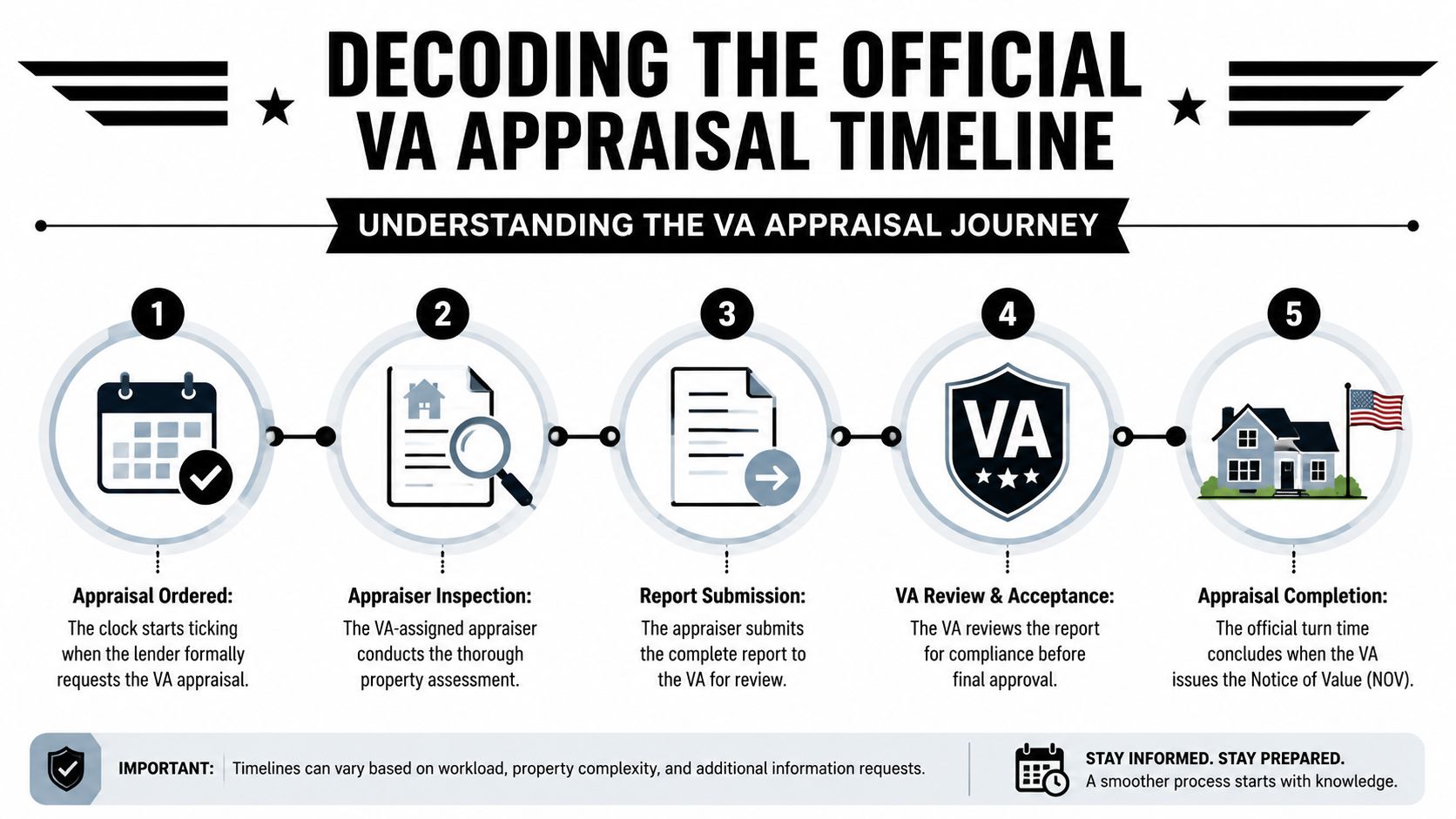
The official clock does not start when the offer is accepted. It does not start when the lender says the appraisal has been requested. It starts after the appraisal is assigned, with the first business day counted next. Weekends and federal holidays do not count toward that timeliness standard.
That distinction causes confusion all the time, especially in faster California markets where buyers, sellers, and agents are all watching the same closing date from different angles.
The official range
VA timeliness standards give you a benchmark, not a closing guarantee. California is generally treated as a shorter-turn state compared with some other parts of the country, but the published target still applies only to the appraiser's completion window. It does not mean every file is clear to close the moment the inspection happens or the report is uploaded.
In practice, I tell buyers to separate three different dates in their mind:
| Milestone | What it means |
|---|---|
| Assignment date | The VA system assigns the order to an approved appraiser |
| Inspection date | The appraiser gets into the property and gathers what is needed on site |
| Report and value issuance | The written appraisal is submitted, reviewed through the process, and the value is finalized |
That separation matters.
A borrower might hear that the inspection is scheduled for Friday and assume the hardest part is over. Sometimes it is. Sometimes the actual waiting starts after the property visit, especially if the report needs follow-up support, revisions, or final value issuance.
What the timeline actually covers
The appraisal timeline is a chain of handoffs. Each handoff has its own pressure point.
First, the order is assigned. Then the appraiser has to make contact and get access arranged. After the inspection, the appraiser still has to analyze comparable sales, complete the report correctly, and submit it through the required system. The file then moves toward the Notice of Value.
That is why “the appraiser already went out” is helpful news, but not final news.
In California, this matters more than many buyers expect. A condo in San Diego, a hillside property in Los Angeles, and a rural home outside the Central Valley do not move through the process with the same speed, even when everyone is doing their job.
Why the math feels off
Business-day counting creates a gap between the official timeline and the calendar sitting in front of you. A file assigned before a holiday weekend can feel stuck, even if it is still technically inside the standard window.
That gap gets expensive fast in California. Rate locks, seller patience, rent notices, and moving schedules all run on calendar days. The VA timeliness framework does not.
The practical takeaway is simple.
Track the appraisal by stage, not by one date on the calendar. If you know whether the file is waiting on assignment, access, inspection, report completion, or final value issuance, you can judge the actual risk to your closing instead of guessing.
Why Your Appraisal Might Be Delayed
A VA appraisal usually slows down at a few predictable points. In California, those slowdowns hit harder because purchase contracts are often tighter, sellers expect quick progress, and even a short stall can put pressure on your rate lock or closing date.

Appraiser workload
The first issue is simple supply and demand. In parts of California, especially around San Diego, Los Angeles, Orange County, and high-volume military markets, there are periods when too many files are chasing too few available VA appraisers.
That does not mean anyone mishandled the file. It means your appraisal lands in a queue, and the queue gets longer during busy seasons, holiday weeks, and spikes in purchase activity.
I see this most often when borrowers assume a strong offer and clean file will automatically mean a fast appraisal. It helps, but it does not change appraiser capacity.
Property complexity
Some properties take longer to evaluate because the value case is harder to support. A standard suburban home with plenty of recent comparable sales usually moves faster than a rural property, a custom home, or a condo with limited matching sales.
California creates this problem more often than buyers expect. Hillside homes, mixed-use areas, older neighborhoods with wide value swings, and condo projects with inconsistent sales history all require more analysis. The appraiser may need extra time to sort through comparable sales, adjustments, and property-specific details before the report is ready.
A slower appraisal in that situation is not always a red flag. Sometimes it is the sign of a careful report.
Condition issues and repairs
Condition problems are one of the biggest reasons a file falls behind schedule. If the home does not meet VA property standards, repairs may be required before the file can move forward cleanly.
The practical problem is not just the repair itself. The main delay usually comes from coordinating the work, getting receipts or proof of completion when needed, and waiting for the return inspection.
Common issues include:
- Peeling paint or visible damage: This shows up often in older California homes.
- Missing handrails or safety items: Small defects can still trigger repair conditions.
- Blocked or locked areas: The appraiser needs access to key parts of the property.
- Utilities not on or systems not working: If the home cannot be fully evaluated, the report can stall.
A repair item can be minor. The scheduling impact usually is not.
Access and coordination problems
Sometimes the property itself is fine, but getting into it becomes the bottleneck. Occupied homes, tenant scheduling issues, gate codes that do not work, or listing agents who respond slowly can all push the inspection back.
This comes up a lot in California duplexes, tenant-occupied properties, and homes with complicated showing restrictions. If the appraiser cannot get timely access, the rest of the timeline does not matter yet.
Regional backlogs and seasonal pressure
Certain parts of the state run hotter than others. Military PCS season, spring and summer buying waves, and local appraiser shortages can create regional backlogs even when the file is otherwise clean.
That is why a buyer in Fresno may have a different experience than a buyer in San Diego or Riverside. Same VA program. Different local pressure.
The practical takeaway is to build margin into the contract whenever possible. In California, the appraisal should never be treated as the step that will somehow make up lost time elsewhere in the transaction.
The Key Players And Their Roles
A lot of borrower frustration comes from asking the right question to the wrong person. The VA appraisal process works better when you know who controls what.
The appraiser
The VA-assigned appraiser is an independent third party. Their job is to assess the property's value and determine whether it meets VA property standards. They are not part of your agent's team, the seller's team, or the lender's team.
That independence is important. It protects the credibility of the valuation. It also means nobody gets to pressure the appraiser for a faster answer or a higher number just because the closing date feels tight.
The lender
Your lender is the coordinator. This is the party that orders the appraisal through the proper channel, tracks milestones, receives updates, and keeps the file moving on the financing side.
The lender can't call and demand special treatment. What a good lender can do is remove preventable delays by making sure the order is complete, communicating quickly, and pushing for clarity when the file stalls. When borrowers want updates, this is usually the right first call.
The Department of Veterans Affairs
The VA sets the rules, oversees the process, and establishes timeliness standards and fee schedules. In California, the VA also sets the maximum appraisal fee structure rather than leaving that number open-ended.
Here's the practical split:
| Party | Main role | What they don't control |
|---|---|---|
| Appraiser | Value opinion and property review | Loan approval or contract terms |
| Lender | Ordering, tracking, communication | The appraiser's independent judgment |
| VA | Rules, oversight, fee and timeliness standards | Day-to-day contract negotiations |
Where bottlenecks happen
Most problems show up at the handoff points.
- Between lender and appraiser: missing data or access coordination
- Between appraiser and property: scheduling problems or condition issues
- Between report and next decision: follow-up questions, repairs, or value concerns
If you want fewer surprises, ask who currently has the file and what they're waiting on.
That question cuts through a lot of vague status updates.
Your Proactive Checklist to Avoid Appraisal Delays
The best way to handle VA appraisal turn times is to do the boring prep work early. Most delays that feel sudden were visible in advance.
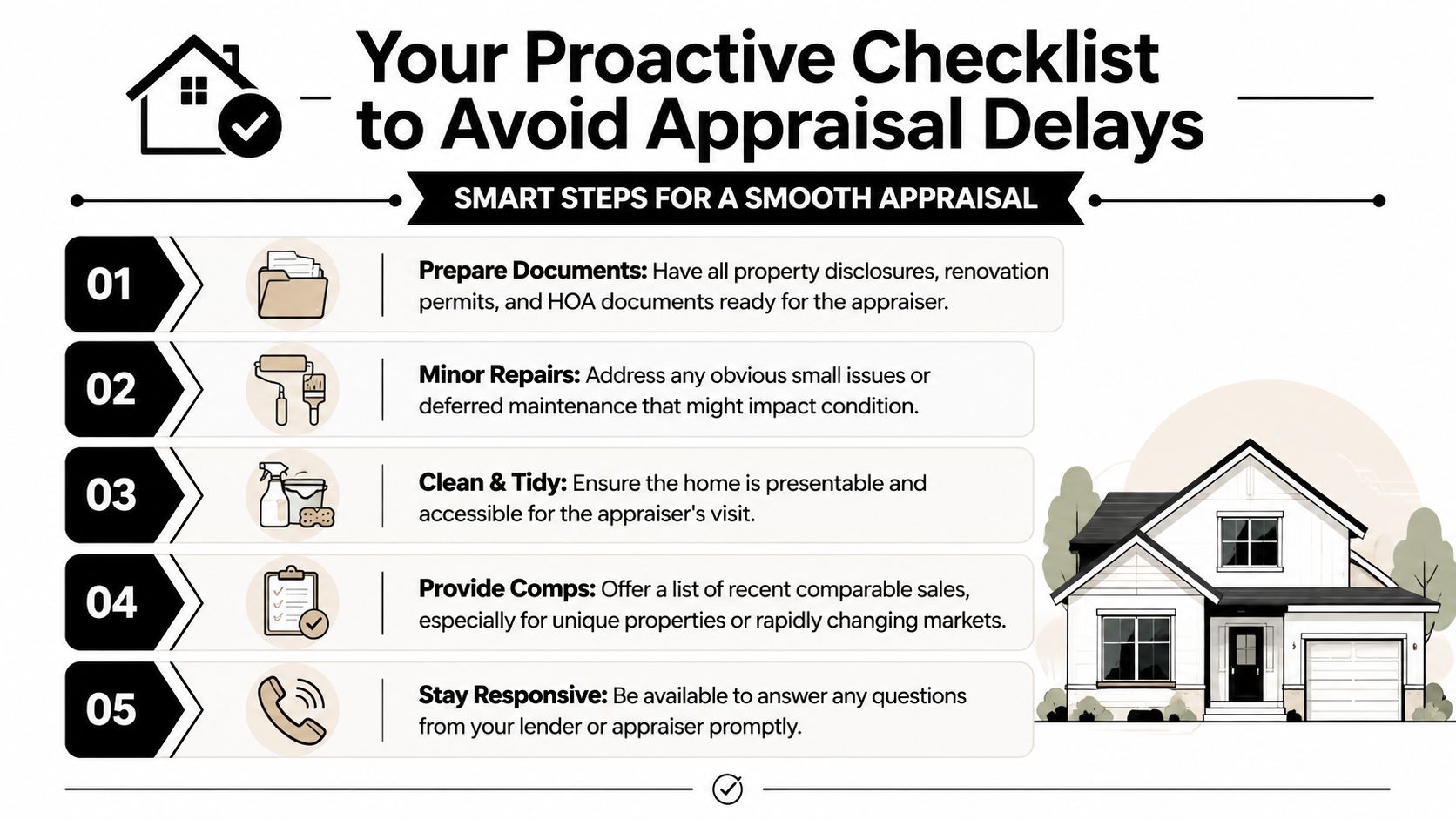
If you're worried about a value shortfall as much as timing, it also helps to understand how appraisal gap coverage works before the report lands. That way, you're not trying to learn the options while everyone is waiting for your answer.
Before the appraiser visits
Handle the access and paperwork issues first. These are the easiest problems to solve and the most frustrating ones to ignore.
- Confirm property access: Make sure the listing agent, tenant, or seller knows the appraiser needs timely entry. Delayed scheduling often starts here.
- Gather useful documents: Permits, HOA information, and records for major improvements can help support a cleaner review on properties with added complexity.
- Make sure the home is fully accessible: Garages, outbuildings, attics, and crawlspaces shouldn't be blocked if they need to be reviewed.
Clean up visible condition concerns
No one needs to remodel a house for an appraisal. But obvious condition issues deserve attention before the appointment.
Some sellers treat VA standards like a mystery. They aren't. If something looks unfinished, unsafe, or neglected, it may create a condition note that slows the file. Small repairs done early are usually cheaper than a delayed closing.
- Address minor safety items: Missing handrails and similar defects can become easy reinspection triggers.
- Handle visible deferred maintenance: Peeling paint, broken fixtures, and damaged areas should not be left as “we'll deal with it later.”
- Present the home well: Cleanliness doesn't determine value, but a tidy, accessible home helps the appraiser move efficiently.
Strong appraisal prep is less about impressing the appraiser and more about eliminating excuses for delay.
Stay ready if value gets tight
In California markets, value support matters. If the neighborhood is changing fast or the property is unusual, your agent should already be thinking about recent comparable sales before there's a problem.
That's especially true in competitive areas where a contract price may move ahead of what closed sales clearly show. The best time to prepare a comp package is before anyone asks for one.
Keep communication tight
This part sounds simple, but it's where many files lose time.
- Answer lender requests quickly. A same-day response is better than letting a minor question age overnight.
- Ask for milestone updates. You want to know whether the file is waiting on assignment, inspection, report completion, or a follow-up item.
- Don't assume silence means progress. Sometimes silence just means no one has pushed the next step.
VA Appraisals A Closer Look at California
California doesn't behave like a generic national market. That's true for pricing, contract speed, housing stock, and appraisal pressure.
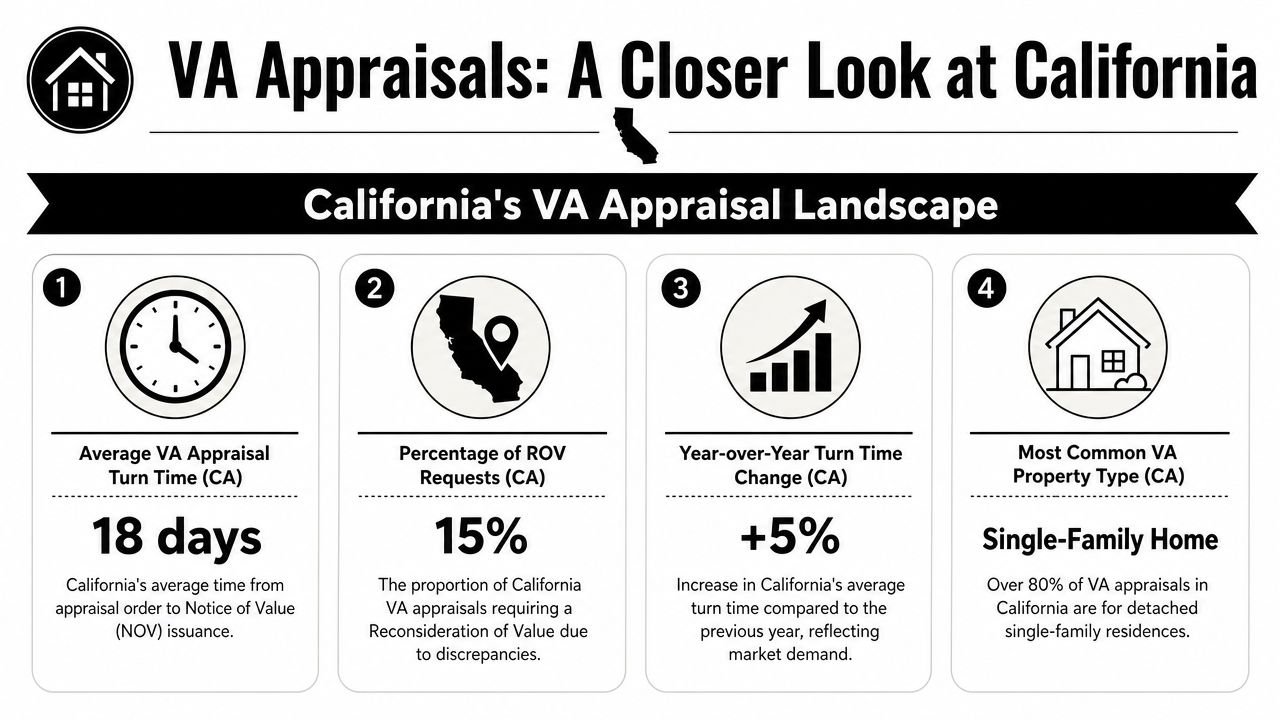
One practical difference is cost. In California, the Department of Veterans Affairs sets a maximum appraisal fee of $750 for standard properties in major counties such as Los Angeles, Orange, Sacramento, and San Diego, while fees can rise to $950 in certain rural or high-cost parts of the state, according to the VA's official appraisal fees and timeliness table.
If you're also comparing the appraisal to a separate property review, it helps to know how a VA home loan home inspection fits into the larger transaction. Buyers often blur those two steps together, and they solve different problems.
Why California buyers feel more pressure
California appraisals often carry extra pressure because the market can move faster than the comparable sales history. In hot neighborhoods, the contract price may reflect current competition while the appraiser still has to support value with closed sales and defensible adjustments.
That can create friction in places like Los Angeles, Orange County, and San Diego where homes attract strong attention and buyers need answers quickly. It also shows up in very different ways across the state. A suburban tract home, a mountain property, a rural home, and a coastal condo don't move through the same valuation environment.
Fees are regulated, but timing still varies
The fee cap helps create predictability on cost. Timing is another story.
California has a published timeliness requirement that looks fast on paper, but practical turn times still depend on local appraiser availability, property type, access, and whether the file turns into a value debate. A fee schedule can be standardized. Real-world workflow cannot.
California-specific pressure points
| California factor | Why it matters |
|---|---|
| Competitive metro pricing | Value support can be harder when contracts move ahead of recent closed comps |
| Older housing stock | Condition notes are more likely on homes with visible deferred maintenance |
| Wide property variation | Condos, hillside homes, rural parcels, and unique layouts take more analysis |
| Regional differences | What works in Sacramento may not look the same in San Diego or a rural county |
The practical answer for California buyers is to treat the appraisal as a local-market event, not a national average.
Common VA Appraisal Questions Answered
How does the Tidewater Initiative affect my closing in a competitive California market
The Tidewater Initiative gives estate agents a 48-hour window to provide additional comparable sales if the appraiser believes the initial valuation may come in low, according to this VA Loan Network explanation of the Tidewater process.
That short window matters a lot in California. If your agent has strong comps ready, Tidewater can function as an early chance to support the contract price. If the response is slow or weak, the dispute can deepen and your closing can slide.
Tidewater isn't the end of the deal. It's the moment when preparation either helps you or exposes you.
What if the appraisal comes in below the purchase price
You still have options. The buyer and seller can renegotiate the price, the buyer can cover some or all of the gap with their own funds, or the parties can meet somewhere in the middle.
The right move depends on the property, the strength of the comps, and how motivated each side is to keep the transaction alive. In California, a low appraisal doesn't always kill the deal, but it does force quick decisions.
Can I talk to the appraiser directly
In practice, communication usually runs through the lender and the agents involved in the transaction. Borrowers should avoid treating the appraiser like a negotiator. That approach rarely helps and can create more confusion than clarity.
A better move is to give your lender and agent what they need quickly, especially if they're gathering supporting documents or comparable sales.
Is a fast inspection date the same thing as a fast appraisal
No. The site visit is only one milestone. The file still needs report completion and the next administrative steps after that. Buyers often relax when the inspection gets scheduled quickly, then get frustrated when the final outcome still takes longer than expected.
What's the best way to protect my closing date
Stay close to the milestones, not the rumors. Ask when the appraisal was assigned, whether access has been confirmed, whether any condition concerns are expected, and whether your market carries value risk. Those answers are more useful than generic promises.
If you're buying in California and want steady guidance from a team that serves veterans, active-duty military, first responders, teachers, healthcare professionals, law enforcement, firefighters, pilots, and other public service heroes, connect with California Loans for Heroes. Their team guides California buyers through the mortgage process with one-on-one support, homebuyer assistance options, and practical guidance built for real transactions, not generic national advice.