You're working long shifts, paying California rent, carrying student loans, and watching home prices move faster than your savings account. A lot of nurses assume that buying a home has to wait until the debt is gone.
That's usually the wrong conclusion.
If you're a California nurse with federal student loans and you work for a hospital, clinic, or public health employer that may qualify for Public Service Loan Forgiveness, you may already have a path to stronger mortgage approval than you think. The key isn't just finding home loans for nurses. It's using your student loan strategy to improve how a lender sees your monthly obligations.
Most guides miss that intersection. They talk about PSLF in one lane and mortgages in another. In real life, those two decisions affect each other every month.
What PSLF Is and Why It Matters for Nurses
A lot of California nurses feel boxed in by a simple math problem. Good income, heavy debt, expensive housing. That combination makes people think homeownership is off the table.
It isn't. But you need to treat PSLF as a financial planning tool, not just a forgiveness program.
Think of PSLF as a long game reward
Public Service Loan Forgiveness works like a loyalty program for public service. You make qualifying payments while working for a qualifying employer, and after the required track record, the remaining eligible federal student loan balance can be forgiven.
For nurses, that matters because many common career paths already line up with the kind of employment PSLF is built around. If you work in a public hospital system, a nonprofit healthcare setting, or a government-linked care environment, you may already be on the right road. The problem is that many nurses never organize their repayment plan around that reality.
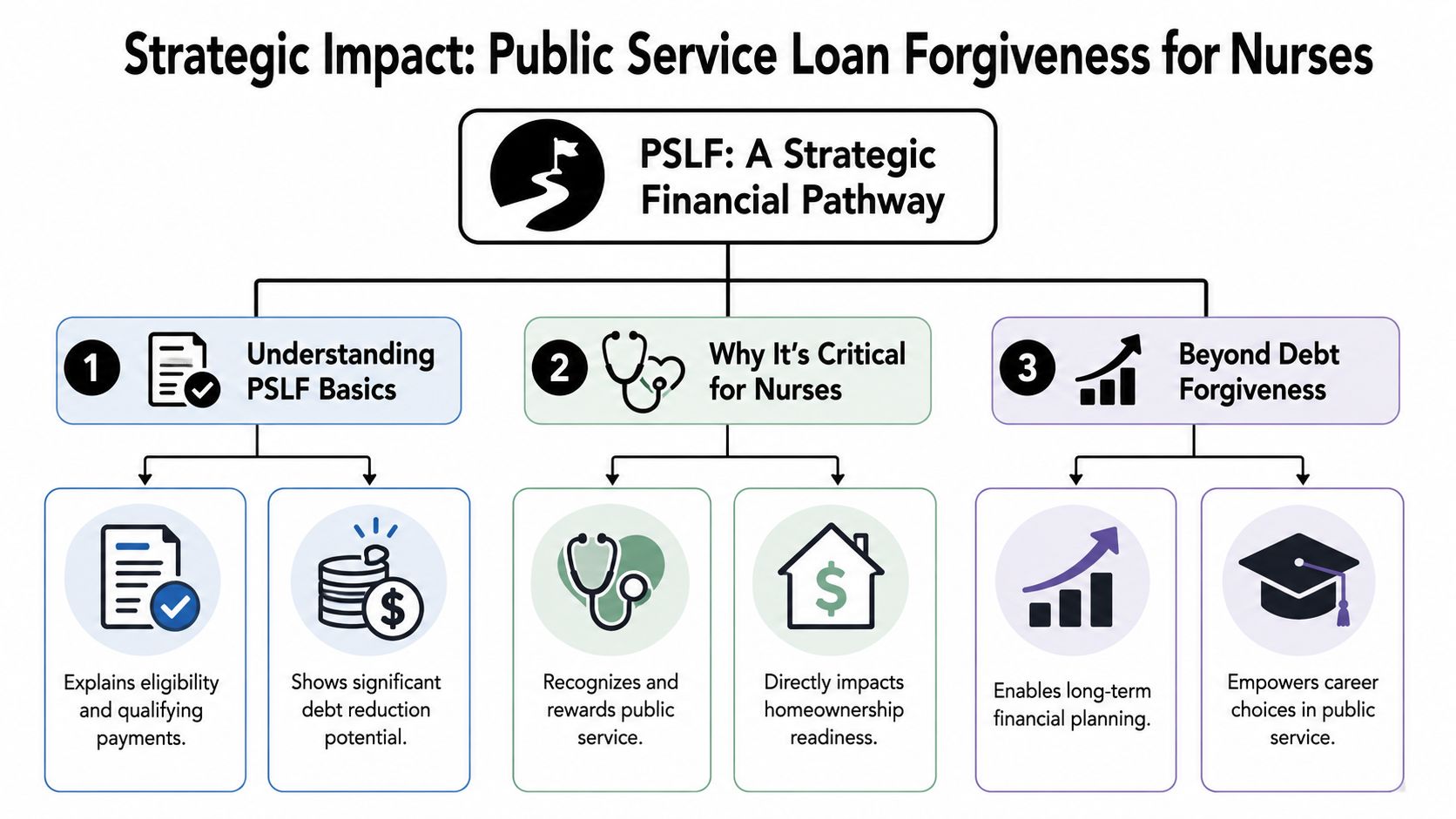
Why this changes the home buying conversation
If PSLF is part of your plan, you stop making decisions as if your only goal is to crush student debt as fast as possible. That mindset can backfire when you're trying to buy in California.
Here's why:
- Lower required payments matter: If you're on an income-driven repayment plan tied to PSLF, your required monthly student loan payment may be lower than on a standard repayment schedule.
- Lower monthly obligations help mortgage approval: Mortgage underwriting cares about your payment burden now, not your moral commitment to becoming debt-free someday.
- Cash reserves matter in California: Keeping more money available for closing costs, prepaid items, moving expenses, and emergency savings is often smarter than overpaying student loans that may eventually be forgiven.
Practical rule: If you may qualify for PSLF, don't aggressively prepay federal loans before you understand how that choice affects mortgage qualification.
Why nurses are in a strong position
Nursing is one of the few professions where the career path and the loan strategy often fit together naturally. A nurse can build income, maintain job stability, pursue forgiveness, and improve home buying readiness at the same time.
That's why I tell nurses to stop thinking in isolated buckets. Your job, your student loans, and your mortgage application are part of one financial system. If you approach them separately, you make expensive mistakes.
If you want a broader overview of lender options for healthcare professionals, review these California home loan resources for nurses and healthcare professionals. Then come back to the student loan side with the same level of discipline.
Confirming Your PSLF Eligibility in California
PSLF only works if three separate pieces line up. Think of them as three keys. If one key is missing, the door doesn't open.
A lot of nurses assume they qualify because they work in healthcare. That's too loose. You need to verify employer, loan type, and payment setup.
Key one is your employer
Your job title doesn't qualify you. Your employer type does.
In California, many nurses work for organizations that may fit PSLF rules, such as public systems, county health departments, and nonprofit hospital employers. Others work for for-profit medical groups, staffing companies, or private practices that may not qualify. Two nurses can do nearly identical work in similar scrubs and only one may be on a PSLF-eligible path.
Use your HR documents, tax forms, and employer status details to confirm exactly who employs you. Don't rely on assumptions based on the hospital brand alone.
If your paycheck comes from a different entity than the facility where you work, verify that entity first. That's the employer that matters.
Key two is your federal loan type
Not every federal student loan setup is equally useful for PSLF. Nurses who borrowed years ago sometimes still have older federal loan structures that need cleanup before payments count the way they expect.
People often lose years.
If your loans need to be consolidated into a qualifying Direct Loan structure, handle that before you build your home buying timeline around forgiveness progress. Waiting until you're halfway through a mortgage preapproval is sloppy and avoidable.
Key three is your repayment setup and payment history
PSLF doesn't reward random payments. It rewards qualifying payments made under the right conditions while you're working for the right employer.
That means your repayment plan matters. Your documentation matters. Your timing matters.
Use this quick self-check:
- Employer check: Is your actual employer a government or nonprofit entity?
- Loan check: Are your federal loans set up in a way that can qualify for PSLF?
- Payment check: Are you making qualifying payments under the right repayment framework while employed in a qualifying role?
If any answer is “I'm not sure,” fix that now, not later.
For nurses employed by county hospitals, state systems, and other public-sector entities, these California government employee home loan programs can also be relevant when you're aligning job status with mortgage planning.
The cleanest move
Keep a file with your employment certifications, repayment records, and loan details in one place. When you eventually apply for a mortgage, you'll want a clean paper trail anyway. PSLF discipline and mortgage discipline are closely related. Organized borrowers move faster and make better decisions.
How PSLF Boosts Your Home Loan Qualification
You finish a 12-hour shift, check your mortgage numbers, and the student loan payment is what kills the deal. Then you switch to the right income-driven repayment plan for PSLF, and the payment a lender counts drops enough to change the entire approval picture.
That is the connection too many nurses miss.
PSLF can improve your mortgage qualification because the repayment plan tied to PSLF often lowers the monthly student loan payment used in debt-to-income calculations. Lower counted debt can mean a better DTI, more room for a housing payment, and a stronger preapproval.

Why income-driven repayment matters
For a California nurse pursuing PSLF, the repayment plan is not just a student loan decision. It is a home buying decision.
Lenders qualify you based on monthly obligations they can document right now. They do not care that your balance may be forgiven later. They care about the payment showing on your credit report, loan statement, or verification documents. If your required student loan payment is lower under an income-driven plan, your file often looks better in underwriting.
That changes real numbers, not just theory.
A lower counted student loan payment can improve these parts of your application:
| Mortgage factor | Higher student loan payment | Lower student loan payment |
|---|---|---|
| Monthly debt burden | Heavier | Lighter |
| DTI ratio | Higher | Lower |
| Room for housing payment | Smaller | Larger |
| Approval flexibility | Tighter | Better |
Why this matters more in California
California housing costs punish sloppy debt planning. A student loan payment that feels manageable on its own can still reduce your buying power enough to knock you out of the price range you want.
That is why PSLF and mortgage planning should be handled together. If you work for a qualifying hospital system, county employer, VA facility, or nonprofit health organization, an IDR plan may help you stay on track for forgiveness while also making your mortgage application cleaner.
Then you can focus on the other side of the deal, cash to close. Programs that help with upfront funds can matter just as much as DTI, especially in high-cost markets. Review your California down payment assistance options for homebuyers alongside your PSLF repayment setup, not after.
My advice
Do this before you tour homes.
Ask your loan advisor one direct question: What student loan payment are you using for qualification, and how are you calculating it? Then confirm your current PSLF repayment plan supports the lowest legitimate payment available under your federal options.
If you are PSLF-eligible and still carrying a higher payment than necessary, fix that first. House hunting before you correct your DTI is poor planning.
Unlocking California Home Loan Programs for Nurses
A lot of California nurses can qualify for the payment. The deal falls apart on cash to close.
That is the part you need to solve with precision, especially if you are already using PSLF and an income-driven repayment plan to keep your monthly debt low for mortgage qualification. Lower DTI helps you get approved. Assistance programs help you get to the closing table. You need both pieces working together.
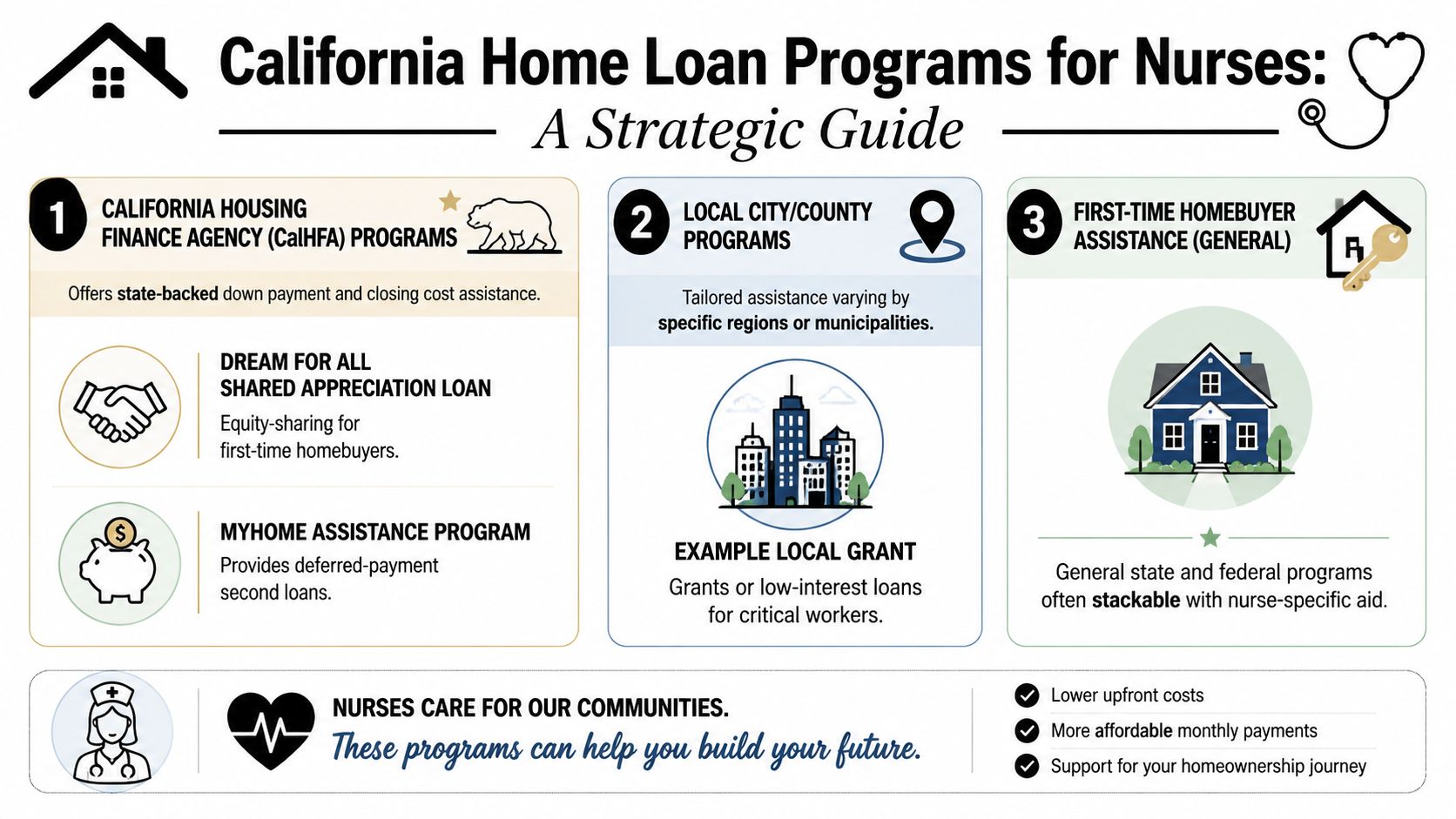
Nurse-specific help can ease the cash squeeze
Some nurse-focused programs help with closing costs, prepaid items, or down payment funds. The value is not just the dollars. The structure matters.
A grant helps immediately because it does not add another payment. A deferred second lien can also be useful because it may preserve monthly cash flow while you are adjusting to a California mortgage, student loan obligations under PSLF, commuting costs, and everything else that hits your budget in the first year of ownership.
I tell nurses to read the fine print before they get attached to a headline amount. Check whether the assistance is repayable, deferred, forgivable, or due when you sell or refinance. Those details decide whether the program helps you or just shifts the cost into the future.
CalHFA Equity Builder is a different tool
CalHFA assistance is often stronger for first-time buyers who need meaningful support and expect to stay in the home long enough to benefit from the program terms. It is not the same as a simple grant, and you should treat it that way.
The question is fit. If your PSLF strategy already lowered your student loan payment and improved your DTI, a larger state assistance program may be the piece that finally makes the purchase workable. If your file is still tight on debt ratios, no amount of excitement about down payment aid fixes the underlying approval problem.
Here is the practical comparison:
| Program | Main benefit | Best use case | What to watch |
|---|---|---|---|
| Nurse-focused assistance | Can reduce cash needed at closing and may include deferred support | Buyer who is short on upfront funds and wants to protect monthly budget | Repayment terms, second-lien rules, program layering |
| CalHFA Equity Builder Loan | Larger assistance tied to first-time buyer eligibility and occupancy rules | Buyer planning to stay put and meet the forgiveness conditions | Eligibility details, timelines, property rules |
Combining programs is where files get messy
This is the point where buyers make preventable mistakes. They hear about FHA, a nurse program, CalHFA help, and a low student loan payment under PSLF, then assume everything can be stacked without issue.
Sometimes it can. Sometimes it cannot.
Layered aid has rules. So does the first mortgage. So does the assistance provider. My team at California Loans for Heroes reviews those pieces together because the wrong combination can delay underwriting, change your required cash, or kill the deal after you are already in contract. Before you write an offer, review the current California down payment assistance programs for homebuyers with someone who understands how these benefits interact.
My recommendation on choosing a path
Pick the program that fixes the actual weak spot in your file.
- If cash to close is the main problem: Start with assistance that reduces upfront funds or limits added monthly payment pressure.
- If you are a first-time buyer planning to stay in the home: Look closely at CalHFA options and the forgiveness terms.
- If student loans are still hurting approval: Rework the PSLF and IDR side first. Then price the home search around the new qualification numbers.
- If you want to combine multiple programs: Get a loan strategy reviewed before you commit to a property.
The right home loan plan for a California nurse is not the one with the biggest marketing number. It is the one that clears underwriting, keeps your budget stable, and still looks smart after move-in.
Avoiding Common PSLF Pitfalls on Your Path to Homeownership
You are six months from buying in California. Your credit is solid. Your income is strong. Then preapproval gets messy because your student loan file is wrong, your employer does not qualify for PSLF, or your payment on paper is higher than it should be.
I see this constantly with nurses.
PSLF mistakes hurt you twice. They put loan forgiveness at risk, and they can make your mortgage approval harder because the lender is underwriting the student loan payment you can document today, not the forgiveness you hope to receive later. For California nurses, that is the whole strategy. Set up PSLF and income-driven repayment correctly, and you can lower your debt-to-income ratio in a way that directly improves home loan options.
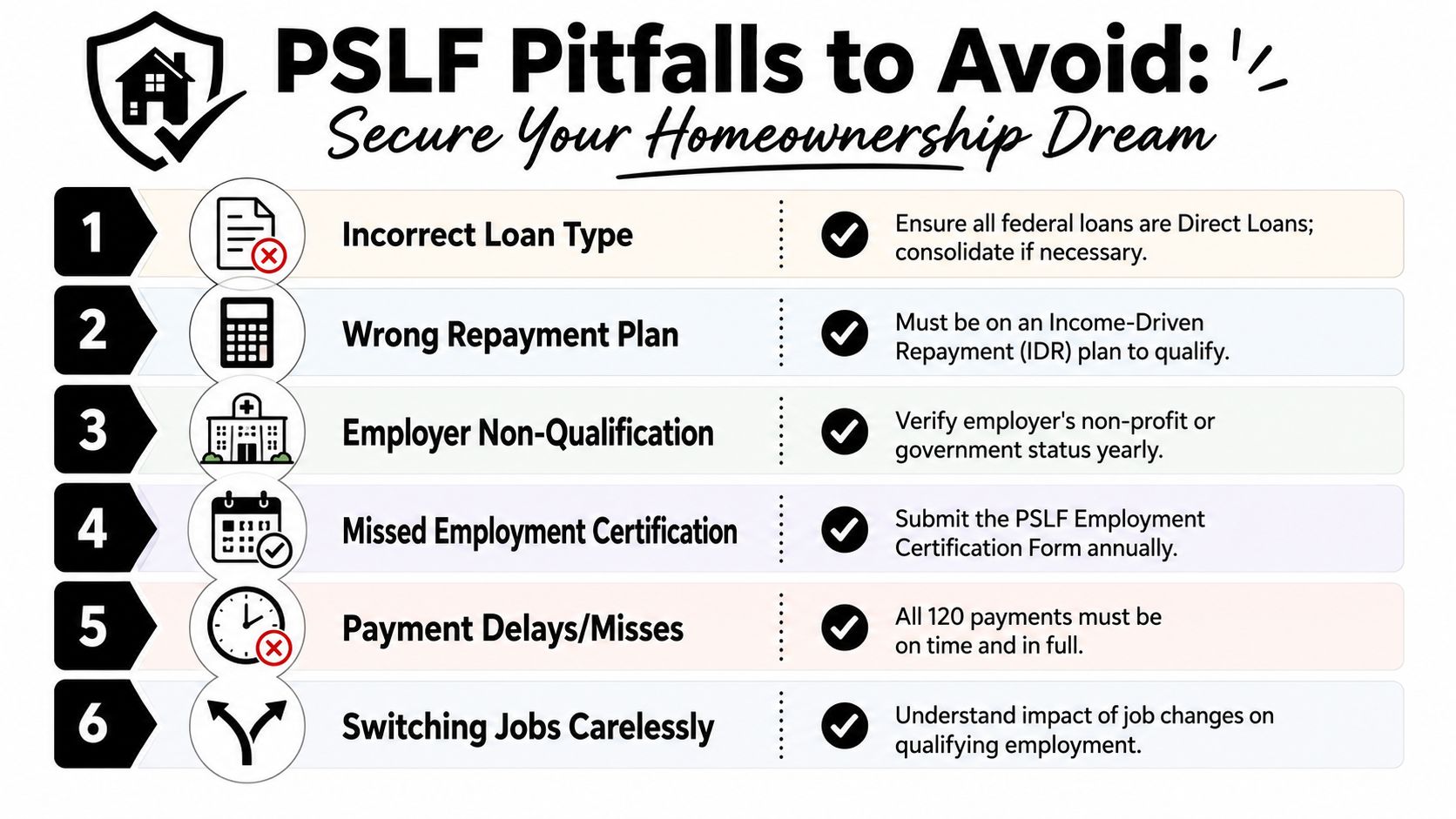
The mistakes that cause the most damage
These are the problems that create the biggest underwriting headaches.
- Assuming the hospital qualifies, without checking the employer entity: The building you work in is irrelevant if your paycheck comes from a private staffing company.
- Leaving federal loans in the wrong structure: If your loans are not set up properly for PSLF, your payment history may not count the way you think it does.
- Using a repayment plan that hurts mortgage qualification: A higher required payment can push your DTI up and reduce buying power, even if PSLF is still your long-term goal.
- Ignoring annual employment certification: Errors sit there until you are trying to buy a house and need clean documentation fast.
- Changing jobs without running the PSLF math first: A pay increase can still be a bad move if it breaks qualifying employment or raises your documented monthly obligations.
What to do instead
Run a PSLF audit before you shop for homes.
Use this checklist:
- Confirm the legal employer name every year. Mergers, payroll changes, and contract arrangements can change your PSLF status.
- Review your federal student loan setup before preapproval. Fixing problems early gives you time to adjust your repayment plan and document the right payment.
- Keep your PSLF records in one place. Save employment certifications, servicer notices, payment confirmations, and any correspondence about repayment plan changes.
- Review job offers through both a PSLF lens and a mortgage lens. The right question is not just salary. It is whether the change helps or hurts forgiveness and home loan qualification.
- Check assistance layering rules before you go under contract. Down payment help, first mortgage rules, and program eligibility all need to work together.
That last point matters more than borrowers expect. California nurses often qualify for multiple forms of help, but stacking aid is never automatic. Each program has its own rules, and lenders also have their own documentation standards. Stay current on HUD and program-specific requirements for layered assistance, and have the full structure reviewed before you commit to a purchase contract.
Clean files close faster. The nurse with clear PSLF records, a documented income-driven payment, and a fully reviewed assistance plan usually has the easier path through underwriting.
My blunt advice
Do not treat PSLF as a side project.
If homeownership is the goal, PSLF administration is part of mortgage preparation. Get the employer right. Get the repayment plan right. Get the paperwork organized. In California, that work can be the difference between barely qualifying and having options.
Frequently Asked Questions about Home Loans and PSLF
Does per diem or registry work qualify for PSLF
It depends on the employer on your paycheck.
If you pick up shifts directly for a government hospital or nonprofit health system, you may still qualify for PSLF. If a private staffing company or registry employs you, that usually changes the answer. Check the legal employer entity, not the hospital floor where you work. California nurses miss this point all the time, and it can cost them both forgiveness progress and homebuying timing.
Do mortgage lenders give me credit for future PSLF forgiveness
No. Underwriters qualify you based on the payment you owe now, not the balance that may disappear later.
That is why PSLF strategy matters so much for home buying. If you are on an income-driven repayment plan with a properly documented monthly payment, that lower payment can improve your debt-to-income ratio and make qualification easier. For California nurses carrying large federal loan balances, that is often the difference between getting approved comfortably and getting squeezed out by DTI.
Can I still use home loans for nurses if I'm not a first-time buyer
Yes, sometimes.
Some programs are first-time-buyer only. Others are open to repeat buyers or depend on how long it has been since you owned a home. Review each program one by one. Do not rule yourself out early, and do not assume every nurse-focused option is available either.
Can Nurse Next Door help if I'm short on cash at closing
It can. As noted earlier, the Nurse Next Door Program is one of the options worth reviewing if cash to close is your main problem.
The bigger issue is fit. Assistance only helps if it works with your first mortgage, your income, your property type, and any other California aid you plan to use. Get the full structure reviewed before you write an offer.
Should I pay extra on federal student loans before buying a house
Usually no, if PSLF is part of your plan.
Extra payments reduce cash reserves and often do little for mortgage qualification. A better move is to protect your down payment funds, keep your emergency savings intact, and make sure your repayment plan is set up in a way that supports both PSLF and mortgage underwriting. For many California nurses, liquidity beats aggressive prepayment.
What should I do first if I want to buy within the next year
Start with a coordinated review of three things:
- Your employer's PSLF status
- Your federal student loan repayment plan
- Your true mortgage budget, including cash to close
Handle those early. If your employer qualifies, your payment is documented correctly, and your budget is realistic for California, you can shop with a real strategy instead of reacting to underwriting surprises later.
California nurses do not need generic mortgage advice. They need a plan that connects PSLF, student loan payments, and home loan approval in the same conversation. California Loans for Heroes helps California heroes, including nurses and healthcare professionals, with home loans, homebuyer assistance, down payment options, and one-on-one guidance built for real-life buying decisions. If you want a clearer path to homeownership in California, start the conversation.