
The most popular advice about home loans for government employees is also the least useful: “Ask for the special government-worker mortgage.” In California, that usually isn't the real question. Public servants generally qualify for the same mainstream loan types as other borrowers. What changes the approval outcome is how a lender reads your pay structure, recurring allowances, employment history, debt obligations, and relocation risk.
That distinction matters because government compensation often includes more than base salary. A teacher may receive documented summer-school income. A firefighter may earn shift differentials or overtime. A state employee may receive locality pay, hazard pay, performance bonuses, special duty pay, or longevity increases. If those items are properly documented and expected to continue, they can strengthen qualifying income. If they're inconsistent or poorly supported, the lender may exclude them.
The practical approach is straightforward. Build the strongest income file, calculate the DTI, compare lender overlays, then check whether California assistance or a rate concession improves the payment enough to matter. That's the framework that helps public employees make a sound mortgage decision.
Why Government Employment Matters More for DTI Than for Special Loan Types
Government employment can help a mortgage application, but not because every public employee receives access to a separate loan category. The stronger advantage is usually income stability and documentation, provided the lender can verify the income and its expected continuance.
Underwriting focuses on repayment capacity. Lenders review gross qualifying income, monthly housing costs, recurring debts, credit history, assets, property value, and employment continuity. A government job may make the employment story easier to document, but it doesn't override those fundamentals.
The income question lenders actually ask
Base salary is only one part of the analysis. Depending on the loan and the lender, documented overtime, shift differentials, locality pay, hazard pay, performance bonuses, special duty pay, and longevity or step increases may be included in qualifying income when there's a verifiable history and a reasonable expectation that the income will continue. That can increase effective qualifying income without changing the employee's grade or pay scale, as explained in this guide to income treatment for government employees.
The result is simple. Higher qualifying income can reduce the apparent pressure from existing monthly debts, which may improve back-end DTI and borrowing capacity. But an underwriter won't count an allowance merely because it appears on one pay stub. Documentation and consistency matter.
Stability helps, but overlays still apply
A lender may view public-sector employment as a stability signal, yet the borrower still has to satisfy the lender's rules. One bank may accept a documented variable-pay history that another lender excludes. One lender may be comfortable with a transfer or temporary assignment, while another may request more employment documentation.
That's why the phrase government employee mortgage can mislead borrowers. The decisive issue is rarely the label on the job. It's the quality of the income file and the lender's interpretation of the borrower's financial profile.
Practical rule: Don't shop only for an occupation-based discount. Shop for a lender that understands which parts of your compensation can be counted and how those items affect DTI.
California Loans for Heroes can help public employees organize the income details lenders scrutinize, compare available loan structures, and identify assistance options without assuming that a special occupation label solves the underwriting problem.
Understanding DTI and Its Front-End and Back-End Components
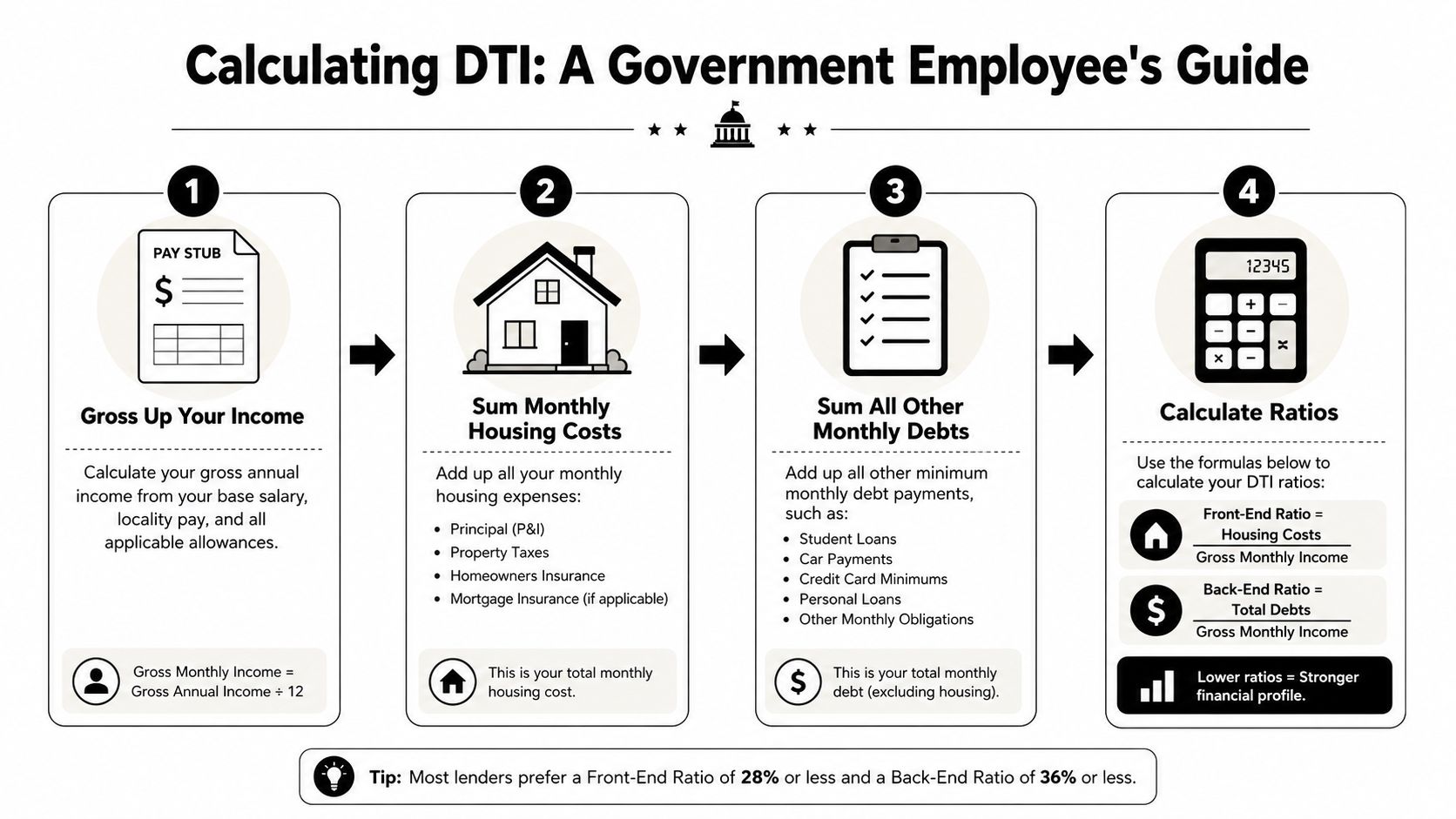
Debt-to-income ratio, or DTI, compares monthly debt obligations with gross monthly income. Lenders use it to judge how much of your income would be committed after closing. The calculation uses gross income rather than take-home pay, because underwriting follows standardized qualifying rules.
The front-end ratio isolates housing expenses. The back-end ratio includes housing plus other recurring debts. Both matter, but the back-end ratio often creates the tighter constraint for public employees carrying student loans, vehicle financing, or credit-card balances.
Front-end DTI focuses on the proposed home
Front-end DTI generally includes the projected monthly housing payment:
- Principal and interest: The scheduled mortgage payment.
- Property taxes: The lender's qualifying estimate for the home.
- Homeowners insurance: Required coverage included in the housing obligation.
- HOA dues: Applicable association fees for the property.
To calculate it, divide the total monthly housing cost by gross monthly income. If gross qualifying income includes eligible allowances, the ratio may improve. If the lender excludes those items, the same house produces a higher front-end ratio.
Back-end DTI includes the whole household balance sheet
Back-end DTI adds recurring obligations such as car loans, student loans, credit-card minimums, personal loans, and other debts that appear in underwriting. Think of gross income as a household budget pie. The proposed housing payment takes one slice, existing debts take additional slices, and the lender evaluates how much remains for ordinary living expenses and financial shocks.
A borrower with modest housing costs can still fail the back-end test if existing debt is heavy. That's common among teachers with education loans, younger public employees with auto financing, and households supporting other obligations.
Why the distinction affects your strategy
Reducing the housing payment can improve both ratios, but paying down a recurring non-housing debt may have a larger effect on the back-end calculation. Before applying, request a complete debt review and ask the lender to identify which obligations are counted, how student loans are treated, and whether documented supplemental pay can be used.
How to Calculate DTI With Government Employee Income
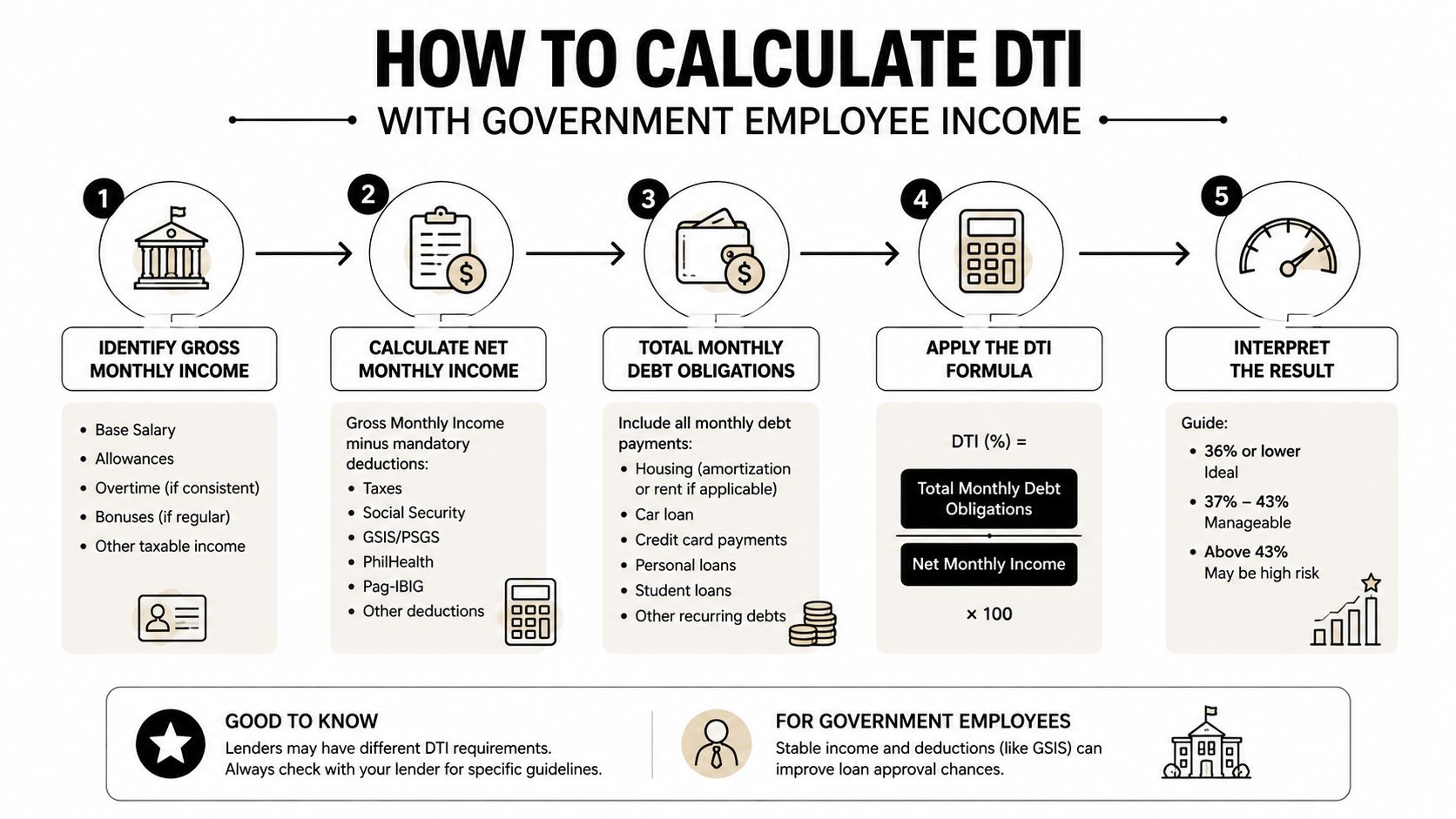
Start with a worksheet, not a guess. Pull your recent pay documentation, identify every recurring compensation component, list all monthly debts, and separate income that is stable from income that requires an averaging history.
Build qualifying gross income
Begin with base salary and divide the annual amount into a monthly figure. Then list recurring additions separately, including locality pay, shift differentials, overtime, hazard pay, performance bonuses, special duty pay, summer-school compensation, or longevity and step increases.
A teacher with a base salary can't automatically add expected summer-school income. The lender needs documentation showing receipt and a reasonable expectation of continuance. The same principle applies to a firefighter's overtime and shift differential. A single unusually large pay period won't necessarily support the income figure the borrower wants.
A state employee with regular locality pay and documented step increases may present a cleaner qualifying-income profile than a borrower whose supplemental income varies sharply from period to period. The underwriter still evaluates the records, but consistent payroll evidence makes the analysis easier.
Add the proposed housing obligation
Estimate the complete payment, not just principal and interest. Include property taxes, homeowners insurance, mortgage insurance where applicable, and HOA dues. California borrowers should be especially careful not to understate taxes or association costs because even a moderate change in the complete payment can alter affordability.
Add every recurring debt
List car payments, student-loan obligations, credit-card minimums, personal loans, and other debts that may appear in the credit report or supporting documentation. Don't omit a balance because you intend to pay it off later. If you want the debt removed from the calculation, ask the lender what payoff documentation is required and whether the transaction must occur before underwriting.
Apply the formulas
Front-end DTI equals total monthly housing costs divided by gross monthly income. Back-end DTI equals total monthly debts, including the proposed housing payment, divided by gross monthly income.
For a teacher, adding properly documented summer-school income may increase the denominator and lower the ratios. For a firefighter, accepted overtime and shift differential can have the same effect. For a state employee, recurring locality pay and step increases may support stronger qualifying income than base salary alone.
The key word is documented. Keep pay stubs, tax records, employment verification, award letters, payroll history, and any employer documentation that explains the compensation. Ask for an income review before making an offer so you know which components the lender will use.
Typical DTI Limits by Mortgage Program and Lender Overlays
Mortgage programs have underwriting frameworks, but the published framework isn't always the practical approval line. Automated underwriting findings, credit profile, reserves, down payment, property type, and lender overlays can move the result in either direction.
A borrower may receive different answers from different lenders despite presenting the same income and debts. One lender may follow the agency's automated recommendation closely. Another may impose stricter internal rules, especially when income is variable, credit is borderline, reserves are limited, or the property carries additional risk.
Use the table as a screening tool
| Loan Program | Typical Front-End DTI | Typical Back-End DTI | Common Overlay Notes |
|---|---|---|---|
| Conventional | Varies by automated underwriting findings | Varies by automated underwriting findings | Credit, reserves, down payment, property type, and lender overlays can change the result |
| FHA | Varies by automated underwriting findings | Varies by automated underwriting findings | Debt profile, credit history, assets, and lender-specific rules remain important |
| VA | No single universal practical threshold for every borrower | Varies by underwriting findings and lender policy | Residual-income analysis, credit, assets, and lender overlays can affect approval |
| USDA | Varies by underwriting findings | Varies by underwriting findings | Property eligibility, income eligibility, credit, and lender overlays apply |
These are screening categories, not promises. A lender may approve a higher DTI with strong compensating factors, or reject a lower DTI because of weak reserves, unstable variable income, or a property concern.
Agency guidance is only half the equation
Government employees often focus on finding the program with the highest theoretical DTI. That's the wrong priority. The better question is which lender will evaluate your exact compensation structure fairly while still offering a payment you can carry comfortably.
Credit quality can support flexibility, but it doesn't erase payment risk. Larger reserves can strengthen the file, while a larger down payment may reduce the loan amount and monthly obligation. A lender may also require additional documentation for probationary employment, recent transfers, temporary assignments, or income that depends on special duty.
The realistic approval envelope is created by the program, the automated underwriting findings, and the lender's overlays together.
Get a side-by-side review before authorizing multiple applications. Ask what DTI the lender expects to approve, which income components it will count, and what conditions could change the answer.
Practical Strategies to Lower Your DTI Before Applying
The fastest way to improve a mortgage file is usually to control recurring monthly obligations. Government employees often spend too much time chasing a special rate and too little time removing a payment from the back-end ratio.
Start with debts that create the largest monthly burden
- Pay down revolving balances: Reducing credit-card balances may lower minimum payments and improve the overall credit profile. Ask the lender to model the DTI effect before moving cash from reserves.
- Review auto financing: A vehicle payment can consume qualifying capacity even when the balance seems manageable. Don't refinance or pay off the loan without checking the effect on liquidity, interest cost, and underwriting.
- Evaluate student-loan obligations: Teachers and other public employees should have the lender calculate the exact payment used for underwriting. A lower documented payment may affect DTI, but the lender must approve the treatment.
- Delay new purchases: Opening a new account or financing a vehicle before closing can change the credit report and add a monthly obligation at the worst possible time.
Improve the income file, not just the ratio
Gather payroll records showing recurring allowances and variable compensation. If your overtime, shift differential, locality pay, or special duty pay has a clear history, give the lender enough documentation to evaluate it. Don't switch employers, change pay structures, or move into an uncertain assignment immediately before applying unless the lender has reviewed the transition.
A borrower may also reduce DTI by choosing a less expensive property, selecting a loan structure with a lower complete payment, or using assistance that reduces the required loan amount. In California's high-cost markets, those decisions can matter more than a small pricing concession.
Use the public service loan calculator to organize the figures before requesting pre-approval. Treat the result as a planning tool, not a lender commitment.
Don't sacrifice reserves blindly
Paying off debt can improve back-end DTI, but draining savings can weaken the application and leave you exposed after closing. Have the lender compare three versions of the file: current debts, debt paydown, and a lower-priced home. Choose the option that improves approval while preserving a practical cash cushion.
California-Specific Programs and How They Interact With DTI
California assistance usually improves affordability indirectly. A grant, closing-cost credit, or rate concession may reduce the cash required at closing, lower the loan amount, or reduce the monthly payment. None of those tools replaces income verification, but they can make the overall structure more workable.
The strongest strategy is to stack compatible benefits in the right order. First establish qualifying income. Then compare mainstream loan types. After that, evaluate county or state assistance, lender credits, and pricing concessions.
County eligibility can determine access
California public employees may qualify for the GSFA Platinum Assist-to-Own feature only when employed by one of the GSFA Member Counties. The property must be a primary residence in California. The program can be used to purchase or refinance anywhere in California, but the employee must meet the county-eligibility requirement described by GSFA's Assist-to-Own program.
That distinction is easy to miss. A government title alone doesn't establish eligibility. Confirm the employer, county participation, occupancy requirement, transaction type, and other program conditions before relying on the assistance in an offer strategy.
Savings may appear at closing rather than in the rate
A lender program states that current or retired California State Employees may be eligible to save $1,395 in closing costs, with the property being purchased or refinanced in California. Review the California State Employee closing-cost program for the current eligibility terms instead of assuming every state employee receives the benefit.
Another California public-employee offering bundles FHA, Conventional, USDA, VA, Jumbo, and Reverse Mortgages, while advertising no lending fees, competitive rates, and fast pre-approvals for eligible employees and retirees of the State of California. The relevant lesson is that a public-employee benefit may be a menu of loan types and pricing mechanics, not one universal mortgage. Compare the structure in this California state employee mortgage program.
Refinance only after calculating the break-even
A stable government paycheck can support refinance eligibility, but it doesn't automatically make refinancing worthwhile. Compare the projected monthly savings with closing costs, the loan-to-value position, the new term, and whether you're considering cash-out or rate-and-term refinancing.
Fixed-rate availability and house-price pressure have made refinancing decisions more sensitive to payment changes and equity. Public-sector employees should use a written break-even analysis, not a headline rate, before replacing an existing mortgage. The California employee loan program can be one place to discuss purchase and refinance structures, but the numbers still need to work for the individual borrower.
How California Loans for Heroes Supports Government Employees
A public employee's mortgage file usually needs coordination more than a slogan. A teacher may need a review of summer-school income. A firefighter or EMS professional may need overtime and shift differentials documented. A state employee may need locality pay, step increases, or special duty compensation separated clearly from base earnings.
California Loans for Heroes works with public servants and other eligible professionals, including law enforcement officers, firefighters, EMS personnel, military members, veterans, healthcare professionals, pilots, teachers, educators, and California government employees. Its HERO Home Loan & Buyer Rewards Program connects eligible borrowers with homebuyer assistance, down-payment assistance options, competitive mortgage rates, refinance solutions, lender credits, and one-on-one support.
The practical decision framework is simple:
- Buying soon: Request pre-approval and an income-component review before making an offer.
- DTI is too high: Model debt paydown, a lower payment, or a lower-priced property before changing jobs or moving cash.
- Already own a home: Compare rate-and-term refinancing with cash-out refinancing and calculate the break-even after closing costs.
- Working for a participating county or state employer: Verify program eligibility before counting assistance in your purchase budget.
Explore home loans for heroes and bring your pay documentation, debt statements, employment details, and current mortgage information to the consultation.
California Loans for Heroes offers mortgage guidance, homebuyer assistance, down-payment assistance options, lender credits, competitive loan options, and refinance solutions for eligible California public servants. Visit California Loans for Heroes to review your DTI, document the income lenders can count, and identify the purchase or refinance structure that fits your actual finances.