
A clear-to-close decision for a police officer in California typically takes 30-45 days from loan application to funding, assuming no major complications with appraisal, title, or document verification. The exact timeline depends on your lender, income documentation, property, and the loan program you choose.
You may already be balancing patrol shifts, court appearances, overtime, and a purchase contract with deadlines that don't move. Once your offer is accepted, the question changes from “Can I qualify?” to “What still has to happen before I get the keys?” That distinction matters because a conditional approval isn't the same as permission to close.
For a home loan for police officers, the fastest path usually comes from understanding each handoff, responding quickly to requests, and preparing variable-income records before underwriting asks for them. California programs can also change the process by offering features such as prioritized processing, flexible guidelines, or reduced upfront costs.
What Clear To Close Means For Your Home Loan
Clear to close means the lender has reviewed the remaining underwriting conditions, accepted the required documentation, and authorized the loan to move toward closing. The closing package can be prepared, but the lender hasn't necessarily released funds, and ownership hasn't officially transferred yet.
That status comes after conditional approval. Conditional approval means the underwriter is willing to approve the loan if you satisfy specific requirements, such as updated pay records, proof of funds, an acceptable appraisal, or clarification of a deposit. Clear to close means those conditions have been resolved to the lender's satisfaction.
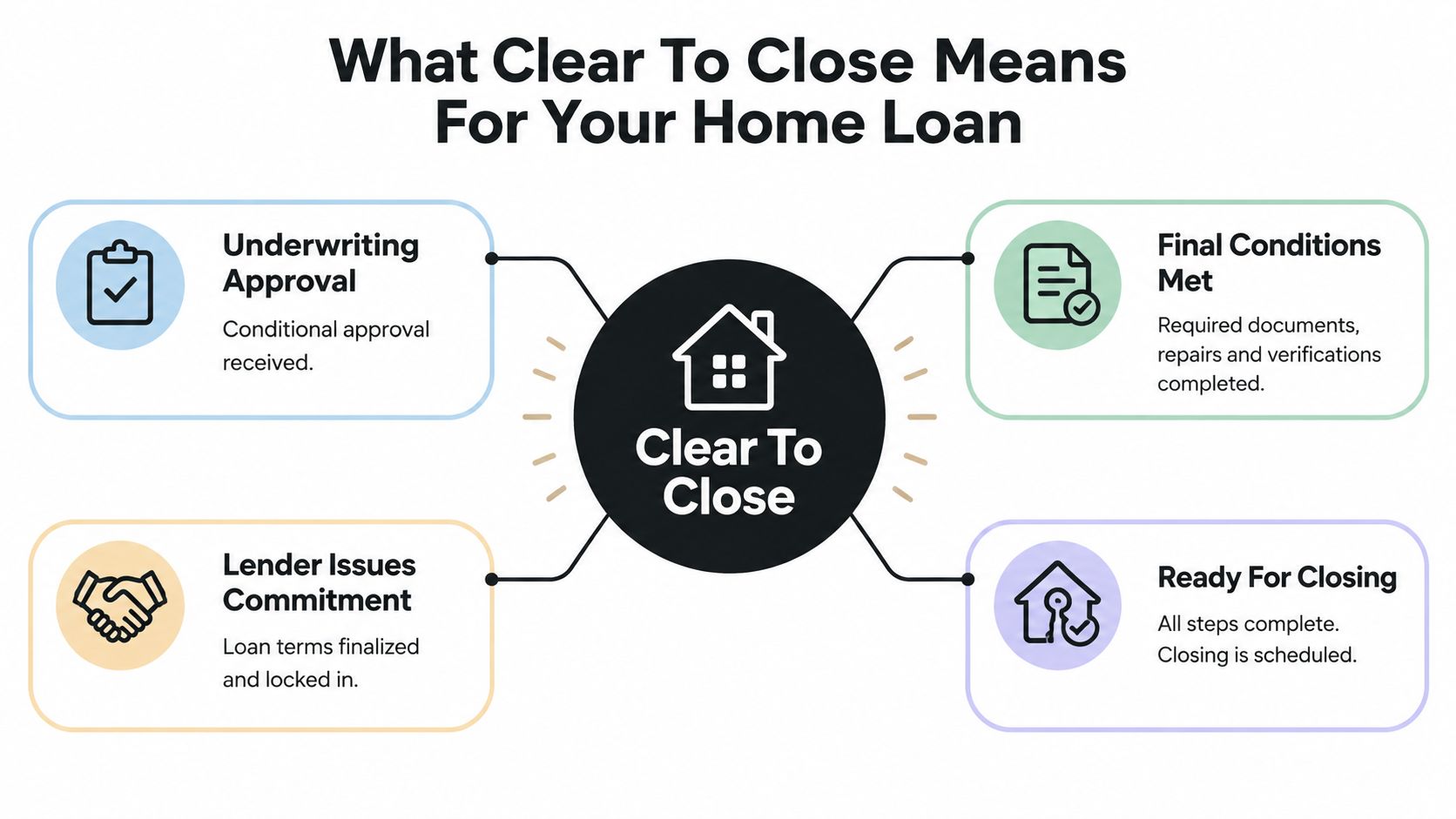
What happens after conditional approval
Your loan officer or processor may still coordinate several final items:
- Final income review: The lender confirms current employment, pay, and any qualifying variable compensation.
- Asset verification: The lender checks that your funds for closing and required reserves are available and properly documented.
- Property review: The appraisal, title work, insurance, and purchase contract must meet program requirements.
- Closing preparation: The settlement team prepares the final documents and confirms signing and funding instructions.
Practical rule: Conditional approval tells you what remains. Clear to close tells you the lender believes those remaining requirements have been satisfied.
Clear to close also isn't the same as funding. At signing, you execute the closing documents. The lender then completes its funding process, and the transaction is recorded according to the closing instructions. Until that happens, avoid new debt, employment changes, unexplained deposits, or large purchases. A lender can still need to verify a material change before releasing funds.
The Stage By Stage Home Loan Timeline
Consider an officer whose offer has just been accepted. The process starts with a review of the borrower, then moves to the property, underwriting, final conditions, and funding.
| Stage | Typical Duration | Borrower Action |
|---|---|---|
| Pre-approval | 1-3 days | Provide credit, income, employment, and asset documents |
| Commitment and appraisal | 5-10 days | Give property access, review disclosures, and support appraisal requests |
| Underwriting | 5-14 days | Answer conditions and submit complete explanations |
| Final approval and clear to close | 3-7 days | Confirm final figures, insurance, and closing availability |
| Funding and recording | 1-3 days | Sign documents and verify wire or certified-funds instructions |
The pre-approval stage establishes a working view of borrowing capacity. The lender pulls credit, reviews initial records, and identifies whether your income profile needs additional documentation. Police compensation can require extra care because overtime, detail pay, court time, and shift differentials may not appear as simple base salary.
The property enters the file
After the purchase contract is accepted, the lender orders the appraisal and begins the property review. The lender may issue a commitment letter during this phase, but that commitment still depends on the appraisal, title, insurance, and underwriting conditions being acceptable.
The appraisal process and turn-time guidance can help you understand why property access and prompt scheduling matter. A missed appointment or delayed document request can affect later stages even when your credit and income are strong.
Underwriting is usually the most variable phase. The underwriter compares your application, pay history, assets, employment, debts, and appraisal against the loan program's requirements. A clean file can move efficiently, while inconsistent records or unresolved conditions can extend the review.
Once final conditions are approved, clear to close often follows within the final-approval window. The closing agent prepares the documents, confirms the amount needed, and coordinates signing. Funding and recording come afterward, so don't schedule movers or terminate a current housing arrangement until your closing team confirms that the transaction has funded.
Factors That Speed Up Or Delay Clear To Close
The timeline usually turns on four areas: appraisal, underwriting, document verification, and title. These aren't separate risks that always occur one at a time. A problem in one area can create follow-up work in another.
Appraisal and property condition
An appraisal that supports the contract price generally keeps the property review moving. A value concern can require additional analysis, comparable-sale review, or a formal response. Property access problems, missing information, or a request for another type of valuation can also add time.
Ask your real estate and lending teams whether the appraiser has received reliable access instructions and the relevant property details. You can't control the appraised value, but you can reduce preventable scheduling problems.

Underwriting and document verification
Underwriting delays often come from incomplete or inconsistent paperwork rather than an obvious credit issue. A pay stub may show a different employer description than a prior record. Bank statements may contain a deposit that needs an explanation. A detail-pay record may not clearly distinguish recurring compensation from a one-time payment.
Respond to every condition with the exact document requested. Sending several unrelated files can create more review work and may not answer the underwriter's question.
A fast response isn't enough if the response doesn't resolve the condition. Ask your loan officer what question each document is meant to answer.
Title and closing readiness
Title work can reveal liens, unresolved easements, ownership questions, or boundary concerns. These issues may have nothing to do with your financial profile, yet they can prevent the lender from funding until the title company resolves them.
Request updates early instead of waiting for the signing appointment. Also confirm homeowner's insurance, vesting information, identification, and the final funds-to-close instructions before closing day.
How Police Officer Income Affects Underwriting
A police officer's paystub can contain several income categories, and lenders don't automatically treat each category like base salary. Overtime, detail pay, court time, and shift differentials are commonly evaluated as variable income, which means the lender looks for documented history and a reasonable expectation that the income will continue. Mortgage underwriting guidance for police overtime and detail pay explains why lenders generally avoid qualifying a borrower from a recent spike alone.
A common technical standard is a documented 24-month history with reasonable continuance. The lender may average qualifying variable income across that period rather than count the most recent high-earning pay period. This approach helps prevent an officer from qualifying for a payment that depends on unusually heavy assignments or temporary overtime.
Base pay compared with variable pay
Base salary is usually easier to document because it follows the employment agreement or regular pay structure. Variable compensation requires the lender to identify the type of pay, confirm its history, and decide whether it can reasonably continue.
Some lenders also limit the amount of overtime they use. One market example states that many lenders accept about 80% of overtime income, while other underwriting frameworks average the full documented history with supporting payroll and employer records. Police-officer home-loan guidance on variable income describes this variation, so you shouldn't assume one lender's treatment applies everywhere.
Prepare two years of W-2s, recent pay stubs, and an employer verification that separates each pay type. Keep itemized payroll records covering 12 to 24 months, particularly if your income includes off-duty detail or mandatory overtime. If your assignment or rank recently changed, tell the loan officer before submission so the file can be evaluated accurately.
The goal isn't to make overtime look like guaranteed salary. The goal is to show the lender which portions are established, traceable, and likely to continue.
Borrower Checklist And Tips To Shorten The Timeline
Speed comes from reducing unanswered questions. Before submitting an application, create one organized folder containing your income, employment, asset, and housing records. Use clear file names, include every page of statements, and avoid editing or obscuring transaction history.
Prepare before the application
Gather:
- Income records: Two years of W-2s, recent pay stubs, tax returns when requested, and itemized overtime or detail-pay records.
- Employment evidence: Employer contact information and verification that separates base wages, overtime, court pay, and differentials.
- Asset records: Complete bank statements showing the funds needed for closing and required reserves.
- Property records: The accepted purchase contract, insurance information, and any documents your agent or lender requests.
- Explanations: A short, factual letter for unusual deposits, employment gaps, credit events, or transfers between accounts.
Request the appraisal as soon as the lender can order it, and ask whether the title report can be reviewed early. A lender experienced with first-responder compensation is more likely to recognize which payroll records answer common underwriting questions.
Protect the file after approval
Don't open new credit, finance a vehicle, move large sums without records, change jobs, or make major purchases while the loan is in progress. Keep making housing and credit payments on time, and tell the lender promptly about any change that could affect income or employment.
| Checklist Item | Why It Matters | When To Complete |
|---|---|---|
| Organize complete paperwork | Reduces repeated requests | Before application |
| Separate variable pay records | Helps classify qualifying income | Before underwriting |
| Avoid new debt or unexplained deposits | Prevents a new financial review | From application through funding |
| Review appraisal and title status | Exposes property problems earlier | As soon as ordered |
| Confirm closing logistics | Prevents signing and funding confusion | Before closing |
Use this home-buying process checklist as a working reference, then ask your loan officer to tailor it to your program. If you're using a HERO product with prioritized processing, confirm how that feature operates and which borrower actions still control the pace.
California HERO Loan Programs And Special Considerations
California doesn't have one universal police mortgage. Program rules differ by lender, loan structure, property, income, occupancy, and employment classification. The practical question isn't only whether you're a police officer. It's whether the program fits your cash position, qualifying income, credit profile, and purchase plan.
CalHERO is explicitly designed for first responders, including police, and advertises reduced rates, reduced fees, prioritized processing, flexible guidelines, and a cash rebate through its program materials at CalHERO Home Loan. Prioritized processing is especially relevant to a clear-to-close strategy, but it doesn't eliminate appraisal, title, insurance, or borrower-document conditions.
The Police Credit Union describes a separate law-enforcement mortgage with 100% financing, 0% down payment, no PMI, and loan limits up to $1,000,000 in its membership and mortgage information at The Police Credit Union law-enforcement program. A zero-down structure can reduce the cash needed upfront, but it doesn't remove the need to document closing costs, reserves, income, debts, and property eligibility.
Compare the structure, not just the headline
LAPFCU's Heroes Home Loan has concrete requirements for eligible borrowers. The program requires that the borrower hasn't owned a home in the last 24 months, has a minimum 700 FICO score, maintains at least three months of payment reserves, and stays at or below a 45% debt-to-income ratio, as reported by Inman's coverage of the LAPFCU program.
Those requirements show why a “special” loan can still involve detailed qualification. Use California law-enforcement home-buying programs to compare program categories, then ask for a side-by-side estimate of the rate, fees, cash required, payment, property rules, and expected processing path.
Common Misconceptions About Police Officer Home Loans
Misconception one: your job title automatically qualifies you for the best loan. Officer status helps identify potential programs, but eligibility may also depend on whether you work full time, part time, or in another employment classification. Primary-residence rules, income bands, county limits, first-time-buyer requirements, property type, credit, reserves, and debt-to-income rules can change the result.
Misconception two: every lender will count all overtime. Variable compensation usually needs a documented history and continuance analysis. Some lenders average it, some limit the amount used, and all require records that make the pay understandable. A recent period of heavy detail work may not support the same qualifying income as an established pattern.
Misconception three: specialized programs only help low-income buyers. Program design varies. Maryland's first-responder and teacher program combines a 0.5% lower first-mortgage rate with a 5% deferred second loan for closing costs, while New Jersey's program offers a 5.35% reduced 30-year fixed rate and doesn't require first-time-buyer status, according to the Maryland program materials and the verified program information provided for New Jersey. These examples show why you should compare the complete financing structure rather than assume an occupation-based loan serves only one income group.
Misconception four: all hero loans work the same way. They don't. One program may reduce the first-mortgage rate, another may provide deferred assistance, and another may offer a zero-down structure. Each can affect the cash needed upfront, monthly payment, documentation, and closing timeline differently.
For a California police officer, the best comparison is a written estimate showing total funds to close, payment, qualifying income, property restrictions, and remaining conditions. That gives you a reliable path from application to clear to close, rather than relying on a headline benefit.
California Loans for Heroes offers California law-enforcement officers access to loan options, homebuyer assistance, down payment assistance possibilities, competitive mortgage rates, lender credits, and one-on-one support through the closing process. Visit California Loans for Heroes to discuss your income structure, program eligibility, and a practical plan for reaching clear to close.