
A first responder's job may be stable, but that doesn't automatically make California homeownership affordable. Transportation and public safety workers, including police officers, firefighters, and related first responders, had a 58.1% homeownership rate in 2024, down from 59.3% in 2014, according to an analysis of occupation-level U.S. housing data. The message for California buyers is clear: your occupation can open doors, but local prices, documented income, down payment funds, taxes, insurance, and underwriting still determine whether you can buy.
Home loans for first responders usually aren't a special mortgage product sitting apart from the rest of the market. They're a combination of conventional, FHA, VA, or other qualifying financing with occupation-based assistance, employer benefits, municipal programs, and lender expertise. In California, the right strategy is to identify which benefit changes the affordability equation, not chase a “hero” label.
What Proof of Employment Means for First Responders
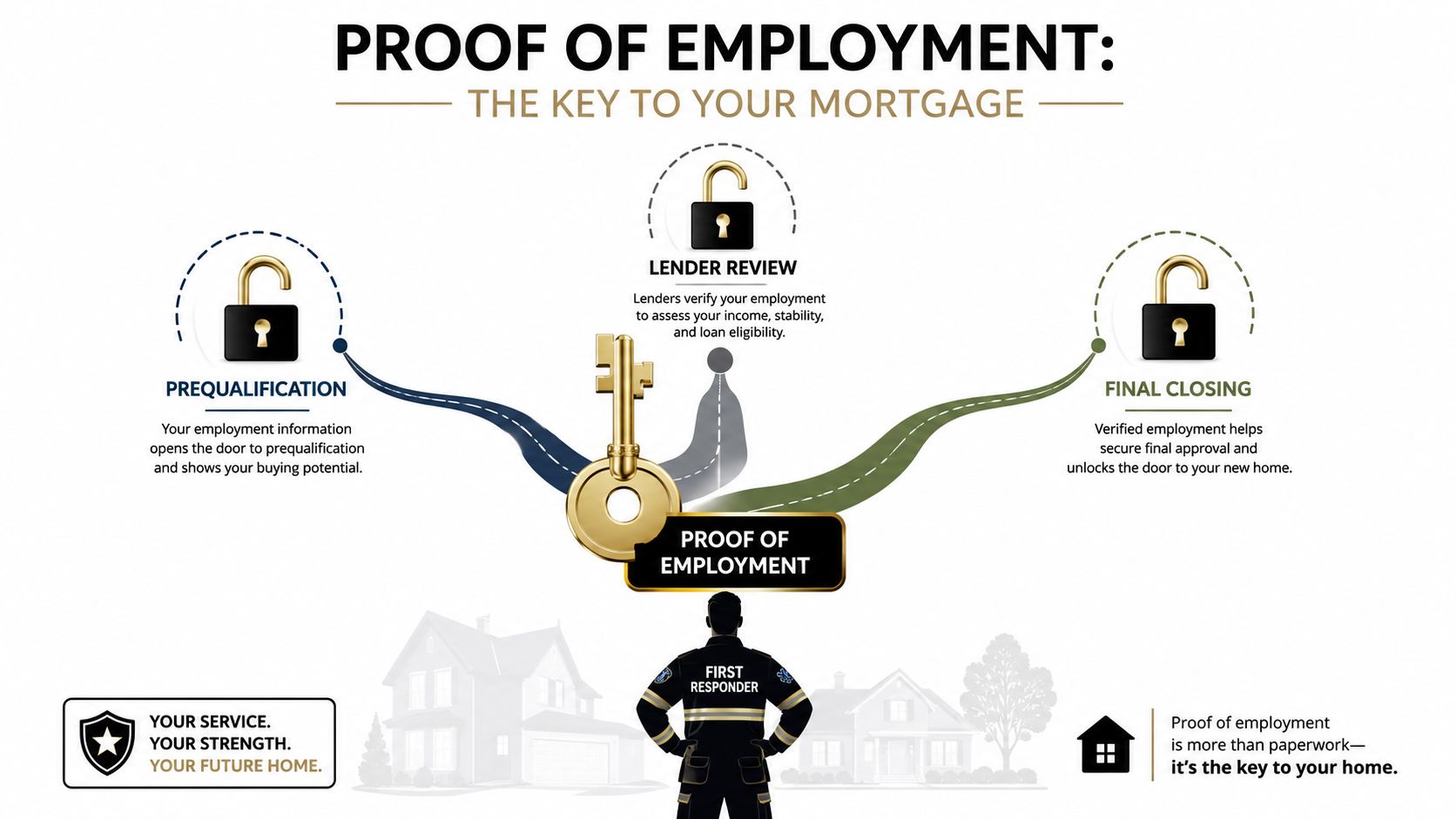
Proof of employment is the professional ID badge of your mortgage file. It enables prequalification, allows the lender to calculate income, supports the final approval, and confirms that your employment remains active before closing. Without clean verification, even a strong credit profile and substantial savings can leave the application stalled.
For a standard W-2 employee, the lender generally verifies the employer, position, start date, pay structure, and current status. First responders often need more detail because their compensation can include overtime, shift differentials, holiday pay, standby hours, special assignments, or recurring stipends. A lender must determine which portions are stable enough to use, rather than treating every line on a pay stub as dependable qualifying income.
Start with the employment foundation
Gather your current pay documentation before you ask for a prequalification. Lenders, benefits administrators, and other parties reviewing your financial profile all rely on the same underlying evidence, including pay stubs, W-2s, employment verification, and tax records. The cleaner the file, the less likely an underwriter is to question whether your income will continue.
California HERO administrators may also require employment verification before approving rate reductions or down payment assistance access. That makes the document more than a mortgage form. It can determine whether you receive the program benefit you expected.
Different roles need different proof
A full-time city firefighter usually has a straightforward employer record, but a contract paramedic or per-diem wildland crew member may need assignment documentation and tax returns. A nurse with shift premiums, a deputy with special duty income, and a federal wildland firefighter may each need the lender to separate dependable earnings from irregular compensation.
Ask your HR department or payroll office for a detailed verification letter, not a vague statement that you work there. Use this government employee home loan resource to understand how employment documentation fits into a broader first responder application.
Practical rule: If a lender can't identify the employer, job status, base pay, and income history from your documents, assume the file isn't ready.
The next step is to isolate each pay component. Base pay is usually easier to document, while overtime and differentials require a history that proves consistency and likely continuation.
How Lenders Read Base Pay, Overtime, and Shift Differentials
Two California firefighters can have identical base salaries and receive different loan approvals. The difference may come from how the lender treats overtime, holiday pay, strike assignments, or shift differentials.
Base pay is the cleanest income source. A lender can generally verify it through current pay stubs, W-2s, and employer confirmation. Variable income receives closer scrutiny. Industry mortgage guidance for W-2 first responders says lenders typically review pay stubs, W-2s, and written employment verification, then average overtime or differential income over 12 to 24 months only when it's consistent and likely to continue. Mortgage guidance for qualifying first responders explains why the same gross earnings can produce different qualifying results.
The underwriting distinction
Consider two firefighters with the same base salary. Firefighter A has a documented pattern of recurring overtime that appears in payroll records and tax documents. Firefighter B earns occasional strike pay and irregular special-duty income without a dependable history.
Firefighter A may have more income counted for underwriting. Firefighter B may have the extra earnings excluded or reduced to a conservative average. That difference can affect debt-to-income calculations and the maximum principal the lender will approve, even though both borrowers may report similar annual gross income.
| Income Type | Underwriting Treatment | Documentation Usually Required |
|---|---|---|
| Base pay | Usually counted when current and stable | Recent pay stubs, W-2s, written employment verification |
| Overtime | May be averaged when consistent and likely to continue | Pay stubs, W-2s, employer verification, income history |
| Shift differential | Reviewed separately and may be discounted | Pay records and employer confirmation |
| Holiday or standby pay | May require a documented recurring pattern | Pay stubs, W-2s, payroll history |
| Recurring stipend | Often excluded unless taxed and stable | Pay records and written employer explanation |
| Special-duty or strike income | May be excluded if sporadic | Detailed history and supporting payroll records |
What surprises public safety borrowers
Hazard pay, EMS bonuses, and special assignments don't automatically receive the same treatment as base wages. A deputy may see overtime accepted because it appears consistently across the documented history, while a nurse's shift differential may be reduced if the schedule changes frequently. A federal wildland firefighter may need to explain seasonal assignments and show that the income pattern supports future continuation.
Ask the lender to identify, in writing, which income components they're using and which they're excluding. Don't wait until underwriting to discover that the pay you rely on for affordability doesn't count.
For rate-focused planning, compare the assumptions behind each quote through police and fire mortgage rate options. The lowest advertised rate isn't useful if the lender won't document your actual compensation structure.
Documents First Responders Need to Prepare
A complete document package makes the lender's job easier and gives you a clearer picture of your buying power. Start with a secure digital folder organized by income, employment, assets, debts, and program eligibility. Upload legible files with complete pages, and keep the original documents available in case the underwriter requests clarification.
Core documents for W-2 employees
Most California first responders should prepare:
- Two years of W-2s: Include every employer relevant to the income history the lender is reviewing.
- Current pay stubs covering the most recent 30 days: Make sure the statement shows your name, employer, pay period, year-to-date income, and deductions.
- Written employment verification: Ask HR or a supervisor with authority to confirm employment status, hire date, title, base pay, and eligible variable compensation.
- Asset statements: Provide complete statements for accounts used toward the down payment, closing costs, reserves, or required borrower contribution.
- Identity and residency records: Follow the lender's secure-upload instructions and provide only what the lender requests.
Your pay stub should match the employer and compensation story in the verification letter. A mismatch in job title, base pay, or employment status can trigger avoidable questions.
Role-specific documentation
Active-duty and reserve military members should include a current Leave and Earnings Statement, commonly called an LES. Retrieve it through myPay, then confirm that the document is current and complete. If you're using VA financing, ask the lender to confirm your Certificate of Eligibility early rather than treating it as a last-minute item.
Contract paramedics and per-diem wildland crews need more than ordinary payroll records. Prepare two years of personal and business tax returns, along with a current contract, assignment letter, or other documentation showing the work arrangement. The lender needs to understand both the income history and the likelihood of continuation.
| Borrower Profile | Additional Documentation |
|---|---|
| Self-employed EMT | Personal and business tax returns, current year-to-date profit and loss |
| Private fire contractor | Contracts, assignment records, tax returns, current profit and loss |
| Side-business nurse | Business tax records, current profit and loss, supporting bank records if requested |
| Reserve or active-duty military member | Current LES and military employment documentation |
| Per-diem or seasonal worker | Contracts, assignment letters, payroll history, tax returns |
Make the employer letter useful
A useful letter states the facts the underwriter needs. It should appear on agency letterhead, be dated within 30 days, and include the employee's job title, full-time or part-time status, hire date, base compensation, expected overtime or differential structure, and the signer's direct contact information for verbal verification. The applicant shouldn't sign their own letter.
Request the letter from the fire or police HR office early. If your agency uses an employment verification vendor, ask the lender whether that vendor's report satisfies the file requirement or whether a supplemental letter is needed.
Redact account numbers, Social Security numbers, and unrelated personal information before uploading documents unless the lender specifically requires the unredacted version through a secure portal. Never email sensitive documents casually. Use the lender's encrypted upload system and keep a copy of everything submitted.
Sample Employer Letter Templates That Lenders Accept
An employer letter should answer the underwriter's questions before the underwriter has to ask them. Boilerplate language such as “employed in good standing” is rarely enough for a first responder whose income includes overtime or differentials.
Sworn firefighter template
Use agency letterhead and adapt the language to your department's actual records:
Date: [Month Day, Year]
To whom it may concern:
[Employee full name] is employed by [fire department or agency] as a [job title]. [He or she] is a [full-time or part-time] employee and began employment on [hire date]. Current base compensation is [$ amount] paid [pay frequency].
The employee's anticipated work schedule is [schedule]. Overtime is [available or regularly scheduled] under [department policy or collective bargaining agreement]. The employee may also receive [shift differential, holiday pay, standby pay, or special assignment compensation], subject to the department's payroll rules.
Please contact [HR representative or supervisor] at [telephone number] or [work email] for verbal verification.
Sincerely,
[Signer name]
[Title]
[Department]
[Direct contact information]
The letter should describe the compensation structure without promising income the department can't guarantee. The lender will still review pay history separately.
County paramedic template
A county-employed paramedic can use parallel language:
Date: [Month Day, Year]
[Employee full name] is employed by [county or agency] as a [paramedic title]. [He or she] is employed [full-time or part-time], began employment on [hire date], and currently earns base pay of [$ amount] paid [pay frequency].
The position includes [shift schedule]. The employee may be eligible for [overtime, shift differential, holiday pay, or standby compensation] according to [applicable policy].
Employment verification is available from [HR representative or supervisor] at [telephone number] or [work email].
[Signer name, title, signature]
Why specificity prevents delays
Suppose an HR generalist confirms the firefighter's title and base pay but leaves out the department's anticipated overtime schedule. The underwriter may pause the file and request a revised letter, especially if the borrower needs variable income to qualify. A specific letter won't guarantee approval, but it gives the lender a usable starting point.
Nurses and law enforcement officers should add precise language for shift differentials, specialty assignments, or recurring premiums. The letter must be signed by HR or an authorized supervisor, not the applicant, and the lender should be able to complete verbal verification using the contact information provided.
California HERO Programs and Down Payment Assistance Compared
California buyers should compare assistance by real affordability impact, not by the size of a headline benefit. Some programs reduce the purchase price, some provide down payment funds, and some create a deferred lien that must be repaid later. The right choice depends on your city, property type, income structure, credit profile, and the lender's own underwriting overlays.
San Francisco's First Responders Downpayment Assistance Loan Program, or FRDALP, offers up to $500,000 for eligible first responders purchasing market-rate housing in the city, according to the FRDALP program information. The assistance is structured as a silent second loan with no monthly payments. Repayment is due when the property is sold or transferred, along with an equitable share of appreciation.
The federal Good Neighbor Next Door program offers eligible law enforcement officers, firefighters, EMTs, and pre-K through 12 teachers a 50% discount on select HUD-owned homes in revitalization areas, as described in HUD's Good Neighbor Next Door program. The buyer must occupy the home as a sole residence for three years. This isn't a rate discount, and the property inventory and location restrictions make it a narrow tool.
California's GSFA Platinum Select includes law enforcement, firefighters, paramedics, EMTs, medical and healthcare workers, and California educators. The program describes assistance of up to 5% of the loan amount, a reported minimum credit score of 640, and eligibility that isn't limited to first-time buyers, according to California down payment assistance information.
| Program | Eligible Occupations | Assistance Amount | Repayment | Min FICO | Stacking Allowed |
|---|---|---|---|---|---|
| FRDALP | Eligible San Francisco first responders | Up to $500,000 | Silent second, repayment at sale or transfer plus equitable appreciation share | Confirm with program lender | Confirm by loan structure |
| GSFA Platinum Select | Law enforcement, firefighters, paramedics, EMTs, healthcare workers, educators | Up to 5% of loan amount | Confirm current subordinate-lien terms | 640 reported | Confirm with lender |
| Good Neighbor Next Door | Law enforcement, firefighters, EMTs, eligible teachers | 50% list-price discount on select HUD homes | Three-year occupancy requirement, confirm resale terms | Confirm with HUD-approved lender | Limited by program rules |
| California HERO Home Loan | Eligible California public-service occupations | Varies by approved structure | Depends on selected assistance | Confirm with lender | Confirm with lender |
FRDALP is most relevant to an eligible San Francisco buyer who can manage the city's property prices but lacks sufficient initial capital. GSFA Platinum Select may be more practical across participating California markets, but a lender overlay can disqualify a high-DTI borrower even when the program itself appears to allow the application. Good Neighbor Next Door can be powerful when a suitable property exists, but it isn't a general solution for San Diego, Sacramento, or the Bay Area.
For program screening and stacking questions, review California down payment assistance options. Ask specifically whether the proposed first mortgage, subordinate lien, occupancy rules, purchase-price limits, and county requirements work together before you make an offer.
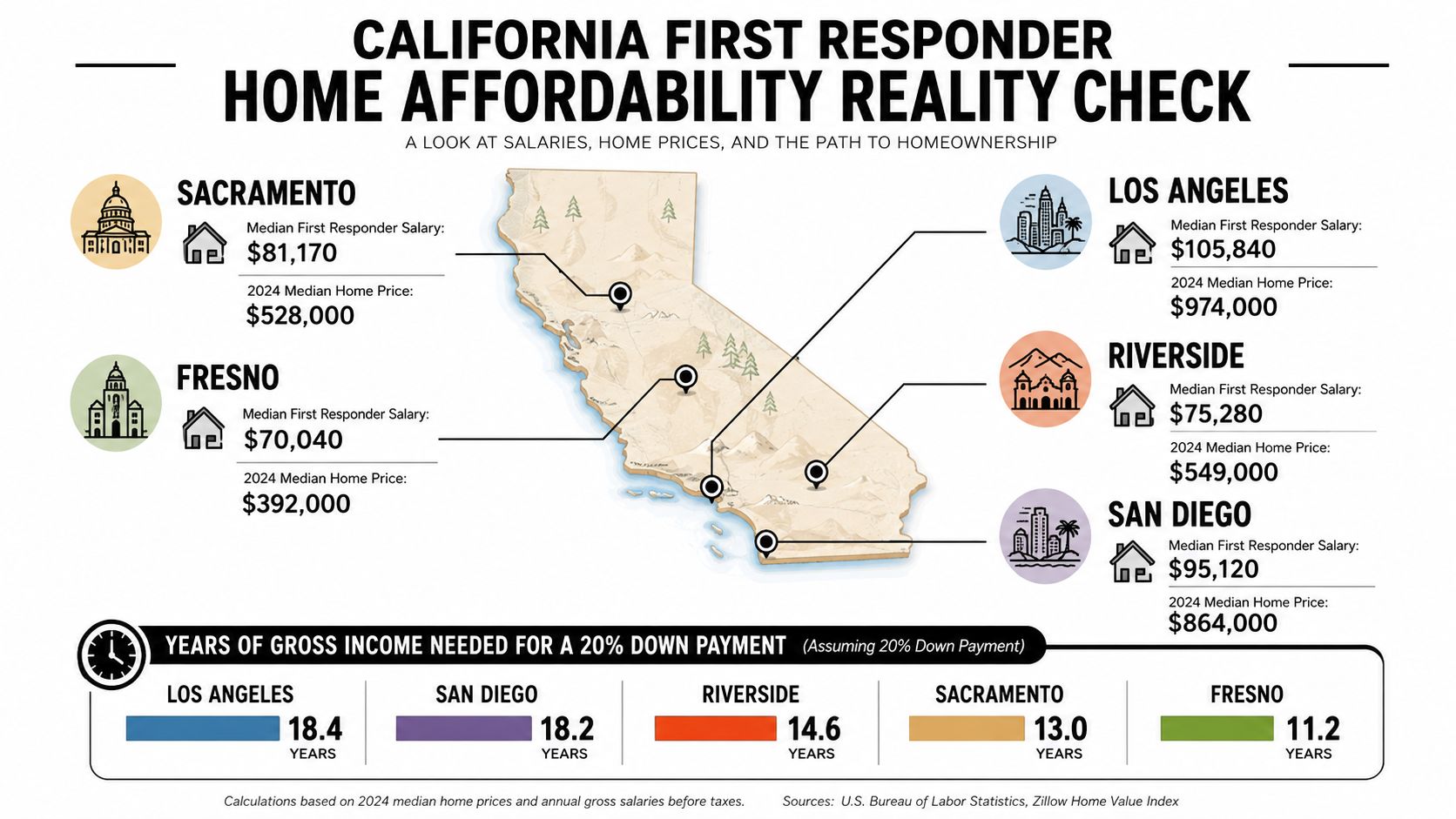
Affordability Reality Check for California First Responders
California first responders don't usually need a program that merely confirms they're heroes. They need a structure that closes the gap between dependable income and the price of a suitable home.
Independent reporting found that younger fire and law enforcement households could afford the median-priced home in only eight of the 50 largest U.S. metros, while teachers and healthcare workers under 35 could do so in only five. The same public-service homeownership affordability analysis places affordability more heavily in the Midwest and Great Lakes and identifies Los Angeles, San Jose, San Francisco, and San Diego among the least affordable markets for multiple public-service professions.
What assistance can and can't fix
A down payment program can reduce the initial cash requirement. It may lower the loan-to-value burden and help a borrower qualify without changing the long-term repayment profile. That matters in expensive coastal markets, but it doesn't erase property taxes, homeowners insurance, HOA dues, maintenance, or the underlying purchase price.
FRDALP can materially change the entry calculation for an eligible San Francisco buyer. GSFA assistance may help a broader group of California occupations. Good Neighbor Next Door can reduce the list price on a qualifying HUD property. None of those benefits guarantees that a buyer can comfortably carry the resulting monthly obligation.
The binding constraint in many California metros is affordability, not occupational eligibility.
Inland markets may give assistance more room to work because prices are lower relative to local public-service incomes. In Los Angeles, Orange County, San Diego, and the Bay Area, the practical move may be a commutable inland city, a smaller condo, or a property with manageable HOA costs. A program should support that decision, not persuade you to overextend.
Your 30-Day Pre-Application Action Plan
Use the next month to build a file that a lender can underwrite without guessing. The objective isn't to collect every possible program brochure. It's to document income, test realistic ZIP codes, and compare loan estimates before you commit.
Week 1, gather and digitize
Create one secure folder for pay stubs, W-2s, LES documents, tax returns, contracts, asset statements, and employment records. Pull a tri-merge credit report and flag collections, medical debts, disputed accounts, or errors that could affect underwriting. Don't open new credit or move large sums between accounts without documenting the reason.
Week 2, verify the job and benefits
Request an employer letter using the detailed format above. Make sure it addresses base pay, overtime, shift differentials, and the contact who can complete verbal verification. If you're considering a HERO roster program, obtain any required HOA clearance letters, and confirm your VA Certificate of Eligibility if applicable.
Week 3, test the market and compare programs
Run affordability math against two or three target ZIP codes instead of relying on a statewide estimate. Compare FRDALP, GSFA Platinum Select, Good Neighbor Next Door, and other available assistance against the actual purchase-price limits and property rules that apply to your county.
Shortlist at least two California-licensed lenders with experience handling first responder income and HERO-related assistance. Ask each lender how they treat overtime, differentials, standby pay, and program-specific debt-to-income overlays.
Week 4, submit and scrutinize
Submit a complete prequalification or preapproval package. Before choosing a loan, compare at least three Loan Estimates, including the rate, points, lender credits, projected cash to close, monthly payment, subordinate-lien terms, and program restrictions. Schedule the appraisal with a qualified appraiser familiar with the county and property type.

Before underwriting begins, reconfirm the treatment of shift differentials and overtime in writing. California Loans for Heroes offers access to mortgage options, down payment assistance, rate-related benefits, refinance solutions, and one-on-one support for eligible public-service borrowers. Visit California Loans for Heroes to discuss your employment documentation, compare available home loans for first responders, and test a purchase strategy against the California market you want to enter.