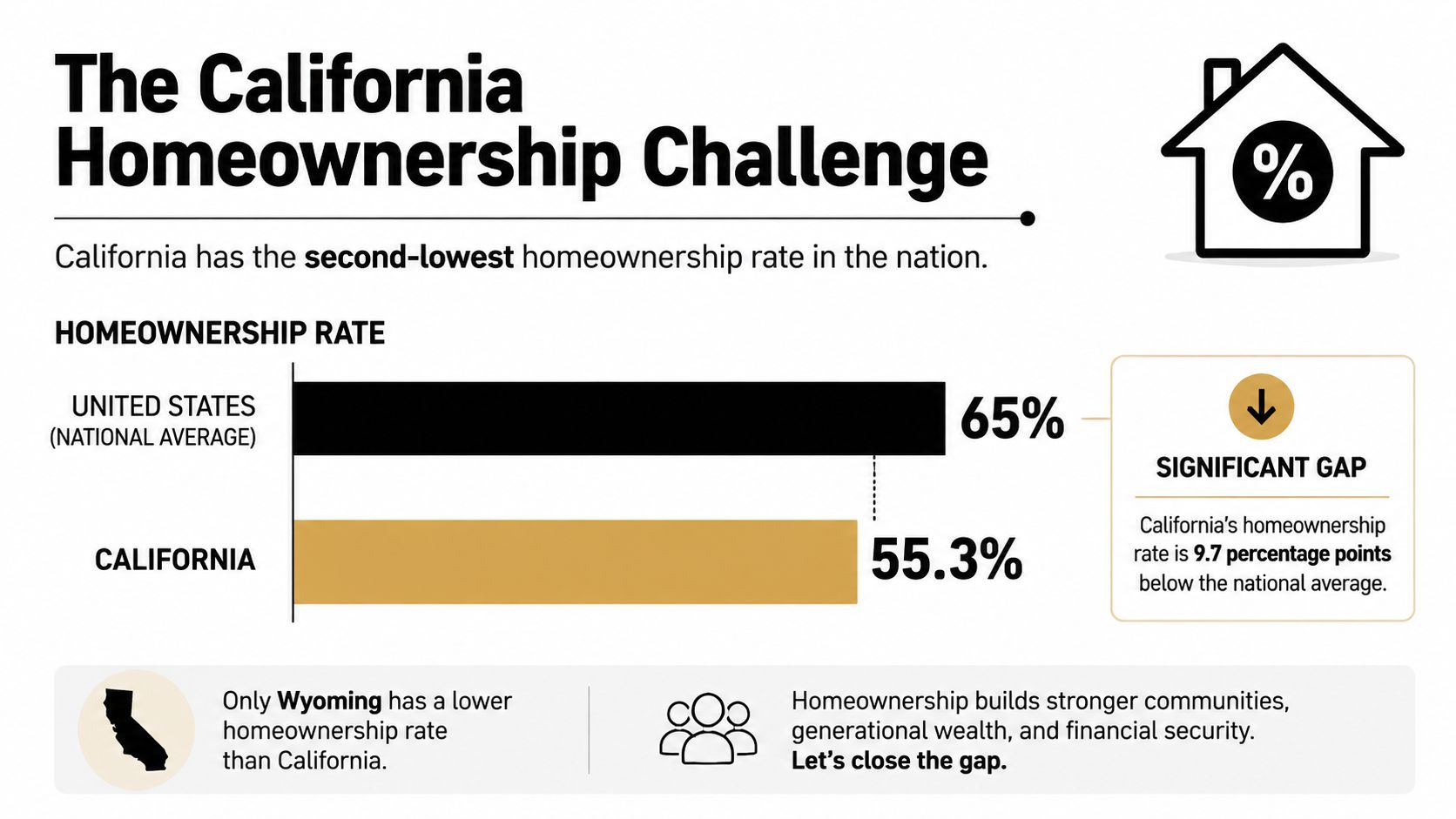
California's homeownership rate was 55.3% in 2025, the second-lowest nationally, so specialized lenders and assistance programs are essential for public service workers seeking affordable financing. The people who do loans for California workers include HERO-focused lenders, CalHFA-approved lenders, credit unions, government-program specialists, and mainstream lenders with occupation-based benefits.
That answer matters because a standard preapproval often misses the programs that can reduce cash needed at closing. Teachers, nurses, firefighters, law enforcement officers, veterans, healthcare professionals, and government employees may have access to state assistance, deferred second mortgages, VA financing, employer benefits, or occupation-targeted incentives. The right lender doesn't just quote a rate. They identify which benefits you qualify for, test how the programs work together, and structure the file so underwriting doesn't sink it.
Why California Workers Need Specialized Lenders
California's affordability problem affects whether public servants can qualify, preserve cash reserves, and compete for homes near their jobs. The California public-sector workforce and housing report connects housing pressure with the state's difficulty retaining and attracting public-sector employees. For borrowers, the practical issue is clear: a standard preapproval may not account for assistance programs or the way public-service income is documented.
Public servants often face several financing constraints at once. Housing costs can absorb a large share of income, down payment savings build slowly, and overtime, shift differentials, stipends, or variable pay may need careful documentation. A lender that evaluates only base salary and credit can overlook qualifying income or recommend a structure that leaves too much money tied up at closing.
Why occupation-specific expertise matters
California's government workforce includes employees with recurring income, specialized compensation, and possible access to occupation-based benefits. State employees, teachers, county workers, public safety professionals, healthcare workers, veterans, and other public servants do not all qualify for the same programs. The lender must identify the borrower's actual eligibility before recommending a loan stack.
That decision requires more than adding every available benefit. The lender should compare the first mortgage, state down payment assistance, deferred or forgivable financing, VA eligibility, and any occupation-specific incentive. A program that reduces cash needed upfront may create repayment conditions, affect monthly obligations, or limit which other benefits can be combined with it.
Practical rule: Choose a specialized lender when your approval depends on layered assistance, variable public-service income, military benefits, or occupation-specific eligibility. Choose a conventional lender when your finances are straightforward and you do not need those programs.
Ask the lender to show the full structure in writing. Confirm how overtime and stipends are counted, which documents prove employment or service, whether assistance is deferred or forgivable, what triggers repayment, and whether the programs can be stacked for the purchase you are considering.
Specialized lending is not automatically the right choice for every public servant. A conventional loan may be cleaner when income is predictable, reserves are strong, and upfront cash is not the obstacle. When cash-to-close is the constraint, start with a lender who can test California DPA and occupation-specific benefits together, then reject any combination whose repayment terms weaken the overall loan.
Types of Lenders Serving California Public Servants
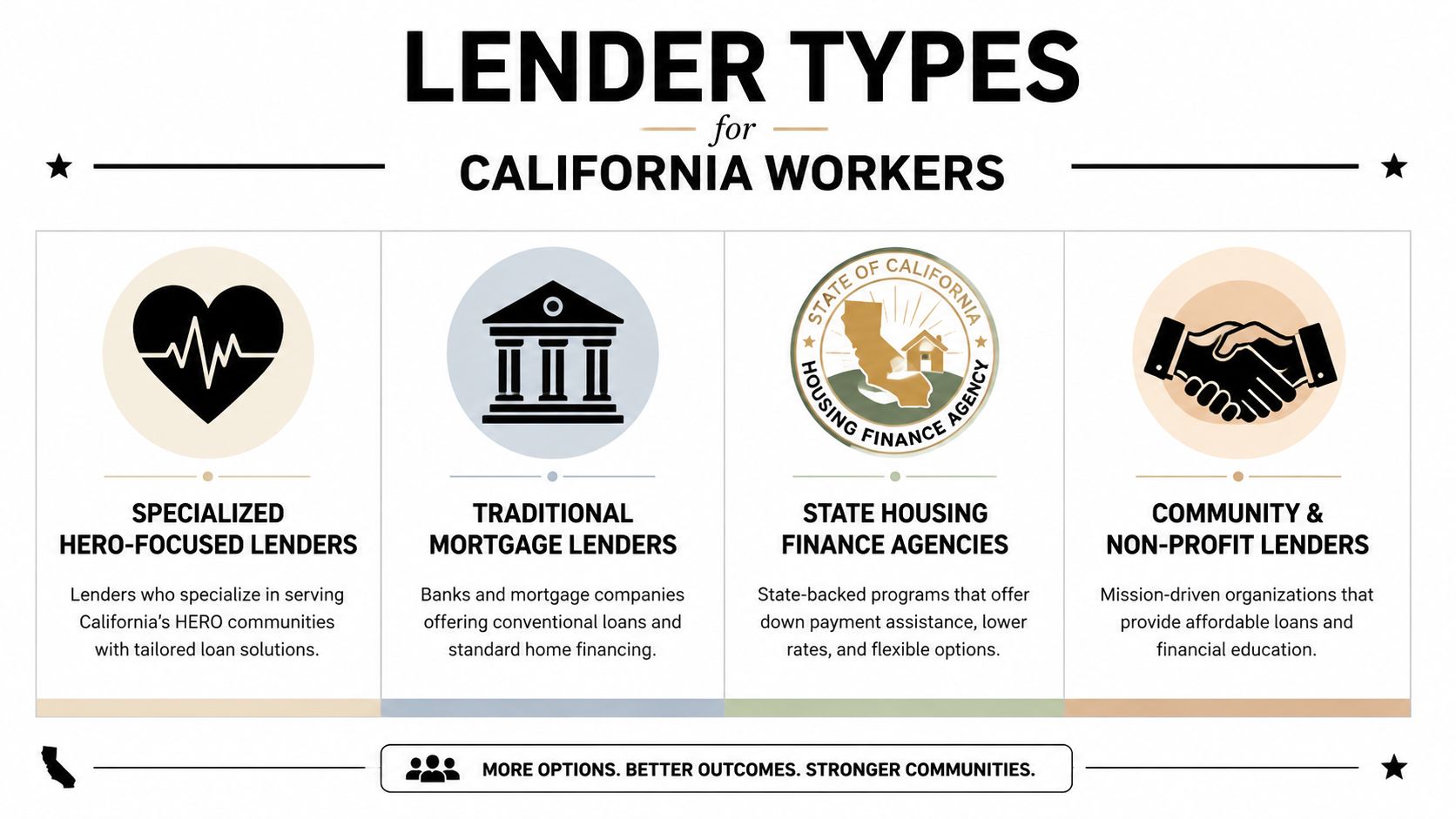
The phrase “who does loans for California workers” points to several lender categories, not one company or one mortgage product. Each category has a different strength.
HERO-focused lenders
Specialized HERO lenders work with borrowers in roles such as law enforcement, firefighting, EMS, military service, nursing, healthcare, education, and government. Their value is program fluency. They may understand how to document public-sector income, verify service or employment, and evaluate whether an occupation-based benefit can sit alongside a first mortgage and DPA.
A borrower comparing California home loan options for public servants should ask whether the advisor can explain the full cost of every loan layer, not just the advertised benefit. Ask who services the first mortgage, whether assistance is forgivable or deferred, what triggers repayment, and whether the program works for a purchase, refinance, or both.
State-affiliated lenders
CalHFA doesn't function like a walk-in bank. Borrowers work through approved lenders who originate loans using CalHFA programs. This category is the right fit when your priority is state-backed assistance, county-based income eligibility, or a deferred junior loan.
The lender must understand both the first mortgage and the assistance product. A loan officer who knows only the first mortgage may not structure the file correctly.
Credit unions and occupation-based institutions
Credit unions may serve public employees, educators, military members, or local communities. They can be useful when you value relationship-based service or have a financial profile that benefits from a more detailed review. Their program menu varies, so don't assume membership automatically creates a special mortgage advantage.
Mainstream mortgage lenders
Large banks and mortgage companies may offer conventional, FHA, VA, and other government-backed loans, sometimes with public-servant incentives. Their advantage is reach and product breadth. Their weakness can be inconsistent knowledge of niche assistance programs, especially when a file requires multiple approvals.
Before choosing, ask these questions:
- Program knowledge: Which California DPA programs do you actively originate?
- Occupation review: How do you verify teacher, first responder, healthcare, military, or government employment?
- Layering: Can you combine a state program with VA financing, an employer benefit, or county assistance?
- Underwriting: Who reviews the file when income includes overtime, shift pay, or public-sector allowances?
- Repayment terms: What happens to each deferred loan when you sell or refinance?
A lender that can't answer those questions clearly isn't ready to manage a complicated public-servant purchase.
State Down Payment Assistance Programs Explained
California assistance programs serve different borrowers. Buyer status, loan type, county income limits, occupation, repayment terms, and timing all affect the fit. Review each option by how it works inside the complete loan structure, not by its largest advertised benefit. For a broader overview, see these California down payment assistance programs.
| Program Name | Max Benefit | Eligibility Requirements | Best For |
|---|---|---|---|
| CalHFA MyHome | Up to the lesser of 3.5% of purchase price or appraised value for FHA loans, or 3% for conventional loans | First-time homebuyer and county-based income limits | Eligible first-time buyers who need help with down payment or closing costs |
| Dream For All | Up to 20% or $150,000 through a shared appreciation loan | Eligible first-generation buyers, first-time-buyer rules, income limits, and selection requirements | Buyers who meet the special eligibility rules and can plan around the application cycle |
| GSFA Platinum and Assist-to-Own | 3.5% of the first mortgage as a deferred second mortgage, plus an optional gift of up to 2%, for a maximum of 5.5% | Eligible law-enforcement personnel, firefighters and EMTs, medical and healthcare workers, teachers, and county employees purchasing or refinancing a primary residence in California | Public servants seeking help with down payment and closing costs |
CalHFA's MyHome Assistance Program provides a deferred-payment junior loan for down payment and closing costs. The borrower must be a first-time homebuyer and meet the program's county-based household-income limits. MyHome can work well when the primary loan already fits, but the lender must confirm that its repayment terms suit the borrower's future plans.
Dream For All requires advance planning. CalHFA's 2026 program uses county-specific income limits, including about $148,000 in Del Norte County, $168,000 in Los Angeles County, and $309,000 in Santa Clara County, according to CalHFA's 2026 announcement. County differences are substantial, so use the applicable local limit rather than a statewide assumption. The shared appreciation structure also deserves careful review before a borrower accepts the assistance.
GSFA Platinum and Assist-to-Own directly address the needs of eligible public servants. The assistance is a deferred second mortgage, while the optional gift can raise total support to 5.5%, according to GSFA's Platinum program details. That arrangement may reduce cash needed at closing without adding a required monthly payment in the same way as a standard installment loan. Confirm the occupation, property, purchase or refinance, and primary-residence requirements before building the application around it.
Decision rule: Start with the program you clearly qualify for. Then test whether another benefit fits its income rules, repayment obligations, and first-mortgage requirements. A larger headline amount is not automatically the better choice.
Dream For All timing also affects eligibility. CalHFA's lender registration window was limited, so borrowers should review the current application cycle before writing an offer. Waiting until contract negotiations can leave too little time to secure a place in the process.
Strategic Program Stacking for Maximum Benefits
Program stacking begins with the first mortgage. Choose the loan that matches the borrower's service history, credit profile, property, and budget. Add assistance only after confirming that the combined structure improves affordability and does not create repayment terms the borrower cannot accept.

Build the stack in the right order
First, identify the primary loan. A veteran may start with a VA loan. A first-time buyer may compare FHA and conventional financing. A public servant refinancing a primary residence may face different choices from someone purchasing a first home.
Second, test state assistance. CalHFA MyHome, Dream For All, and GSFA Platinum use different eligibility and repayment rules. Each option must fit the first mortgage's underwriting standards and program requirements. Read the repayment terms closely. A deferred second mortgage may avoid a regular monthly payment while still reducing future equity or becoming due at sale or refinance.
Third, investigate occupation-specific benefits. A teacher should ask the school district about employer-linked assistance. A firefighter or EMS professional should check first-responder programs. A county employee should ask about county-specific support. Compatibility must be confirmed in writing because an occupation benefit may conflict with a state program's income, lien, or first-mortgage rules.
Compare trade-offs before committing
The largest assistance amount is not automatically the strongest package. Compare cash needed at closing, required payments, lien priority, repayment timing, future equity, and the conditions that could trigger repayment. Shared appreciation programs require particular care because the amount owed may depend on the home's future value.
Dream For All may appeal to an eligible first-generation buyer, yet its selection process and shared appreciation terms can make it unsuitable for a borrower who needs predictable timing or wants to protect future equity. Review the current application cycle before making an offer, especially when registration depends on a limited lender window.
A VA loan paired with assistance may fit a veteran, while GSFA Platinum may suit an eligible firefighter or teacher. For specialized VA down payment assistance in California, ask the lender to compare that structure with conventional and FHA alternatives. The comparison should show cash to close, payment obligations, repayment exposure, and how each lien affects the borrower's long-term position.
Stacking works when every program fits the same transaction, underwriting file, and closing timeline.
Specialized lenders compare the complete payment and cash-to-close picture across loan types. Ask for that side-by-side analysis before choosing assistance based on its headline amount alone.
Your Application Preparation Checklist
A clean application starts before the home search. Public servants should organize their file early, particularly when qualifying income includes overtime, special assignments, shift differentials, military pay, or earnings from multiple employers. Complete records give the lender a reliable basis for choosing how state assistance and occupation-specific benefits can work together.
Assemble the core file
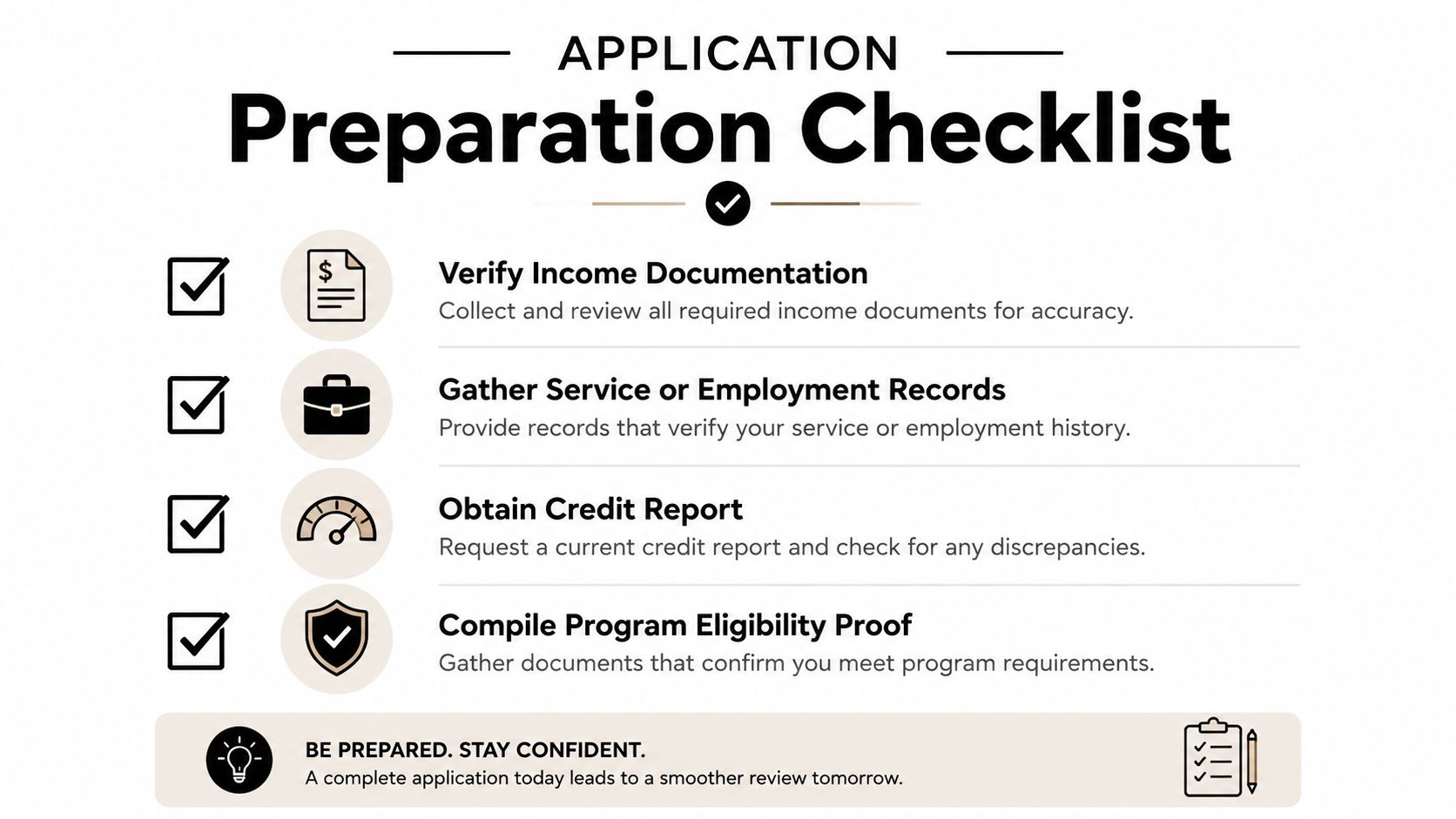
- Verify income documentation: Gather recent pay stubs, requested tax returns, employment records, and explanations for unusual income changes.
- Document available funds: Prepare bank statements and records for savings, gifts, retirement withdrawals, or other closing funds.
- Confirm employment or service: Keep government employment verification, school district records, healthcare employment documents, first-responder credentials, or military-service proof available.
- Review credit information: Obtain your credit report, dispute inaccurate accounts, and avoid opening new credit before underwriting ends.
- Prove program eligibility: Collect first-time-buyer information, county and household-income details, veteran documentation, and occupation-specific records.
Prepare the file for program review
Build a clear eligibility file before asking the lender to stack assistance programs. County and household-income details can affect state assistance, while service records or occupation documentation may support a separate benefit. Give the loan officer every relevant record early so the proposed structure reflects the borrower's actual qualifications.
Ask the lender to run more than one structure. Compare the required documents, funds available at closing, payment obligations, lien terms, and timing for each option. A lower loan amount, a different first-mortgage product, a deferred junior loan, or employer assistance may change which combination fits the transaction.
Use a practical preparation timeline
Start well before making offers. Early preparation leaves time to correct credit-report errors, verify employment, document variable income, and confirm whether a limited-window program is available. It also reduces the risk that regular salary is confused with overtime or other income that needs separate documentation.
Ask for a written list of outstanding conditions after preapproval. Respond with complete files, consistent explanations, and records for unexplained transfers. Public-sector employment can support an application, but underwriters still require evidence. Keep the file current until closing, especially after any job, account, or income change.
Common Mistakes That Cost California Workers Thousands
The costliest error is treating eligibility as approval. Meeting an occupation requirement does not overcome income limits, first-time-buyer rules, debt-to-income ratio, timing, or an incompatible loan structure.
Assuming eligibility equals approval
A lender must verify every qualification together. Public-sector employment may support one benefit while county income, household composition, credit obligations, or loan type determines whether the full structure works.
Waiting for the perfect program
Dream For All uses random selection and a limited registration window. Review the program-timing section above before planning around it. If registration or selection does not align with your purchase, build a workable alternative instead of delaying the transaction.
Misreading income eligibility
Income limits vary by county. A household may qualify in one county and fail in another, and the calculation may include household income rather than only base salary. Confirm the applicable county limit before choosing a price range or assistance strategy.
Treating first-time-buyer status casually
MyHome requires first-time-buyer eligibility. Previous ownership, a spouse's ownership history, and other program rules can change the result. Have the lender verify the definition before you count on the benefit.
Ignoring DTI until the end
CalHFA's published 43% maximum total DTI can stop a file even when automated underwriting looks favorable. Resolve avoidable obligations before applying, and avoid adding a vehicle, credit card, or personal loan during the mortgage process.
Choosing a lender who knows only one layer
A lender may understand VA financing but lack experience with GSFA. Another may know CalHFA but overlook employer assistance. Require a side-by-side comparison covering the first mortgage, assistance, monthly payment, cash-to-close, lien terms, and repayment triggers. If the advisor cannot explain how the programs fit together, choose a lender who can.
Success Stories from California Public Servants
The following planning scenarios are models for decision-making, not verified borrower case studies or promises of a particular result. Each one shows how occupation benefits, state assistance, and loan rules must fit together before a buyer makes an offer.
A Los Angeles teacher starts with a conventional first mortgage and investigates CalHFA MyHome because upfront cash is the main obstacle. The teacher also asks the school district about employer assistance. The critical step is confirming that the district benefit and the CalHFA junior loan can coexist, then checking the resulting DTI and repayment terms before making an offer.
A San Diego firefighter who is also a veteran compares a VA loan with GSFA Platinum. The firefighter asks whether the assistance can be layered with VA financing, whether the property qualifies, and how the combined structure affects cash-to-close and future repayment. The lender documents occupation and military eligibility separately, because each benefit has its own requirements.
A Sacramento nurse considers Dream For All after reviewing the first-generation and first-time-buyer requirements. The nurse confirms county income eligibility, watches the registration schedule, and prepares the required documentation before house hunting begins. The California down payment assistance programs can then be compared with occupation-specific benefits based on timing, eligibility, and repayment obligations.
A Bay Area government employee faces a difficult affordability calculation in a county where CalHFA's published Dream For All income example reaches about $309,000 in Santa Clara County. The employee compares Dream For All with MyHome, employer benefits, and a conventional first mortgage. Monthly payment and future equity carry more weight than the largest advertised assistance amount.
These examples point to a practical test: can the proposed programs coexist, preserve acceptable DTI, and produce repayment terms the buyer understands? Require a side-by-side review before accepting a generic preapproval.
California Loans for Heroes helps veterans, active-duty military members, first responders, law enforcement officers, firefighters, nurses, healthcare professionals, teachers, pilots, and other public service employees evaluate home loans, down payment assistance, refinance options, lender credits, and HERO Home Loan & Buyer Rewards Program benefits. Visit California Loans for Heroes to review eligibility and program combinations for a purchase or refinance.