
A California teacher, nurse, firefighter, or law enforcement officer can spend years serving the community while watching home prices move further out of reach. The obstacle often isn't the monthly mortgage alone. It's the cash required for the down payment, closing costs, prepaid expenses, and reserves before the keys can change hands.
Hometown Heroes down payment assistance can address that upfront barrier. California buyers shouldn't assume assistance is limited to very low-income households or that every program works the same way. The right strategy starts with identifying the program, loan structure, occupation rules, county income limit, and mortgage product that fit your situation.
Your Path to Homeownership in California
California homebuying becomes more manageable when you separate the problem into two questions: Can you qualify for the mortgage? and How much cash must you bring to closing? Down payment assistance primarily addresses the second question. It can reduce the amount of savings needed without replacing the first mortgage or eliminating the normal underwriting review.
A public-service career may qualify you for programs aimed at teachers, educators, healthcare professionals, firefighters, emergency personnel, law enforcement officers, veterans, active-duty military members, pilots, and government employees. The exact occupation list varies by program, so a job title alone isn't enough. Your employer, work location, employment status, income, household size, property, and occupancy plans can all matter.
Practical rule: Don't wait until you've found a house to investigate assistance. Confirm your options before you make an offer.
The policy focus is significant. By Q1 2026, the national count of homebuyer assistance programs had reached 2,679, including 1,666 programs, or 62%, focused on first-time buyers, according to Down Payment Resource's program index. That doesn't mean every program is available in California, but it does show that down payment assistance has become a major homeownership tool rather than a niche option.

Start by taking these steps:
- Identify your buyer status. Many programs use a first-time buyer definition based on recent ownership, not whether you've ever owned a home.
- Check county-specific income rules. A household that exceeds a limit in one county may fit within another county's program limits.
- Review the property requirements. Assistance may require a primary residence and may restrict the type or location of the property.
- Choose a participating lender. The lender must understand both the first mortgage and the assistance lien.
- Compare total cost, not just assistance. A larger benefit isn't automatically better if it comes with an unsuitable loan or repayment terms.
For a practical overview of the purchase process, use this first-home buying guide for California buyers. The strongest applicants treat DPA as part of a complete financing plan, not as a last-minute source of money.
How Hometown Heroes Assistance Actually Works
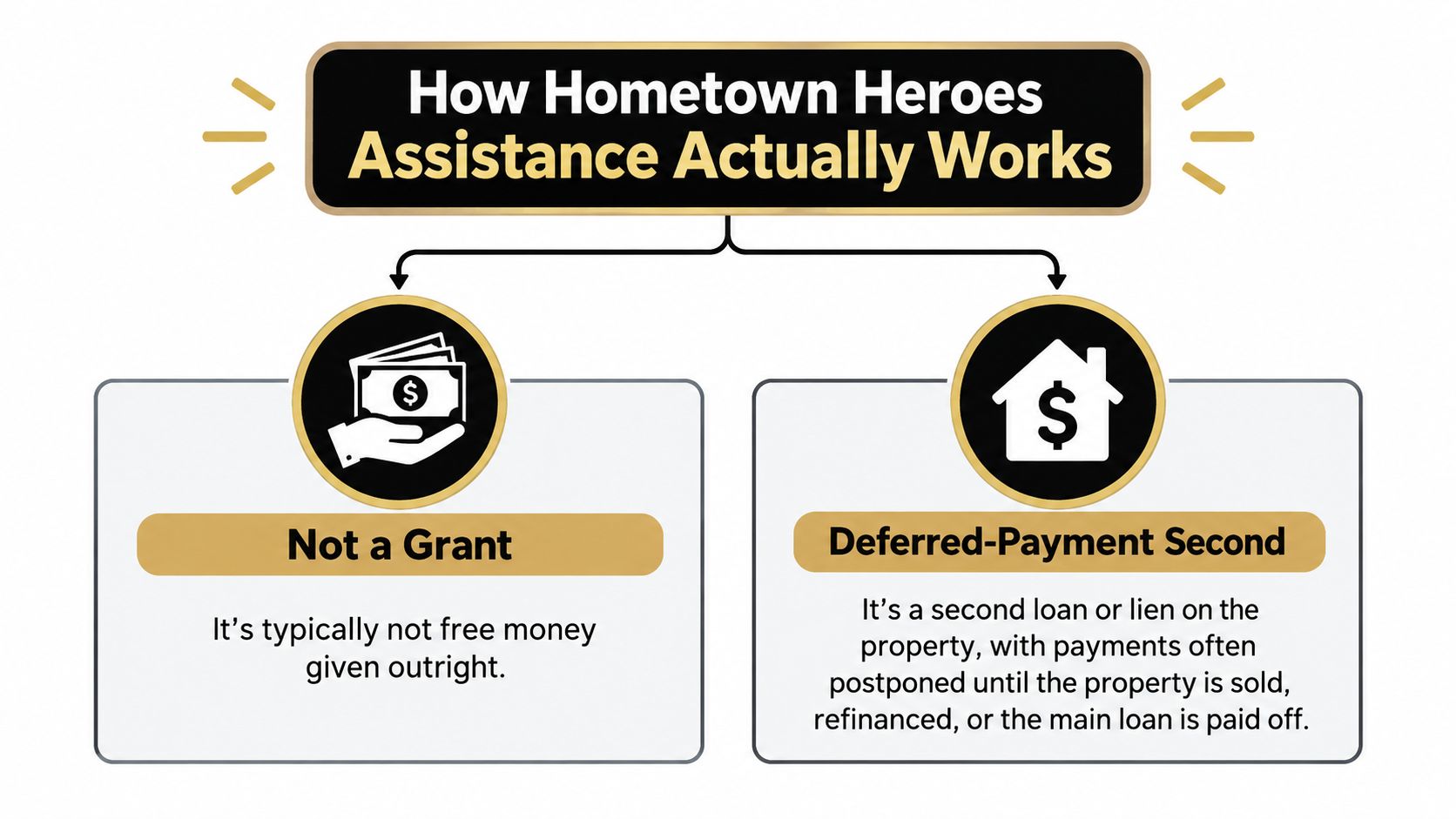
Most Hometown Heroes-style assistance isn't a grant. It is typically a zero-interest, deferred-payment second mortgage recorded behind the first mortgage. You receive funds at closing, but you generally don't make a separate monthly payment on that second loan.
The assistance functions as an interest-free loan from a supportive family member. The money helps you buy the home today, and repayment is postponed until a defined event. Depending on the program, that event can include selling the property, refinancing, paying off the first mortgage, or no longer occupying the home as your primary residence. The legal documents control the result, so never rely on the phrase “no monthly payment” without reading the repayment terms.
The assistance may be applied toward more than the down payment. Program rules can allow funds for closing costs, prepaid escrows, and other approved cash-to-close expenses. Some designs may also permit certain upfront mortgage insurance costs. That flexibility matters in California because a buyer may have enough income for a payment but not enough liquid savings for every expense due at settlement.
The key budget effect is straightforward. If the assistance covers part of the funds needed to close, you preserve more of your savings for moving expenses, repairs, emergency reserves, and homeownership costs. Because the deferred second generally has no current payment, it can lower your upfront cash requirement without adding another monthly debt payment. The first mortgage still has to be fully underwritten, and the second lien remains a real obligation.
What repayment actually means
Repayment usually occurs when a triggering event happens. Selling the property normally requires the title company to address the second lien from the sale proceeds. Refinancing can require approval for the assistance lien to remain in second position, or it may require repayment as part of the refinance.
Occupancy also matters. If you move out and convert the home into a rental, the program may treat that change as a repayment trigger. Ask for written answers about resale, refinance, relocation, hardship, and occupancy before you accept the funds.
No monthly payment doesn't mean no debt. It means the program postpones repayment while you meet its conditions.
Qualifying as a Hero in California
California programs don't use one universal definition of a hero. Your occupation may place you in the intended audience, but approval depends on the full program framework. A nurse at a qualifying healthcare employer, a teacher employed by a school district, a firefighter, a law enforcement officer, an EMS professional, a veteran, or a public employee may have a strong starting point. The program still needs to verify employment, income, property eligibility, and mortgage qualification.
Use the California Loans for Heroes list of eligible heroes as a starting point, then confirm the specific rules with a participating lender. Some programs focus on service professions broadly, while others define eligible employers, facilities, duties, or employment arrangements more narrowly.
Income is measured locally
For many California programs, eligibility is tied to county-specific income limits based on the property location and household circumstances. CalHFA publishes those limits and states that it no longer uses its own sales price limits for eligible properties, a change effective June 1, 2020, as explained in its official income and property limits guidance.
That flexibility can help buyers in expensive California markets, but it doesn't remove underwriting limits. Lenders still review income documentation, debts, assets, credit history, and the proposed property. Household income rules may also differ from the income used to approve the first mortgage, so ask exactly whose income must be counted.
Credit and first-time buyer status
Credit requirements depend on the assistance program and the underlying mortgage. Don't assume an occupation-based program ignores credit standards. A lender must determine whether your credit profile fits the approved first mortgage and the DPA program's rules.
First-time buyer status also deserves careful attention. Many frameworks define a first-time buyer as someone who hasn't owned a principal residence during the previous three years, rather than someone who has never owned any property. Former homeowners may therefore qualify, subject to the program's own definition and documentation.
Occupancy and documentation
Expect to prove that the home will be your primary residence. Prepare employment records, income documents, tax information when requested, asset statements, identification, and evidence supporting your buyer status. If your work is hybrid, mobile, contract-based, or spread across locations, ask for a determination before writing an offer.
A good lender should review your eligibility early, explain any unresolved issue, and tell you whether the assistance is a deferred loan, forgivable structure, or another form of aid.
California Down Payment Assistance Programs to Know
California buyers should compare programs by assistance amount, loan structure, eligible use of funds, income rules, and first-mortgage compatibility. The largest advertised amount isn't always the best choice. A smaller deferred loan may fit your mortgage better, while a larger local program may require a narrower income band or a particular property location.
CalHFA MyHome Assistance
CalHHA's MyHome Assistance Program provides a deferred-payment junior loan of up to 3.5% of the purchase price or appraised value, subject to the program's stated calculation, for down payment and closing costs. It must be paired with eligible CalHFA government financing, such as an FHA loan, as described on the CalHFA MyHome Assistance Program page.
This option is worth examining when you want a statewide program connected to an approved government-loan structure. It isn't universal cash that can be attached to any mortgage, and the lender must confirm the current underwriting and eligibility requirements.
California Moderate Income Purchase Assistance
The California Moderate Income Purchase Assistance Program targets buyers above the lowest income bands. Eligible buyers earning 81% to 120% of Area Median Income may receive up to $60,000, while buyers earning 121% to 150% of Area Median Income may receive up to $35,000, with the applicable household-income bands published by household size, according to the program details published by FHA.com.
This program can be particularly relevant for essential workers whose salaries exceed traditional low-income thresholds but still don't leave enough liquid cash for a California purchase. Confirm the administering agency, location requirements, repayment terms, and current availability before planning around the advertised maximum.
Local programs can change the answer
City and county programs may offer terms that differ from statewide options. Berkeley's first-generation homebuyer program, for example, offers loans of up to $150,000, with repayment deferred until the home is sold, transferred, or the mortgage is paid off, according to Berkeley's housing assistance announcement. That is repayable aid, not a grant.
| Feature | CalHFA MyHome Assistance | CA Moderate Income Purchase Assistance |
|---|---|---|
| Assistance type | Deferred-payment junior loan | Program-specific assistance loan |
| Maximum stated benefit | Up to 3.5% of the purchase price or appraised value | Up to $60,000 or $35,000, depending on AMI band |
| Primary use | Down payment and closing costs | Down payment and approved purchase costs, subject to program rules |
| Financing connection | Paired with CalHFA-approved government loans, including FHA | Confirm approved first-mortgage and local program requirements |
| Best fit | Buyers using eligible CalHFA financing | Moderate-income buyers who fit the published AMI bands |
Don't compare the headline amount alone. Ask for a written estimate showing the first mortgage, assistance lien, cash to close, monthly payment, and repayment trigger.
Combining Assistance with HERO Loans and Rewards
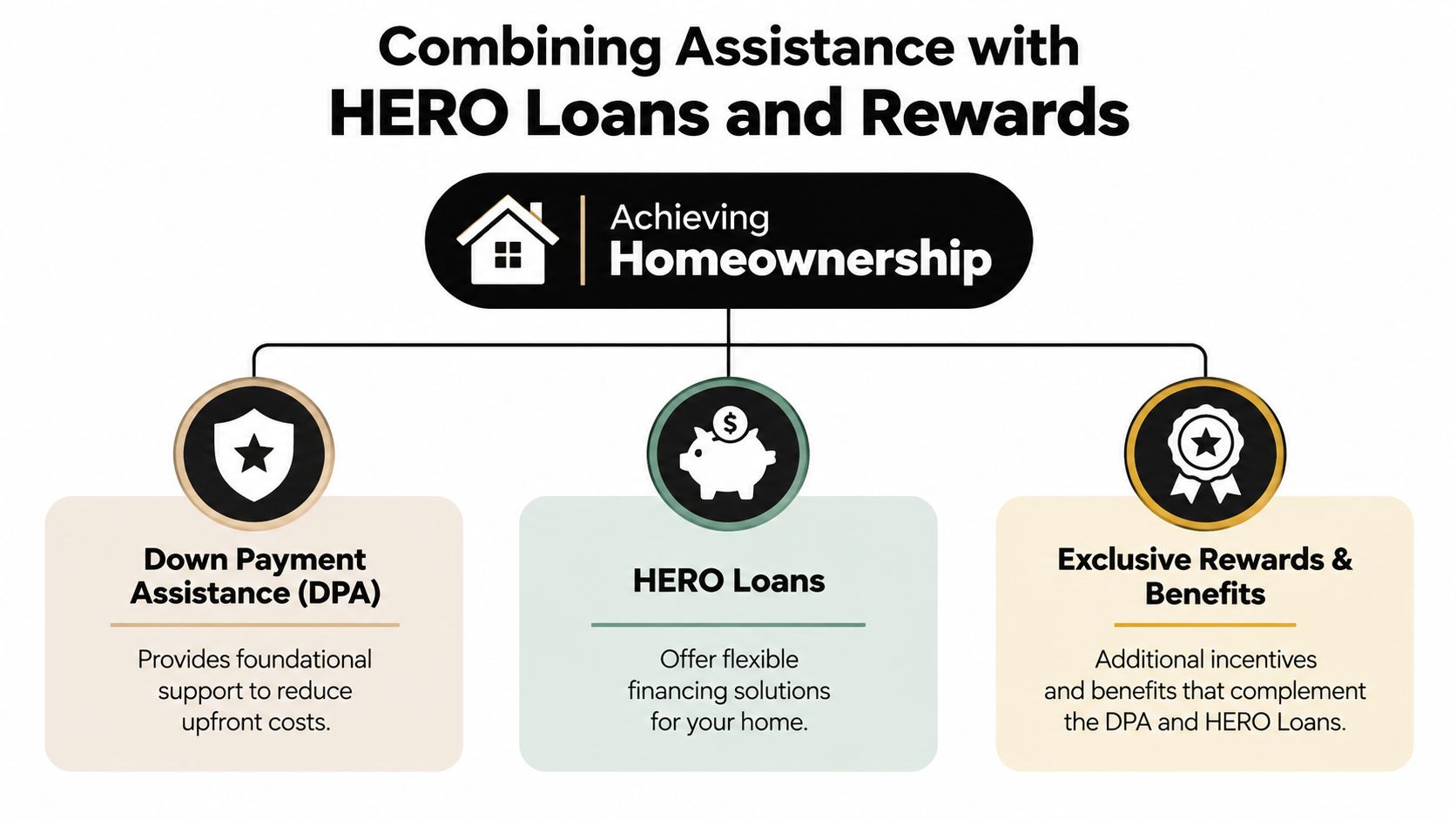
Down payment assistance is one component of the financing plan. A California essential worker may also need a first mortgage with suitable terms, a lender familiar with public-sector borrowers, and credits that reduce remaining closing expenses. That combination is where a specialized product such as the HERO Home Loan can become relevant.
The right approach is to test the pieces together rather than assume every benefit can be stacked. The lender should verify whether the DPA program permits the proposed first mortgage, whether the HERO Home Loan meets agency requirements, and whether Buyer Rewards or lender credits can be applied to eligible closing costs without violating program limits.
Build the package in the right order
Start with the first mortgage. The loan type determines the down payment requirement, underwriting standards, and how assistance can be applied. Then add the DPA as a compatible subordinate financing source. Finally, review lender credits or rewards for remaining closing costs, prepaid items, and other permitted expenses.
California Loans for Heroes offers the HERO Home Loan and Buyer Rewards Program, which can provide access to homebuyer assistance options, mortgage financing, lender credits, and dedicated support for eligible California service professionals. Treat those features as items to evaluate in a loan comparison, not as automatic savings available to every borrower.
The goal isn't to collect programs. The goal is to create one compliant financing structure that lowers cash to close while keeping the monthly payment and future obligations understandable.
Ask for a side-by-side estimate
Request two or more loan scenarios:
- DPA scenario: Show the assistance amount, first mortgage, second-lien terms, cash to close, and repayment trigger.
- HERO loan scenario: Show the product's rate, fees, eligibility rules, and interaction with the DPA.
- Rewards scenario: Show exactly how lender credits apply and which costs remain the buyer's responsibility.
- No-assistance scenario: Use this as a baseline for comparing total cash, payment, and long-term flexibility.
A strong comparison reveals tradeoffs. Assistance may preserve savings but create a lien. A reward may reduce closing costs but depend on loan terms. The best structure is the one you understand and can afford beyond closing day.
Common DPA Pitfalls and Questions Answered
The most expensive DPA mistakes happen before closing. Buyers assume their job automatically qualifies, count on an advertised maximum without a formal review, or confuse deferred repayment with forgiveness. A careful preapproval prevents those errors.
Does prior ownership disqualify me?
Not necessarily. A common myth says DPA is only for people who have never owned a home. Many programs instead define “first-time homebuyer” as someone who hasn't owned a principal residence during the previous three years, as explained in Down Payment Resource's guide to DPA myths.
Ask the lender to review your ownership history under the exact program definition. Don't self-reject because you owned a home in the past.
Is the assistance free money?
Usually, no. A deferred second mortgage generally carries no monthly payment, but the balance can become due when you sell, refinance, pay off the first mortgage, or stop using the property as your primary residence. A forgivable program has different conditions, so read the documents instead of relying on marketing language.
What should I ask before applying?
Use this short checklist:
- Employment: Does my employer and work arrangement fit the program's definition?
- Income: Which household income counts, and which county limit applies?
- Credit: Does my credit profile meet both the first-mortgage and DPA requirements?
- Property: Is the intended home eligible as a primary residence?
- Cash to close: Which costs can the assistance cover, and what must I bring?
- Repayment: What event triggers repayment, and can the second lien remain in place after refinancing?
- Timing: When must the lender reserve or document the funds?
Get the answers in writing. Program availability, funding, and underwriting rules can change, and a prequalification isn't the same as final approval.
Can I combine DPA with other benefits?
Sometimes, but never assume. A DPA program may restrict other subordinate financing, while lender credits may have limits on how they can be used. Your loan officer and escrow team should coordinate the final structure before you sign an offer.
California heroes should also plan for life after purchase. If you may relocate, refinance soon, or sell before building meaningful equity, ask how the deferred balance affects that decision. The assistance can be valuable, but it comes with a future obligation that belongs in your long-term housing plan.
If you're a California veteran, first responder, law enforcement officer, firefighter, nurse, healthcare professional, teacher, pilot, or public employee, California Loans for Heroes can review Hometown Heroes down payment assistance, HERO Home Loan options, and eligible Buyer Rewards with you. Contact the team before making an offer so you know which programs fit, how much cash you'll need, and what repayment terms apply.