
You're stationed in California, your housing allowance is doing serious work, and you're trying to decide whether buying makes sense before your next PCS. The challenge isn't finding a mortgage with a competitive rate. You need to account for California's expensive housing markets, military relocation risk, VA underwriting, upfront fees, occupancy rules, and protections that apply to existing debts rather than to a new VA mortgage.
For many service members, active duty military home loans start with the VA program. That's usually the right place to begin, but it isn't automatically the right loan for every borrower or every California property. FHA, conventional financing, CalVet, and targeted assistance programs can deserve a real comparison, especially when the funding fee, cash reserves, loan size, or long-term plans change the calculation.
Why Active Duty Military Home Loans Matter in California
An active-duty service member stationed near San Diego receives orders, finds a home that fits the family, and learns that the price is far higher than what friends and relatives pay elsewhere. The buyer may have reliable military income and a strong housing allowance, but the lender still has to determine whether enough cash remains after the proposed payment and recurring obligations. A quick online prequalification won't capture every issue.

California adds practical complications. Property taxes, insurance, association dues, commuting costs, and local prices can make a payment look manageable on paper while leaving too little monthly cash flow. A lender who understands military pay structures and California property conditions should analyze the whole budget, not just quote a headline rate.
The VA loan is the starting point, not the conclusion
The VA home loan program began in 1944 under the original GI Bill. By August 5, 2025, it had guaranteed its 29 millionth home loan and backed nearly $4 trillion in home loans since launch, according to published VA loan program statistics. That history explains why VA financing is often the first option active-duty borrowers ask about.
The program can offer a path to purchase without a down payment in many cases, and it doesn't use private mortgage insurance in the same way conventional financing does. But the home must be your primary residence, and the lender still applies its own credit, income, asset, and property review.
California buyers need a broader comparison
A good mortgage conversation should put VA, FHA, conventional, and CalVet options on the same worksheet. The right choice depends on your entitlement, down payment, credit profile, property type, expected time in the home, and ability to absorb closing costs.
Your assignment timeline matters just as much. A buyer facing deployment or a likely PCS needs a realistic occupancy and document-signing plan, not just an approval letter. Choose a lender who can explain the trade-offs clearly and coordinate around military orders without treating your service obligations as an inconvenience.
VA Loan Eligibility and Requirements for Active Duty Borrowers
Eligibility and approval are separate decisions. You can qualify for the VA benefit and still need to satisfy a lender's underwriting standards for the mortgage itself.
Start with service eligibility
Active-duty borrowers can establish VA home loan eligibility after as few as 90 continuous days of active service, according to the U.S. Department of Veterans Affairs eligibility guidance. The VA requires a valid Certificate of Eligibility, commonly called a COE, and eligibility can be reestablished after discharge or release from active duty.
The COE confirms access to the benefit. It doesn't tell you how much home you can afford, guarantee an approval, or replace the lender's review of income and credit. For active-duty applicants, the lender may also need current service documentation to support the application.
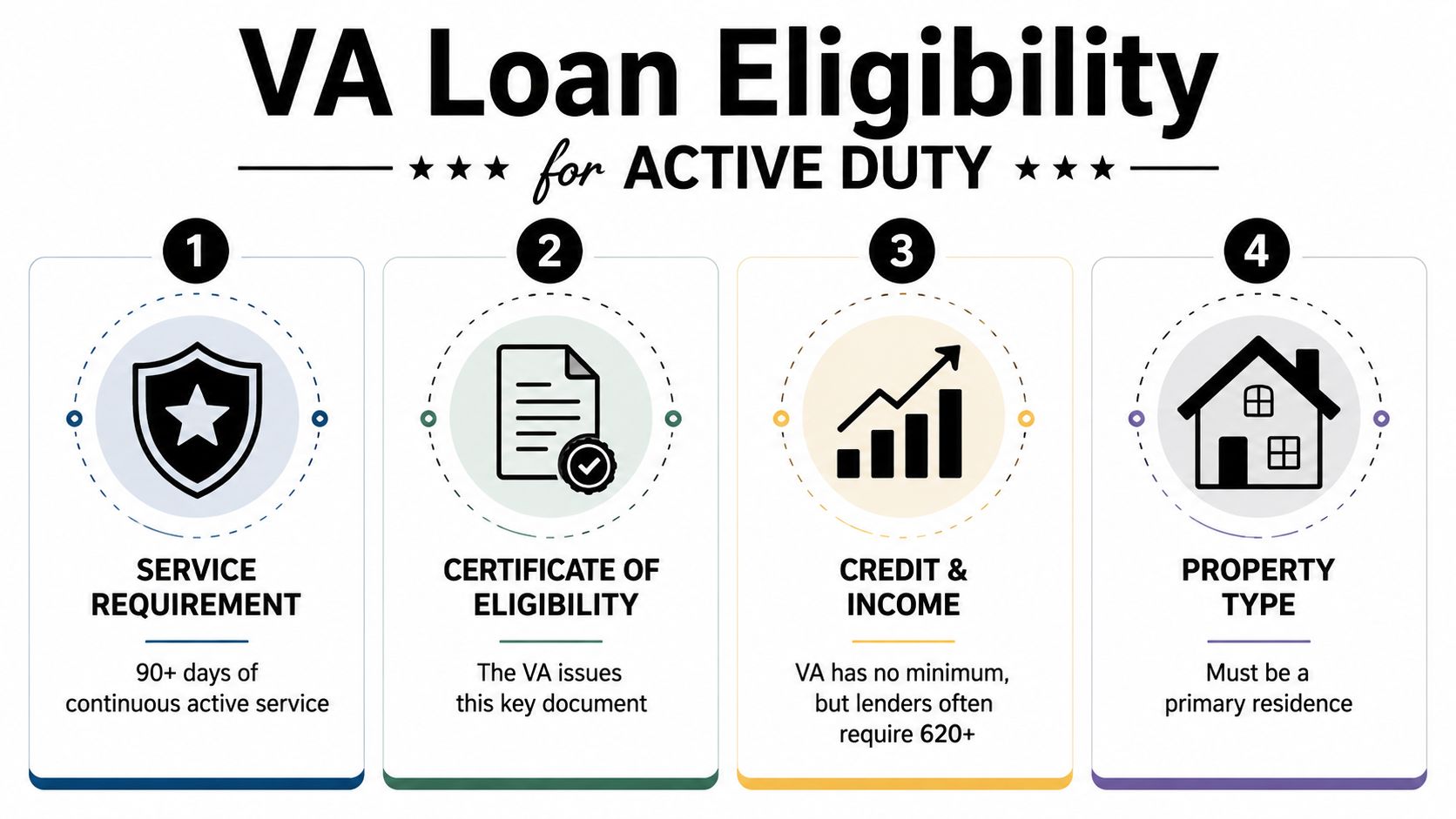
Use this qualification sequence
Confirm your service record: Verify that your active service satisfies the applicable VA requirement. Don't rely on an assumption based only on your current duty status.
Obtain the COE: Your lender can help request it, or you can use the VA's own process. Resolve documentation gaps before you write an offer.
Prepare financial records: Expect review of pay, recurring obligations, credit history, assets, and the proposed housing expense. Military income can be consistent, but underwriting still needs clear documentation.
Confirm the property plan: The home must be intended as your primary residence. A purchase purely for investment or a property you don't intend to occupy won't fit the standard VA purpose.
For a practical overview of the documentation and process, review this guide to VA home loan eligibility.
National Guard eligibility requires careful reading
Some National Guard members may qualify with at least 90 days of active service, including at least 30 consecutive days under qualifying Title 32 activation, as described in the VA's home loan program information. Guard status alone doesn't answer the question. The activation authority, service length, and records matter.
Residual income can decide the file
VA underwriting looks beyond a simple debt-to-income ratio. The residual-income framework measures what remains after taxes, housing costs, and recurring obligations. The VA handbook also reduces the residual-income requirement by 5% for active-duty or retired servicepeople, as summarized in military housing loan underwriting guidance.
That means a borrower with an acceptable DTI can still face a problem if the remaining monthly cash flow is too low. In California, where housing costs can be substantial, ask your lender to show the residual-income calculation before you become emotionally attached to a property.
Comparing VA, FHA, Conventional, and CalVet Loan Options
There isn't one universal winner. VA financing is often the strongest starting point for an eligible active-duty borrower, but an alternative may fit better if you're making a substantial down payment, want to compare upfront charges, or are considering a property and ownership structure that needs closer review.
| Loan Type | Down Payment | Mortgage Insurance | Funding Fee / Upfront Cost | Best For |
|---|---|---|---|---|
| VA | No down payment in many cases | No private mortgage insurance requirement | VA funding fee may apply, with exemptions for certain borrowers | Eligible active-duty borrowers seeking to preserve cash |
| FHA | Down payment required under FHA rules | Mortgage insurance applies | FHA upfront mortgage insurance and other closing costs | Buyers whose credit or cash profile fits FHA underwriting |
| Conventional | Depends on the lender and transaction | May apply when equity is limited | No VA funding fee, but standard closing costs and pricing apply | Borrowers with strong credit, cash, and conventional pricing |
| CalVet | Program-specific | Program-specific | Program-specific state program costs | Eligible California buyers who value CalVet's structure and support |
| HERO assistance | Depends on the selected first mortgage and assistance option | Depends on the first mortgage | Assistance, lender credits, and program terms vary | California public-service borrowers seeking coordinated guidance |
VA financing preserves cash, but carries a fee for many borrowers
The VA program doesn't require a down payment in many cases, which can be valuable in California because keeping cash available for reserves, moving expenses, repairs, and military transitions matters. The trade-off is that many borrowers pay a VA funding fee, unless they qualify for an exemption.
The VA's guaranty structure is tied to entitlement amounts, including a basic entitlement of $36,000 and a guaranty of up to 25% of the loan amount above certain thresholds, as explained in the VA guaranty handout. Your lender should explain how entitlement affects the transaction rather than assuming the same structure applies to every purchase.
FHA and conventional loans deserve an honest quote
FHA may be useful when the borrower's credit or down-payment profile fits its rules, but mortgage insurance and upfront costs need to be included in the comparison. Conventional financing can make sense for a borrower with strong credit and meaningful cash who prefers to avoid a VA funding fee, especially if the borrower plans to hold the property for a long time.
CalVet is a California-specific alternative that should be evaluated on its actual terms. Don't assume it automatically beats VA financing, and don't dismiss it because VA is familiar. Ask for side-by-side estimates showing the cash required, monthly payment, insurance treatment, and total financing costs.
Choose by ownership plan, not marketing slogan
If preserving liquidity is your top priority, VA may have a clear advantage. If you're putting substantial money down, conventional financing may deserve more attention. If you want a state-specific structure or a coordinated assistance path, CalVet and HERO-related options may be worth reviewing.
The recommendation is simple: get written comparisons for the same property and transaction assumptions. Rate alone won't tell you which loan leaves your household in the stronger position.
Understanding the True Cost of a VA Loan in California
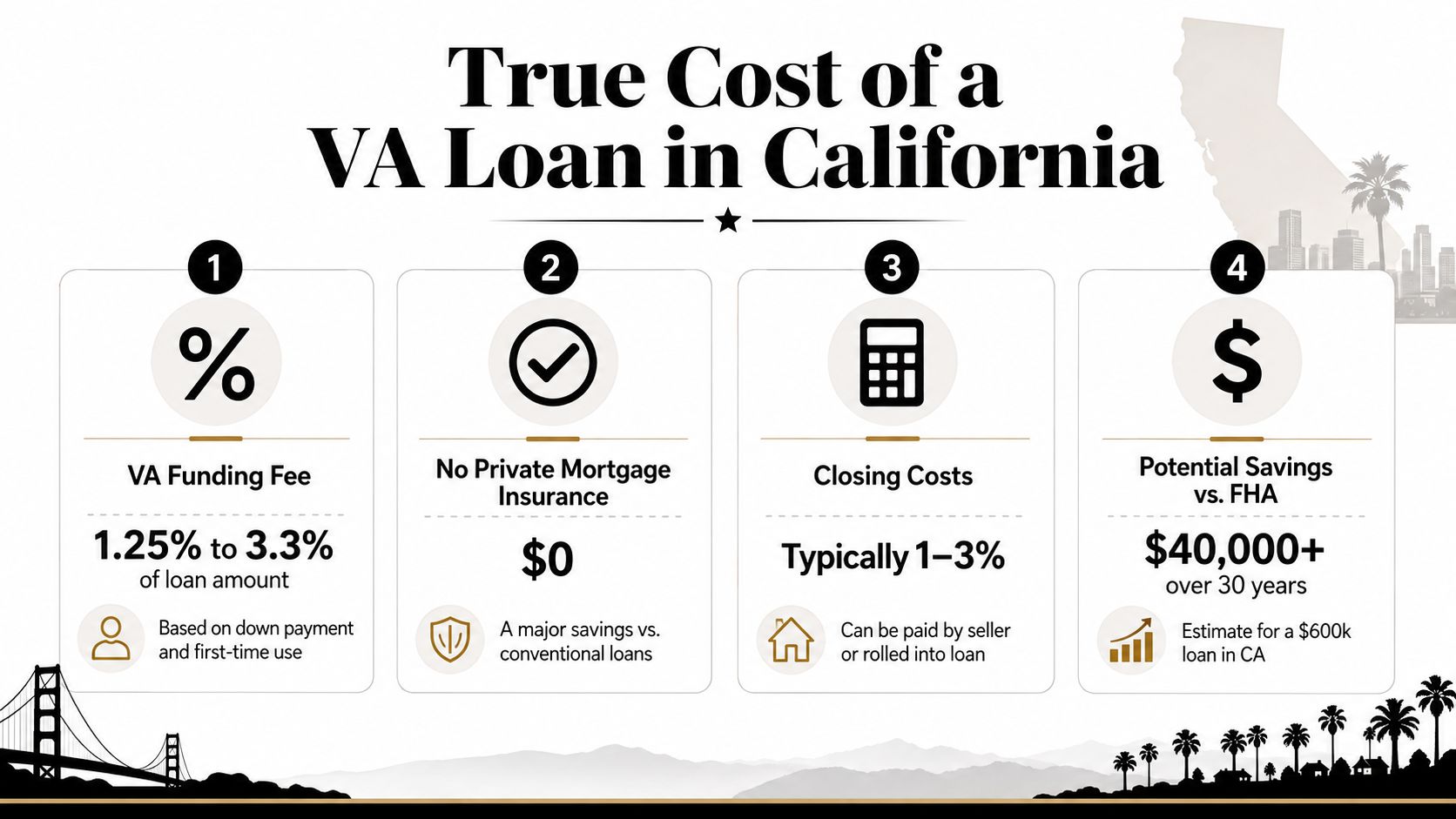
The phrase “zero down” is useful, but incomplete. A VA purchase can reduce the cash needed at the front of the transaction, yet you still need to budget for the funding fee when applicable, closing costs, prepaid items, reserves, inspection-related expenses, and the monthly payment created by California's housing prices.
The funding fee changes the payment math
For 2026, the funding fee for a first-use VA purchase loan with less than 5% down is 2.05%, with lower rates at higher down payments, according to this 2026 VA loan buyer guide. The fee can often be financed, but financing it increases the loan balance and therefore affects the payment and total interest.
The fee is waived for certain veterans receiving VA compensation for service-connected disabilities and for some surviving spouses. Certain Purple Heart recipients may also qualify for an exemption. Confirm your status before you finalize the loan structure, because an exemption can materially change the upfront economics.
Residual income matters more in expensive counties
VA underwriting measures cash left after taxes, housing costs, and recurring obligations. For loans of $80,000 and over, the 2026 residual-income benchmark for a family of four is $888 in the Northeast, $868 in the Midwest and South, and $967 in the West, according to VA residual-income guidance for military housing loans.
California falls within the West benchmark, but the practical issue goes beyond geography. A borrower may pass a DTI screen and still struggle to satisfy the residual-income standard after a high housing payment, car debt, childcare, or other recurring obligations. Ask for a complete cash-flow analysis before bidding at the top of your approval range.
Practical rule: Treat the funding fee as part of the purchase price decision, not as a minor line item discovered at closing.
SCRA is not a VA financing benefit
The Servicemembers Civil Relief Act can cap interest on qualifying pre-service mortgage debt at 6% once the borrower provides proper notice and orders, as described in the 2026 active-duty buyer guide. This protection applies to an existing mortgage debt incurred before service. It isn't the same thing as a VA loan benefit and doesn't automatically change the terms of a new purchase mortgage.
That distinction matters for service members who already own a home, rent it during a relocation, or carry a pre-service mortgage. Tell your lender and legal adviser about existing debts and orders so the correct protection is considered.
For a transaction-specific fee review, use a detailed VA funding fee chart and have the lender confirm the applicable category.
Refinance Options for Active Duty Military Homeowners
Refinancing can help, but it isn't automatically beneficial because a new rate looks lower. The lender should compare the new payment and closing costs against the time you expect to keep the property, the effect of restarting the amortization schedule, and your upcoming PCS or deployment plans.

VA IRRRL is designed for an existing VA loan
The VA Interest Rate Reduction Refinance Loan, or IRRRL, is intended for borrowers refinancing an existing VA mortgage to improve the rate or payment structure. It typically involves less documentation than a new purchase or cash-out transaction, but the process is simplified and does not mean automatic approval or automatic savings.
Ask for a break-even analysis. If the refinance adds closing costs, divide those costs by the expected monthly savings, then compare the result with your likely time in the home. A PCS could change that timeline quickly.
Cash-out refinancing serves a different purpose
A VA cash-out refinance can let a homeowner access available equity, subject to lender, VA, and property requirements. That money might support a major project or consolidate debt, but converting unsecured or lower-cost debt into a mortgage can increase the risk attached to your home.
California equity can also be uneven across neighborhoods and property types. A valuation may not support the amount you expect, and a higher balance can weaken your flexibility if orders arrive and you need to sell or rent the property.
Avoid the common refinance trap
Don't reset the loan term without examining the long-term cost. A lower payment can result from extending repayment rather than from a meaningful improvement in the rate or balance structure.
Use a written comparison that shows the current balance, new balance, closing costs, monthly payment, total interest implications, and projected time in the property. If you're on active duty, include deployment, PCS timing, and SCRA considerations in the discussion before signing.
How the HERO Program Supports Active Duty Borrowers in California
Active-duty borrowers often need more than a generic mortgage quote. They need someone to coordinate military documentation, explain VA trade-offs, compare California programs, and keep the transaction moving when duty requirements change.
The HERO Home Loan & Buyer Rewards Program from California Loans for Heroes is designed for active-duty military, veterans, and other public-service professionals. Its stated offerings include access to down payment assistance, competitive mortgage rates, lender credits, refinance solutions, and dedicated one-on-one support. Program availability and terms depend on the borrower, property, selected loan, and applicable eligibility requirements.
Where coordinated support helps
A service member comparing VA with FHA, conventional, or CalVet financing shouldn't have to collect disconnected answers from multiple sources. A coordinated lender conversation can clarify:
- Cash requirements: Which costs must be paid at closing and which assistance or lender-credit options may apply.
- Loan selection: Whether VA's structure fits better than an alternative after considering the funding fee and monthly obligations.
- Timing: How PCS orders, deployment, or a narrow closing window affect documentation and occupancy planning.
- Refinance strategy: Whether an IRRRL or cash-out transaction aligns with the household's longer-term plan.
Review the HERO Home Loan & Buyer Rewards Program as one California-specific option, then request written terms. Assistance programs can have rules, conditions, and participating-lender requirements, so the right question isn't “How much do I get?” It's “What does this assistance change in my total cash-to-close and long-term cost?”
Personal guidance has operational value
For a buyer serving from a California installation, responsiveness matters. A lender who can explain the COE, residual income, funding fee, property requirements, and document timeline in plain English reduces avoidable friction. That doesn't replace underwriting, but it can help you make an informed decision before you submit an offer.
Next Steps to Apply for an Active Duty Military Home Loan
Start before you tour homes seriously. Your first objective is to learn what you qualify for and what payment leaves enough room for real military life.
Collect your records. Gather service documentation, income records, recurring-debt information, asset statements, and any orders that may affect timing.
Request the COE. Confirm VA eligibility early. If you're in the National Guard, verify that your activation history fits the applicable requirements.
Build a realistic budget. Include the full housing payment, taxes, insurance, association dues, utilities, transportation, and recurring obligations. Ask the lender to review residual income, not just DTI.
Compare loan types. Request side-by-side estimates for VA, FHA, conventional, and CalVet when each could reasonably fit. Include funding fees, mortgage insurance, lender credits, cash-to-close, and the expected time in the home.
Get pre-approved. A documented preapproval is more useful than a casual estimate, especially in competitive California markets.
Plan for service changes. Tell the lender about PCS orders, deployment, leave constraints, and any need for authorized signing arrangements before you're under contract.
Review the final numbers. Confirm the funding-fee category, occupancy plan, property conditions, closing costs, and monthly payment before signing.
A military-focused California lender should give you a clear decision, not push you toward the first product that fits a basic worksheet.
California Loans for Heroes offers home purchase and refinance assistance for active-duty military borrowers, including access to eligible assistance options, lender credits, competitive mortgage solutions, and one-on-one guidance. Visit California Loans for Heroes to compare your VA, CalVet, FHA, and conventional paths with a team familiar with California housing and military timelines.