Maria is a 31-year-old Cal Fire engineer in Riverside earning $78,000. She's sitting across from her loan officer with a choice that sounds simple but isn't: wait two more years to save for a traditional 20% down payment, or buy now with an FHA loan requiring 3.5% down. On a $100,000 illustration, that's the difference between $3,500 upfront and $20,000 upfront, but California home prices make the decision much larger. Waiting could mean giving up today's opportunity to build equity, while buying now means accepting mortgage insurance and a higher monthly obligation.
Then there's the question Maria didn't expect. She served in the Guard, so does she have usable VA entitlement? The answer depends on her service record and eligibility documentation, not on being a Guard member. I see this conversation every week with California firefighters, nurses, teachers, police officers, and veterans. The right answer rarely comes from choosing the smallest percentage on a loan worksheet.
This guide treats low down payment mortgage options as an ecosystem. We'll define the terminology, compare FHA, VA, USDA, and conventional loans, examine the true monthly cost, map California assistance and HERO rewards, challenge the smallest-down-payment myth, outline the application process, and finish with a profile-to-program framework.
A California Buyer's Starting Point
The decision behind the percentage
Maria's question isn't really, “Can I qualify with 3.5% down?” She wants to know whether preserving cash is smarter than building equity immediately. A lower upfront contribution could leave money available for closing costs, reserves, repairs, or a future rate buydown. A larger contribution could lower the loan balance and reduce the cost of mortgage insurance.
Mortgage-market data show that buyers using small down payments aren't unusual. In 2024, borrowers putting down between 3% and 5% had an 89.5% approval rate, and from 2018 through 2021, the largest share of purchase borrowers consistently put down less than 10% (Fair Lending Statistics from Homebuyer.com). Those figures explain why low-down-payment financing remains foundational, especially for first-time buyers and households that need to keep cash available after closing.
Advisor's rule: Don't compare down payments until you've compared the cash you'll have left after closing.
The traditional 20% benchmark still matters, but it's not an entry ticket to homeownership. Maria may have an FHA path, a conventional option, access to assistance, or a VA option if her Guard service satisfies the program's eligibility requirements. Each route changes more than the initial check. It can affect insurance, funding fees, underwriting, monthly payment, refinancing flexibility, and how quickly she builds usable equity.
What I ask first
I start with four questions:
- Service eligibility: Have you verified VA entitlement with your lender and the Department of Veterans Affairs?
- Cash reserves: How much money remains after the down payment, closing costs, prepaid items, and moving expenses?
- Monthly comfort: Can the household handle the full payment, including taxes, insurance, mortgage insurance, or program fees?
- Long-term plan: Are you likely to stay long enough for a larger down payment to repay its opportunity cost?
Maria's decision is the roadmap for every buyer. The best low-down-payment mortgage options aren't the ones with the lowest advertised minimum. They're the ones that fit the buyer's eligibility, cash position, monthly budget, and equity goals.
What Counts as a Low Down Payment
A low down payment generally means putting down less than the traditional 20% benchmark. For California buyers, the practical range is usually 0% to 5%, because that's where the major government-backed and conventional programs create the most meaningful alternatives.
The four major loan families
FHA is a government-insured mortgage that can require 3.5% down for borrowers meeting the qualifying credit threshold. It's often the first serious option for buyers whose main obstacle is limited savings or a less established credit profile.
VA loans can require 0% down for eligible veterans, active-duty service members, certain Guard and Reserve members, and eligible surviving spouses. VA loans don't use monthly private mortgage insurance, but borrowers may owe a funding fee unless exempt.
USDA loans can also offer 0% down when the buyer meets household-income requirements and purchases in an eligible rural area. Rural eligibility includes specific property locations, so a buyer must check the address rather than rely on the city's reputation.
Conventional programs include conventional 97% loan-to-value financing, Fannie Mae HomeReady, and Freddie Mac Home Possible. These can require 3% down, with private mortgage insurance that may be cancellable as the borrower builds equity.
What can fund the down payment
Eligible gift funds from relatives can often help. Approved down payment assistance may come through a grant, deferred loan, forgivable loan, or another structure. Employer-based programs, including HERO rewards where available, can also contribute.
Sweat equity generally isn't accepted as a substitute for the required cash contribution. Borrowed funds need careful review because undisclosed or poorly documented debt can create underwriting problems.
Minimum down payment is only one variable. Credit score, mortgage insurance, income limits, debt-to-income guidelines, property location, and assistance rules can change which loan is affordable.
Comparing FHA, VA, USDA, and Conventional Loans
A California buyer should compare the entire loan ecosystem, not chase the smallest down payment. Eligibility, cash needed at closing, insurance duration, fees, and future flexibility matter more than a single headline number. For a veteran, VA usually deserves the first review. For a buyer with limited savings or flexible credit needs, FHA may be easier to approve. USDA can fit a qualifying household buying in an eligible area, while conventional financing often suits stronger credit and broader property choices.
| Program | Comparative advantage | Cash-to-close impact | Ongoing cost and flexibility | Best fit |
|---|---|---|---|---|
| FHA | More flexible credit underwriting | Low required contribution, but upfront MIP adds to the loan balance or closing costs | Recurring MIP can last for the loan term | Buyer with limited savings or credit flexibility |
| VA | No monthly mortgage insurance | Funding fee may increase the loan balance or cash required, unless exempt | No monthly PMI, with program-specific funding fee rules | Eligible veteran, service member, or surviving spouse |
| USDA | Can reduce the buyer's required cash contribution | Upfront and annual guarantee fees still affect the transaction | Annual fee applies under program rules | Qualifying household purchasing an eligible rural property |
| Conventional 97, HomeReady, Home Possible | PMI may be cancellable as equity builds | Low down payment, with pricing shaped by credit and other underwriting factors | PMI can end under the loan's rules | Credit-strong buyer seeking flexibility and wider property choices |
FHA's 3.5% down threshold is tied to a commonly cited 580 minimum score. Borrowers with scores from 500 to 579 generally need 10% down, according to Experian's FHA qualification guidance. FHA also charges a 1.75% upfront mortgage insurance premium, while annual MIP is often 0.55% on a 30-year loan, as explained in Neighbors Bank's FHA mortgage insurance explanation. Treat FHA as an access-oriented option, not automatically the cheapest one.
VA borrowers should verify eligibility before assuming the program is unavailable. The VA's funding fee schedule lists a 2.15% funding fee for a first-use purchase loan below 5% down and 3.30% for subsequent use below 5%. The fee falls to 1.50% with a 5% to 9.99% down payment and 1.25% with 10% or more. An eligible exemption can remove the fee, making VA especially compelling for veterans who want to preserve savings without taking on monthly PMI.
USDA household income generally cannot exceed 115% of area median income. Published 2026 limits cited for many areas are $119,850 for one-to-four-person households and $158,250 for five-to-eight-person households, according to USDA program guidance summarized by Cole Brantley. Confirm the property address and household-income calculation before choosing this route.
California buyers should also compare local assistance with the core loan programs. Review California low-down-payment home loan options and have a lender price the same borrower under multiple programs. That comparison exposes the cash-to-close difference, insurance timeline, and payment trade-off instead of reducing the decision to down payment alone.
What Putting Less Down Costs
A low down payment changes the cost structure through insurance, loan pricing, and interest over time. The lowest cash requirement at closing can create a higher payment later, while keeping savings available can protect buyers from becoming house-rich and cash-poor.
Fees that follow the loan
FHA charges a 1.75% upfront MIP and recurring MIP that can remain for the life of the loan on many terms. VA uses a funding fee instead of monthly PMI, with the amount varying by use and down-payment level. USDA combines an upfront guarantee fee with an annual fee. Conventional loans below the applicable equity threshold typically carry PMI, which may be cancellable under the loan's rules.
| Loan Type | Upfront Fee | Annual Cost | Estimated Lifetime Cost Over 30 Years |
|---|---|---|---|
| FHA | 1.75% upfront MIP | Often 0.55% annual MIP on a 30-year loan | Depends on balance, term, MIP duration, and rate |
| VA | Funding fee varies by use and down payment | No monthly PMI | Depends on funding fee, balance, and rate |
| USDA | Upfront and annual guarantee fees | Annual fee applies under program rules | Depends on guarantee fees, balance, and rate |
| Conventional | No standard government upfront fee | PMI while required | Depends on PMI duration, balance, and rate |
As noted earlier, FHA and VA costs depend on the program rules, borrower profile, loan balance, and down payment. I will not quote a universal monthly payment because purchase price, taxes, insurance, loan amount, credit, rate, and occupancy all change the result.
The payment comparison I use with clients
Run three scenarios instead of one:
- Minimum down: Preserve more cash, while accepting the highest loan balance and applicable insurance or fee.
- Moderate down: Test whether a larger contribution reduces a VA funding fee tier or lowers conventional PMI enough to justify using more cash.
- 20% down: Measure the payment without conventional PMI, then confirm that emergency reserves remain healthy.
The break-even point for a larger down payment arrives when monthly savings recover the additional cash invested. If those funds would otherwise cover emergency reserves, repairs, or a rate buydown, the loan with the lower calculated cost can still create more financial strain.
Compare cash retained, monthly payment, insurance duration, projected holding period, and refinance risk, not just the interest rate. For California buyers, that comparison is the practical way to judge the entire low-down-payment ecosystem rather than choosing a loan solely because it requires less cash at closing.
California Down Payment Assistance and the HERO Program
California buyers should search for assistance before assuming they must save the entire down payment themselves. The state and local ecosystem includes deferred loans, forgivable assistance, targeted educator programs, employer rewards, and city or county support. Availability depends on income, occupancy, purchase price, geography, first-time-buyer status, and funding.
State programs worth checking
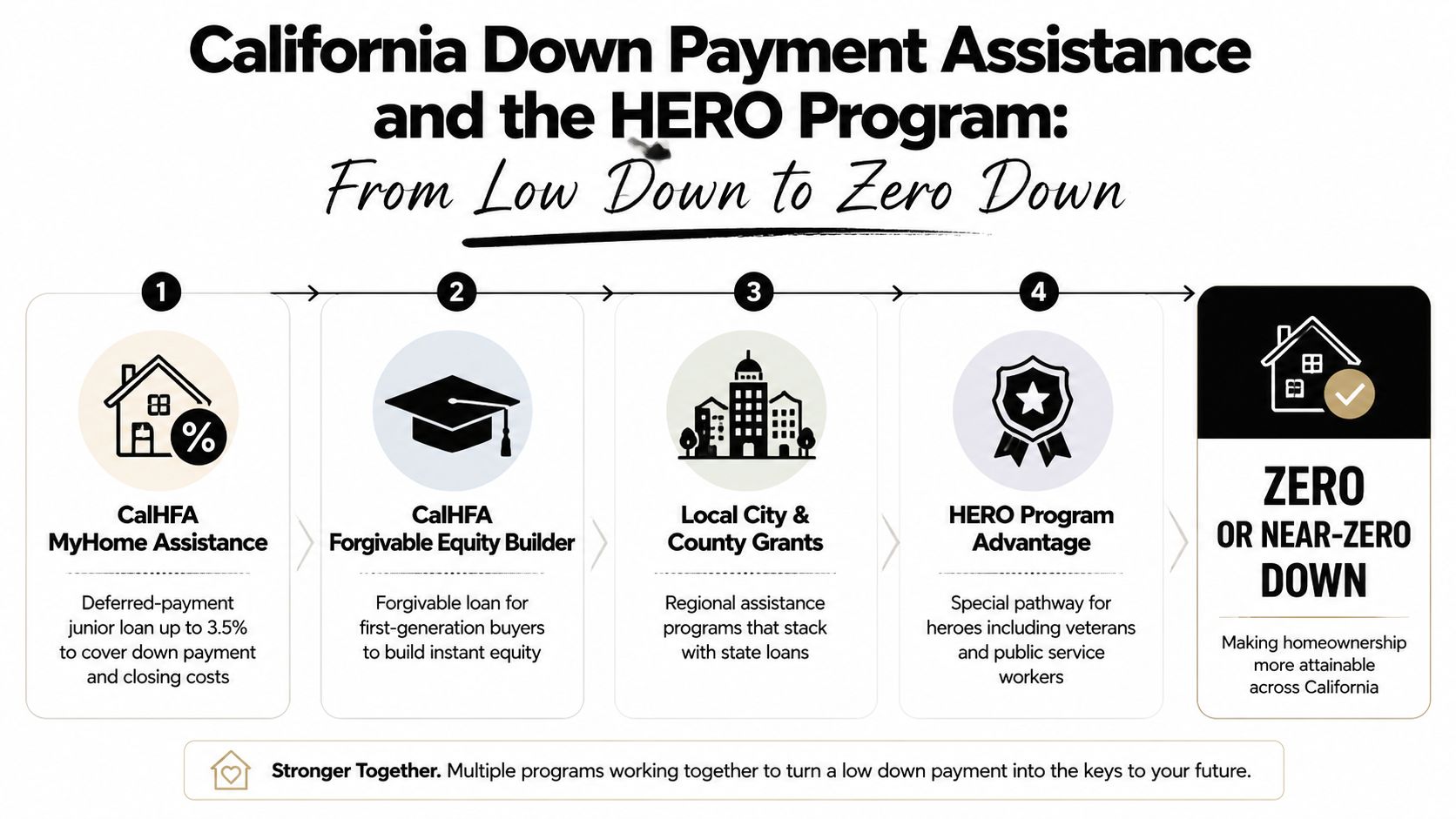
CalHFA's MyHome Assistance Program can provide a deferred-payment junior loan of up to 3.5% of the purchase price, subject to program rules. CalHFA FHA financing can also pair with the Zero Interest Program, which uses subordinate financing to help with upfront costs.
Credentialed educators should ask about the Extra Credit Teacher Home Purchase Program. Classified school employees may qualify for the School Facility Employee Program. These programs aren't interchangeable, and the buyer's employment classification matters.
Local programs can add another layer:
- San Francisco: Down Payment Assistance Loan Program.
- Los Angeles: Cal-LAP.
- San Diego: First-Time Homebuyer Program.
- Sacramento: SHARE.
Program names and funding conditions change, so use the administering agency or an approved lender to verify current eligibility.
Where HERO rewards fit
Employer HERO rewards may be available through participating companies, school districts, hospitals, fire departments, and police agencies. Depending on the employer and program terms, assistance may take the form of a down payment contribution, forgivable loan, or matched savings. Some participating employers offer amounts often ranging from $5,000 to $25,000, but you must verify the actual benefit with the HERO member portal or your HR department.
The practical stacking concept is straightforward. CalHFA may address the down payment, while HERO may help close the remaining cash-to-close gap, but the programs must permit combination. Income limits, lien position, repayment terms, and documentation rules can prevent stacking even when both programs appear available.
Start verification early:
- Confirm employment: Obtain written confirmation from HR or the participating employer.
- Document service: Provide the required proof of veteran, first responder, healthcare, educator, or public-service status.
- Review repayment: Ask whether the assistance is deferred, forgivable, matched, or repayable.
- Check layering: Have the lender approve the combined structure before making an offer.
The broader assistance environment has expanded to 2,746 programs nationwide as of July 1, 2026, with 75% providing down payment or closing-cost help, according to Down Payment Resource's 2026 program update. Yet a 2025 survey found that only 27.5% of recent first-time buyers used assistance, even though 65.3% of renters planned to use it, which points to an eligibility and comprehension problem rather than a simple lack of programs.
For California-specific program matching, review down payment assistance options in California and ask for a written cash-to-close comparison.
Why the Smallest Down Payment Is Not Always the Best Deal
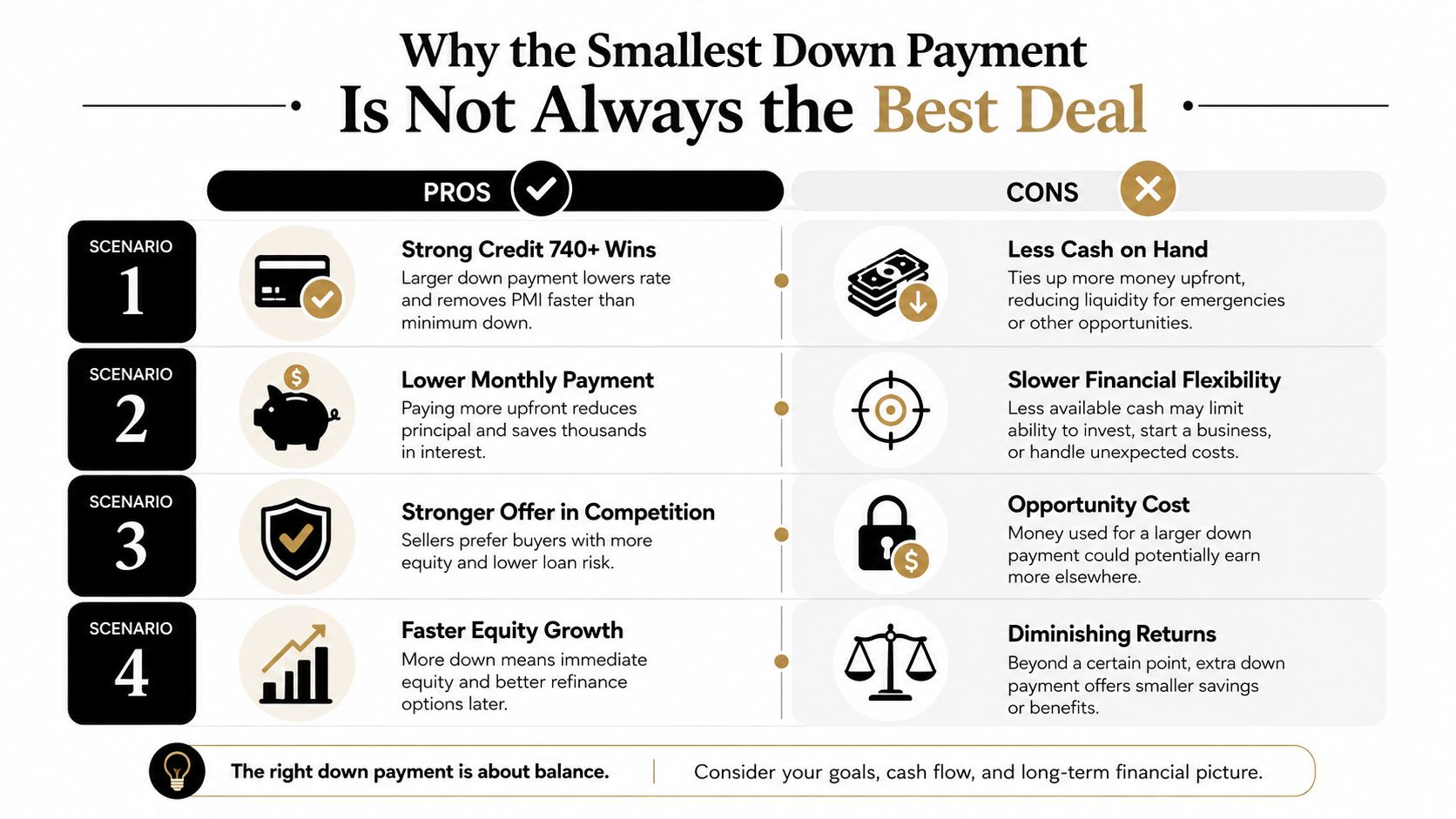
The smallest down payment protects cash, but it also creates the largest loan balance. That trade-off can be sensible for a buyer who needs reserves, but it's a poor default for everyone.
Four situations where more cash can win
Strong credit: A buyer with a 740 or higher credit score may receive stronger conventional pricing than a borrower with weaker credit. At 20% down, the borrower can generally avoid conventional PMI, reducing the recurring payment.
The cash-to-close trap: A low down payment doesn't eliminate closing costs, prepaid items, or reserves. A $600,000 FHA purchase can require more than $35,000 in liquid funds once the 3.5% down payment is combined with those other charges, depending on the transaction. The exact amount must come from a loan estimate, not a blog calculator.
Equity speed: Buyers who put down 10% to 20% start with more equity and a smaller balance. Buyers using 3.5% FHA financing start with less equity and also finance the upfront MIP, so their equity position may grow more slowly unless they make extra principal payments or the property appreciates.
Refinance vulnerability: A high loan-to-value ratio can make refinancing harder if an appraisal doesn't support the needed value. A buyer shouldn't assume that falling rates automatically create an easy refinance opportunity.
The Sacramento nurse example
A nurse earning $120,000 in Sacramento with $80,000 saved shouldn't automatically choose the minimum down payment. She should compare 3%, 10%, and 20% while protecting an emergency reserve and accounting for the full cash-to-close requirement.
Putting 20% down may reduce the payment most, but it could drain savings. Putting 3% down may preserve too much cash at the cost of insurance and interest. In many cases, 10% down is the serious middle-ground scenario, not because it's universally optimal, but because it can lower the balance while leaving more reserves than a 20% contribution.
My candid recommendation: Keep enough cash for ownership surprises before chasing a lower payment.
How to Apply Step by Step
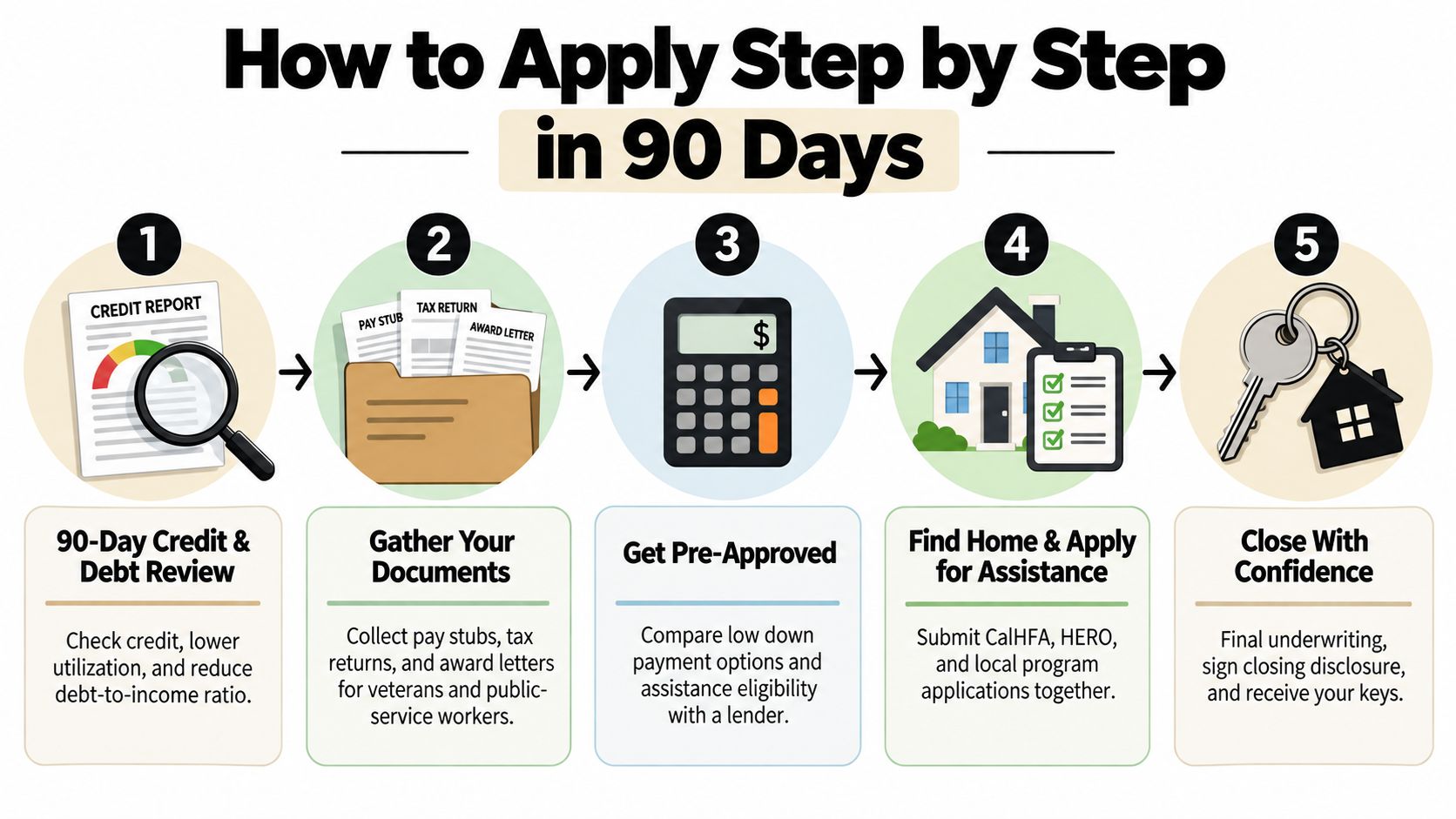
A clean application begins before the home search. Start with a 90-day credit and debt review. Check for reporting errors, reduce revolving utilization, avoid new credit, and calculate the payment you can handle without relying on overtime that may not qualify.
Build the file before making an offer
Gather recent pay stubs, tax returns, bank statements, employment history, and documentation for any gift funds. Veterans and public-service workers should also collect award letters, service records, employment verification, and any documents needed to confirm program eligibility.
Use prequalification to understand a rough range. Use full preapproval and underwriting to make a credible offer. Your lender should compare FHA, VA, USDA, conventional, CalHFA, local assistance, and HERO eligibility rather than placing you into the first program that meets a minimum score.
Coordinate assistance and underwriting
Once you're under contract, the lender orders the appraisal and completes program-specific review. CalHFA reservations, HERO enrollment, and local assistance applications should be coordinated with the lender's timeline, not left until the final week. Employer verification may come through HR or the HERO portal, and service documentation must match the program's requirements.
A Loan Estimate is generally provided within three business days after the required application information is received. California closing timelines often fall within 25 to 35 days, but appraisal availability, assistance approvals, title work, and underwriting conditions can change that schedule.
Before signing disclosures, confirm:
- Cash to close: The final amount and every source of funds.
- Gift documentation: Signed gift letter and verified transfer trail.
- Assistance terms: Repayment, forgiveness, lien position, and occupancy rules.
- Rate lock: Lock period, expiration, extension cost, and whether the payment fits your budget.
- Monthly payment: Principal, interest, taxes, insurance, mortgage insurance, and applicable fees.
Use this first-home buying process guide as a checklist, then have your lender reconcile it with the actual disclosures.
Choosing the Right Path for Your Situation
The best program depends on the buyer, property, and cash position. I'd begin with eligibility, then test the monthly payment and long-term cost.
| Loan Type | Minimum Down | Monthly Mortgage Insurance or Fee | Estimated Equity at 5 Years |
|---|---|---|---|
| FHA | 3.5% with qualifying credit | Recurring MIP for many borrowers, plus financed upfront MIP | Starts lower because of the small down payment and financed upfront MIP |
| VA | 0% for eligible borrowers | No monthly PMI, funding fee may apply | Depends on appreciation and principal reduction, with no initial down-payment equity |
| USDA | 0% for eligible buyers | Annual guarantee fee under program rules | Starts with no down-payment equity and depends on principal reduction and appreciation |
| Conventional | 3% | PMI can be cancellable as equity grows | Starts higher than zero-down options and may improve faster as PMI is removed |
A practical buyer-to-program match
Active-duty service members and eligible veterans should price VA first. A modest down payment can reduce the funding fee tier, but preserving reserves may still justify zero down.
Rural and moderate-income buyers should check USDA before dismissing a property because it sits outside a major metro. Verify the exact address and household income.
Teachers and nurses should investigate CalHFA, educator-specific programs, local assistance, and employer HERO rewards together. Assistance may solve the cash-to-close problem that a loan program alone doesn't fix.
Credit-strong buyers in expensive California metros should compare conventional 3% financing with employer assistance and larger-down scenarios. Cancellable PMI can make conventional financing more flexible than FHA over time.
First-time buyers are increasingly concentrated in FHA when limited cash is the binding constraint. ICE reported that first-time buyers using FHA put down about $16,000, compared with about $77,000 for conventional conforming prime loans and $134,000 for repeat buyers, while the overall average first-time-buyer down payment was about $49,000, as reported in the ICE Mortgage Monitor update. Those figures describe different borrower groups, so don't treat them as a target for your own purchase.
California Loans for Heroes offers eligibility guidance, assistance options, mortgage comparisons, and one-on-one support for veterans, first responders, healthcare professionals, educators, and other public-service workers. Use that guidance to compare reserves, qualification, insurance, and long-term equity before committing to a loan structure.
If you're a California veteran, first responder, nurse, teacher, or public-service employee, California Loans for Heroes can help you compare low-down-payment programs, assistance possibilities, and HERO rewards around your actual cash reserves and eligibility. Visit the site to start a personalized review before you make an offer or spend another year waiting to save.