
A California firefighter finishes a night shift, checks the mortgage statement, and sees that the payment no longer fits comfortably beside groceries, insurance, and rising household costs. A nurse may face the same pressure after buying at a higher rate, while a teacher or law enforcement officer may have plenty of home equity but still be paying for mortgage insurance. The right solution depends on which part of the payment is too large.
The most effective answer to how to reduce monthly mortgage payment isn't always refinancing. Sometimes the fastest result comes from removing PMI. Sometimes a recast preserves an unusually low interest rate. A hardship modification may be more appropriate than either option, and California property-tax rules can change how you evaluate a refinance or transfer.
This guide applies a California HERO lens to each choice. By the end, you'll know whether to investigate PMI cancellation, compare a refinance, request a recast, extend the loan term, explore a modification, or ask about HERO assistance.
Why Your Mortgage Payment Feels Too High Right Now
A firefighter in Riverside might have purchased a home when rates were more favorable, then watched the monthly bill climb because property taxes, homeowners insurance, or mortgage insurance took a larger share of the payment. A nurse in Sacramento might have bought more recently at a higher rate and now have limited room after childcare, commuting, and other household expenses. Neither borrower should start by assuming a refinance is automatically the answer.

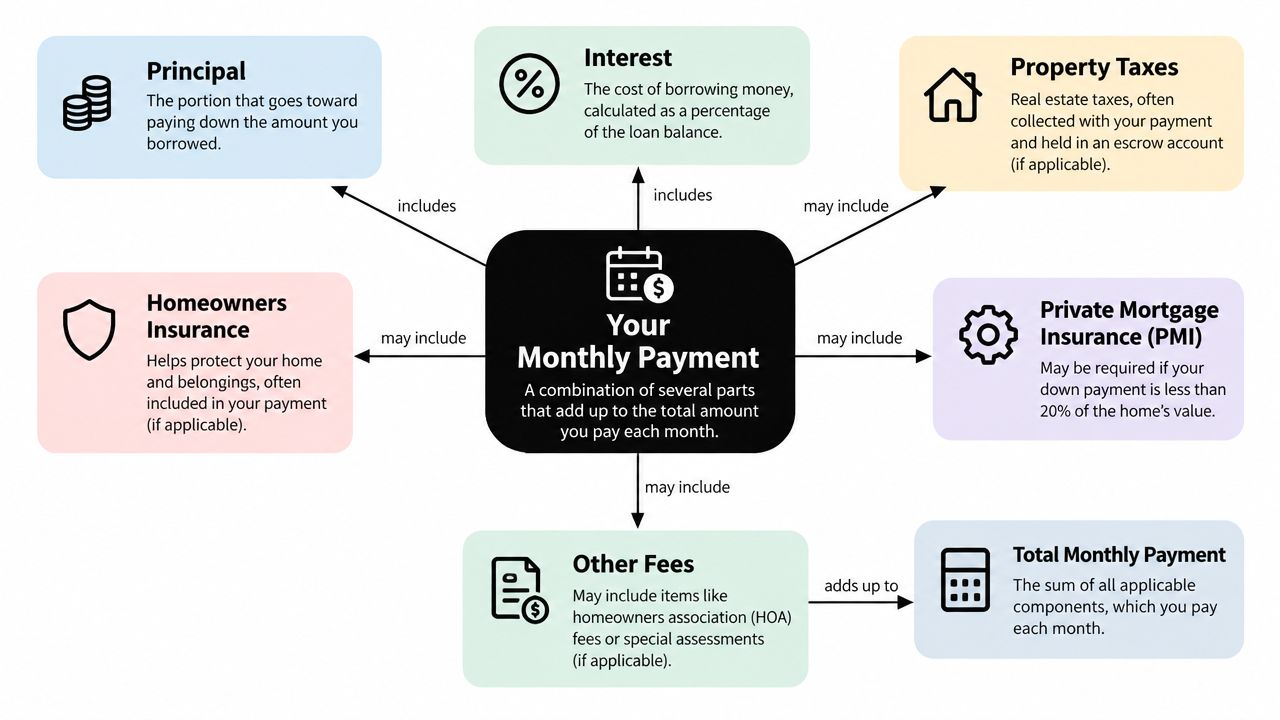
Your payment usually combines principal, interest, property taxes, homeowners insurance, and sometimes mortgage insurance. The Consumer Financial Protection Bureau explains that principal reduces the loan balance, while interest is the charge for borrowing the money. That distinction matters because a lower interest rate changes the borrowing cost, while PMI removal changes the insurance portion without changing the note rate or loan term. The CFPB's PMI guidance also confirms that borrowers may request cancellation when the balance is scheduled to reach 80% of the home's original value, subject to applicable requirements.
Start with the payment driver
Read the latest mortgage statement and separate the principal-and-interest amount from escrow and mortgage insurance. If taxes or insurance are the problem, refinancing may barely help. If PMI is listed, equity may provide a quicker path. If principal and interest dominate the bill, rate, term, recast, or modification deserves closer review.
California's high home prices make this distinction especially important for public-service workers. A small monthly change can affect whether a household can keep building savings, handle an emergency, or remain in the community where it works. Generic advice such as “just refinance” ignores the different ways a payment becomes unaffordable.
The decision you should reach
Before choosing a loan product, identify the exact component you want to reduce and decide whether you need permanent savings, temporary cash-flow relief, or protection from payment shock. You'll then be able to compare the cost of each option instead of chasing the lowest advertised payment.
If you want a current starting point for your review, compare your existing note rate with current California mortgage-rate information, then gather your statement, insurance declaration page, tax information, and current loan balance.
Understanding What Makes Up Your Monthly Payment
Mortgage payments aren't one charge. They're a bundle of costs, and each cost responds to different actions.
The principal is the portion that reduces what you owe. The interest is the lender's charge for financing. Lenders calculate the principal-and-interest payment from the loan amount, interest rate, and term. A lower rate or longer repayment period can reduce the required payment, but those choices can affect the total interest paid over time.
Property taxes and homeowners insurance usually flow through escrow. They don't respond directly to a lower mortgage rate. If your escrow payment rose after a tax adjustment or insurance premium change, ask the servicer for an escrow analysis and verify the underlying bill. Don't pay refinance closing costs to solve a problem caused by an incorrect or unusually high escrow estimate.
California taxes need a separate review
California's Proposition 13 sets the annual property-tax rate at 1% of assessed value and generally limits annual assessed-value increases to no more than 2% per year, unless a change in ownership or qualifying new construction triggers reassessment. Those rules can make an existing homeowner's tax position different from a recent buyer's, so don't assume a refinance will reset your assessment. California Proposition 13 background explains the basic tax framework.
An Orange County assessor explanation states that a reassessable change in ownership creates a new base-year value tied to the property's market value at transfer. A refinance alone doesn't create that new base-year value. The Orange County Assessor's property assessment guidance is a useful reference when you're weighing financing changes against tax concerns.
Read the statement in the right order
Use this sequence:
- Separate principal and interest: Decide whether the loan itself, rather than escrow, drives the payment.
- Find mortgage insurance: Confirm whether PMI appears as a separate charge.
- Review escrow: Compare the tax and insurance figures with your actual bills.
- Check the balance and value: Estimate whether your equity supports PMI cancellation or a recast.
- Identify the loan type: Conventional, FHA, VA, and other programs have different rules.
Key takeaway: Reduce the part of the payment that is inflated. A lower rate won't remove PMI, correct an escrow error, or automatically lower property taxes.
Refinancing Recasting and Extending Your Loan Term
These three strategies all target principal and interest, but they solve different problems. Refinancing replaces the existing loan. Recasting keeps the loan and recalculates the payment after a substantial principal reduction. Extending the term spreads repayment over a longer period, usually lowering the required payment while increasing the time debt remains outstanding.
Freddie Mac's Primary Mortgage Market Survey reported a 30-year fixed-rate average of 6.76% for the week ending September 10, 2026, compared with a record low near 2.65% in January 2021 and a record high around 18.45% in October 1981. Its historical archive also lists 30-year fixed-rate averages of 2.96% in 2021, 5.34% in 2022, 6.81% in 2023, and 6.6% in 2025. Freddie Mac's mortgage-rate survey shows why a refinance can be powerful when the spread is meaningful, but disappointing when the new rate barely improves on the old one.
Compare the three paths
| Strategy | How Payment Drops | Typical Costs | Best For |
|---|---|---|---|
| Refinance | Replaces the current rate, term, or both | Closing costs, appraisal or lender fees may apply | Borrowers with a meaningful rate improvement and a break-even period that fits their plans |
| Recast | Recalculates the payment after a lump-sum principal reduction | Servicer-specific recast fee or requirements may apply | Borrowers with available cash who want to keep their existing rate |
| Term extension | Spreads the balance across a longer repayment period | Possible modification or refinance costs | Borrowers prioritizing required-payment relief over faster payoff |
A refinance makes sense only after you calculate the break-even point. Add the closing costs, then divide that total by the expected monthly savings. If you may move, retire, or otherwise pay off the loan before that point, the lower payment could still cost more overall. A rate-and-term refinance deserves a detailed comparison of the old amortization schedule, the new schedule, prepaid items, and whether the new term restarts repayment over a longer period. Review how a rate-and-term refinance works before comparing offers.
Choose the structure that matches your cash
A recast is often the cleanest answer for a borrower who received a large cash inflow and already has a favorable rate. It lowers the balance used to calculate future payments without replacing the entire mortgage. The tradeoff is liquidity. Don't put every available dollar into the home if doing so leaves no reserve for repairs, medical costs, or income disruption.
Term extension is the bluntest tool. It can create breathing room, but a lower payment may mean more interest over the life of the loan. For FHA borrowers, an FHA Streamline Refinance is designed for an existing FHA-insured mortgage, and one cited requirement is that the combined new rate must be at least 0.50 percentage points below the old rate. The FHA Streamline eligibility reference should be checked alongside current lender requirements.
Eliminating PMI and Using Buydowns and Lender Credits
PMI is one of the clearest opportunities to lower a payment without changing the interest rate. For a conventional mortgage, a borrower can generally request cancellation when the loan reaches 80% loan-to-value, equal to 20% equity in the home's original value. Automatic termination generally occurs at 78% of the original value, equal to 22% equity, when the borrower is current and meets the required payment-history conditions. The Homeowners Protection Act explanation outlines these thresholds.
Follow the PMI review process
Start with the original property value and current principal balance. Don't rely only on today's market value because cancellation rules often use the original value or another qualifying basis set by the loan documents.
Then contact the servicer and ask for its PMI-cancellation requirements. The servicer may request a valuation, evidence of payment history, and confirmation that the property hasn't declined in value. Keep the request in writing and ask when the review will be completed. If approved, confirm the revised payment after the insurance charge disappears.
This guide to removing PMI can help you prepare the questions before contacting the servicer.
Understand what a buydown really does
A temporary buydown uses money at closing to subsidize the interest rate for an initial period. The payment reduction is temporary, so you must qualify for and afford the underlying payment that follows. It can help a buyer manage an early transition, but it isn't the same as permanently lowering the note rate.
A permanent buydown pays discount points to reduce the interest rate for the loan's remaining term. Compare the upfront cost with the monthly savings and calculate how long you must keep the loan to recover that cost. The seller, builder, lender, or another party may contribute, depending on the transaction and program rules.
Lender credits work in the opposite direction. The lender provides money toward eligible closing costs in exchange for a higher interest rate. That can preserve cash at closing, which may matter to a California teacher or nurse with limited funds, but the higher rate can increase the monthly payment and lifetime interest.
Don't evaluate a buydown or credit by the first payment alone. Compare cash required, payment after any temporary period, total interest, and the time you expect to keep the mortgage.
Hardship Options Loan Modifications and California HERO Assistance
Some borrowers aren't optimizing a manageable loan. They're trying to prevent a payment from overwhelming the household after illness, reduced hours, deployment, job disruption, or another serious hardship. In that situation, call the servicer early. Waiting until payments are missed can reduce the available choices.
Forbearance can pause or reduce payments temporarily, but it doesn't erase the amount owed. Ask exactly how missed payments will be repaid. A lump-sum demand, repayment plan, or added balance creates very different consequences.
Use modification for durable hardship relief
A loan modification can lower the required principal-and-interest payment through a combination of rate reduction, term extension, and sometimes principal forbearance or forgiveness. Federal Reserve analysis found that modified mortgages receiving a payment decrease fell from an average of $1,623 to $1,200, a 25% reduction. The Federal Reserve mortgage-modification analysis also reported that roughly 81% of modifications produced payment reductions, nearly 7% increased payments, and about 4% left payments unchanged.
The figures make one point clear. Never assume “modification” means “lower payment.” Request the complete post-modification amortization schedule, confirm whether arrears are capitalized, identify any deferred balance, and ask whether the rate can change later. Chicago Fed research found that a 10% payment reduction was associated with a 4.3 percentage-point decrease in six-month redefault probability, while New York Fed work associated the same reduction with a 4.5 percentage-point decrease in predicted 12-month redefault probability. The Chicago Fed mortgage-performance research supports targeting a payment that remains sustainable after escrow changes, not merely accepting the first offer.

Match assistance to your role and transaction
California Loans for Heroes works with veterans, active-duty military, first responders, law enforcement officers, firefighters, nurses, healthcare professionals, pilots, teachers, educators, and other public-service employees. Its HERO Home Loan and Buyer Rewards Program includes homebuyer assistance, down payment assistance options, refinance solutions, lender credits, and one-on-one support, subject to eligibility and participating partners.
These programs may matter most before closing, because reducing the cash required for a purchase can help a borrower choose a sustainable payment instead of stretching for a larger loan. Ask for written eligibility terms, the source of every credit, and whether a participating real estate agent is required.
A refinance by itself doesn't create a new California Proposition 13 base-year value. Qualifying ownership transfers or construction events can trigger reassessment, so separate financing changes from title and property changes.
Prepare income documentation, current statements, tax and insurance information, hardship records, and a clear household budget. Be cautious with anyone demanding upfront money, guaranteeing approval, or telling you to stop communicating with your servicer.
Choosing Your Best Path to a Lower Payment
The best strategy is the one that lowers the correct part of your bill without creating a larger problem later. Use this decision filter:
- PMI appears and equity is sufficient: Ask the servicer to review cancellation before considering a refinance.
- Your current rate is materially above available rates: Compare a rate-and-term refinance, including closing costs and break-even timing.
- You have cash but want to preserve a favorable rate: Ask whether the servicer permits a recast and calculate the cost of using that cash.
- You need immediate cash-flow relief: Compare a term extension, temporary arrangement, or modification, then inspect the new amortization schedule.
- You're buying or refinancing as a California HERO: Ask about eligible assistance, lender credits, and program terms before selecting the loan structure.
A lower payment isn't automatically a better mortgage. Extending the term can increase lifetime interest. A lender credit can mean a higher rate. A temporary buydown can end before your budget improves. A modification can capitalize arrears or leave the payment unchanged. Put every proposal beside the existing loan and compare required payment, cash due, total interest, loan balance, and future payment risk.
Keep California tax rules in the calculation. A refinance alone doesn't reset the Proposition 13 base year, but a qualifying transfer or construction event can trigger reassessment. That distinction deserves confirmation before you change ownership or title.
Your next step should be specific. Pull the latest mortgage statement, write down the principal-and-interest amount, escrow amount, PMI charge, balance, rate, and loan type, then request a payment review. That information lets an advisor tell you whether the immediate win is PMI cancellation, a refinance, recast, term change, hardship option, or HERO assistance.
California Loans for Heroes can review your current mortgage structure, compare refinance and payment-relief options, and explain available HERO Home Loan and Buyer Rewards Program assistance for eligible California public-service borrowers. Visit California Loans for Heroes with your mortgage statement ready and request a personalized payment review before accepting a new loan or modification.