
You've found a home you can afford on paper, but the cash needed at closing tells a different story. As a California teacher, you may have steady employment and a clear reason to put down roots, yet saving for the down payment, closing costs, reserves, and moving expenses can still feel out of reach. The challenge isn't always the monthly mortgage. Often, it's getting enough money together before you receive the keys.
Teacher home buying assistance can help, but it isn't one universal benefit or a single check. California buyers may encounter non-repayable grants, forgivable equity assistance, deferred second loans, and low-down-payment first mortgages. Each layer has its own eligibility rules and repayment conditions. A program that looks generous at first glance may become less attractive if you plan to sell, refinance, or move soon.
This guide explains how those layers fit together, which national, state, and California-focused options deserve attention, what eligibility questions to answer early, and how to apply without losing time. The goal is simple: help you compare the full financing structure, not just the largest advertised assistance amount.
Introduction to Teacher Home Buying Assistance in California
A teacher in California may spend the workday helping students build a future while struggling to build enough savings for a home nearby. Rent, transportation, classroom expenses, and family obligations can compete with the money needed for a down payment. Even when a lender approves the monthly payment, the upfront cash requirement may stop the purchase before the search really begins.
That tension explains why educator-focused housing programs exist. A Connecticut milestone shows that teacher homeownership support has been formalized at the state level for more than two decades. On October 23, 2000, Connecticut began administering its Teachers Mortgage Assistance Program through the Connecticut Housing Finance Authority, following Public Act 2000-187. The program served certified public school teachers buying a first home as a primary residence in a priority or transitional school district, with the broader policy aim of helping educators live in the communities where they work. Connecticut's teacher mortgage assistance history
California's challenge is especially practical. A small grant may help with a fee, but it may not solve the larger problem created by a high purchase price. That's why the most useful way to understand teacher home buying assistance is as a layered capital stack. One layer may reduce the down payment, another may help with closing costs, and a first mortgage may provide the primary financing.
Why the structure matters
Two programs can advertise similar assistance while creating very different long-term costs. One benefit may never need repayment. Another may be a deferred loan due when you sell or refinance. A third may include shared appreciation, meaning the program receives more than the original assistance when the home's value rises.
California teachers also need to distinguish teacher-specific benefits from general first-time buyer programs. Some options are tied to occupation, while others depend mainly on the first mortgage, income, credit profile, property location, or primary-residence requirement.
Practical rule: Don't choose a program from the headline amount alone. Ask what you receive, when repayment begins, and what happens if your career or housing plans change.
How Teacher Home Buying Assistance Actually Works
A California teacher buying a $500,000 home may combine several financing tools at closing. A first mortgage of 3.5% can cover the required down payment structure, while a 4% deferred second loan can help with upfront costs. The key is to trace where every dollar goes and when each obligation comes due.
For example, 3.5% of $500,000 is $17,500. A 4% second loan equals $20,000. If the second loan is approved for down payment or closing costs, it may cover that $17,500 requirement and leave up to $2,500 for eligible closing expenses. The buyer still needs to budget for costs the program does not cover, such as inspections, prepaid items, reserves, or fees outside the assistance rules.
The assistance changes the cash-to-close calculation. It does not automatically reduce the purchase price or erase the first mortgage. The first mortgage remains the main debt with a regular monthly payment. The deferred second loan may have no monthly payment, but its balance still exists.
Program terms determine whether the assistance is a grant, forgivable support, or a loan. California's Teacher Next Door program advertises grants from $1,000 up to $9,000, with additional down payment assistance of up to $24,000 for eligible Pre-K through 12th-grade teachers, administrators, and school staff. California Teacher Next Door grants and assistance A separate California assistance summary describes options including up to 10% forgivable equity assistance for buyers under 80% of area median income, with 5-year forgiveness schedules. California teacher home loan programs
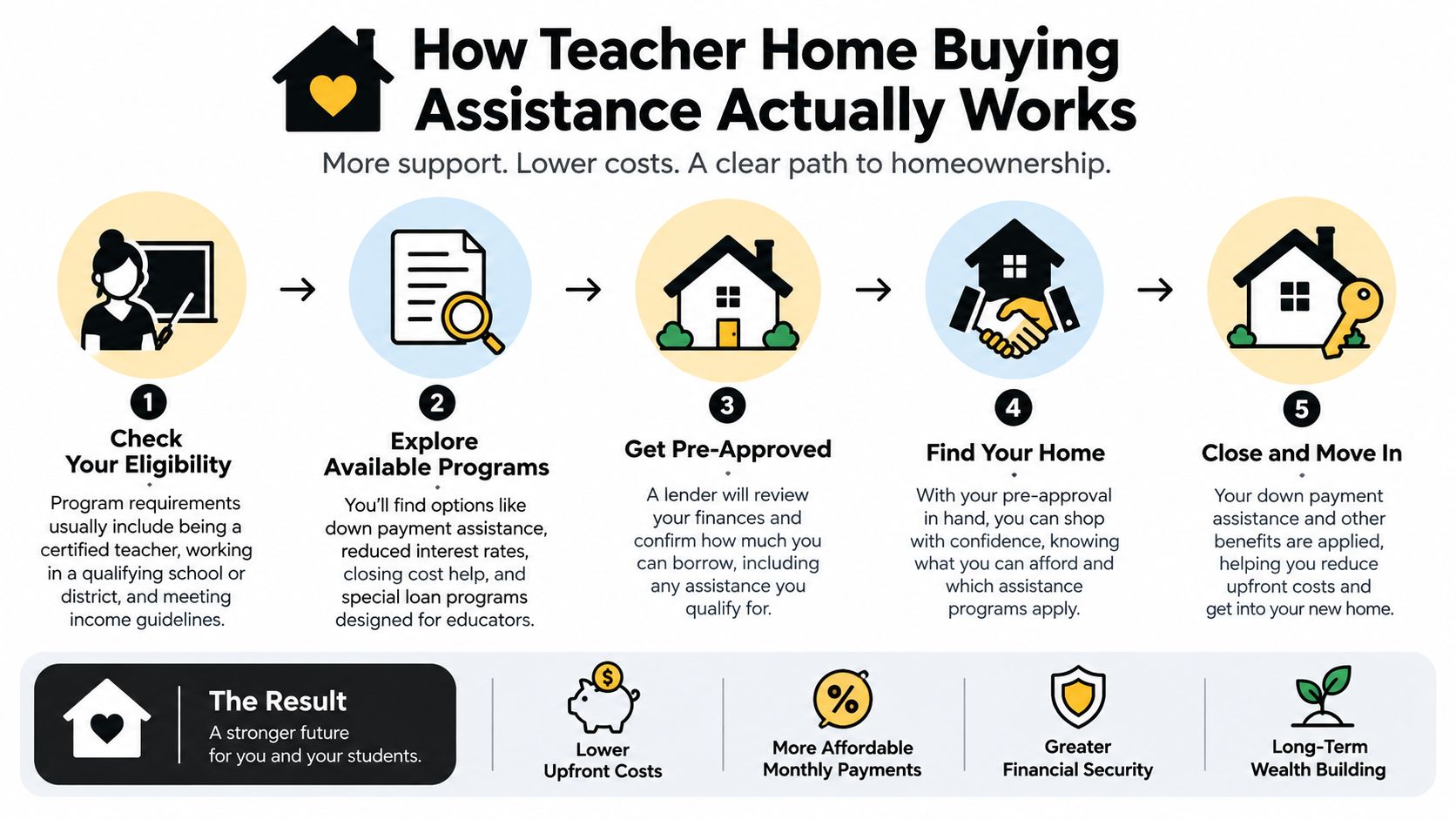
The repayment clause is the part many buyers overlook. A deferred balance may become due when you sell, refinance, pay off the first mortgage, or stop using the property as your primary residence. Forgivable assistance may disappear gradually under its schedule, yet moving before the required period can trigger repayment. Selling to accept a position in another district or moving for family reasons can therefore change the cost of the benefit.
Before making an offer, ask the lender to show the exact cash-to-close worksheet, monthly payment, total assistance balance, and repayment triggers. Judge the program by how it works during the years you expect to own the home, not only by the amount offered at closing.
National State and Local Programs Available to California Teachers
A California teacher may build a home purchase with several funding layers. One program can reduce the price, another can cover part of the upfront cash, and a first mortgage can finance the remaining balance. The layers work like a capital stack, but each has its own rules for pairing, occupancy, and repayment.
The comparison below focuses on what happens behind the headline benefit.
California Teacher Assistance Programs Compared
| Program | Assistance Type and Amount | How It Pairs and When Repayment Can Apply |
|---|---|---|
| HUD Good Neighbor Next Door | Eligible teachers may buy a HUD-owned home at 50% off list price | The property must be in a designated revitalization area, and the buyer must occupy it as a sole residence for 36 months. With FHA financing, HUD materials indicate a minimum $100 down payment may apply instead of the standard 3.5% minimum. HUD Good Neighbor Next Door details |
| CalHFA School Teacher and Employee Assistance Program | Deferred, zero-interest second loan of up to 4% of the purchase price | It must be paired with a CalHFA first mortgage and can help with down payment and closing costs. Because it is deferred rather than automatically forgiven, a sale, refinance, or payoff may require repayment under the program terms. CalHFA School Teacher and Employee Assistance Program |
| CalHFA MyHome Assistance Program | Up to 3.5% with an FHA first mortgage, or up to 3% with a conventional first mortgage | The first-mortgage choice controls the assistance limit. The second loan is tied to that primary loan, so changing or paying off the first mortgage can affect when the balance is due. CalHFA MyHome Assistance Program |
| Teacher Next Door California | Non-repayable grants from $1,000 up to $9,000, plus down payment assistance up to $24,000 | Availability and participation rules apply. Buyers should confirm whether the grant can be combined with their chosen first mortgage and whether any separate assistance carries a repayment condition. California teacher homebuying assistance options |
HUD offers a large potential price reduction, but the buyer must locate a qualifying home and accept the occupancy commitment. That makes it less predictable than assistance designed to attach to a standard purchase loan.
CalHFA programs are more like coordinated building blocks. The first mortgage, second loan, buyer qualifications, and property must fit together through an approved lender. A deferred balance can remain quiet until a trigger occurs, while a grant may have different conditions. Before choosing a stack, ask how refinancing, selling, renting out the home, or leaving a school position would affect each layer.
For a broader review, see down payment assistance for teachers, then verify current terms with the participating lender or program administrator.
Eligibility Requirements Every California Educator Should Know
教師購屋援助不是通過一個條件就能核准。審查通常像逐層檢查的清單,先確認工作資格,再核對收入與買方條件,最後檢查房屋和居住安排。每一層都可能影響補助、可原諒的資產援助或低頭期款貸款能否放進同一個資金組合。
依序完成資格檢查
第一步,確認工作身分。 California Teacher Next Door 的資料將 Pre-K through 12th-grade teachers, administrators, and school staff 列為可能符合資格的參與者,但仍受計畫供應情況限制。其他方案的定義可能不同,副校長、輔導員、助教或行政人員應請計畫確認職稱和雇用類型,不要只依照日常稱呼判斷。
第二步,核對收入與買方資格。 有些方案要求首次購屋,有些則可能接受符合條件的再次購屋者。收入審查也可能包括家庭收入、債務和所在地的收入上限。California 的部分可原諒資產援助針對低於 80% of area median income 的買方,因此要以家庭組成和所在郡的標準計算,而不是只看薪資單上的單一數字。California income-based teacher assistance
第三步,檢查信用與教育要求。 貸款方可能審查信用紀錄和現有債務,部分方案則要求完成核准的購屋教育課程。及早完成課程,能讓這項條件在找到房屋後不再成為延誤原因。
第四步,確認房屋與居住安排。 援助通常用於自住住宅,不適用於投資物業。HUD 方案還要求房屋符合指定的振興區域,並設有自住承諾。若你預計轉調學校、出租房屋或短期內搬遷,應在選擇資金組合前先詢問後果。HUD occupancy requirements for teachers
第五步,核對第一順位貸款。 CalHFA School Teacher and Employee Assistance Program 必須搭配 CalHFA 第一順位房貸。這表示援助不是之後再附加的獨立折扣,而是像拼圖一樣,第一順位貸款、第二層援助、買方條件和房屋都要彼此吻合。
Colorado 的 Schools to Home 計畫也說明了細則的重要性。該計畫限於全職公立學校員工和首次購屋者,並要求購屋教育、收入及信用審查。其共享增值安排可能在出售、再融資或不再自住時要求償還。Colorado teacher assistance eligibility and repayment details
先整理雇用證明、家庭收入、信用概況、過去持有房屋的紀錄、目標郡,以及可能搬家的時間。這份自我檢查能幫你提早看出,哪一層援助適合長期持有,哪一層可能在搬遷時產生還款責任。
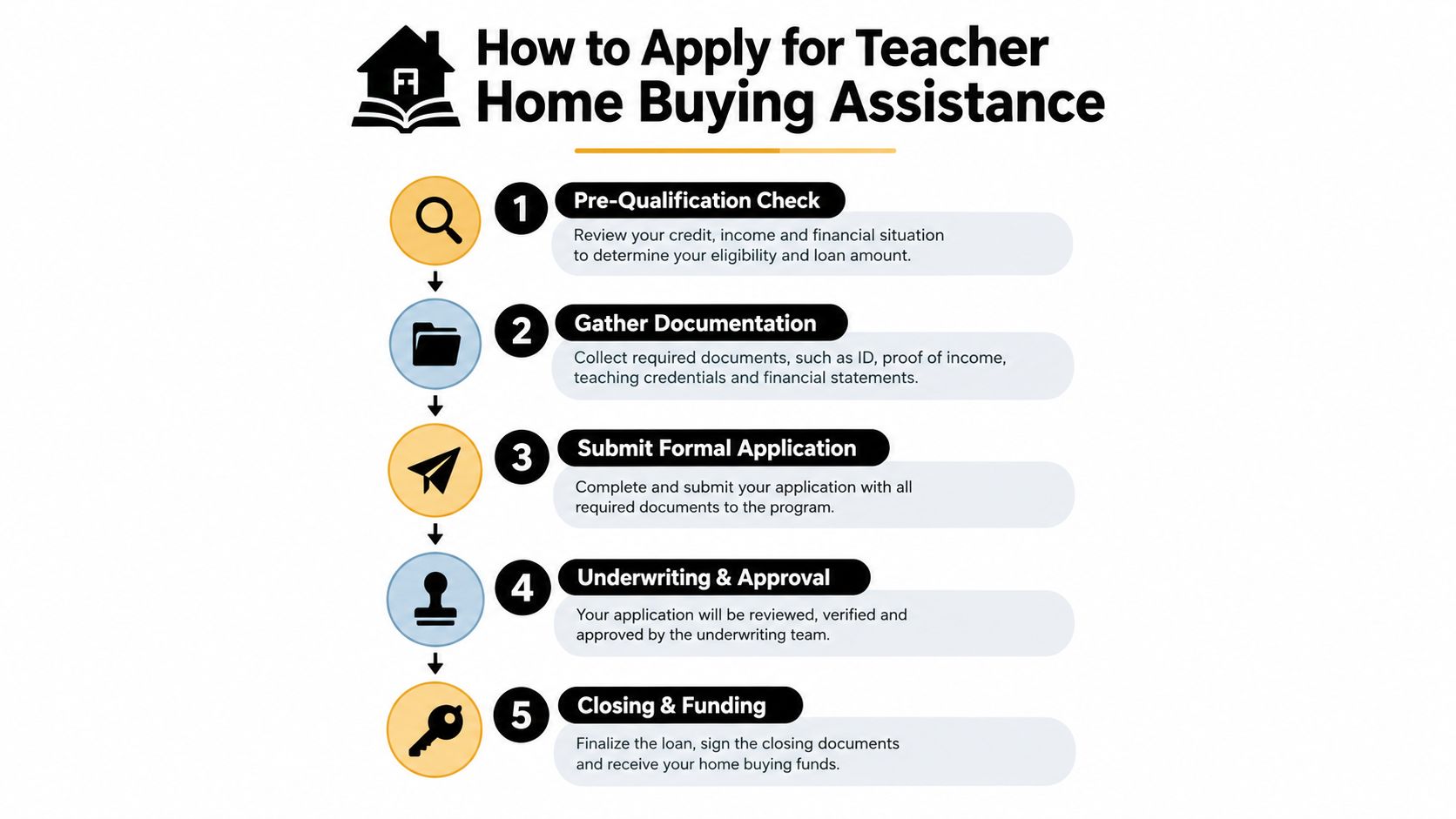
How to Apply for Teacher Home Buying Assistance Step by Step
The application process becomes more manageable when you treat it as a coordinated file rather than a series of disconnected forms. Your lender needs to approve the first mortgage, while the assistance provider needs to confirm its own requirements. Delays often happen when one side doesn't receive updated documents from the other.
1. Start with a qualification conversation
Speak with a lender familiar with California educator programs before touring homes. Ask for a realistic purchase range based on income, debts, taxes, insurance, mortgage terms, and the assistance structure. A pre-qualification conversation can also identify whether a CalHFA first mortgage is required.
2. Complete education early
If the chosen program requires homebuyer education, take the course before you make an offer whenever possible. Early completion gives the lender evidence that a major condition is satisfied and leaves more time to address questions.
3. Build a clean documentation file
Expect to provide employment verification, income records, asset statements, identification, tax documents where required, and information about current debts. Teachers with variable pay, stipends, summer income, or multiple school positions should explain how each income source works and provide consistent records.
4. Secure first-mortgage approval
Assistance doesn't replace underwriting. The lender still evaluates repayment ability, credit history, debts, assets, and the property. Don't open new credit, move large sums without documentation, or change employment without first discussing the effect with your loan officer.
5. Confirm the assistance layer
Once the first mortgage and property are identified, verify the assistance amount, lien position, repayment trigger, occupancy rule, forgiveness schedule, and any appreciation-sharing provision. Get the terms in writing. A deferred second loan may have no current payment while still creating a future obligation.
6. Coordinate closing
The title company, lender, assistance provider, real estate agent, and buyer must use matching figures and deadlines. Review the final disclosure carefully, including the first mortgage, second loan, grants, credits, cash contribution, and funds needed at closing.
A practical guide to getting down payment assistance can help you organize the early steps, but the lender must confirm current program availability and underwriting rules. Don't wait until you're in escrow to discover that your preferred assistance requires education, a specific first mortgage, or additional documentation.
Smart Strategies to Maximize Your Assistance and Avoid Costly Strings
A teacher buying a home may combine several forms of financing: a grant can reduce cash needed upfront, a forgivable benefit can reward continued occupancy, and a deferred second loan can postpone repayment. Together, these layers form a capital stack. The right combination depends on how long you expect to own the home and what happens if your plans change.
Start with a timeline decision matrix:
| Expected ownership | Priority | Terms to examine |
|---|---|---|
| About 3 years | Keep the future balance predictable | Sale, refinance, and early-move repayment rules |
| About 7 years | Benefit from possible forgiveness | Forgiveness schedule, occupancy requirements, and remaining balance |
| Uncertain | Preserve flexibility | Whether repayment includes appreciation or other charges |
A short ownership period can make a deferred loan less attractive, even when it reduces cash needed at closing. A longer period may make forgiveness more valuable, provided you meet every condition. Shared-appreciation assistance requires a separate calculation because repayment may include the original assistance plus a portion of the home's appreciation.

Ask for a written answer to this question: “What will I owe if I sell, refinance, or stop occupying the home next year, and what will I owe after the forgiveness period ends?” The answer should identify each lien, the repayment trigger, and any appreciation-sharing provision. A loan with no current payment can still create a future obligation.
Protect the savings you keep. Use assistance to maintain a reasonable cash cushion rather than stretching into a home that works only under ideal conditions. Repairs, insurance changes, property taxes, utilities, and maintenance still belong in the budget. Lower cash needed upfront helps only when the monthly payment and ownership costs remain manageable.
Housing affordability is difficult for early-career educators. The National Council on Teacher Quality found that in 2025, 39 of 72 sampled districts were unaffordable for early-career teachers with bachelor's degrees, while 34 remained unaffordable for teachers with master's degrees. National Council on Teacher Quality housing affordability findings Assistance may narrow that gap without removing it.
Before choosing, compare the estimated payment, cash to close, repayment balance, forgiveness conditions, and expected ownership period. Review mortgage rates for teachers while asking whether a lower rate or a larger assistance layer better fits your timeline.
Your Next Steps Toward Homeownership as a California Teacher
Teacher home buying assistance works best when you understand the whole structure. A grant, forgivable benefit, deferred second loan, or low-down-payment mortgage can each solve a different part of the purchase problem. The important details are the eligibility rules, the first-mortgage requirement, the occupancy commitment, and the repayment terms if you sell or refinance.
Start by writing down your expected ownership timeline and the California areas where you'd realistically live. Then gather employment and income documents, check your credit profile, complete any required education, and speak with a lender who can compare the available layers rather than presenting one program in isolation.
Ask for a written estimate showing the first mortgage, assistance amount, cash to close, monthly payment, and future repayment triggers. That side-by-side view makes it easier to decide whether a program supports your long-term plans or only makes the initial purchase look easier.
California teachers contribute to the communities where they work. A well-designed assistance plan can help make ownership more practical, but the right plan is the one you can understand, afford, and maintain.
California Loans for Heroes offers California educators access to homebuyer assistance, down payment assistance options, competitive mortgage rates, lender credits, and one-on-one support through its HERO Home Loan & Buyer Rewards Program. Visit California Loans for Heroes to connect with a team that can help you review teacher home buying assistance and begin the pre-approval process.