
A typical California down payment assistance program offers roughly 3% to 5% of the purchase price, with statewide assistance averaging about $18,000, while an outlier such as California's Dream For All can reach 20% of the home's purchase price. The amount you can use depends on the program cap, your income, the county, the property price, and the first mortgage paired with the assistance.
That range explains why the question “how much down payment assistance can I get?” has no single California-wide answer. A first-time teacher buying a $560,000 home in Sacramento may see a very different result from a veteran purchasing in Los Angeles, a first-generation buyer applying for Dream For All, or a public-service professional using a HERO loan strategy.
Down payment assistance, or DPA, can help with the down payment, closing costs, and, under some programs, prepaid expenses or other approved costs. It generally isn't a blank check for every cash expense connected to buying a home. The assistance may also come as a grant, deferred-payment junior loan, forgivable loan, or shared-appreciation loan, and each structure changes what happens when you sell, refinance, or pay off the first mortgage.
What California Buyers Really Want to Know About Assistance Amounts
A Sacramento teacher looking at a $560,000 home may do the first calculation quickly: a percentage-based program could produce a meaningful amount, while a fixed-dollar program might provide a smaller but more predictable contribution. The important question isn't just the advertised maximum. It's whether the buyer's income, county, purchase price, loan type, and household circumstances allow that maximum to be used.
National program data provides a useful benchmark. Down Payment Resource reported an average benefit of about $18,000 and identified 2,624 active programs nationwide in Q3 2025. That average can help a California buyer understand the ordinary scale of assistance, but it doesn't describe the ceiling of every local or state program.
California also has programs with much higher nominal limits. CalHFA's Dream For All program can provide up to 20% of the purchase price for down payment and/or closing costs, subject to a maximum of $150,000 or 20% of the sales price or appraised value, whichever is less. That doesn't mean every applicant receives $150,000. It means the program's formula can produce a larger benefit when the buyer meets its requirements.
What DPA may cover
Depending on the program and lender approval, assistance may be applied toward:
- Down payment: The funds can reduce the amount you need to bring toward the required equity contribution.
- Closing costs: Some programs allow assistance for lender fees, escrow charges, and other approved settlement expenses.
- Prepaid items: Certain programs may permit prepaid escrows, such as approved taxes or insurance reserves.
- Rate-related costs: Some assistance structures may support approved financing costs, but this must be confirmed in the program documents.
DPA usually won't replace the need for underwriting, reserves, inspections, appraisal, or a borrower contribution if the program requires one. A realistic estimate starts with the program's usable amount, then subtracts any costs the rules don't permit the funds to cover.
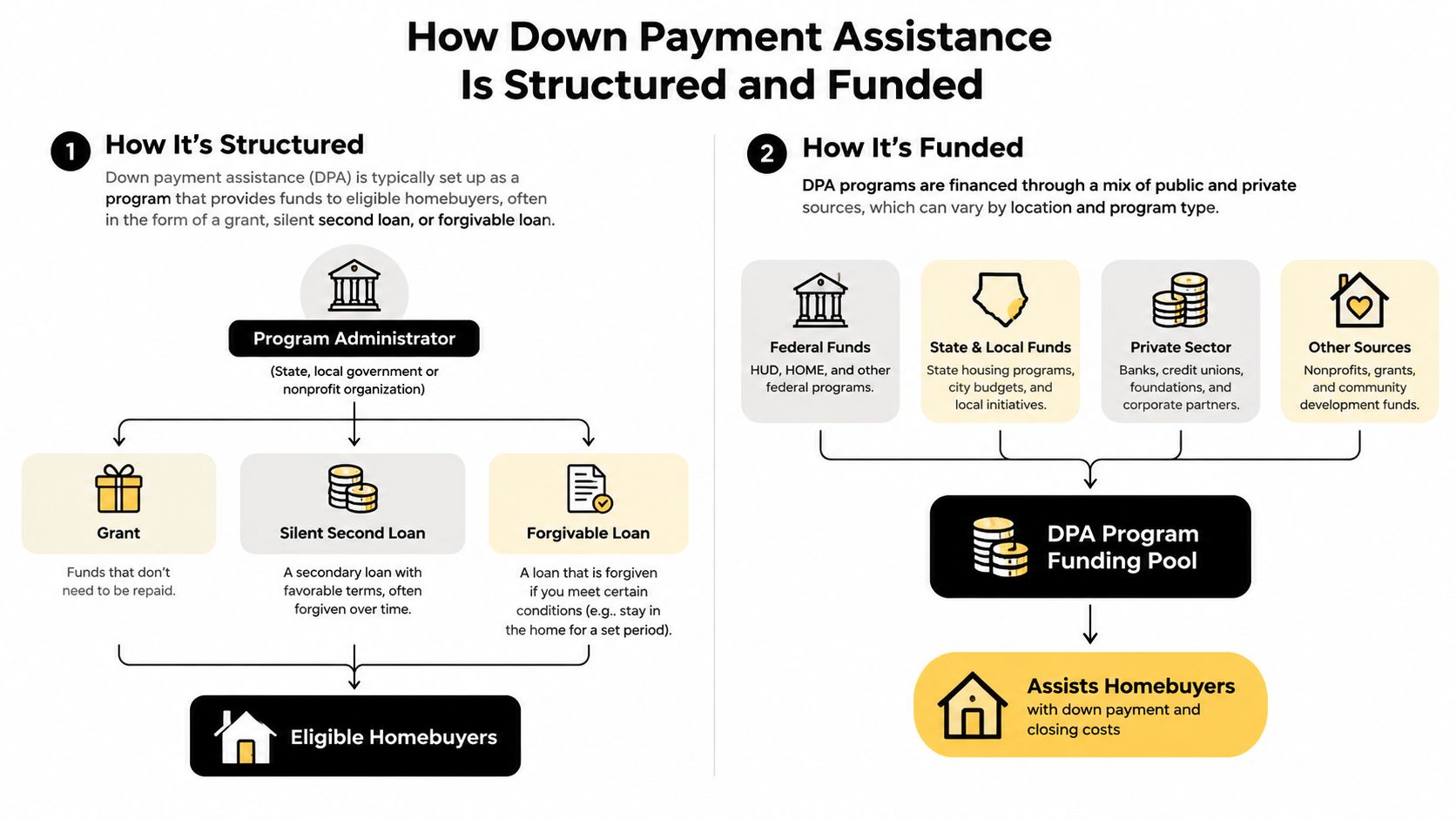
How Down Payment Assistance Is Structured and Funded
Think of California DPA as a group of scholarships. One scholarship gives a fixed award, another pays a percentage of tuition, and a third is technically repayable but lets the student postpone repayment until a later event. Homebuyer assistance follows a similar pattern.
A fixed-dollar grant or loan provides a stated amount. Urban Institute data reported that in 2022, 60.7% of down payment assistance programs provided a fixed dollar amount, with a median contribution of $15,000. Another 22.1% tied aid to a percentage of the sales price, while 9.5% tied it to a percentage of the loan amount, with median contributions of 10% and 5%, respectively. The underlying program analysis is summarized by AmeriSave.
A percentage-based program grows with the purchase price, but it still has a ceiling. Dream For All, for example, uses a percentage formula and a $150,000 maximum. A deferred-payment junior loan, such as CalHFA MyHome, generally sits behind the first mortgage. You may not make monthly payments on the junior loan, but repayment can be triggered when you sell, refinance, transfer ownership, or pay off the first mortgage.
Funding can come from state housing agencies, federal housing funds, county housing authorities, local reserves, or employer-assisted housing programs. The source of the money matters because it affects eligibility, documentation, income limits, and whether the benefit is forgivable or repayable.
Practical rule: Treat “no monthly payment” and “forgiven” as different statements. A deferred loan may still be due later, while a forgivable loan has specific conditions you must satisfy.
Shared-appreciation programs create another repayment model. CalHFA's Dream For All program materials state that borrowers above 80% of area median income may share up to 20% of the home's price appreciation, while borrowers at or below 80% AMI may share up to 15%. The original assistance and the appreciation obligation must be reviewed together before you choose the program.
The Four Levers That Decide Your Assistance Number
The advertised maximum is only the top line. Four practical levers determine the amount that appears in your pre-approval and closing figures.
Program cap
Every program has a limit. A fixed-dollar program may stop at a stated amount, while a percentage program may be limited by a percentage of the purchase price, appraised value, or loan amount. California's CalHFA MyHome program allows a deferred-payment junior loan up to the lesser of 3.5% of the purchase price or appraised value for FHA loans, and up to the lesser of 3% for conventional loans.
Purchase price and appraisal
A program can calculate assistance from the lower of the contract price or appraised value. County purchase-price limits may also exclude an otherwise qualified buyer. CalHFA loan limits and Dream For All county rules must be checked for the specific transaction, not assumed from a statewide advertisement.
Household income
Income limits are tied to household and county rules. Dream For All income limits can vary sharply by county. CalHFA's 2026 announcement listed limits of about $148,000 in Del Norte County, $168,000 in Los Angeles County, and $309,000 in Santa Clara County for the program described in the announcement. CalHFA provides those county examples.
First mortgage type
FHA, conventional, VA, and USDA financing don't use identical down-payment, mortgage-insurance, or subordinate-financing rules. The first mortgage determines how much assistance can be layered and whether the final structure meets lender requirements.
| Lever | How It Changes Your DPA | Typical California Range |
|---|---|---|
| Program cap | Limits the maximum fixed amount or percentage | Often a few thousand dollars to a much larger targeted benefit |
| Purchase price | Converts a percentage into a dollar amount and may trigger price limits | Percentage-based formulas rise with price until capped |
| Household income | Determines whether you qualify and which tier applies | Rules vary by county, household, and program |
| Loan type | Controls compatibility with junior financing and required down payment | FHA and conventional structures can produce different usable amounts |
For example, a Riverside County buyer may qualify while household income remains within the program's AMI threshold. If documented income crosses that threshold before final approval, the buyer could lose eligibility or move into a different assistance tier, even though the purchase price hasn't changed.
Comparing California's Major Down Payment Assistance Programs
A Los Angeles County buyer purchasing a $650,000 home with household income of $92,000 should compare each program's formula, not its advertised maximum. The assistance amount depends on county and loan limits, income eligibility, appraised value, and whether the first mortgage permits the junior financing.
Dream For All offers the largest percentage opportunity among these programs. It may provide up to 20% of the purchase price or appraised value, capped at $150,000, for down payment and/or closing costs. The buyer must use a Dream For All Conventional first mortgage. The assistance also carries shared-appreciation and repayment terms, so the upfront amount is only one part of the cost.
CalHFA MyHome uses a smaller percentage formula. It allows up to 3.5% for FHA or 3% for conventional financing, based on the lesser of the purchase price or appraised value. The calculation works like a measuring cup: the percentage determines the amount poured in, while program, income, property, and lender rules determine whether the buyer can use it.
Occupation can change the first-mortgage path without removing standard qualification rules. For example, VA financing allows a $0 down first mortgage, which can reduce the DPA needed compared with an FHA loan requiring 3.5% down. Veterans and HERO buyers should still verify how service-related income, benefit awards, overtime, or variable pay will be documented. Buyers comparing conventional structures can review this conventional loan with down payment assistance guide.
| Program | Maximum Assistance | Income Limit | Purchase Price Cap | First-Time Buyer Required | Repayment Terms |
|---|---|---|---|---|---|
| Dream For All | Up to 20%, capped at $150,000 | County-specific AMI rules apply | County and program limits apply | Program-specific rules apply | Shared appreciation and repayment rules apply |
| CalHFA MyHome | Up to 3.5% for FHA or 3% for conventional, subject to program formula | CalHFA income rules apply | CalHFA and loan limits apply | Program-specific rules apply | Deferred junior loan terms apply |
| CalHFA FHA subordinate financing | Program-specific assistance paired with FHA | CalHFA and FHA rules apply | FHA and CalHFA limits apply | Program-specific rules apply | Review the note, lien, and repayment provisions |
The same $650,000 purchase can produce different assistance amounts. A percentage may apply to the sales price or appraised value, while another limit may restrict the usable loan amount. A conventional structure can also change the cash required at closing because its down-payment and mortgage-insurance rules differ from FHA financing. Availability and final approval remain subject to current program and lender requirements.
Sample Calculations at Three California Price Points
These examples show how the calculation works, not guaranteed approvals. The final amount can change with the appraisal, documented income, county rules, loan limits, lender overlays, and program availability. In California, the “maximum” is usually the smallest number produced by those limits.
Example one, a $475,000 FHA purchase
A first-time buyer earns an estimated $85,000 and uses CalHFA MyHome with an FHA first mortgage. For an FHA loan, the program formula allows up to 3.5% of the lesser of the purchase price or appraised value, according to CalHFA's MyHome guidelines.
- Purchase price: $475,000
- Assistance calculation: $475,000 × 3.5% = $16,625
- Program selected: CalHFA MyHome with FHA
- Estimated first mortgage balance: Approximately $458,375 before other financed costs
- Remaining down payment: $0 of the 3.5% FHA minimum is required in cash if MyHome covers the full calculated amount and the transaction qualifies
- Cash still needed: Closing costs, prepaid items, required reserves, and expenses the assistance agreement does not cover
The percentage is a measuring tool, not an unrestricted check. It converts the qualifying value into a specific assistance amount, then the loan and settlement requirements determine how that money can be used.
Example two, a $720,000 purchase
Assume a buyer earns an estimated $120,000 and uses a CalPLUS FHA structure with MyHome. If the MyHome component is calculated at 3.5% of the qualifying value, the estimate is:
- Purchase price: $720,000
- MyHome calculation: $720,000 × 3.5% = $25,200
- Program selected: CalPLUS FHA with MyHome, subject to compatibility and limits
- Estimated first mortgage balance: Approximately $694,800 before other financed costs
- Remaining down payment: $0 of the FHA minimum may be needed in cash if the approved assistance covers that contribution
- Cash still needed: Closing costs, prepaid items, reserves, and other expenses excluded by the final assistance agreement
The higher price produces a larger percentage-based figure, but it can also bring the buyer closer to county income, purchase-price, or loan ceilings. Income and purchase price must therefore be tested as one package, not separately.
Example three, a $1,150,000 HERO purchase
For a HERO Home Loan scenario, assume a 5% silent second is available and the buyer meets that product's rules:
- Purchase price: $1,150,000
- Assistance calculation: $1,150,000 × 5% = $57,500
- Program selected: HERO Home Loan with a 5% silent second
- Estimated first mortgage balance: Approximately $1,092,500 before other financed costs
- Remaining down payment: The silent second reduces the buyer's required cash contribution, subject to the first mortgage terms and required borrower contribution
- Cash still needed: Closing costs, reserves, and expenses outside the approved assistance
A silent second can reduce the cash needed for the purchase, but it still has legal terms. Review the lien, repayment trigger, and refinance rules before treating the estimate as available cash.
For costs that may remain after assistance, review this closing costs breakdown.
Stacking Programs and Common Eligibility Misconceptions
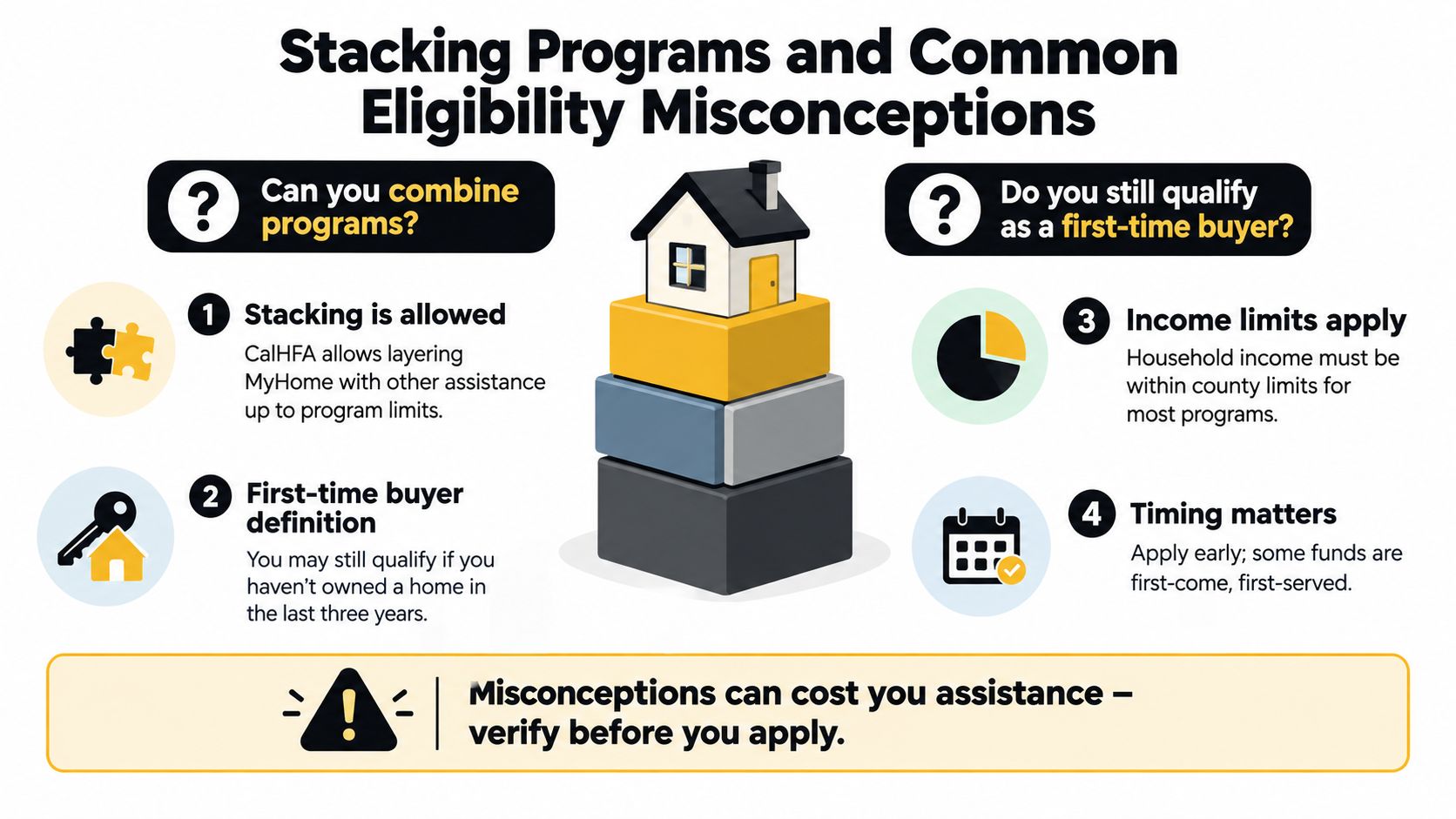
Stacking means using more than one eligible source of assistance in the same purchase. CalHFA may allow MyHome to layer with other approved assistance, including certain CalPLUS FHA structures, but the combined amount still has to fit program limits, loan requirements, and the final settlement statement.
Dream For All is not another unrestricted layer. It's paired with a Dream For All Conventional first mortgage and carries shared-appreciation terms. A private local program may also exclude a buyer who has already received CalHFA funds, so “stackable” always means stackable under the written rules.
First-time buyer status
Prior ownership doesn't always disqualify you forever. CalHFA guidance commonly treats a borrower who hasn't owned and occupied a principal residence during the prior three years as a first-time buyer for applicable program purposes. Confirm the exact definition with the lender because ownership history, occupancy, and program rules can interact.
Other assumptions create avoidable errors:
- Spouse and household income: Programs may evaluate household income differently from the way a lender calculates qualifying income.
- Roommate income: A roommate's earnings may not be treated the same as a co-borrower's documented income.
- Gift funds: Gift money and DPA may be compatible in some structures, but the source, documentation, and lender rules must be approved.
- Public-service occupations: Teachers, nurses, firefighters, and other professionals aren't automatically excluded because they earn above a common AMI tier. County limits and program-specific rules determine the result.
The right stacking question isn't “Can I combine two programs?” It's “Can these two liens, income rules, and repayment terms coexist in this exact transaction?”
Some buyers also assume DPA is limited to the minimum down payment. Program data shows that assistance can sometimes address closing costs or prepaid expenses as well. Michigan's first-generation pilot, for example, covers down payment, closing costs, and prepaid escrows, while New Hampshire's program offers up to $35,000 toward down payment and/or closing costs for a manufactured home, as described in Down Payment Resource's program coverage.
Working With California Loans for Heroes to Estimate and Apply
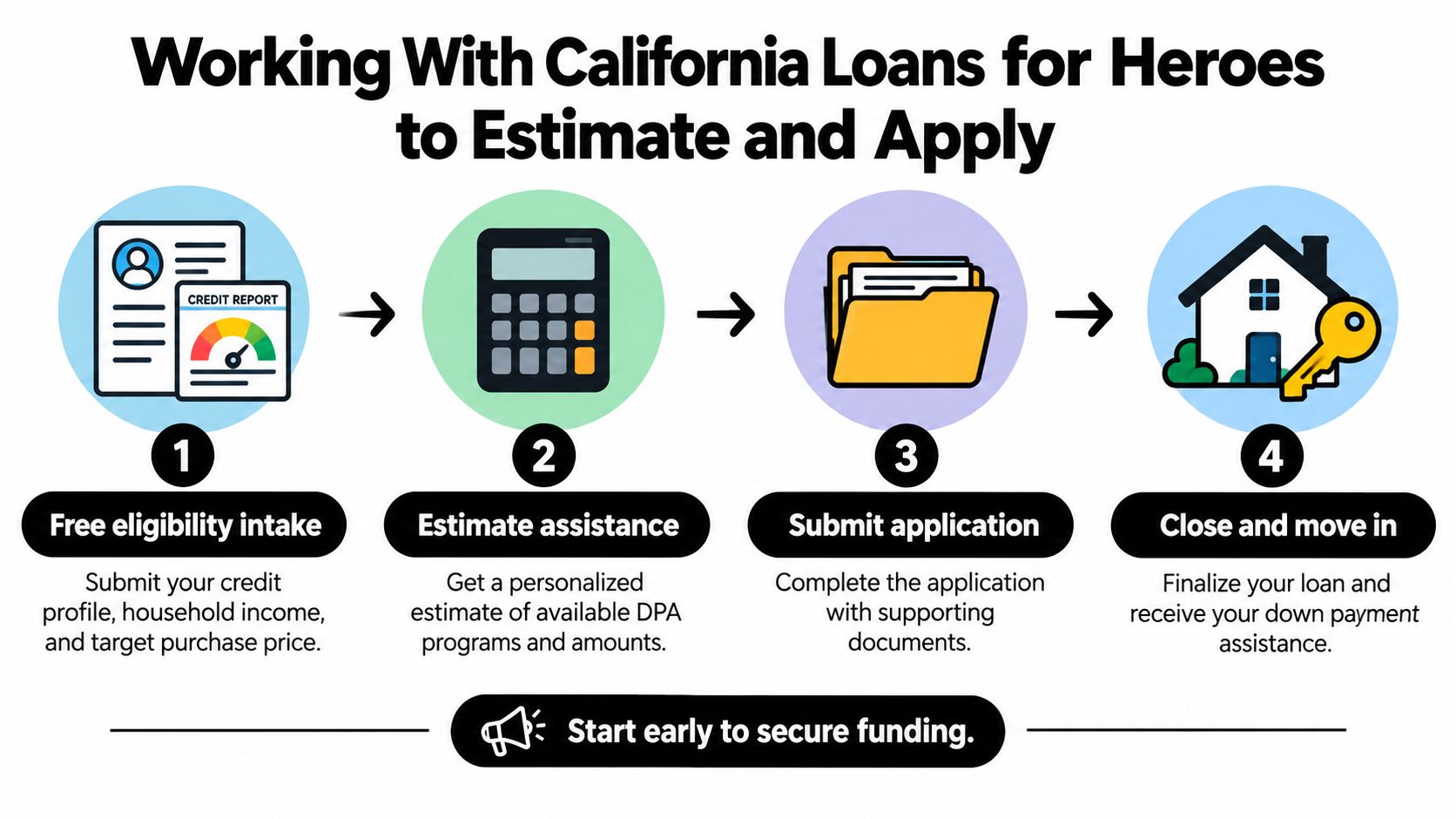
A reliable estimate begins before you make an offer. Start with a free eligibility intake that reviews your credit profile, household income, target purchase price, county, occupation, and intended loan type. That information gives the loan officer enough context to compare programs instead of quoting a generic maximum.
A HERO-certified loan officer can place Dream For All, CalHFA MyHome, and CalHFA FHA options side by side. The comparison should identify the applicable income ceiling, purchase-price or loan limit, assistance formula, required first mortgage, and repayment trigger for each option.
Documents that support the estimate
Prepare documents that help the lender calculate stable income and verify eligibility:
- Employment records: Two years of W-2s and recent pay stubs.
- Benefit documentation: Award letters for VA benefits or other qualifying income.
- Asset records: Bank statements and documentation for gift funds, if applicable.
- Purchase details: The target price, property type, and estimated closing timeline.
The officer can then determine whether the assistance is reserved through the relevant program portal and whether the funds remain available through contract-to-close. A calculation made before an offer may change after appraisal, final income review, or program confirmation.
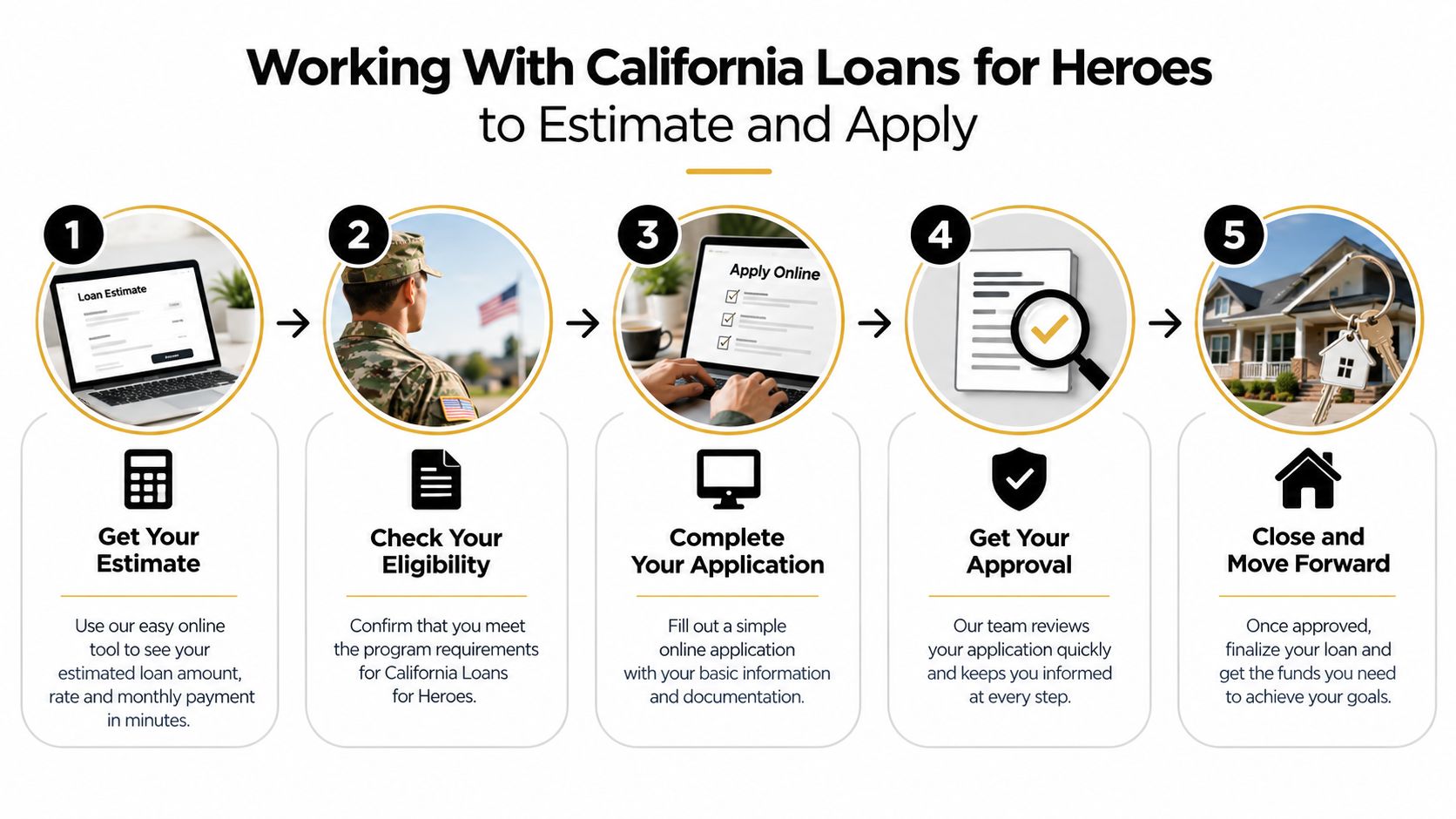
California Loans for Heroes offers assistance options and one-on-one mortgage support for California service professionals, including military members, veterans, first responders, healthcare professionals, teachers, and other public-service employees. Buyers can also review Hometown Heroes down payment assistance as part of a broader financing comparison.
The practical timeline usually includes pre-approval, DPA eligibility review, reservation or application, contract acceptance, appraisal, final underwriting, and closing. Start the review before house hunting so the assistance estimate reflects a realistic payment and cash-to-close plan.
Putting It All Together and Frequently Asked Questions
Use this short checklist before relying on a DPA advertisement:
- Confirm the county's purchase-price and income limits.
- Calculate the assistance from the lower qualifying value when required.
- Compare a fixed-dollar junior loan with percentage-based or shared-appreciation assistance.
- Get pre-qualified before touring homes.
California's ordinary DPA range often falls around 3% to 5% of the purchase price, with average benefits near $18,000, while Dream For All can reach 20%, subject to its cap and rules.
Frequently asked questions
Is CalHFA MyHome forgiven after five years?
Don't assume it is. MyHome is structured as a deferred-payment junior loan, so review the specific note and repayment terms rather than treating the assistance as automatically forgivable.
Does buying in San Mateo or Los Angeles change the amount?
Yes, county income limits, purchase-price limits, and program availability can change the usable benefit. A high-cost county may permit a higher purchase price while still applying separate income and loan constraints.
What if my income rises before closing?
The lender or program administrator may recalculate eligibility. A higher income could change your tier or make you ineligible.
Can I refinance later?
Possibly, but refinancing may trigger repayment or require approval for the subordinate lien. Confirm the program's refinance rules before changing the first mortgage.
California Loans for Heroes helps eligible California service professionals compare mortgage financing, homebuyer assistance, and HERO program options based on their county, income, and purchase goals. Visit California Loans for Heroes to request an eligibility review and estimate how much down payment assistance may fit your transaction.