
A California service member finds the right house, writes a strong offer, and expects the VA loan to carry the deal through. Then the appraisal identifies a property condition issue, the seller questions the financing, or underwriting asks for income documents that weren't ready. The problem usually isn't the buyer's VA benefit. It's the way the property, entitlement, lender, and contract fit together.
The VA home buying process is achievable, but California buyers need more than a generic eligibility checklist. High purchase prices, competitive offers, appraisal sensitivity, county loan-limit considerations, and the need to protect cash for repairs or an appraisal gap all affect the structure of the transaction. A buyer who prepares those details early can make a VA offer that feels organized and dependable to the seller.
Introduction to the VA Home Buying Process in California
The VA home loan program began with the Servicemen's Readjustment Act of 1944. Since then, the U.S. Department of Veterans Affairs has guaranteed nearly 29 million home loans for service members and Veterans, representing nearly $4 trillion in total home-loan volume backed by the program. Nearly four million active VA-backed mortgages existed as of 2025, showing that VA financing is a major channel for military households, not a niche benefit. (VA announcement on the 29 millionth guaranteed home loan)
That scale matters in California. A VA buyer may be competing against offers with conventional financing, substantial cash reserves, or fewer perceived conditions. The answer isn't to hide the VA loan or weaken protections. The stronger approach is to present a complete file, work with professionals who understand VA requirements, and evaluate the home before making promises that become difficult to keep.
The journey starts with eligibility and a Certificate of Eligibility, then moves through lender pre-approval, home selection, offer strategy, appraisal, inspection, underwriting, and closing. Each stage has a different job. Eligibility confirms access to the benefit, pre-approval establishes purchasing capacity, the inspection examines the home's condition for the buyer, and the VA appraisal addresses both value and minimum property standards.
Practical rule: A competitive VA offer isn't created by removing every contingency. It's created by reducing uncertainty before the seller has to ask questions.
The property itself deserves early attention. A home may look attractive online and still create trouble because of safety defects, unfinished work, structural concerns, or features that require additional documentation. In California's competitive markets, buyers also need to decide how much cash to preserve for closing costs, repairs, reserves, and any gap between the contract price and appraised value.
HERO benefits can be part of that financial structure. Programs offering homebuyer assistance, down payment assistance options, lender credits, competitive rates, and one-on-one support may help eligible professionals manage the cash demands of a California purchase. The right plan connects the VA benefit to the specific house and the buyer's actual resources.
Getting Eligible and Securing Your Certificate of Eligibility
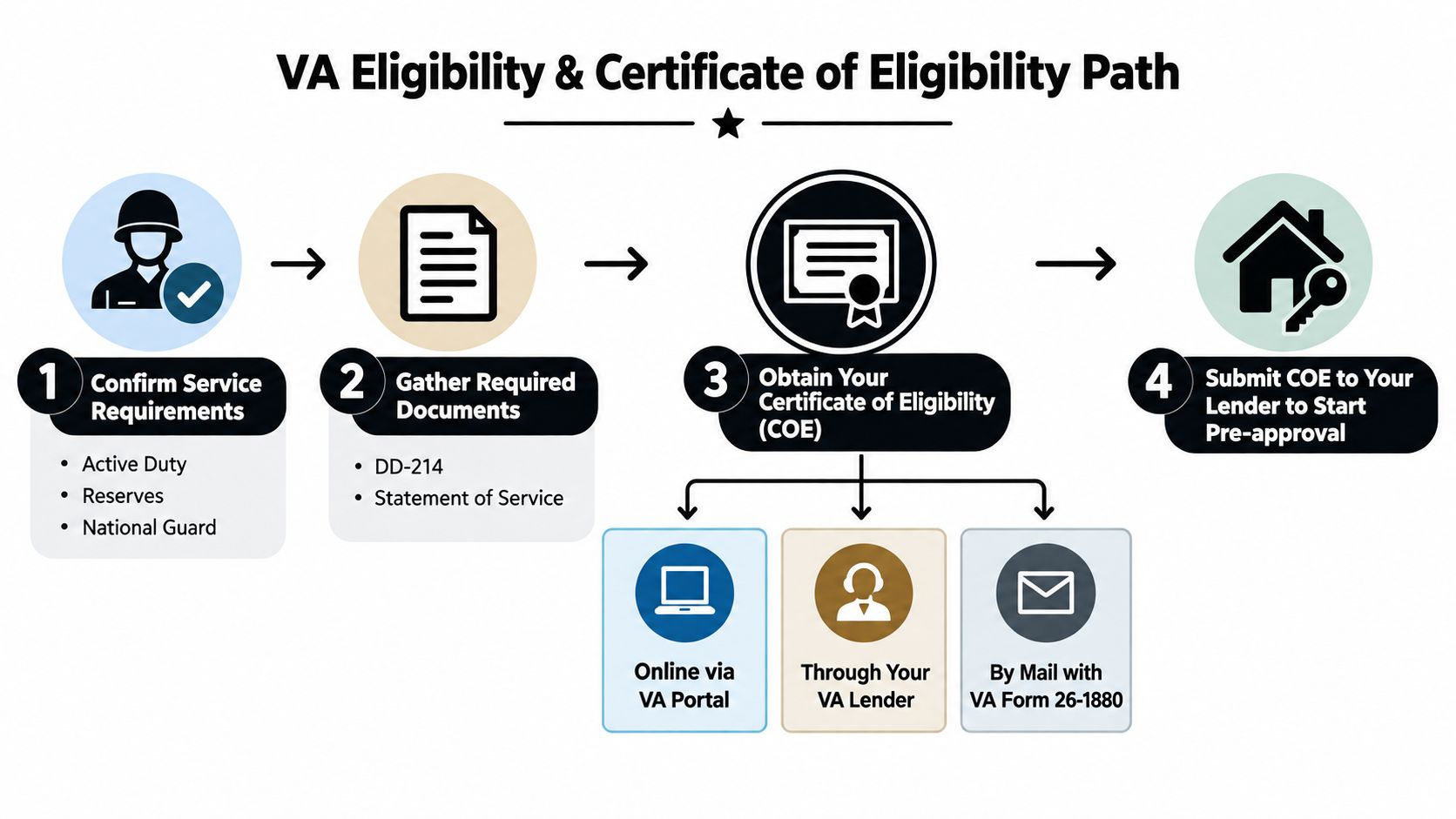
Eligibility is the first gate, but obtaining a Certificate of Eligibility, commonly called a COE, is the document that lets the lender verify the benefit. Active-duty service members, Veterans, qualifying members of the Reserves and National Guard, and certain surviving spouses may have a path to VA loan eligibility. The exact determination depends on service history and applicable VA rules, so buyers should verify rather than assume.
Start with the correct service record
The document you need depends on your status. A Veteran will commonly use a DD-214, while an active-duty borrower may provide a statement of service. Reserve and National Guard borrowers may need service documentation that reflects qualifying duty. A lender can often retrieve the COE electronically, but the lender still needs accurate personal and service information to resolve mismatches.
You can request a COE in three practical ways:
- Through a VA lender: This is often the most efficient route because the lender can request the document while beginning the pre-approval review.
- Online through the VA portal: Borrowers who prefer to manage the request directly can use the VA's online housing resources.
- By mail: A borrower can submit VA Form 26-1880 when electronic access isn't available or when a manual review is necessary.
A COE confirms eligibility, but it doesn't approve the mortgage. The lender still reviews income, assets, credit history, debts, occupancy, and the property. For a plain-language overview of service categories and documentation, review this guide to VA home loan eligibility.
Check entitlement before touring expensive homes
Full entitlement and partial entitlement create different planning questions. VA materials explain that remaining entitlement is calculated by subtracting used entitlement from the one-unit loan limit multiplied by 0.25, as described on this VA entitlement and loan-limit resource. Buyers with no prior VA use may have full entitlement, while a buyer who still owns or previously used a VA-backed loan may have remaining entitlement that affects the next purchase.
Full entitlement no longer has a national loan limit in the traditional sense, because the VA guaranty is tied to 25% of the conforming loan limit. Partial entitlement requires more careful structuring, particularly in California counties where purchase prices can be high. The lender may need to calculate the remaining guaranty, determine whether a down payment is required, and explain how the contract price affects cash to close.
Gather service records, recent income information, asset statements, identification, and documentation about any existing VA loan before requesting pre-approval. Also ask the lender to review whether you may be exempt from the funding fee. Resolving that question early prevents a late change to the loan balance or cash-to-close estimate.
Choosing Your VA Lender and Agent and Getting Pre Approved
A general mortgage team may process VA loans, but that doesn't mean it manages California VA transactions well. The lender's familiarity with appraisal scheduling, Minimum Property Requirements, funding-fee questions, entitlement calculations, and underwriting documentation can directly affect whether a purchase stays on track.
Your real estate agent matters just as much. An agent who understands VA contracts can identify property risks, explain the financing accurately to the listing agent, and write terms that protect the buyer without making the offer appear unnecessarily uncertain. The strongest team treats the VA loan as a structured financing tool, not an obstacle.

Compare the team before comparing houses
Use interviews to test how each professional handles the parts of the transaction that commonly create friction.
| Decision area | VA-focused team | General team that rarely handles VA loans |
|---|---|---|
| Loan volume | Can explain its experience with VA purchase files and recurring documentation issues | May understand conventional underwriting better than VA-specific requirements |
| Appraisal management | Discusses scheduling, property condition, and what happens if repairs or a value issue arise | May treat the appraisal as only a valuation step |
| Funding-fee guidance | Reviews exemptions and whether financing the fee supports the buyer's cash plan | May provide a generic estimate without connecting it to the transaction |
| Entitlement review | Calculates the effect of prior VA use and county-limit considerations | May identify the issue only after the buyer has selected a home |
| HERO access | Can explain whether an eligible buyer may qualify for down payment assistance, lender credits, or other program features | May not offer or understand those options |
A strong pre-approval letter should reflect more than a quick credit conversation. The lender should review income stability, employment history, assets, debts, service documentation, and the intended occupancy. The letter should also make clear that final approval depends on the property, appraisal, title, and underwriting.
For lender-selection questions and California-focused support, compare VA home loan lenders alongside other qualified providers. Ask every lender who schedules the appraisal, how quickly the team responds to document requests, how it handles a low appraisal, and whether it can explain your estimated cash to close in plain language.
A seller doesn't need a VA buyer to be risk-free. The seller needs confidence that the buyer's team knows what it's doing.
Finding the Right Home and Making a Competitive VA Offer
The best VA property search starts before the first showing. Tell your agent that you want to screen for condition, occupancy suitability, title complications, unpermitted work, and features that could create appraisal questions. A clean, well-maintained property isn't guaranteed to pass, but visible neglect should trigger deeper questions before you spend money or write an offer.

Build the offer around certainty
California offers often compete on more than price. Your lender and agent should coordinate the financing presentation, contingency language, deposit terms, seller-credit request, and timing. The goal is to show that you understand the transaction and have a realistic plan for each milestone.
Before submitting, review:
- Property condition: Look for roof damage, exposed wiring, unsafe stairs, broken windows, plumbing defects, active leaks, and incomplete construction.
- Occupancy: Confirm that the home will be your primary residence and that the intended move-in timing works with VA requirements.
- Appraisal exposure: Discuss what happens if the appraised value is below the contract price. Don't promise cash you haven't verified.
- Repairs: Decide whether the seller will address known issues before closing or whether the property should be rejected before the offer is written.
- Credits and costs: Request only credits that fit the lender's calculations and the buyer's actual closing-cost needs.
- Communication: Give the listing agent a direct lender contact who can confirm the file's readiness.
Seller misconceptions can be handled with facts and preparation. A VA loan doesn't mean the buyer is unqualified, and the appraisal isn't a substitute for a home inspection. At the same time, the seller shouldn't be asked to accept vague promises about repairs or timing.
If multiple offers are present, a slightly stronger offer may still lose if the buyer can't explain the appraisal plan or document available funds. A well-structured offer protects the buyer while demonstrating that the lender has already reviewed the core financial file.
Navigating Inspection and the VA Appraisal With Confidence
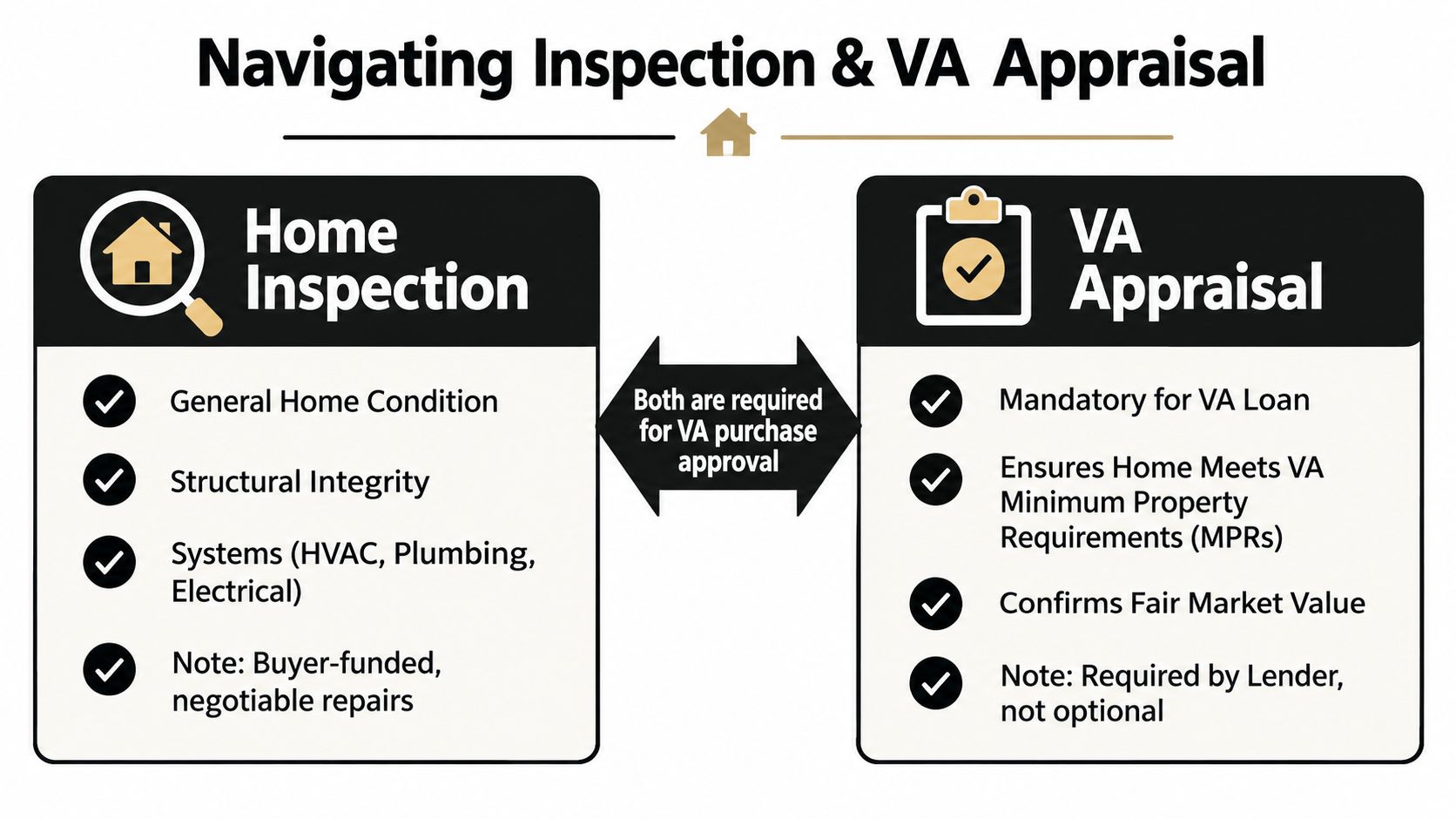
The inspection and appraisal answer different questions. The home inspection is the buyer's investigation of the property's general condition, systems, and potential defects. The VA appraisal is mandatory for a VA purchase loan and combines a market-value opinion with a review of the VA's Minimum Property Requirements, or MPRs, addressing safety, structural soundness, and sanitation.
The inspection protects the buyer
An inspector may examine the roof, foundation, attic, electrical system, plumbing, HVAC, drainage, appliances, and visible signs of moisture or deterioration. The inspector's report can identify maintenance needs that don't necessarily violate VA standards. The buyer and agent then use that information to negotiate repairs, credits, price changes, or the right to cancel under the contract.
The VA appraisal is not a detailed substitute for that work. The appraiser evaluates the property for value and observes conditions relevant to MPRs. A home can support the market value yet still require repairs before the lender can close the VA loan. Examples include health or safety defects, significant structural concerns, unsafe access, inadequate sanitation, or other conditions that affect habitability.
A buyer should schedule the inspection promptly, even though the appraisal is a separate lender requirement. This VA home inspection guide can help frame the difference between buyer due diligence and the lender's property review.
What happens when the appraisal raises a problem
If the appraiser identifies a repair issue, the parties may need to determine who will complete the work, whether a qualified professional must document it, and whether a final inspection is required. Sellers sometimes resist VA repairs because they misunderstand the standard or fear delay. A VA-experienced agent can narrow the issue to the actual requirement instead of turning every observation into a negotiation crisis.
VA guidance has changed to reduce avoidable delays. Updates include removing the full Radon Gas requirement, revising standards for pre-1978 and post-1978 homes, and streamlining guidance on detached improvements. The VA reported that the average VA appraisal took about seven business days as of May 31, although the condition of the property, local workload, corrections, and scheduling can still affect the timeline. (VA home-buying process guidance)
If the value is below the contract price, the buyer may renegotiate, challenge the valuation through the lender's reconsideration process, bring verified funds if appropriate, or leave under the contract's terms. The wrong response is to discover the gap after committing money that was reserved for closing or reserves.
The occupancy commitment also matters. The buyer must intend to use the property as a primary residence, generally occupying it within about 60 days of closing. The lender should review unusual circumstances, such as delayed relocation or extensive repairs, before the offer is written.
Underwriting Closing and HERO Program Benefits That Save You Money
Once the property clears the appraisal and inspection decisions, underwriting becomes the main source of closing risk. The underwriter verifies the borrower's income, assets, debts, employment, service documentation, insurance, title, and any conditions tied to the property. Fast responses matter because an unanswered request can hold up the entire file even when the buyer believes everything is complete.
The funding fee belongs in the cash-to-close conversation from the beginning. The VA describes it as a one-time charge paid at closing, and the fee can often be rolled into the loan balance. Whether financing it or paying it at closing makes sense depends on the buyer's available cash, loan structure, exemption status, and preference for preserving reserves. (VA funding fee and closing-cost information)
Closing timeline and cost factors
| Factor | What It Means for Your Closing |
|---|---|
| Document requests | Missing or inconsistent income, employment, asset, or service records can create underwriting conditions and delay approval. |
| Appraisal | Scheduling, repairs, corrections, or a value dispute can move the closing date. |
| Funding fee | Confirm whether you're exempt, paying it at closing, or financing it into the loan balance. |
| Closing costs | Review lender fees, title charges, prepaid items, credits, and the final cash-to-close figure before signing. |
| Closing window | Many VA purchases close in roughly 30 to 45 days when appraisal scheduling and underwriting are smooth, according to published VA loan performance analysis. (2024 Vetted VA loan white paper) |
| HERO assistance | Eligible buyers may be able to evaluate down payment assistance options, lender credits, competitive rates, and dedicated support as part of the overall financing plan. |
The HERO Home Loan and Buyer Rewards Program can be relevant for Veterans, active-duty military, first responders, healthcare professionals, teachers, pilots, and public service employees. California Loans for Heroes describes support that may include homebuyer assistance, down payment assistance options, lender credits, refinance solutions, and one-on-one guidance. Those features don't replace underwriting, but they may help a buyer decide where limited cash should go.
Published analysis also shows why documentation discipline matters. One analysis reported a 9.3% denial rate for VA borrowers, compared with 16.0% for conventional, 13.8% for FHA, and 13.7% for USDA borrowers. Federal loan-application data cited in the same white paper showed 58.2% originated, 11.9% denied, and 22.2% withdrawn for VA applications. (Vetted VA loan performance analysis)
The practical lesson is simple. Keep an updated document folder, answer requests quickly, avoid unexplained transfers between accounts, and ask for a written cash-to-close estimate before the final closing disclosure.
Your Next Move Toward Homeownership With VA Benefits
California buyers shouldn't treat the VA home buying process as a national checklist with a California price tag added later. The property must work, the entitlement must support the structure, the lender must manage the timeline, and the offer must communicate confidence without sacrificing necessary protections.
The most avoidable problems usually begin before the offer. Buyers shop without confirming entitlement, overlook visible property defects, assume the appraisal is an inspection, or wait until underwriting to locate service and income records. A short preparation call can expose those issues while there's still time to solve them.
Use this week to create momentum:
- Confirm eligibility: Request your COE and ask whether you have full or partial entitlement.
- Review the financing structure: Discuss county-limit considerations, funding-fee treatment, cash reserves, and any potential appraisal gap.
- Interview the team: Choose a lender and agent who can explain VA property standards and communicate with sellers.
- Prepare documents: Gather service records, income evidence, asset statements, and information about existing VA loans.
- Screen homes carefully: Have your agent identify condition, occupancy, title, and repair concerns before you write.
- Ask about HERO options: Determine whether assistance, lender credits, or other available program features fit your purchase plan.
You don't need to wait until every question is answered before starting. You do need the right questions in front of the right professionals, especially when a California purchase leaves little room for an avoidable surprise.
California Loans for Heroes offers VA-focused home loan guidance, homebuyer assistance, down payment assistance options, lender credits, and one-on-one support for eligible California military members and other heroes. Visit California Loans for Heroes to discuss your entitlement, property strategy, and path toward a confident pre-approval.