
You're looking at a refinance quote, feeling good about the new rate, and then the Loan Estimate lands in your inbox. The payment may look better, but the closing costs don't. In California, that surprise hits hard because title charges, escrow fees, recording costs, and prepaid items can add up fast.
That's where a lender credit for refinance can help.
It's not free money, and it's not a trick. It's a pricing choice. You can use it to reduce what you bring to closing by accepting a higher mortgage rate than the lowest available option. For many HERO borrowers, that trade can make sense. A teacher trying to preserve savings, a firefighter moving between shifts and life expenses, or a military family handling a relocation may care as much about cash today as rate over time.
A lot of refinance articles stop at “no-closing-cost refinance” and leave out the part that causes the most confusion. A lender credit may cover some charges on your California Loan Estimate, but it doesn't always wipe out everything. Prepaid interest, homeowners insurance, and property tax escrows can still leave you with money due at closing.
Introduction to Lender Credits in a California Refinance
You open a refinance quote hoping for a lower payment. Then the California Loan Estimate shows title fees, escrow charges, prepaid interest, and reserves for taxes or insurance. The rate may look attractive, but the question becomes simpler. How much cash do you need to bring in?
That is the moment lender credits start to matter.
Closing costs can take a noticeable bite out of a refinance budget. The Consumer Financial Protection Bureau explains lender credits and points as part of mortgage pricing, and California borrowers often feel that tradeoff quickly because local settlement charges and prepaid items can stack up on the Loan Estimate.
For many HERO households, cash on hand matters just as much as the note rate. A teacher may want to keep reserves intact before summer. A firefighter may be planning around overtime swings. A military family may be timing a refinance around a move. In each case, the same question comes up. Can this refinance work without draining savings?
A lender credit can reduce some of the charges listed on the Loan Estimate, but it does not erase every dollar due at closing. That distinction causes a lot of confusion.
Here is the practical way to look at it. Your Loan Estimate works like a grocery receipt with separate categories. Some line items are lender or settlement charges that a lender credit can offset. Other line items are prepaid costs, such as daily interest, homeowners insurance, and escrow deposits for property taxes or insurance. Those are tied to the property and the timing of closing, and they often still require cash even if the lender gives a credit.
The Loan Estimate itself helps you see this clearly. The form from the Consumer Financial Protection Bureau separates loan costs from other costs, which is exactly why two borrowers can both hear the phrase "no-closing-cost refinance" and still have very different cash-to-close numbers.
That page-by-page view is what matters in California. Instead of treating lender credits as a vague perk, it helps to map them directly to the Loan Estimate and ask a plain question for each section. Can the credit cover this fee, or is this still my cash requirement?
If you understand that one distinction early, the rest of the refinance comparison gets much easier.
How Lender Credits Work and Why Rates Change
A California borrower might look at two refinance quotes and wonder why one shows less cash due at closing but a higher rate. That difference is often the lender credit.
A lender credit works like shifting part of your closing cost from today into the loan's pricing over time. You bring in less money now, and in exchange you accept a higher interest rate than you would on a lower-cost pricing option.
That trade shows up on the Loan Estimate even when the paperwork feels technical. One version of the loan may have a lower rate with little or no lender credit. Another may have a slightly higher rate with a credit that helps reduce certain closing charges. Same refinance goal, different cost structure.
Core rule: Less cash at closing usually means a higher rate. A lower rate usually means more cost upfront.
That is why lender credits are not free money. The cost is built into the rate the lender offers.
Why the rate changes
Mortgage pricing works more like a menu than a single sticker price. A lender may offer several combinations on the same day. One option gives you a lower rate if you pay more of the closing costs yourself. Another gives you a credit if you accept a higher rate.
A simple way to picture it is an airline ticket. The base fare may look lower, but once you add bags and seat selection, the total changes. Mortgage pricing works in a similar way. The rate and the credit are connected parts of one package.
If you want context for how quotes move with the market, compare your offer with current mortgage rate trends in California.
Why borrowers choose lender credits
For some homeowners, protecting cash matters more than getting the lowest possible rate on paper. That can make sense if you are trying to keep emergency reserves, limit out-of-pocket closing costs, or expect you may not keep the new loan long enough for a lower rate to repay its upfront cost.
Confusion often starts. Borrowers hear "higher rate" and assume the credit is always a bad deal. It is not automatically good or bad. It depends on how long you expect to keep the loan and how much value you place on keeping cash in the bank today.
How this connects to the Loan Estimate
The best way to judge a lender credit is to tie it back to the Loan Estimate, not just the headline rate. If one quote offers a credit, ask what dollar amount it offsets and which line items still remain. That keeps the comparison grounded in actual closing figures instead of marketing language.
Lenders may also describe pricing in points. In plain terms, points are a way to measure how much you pay to change the rate, either upward or downward. A credit is the reverse side of that same pricing system. You are using rate to reduce certain closing costs rather than paying cash to lower the rate.
What Lender Credits Can and Cannot Cover at Closing
A California homeowner gets a refinance quote that says “lender credit” and assumes closing day will require little or no cash. Then the Loan Estimate arrives, and there are still charges listed for prepaid interest, homeowners insurance, and escrow setup. That surprise usually comes from one simple issue. The credit applies to some boxes on the Loan Estimate, not every box.
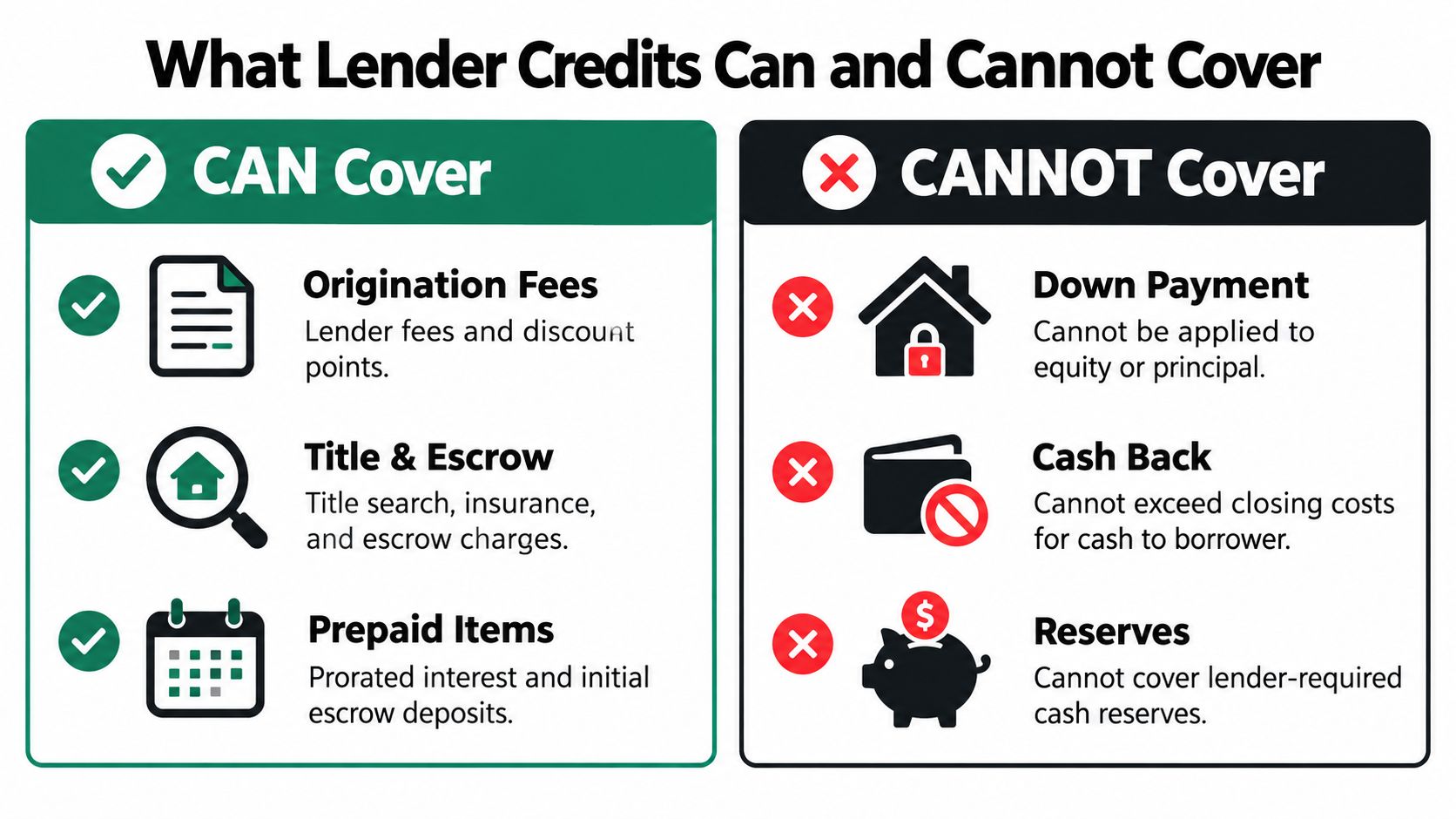
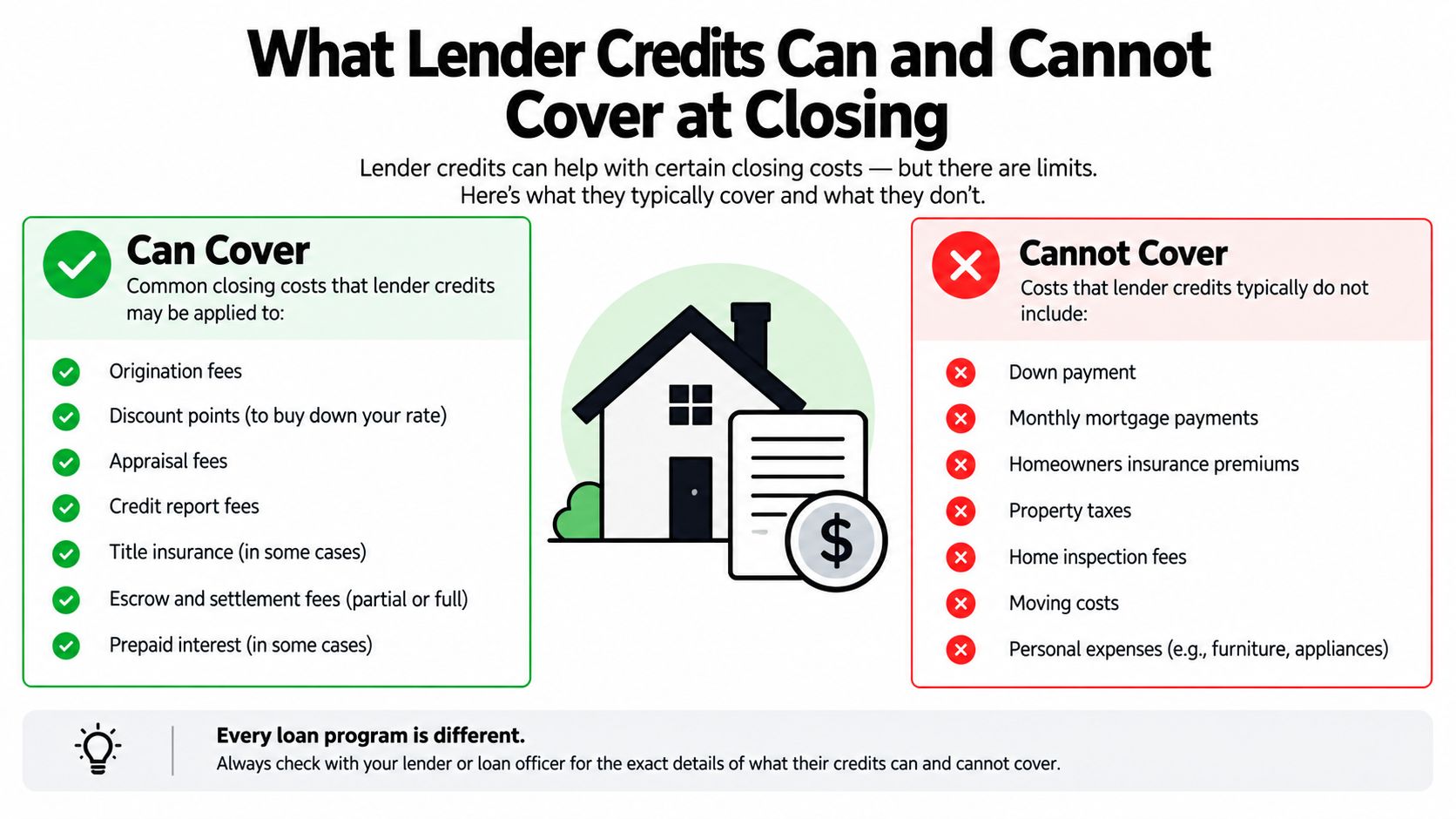
The clearest way to read a lender credit is to match it to the actual fee sections on the Loan Estimate. Some charges are true closing costs tied to making the new loan. Others are prepaid items or reserve deposits collected in advance. A lender credit often helps with the first group much more than the second.
That difference matters in California, where tax and insurance collections can be large enough to change your cash-to-close number in a meaningful way.
Charges a lender credit can often offset
On a typical refinance Loan Estimate, lender credits usually go toward charges connected to processing and closing the new mortgage. These are the costs borrowers often mean when they say “closing costs.”
That often includes:
- Lender fees such as origination or underwriting charges
- Appraisal fees if the new loan requires an appraisal
- Title and escrow charges for handling the refinance
- Recording fees and similar government filing costs
These are the charges a lender can often reduce or fully cover through pricing.
Charges that may still require cash
Some line items serve a different purpose. They are not charges for arranging the loan. They are funds collected ahead of time for bills that will come due after closing.
Common examples include:
- Property tax escrows
- Homeowners insurance premiums
- Prepaid interest
A simple way to picture it is this. Closing costs are like the bill for setting up the transaction. Prepaids and escrows are like stocking the account so future tax and insurance payments can be made on time.
That is why a refinance can be advertised with a lender credit and still show money due at closing.
A lender credit can reduce closing costs without eliminating all cash to close.
Reading the Loan Estimate the right way
Start with the lender credit shown in the Loan Estimate, then trace where it helps. Look closely at lender charges, title charges, and government fees first. After that, review the sections for prepaids and initial escrow payment at closing. Those are often the lines that still require cash even when the credit is generous.
A practical checklist helps:
- Lender charges. These are often the first fees a credit can offset.
- Title, escrow, and recording charges. These may also be reduced by the credit.
- Prepaids. Check for upfront interest and insurance payments.
- Initial escrow payment at closing. Review whether taxes and insurance reserves are being collected.
- Cash to close. This summary shows what you may still need to bring in.
If you want a clearer view of how those line items usually show up, review this California closing costs breakdown.
Why confusion starts here
The phrase “no-closing-cost refinance” sounds broader than it usually is. In practice, it often means the rate was priced to create a credit that covers some allowable fees. It does not always mean every charge on the Loan Estimate disappears.
For California borrowers, that distinction can prevent a last-minute cash shortfall. The right question is not whether a credit exists. The right question is which specific Loan Estimate lines it covers, and which ones still belong to you.
Understanding the Rate Versus Cost Trade Off With Real Numbers
A California homeowner sees two refinance quotes on the same day. One offers a lower rate with little or no lender credit. The other offers a larger credit, but the rate is higher. The choice feels small on paper, yet it changes both your cash to close and what you pay month after month.
The easiest way to judge that trade is to use the Loan Estimate like a map. One side shows the credit helping with closing charges. The other side shows the rate attached to that help.
Start with a simple dollar example
A lender credit is often priced in amounts that relate to your loan size. On a $300,000 refinance, a credit might be around $3,000. On a $200,000 refinance, it might be closer to $2,000. The exact amount depends on daily pricing, the lender, your loan type, and how much of a rate increase you accept.
That matters because the credit is not free money. It is more like choosing a higher train fare later so you can skip more of the ticket cost upfront today. The larger the credit, the more likely the rate moves up with it.
Here is the trade in plain terms:
| Loan Amount | Example Credit | What Usually Changes | What You Feel |
|---|---|---|---|
| $200,000 | about $2,000 | Rate is higher than a low-credit option | Less cash due at closing, but less monthly savings |
| $300,000 | about $3,000 | Rate is higher than a low-credit option | Bigger help upfront, but higher cost over time |
Match the credit against the actual charges
Many borrowers get tripped up. A $3,000 credit sounds large until you place it next to the full refinance bill on the Loan Estimate.
Refinance costs are often a few different buckets combined. You may have lender fees, title and escrow charges, recording fees, prepaid interest, homeowners insurance, and initial escrow deposits for taxes and insurance. Earlier in this guide, we covered that prepaid items and escrow funding often still require cash even when the lender gives a healthy credit.
So if your total closing costs and prepaids add up to much more than the credit, three outcomes are common:
The credit covers only part of the bill
You save money at closing, but you still bring cash for prepaid items or remaining charges.The credit gets you close to break-even
The cash due becomes small enough that the refinance feels manageable.The rate increase costs too much
The lender can reduce more of the upfront bill, but the higher rate weakens the benefit of refinancing.
Use side-by-side Loan Estimates, not guesses
The cleanest comparison is to ask for two or three Loan Estimates built on the same day.
Ask for:
- one quote with little or no lender credit
- one quote with a moderate credit
- one quote with a larger credit if keeping cash matters most
Then compare four lines carefully:
- the interest rate
- the lender credit
- total closing costs
- cash to close
After that, compare the monthly payment. A small rate increase can look harmless until you spread it over the time you expect to keep the loan.
If you want help lining those quotes up correctly, this guide to comparing mortgage rates side by side gives a practical framework.
A practical way to judge the trade
Ask two questions.
How much cash does this credit save me today?
How much extra will this rate cost me each month?
That is the heart of the decision. If the upfront savings solves a real cash problem, the higher rate may be reasonable. If you expect to keep the loan for many years, the lower-rate option may save more even if it asks for more cash at closing.
For HERO borrowers in California, this is often the clearest way to decide. Put the lender credit next to the exact Loan Estimate charges it can reduce, then separate out the prepaids, escrows, and insurance items that may still be yours to cover. Once you see those pieces clearly, the rate-versus-cost trade stops feeling abstract and starts looking like a straightforward math choice.
When a Lender Credit Makes Financial Sense for You
A California homeowner sits down to sign refinance papers expecting the lender credit to wipe out the closing bill. Then the Loan Estimate shows something different. Some costs shrink, but prepaid interest, homeowners insurance, and new escrow deposits still leave cash due at closing.
That is the moment when a lender credit either fits your plan or misses the mark.
A lender credit usually makes the most sense when your main goal is to lower the cash burden tied to lender and third-party closing charges, not when your goal is the absolute lowest rate for the longest possible time. For many HERO borrowers, the question is simple. Are you trying to keep more money in your bank account now, or save more through a lower payment over years?
Situations where the credit may fit
A lender credit often fits well in a few specific cases:
- You want to protect cash reserves. If bringing several thousand dollars to closing would leave your emergency savings too thin, a credit can reduce the pressure.
- You may sell, refinance again, or pay off the loan sooner. A slightly higher rate matters less if you do not expect to keep the new loan for a long stretch.
- You are in a transition period. Moves, duty-related planning, schedule changes, or family expenses can make lower upfront cost more useful than the lowest possible rate.
- Your Loan Estimate shows charges the credit can meaningfully offset. This matters most when the lender credit covers origination and some third-party fees, even though prepaid items still remain.

Here is a practical way to look at it. A lender credit works like a store coupon that only applies to certain parts of your bill. If the coupon reduces enough of the charges you can control, it may solve the problem you have. If your biggest cash need comes from prepaid taxes, insurance, or escrow funding, the credit may help less than you expected.
Why timing and market conditions matter
Borrower behavior changes when refinance savings get harder to find or when upfront costs feel heavier. The CFPB reported that refinance originations dropped from 8.3 million in 2021 to 2.2 million in 2022, and that cash-out loans made up most refinance originations in 2022, as noted in its mortgage market report on refinance activity and closing costs.
That kind of market shift helps explain why lender credits come up so often in real refinance conversations. When borrowers care more about cash at closing, a higher-rate option with a credit can move from "maybe" to "worth considering."
A practical decision filter
Before you say yes to the credit, match it to the Loan Estimate in front of you.
- Will the credit mainly reduce Section A and other closing charges, or are prepaids the bigger issue? If prepaids and escrows are the large numbers, cash to close may still be significant.
- How long do you expect to keep this new loan? The shorter the timeline, the easier it can be to justify paying less upfront and a little more each month.
- Would paying costs out of pocket weaken your savings too much? Monthly math matters, but reserve strength matters too.
- Does the credit solve a real problem, or does it just sound attractive? A bigger credit is not automatically a better deal.
One sentence can keep this clear: the right lender credit is the one that lowers the costs you can offset without raising the rate more than your timeline can justify.
For borrowers comparing refinance options, California Loans for Heroes is one option that offers refinance support and lender credit-related guidance for eligible California HERO households.
California Considerations and Common Misconceptions to Avoid
California refinance math can feel different because the non-rate costs are hard to ignore. Fees, escrows, and insurance collections can create a bigger cash hurdle than borrowers expect.
The Federal Reserve says refinancing fees are not unusual at 3% to 6% of the outstanding principal in its refinancing cost overview. That's one reason lender credits come up so often in real conversations. But the same broad mortgage guidance discussed earlier makes an important point: credits may offset some closing costs rather than all loan obligations.

Myth versus reality
Myth: A lender credit is free money
Reality: You're usually paying for it through a higher interest rate over time.Myth: No-closing-cost means no cash under any circumstance
Reality: Prepaid items and escrow funding may still leave money due at closing.Myth: The lowest cash-to-close option is always best
Reality: If the rate jumps too much, the long-term cost can outweigh the upfront relief.
Why HERO borrowers should pay close attention
Veterans, active-duty households, nurses, teachers, firefighters, law enforcement officers, and other public servants often refinance during busy seasons of life. Some are managing PCS moves. Others are preserving reserves because overtime, childcare, commuting, or relocation costs are already stretching the monthly budget.
In those cases, lender credits can be useful. They can also be misunderstood.
A credit can help with cash strain, but it doesn't replace careful review of the Loan Estimate. Borrowers in high-cost California markets should pay special attention to escrow deposits and insurance-related charges, because those are often the line items that turn a “low cash” refinance into a larger-than-expected closing requirement.
Choosing the Right Lender Credit Strategy for Your Refinance
The best lender credit strategy usually comes down to one question. Are the upfront savings worth the higher rate for the amount of time you expect to keep the new loan?
If you'll likely keep the refinance for a shorter period, a lender credit may be a smart way to reduce out-of-pocket cost. If you expect to keep the loan for a long time, a lower rate with less or no credit may produce better overall value.
A short checklist before you commit
Ask for multiple structures
Request one quote with little or no lender credit and another with a meaningful credit.Read the Loan Estimate line by line
Separate lender fees and third-party charges from prepaid interest, taxes, and insurance.Focus on cash to close and rate together
Don't judge the loan by only one number.Match the loan to your timeline
A refinance should fit your life plan, not just today's sticker price.
The right refinance isn't the one with the lowest rate or the biggest credit by itself. It's the one that balances cost, cash flow, and how long you'll actually keep it.
For California borrowers, that balance matters even more because closing costs and prepaids can change the economics of the deal. If you understand what the lender credit covers, what it doesn't, and what the higher rate costs over time, you're in a strong position to choose confidently.
California Loans for Heroes helps veterans, active-duty military, first responders, nurses, teachers, pilots, and public service employees across California review refinance options, compare lender credits, and understand true cash-to-close numbers before they commit. If you want help reading a Loan Estimate and weighing the rate-versus-cost trade clearly, visit California Loans for Heroes.