
You open your mortgage statement, scan the payment breakdown, and there it is again. PMI. Money leaving your account every month for coverage that protects the lender, not you.
If you're a California teacher, firefighter, nurse, law enforcement officer, pilot, veteran, or other public servant, that charge gets old fast. You already carry enough monthly costs. You shouldn't keep paying private mortgage insurance one month longer than necessary.
The good news is that removing PMI from mortgage payments isn't a mystery. It's a rules-based process. If you know your loan type, your equity position, and the cancellation path that applies to you, you can stop guessing and start pushing your servicer to do its job.
Understanding Your PMI Charge and How to Fight It
PMI exists because your lender took on more risk when you bought with less equity. That's the plain-English version. If you put less than the standard equity cushion into a conventional loan, the lender likely required private mortgage insurance as a condition of approval.
A lot of borrowers assume PMI sticks around until they refinance or sell. That's wrong. Federal law gives you a path out.
Under the Homeowners Protection Act of 1998, lenders must automatically terminate PMI when your mortgage balance reaches 78% of the home's original purchase price, or the month after your loan hits its midpoint, whichever comes first, as outlined in Bankrate's summary of PMI removal rules. For a $500,000 home, that automatic cancellation point is $390,000. That's not a courtesy. It's a legal requirement.
What PMI is and what it is not
PMI is not homeowners insurance. It doesn't repair your roof, replace stolen property, or cover liability claims. It protects the lender if you default.
That distinction matters because it changes how you should think about the charge. This isn't a lifetime feature of your mortgage. It's a temporary cost tied to your equity level and payment history.
Your leverage is the law
If you're trying to figure out whether removing PMI from mortgage payments is possible, start with one fact: you have rights under federal law.
You don't need to wait around for a friendly phone rep to volunteer useful information. You need to know your trigger points, document your payment history, and make the request the right way when the numbers line up.
Practical rule: Treat PMI removal like a compliance issue, not a customer service issue. Servicers respond better when you use the right threshold, the right documents, and a written request.
Why borrowers overpay
Borrowers frequently overpay PMI for one of three reasons:
- They don't know the removal rules. They assume the charge is permanent.
- They focus on home appreciation first. Sometimes the original-value path is simpler and faster.
- They rely on phone calls. That usually creates delays, confusion, and zero paper trail.
If your goal is saving money, don't wait for your servicer to guide you. Track your own numbers. Check your mortgage statements. Know whether your loan is conventional, FHA, or VA. Then act.
That's how you stop PMI from hanging around longer than it should.
Your First Step Calculating Your Loan-to-Value Ratio
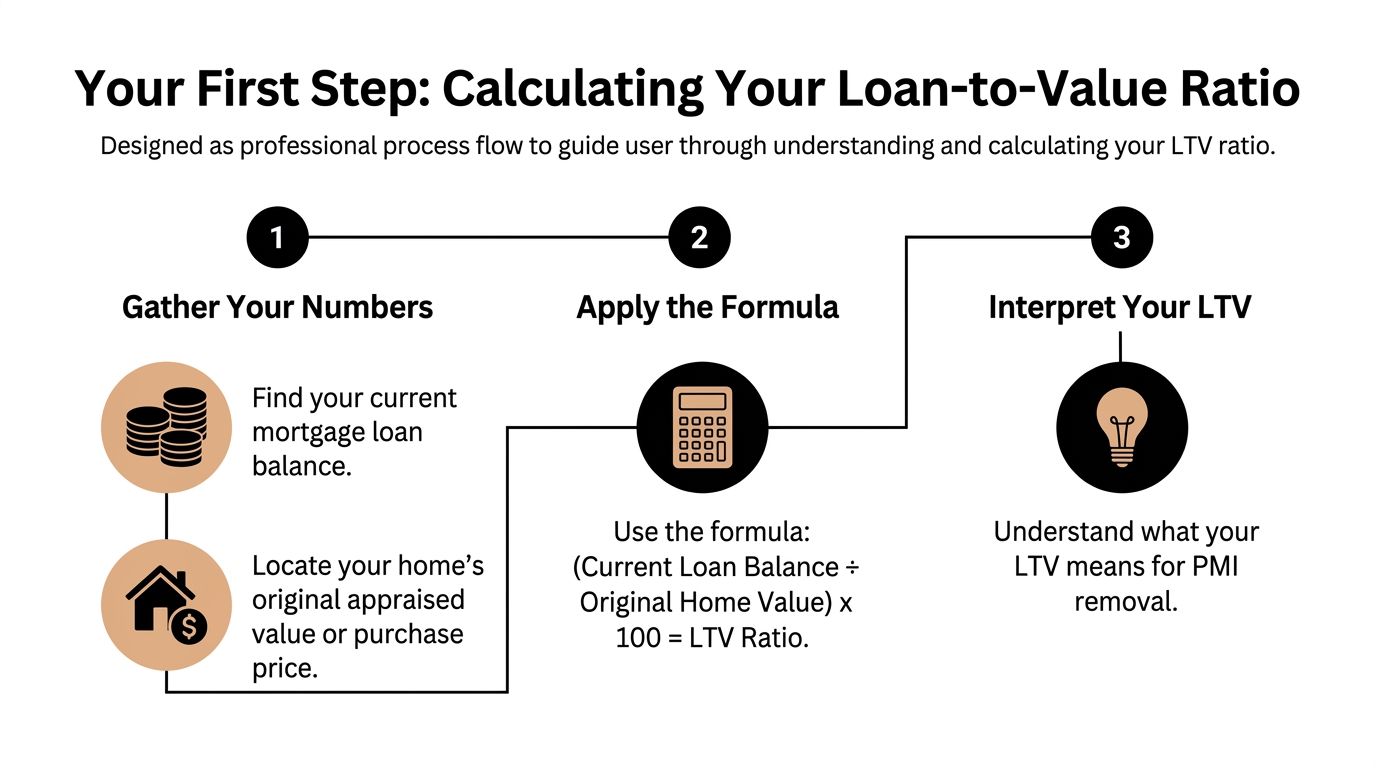
Before you ask anyone to remove PMI, calculate your loan-to-value ratio, or LTV. This is the number that drives the whole conversation.
Use this formula:
(Current Loan Balance ÷ Home Value) x 100 = LTV
That gives you the percentage of the home's value that your mortgage still represents. Lower is better. If you're serious about removing PMI from mortgage costs, this is the first number you need.
Where to find the two numbers
Start with your current principal balance. You can usually find it on your monthly mortgage statement or in your loan servicer's online portal. Make sure you're looking at principal, not the full payoff amount with interest or fees.
Then identify the right property value to use. Borrowers often get tripped up here.
For automatic and many borrower-requested PMI cancellation rules, the servicer often looks at the home's original value, not whatever Zillow says today. Original value usually means the purchase price or original appraised value tied to the loan file.
Original value versus current value
This distinction matters more than people think.
If your balance has dropped enough based on the original value, you may be able to request removal without making the case that your home appreciated. That's often the cleaner route.
If you're trying to get PMI removed earlier because your home value climbed, the lender may want fresh evidence. Some servicers have changed how they handle that. Recent lender policy shifts show that some now accept a Broker Price Opinion instead of a full appraisal for early removal if the homeowner has 2+ years of perfect payments, and that can avoid spending $400-$600 on a full appraisal, according to Essent's guidance on removing PMI.
If your servicer offers a BPO instead of a full appraisal, ask for it directly. Don't volunteer to pay for the more expensive option before you know what's acceptable.
A simple California example
Let's use a straightforward example. Say you bought your home for $500,000 and your current loan balance is $390,000.
Your math looks like this:
($390,000 ÷ $500,000) x 100 = 78% LTV
That number matters because it tells you you've hit a key threshold tied to removal rules discussed elsewhere in this guide. The point isn't fancy math. The point is knowing exactly where you stand before you contact the servicer.
What to do after you calculate it
Use this quick decision guide:
- If your balance is close to the threshold using original value: Review your amortization schedule and prepare your paperwork.
- If you're short based on original value but think appreciation changed the picture: Ask whether the servicer accepts a BPO or requires a full appraisal.
- If you're buying and planning ahead: Understand how equity builds from day one and how assistance programs affect your entry strategy. A good primer is this guide on how much down payment assistance can cover.
A lot of PMI headaches come from bad assumptions. Run the numbers first. Then make your move based on facts, not hope.
Pathways to Removing Conventional Loan PMI
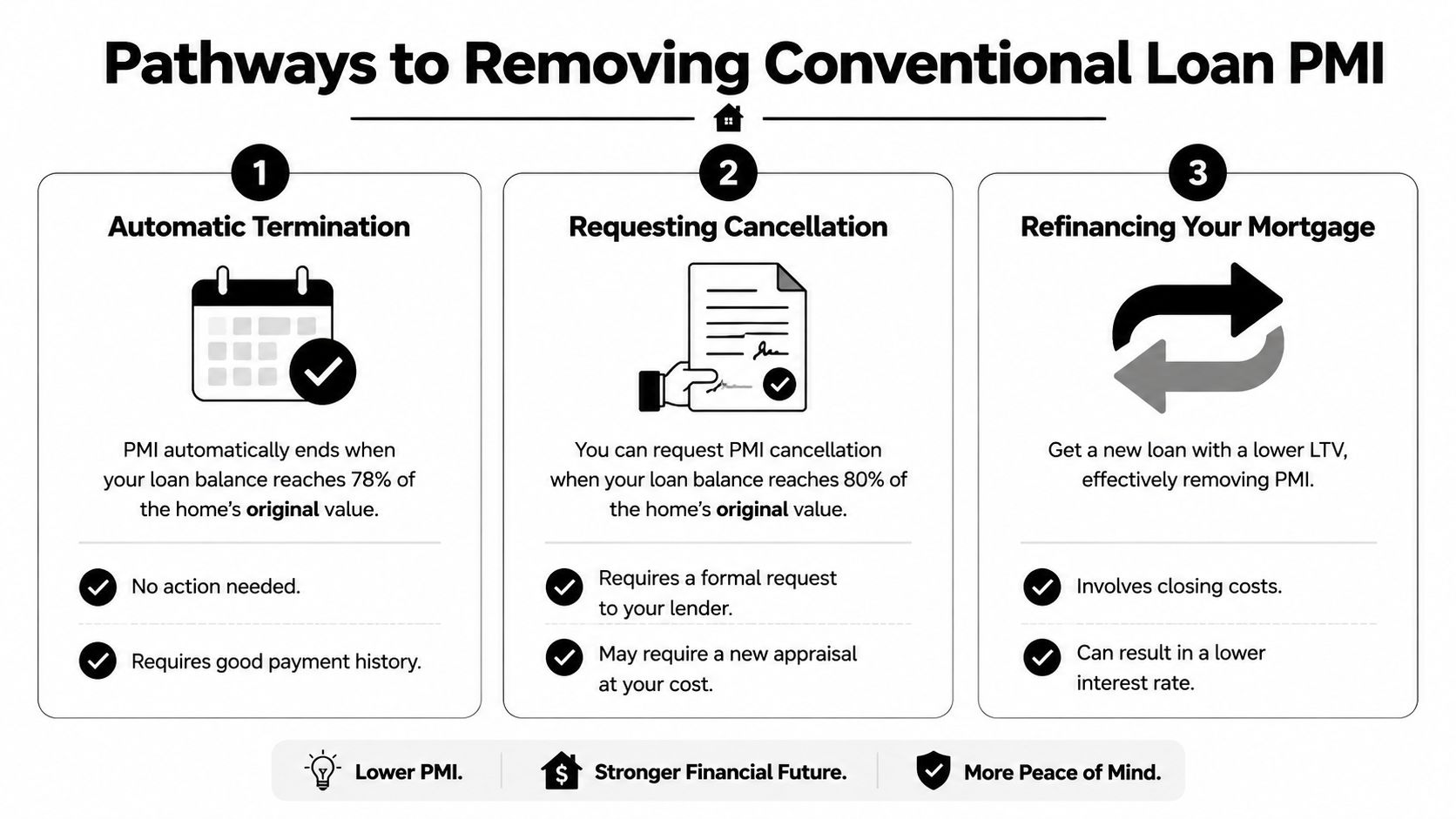
If you have a conventional loan, you generally have three ways to get rid of PMI. One happens automatically. One requires you to act. One is the backstop if the first two don't happen on schedule.
Borrowers either save money or waste time. Pick the wrong path and you delay the result. Pick the right one and you cut a useless monthly cost.
Automatic termination
This is the easiest path because you don't have to initiate it. Under the federal Homeowners Protection Act, servicers must automatically terminate PMI when the mortgage principal balance is first scheduled to reach 78% of the home's original value, as long as you're current and haven't had more than one 30-day late payment in the prior 12 months, as explained in this summary of HPA cancellation standards.
The key phrase is scheduled to reach. That means the original amortization schedule matters. Your servicer isn't supposed to wait for you to beg for cancellation if the loan is already set to hit the legal trigger.
Automatic termination is the cleanest option, but I don't recommend sitting back and trusting the system blindly. Watch your statements when that date approaches.
Borrower-requested cancellation
This route is for homeowners who want PMI gone as soon as they qualify instead of waiting for automatic removal.
Here, your job is simple. Get your balance where it needs to be, make sure your payment history is clean, and send a written request. This path usually gives you the earliest practical off-ramp on a conventional loan.
What usually matters most:
- Your payment history: If you've been late, expect resistance.
- Your equity evidence: The servicer may want proof the property hasn't declined.
- Your paper trail: Written requests beat phone calls every time.
This path is especially useful if you've paid down principal aggressively or think your current property value supports earlier removal. If you're also looking at broader monthly payment strategy, compare it with a rate and term refinance option before you decide. Sometimes cancellation is the best move. Sometimes replacing the loan is cleaner.
Borrower-requested cancellation gives you control. That's why I like it. You don't wait for the servicer's calendar. You force the review when you're ready.
Midpoint termination
This is the safety net. It matters most for borrowers who never sent a request or whose amortization didn't hit the value-based trigger as expected.
Midpoint termination means PMI can't sit on the loan forever if the legal time marker has arrived and your loan qualifies. It's the fallback protection many borrowers don't know exists.
Side-by-side comparison
| Path | Trigger | Your role | Main issue to watch |
|---|---|---|---|
| Automatic termination | Scheduled balance reaches the federal threshold based on original value | Monitor statements and confirm removal | Servicer delays or applies payment-history issues |
| Borrower-requested cancellation | You reach the request threshold and submit documents | Send a written request and support it | Appraisal, BPO, or documentation requirements |
| Midpoint termination | Loan reaches the amortization midpoint | Verify the servicer actually removed PMI | Borrowers miss the date and keep paying |
My recommendation
Don't wait passively unless you're very close to the automatic cancellation date and your payment history is spotless.
If you're earlier in the timeline and your numbers support action, push for borrower-requested cancellation. If your current rate is also a problem, evaluate refinance instead of treating PMI as the only issue. The smartest move isn't always the most obvious one. It's the one that reduces your total monthly burden with the least friction.
Crafting Your PMI Removal Request
Most PMI removal requests fail for one reason. Borrowers handle them casually.
They call the servicer, ask a vague question, get a vague answer, and assume that's progress. It isn't. If you want removing PMI from mortgage payments to happen, submit a written request that is clean, specific, and easy for the servicer to process.
Use this request template
You can adapt this for email or letter, depending on what your servicer accepts.
Subject: Request for PMI Cancellation Under the Homeowners Protection Act
To whom it may concern,
I am requesting cancellation of Private Mortgage Insurance on my conventional mortgage loan under the Homeowners Protection Act.
Loan number: [Your Loan Number]
Property address: [Your Property Address]My loan balance has reached the required threshold for borrower-requested PMI cancellation based on the applicable value standard for my loan. I am current on my payments and request a review of my eligibility for PMI removal.
Please provide any required documentation, including whether you require an appraisal or Broker Price Opinion, and confirm the next steps in writing.
Thank you,
[Your Full Name]
[Your Phone Number]
[Your Email Address]
Keep it professional. Don't write a long emotional explanation. You're not asking for a favor. You're invoking a review under the law and the servicer's own guidelines.
What to gather before you send it
Use a checklist. Missing paperwork creates delays.
- Your current mortgage statement: This shows your principal balance and confirms the servicer information.
- Proof you're current on payments: If the portal shows payment history, save it.
- Property details: Include the exact address used on the mortgage records.
- Loan number: Put it on every page if you mail documents.
- Servicer instructions: Check whether the request must go through secure upload, mail, or a servicing message center.
A technical point matters here. If the loan is younger than five years, the lender typically requires an appraisal confirming at least 25% equity (80% LTV) to show the property hasn't declined. If the loan is older than five years, the lender may only require confirmation of the standard 20% equity threshold, based on the requirement described in this PMI removal explanation.
How to handle the appraisal issue
Don't assume the servicer's first answer is the only answer.
Ask these questions in writing:
- Do you require a full appraisal or will you accept a BPO?
- What value standard are you using for my review?
- What payment-history documentation do you need from me?
If you've already dealt with valuation issues on another loan type, you know timing matters. That's also why turnaround expectations matter on valuation-related items like VA appraisal turn times, even though VA loans follow different insurance rules.
Keep every message. Save every upload confirmation. If the servicer drags its feet, your paper trail becomes your leverage.
Follow-up that actually works
Give the servicer a reasonable processing window, then follow up in writing if you don't get a clear answer. Not a generic "just checking in" note. Ask whether the file is complete and whether any additional conditions remain.
If they deny the request, make them state the reason in writing. You want the exact issue, not a call-center summary. Maybe the balance isn't low enough. Maybe they need valuation support. Maybe the payment history doesn't qualify yet. Fine. Get the denial reason, fix the problem, and go back in with a stronger file.
Special Considerations for California and Different Loan Types
Generic PMI articles usually blur everything together. That's sloppy. The rules are different depending on whether you have a conventional, VA, or FHA loan, and California borrowers have an extra advantage that many lenders don't explain clearly.
Conventional loans
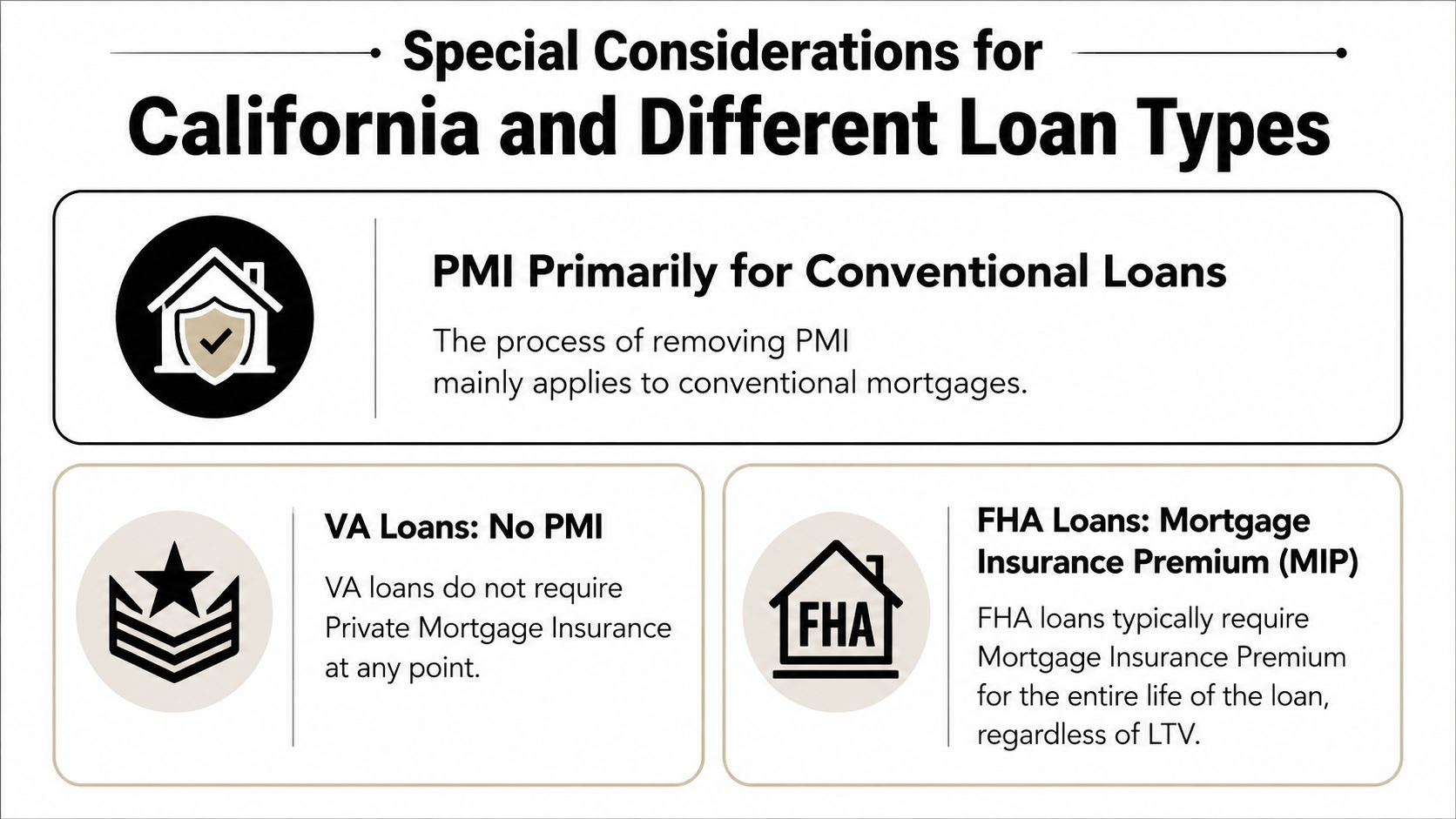
The PMI removal process largely pertains to these situations. If you're working on removing PMI from mortgage payments, you're usually dealing with a conventional loan and one of the cancellation paths already covered above.
California adds something important here.
California edge: State law requires automatic PMI cancellation when the loan-to-value ratio reaches 75% based on the original home value and current loan balance, without requiring an appraisal or relying on market appreciation, according to this California PMI cancellation summary.
That is a stronger rule than the federal standard. If you own in California, use it.
VA loans
VA loans are different. They don't require PMI. That's one reason so many eligible service members and veterans prefer them.
If you currently have PMI, you're likely not in a VA loan right now. You may have bought with conventional financing, refinanced at some point, or used a different structure entirely.
FHA loans
FHA loans use Mortgage Insurance Premium (MIP) instead of PMI. That's not just a different label. The removal rules are more restrictive.
If you have FHA MIP, don't assume this article's conventional PMI cancellation process applies the same way. Often, the practical fix is reviewing whether a refinance into a conventional loan makes sense. That's especially true if you've built meaningful equity and want to eliminate mortgage insurance instead of waiting on rules that don't work in your favor.
The bottom line by loan type
- Conventional: Best candidate for formal PMI removal.
- VA: No PMI to remove.
- FHA: Usually requires a different strategy, often centered on refinance analysis.
If you're in California, check whether the state automatic-cancellation rule helps you sooner than the standard federal track. That's one of the few real home-field advantages borrowers here get. Use it.
Your Next Steps with California Loans for Heroes
At this point, you don't need more theory. You need a decision.
If you have a conventional loan, your next move is usually one of three things. Calculate your LTV and request removal if you qualify. Wait for the automatic date and verify the servicer follows through. Or replace the loan entirely if refinance gives you a cleaner result.
The midpoint rule is your backstop. If you don't request cancellation at the 80% mark, federal law still requires PMI to be removed no later than the month after the loan reaches the midpoint of its amortization schedule, as explained by the Consumer Financial Protection Bureau's PMI guidance. That's protection, but it shouldn't be your only plan.

When refinance is the better move
Sometimes removing PMI from mortgage payments through a servicer request is the right answer. Sometimes it isn't.
Refinance deserves a serious look when:
- Your current rate is no longer competitive: Dropping PMI alone may not be enough.
- Your loan type is working against you: FHA borrowers often need a different exit path.
- Your equity is strong: A new conventional loan structure may remove the insurance issue altogether.
Why public servants should be more aggressive
California public service professionals don't have time to babysit a servicer. You work long shifts, fixed schedules, rotating call, classroom hours, clinical hours, and public-facing jobs that don't leave much room for paperwork battles.
That makes a blunt strategy the right one. Run the numbers. Identify the correct path. Push the request in writing. If the loan itself is inefficient, evaluate refinance instead of trying to patch a bad setup.
The best PMI strategy is the one that gets the charge off your statement fast, with the least extra cost and the fewest servicer delays.
If you're a veteran, first responder, teacher, nurse, pilot, or California government employee, don't settle for vague answers from a call center. Get a real review of your loan, your equity position, and your options.
If you're ready to stop overpaying on your mortgage, talk with California Loans for Heroes. Their team helps California veterans, active-duty military, first responders, teachers, healthcare professionals, pilots, and public service employees review whether a PMI removal request or a refinance makes more sense for their specific loan. If there's a faster way to cut that monthly cost, they'll help you find it.