
You're at the kitchen table with your DD-214 beside a stack of pay records, trying to answer one question before you call a lender: Do I qualify for a VA home loan? Two years of service may feel like a clear answer, but VA home loan eligibility isn't decided by service history alone.
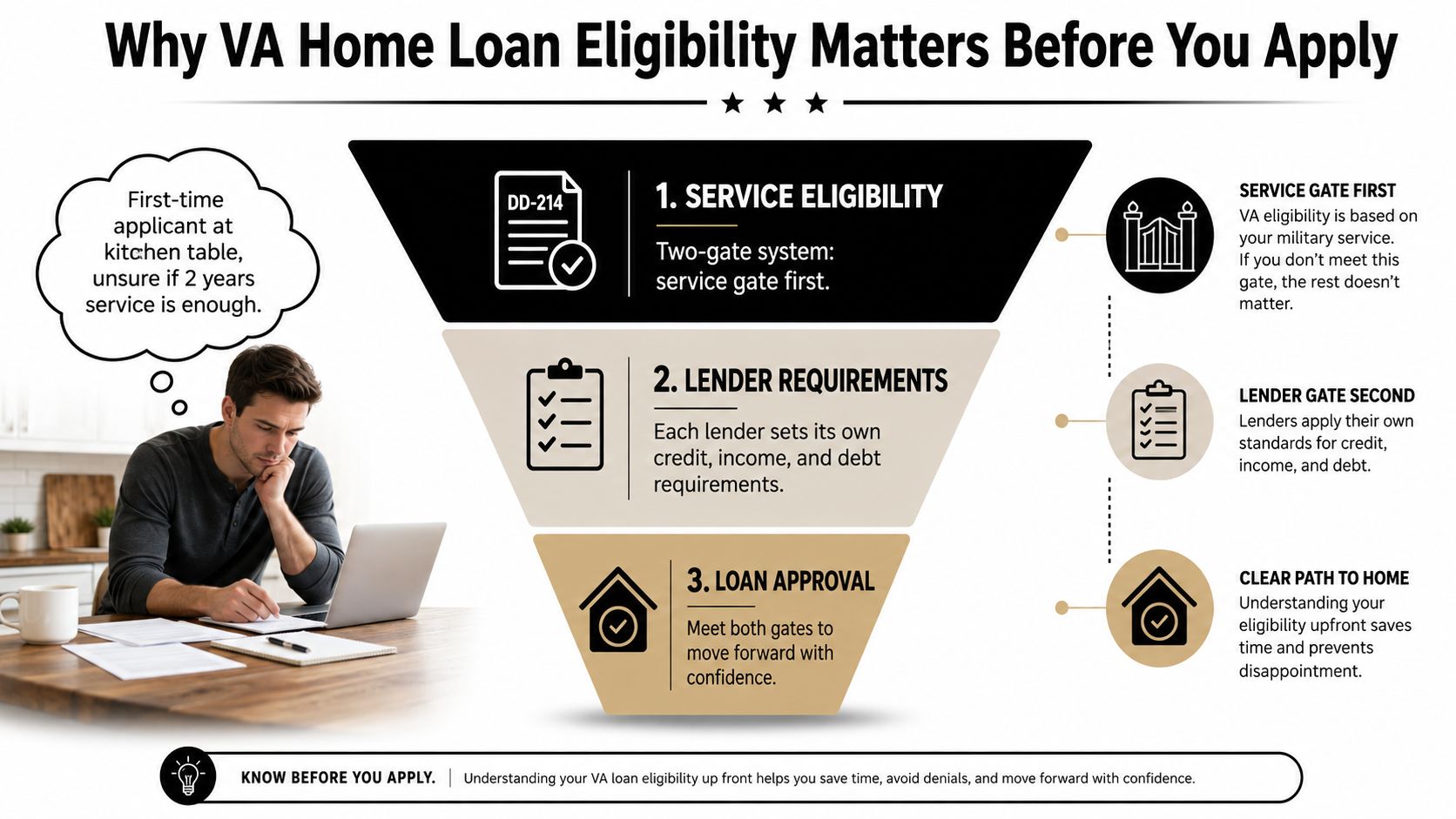
The process has two gates. The first is the VA's service and status review. The second is the lender's mortgage review, which covers credit, income, debt, occupancy, and the property itself. Clearing the first gate gives you access to the benefit, but it doesn't guarantee loan approval.
In this guide, you'll learn how to identify the gate causing a delay and what documentation can move your application forward. You'll also see why reviewing current requirements before touring California homes matters, particularly when residual income rules, county loan limits, and available California assistance programs may affect your financing strategy.
Why VA Home Loan Eligibility Matters Before You Apply
A borrower can have qualifying military service and still receive a denied prequalification. That usually happens because the borrower treats eligibility as the entire mortgage decision instead of the first checkpoint.
Eligibility means the VA recognizes your service, duty status, discharge, or qualifying relationship as sufficient for the home loan benefit. The VA generally confirms this through a Certificate of Eligibility, or COE, which is the document a private lender uses to verify that the service gate has been cleared. Entitlement is the VA-backed borrowing benefit connected to your eligibility. The funding fee is a charge that generally applies to VA loans used to buy, build, improve, repair, or refinance a home, although qualifying exemptions exist. The VA explains funding fee exemptions and closing-cost rules here.
The lender then takes over the second review. Lenders assess satisfactory credit, reliable income, debt obligations, occupancy, and the property. The VA itself says eligibility is only one part of obtaining a VA-backed loan, and the lender still reviews credit and income information after the COE process. Review the VA home loan program guidance before assuming your service record guarantees approval.
Why the order matters
Suppose a buyer pays for an appraisal before the lender confirms occupancy or income documentation. If the file later fails underwriting, that appraisal may not help the buyer close. A similar problem can arise when a buyer commits earnest money before confirming that the property fits VA requirements.
Practical rule: Confirm both gates before you spend heavily on inspections, appraisals, or contract-related costs.
California buyers also need to verify current program details rather than rely on an old checklist. County loan limits, residual income requirements, and state assistance options can change the way a lender structures the transaction. Start with service records, then confirm the COE, then ask a lender to model the full loan.
Service Requirements for Active Duty, Veterans, Reserve, and National Guard
The right service rule depends on when you served, how you served, and how your service ended. The VA's historical record shows that eligibility expanded in stages from the Servicemen's Readjustment Act of 1944. Early rules focused on World War II service, while later expansions included postwar and peacetime groups, Vietnam-era service, Gulf War service, and qualifying Selected Reserve and National Guard members. The VA's eligibility history shows why older advice may not fit today's applicant.
Match your status to the service rule
| Applicant Status | Minimum Service | Qualifying Era or Order Type | Proof Document |
|---|---|---|---|
| Active-duty service member | Generally at least 90 days of non-training active-duty Title 10 service | Current qualifying active-duty service | Statement of service |
| Veteran | Commonly 90 days during a qualifying wartime period or 181 days during peacetime, with additional rules for some entrants | Qualifying era and eligible discharge | DD-214 |
| National Guard or Reserve member | May qualify with six years of service, or qualifying active service that includes 90 days, with 30 consecutive days under certain Title 32 orders | Selected Reserve service or qualifying Title 10 or Title 32 activation | DD-214, orders, NGB records, or statement of service |
| Eligible surviving spouse | May qualify when the service member died on active duty or from a service-connected cause, subject to VA requirements | Qualifying spouse status and applicable benefit eligibility | Death certificate, marriage records, service records, and VA forms |
VA eligibility guidance confirms that active-duty members, Veterans with eligible discharges, certain Guard and Reserve members, eligible spouses, and other uniformed-service personnel may qualify.
Basic training creates confusion. For a regular active-duty member, training may be part of qualifying continuous service. For a Guard or Reserve member, training alone generally isn't enough because it may be classified as active duty for training rather than qualifying active duty. Title 32 service can also matter, particularly when orders document qualifying activation.
A discharge characterized as other than dishonorable is generally required, but an early or problematic discharge doesn't always end the inquiry. The VA may review exceptions, and a discharge upgrade or correction process may create another path.
For Guard and Reserve applicants, document retrieval deserves attention before requesting a COE. The VA home loan guidance for Reservists can help you identify whether your file needs a DD-214, NGB-22, NGB-23, retirement-points record, orders, or a current statement of service.
Credit, Income, and Occupancy Rules Lenders Check Next
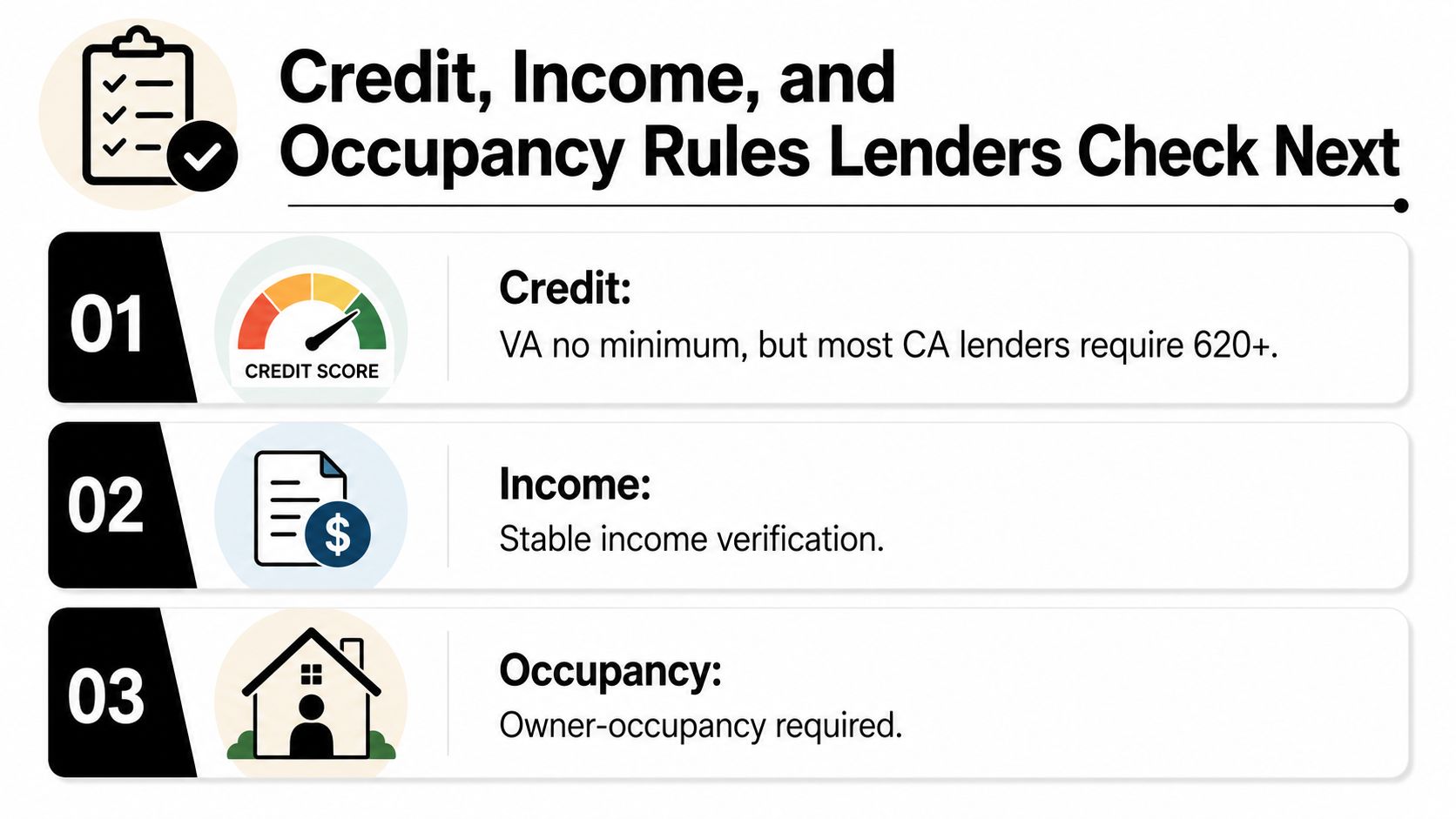
Once the service gate is cleared, the lender evaluates whether you can repay the mortgage and occupy the home as required. The VA doesn't impose a universal minimum credit score, but individual lenders can set their own underwriting standards. That means a borrower may be VA-eligible while still needing to improve credit, document income, or resolve debt issues before approval.
Credit and income tell the lender how the loan fits
A lender reviews payment history, current obligations, employment, and the stability of earnings. Active-duty borrowers may use records such as a Leave and Earnings Statement, while self-employed borrowers generally need business and personal tax documentation. The lender also evaluates debt-to-income and residual income, which asks a practical question: after housing costs and recurring debts, is enough income left for the household's ordinary expenses?
A San Diego staff sergeant might have base pay, housing allowance, and savings built during deployment. That combination could support a purchase plan, but the lender still needs to verify the income, calculate qualifying obligations, and review the proposed property. The example is attainable only after the numbers are documented and the lender confirms the complete file.
Occupancy is a technical requirement
The home must be your primary residence, not a vacation property or a purchase intended solely for investment. For a purchase loan, you must certify personal occupancy and generally move in within a reasonable time. The VA handbook describes that period as about 60 days after closing, although limited exceptions can support a longer timeline. The VA purchase loan requirements explain why occupancy is more than a casual statement of intent.
Deployment, duty location, or a spouse's occupancy can require careful documentation. If you can't demonstrate a credible occupancy plan, the loan may fail VA guaranty compliance even if your service record is fully eligible.
The lender needs a complete story: qualifying service, verified income, manageable obligations, and a realistic plan to occupy the property.
How the Certificate of Eligibility Ties It All Together
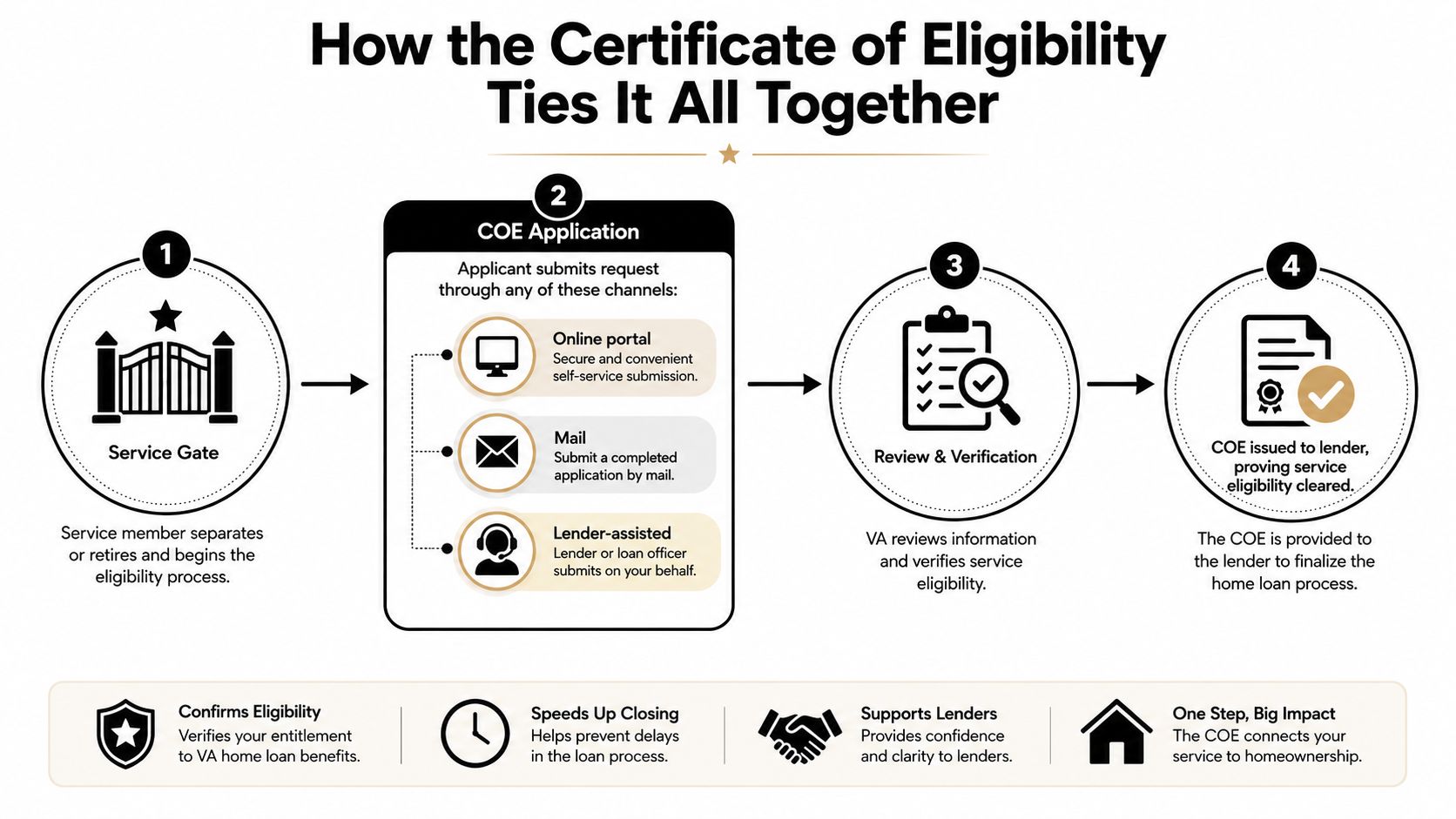
The Certificate of Eligibility is a federal document that confirms to a private lender that you've cleared the VA's service-based eligibility review. It isn't a loan approval, a property approval, or a promise that underwriting will accept your application.
You can request a COE through three routes:
- Online through VA.gov. A Veteran typically prepares a DD-214, while an active-duty service member prepares a signed statement of service. Guard and Reserve applicants may need activation records, retirement-points statements, orders, or separation documents.
- Through a lender. Many lenders can request the COE through the VA's automated system. This can be useful when the VA already has enough service information electronically.
- By mail. You can complete VA Form 26-1880 and send it to the appropriate regional loan center. Mail can take longer than online or lender-assisted requests.
The COE can show the service information supporting eligibility, available entitlement details, and whether the VA has recorded a funding fee exemption. If the VA needs more records, the request may pause until you supply them. A missing or incomplete DD-214 doesn't necessarily end the application. A lender or VA representative can explain what replacement or supplemental records may work.
Think of the COE as a handoff
The VA confirms the service side. The lender then evaluates repayment ability, credit, occupancy, appraisal, title, and property condition. That separation prevents a common misunderstanding: a borrower can receive a COE and still need additional work before receiving a final approval.
For help organizing service records before requesting the document, use this guide to verifying Veteran status. Keep copies of every submission and compare names, dates, and service character across your records.
Edge Cases That Change Who Qualifies
Some applicants don't fit the basic active-duty or Veteran checklist. Their eligibility often depends on a document, a service classification, or a relationship the first review overlooked.
Surviving spouses and nontraditional applicants
An eligible surviving spouse may qualify when the service member died on active duty or from a service-connected cause. The VA may request the Veteran's discharge records, marriage documentation, a death certificate, and applicable VA forms. Some surviving spouses who remarried after reaching the applicable age threshold may also have a pathway, so remarriage should be discussed rather than treated as an automatic disqualification.
Cadets and midshipmen at service academies, certain unremarried surviving spouses, and some participants connected with Chapter 31 Veteran Readiness and Employment can raise specialized questions. These cases require a direct review of the applicant's records and the specific benefit category.
Title 32, Purple Heart, and discharge questions
National Guard members may have qualifying service under Title 32 orders, including certain AGR tours or federally declared emergencies. The VA may request orders, a DD-214 showing the relevant activation authority, an annual points statement, or a DD-220 with supporting orders. The order language matters, so don't rely on a verbal description of the assignment.
A Purple Heart recipient may qualify for a funding fee exemption when the recipient provides evidence of the award before closing. Other exemptions can apply to borrowers receiving VA compensation for a service-connected disability, borrowers eligible for that compensation but receiving retirement or active-duty pay instead, surviving spouses receiving DIC, and certain borrowers with a qualifying proposed or memorandum rating before closing. Review the VA funding fee rules and give the lender documentation early.
| Scenario | Qualifying Condition | Key Documentation |
|---|---|---|
| Surviving spouse | Service member died on active duty or from a service-connected cause | Marriage record, death certificate, service documents, VA forms |
| Title 32 Guard activation | Qualifying activation with the required service duration and order classification | DD-214, orders, DD-220, or points statement |
| Purple Heart recipient | Evidence of the award is available before closing | Official award documentation |
| Other-than-honorable discharge | VA or a review board determines that eligibility can be established | Discharge records and review decision |
| Academy or VR&E-related case | Applicant falls within a specialized eligibility category | Service, program, and benefit records |
A discharge that initially blocks eligibility may be reviewed through the appropriate Discharge Review Board or Board for Correction of Naval Records. The process can take time, so begin gathering records before entering a purchase contract.
Common Myths About VA Home Loan Eligibility
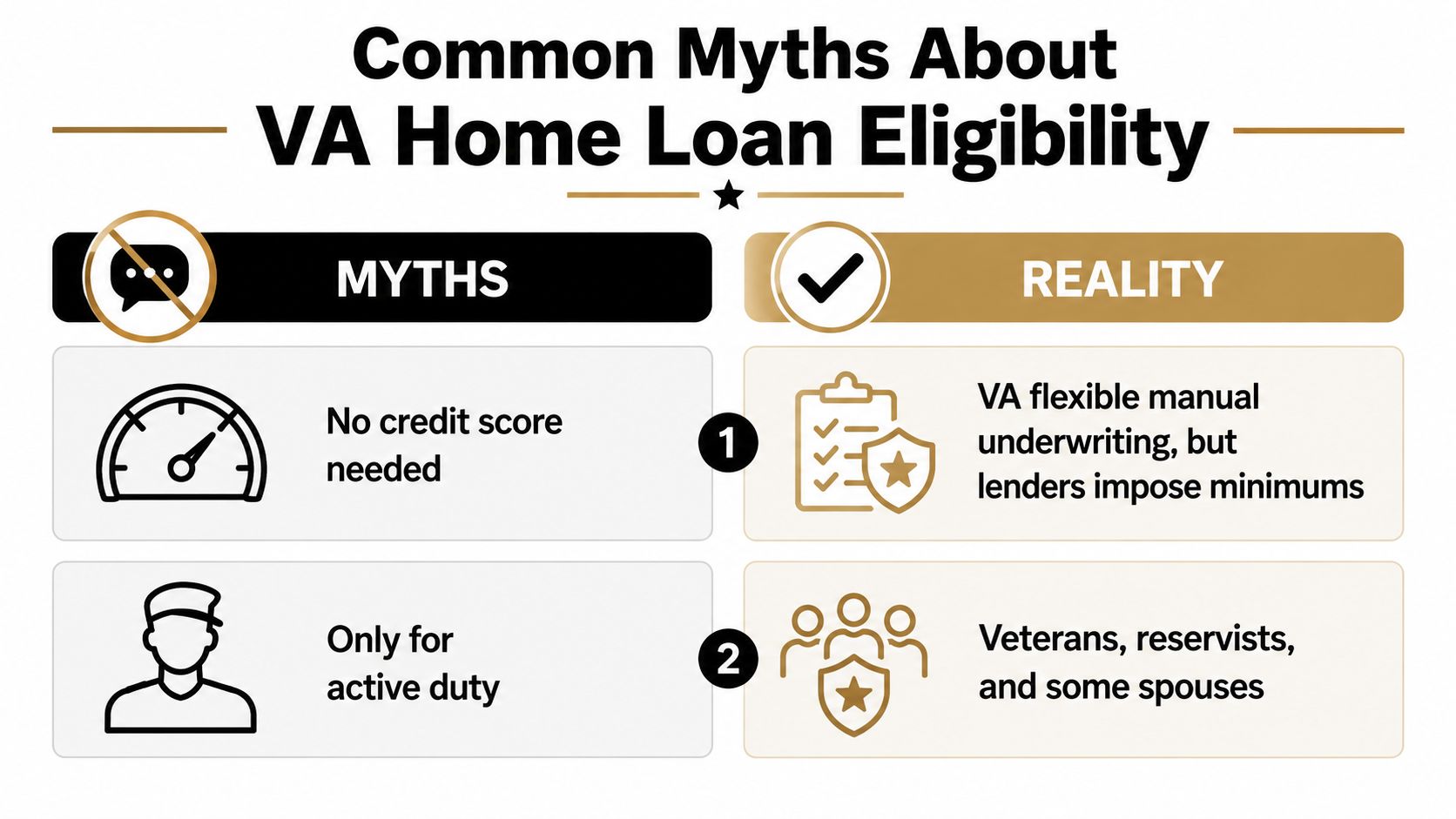
Myth one, no credit review is needed
The VA doesn't set one universal credit-score minimum, but lenders still evaluate credit and may apply their own standards. A flexible manual review doesn't remove the need to show a credible repayment history.
Actual rule: Ask the lender which standards apply before authorizing a full application. A borrower with damaged credit may have options, but the answer depends on the complete file.
Myth two, zero down means any purchase price works
A VA loan can reduce or eliminate the need for a down payment when the borrower has sufficient entitlement and the transaction supports the purchase. That doesn't mean every price, appraisal, debt profile, or county limit disappears.
Actual rule: The lender reviews entitlement, appraisal, income, and current county loan-limit considerations. Some buyers also choose to contribute funds to reduce the amount financed or manage costs.
Myth three, any property qualifies
VA financing is intended for a safe, sound primary residence. The appraisal process includes VA Minimum Property Requirements, so serious health, safety, or structural concerns can affect the transaction.
A home can look attractive online and still require repairs before it meets VA standards. Discuss unusual construction, major deferred maintenance, and mixed-use features with the lender before making an offer.
Myth four, the loan is for investment property
The borrower must intend to occupy the home as a primary residence. A property bought solely for rental income or occasional use usually falls outside the core VA purchase-loan purpose.
Myth five, bankruptcy or foreclosure permanently ends eligibility
A past bankruptcy or foreclosure doesn't automatically settle the question forever. The VA and the lender review timing, circumstances, restored credit, and applicable waiting rules. Lender overlays may be stricter than the VA's baseline approach, so get a file-specific answer instead of relying on a general internet rule.
Your Next Steps With California Loans for Heroes
Start with the records that prove your service status. A separated Veteran will usually begin with a DD-214. An active-duty applicant generally needs a current statement of service, while a Guard or Reserve applicant may need activation orders, points statements, NGB records, or other documentation tied to the type of service performed.
Then request the COE through VA.gov or ask the lender to retrieve it. If the VA can't verify your history electronically, respond quickly to requests for additional records. Check every document for consistent spelling, dates, service branch, and discharge information.
Prepare for the lender's review
Bring more than your service record to the first conversation. A lender may need:
- Income records: Pay documentation, employment information, benefit records, or self-employment materials.
- Debt details: Monthly obligations, credit accounts, support payments, and any loans that don't appear clearly on a credit report.
- Occupancy information: The property address, expected move-in plan, duty location, and any deployment-related explanation.
- Property details: Intended use, property type, known repairs, and whether another party will occupy or own part of the home.
A California HEROES program or recognized lender may also help eligible California Veterans, active-duty members, and surviving spouses evaluate down payment assistance, tax-credit combinations, and related homebuyer support. Those options depend on program rules and borrower qualifications, so ask for a current explanation rather than assuming every benefit applies to every purchase.
Resolve small errors before they become large delays
A misspelled name on a DD-214 can slow COE verification. An undisclosed separate-property buyout can change the lender's debt analysis. Unreported child-support obligations can also create an underwriting issue after the file is already underway.
Use the initial consultation to discuss the proposed credit pull, debt-to-income modeling, occupancy, property type, and estimated closing costs. The best time to surface a complicated service record or financial obligation is before you write an offer, not after the appraisal is ordered.
A specialist can help you determine whether the problem is service eligibility, documentation, lender underwriting, or property suitability. Once you know which gate is holding you back, the next step becomes much more manageable.
California Loans for Heroes helps California Veterans, active-duty service members, surviving spouses, and other eligible HEROES understand VA home loan eligibility, organize documentation, and evaluate available homebuyer assistance. Visit California Loans for Heroes to schedule a conversation and take the next step toward a properly prepared application.