
California home prices can make even disciplined buyers feel stuck. You serve, you save, you do the math, and the cash needed for a typical down payment still looks out of reach.
That's exactly why so many California veterans and HEROes overlook the strongest mortgage tool available to them. The VA home loan isn't a niche benefit. It's a serious buying-power advantage that can cut upfront costs, lower monthly payments, and open doors in markets where conventional financing often falls short.
A lot of eligible borrowers still miss it. Despite the program's power, 76% of eligible veterans have not utilized this benefit, with experts estimating nearly $28 billion in unused VA loan volume was untapped nationwide in 2024 alone according to NewDay USA's VA loan statistics roundup.
Your Path to California Homeownership Starts Here
You're sitting at the kitchen table in San Diego, Fresno, or Sacramento with solid income, decent credit, and enough discipline to handle a mortgage. Then the deal falls apart on one issue. Cash. The down payment, closing costs, reserves, and moving expenses stack up fast in California, and a good buyer starts to feel boxed out.
I see this constantly.
The mistake is treating your financing like you're a generic borrower shopping the same options as everyone else. If you're a veteran, active-duty service member, or part of California's HERO community, that approach costs you money. Start with the benefits of a VA loan in California, not with conventional financing and not with guesses about what a seller will accept. Review the actual advantage first through this guide to VA loan benefits for California HERO homebuyers.
The benefit too many California buyers misread
A lot of eligible borrowers assume the VA loan is harder to use in California, too restrictive for competitive markets, or weaker than a conventional offer. That advice is usually coming from people who do not work with veteran buyers every day.
In high-cost counties, the right loan structure matters as much as the price you offer. A mortgage that preserves cash can put you in a stronger position than one that drains your savings before you even get the keys. California buyers need room for inspections, appraisal gaps, insurance changes, repairs, and the normal surprises that show up in escrow.
That is why this benefit deserves your first look.
Why California veterans should compare VA and CalVet early
Federal VA financing is not the only program worth reviewing here. California buyers also need to compare it with CalVet, especially if they want to see how state-run options stack up on rate, fees, property standards, and long-term fit.
My advice is simple. Do not assume one program wins every time. VA is often the stronger move for flexibility and low cash-to-close. CalVet can be worth a serious look in the right scenario. The smart move is to compare both before you write offers, not after you are already under contract and rushing to make the numbers work.
If you skip that comparison, you can end up choosing a loan that looks fine on paper but leaves you short on cash or overpaying each month.
Use the benefit you earned. Use the California-specific options available to you. Then choose the loan that gives you the best chance to buy well and keep more money in your pocket after closing.
The Core Power of Your VA Loan Benefit
A California buyer with solid income can still get boxed out for one simple reason. Cash.
That is why the VA loan matters so much. It cuts the two costs that derail buyers fastest, cash due at closing and extra monthly drag. It can also improve rate options, which matters even more in California counties where small payment changes can decide whether a deal still pencils out after taxes, insurance, and reserves.
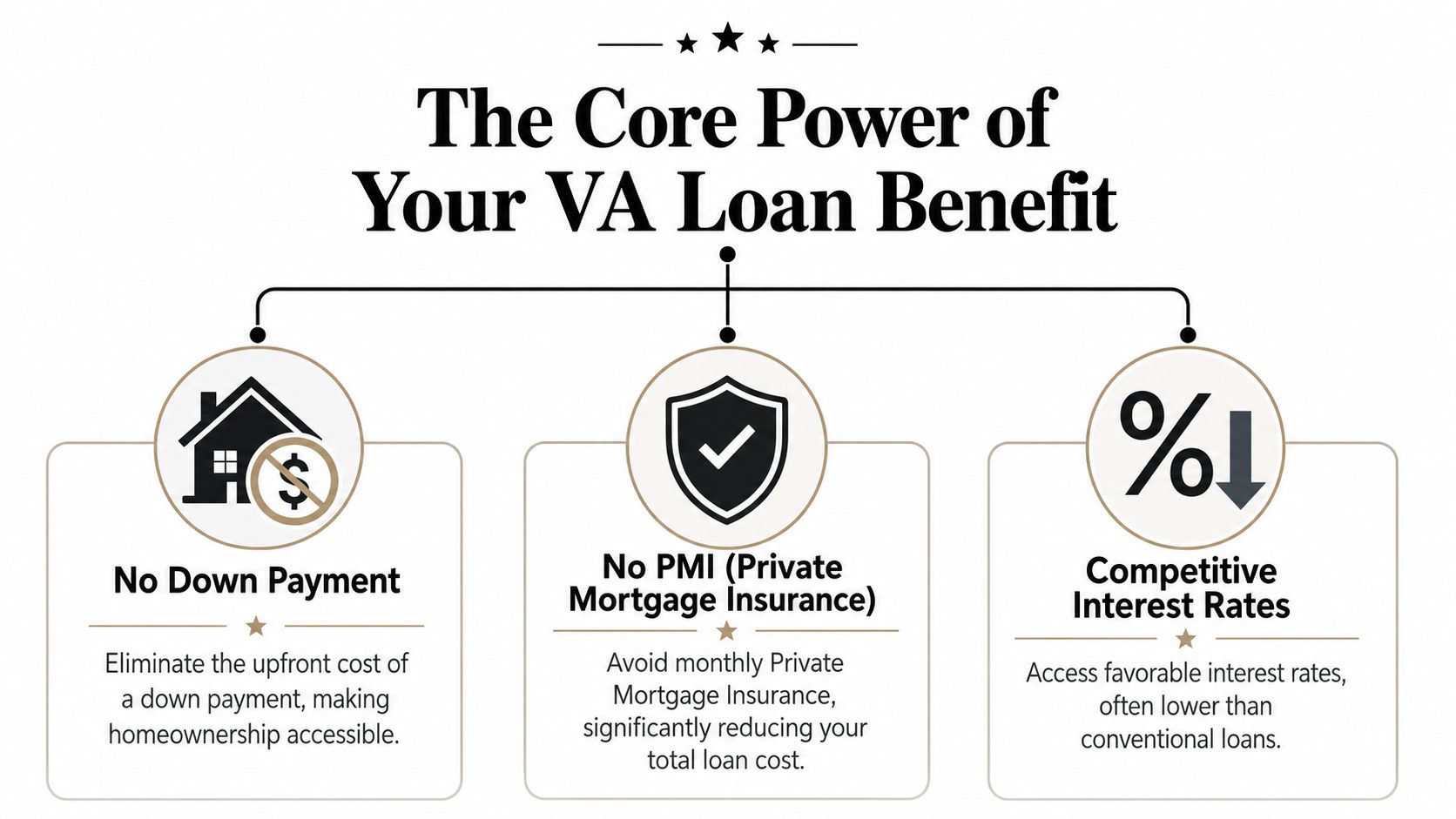
No down payment preserves your strongest asset
For many eligible veterans, the biggest win is keeping cash in the bank.
That money is often better used for the practicalities of a California purchase: appraisal gaps, inspections, repairs, reserves, moving costs, and the first round of homeownership expenses that show up right after closing. As noted earlier, a large share of VA buyers use the program with no down payment. That is the point of the benefit. It gives qualified borrowers a path to buy without waiting years to stack a huge down payment.
I tell California veterans the same thing every week. Liquidity matters. A buyer who closes with reserves is in a far better position than a buyer who empties savings just to say they put money down.
No PMI keeps more of your payment working for you
This is one of the most overlooked savings advantages in the entire mortgage market.
Conventional borrowers who buy with less than twenty percent down usually pay private mortgage insurance. VA borrowers do not. As mentioned earlier, the FDIC notes that the VA guaranty reduces lender risk and supports loan structures without PMI. That means more of your monthly payment goes toward principal, interest, taxes, and insurance instead of a fee that does nothing for your balance sheet.
In California, that matters fast. Even a modest monthly savings can help you qualify more comfortably, keep better reserves, or absorb rising insurance and property tax costs without stress.
Lower rates can widen your buying range
Rate matters. A lot.
As mentioned earlier, the FDIC notes that VA financing can price below comparable conventional options. You should never assume that on blind faith, but you should absolutely test it with real quotes. In expensive California markets, a better rate can mean the difference between stretching too far and buying with a payment you can live with.
That is also why I recommend reviewing the benefits of a VA loan for California borrowers before you compare offers. You need to understand the full cost structure, not just the rate printed at the top of a worksheet.
Full entitlement gives California buyers more room than many realize
A lot of veterans still assume the VA loan only fits lower-priced homes. That advice is outdated.
Borrowers with full entitlement are no longer boxed in by the old VA county loan limit structure for zero-down financing, as long as they qualify with the lender for the loan amount. In California, that matters because home prices can rise far beyond old assumptions about what a VA buyer can reasonably target.
The practical takeaway is simple. Do not disqualify your own benefit before a lender reviews your entitlement, income, assets, and county pricing. Compare VA and CalVet early, but give the VA loan a serious first look. For many California HEROes, it remains the strongest tool for buying sooner, keeping more cash, and avoiding unnecessary monthly costs.
VA Loans vs Conventional and FHA Mortgages
A California veteran shopping in San Diego, Riverside, or Sacramento can lose tens of thousands by choosing the wrong loan type before the first offer is even written. I see it all the time. A buyer focuses on what seems easier to get approved, then ends up with a higher payment, more cash due at closing, and insurance costs that keep draining the budget every month.
If you have VA eligibility, start there. Compare everything else against it. Do not make conventional or FHA your default just because a big bank put those options in front of you first.
Head-to-head cost comparison
| Feature | VA Loan | FHA Loan | Conventional Loan |
|---|---|---|---|
| Down payment | Built for eligible borrowers who want to buy with no down payment | Requires a down payment | Often requires a down payment, and stronger pricing usually comes with more money down |
| PMI or mortgage insurance | No PMI | Mortgage insurance is part of the program | PMI usually applies when you put less than twenty percent down |
| Interest rate position | Often more favorable for eligible borrowers, as noted earlier | Depends on lender, credit, and overall file | Can be competitive for some buyers, but often loses on total monthly cost when PMI is added |
| Monthly payment impact | Usually lower because there is no PMI and less cash is tied up upfront | Often higher because mortgage insurance increases the payment | Can rise quickly once PMI, rate, and down payment requirements are factored in |
That table is the quick version. The primary decision is about cash flow and flexibility.
In California, that matters more. Home prices are higher, reserves matter, and many HERO buyers need room for inspections, appraisal gaps, repairs, or keeping cash on hand after closing. A loan that preserves cash without adding monthly mortgage insurance deserves serious priority.
Where FHA and conventional usually lose
FHA is the backup plan, not the first plan, for an eligible veteran. It can help a buyer who does not have VA entitlement available, but it usually comes with extra monthly cost that keeps working against you long after closing.
Conventional can make sense in a narrow lane. If a borrower has a strong down payment, excellent credit, and pricing that clearly beats VA on total cost, then it deserves a real look. But I want to stress the phrase total cost. Not the headline rate. Not the lender's marketing. Total cash to close and total monthly payment.
That is the standard.
The California-specific angle many buyers miss
California veterans should also compare VA financing with CalVet, especially if they are looking at property type, insurance costs, or state-level program features that may fit their situation better. VA is still the first option I would test for most eligible buyers, but CalVet deserves a side-by-side review instead of an afterthought.
One more issue matters in competitive California markets. Appraisal timing can affect your offer strategy. Before you choose a loan, review current California VA appraisal turn times so you know how the timeline may affect negotiations in your target county.
My recommendation
Use this order:
- VA first: Best starting point for eligible veterans who want to keep more cash and avoid monthly mortgage insurance.
- CalVet second: Worth comparing in California because state-specific features can fit some HERO buyers better.
- Conventional third: Only choose it if the full numbers beat VA, not because it feels more familiar.
- FHA last: Useful when VA is not available, but rarely the smartest choice for an eligible veteran.
The biggest mistake is treating these loans like they are interchangeable. They are not. If two options buy the same house, choose the one that keeps more money in your pocket at closing and every month after.
Navigating the VA Loan Process in California
The basic VA loan path is straightforward when the right people are involved. The process gets messy when buyers use lenders or agents who don't understand how VA financing works in California.
You don't need a complicated checklist. You need a clean sequence and a few California-specific advantages that most generic guides barely mention.
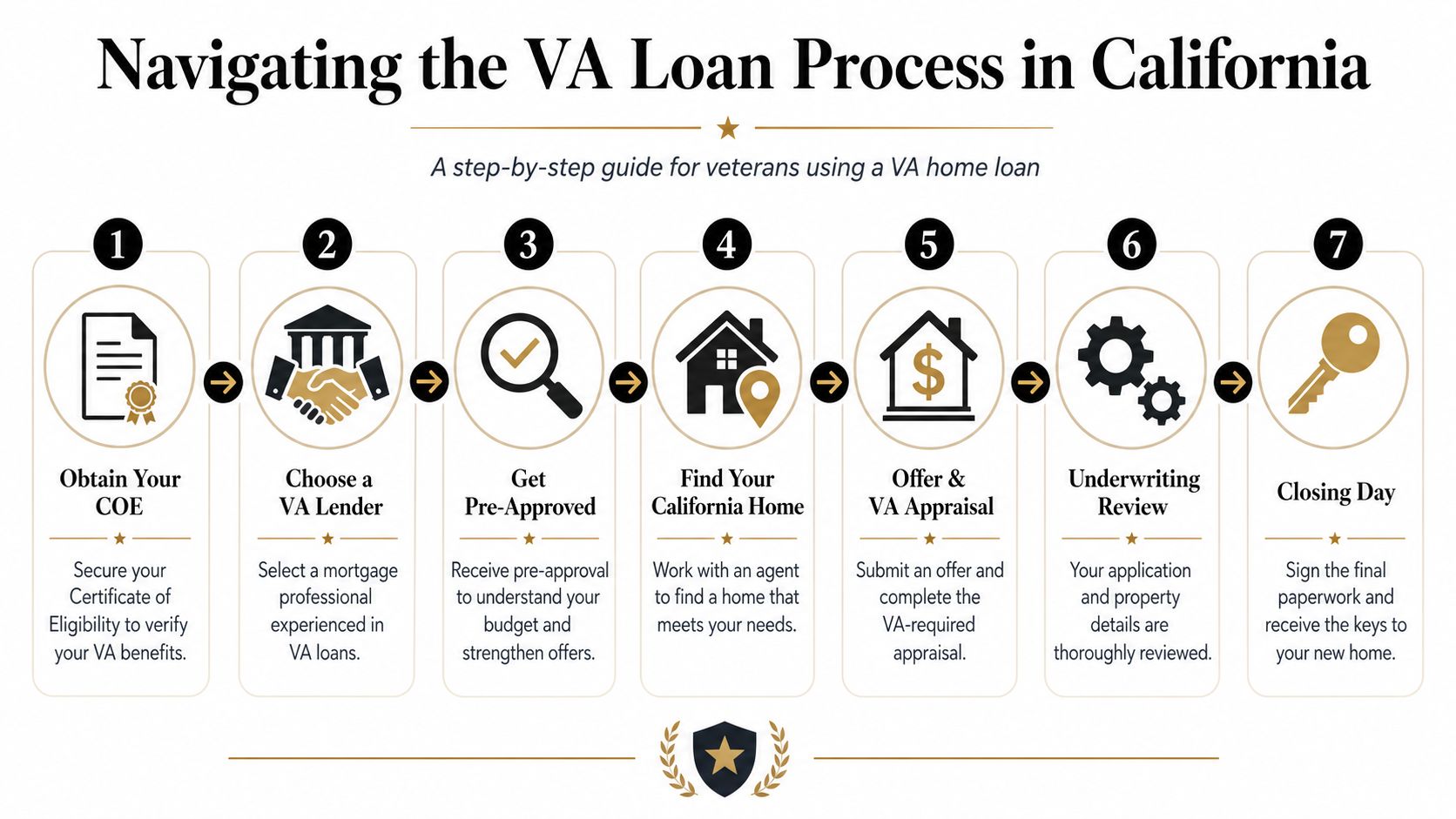
The standard process that actually works
Get your Certificate of Eligibility
This confirms your VA eligibility. Many lenders can help obtain it directly, so don't treat this like a barrier.Choose a lender that knows VA loans
Experience matters. A lender can be licensed in California and still be weak on VA execution.Get pre-approved before shopping seriously
Pre-approval clarifies budget, strengthens offers, and keeps you from chasing homes that don't fit your payment comfort zone.Work with a real estate agent who respects VA financing
You want an agent who knows how to position your offer confidently, not one who treats VA as a backup plan.Complete the appraisal and underwriting process
Quality upfront prep pays off at this stage.Close with a full understanding of your cash to close
The right lender should walk you through this long before signing day.
If you want a local timing reference, review current California VA appraisal turn times.
California's biggest advantage for full-entitlement borrowers
Generic national articles often fail California buyers. Specifically, for veterans with full VA entitlement in 2026, there is no VA-imposed maximum loan limit for purchasing a California home, allowing them to finance any purchase price with 0% down payment regardless of whether it exceeds the standard $832,750 baseline or the high-cost area cap of $1,249,125, according to VA Loan Network's California market update.
That doesn't mean every borrower can buy any home. You still need lender approval, income support, and a file that underwrites properly. But it does mean the VA itself isn't the limiting factor for full-entitlement borrowers in the way many people still assume.
In California, buying power often depends less on the program and more on how well your lender structures the file.
CalVet is worth knowing, but understand the structure
California veterans should also know about CalVet Home Loans. It's a state-specific option, and it isn't structured the same way as a traditional mortgage.
According to CalCLogix's California VA loan guide, the CalVet Home Loan uses a land contract structure where the state agency buys the property and holds legal title until the loan is paid off, while the veteran holds equitable title with the rights of ownership, tax benefits, and use.
That's not automatically bad. It just means you need to understand the legal structure before choosing it. A lot of borrowers hear “state veteran loan” and assume it works like federal VA financing. It doesn't.
Eligibility also differs. The State of California veteran services page states that a veteran must have served at least 90 days of active duty, received a discharge under honorable conditions, and not currently have another CalVet Home Loan to qualify, with no prior California residency required if buying a primary residence in the state.
A California tax break too many disabled veterans miss
If you have a service-connected disability, don't stop at the mortgage. Check your property tax relief options immediately after closing.
A California-focused explanation on the disabled veteran property tax exemption process notes that veterans can file BOE-261-G with the county assessor for a property tax exemption that can waive taxes on the home. If the filing is late, the veteran may still receive 85% of the exemption and can file retroactively for up to 8 years.
That's one of the most overlooked money-saving moves available to qualified disabled veterans in California.
Advanced Strategies and Refinance Options
The best use of veteran home loan benefits doesn't stop when you get the keys. Smart borrowers use the benefit again, either to improve the terms on the home they bought or to support the next housing move.
That's where refinance strategy and entitlement strategy matter.

Know your two main refinance paths
The Interest Rate Reduction Refinance Loan, often called the IRRRL or streamline refinance, is built for borrowers who already have a VA loan and want a simpler way to improve the rate or adjust the term.
The VA Cash-Out Refinance serves a different purpose. It's the option to review when you want to tap equity, replace a non-VA loan, or restructure larger financial goals around the property.
Here's the clean way to decide:
- Use IRRRL when the goal is efficiency: You already have a VA loan and want a rate-and-term improvement with less friction.
- Use Cash-Out when the goal is access: You need to pull equity or replace other financing as part of a broader plan.
- Run the math before acting: A refinance should solve a real problem, not just create fresh closing costs.
If you want a practical starting point, use a VA refinance rates calculator for California borrowers.
Second-tier entitlement can create flexibility
Many veterans think they get one VA loan, one time, for one house. That's wrong.
The benefit is a lifetime entitlement and can be used multiple times. In some scenarios, veterans can also use second-tier entitlement to buy another home while keeping the prior property. That matters for military moves, growing families, and California buyers who need flexibility during relocation.
The details depend on your current entitlement use, the existing property, and lender underwriting. For this reason, a quick phone call with the wrong lender can give you the wrong answer.
Lender overlays are the trap most borrowers don't see
Blunt advice matters. Just because the VA says a down payment isn't required doesn't mean every lender will treat your file the same way.
The VA itself notes that lenders may require down payments for some borrowers, and the VA home loans benefit page also reflects that lender overlays vary significantly, with some requiring 5–10% down for certain applicants despite VA eligibility.
Shop lenders based on VA competence, not just advertised rates.
A lender overlay can show up because of credit profile, debt-to-income concerns, or other internal rules. That's why one lender can say yes at zero down while another asks for money down on the same basic borrower profile.
If a lender tells you a VA loan requires a down payment, your next question should be simple. “Is that a VA rule, or is that your overlay?” That question can save you time, cash, and a lot of bad assumptions.
Your Action Plan for California Homeownership
If you're eligible, the path is clearer than commonly perceived. The strongest veteran home loan benefits are practical, not theoretical. You may be able to buy with no down payment, avoid PMI, compete more effectively in California, and stack state-specific advantages on top of the federal program.
The mistake is waiting until you feel perfectly ready. You don't need perfect timing. You need clean information, your documents in order, and a lender who understands California veteran financing.
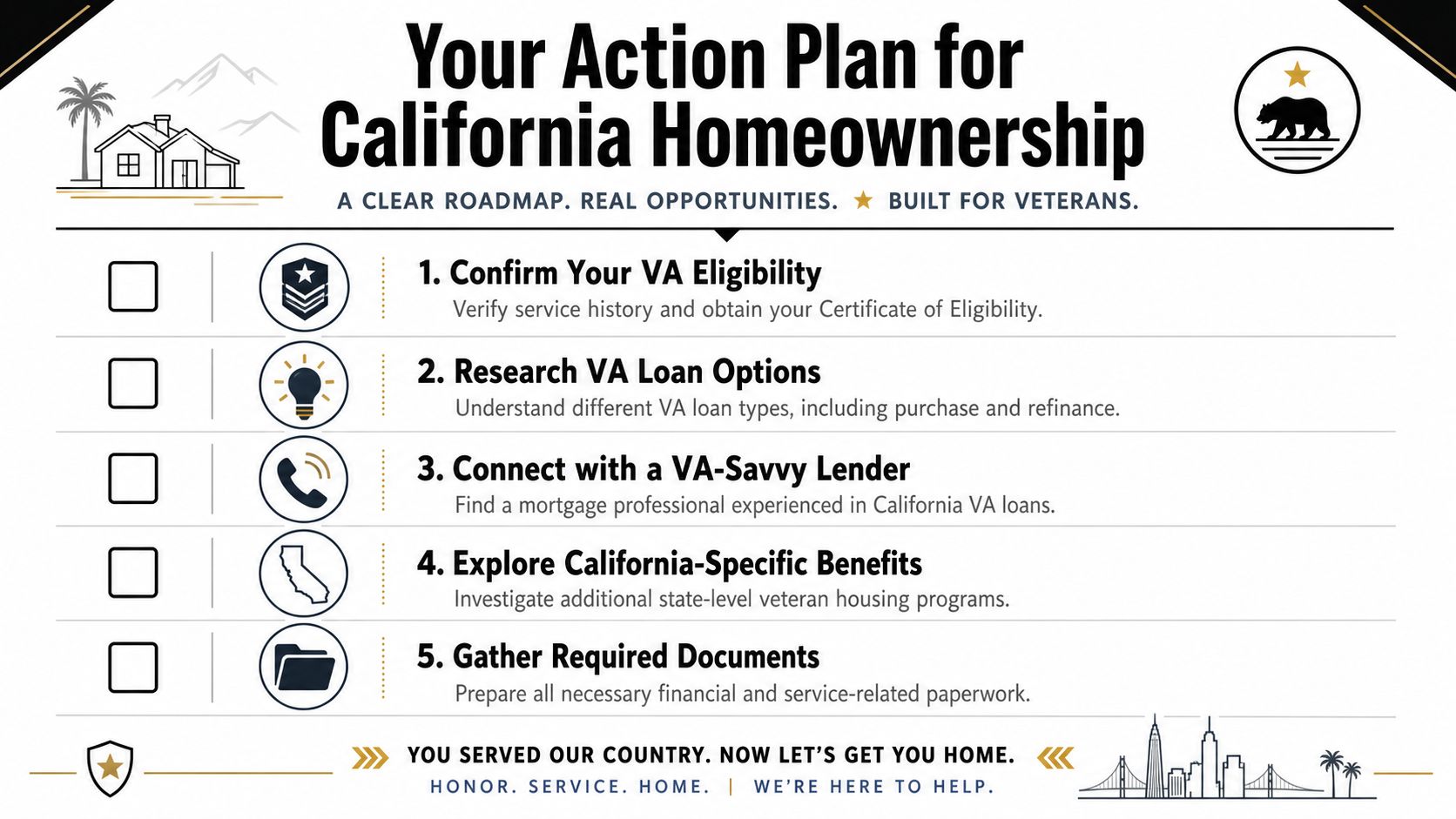
Start with these four moves
Confirm your eligibility and get your COE
Don't guess. Verify the benefit and remove uncertainty at the start.Review your finances with honesty
Look at income, debts, reserves, and the payment range you want to live with. Qualification matters, but comfort matters too.Choose a California specialist, not a generic call center
You want a lender who understands VA execution, California property realities, and the local issues that can derail a file.Get pre-approved before making offers
This is what turns research into an advantage. A real pre-approval helps you act fast and negotiate from a stronger position.
A few smart habits that save headaches
- Keep documents accessible: Have service records, income documents, and asset statements ready.
- Ask direct questions about overlays: Don't let lender-specific rules surprise you late.
- Check state-level benefits early: If CalVet or a disabled veteran property tax exemption may apply, review that before closing, not after the fact.
- Build your team carefully: A weak lender or inexperienced agent can make a strong benefit feel harder than it is.
The right financing strategy doesn't just help you buy a home. It protects your cash and gives you better options after closing.
My recommendation
If you're a California veteran or eligible HERO and you haven't run a real VA loan comparison yet, do that first. Don't lead with conventional financing because it's familiar. Don't assume California prices make the benefit irrelevant. And don't let one lender's overlay define what's possible.
Veteran home loan benefits are strongest when you use them deliberately. Start with eligibility, move to pre-approval, compare the actual numbers, and make your next decision from a position of strength.
California Loans for Heroes helps veterans, active-duty military, first responders, law enforcement, firefighters, nurses, healthcare professionals, teachers, pilots, and public service employees through home financing across the state. If you want expert help evaluating VA purchase options, refinance strategies, or California-specific HERO benefits, connect with California Loans for Heroes.