
You're probably in one of two places right now. Either you're scrolling listings after a long shift and wondering whether buying in California is still realistic, or you're tired of renewing a lease and ready to stop building someone else's equity.
If you're a veteran, firefighter, nurse, teacher, law enforcement officer, pilot, or other public service professional, the buying a house process step by step looks different for you than it does for the average buyer. You may have access to loan options, down payment assistance, or veteran benefits that generic homebuying guides barely mention. In California, that matters. A lot.
The mistake I see most often is simple. Buyers start with homes, not numbers. They fall in love with a property before they've built a financing strategy that can survive California pricing, underwriting, inspections, and closing. That's backwards. If you want to win in this market, you need a clean plan first and emotion second.
Are You Financially Ready to Buy a House in California
California homeownership starts with math, not motivation. If you don't know your debt, savings position, and credit profile, you're not ready to shop. You're ready to prepare.
For public service professionals, this step matters even more because your work schedule can make paperwork, follow-up, and budgeting harder than it should be. Shift work, overtime, contract renewals, deployment history, and variable income all affect how a lender reads your file. You need to know where you stand before you spend a weekend touring homes.
Start with your debt-to-income ratio
Your debt-to-income ratio, or DTI, tells a lender how much of your monthly income is already committed to debt payments. In California, conventional mortgage loans require a minimum debt-to-income ratio of under 36% to qualify, according to this California homebuying guide from CU SoCal.
That number gives you a hard benchmark. If you're over it, don't guess your way forward. Fix it before you apply.
A practical way to think about DTI:
- Carrying too much monthly debt: Large auto payments, personal loans, or high credit card minimums can block approval even if your salary looks strong.
- Using overtime to stretch too far: Overtime may help, but you shouldn't rely on peak-income months to justify a payment that feels tight in ordinary months.
- Ignoring small recurring debts: Student loans, installment plans, and minimum payments all count.
Practical rule: If your monthly budget already feels cramped before a mortgage payment, your loan approval amount probably isn't your comfort level.
Know what lenders will look at
Credit score, reserves, and cash available all matter. You don't need perfect finances, but you do need a file that makes sense.
Here's the simplest readiness check:
| Readiness area | What to review | Why it matters |
|---|---|---|
| Credit | Payment history, balances, recent new debt | Affects eligibility and loan options |
| Savings | Down payment, closing costs, emergency cushion | Determines how much flexibility you have |
| Monthly debt | Car loans, cards, student loans, personal loans | Drives your DTI and affordability |
Don't treat your savings account like a single bucket. Separate your funds into categories so you know what's available for the transaction and what needs to stay untouched for emergencies.
If you're still figuring out assistance options, review what down payment assistance can cover for California buyers before assuming you need years of cash savings.
Set your target before you browse
Generic advice says you need 20% down. That's outdated for many buyers. You may qualify with far less depending on the loan type, but lower down payment options don't remove the need for discipline. They just change the path.
Ask yourself three blunt questions:
- Can I keep my total debt profile under control?
- Can I document my income cleanly?
- Can I buy without draining every dollar I have?
If the answer to any of those is no, pause the home search. A delayed purchase is better than a bad one. In California, readiness beats urgency every time.
Securing Your HERO Loan Pre-Approval
Pre-approval isn't a nice-to-have. It's your ticket into the market.
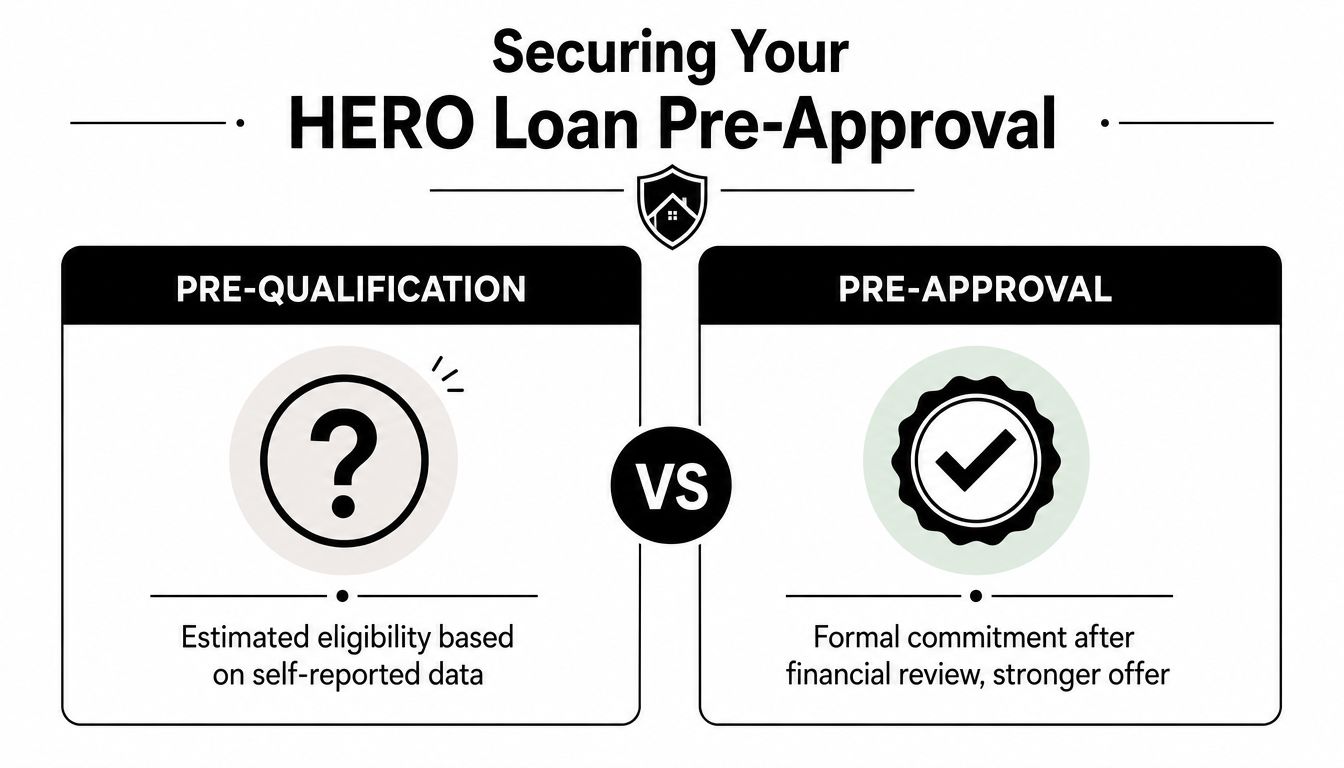
Too many buyers confuse pre-qualification with pre-approval, then act shocked when their offer gets ignored or their financing falls apart later. Pre-qualification is a rough estimate based on what you say. Pre-approval is a lender reviewing your income, assets, credit, and documentation and issuing a formal letter with real weight behind it.
Why speed matters
Buyers who move early on financing put themselves in a stronger position. Approximately 65% of first-time homebuyers who obtain pre-approval within 30 days successfully close their purchase, compared to only 38% of those who delay or skip this step, according to Redfin's home-buying timeline guide.
That gap is not small. It tells you exactly what I tell clients every day. Waiting on pre-approval wastes time, weakens your offer, and creates avoidable surprises.
Pick the right loan type for your role and profile
Not every buyer should chase the same mortgage. California heroes often have better options than a standard conventional setup.
Consider the loan path that fits your file:
- VA loan: Often the strongest option for eligible veterans and active-duty buyers because of its low cash barrier and veteran-specific benefits.
- FHA loan: Useful when credit needs work or your savings are limited.
- Conventional financing: Strong for borrowers with clean credit, stable income, and manageable debt.
- HERO-focused programs: These can matter if you qualify for assistance, lender credits, or other public-service benefits through a specialized platform like home loans for California heroes.
Pre-approval should match your likely offer strategy, not just your maximum borrowing power.
What to submit before you make offers
A solid pre-approval file usually depends on clean documentation. Don't drip documents to your lender one piece at a time. That slows everything down and signals that your file may be messy.
Bring order to it with this checklist:
- Income proof: Recent pay information and anything needed to explain overtime, bonuses, or variable earnings.
- Asset proof: Bank and investment records that show where your down payment and reserves are coming from.
- Debt clarity: Be ready to explain loans, recurring obligations, or any recent credit activity.
- Employment consistency: If your role changed, your lender needs that story early, not during underwriting.
One more hard truth. Don't open new credit, finance a vehicle, or run up card balances after pre-approval. Buyers sabotage themselves all the time by changing their financial profile mid-transaction.
The Search and Offer Strategy for California Buyers
The house hunt is where buyers get sloppy. They assume the best offer is the highest number. In California, that's incomplete and sometimes flat-out wrong.
A smart offer has structure. Price matters, but terms matter too. Seller confidence matters. Your agent's communication matters. Your lender's reputation matters. If you're using a public-service or veteran-focused loan, your team needs to know how to present it without sounding defensive or uncertain.
Build a search filter that reflects reality
Prioritize your fundamental needs, then trim the fantasy list. You need a home that fits your payment, commute, and life. You don't need every upgrade from day one.
Use a three-bucket method:
| Bucket | What belongs here |
|---|---|
| Must-have | Commute tolerance, bedroom count, property type, school or work access |
| Strong preference | Garage, yard size, layout, updated kitchen |
| Nice but optional | Cosmetic upgrades, premium finishes, bonus rooms |
That framework keeps you from overbidding on features you can improve later.
Your offer needs more than a price
Write offers that anticipate friction. That means paying attention to contingencies, timing, and negotiation room before the first counter comes back.
Here are the parts buyers should treat strategically:
- Contingencies: These protect you when financing, inspection, or appraisal issues show up.
- Earnest money positioning: This signals seriousness, but you still need safeguards in place.
- Seller credits and repair structure: These can sometimes outperform a simple price concession.
- Appraisal language: Many buyers are often exposed.
Most guides treat the appraisal as paperwork. That's a mistake. According to Rocket Mortgage, 28% of 2025 home purchases faced appraisal gaps, yet only 12% of buyers successfully renegotiated because existing content fails to explain negotiation tactics like appraisal repair credits or down payment adjustment clauses in its guide to buying a house.
That should change how you think about your offer.
Use appraisal leverage before you need it
If you wait until a low appraisal lands, you've already lost negotiating power. Strong buyers and strong agents build the response path into the contract strategy from the start.
Ask direct questions before submitting:
- If the appraisal comes in low, will I have cash to bridge the gap?
- If not, what contract terms give me room to renegotiate?
- Is the seller likely to respond to credits, repairs, or a price adjustment?
Buyers don't lose homes only because they bid too low. They lose them because they write brittle offers that can't absorb normal transaction stress.
That's the difference between shopping and competing.
Navigating Home Inspections and Contingency Periods
This is the stage where excitement needs to shut up and evidence needs to speak. Once your offer is accepted, your job changes. You are no longer trying to win the house. You are trying to verify that the house deserves to be bought.
That means inspection, appraisal, document review, and disciplined follow-through. Skip any of them and you increase your risk fast.
Don't waive the inspection just to feel competitive
The most dangerous phrase in homebuying is “it'll probably be fine.” It often isn't.
The home inspection and appraisal phase represents the highest risk point for transaction failure, with 20–25% of home sales collapsing due to undisclosed structural issues or appraisal gaps. Skipping this step leads to average post-purchase repair costs of $12,000–$18,000, according to Homes.com's buyer guide.
Those are not minor mistakes. They are the kind that wreck your first year of ownership.
What a serious inspection review looks like
A proper inspection isn't just a formality or a box to check for the lender. It's your best chance to find out what the seller didn't know, didn't disclose clearly, or hoped you wouldn't press.
Focus on findings in categories like:
- Structure and roof: Foundation movement, cracks, drainage issues, roof wear.
- Core systems: Plumbing, electrical, HVAC, water heater.
- Health and safety issues: Signs of mold, hazardous materials, or moisture intrusion.
- Functionality concerns: Windows, doors, appliances, fixtures, and drainage performance.
Don't get distracted by cosmetic noise. An ugly paint job is not a deal problem. Water intrusion might be.
Use the contingency period like a professional
Your contingency window is your negotiation window. Use it deliberately.
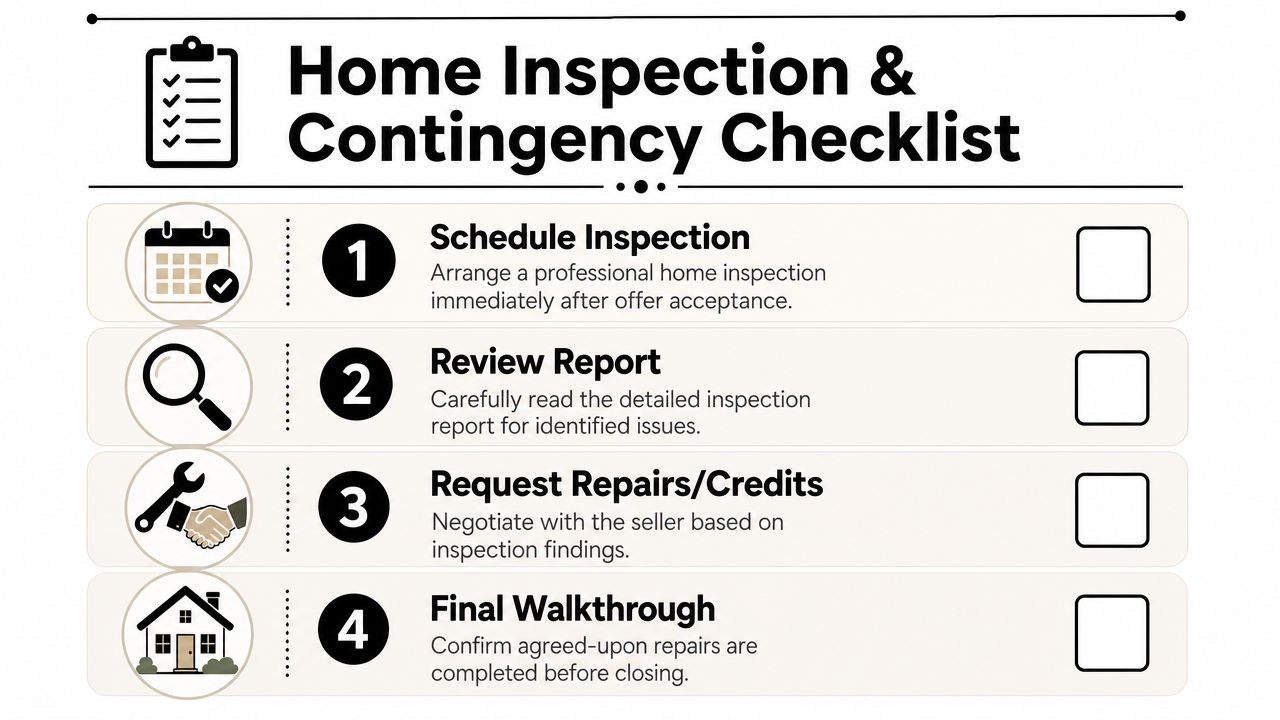
A practical sequence looks like this:
- Order the inspection immediately after acceptance.
- Read the full report, not just the summary.
- Separate defects into safety issues, major cost issues, and minor maintenance items.
- Ask for repairs, credits, or a price adjustment based on what matters.
- Confirm what happens if the appraisal doesn't support the contract price.
A clean-looking house can still hide expensive problems. Buy the report, not the staging.
For buyers using veteran benefits, public-service programs, or other specialized financing, due diligence can be even more important because you need the property condition and value to align with your loan path. This stage protects your cash, your loan, and your sanity.
From Final Walkthrough to Closing Day
The last stretch of the buying a house process step by step is where buyers get careless because they think the hard part is over. It isn't. You're close, but the file still has to cross the line.
At this stage, your lender is working through final underwriting conditions, your title and escrow teams are preparing documents, and you need to review every closing number carefully. Don't go quiet now. Stay responsive.
Review the Closing Disclosure like it matters
Your Closing Disclosure is the document that shows your final loan terms and closing costs. Read it line by line. If something changed and you don't understand why, ask immediately.
Pay special attention to:
- Cash to close: Make sure the required funds match your expectations and available accounts.
- Loan terms: Confirm the interest rate, loan type, and payment structure.
- Credits and fees: Check lender credits, seller credits, and line-item charges.
- Prepaids and escrow items: These often confuse buyers because they are real costs, even when they're not lender fees.
If you want a plain-English breakdown before reviewing your final numbers, this guide to California closing costs and who typically pays them is worth reading.
Handle the final walkthrough the right way
The final walkthrough is not a celebration tour. It's a verification step.
Check that the property is in the agreed condition, that negotiated repairs were completed if required, and that major systems still function as expected. If the seller was supposed to leave appliances or fixtures, confirm they're still there.
Use a short walkthrough checklist:
| Final walkthrough check | Why it matters |
|---|---|
| Repair items completed | Confirms contract compliance |
| No new damage | Protects you from last-minute surprises |
| Agreed items remain | Prevents disputes over fixtures or appliances |
| Home is vacated as expected | Avoids possession issues |
Don't change your finances before signing
Buyers often make foolish moves. They buy furniture on credit, move money around without a paper trail, or switch jobs at the wrong moment. Don't do any of that unless your lender has already approved the change.
Once underwriting issues the clear-to-close, your closing appointment is mostly execution. You sign, you wire or deliver funds as instructed, and once recording is complete, the home is yours.
Stay boring until the keys are in your hand. Boring buyers close.
Thriving in Your First Year as a HERO Homeowner
Closing day is not the finish line. It's the transfer of responsibility.
For public service professionals, the first year matters because your schedule already pulls at your time and energy. If you don't put simple systems in place early, the house starts running you instead of serving you.

Protect your cash flow after closing
A home creates ongoing obligations that don't wait for a convenient month. Repairs, maintenance, insurance changes, and tax-related costs all show up eventually.
The best move is to create a separate home fund right away. Keep it distinct from your general emergency savings so you don't confuse a plumbing issue with a true financial crisis.
Use your first year to get organized around:
- Maintenance tracking: Keep receipts, warranties, service dates, and contractor names in one place.
- Seasonal priorities: Roof, drainage, HVAC filters, smoke detectors, and water shut-off familiarity.
- Budget discipline: Don't treat every project as urgent just because you finally own the place.
New homeowners get into trouble when they spend on upgrades before they understand the home's real maintenance needs.
Understand what your financing gave you
Your mortgage structure shapes your first year more than most buyers realize. That's especially true if you bought with a low-down-payment option or veteran benefit.
For example, for a median-priced home in California at $936,300, a standard 20% down payment can reach $187,300, but government-backed VA loans for certified U.S. veterans and active-duty military offer 0% down payment, according to Clever's California homebuying breakdown.
That kind of access can make ownership possible sooner, but it also means you need to be disciplined after closing. Saving cash upfront is valuable only if you manage the house well once you own it.
Think beyond move-in day
Your first year should include more than unpacking and decorating. Review your property tax records, keep all closing paperwork accessible, and ask whether any local exemptions or veteran-related benefits apply to your situation.
Also keep an eye on the long game. A future refinance, renovation, or move-up purchase depends on how you manage this home now. Pay on time, protect your reserves, and maintain the property with intention. The first year builds the foundation for every financial decision that follows.
California Home Buying FAQs for HEROES
Some questions come up in every conversation with California buyers in public service. Here are the direct answers.
How much down payment do I actually need
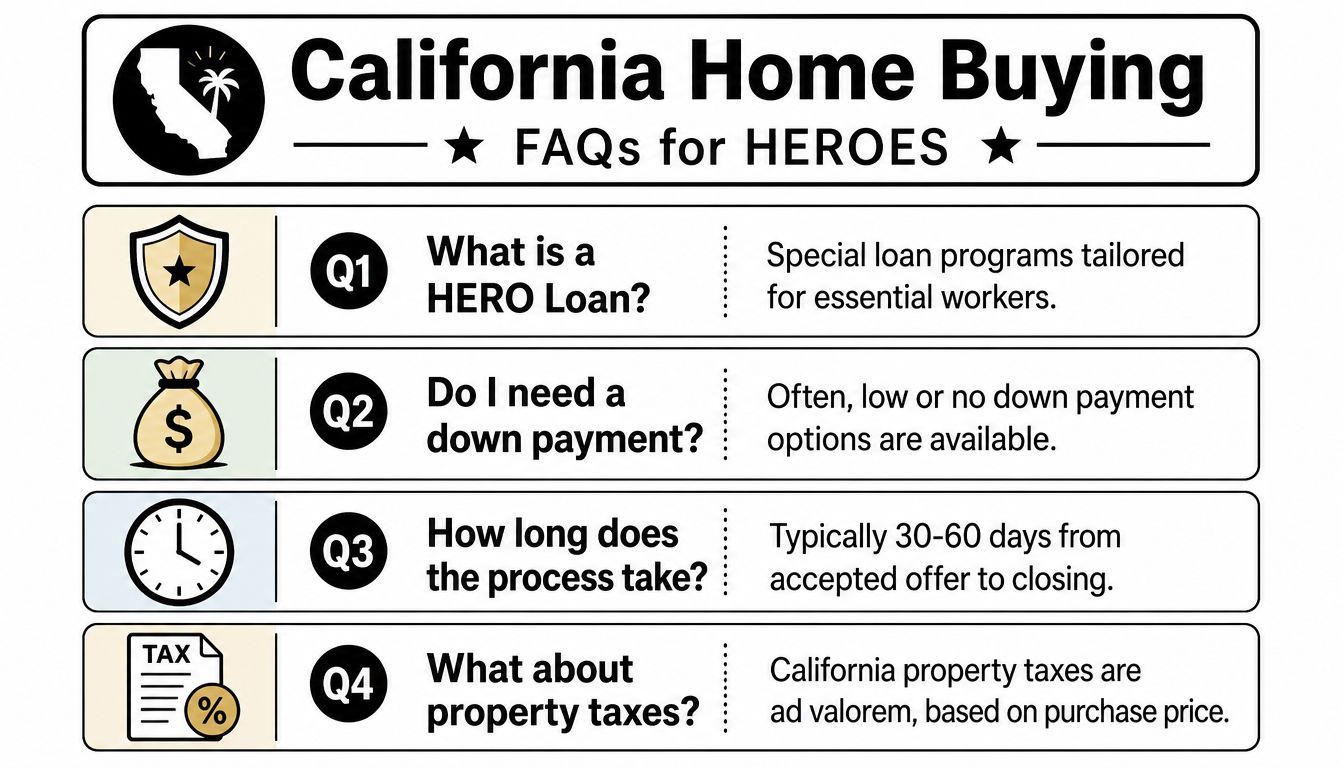
Probably less than you think. The median down payment for first-time homebuyers is 10%, while options like FHA loans require a minimum of 3.5% down, and VA loans for eligible military members reduce the down payment requirement to 0%, according to Rate's homeownership statistics page.
That means you shouldn't assume you need a full 20% to buy. You do need a plan for down payment funds, closing costs, and reserves, but low-down-payment paths are real.
What is a HERO loan
In practice, people use “HERO loan” to describe home loan options and related benefits specific to essential workers and public service professionals. That can include specialized lender support, assistance options, buyer rewards, or mortgage paths that align better with veterans, teachers, healthcare workers, first responders, and similar professions.
It's not one universal mortgage product with one rulebook. The key is working with a lender who understands the programs available to your profession and location.
Can the GI Bill buy me a house
The GI Bill itself isn't the same thing as a VA mortgage benefit. Buyers often mix those up. If you're a veteran or active-duty service member, the more relevant homebuying benefit is usually VA loan eligibility, not the GI Bill.
If you qualify, your best next step is to confirm your veteran housing benefits early and make sure your lender structures the file correctly from the start.
How long does the process take
There isn't one perfect timeline for every transaction. It depends on your preparation, your loan file, the seller, inspections, appraisal, and how responsive everyone is. A clean file with a serious buyer moves much more smoothly than a buyer who starts gathering documents after going under contract.
What about property taxes and closing costs
You need to budget for both from day one. Property taxes in California are a real ownership cost, not an afterthought, and closing costs can surprise buyers who focused only on the down payment.
The fix is simple. Ask for a full cost breakdown before you write offers, then compare that estimate against your actual closing disclosure later. Buyers who understand the full cash picture make better decisions and feel less pressure at the end.
California Loans for Heroes helps veterans, active-duty military, first responders, firefighters, teachers, nurses, healthcare professionals, pilots, law enforcement, and other public service employees understand California homeownership with more clarity and less stress. If you want expert help choosing the right loan path, understanding benefits available to your profession, or building a smarter purchase strategy, visit California Loans for Heroes.