
Only 17% of homes for sale in California were affordable on the average teacher salary of $69,300, according to a Redfin analysis of teacher home affordability. The same analysis placed the median California list price at $485,000, while a teacher earning that average salary could afford roughly $260,000 under standard housing-payment guidelines.
That gap explains why a California teacher mortgage isn't a matter of finding a low rate. The work is matching your county, household income, buyer status, employment, credit profile, occupancy plans, and assistance programs to a structure that can survive underwriting. Many teachers lose access to help before they ever reach the offer stage because they assume every educator benefit works the same way.
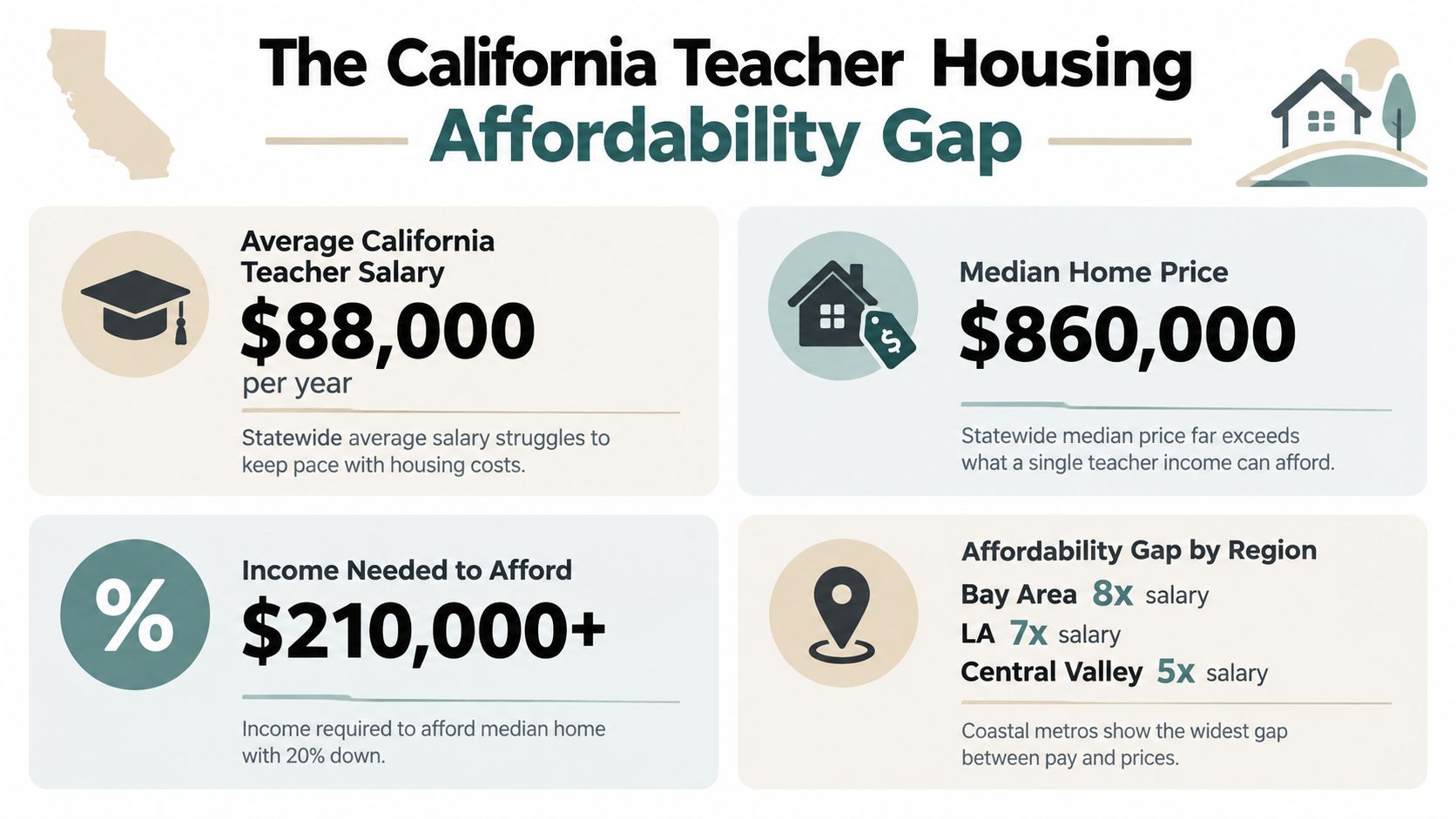
The California Teacher Housing Affordability Gap
California teachers face a location problem as much as an income problem. A salary that can support a purchase in an inland market may fall far short in a coastal county, even when the borrower has strong credit and stable public-sector employment.
Redfin's analysis found that San Francisco affordability fell to 0%, while only 17.4% of homes statewide were listed below the teacher-affordable price point. That isn't a minor difference between neighborhoods. It shows why a standard loan conversation can produce completely different outcomes in Bakersfield, Fresno, Sacramento, Los Angeles, San Diego, San Jose, and San Francisco.
Location changes the mortgage equation
The Berkeley Terner Center study on housing affordability for California educators found that 52% of California school districts are in counties where a beginning teacher salary cannot cover the median asking rent without becoming rent-burdened. The study defines rent-burdened housing as housing costs exceeding 30% of income.
Purchase access varies just as sharply. An average teacher salary could qualify for 77% of homes in Bakersfield, 72% in Fresno, and 33% in Sacramento, compared with 17% in Los Angeles, 14% in San Diego, 2% in San Jose, and less than 1% in San Francisco, according to the same California teacher housing analysis.
| Market | Share of homes affordable on an average teacher salary |
|---|---|
| Bakersfield | 77% |
| Fresno | 72% |
| Sacramento | 33% |
| Los Angeles | 17% |
| San Diego | 14% |
| San Jose | 2% |
| San Francisco | Less than 1% |
The practical conclusion is direct: a California teacher mortgage must be designed around the property location first. A program that looks useful statewide may provide little relief if the maximum purchase price, income cap, or assistance limit doesn't fit the county.
Why specialized programs exist
Teacher-focused programs don't erase California's housing prices. They can reduce the upfront cash requirement, add deferred assistance, offer a lender credit, or create access to local housing initiatives tied to school employment.
That help matters, but it doesn't replace normal qualification. Teachers still need a loan structure that accounts for salary, supplemental income, student debt, credit, reserves, and the property's monthly payment. The right strategy is not to chase every advertised benefit. It's to identify the combination that improves affordability without creating repayment or eligibility problems later.
Mortgage Programs Designed for California Educators
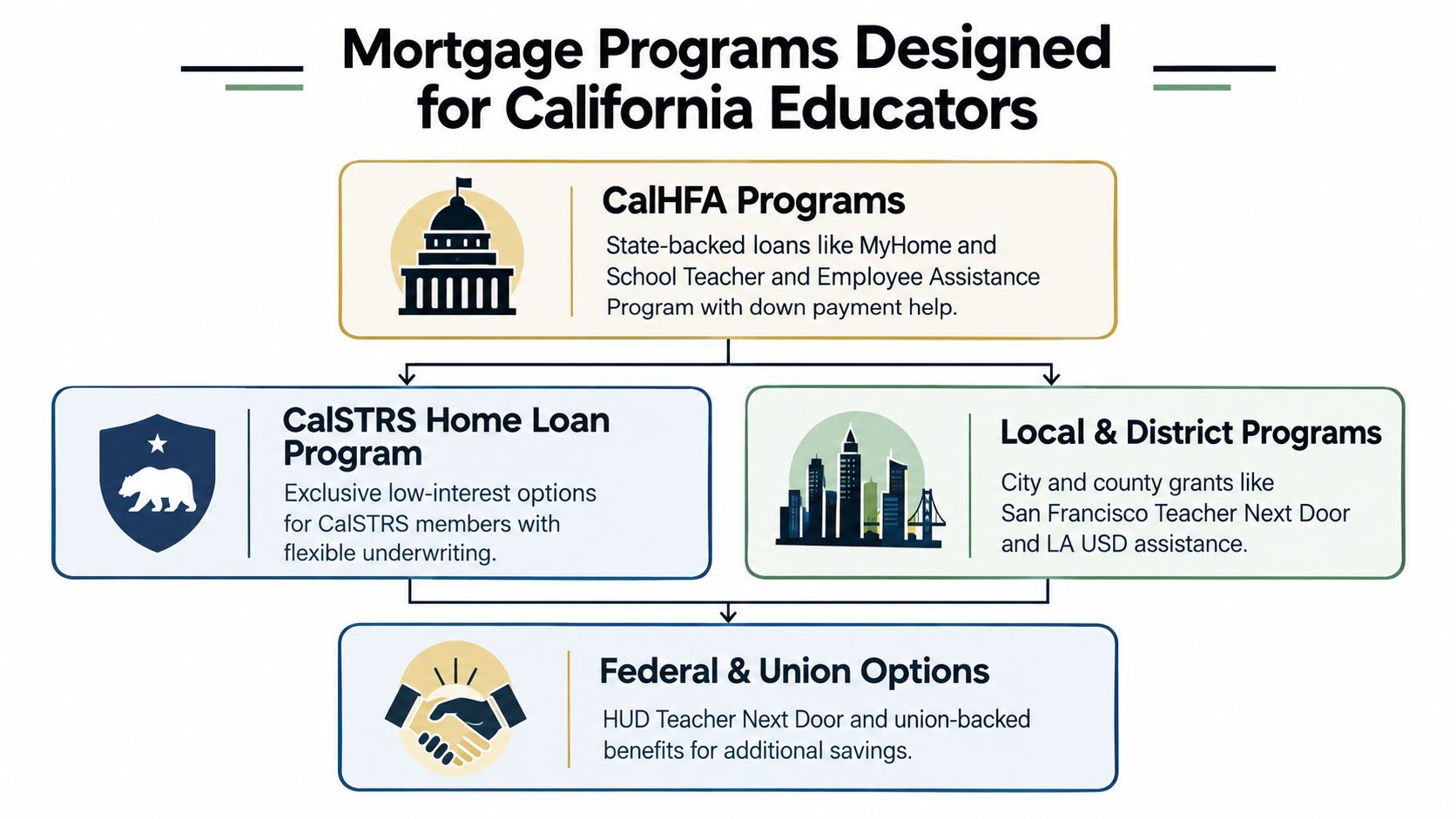
Teacher mortgage options in California generally fall into several layers. The first layer is the primary mortgage, which funds the purchase. The second is subordinate assistance, which may help with the down payment or closing costs. The third can include local grants, employer-linked discounts, or profession-specific benefits.
CalHFA is central to many educator transactions. Its teacher and school-employee options must be paired with a CalHFA first mortgage, while the subordinate assistance is structured as deferred-payment help for down payment and/or closing costs. Older CalHFA program documentation describes assistance capped at the lesser of a fixed dollar amount or a percentage of the sales price or appraised value, with different caps in high-cost areas.
Start with the first mortgage
The first mortgage determines the core underwriting framework. CalHFA options can be useful because they connect the first loan with approved assistance, but the borrower still has to meet first-time buyer rules, income limits, and lender credit and loan requirements.
CalSTRS members may also investigate the CalSTRS Home Loan Program, while federal, union, city, county, and district programs can provide separate forms of support. These options aren't interchangeable. A lender must confirm whether a benefit is a grant, a deferred loan, a rate adjustment, or a credit applied at closing.
For a broader overview of home loan programs for teachers, compare the first mortgage and assistance layer separately. A low-cost first mortgage can still fail if the assistance lien has incompatible terms or if the combined structure violates lender rules.
Understand the local layer
Local programs can be more targeted than statewide programs. San Francisco's Teacher Next Door guidance, for example, sets a household income limit of 200% of Area Median Income, and it counts all household members 18 and older who will live in the property when calculating income. That means a teacher's eligibility can change when a co-borrower or adult household member is included.
Some district or county programs also have employment, occupancy, credit, or service requirements. Treat each benefit as a separate underwriting file until a qualified lender confirms that the pieces can be combined.
Practical rule: Never assume that two programs stack because both advertise down payment help. Confirm lien position, income rules, buyer status, occupancy, repayment, and lender approval before relying on either benefit in an offer.
Down Payment Assistance Options and How They Stack
Down payment assistance can solve a cash-to-close problem, but it doesn't automatically solve a payment or eligibility problem. The strongest application starts by separating four questions: how much assistance is available, whether it must be repaid, when repayment occurs, and whether the program can sit beside the selected first mortgage.
The CalHFA MyHome Assistance Program is a subordinate loan that can be used for down payment or closing costs. Borrowers must meet CalHFA income limits, and when lender guidelines conflict, the lender must follow the more restrictive rule.
A California teacher homebuying guide describes these educator-relevant options:
| Program | Max Assistance | Forgiveness | Key Requirement |
|---|---|---|---|
| CalHFA MyHome | Amount governed by current program and lender limits | Deferred assistance, repayment terms apply | CalHFA first mortgage and income limits |
| CalHFA STEAP | Up to 3.5% | Assistance terms and repayment apply | Eligible school employee, CalHFA structure |
| CalHFA Forgivable Equity Builder | Up to 10% | Forgiven after 5 years | Buyer under 80% AMI |
| GSFA Platinum | Up to 5.5% | Depends on selected assistance structure | Program and lender eligibility rules |
The program mechanics and thresholds above come from this California teacher homebuying program guide. Verify current availability before making an offer because program rules, funding, and lender participation can change.
Stacking is a design problem
CalHFA teacher assistance is typically layered rather than standalone. The borrower uses an eligible CalHFA first mortgage, then adds subordinate assistance that reduces the amount of personal cash needed at closing. That second lien may not require immediate monthly payments, but repayment can be triggered by a sale or refinance, creating a payoff profile similar to a silent second mortgage.
The teacher down payment assistance resource can help you identify possible combinations, but your lender must test the actual structure. Assistance may be limited by the purchase price, appraised value, income, county, first-mortgage product, or the more restrictive lender guideline.
Choose the cleanest structure
Don't select a program because it offers the largest headline amount. A smaller benefit with clear repayment terms may be more workable than a larger benefit that conflicts with your first mortgage or creates a future payoff issue.
Ask your lender to provide a written stacking analysis showing the first loan, subordinate lien, cash contribution, estimated closing costs, monthly payment, and repayment trigger. If the lender can't explain the full structure, the plan isn't ready for underwriting.
Eligibility Traps That Silently Disqualify Teachers
The most damaging California teacher mortgage mistakes happen before the application is submitted. Teachers often focus on occupation-specific benefits and overlook the rules that control approval.
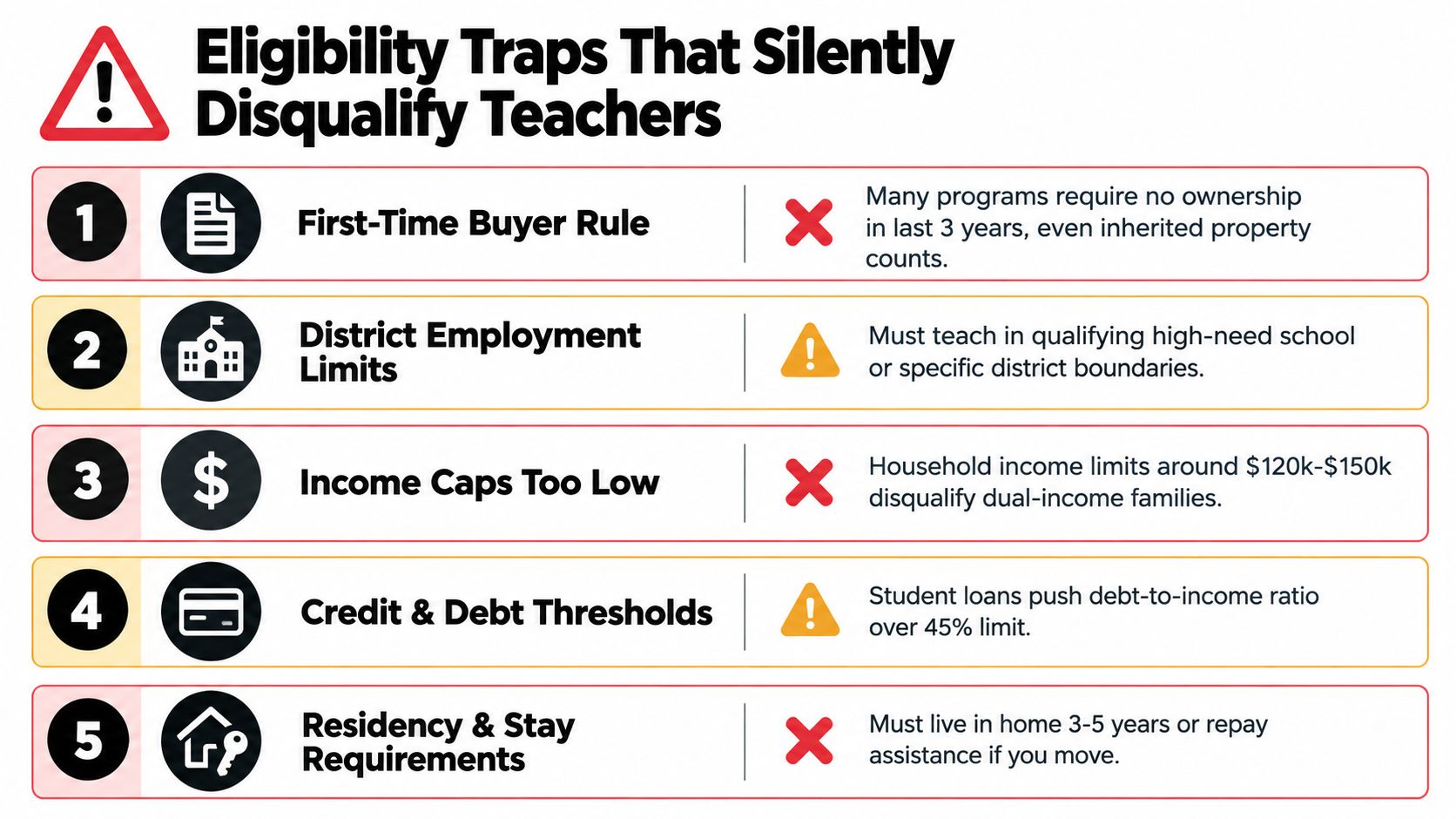
Many CalHFA paths require borrowers to be first-time homebuyers, meet CalHFA income limits, and satisfy the first-mortgage lender's credit and loan requirements. That can exclude a move-up buyer, a repeat buyer, or someone who previously owned property even though the borrower has stable employment and enough income for the payment.
The rules that deserve a written answer
First-time buyer status is the first checkpoint. Ask how the program defines prior ownership, including inherited property, a former residence, or a previous purchase with another borrower.
Income caps can disqualify households that appear financially ordinary in an expensive county. San Francisco's Teacher Next Door rules count the income of all household members 18 and older who will live in the home and set the household limit at 200% of AMI, according to the city's Teacher Next Door program guidance.
Credit rules vary by jurisdiction. The Santa Clara County Office of Education's housing resource page identifies a 620 minimum credit score for an affordable-housing program for teachers and school district employees. It also states that the program doesn't discriminate based on prior bankruptcy or foreclosure, but that doesn't eliminate current credit, debt, income, or lender requirements. Review the Santa Clara County educator housing resources before assuming a past event is an automatic denial.
Occupancy is not optional. Assistance programs generally support an owner-occupied home, not an investment property. Some programs also impose service or residency expectations, so leaving the district, renting the home, or refinancing can affect repayment.
The hidden trap is program stacking. A teacher may qualify for each benefit separately but fail when the benefits are combined under one lender's more restrictive rules.
Repeat buyers need a different plan
The underserved group is clear: teachers who aren't first-time buyers, teachers in high-cost counties, and households whose combined income exceeds a local cap. For these borrowers, a conventional or government first mortgage paired with a lender credit, local assistance, or a profession-linked benefit may be more realistic than a CalHFA-only strategy.
Run eligibility before shopping. A written county-specific review can prevent you from building an offer around assistance that your household can't use.
Step-by-Step Application Process for Teacher Mortgages
A successful application starts with preparation, not a property address. Teacher income can involve a district salary, stipends, summer pay, extra assignments, or other compensation that requires clear documentation and consistent treatment by the lender.
Six steps that keep the file moving
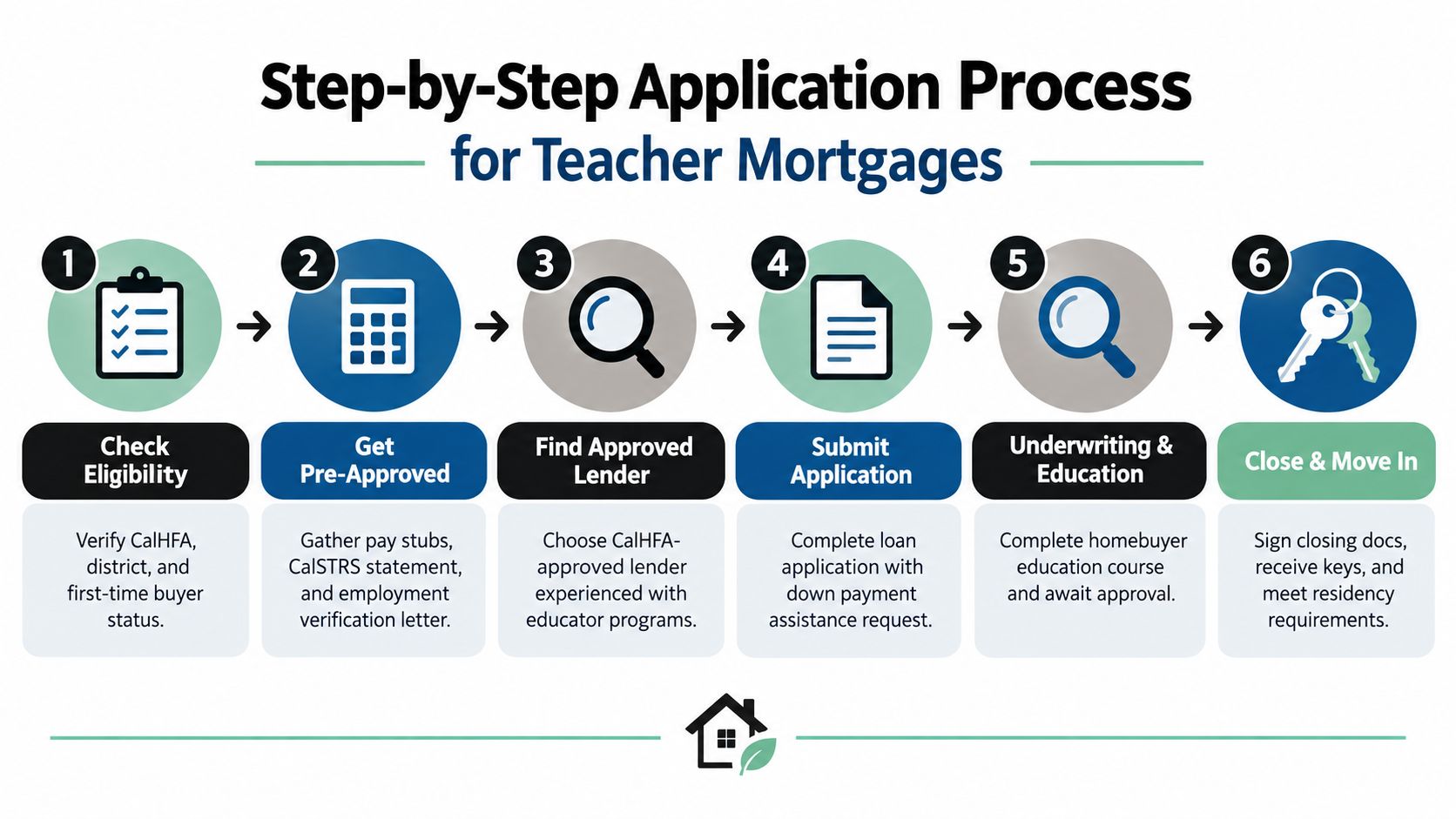
Check eligibility first. Confirm first-time buyer status, county income limits, qualifying employment, occupancy, credit, and the specific CalHFA or local program rules.
Build the income file. Gather pay stubs, tax documents where requested, employment verification, district confirmation, asset statements, and any CalSTRS documentation relevant to the loan review. Keep explanations ready for pay changes, leave, stipends, or seasonal compensation.
Choose an approved, experienced lender. A general mortgage broker may understand the first loan but not the assistance lien, education requirement, county restrictions, or stacking rules. Ask whether the lender regularly closes CalHFA and educator transactions.
Submit the assistance request with the mortgage application. Don't wait until after an offer is accepted to discover that the assistance program requires separate approval or documentation.
Expect underwriting questions. The underwriter will test income, debt, credit, assets, property eligibility, occupancy, and program compliance. Complete required homebuyer education early when the program calls for it.
Review closing and repayment terms. Before signing, confirm the first mortgage, subordinate assistance, payment obligations, payoff triggers, and residency requirements. Save every program document for future reference.
The lender should explain which conditions come from the first mortgage and which come from the assistance program. That distinction matters because fixing a standard loan condition won't necessarily resolve an assistance-program issue.
How California Loans for Heroes Simplifies the Process
California teacher mortgage programs are fragmented. One benefit may come from CalHFA, another from a county, another from a district, and another from the lender. Each can carry separate income, employment, occupancy, documentation, and repayment rules.
California Loans for Heroes offers a HERO Home Loan and Buyer Rewards Program for eligible California service professionals, including teachers and educators. The publisher describes access to homebuyer assistance, down payment assistance options, competitive mortgage rates, refinance solutions, lender credits, and dedicated one-on-one support through its home loans for heroes program.
That model can be useful when the main problem isn't finding a mortgage product but coordinating several moving parts. A specialist should be able to compare a CalHFA structure with local assistance, explain whether a lender credit can be used alongside another benefit, and identify where an income or buyer-status rule blocks the plan.
What to demand from a specialist
Ask for a side-by-side loan scenario rather than a general promise of savings. The comparison should show the first mortgage, assistance amount, cash required, monthly payment, lender credits, subordinate-lien repayment, and the effect of refinancing or selling.
Also ask whether the proposed program supports your actual situation. A teacher who is a repeat buyer, lives in a high-cost county, has a non-educator co-borrower, or plans to move within a few years needs answers specific to those facts.
The right advisor won't push the biggest assistance headline. They'll identify the structure that can close and remain manageable after closing.
Frequently Asked Questions About Teacher Mortgages
Can teachers refinance with assistance programs?
Possibly, but refinancing can trigger repayment of deferred assistance. CalHFA-related assistance may become due when the property is sold or refinanced, so ask for a payoff calculation before replacing the first mortgage.
What happens if I leave my school district?
The answer depends on the program. Some benefits are tied to qualifying employment, while others focus on borrower status, property occupancy, or the original loan terms. Get the rule in writing before changing employers.
Can a non-educator co-borrower apply with a teacher?
Often, a non-educator can participate in a mortgage, but household income rules may change. San Francisco's Teacher Next Door guidance counts all household members 18 and older who will live in the property, so adding a co-borrower can affect eligibility.
Do private-school teachers qualify?
Not automatically. Eligibility depends on the specific program's definition of a qualifying school employee or educator. Confirm the employer and role requirements with the program administrator and lender before relying on assistance.
Is assistance always free money?
No. Some assistance is deferred rather than forgiven, and repayment may occur after a sale or refinance. Forgiveness programs also have conditions, such as the Forgivable Equity Builder requirement for buyers under 80% AMI and forgiveness after 5 years, as described in the cited California teacher homebuying guide.
What's the best next step?
Start with a county-specific eligibility review, then request a written comparison of available first mortgages and assistance layers. Don't make an offer until you know the program can support the property's location, your household income, your buyer status, and your occupancy plans.
California Loans for Heroes offers educator-focused home loan guidance, assistance options, lender credits, and one-on-one support for California teachers navigating fragmented mortgage programs. Visit California Loans for Heroes to discuss your county, buyer status, and the mortgage structure that fits your application.