
You're probably doing the math right now. You teach full time, you pay rent that keeps climbing, you've tried to save, and every time you get a little ahead, something wipes out the progress. Car repair. Student loans. Childcare. A rent increase. In California, that cycle wears people down fast.
Most teachers don't have an income problem. They have a cash-to-close problem.
That distinction matters. Plenty of educators can handle a mortgage payment, especially when it's close to what they already pay in rent. What stops them is coming up with the down payment, closing costs, reserves, and all the other upfront expenses that hit at once. That's exactly why teacher-focused down payment assistance exists.
The problem is that most articles on this topic are weak. They give you a generic list, throw around a few buzzwords, and skip the details that affect your decision. If you're a California teacher, you need more than a list. You need to know how these programs work, when the money has to be repaid, how second liens can create problems later, and how to combine benefits instead of leaving money on the table.
Why California Homeownership Feels Out of Reach for Teachers
A California teacher can do everything “right” and still feel stuck. You show up early, stay late, buy classroom supplies out of pocket, build a stable career, and then spend another year watching housing stay just far enough away to feel frustrating.
That's the reality for a lot of educators. The monthly payment isn't always the first obstacle. A key barrier is the pile of cash needed before you ever get the keys. Down payment. Closing costs. Prepaids. Inspections. Moving expenses. Saving for all of that while paying California rent is brutal.
A common pattern looks like this: a teacher starts out thinking they need to save a giant down payment before they can even talk to a lender. So they wait. Then rates change, rents rise, home prices move, and the target keeps shifting. Waiting feels responsible, but in many cases it keeps teachers out of the market longer than necessary.
You don't need to solve the whole affordability problem alone. You need the right structure.
That's where down payment assistance becomes practical, not theoretical. It isn't some niche option for a tiny group of buyers. It's one of the few tools built specifically to address the exact issue teachers face most often, which is lack of upfront cash even when income and employment are solid.
What teachers usually get wrong
- They assume they need a traditional large down payment: Many educators delay the process because they think homeownership starts only after years of aggressive saving.
- They treat all assistance the same: A grant, a forgivable loan, and a deferred second lien can look similar at first. They are not.
- They focus only on the home search: The financing strategy should come first. The wrong loan structure can create problems later, especially in California where refinancing decisions matter.
What changes the conversation
Once you understand that the goal is lowering cash needed at closing, the process gets clearer. You stop asking, “How will I save everything myself?” and start asking better questions:
- Which programs fit my job and income?
- Is the assistance repayable?
- Can I combine it with other benefits?
- What happens if I refinance or sell later?
Those are the questions that move teachers from browsing listings to buying.
What Exactly Is Down Payment Assistance
Think of down payment assistance as a scholarship for your home purchase. It's money or structured aid designed to reduce the upfront cash you need to buy. That's the simplest useful definition.
It usually helps with one or both of these costs:
- Down payment funds: Money applied toward the purchase.
- Closing costs: Fees and expenses due at closing.
That distinction matters because many teachers don't get blocked by just one line item. They get blocked by the combined hit of everything due at once.
Why DPA exists
These programs exist because lenders, housing agencies, and specialty programs know a lot of buyers can afford a monthly payment but can't easily build a large cash reserve while renting. Teachers are a perfect example. Stable job. Clear income history. Strong community role. Limited ability to stack cash while living in expensive markets.
A good DPA program doesn't “create” affordability from nowhere. It bridges the gap between what a teacher can manage monthly and what the transaction demands upfront.
Teachers and other public service professionals in California can receive up to $9,000 in exclusive homebuyer grants and up to $24,000 in down payment assistance through the national Teacher Next Door Program, which has assisted over 50,000 applicants annually nationwide. The program also states that it requires no credit check for the pre-application and allows buyers to purchase any home on the market with no location or property type restrictions, with low-interest home loan options for educators and school employees, according to the Teacher Next Door California program overview.
What DPA is not
A lot of buyers hear “assistance” and assume it means free money with no strings attached. Sometimes that's true. Often it isn't.
Here's the practical way to consider this:
| Type of help | What it does | What you need to check |
|---|---|---|
| Grant | Reduces cash needed upfront | Whether any occupancy rules apply |
| Forgivable loan | Starts as a loan, then may disappear over time | How long you must stay in the home |
| Deferred loan | Delays repayment until a future trigger | Whether refinance or sale triggers payoff |
Practical rule: Don't ask only how much assistance you can get. Ask what form it takes and what it obligates you to do later.
Why this matters in California
In lower-cost markets, a buyer might muscle through the upfront costs with savings alone. In California, many teachers can't. That's why down payment assistance teachers search terms are so common. People aren't looking for theory. They're looking for a path that works in a high-cost state.
And that path usually starts with understanding the structure before you start house hunting.
Decoding the Main Types of Teacher DPA Programs
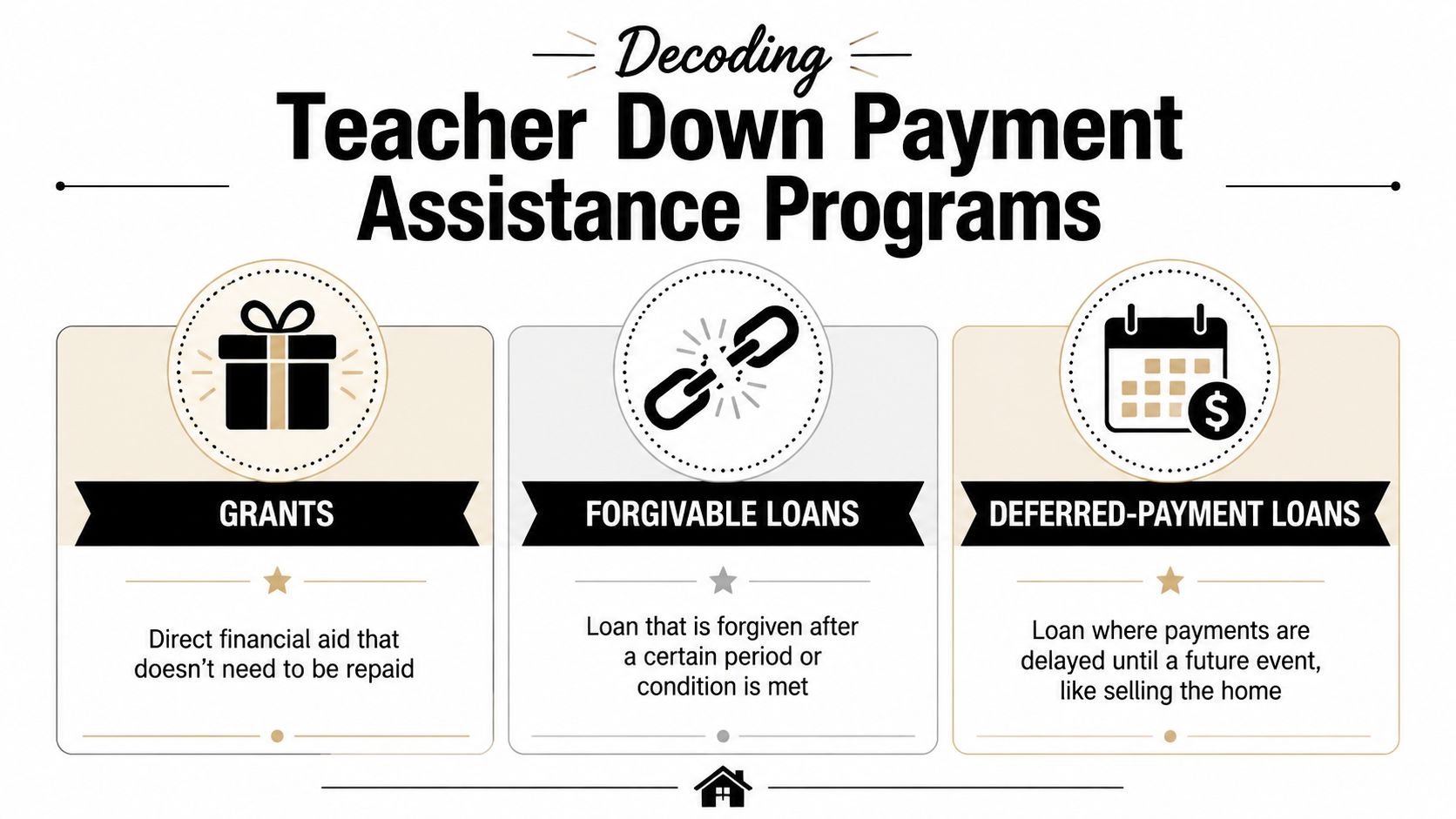
Three structures show up again and again in teacher homebuyer programs. If you can tell them apart quickly, you'll avoid most of the confusion in this space.
Grants
A grant is the cleanest form of assistance. It lowers your cash to close and typically doesn't require repayment if you meet the program terms. For teachers, this is usually the most attractive option because it's simple and predictable.
The Teacher Next Door Program structure includes a non-repayable home-buying grant of up to $9,000 for closing costs, according to the Teacher Next Door program details. That's the kind of benefit buyers understand immediately because it directly attacks one of the hardest parts of the transaction.
Best fit for:
- Buyers who want the fewest future complications
- Teachers with decent income but limited savings
- People who value simplicity over squeezing every possible option together
Forgivable loans
A forgivable loan starts as a real loan. Then the balance may be forgiven if you meet the occupancy or time-based rules. Stay in the home long enough, and you may never repay it.
This can work very well for teachers who plan to stay put. It's especially useful for buyers who need meaningful help now and expect to remain in the home long enough to satisfy the forgiveness period.
The catch is obvious. If life changes and you move earlier than planned, the “assistance” can turn back into debt.
Deferred-payment loans
This is the structure buyers underestimate. A deferred-payment loan delays repayment instead of erasing it immediately. Many programs require no monthly payment on that second lien while you live in the home, but the balance can become due when a trigger happens.
Typical triggers include:
- Selling the home
- Refinancing the first mortgage
- Moving out or converting the home
- Failing occupancy requirements
The most important question to ask is: Under what conditions, if any, does this money need to be paid back?
That question should drive your decision more than the headline amount.
A side-by-side way to evaluate them
| Program structure | Monthly payment impact | Future risk level | Best for |
|---|---|---|---|
| Grant | Usually simplest | Low | Buyers who want clarity |
| Forgivable loan | Often manageable | Moderate | Teachers staying long term |
| Deferred-payment loan | Helpful upfront | Higher | Buyers who fully understand the triggers |
The right choice depends less on the biggest advertised benefit and more on your likely timeline. If you may refinance, relocate, or move districts, you need to read the second-lien terms with real care.
Top Down Payment Assistance Programs for California Teachers
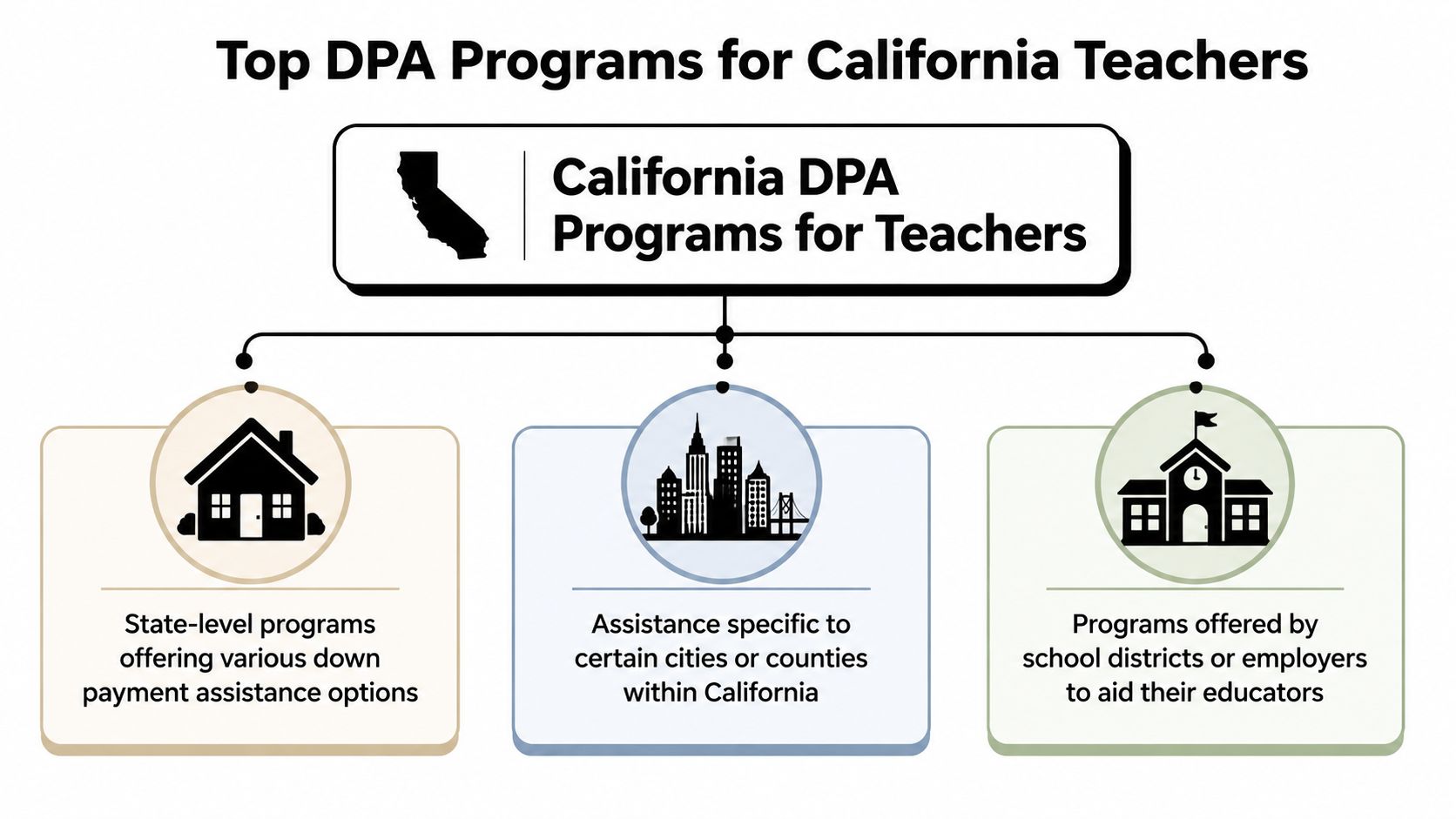
California teachers need a short list that's useful. Not a bloated directory. Start with three buckets: statewide options, local city or county programs, and national teacher-specific programs that can be used in California.
National teacher-specific options
Teacher Next Door is one of the most recognizable names in this category. For California teachers, the main appeal is flexibility. The program is designed for educators and school employees, and it can be used for homes on the open market rather than forcing buyers into narrow location restrictions.
According to program data summarized by NEA Member Benefits, teachers can receive up to $9,000 in grants and up to $24,000 in payment assistance, for $33,000 in potential assistance. That's why this program gets attention. It can materially reduce the cash hurdle at closing.
If you want a starting point for teacher-specific mortgage options, review the available home loan programs for teachers.
State-level California programs
California buyers should also look at statewide housing agency options. The exact program mix can change, and funding availability can shift, so the smart move is to review current guidelines before you fall in love with a property.
What matters most at the state level is compatibility:
- Does the program work with your loan type?
- Does it come as a grant, forgivable second, or deferred second?
- Are there income limits or first-time buyer rules?
- Does the property need to be owner-occupied?
- Are there education-course requirements?
These questions are more important than marketing language. A program can sound generous and still be a poor fit if the rules clash with your plans.
City and county assistance
Some of the best opportunities are local, not national. Certain cities and counties offer homebuyer aid that can sometimes be paired with broader mortgage programs. These can be powerful for teachers because local agencies often want stable community members to stay in the area.
The downside is complexity. Local programs tend to have narrow eligibility windows, specific documentation standards, and funding caps. They can open and close, run out of money, or require extra steps that generic articles never mention.
A good search strategy looks like this:
- Start with your work area: Search your city, county, and neighboring communities.
- Check housing authority pages: Local housing departments often publish current first-time buyer or workforce housing options.
- Verify occupancy rules early: Many local programs are strict about owner occupancy.
- Ask whether they can be layered: Some local programs can work with teacher-specific aid. Others can't.
The best California program isn't always the one with the biggest headline amount. It's the one you actually qualify for, can close on, and can live with after closing.
Employer or district-connected opportunities
Some school districts, education foundations, or local nonprofit partners create teacher housing assistance programs. These aren't available everywhere, but they're worth checking because they can be designed for recruitment and retention.
District-connected programs often come with tradeoffs, such as continued employment requirements, occupancy rules, or additional homebuyer education steps. Read those terms carefully. If the program fits your career plans, it can be excellent. If you may change districts soon, be cautious.
Navigating the DPA Application Process
The process feels intimidating when you think of it as one giant approval. It gets easier when you break it into pieces and handle them in the right order.
Start with strategy, not listings
Most teachers make the mistake of shopping for homes first and financing second. Reverse that. Before you tour properties, get clear on what type of assistance you may qualify for and whether it comes as a grant, forgivable loan, or deferred second.
That early review shapes everything: your realistic price range, your cash needed, your timeline, and your future flexibility. A solid overview of the steps can help you learn how to get down payment assistance before you start making offers.
The usual sequence
Initial consultation and pre-qualification
During this stage, income, employment, and basic eligibility get reviewed. If you're a teacher, job documentation matters, but so does matching you to the right assistance structure.Document collection
Most buyers need standard mortgage paperwork. The faster you provide it, the smoother the process goes.Pre-approval with program alignment
This is different from a generic pre-approval. The loan needs to fit the assistance, and the assistance needs to fit the loan.Home search with guardrails
Once you know the structure, you can search with confidence and avoid homes that create financing issues.Offer, contract, and closing coordination
DPA often adds layers to underwriting and closing. That doesn't make it bad. It just means the file needs to be organized from the start.
Documents to gather early
- Recent pay stubs: Teachers with supplemental income should identify what can be counted.
- Tax returns and W-2s: Keep them accessible and complete.
- Bank statements: Assistance programs often scrutinize available assets and sourcing.
- Employment verification: Your school or district may need to confirm status.
- Identification and residency documents: Standard, but don't wait until the last minute.
- Program-specific forms: Many DPA programs require disclosures, education certificates, or occupancy affidavits.
Where delays usually happen
| Step | Common issue | Better move |
|---|---|---|
| Pre-approval | Buyer applies before understanding DPA fit | Confirm eligible programs first |
| Documentation | Missing pages or inconsistent statements | Submit complete files upfront |
| Contract phase | Program timelines ignored | Build realistic closing expectations |
| Final approval | Occupancy or education conditions missed | Clear all side requirements early |
A clean file wins. Teachers who stay organized, ask direct questions, and understand their assistance terms early usually have a much better experience than buyers who chase listings first and paperwork later.
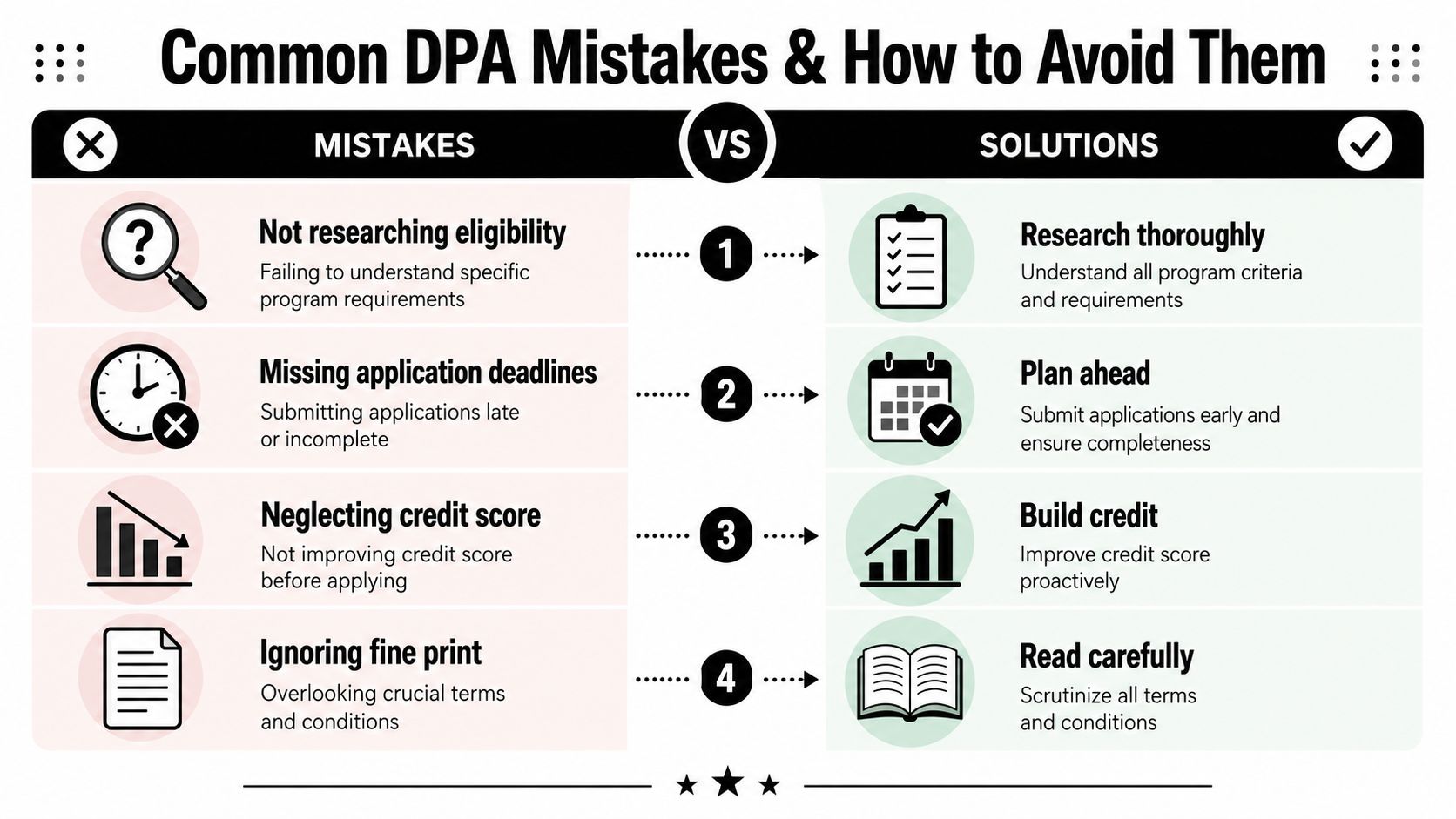
Common Mistakes That Can Cost Teachers Thousands
Most mistakes in this area aren't dramatic. They're quiet. A teacher signs up for a program that sounds helpful, skips the fine print, and discovers the downside later when life changes.
That's why generic down payment assistance teachers articles miss the mark. They talk about access. They don't talk enough about consequences.
Mistake one, ignoring the refinance trigger
Some assistance is attached as a second lien. That structure can be fine. The problem starts when buyers assume “deferred” means “never due.”
It doesn't.
In Texas, the Homes for Texas Heroes program provides down payment assistance as either a non-repayable grant or a deferred forgivable second lien loan that requires repayment if the home is sold or refinanced within three years, according to the Texas State Affordable Housing Corporation teacher home loan page. That's a concrete example of a rule buyers need to understand before closing, not after.
If your DPA sits in second position, ask what happens when you refinance the first mortgage. Ask before you sign anything.
A lot of buyers never ask that question. They should.
Mistake two, failing to stack benefits intelligently
Another costly mistake is treating each benefit as a separate silo. That leaves tax advantages and layered assistance on the table.
One major blind spot is the Mortgage Credit Certificate, or MCC. Existing guidance rarely explains how teacher-specific aid can interact with it. The available data points to a real education gap here: 42% of first-time teacher homebuyers in major markets are unaware of MCCs, leading to an average $1,200 per year in tax savings missed, according to the MCC and teacher buyer analysis included in the verified data above. The same verified data notes that without a clear stacking strategy, teachers may miss $5,000 to $10,000 in total assistance by treating programs as mutually exclusive rather than complementary.
If you qualify for DPA and an MCC-compatible structure, you should explore both together. Don't assume the first program you find is the full answer.
Mistake three, focusing only on the headline amount
Bigger isn't automatically better. A larger assistance package with restrictive terms can be worse than a smaller one with cleaner rules.
Use this filter before you commit:
- Repayment test: Is it a grant, forgivable loan, or deferred lien?
- Refinance test: Does a future rate-and-term refinance trigger payoff?
- Mobility test: What happens if you move districts or need to relocate?
- Stacking test: Can this work with an MCC or other local aid?
- Timeline test: Will the program still make sense if your plans change?
Mistake four, applying too late in the process
Teachers sometimes wait until they're under contract to ask about assistance. That's backwards. Some programs have extra approvals, education requirements, or limited funds. If you start late, you create avoidable stress and can lose options.
The best buyers don't chase the biggest promise. They choose the cleanest structure that fits their actual life.
How California Loans for Heroes Makes Homeownership Happen
Complexity shouldn't keep teachers from buying in California. But complexity does need to be managed by people who understand teacher programs, layered assistance, second-lien terms, and the difference between a helpful benefit and a future headache.

The advantage of working with a team that focuses on hero professions is simple. They already know the questions that matter. They know teachers often have strong employment histories but limited upfront cash. They know that a deferred second lien can look harmless until a refinance comes up. They know that benefit stacking isn't optional if you want the strongest structure possible.
That matters because the wrong guidance wastes time. The right guidance helps you narrow options quickly, understand your repayment exposure, and move forward with a plan that fits both your purchase and your future.
If you want to understand the process from first conversation to closing, review how California Loans for Heroes works. A strong advisor doesn't just tell you that assistance exists. A strong advisor helps you use it wisely.
Teachers already spend enough time navigating broken systems. Your mortgage plan shouldn't be one of them.
If you're a California teacher and want clear answers on down payment assistance, repayment terms, second liens, and how to combine the right benefits, talk with California Loans for Heroes. They specialize in helping California HEROES cut through the noise, identify the best-fit path, and move toward homeownership with confidence.