
You're working long shifts, the overtime helps but doesn't seem to move the needle, and every time you check California home prices the gap still looks too wide. That's where a lot of police officers get stuck. They assume buying means waiting years, saving a huge down payment, and settling for whatever a generic lender says they can afford.
That's the wrong approach.
There are real home loans for police officers, real assistance programs, and real ways to reduce your cash needed at closing if you know where to look and how to structure the deal. The problem isn't that options don't exist. The problem is that most officers get partial information, talk to lenders who don't understand first responder programs, and miss benefits that could make the numbers work.
If you're trying to buy in California, you need a practical roadmap, not mortgage jargon. That starts with understanding which programs help, which ones come with strings attached, and how to avoid wasting time on benefits that look good online but don't fit where or how you live.
Serving Your Community and Buying a Home in California
A lot of California officers are living the same story. You serve in one city, rent in another, commute farther than you want to, and keep asking yourself whether buying a home near work is realistic or just a nice idea for someday.
For many officers, the math looks brutal at first glance. You've got stable income, strong employment history, and a career the public depends on, but California prices still push the goalpost out. That disconnect frustrates people for a reason. You can be financially responsible and still feel boxed out.
The good news is that law enforcement isn't starting from zero. Specialized programs exist because the normal path to homeownership often doesn't fit first responders. Some programs attack the upfront cost. Others create discounts on the home itself. Some open the door to assistance on properties sold on the regular market instead of limiting you to a narrow list.
Homeownership for officers in California usually doesn't fail because of income alone. It fails because nobody showed the buyer how to line up the right loan with the right assistance.
That's the part that matters. Buying a home in this state isn't just about finding a low rate. It's about combining the right financing, the right down payment help, and the right property strategy so your cash requirement stops being the deal killer.
If you want a starting point built around law enforcement buyers in this state, review the programs geared toward California law enforcement homebuyers. Then evaluate what fits your income, location, and timeline.
What Is Down Payment Assistance and How Does It Work
Down payment assistance is the booster pack that helps you get into the home before your savings account catches up. If the down payment and closing costs are the part that keeps stopping you, DPA is often the tool that changes the conversation from “not yet” to “let's run the numbers.”
Here's the visual breakdown.
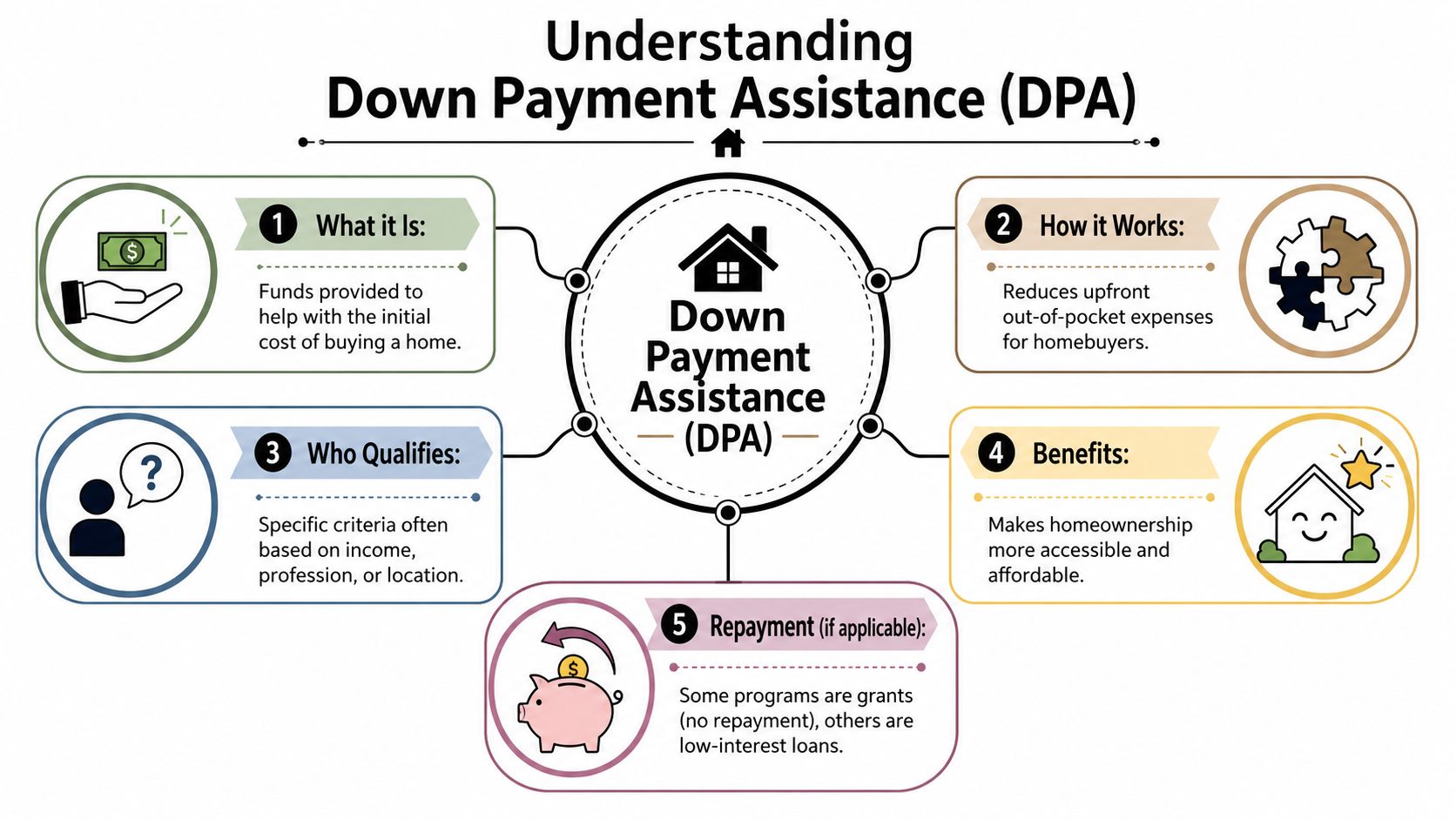
The main DPA types
Not all assistance works the same way. That's where buyers get tripped up. They hear “assistance” and assume it all means free money. Sometimes it does. Sometimes it doesn't.
Grant. This is the cleanest form of help. It's money applied to your purchase costs that you typically don't repay. For your wallet, that means less cash needed up front and no extra monthly payment tied to that assistance.
Forgivable loan. This starts as a loan, but the balance can disappear if you stay in the home long enough and follow the program rules. For you, that means the benefit is strong, but moving too soon can turn “help” into a repayment issue.
Deferred second mortgage. This is a real loan, but you usually don't make monthly payments on it right away. Repayment often waits until you sell, refinance, or pay off the first mortgage. That helps cash flow now, but it still sits on the property.
Traditional second mortgage. This one is straightforward. It's assistance, but it's also debt. If the payment is due monthly, you need to budget for it from day one.
What this means for police officers
The right question isn't “Can I get assistance?” It's “What kind of assistance fits how long I plan to stay in the home?”
That distinction matters because a program can look attractive at closing and still be the wrong fit if you expect a transfer, promotion, relocation, or family move in the near future.
One example worth knowing is the Officer Next Door program. Eligible police officers can access a non-repayable grant of up to $9,000 combined with down payment assistance of up to $24,000, and it allows the purchase of any home on the open market according to Officer Next Door program details. That flexibility matters in California, where inventory and commute patterns often force buyers to look beyond a narrow property list.
Practical rule: Don't compare two assistance programs by headline alone. Compare how each one affects your cash to close, your monthly payment, and what happens if you move.
If you're looking at options in this state, it helps to start with a current overview of California down payment assistance programs, then match the structure to your actual plan instead of chasing the biggest advertised benefit.
Key Home Loan Programs for Law Enforcement
Some law enforcement programs are excellent. Others sound better than they work in real life. You need to know the difference.
Good Neighbor Next Door
The strongest federal benefit on paper is HUD's Good Neighbor Next Door program. Eligible full-time police officers can buy certain HUD-owned homes at exactly 50% of the appraised value in designated revitalization areas under the HUD Good Neighbor Next Door program. That's not a minor incentive. It's a major discount built into the purchase itself.
HUD also requires the buyer to occupy the property as a primary residence for 36 months, and the program is limited to one-unit properties. That means no vacation property, no investment play, and no loose plan to “figure it out later.” You live there, or you don't use the program.
Here's my view. Good Neighbor Next Door is fantastic if the right property exists in the right place at the right time. That's the catch. It's not a broad, everyday California buying strategy. It's an opportunity program. If it matches your target area and timeline, jump on it. If not, don't build your whole plan around waiting for one listing.
The proposed HELPER Act
The proposed HELPER Act matters because it shows where policy is trying to go, but it is not a current loan you can close today. If passed, it would create a one-time-use FHA program for qualified first-time homebuyers in law enforcement, firefighters, and EMS with $0 down payment, no monthly mortgage insurance premium, and only an upfront mortgage insurance premium, according to coverage of H.R. 2094 and its March 2026 reintroduction.
That would be a big shift from standard FHA structure.
What should you do with that information? Simple. Watch it, but don't pause your home purchase waiting for Congress. Buyers lose time that way. Use programs available now and treat HELPER as a possible future option, not a present strategy.
A useful model from Texas
Texas offers a good example of how a state can structure help for officers. Through Homes for Texas Heroes, peace officers can receive down payment assistance ranging from 3% to 5% of the total loan amount through either a non-repayable grant or a deferred forgivable second lien, and they can pair it with a Mortgage Credit Certificate. The MCC becomes free when used with the assistance, which saves $500, according to the Homes for Texas Heroes program.
That program isn't for California purchases, but it's still worth noting because it shows how smart assistance is built. It lowers cash needed up front, gives the buyer a choice in structure, and rewards buyers who plan to stay put.
The best officer programs do one of three things. They cut the purchase price, reduce cash to close, or lower long-term cost. The stronger ones do more than one.
One warning belongs here because too many officers find it out too late. Some police-specific rate discounts are location-locked. Connecticut's CHFA program offers 0.125% rate cuts, but only for municipal officers buying in their work town, and the same source notes that 42% of rural police work in one county and live in another while 57% of rural first responders face housing shortages in their work zone, according to CHFA police program information. That's not California-specific, but the lesson is universal. A benefit that forces you into the wrong location isn't much of a benefit.
Your Guide to California Police Officer Home Loans
California is where the theory gets tested. A national program may look good, but if it doesn't fit California pricing, inventory, or commute realities, it won't help you buy.
The starting point for most officers here is a conventional loan, not because it's glamorous, but because it's practical and widely available. For California police officers, a conventional loan can require as little as 3% down if the loan amount is under $806,500, which was the low-balance conforming loan limit in 2025. For loan amounts above that threshold, the minimum down payment is 5%, according to California police officer mortgage guidelines.
That matters because it gives you a clear benchmark. If your target purchase fits under that low-balance conforming threshold, the entry point may be lower than you assumed. If your price point pushes higher, you need to prepare for the larger minimum contribution or find assistance that fills the gap.
Here's the visual most California buyers relate to when they start comparing programs and support options.

How to think about stacking benefits
In California, the smartest move is usually to think in layers.
| Layer | What it does | Why it matters |
|---|---|---|
| Primary mortgage | Finances the home itself | Determines core payment and qualification |
| Down payment assistance | Reduces cash needed at closing | Helps preserve savings and speed up purchase timing |
| Credits and fee reductions | Lowers transaction cost | Cuts out-of-pocket pressure at closing |
| Property strategy | Keeps the location realistic | Prevents you from chasing a benefit that creates a worse commute or budget |
That's the roadmap. You're not hunting for one magical program. You're building a structure that works.
What officers get wrong in California
A lot of buyers focus only on rate. That's a mistake. Rate matters, but it's only one part of the deal. If one loan saves a little on rate but forces you to bring far more cash to close, it may be the worse option for your situation.
The second big mistake is chasing restricted programs without checking whether the property rules fit California inventory. If the program only works on a narrow slice of homes, your search can become frustrating fast. Open-market flexibility is valuable here because buyers often need more options, not fewer.
Third, don't ignore commute reality. Some officer benefits in the broader market are tied too tightly to where you work. California buyers need portability. If your affordable home is in one area and your department is in another, a location-locked perk can turn into a dead end.
The California-first strategy I recommend
If you're buying in California, I'd approach home loans for police officers in this order:
- Set your true price ceiling first. Not the max a calculator spits out. The payment that still leaves room for life.
- Check whether your target loan amount stays under the low-balance conforming threshold. If it does, that 3% minimum down option may keep the deal far more manageable.
- Add assistance only after the base loan works. Assistance should improve the plan, not rescue a bad one.
- Prioritize open-market flexibility. California inventory moves fast, and you need room to shop intelligently.
- Work with someone who can compare structures, not just quote a payment. The right question is how the whole transaction comes together.
A good California strategy doesn't just help you qualify. It helps you buy without emptying every reserve account you've built.
That's the difference between getting approved and buying well.
How to Apply for Police Officer Mortgage Programs
The application process gets easier when you stop treating it like a mystery. It's a sequence. Handle each part in the right order, and the loan feels manageable instead of chaotic.
Here's the big-picture flow.
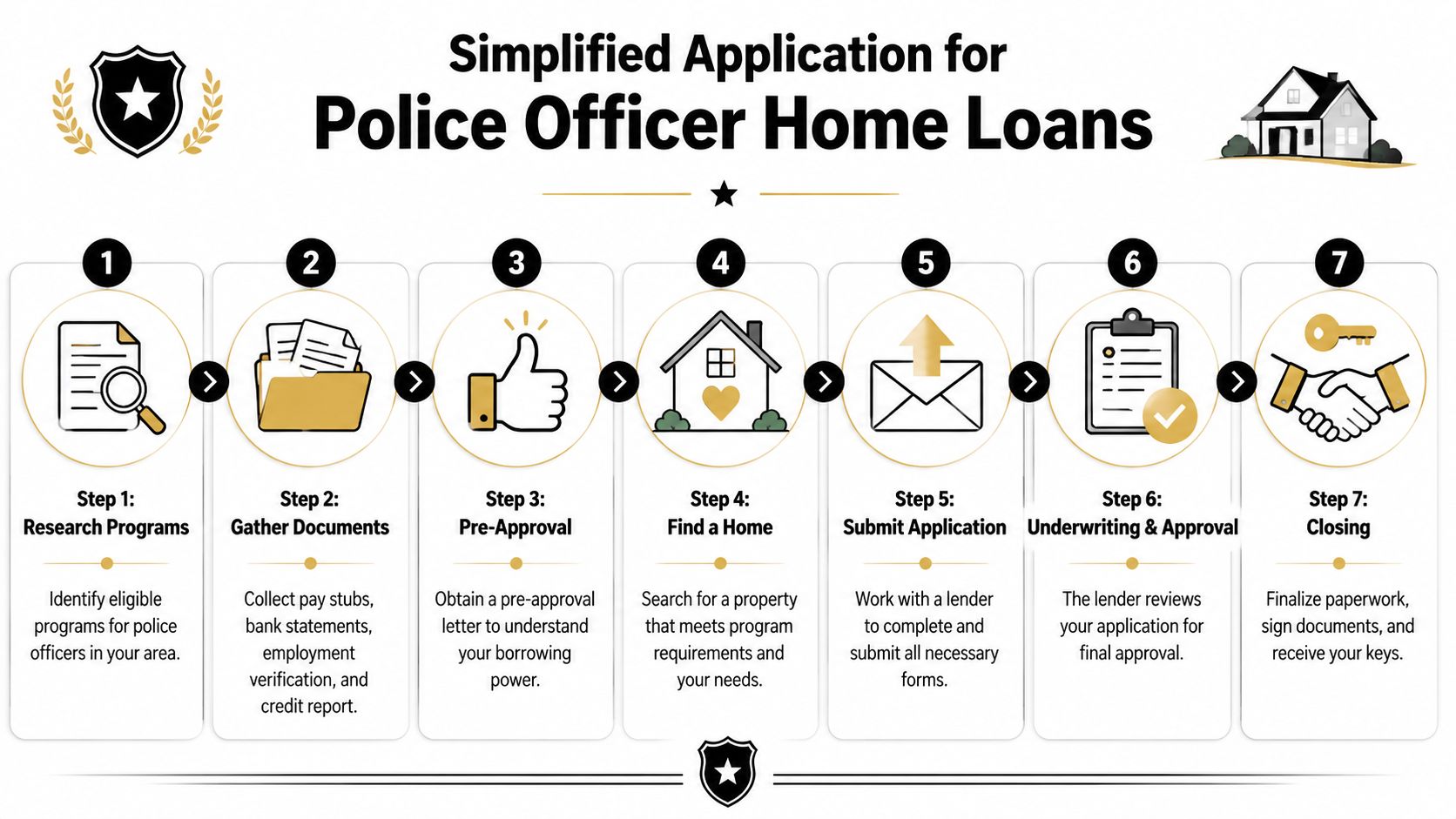
Step through it in order
Review your finances thoroughly
Start with the basics. Pull together income documents, check your available funds, and look at recurring debt. You don't need perfection. You need clarity.Choose a lender who understands officer programs
A generic loan quote isn't enough. You want someone who knows how first responder programs fit with conventional financing, assistance options, and California realities. That cuts down on missed opportunities and bad assumptions.Get pre-approved before shopping seriously
Pre-approval tells you what the lender will support and what your monthly range looks like. It also keeps you from wasting weekends on homes that don't fit the plan.
Get the financing framework settled before you fall in love with a property. Buyers make expensive decisions when emotion outruns math.
Ask whether assistance requires separate approval
Some programs involve more than the first mortgage file. That means extra forms, timing issues, or homebuyer education requirements. Don't assume your first approval automatically covers every layer of assistance.Shop with property rules in mind
Not every program works on every property. Condos, one-unit homes, and location-specific purchases can all trigger different rules. Know those limits before you write offers.
What to expect near closing
The last stage is where details matter. Your lender will finalize conditions, verify employment, confirm funds, and work through title and closing documents. This is also where buyers need a clear estimate of their cash to close and any credits or assistance being applied.
Use a checklist, not memory.
- Income paperwork ready. Keep pay stubs, statements, and job documentation current.
- Funds documented. Large unexplained deposits can slow things down.
- Program conditions tracked. If the assistance requires education or extra signatures, get them done early.
- Closing numbers reviewed. You should understand where every dollar is going before signing.
If you treat the mortgage like a shift handoff, it goes smoother. Be organized, be early, and don't leave loose ends for the last minute.
Important Financial Considerations to Know
The best program on paper can become a problem if you ignore the fine print. In this way, disciplined buyers protect themselves.
Occupancy and repayment rules matter
If you use HUD's Good Neighbor Next Door benefit, you're committing to occupy the home as your primary residence for three years under the Good Neighbor occupancy rules. That requirement isn't decorative. If your career path or personal life makes an early move likely, think carefully before using a program with a hard occupancy condition.
Assistance can also come with different repayment triggers. A grant may not need repayment. A deferred second may be dormant until you sell or refinance. A forgivable structure may only stay favorable if you remain in the home long enough. Those aren't small differences. They affect your exit options.
Closing costs and tax details
A lot of officers focus on down payment and underestimate closing costs. That's a mistake because a loan can look affordable until the final settlement figures arrive. Before you commit, make sure you understand the line items involved in California closing costs and fees.
Tax treatment is another area where people get sloppy. Some assistance is structured like a grant. Some is clearly a loan. Some state programs also tie in a Mortgage Credit Certificate, which can improve affordability over time. If a program includes a tax component, run it past a qualified tax professional before assuming how it will affect your return.
The safest home purchase is the one you can still live with after a transfer, refinance, or life change. Read the exit rules before you sign the entry papers.
Taking the First Step Today
California homeownership isn't easy for law enforcement, but it's not out of reach either. Officers who buy successfully usually do three things well. They choose the right base loan, reduce upfront cost with the right assistance, and avoid programs that create more restrictions than value.
That is the correct path. Not waiting for the market to become easy, and not assuming every lender knows how to structure home loans for police officers in California.
If you're serious about buying, stop guessing. Get your numbers reviewed, find out which programs fit your county, price range, and timeline, and build a plan around your real cash to close. That's how you move from browsing listings to making a smart offer.
If you're ready to see what you may qualify for, talk with California Loans for Heroes. Their team helps California law enforcement officers review mortgage options, down payment assistance, lender credits, and homebuyer support with one-on-one guidance and no-obligation next steps.