
You just got your first California property tax bill, and the number looks bigger than the lender's estimate. That's usually where first-time buyers get tripped up. The mistake is simple, they assume the bill is based on the full purchase price and a single flat rate, when California taxes are built from assessed value, local levies, and a few extra charges that show up after closing.
If you want to know how to calculate property taxes without guessing, start with the tax base, not the market price. Then work through the local rate, any voter-approved debt, and the separate bills that can arrive later. That's the only way to read the statement like a homeowner instead of a speculator.
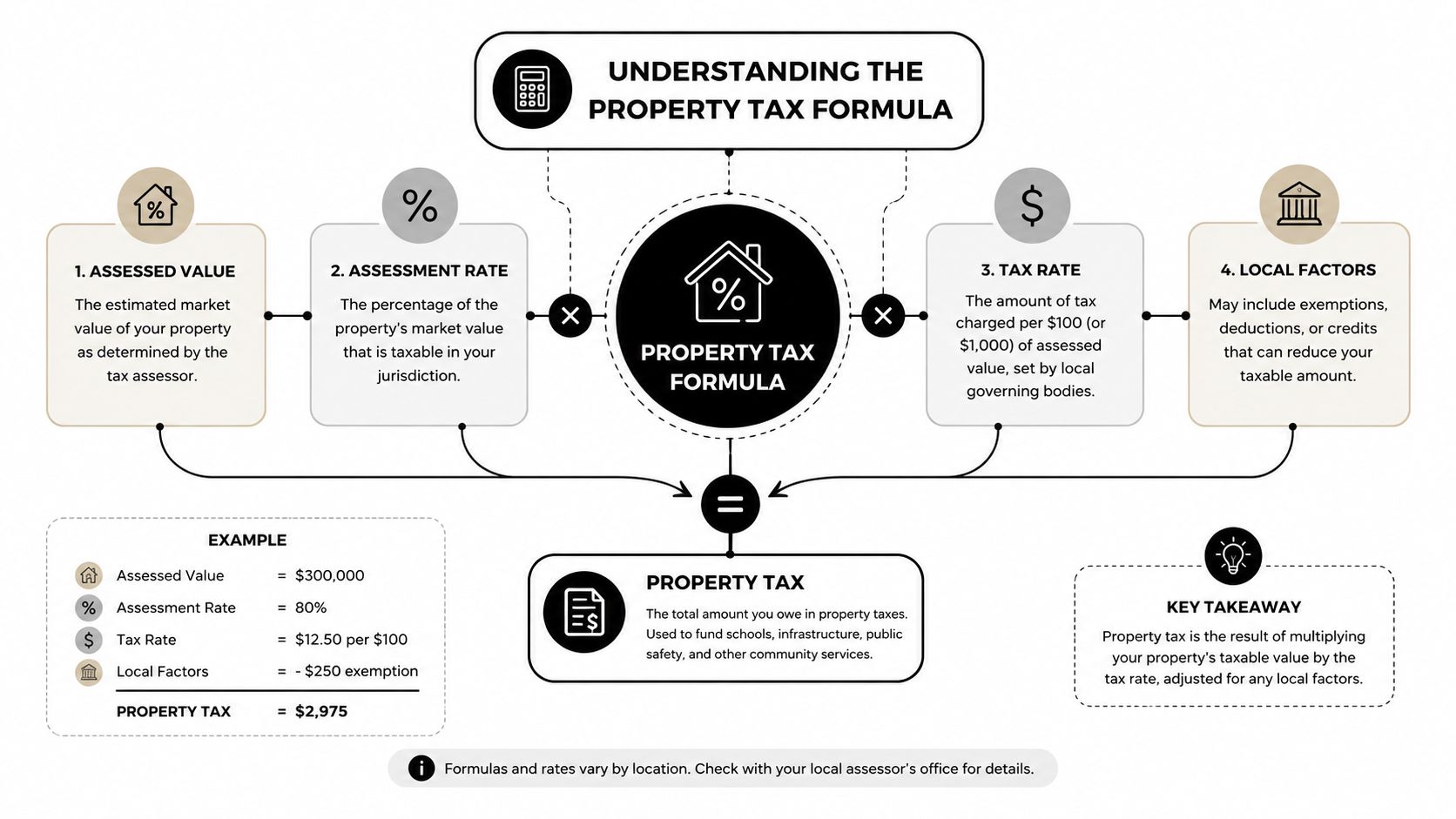
Understanding the Property Tax Formula
The first thing to stop doing is multiplying the sale price by a random percentage and calling it a tax estimate. That shortcut misses the structure of the bill. Property taxes are usually based on assessed or taxable value, then multiplied by a local tax rate or mill rate, which is why two homes with the same market price can end up with different tax bills depending on local rules and exemptions.
Start with the taxable base, not the market price
New York State spells out the core math clearly, Taxes owed = taxable assessment × property tax rate per thousand, with the rate per thousand calculated as (tax levy ÷ total taxable assessments) × 1,000 (New York property tax calculation formula). Tennessee uses the same basic structure, but adds a legally fixed assessment ratio first. Residential and farm property are assessed at 25% of appraised value, while commercial and industrial property are assessed at 40% (Tennessee property tax bill formula).
That's the part many buyers miss. The tax base can be far below market value, so the final bill can change a lot even when the local rate stays the same. In practice, you identify the jurisdiction's assessment rules first, compute the taxable value second, and apply the tax rate last.
Why local rates matter so much
The rate itself is not fixed in a vacuum. Indiana defines the tax rate as aggregate tax levy ÷ aggregate net assessed value, and the individual bill as (tax rate × net assessed value) − tax credits (Indiana property tax guidance). Tennessee says county commissions set rates based on the amount of money budgeted to fund services, so the rate changes with local spending needs and the size of the tax base (Tennessee property tax bill formula).
Practical rule: If you don't know the assessment rule and the local levy structure, your estimate is just a guess.
That's why mortgage lenders ask for both property value and local tax rate. Annual property tax is commonly estimated as (assessed or taxable value) × local rate, then adjusted for exemptions, credits, and special levies (Indiana property tax guidance). If you're trying to budget correctly, that sequence matters more than the headline sale price.
California Property Tax Rules Under Prop 13
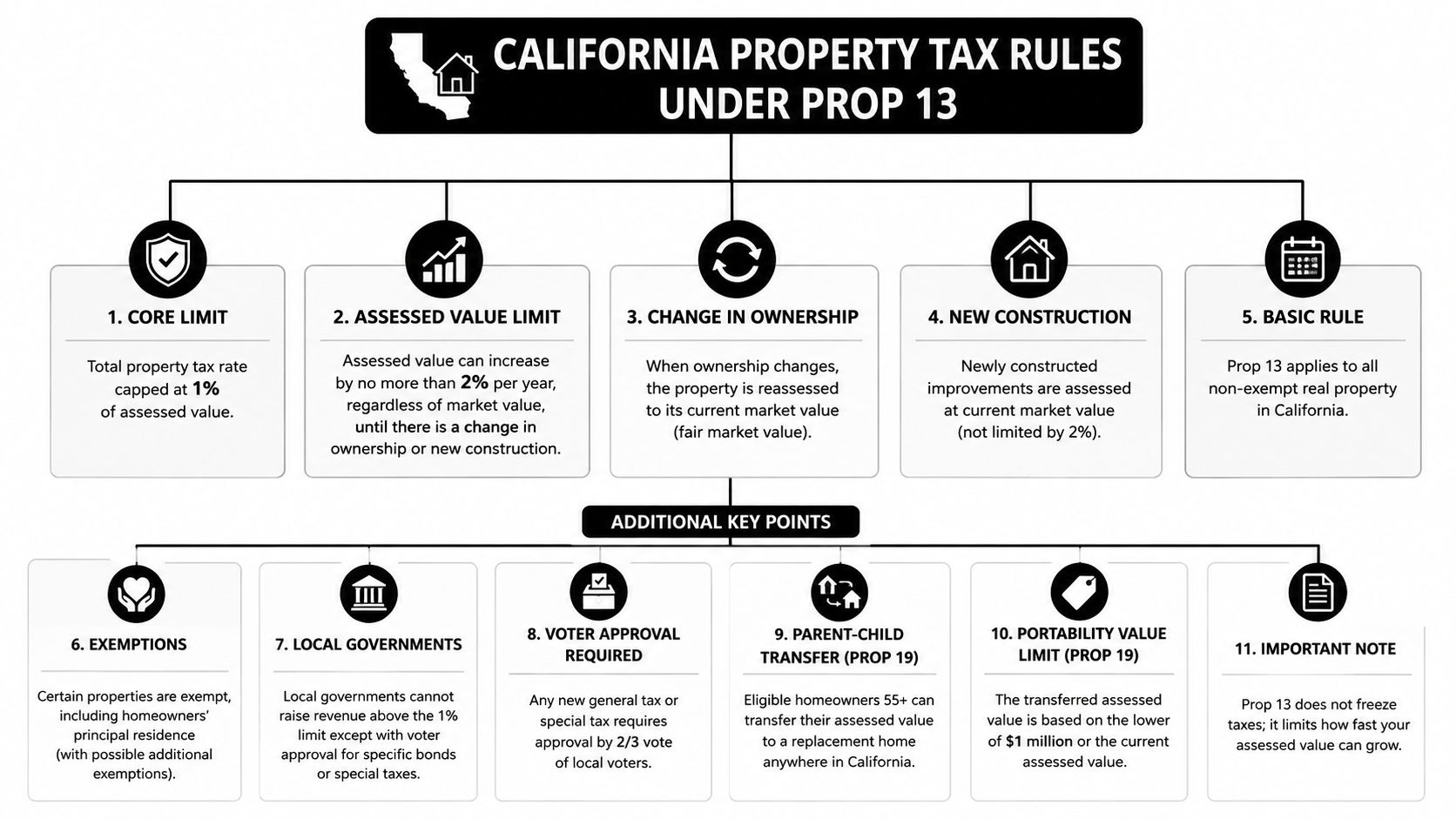
California buyers need to think differently from buyers in states that rely on a simple annual rate. Proposition 13 is the reason. It limits how the assessed value can move over time, so your tax bill is tied to the county's assessment rules and your purchase history, not just the home's market value.
What Prop 13 changes at closing
For most first-time buyers, the taxable value gets reset at purchase. That means the bill you see after closing often looks much closer to the price you paid than the seller's old bill did. Long-time owners can have a much lower assessed value because their tax base has been protected over time, which is exactly why comparing your bill to a neighbor's bill usually leads nowhere useful.
California also keeps the basic structure simple on paper, but the final number isn't always simple in real life. The state's system relies on assessed value first, then local tax calculations after that. That's the right order, not the other way around.
The base rate is only the starting point
The mistake is thinking California property tax equals one clean percentage. The state's framework starts with the assessed value and then layers on the local rate, plus voter-approved debt and other local charges where applicable. That's why the same county can produce different bills across neighborhoods, even when homes look similar on paper.
New York City's official breakdown is a useful comparison because it shows how assessment tiers can differ by class, with 6% for Tax Class 1 and 45% for all other classes before exemptions are subtracted (NYC property tax calculation). California doesn't use that exact structure, but the lesson is the same. The taxable base is what drives the bill, not the sticker price alone.
Read the bill like a homeowner
If you're buying in California, don't accept a lender's estimate without checking whether the figure includes local debt, bonds, or special assessments. The county tax bill usually reflects more than one layer of taxation, and those layers can make a material difference. Once you understand that, Prop 13 stops being a mystery and starts being a guardrail.
Worked Example of a California Property Tax Bill
A clean example is the fastest way to understand the math. Say you're buying a California home and the county sets the taxable value based on your purchase price. You still need to translate that value into an annual bill and then into a monthly escrow figure so you know what your mortgage payment will feel like.
Break the bill into pieces
Use this as the sequence, not a shortcut.
| Calculation Step | Value | Notes |
|---|---|---|
| Purchase price / taxable value | Home price you paid | This is the starting point for the estimate |
| Base property tax | Taxable value × base rate | California bills usually start here |
| Local voter-approved debt | Added on top of the base tax | This can vary by county and district |
| Annual property tax estimate | Base tax plus local charges | This is the yearly figure to budget for |
| Monthly escrow estimate | Annual estimate ÷ 12 | Use this for mortgage planning |
Realtor.com gives a straightforward arithmetic example, if a home is worth $200,000 and the property tax rate is 4%, the annual tax is about $8,000 (Realtor.com property tax example). Zillow's calculator explanation uses the same annual formula, Annual property tax = Property value * (Property tax rate % / 100), and then divides by 12 for a monthly estimate (Zillow property tax calculator explanation).
The monthly escrow number is only useful if the annual tax estimate is honest. Leave out local add-ons, and you underbudget.
What the example should teach you
The point isn't that every California bill follows one universal percentage. The point is that the bill is built step by step, from the taxable value to the annual levy, and then to the monthly escrow. If you're comparing homes, use the same method every time. That's how you avoid getting surprised after closing, when the tax line item lands in your mortgage payment.
Supplemental Taxes, Mello-Roos, and Special Assessments
A lot of California buyers get blindsided. The monthly mortgage payment looks manageable, then the tax bill arrives with something extra on it. That extra line is often a supplemental tax bill, a Mello-Roos charge, or another special assessment tied to the neighborhood.
A buyer in a newer master-planned community usually feels this first. The base property tax looks normal, but the district charge pushes the total higher than expected. A buyer in an older subdivision may not see the same add-ons at all, which is why two homes in the same city can carry very different annual burdens.
Supplemental taxes show up after reassessment
When a property is reassessed after purchase, a supplemental bill can follow. That bill is tied to the change in taxable value, not to some hidden fee from the lender. It often catches buyers because the normal mortgage payment already started, so the extra notice feels unexpected even though it's part of the local tax structure.
Mello-Roos and special assessments are neighborhood-specific
Mello-Roos is a community facilities district tax, and it's usually attached to newer developments. Special assessments can also fund roads, infrastructure, lighting, or other local projects. If the home is in one of those areas, the tax bill can be higher than a simple base-rate estimate suggests.
Before you buy, read the preliminary title and closing documents carefully, and cross-check the tax details with the property records. If the paperwork points to a special district or a complex title issue, review the title search and insurance guidance before you assume the monthly payment is complete.
If a home sits in a special district, the purchase price is only part of the story. The tax bill tells you whether the neighborhood comes with an extra layer of cost.
For planning, treat these add-ons as part of the true housing cost, not as a surprise to be “figured out later.” If the community has special assessments, ask about them before closing. That's the difference between a budget that works and a payment that keeps drifting upward after move-in.
Finding Assessed Value and Tax Rates Online
You do not need to wait for the annual bill to verify the numbers. County assessor and tax collector websites usually give you the data you need to check assessed value, tax rates, and any extra assessments before you buy or refinance. That's the cleanest way to confirm whether your lender's estimate is realistic.
What to look for on official sites
Start with the parcel record or assessment page. Then check the tax rate page, because the rate is often split across multiple local jurisdictions. If the county lists school, city, county, or special-district components separately, add them up before you compare the total to your mortgage estimate.
A good habit is to cross-reference the assessor's value with the tax collector's current bill. If the assessor shows a different taxable value than what your lender used, your payment estimate may be off. If exemptions appear on the record, make sure they're applied to the parcel you're buying.
How to estimate escrow without guessing
Once you've found the annual tax amount, divide by 12 to get a monthly estimate, the same basic step Zillow uses in its calculator explanation (Zillow property tax calculator explanation). That gives you the escrow figure you should expect to see built into the mortgage payment.
Keep your eye on the tax bill itself, not just the headline rate. The rate matters, but the taxable value and any local add-ons matter just as much. If the official records don't match the lender's worksheet, trust the county data and push for a correction before closing.
Exemptions, Appeals, and Payment Options
If your assessed value looks too high, don't sit on it. Challenge it. Property taxes are not something you just accept because they arrived in an official envelope. A clean appeal, backed by the right documents, can change the bill if the county has overvalued the property.
Use exemptions before you pay more than you need to
Some homeowners qualify for exemptions that reduce the taxable amount. Veterans, seniors, and disabled homeowners should check eligibility early, because those programs can lower the bill before the payment is due. Public service professionals should also ask about special programs tied to their status, since those options are often overlooked until after the first payment shock.
The main point is simple. If you qualify, file the exemption. Don't assume the lender did it for you. And if your bill is still too high, compare the assessed value to recent evidence, not to a neighbor's tax bill.
Appeal the number with proof, not frustration
A strong appeal usually starts with the county's own records, recent comparable sales, and any documentation showing the property was over-assessed. If the assessment doesn't match the market reality at the time of purchase, you have a reason to ask for review. Bring facts, keep the argument tight, and submit the appeal on time.
Payment plans matter when cash flow is tight
If the bill is manageable annually but rough in one lump sum, use the payment structure your county or lender allows. Impound accounts spread the cost into monthly mortgage payments, and installment plans can keep the bill from overwhelming your cash flow. That's especially useful for first-time buyers who are already juggling closing costs, move-in expenses, and reserves. For a practical look at those upfront costs, see the closing costs breakdown.
A property tax bill is not just a number to memorize. It's a cash-flow problem, and the right payment setup solves that problem before it grows.
Key Takeaways for California Homebuyers and Homeowners
California property taxes are easiest to understand when you stop looking for one flat formula. Start with assessed value, then layer in the local rate, voter-approved debt, and any special assessments. For California buyers, Prop 13 makes the assessed value the critical number, which is why the seller's old bill rarely tells you what your payment will be.
Use this checklist every time:
- Verify the taxable value on the county record before you close.
- Check local tax components so you don't miss bonds or district charges.
- Look for supplemental taxes after purchase if the property was reassessed.
- Ask about Mello-Roos and other special assessments in newer communities.
- Apply exemptions and appeals as soon as you know you qualify.
- Convert annual tax to monthly escrow by dividing by 12.
If you're a HERO professional, including veterans, teachers, first responders, and healthcare workers, you should be especially disciplined here. Your mortgage payment only works if the tax estimate is realistic. Use the home buying checklist to keep the rest of the transaction on track.
California Loans for Heroes helps California buyers, especially veterans, first responders, teachers, and other public service professionals, make sense of the full homeownership budget, including taxes, escrow, and closing costs. If you're trying to buy with confidence and keep your numbers straight from day one, visit California Loans for Heroes and get guidance that's built around the costs of owning a home in California.