
You finish a long shift, pull into the driveway of a rental you're tired of paying for, and open another round of California listings on your phone. The homes near your agency are expensive. The commute from the places you can afford is punishing. Your schedule makes it hard to chase listings, gather paperwork, and compare financing options without feeling like you've picked up a second job.
That frustration is real. So is the opportunity.
A lot of officers assume buying in California is out of reach unless they've saved a huge down payment or they're willing to settle far from the community they serve. I think that's the wrong assumption. The smarter move is to look at law enforcement home buying programs early, before you rule yourself out. Some programs reduce upfront cash needs. Some help with closing costs. Some open up financing paths that a generic lender won't explain clearly.
The key is choosing the right program for how you get paid, where you want to live, and how much flexibility you need. Most officers don't need more motivation. They need a cleaner decision framework.
Your Path to Homeownership as a California Officer
You're probably not starting from a blank slate. You've likely already done the math in your head during meal breaks or after shift change. Mortgage payment. Rent. Utilities. Gas. Overtime that helps one month and disappears the next. A home starts to feel possible, then impossible, then possible again depending on the week.
That back-and-forth keeps a lot of officers stuck.

The problem usually isn't a lack of discipline. It's that California housing punishes guesswork. If you're relying on broad internet advice or a lender who doesn't understand officer income, you can waste months chasing the wrong target. Overtime, shift differentials, special assignment pay, and timing around contract raises all matter. So does whether the assistance program you choose fits the property and your long-term plans.
That's why I tell California officers to stop treating this like a generic first-time buyer process. It isn't. You need a path built around your profession and your market. Programs created for public servants can make the gap between “still renting” and “under contract” a lot narrower, especially if you start with a specialist who already works with officers. A focused starting point like the California law enforcement home loan options page gives you a better overview than a random search result ever will.
What changes when you use the right program
The right program does three practical things:
- It lowers the cash barrier: You may not need to carry the full burden of down payment and closing costs alone.
- It reduces confusion: Instead of forcing a standard borrower profile onto a non-standard pay structure, the process accounts for how officers earn.
- It gives you a decision path: You can evaluate statewide options, federal options, and profession-specific help without mixing up rules.
Buying a home in California as an officer isn't about finding a miracle program. It's about stacking the right advantages and avoiding the wrong loan setup.
If you're serious about buying, you don't need more vague encouragement. You need a plan that works in practice.
What Exactly Are Law Enforcement Home Buying Programs
Law enforcement home buying programs are financing and assistance options designed to help officers clear the biggest barriers to homeownership. They exist because public servants often face high local housing costs while working in the very communities that depend on them.
In California, that mismatch is serious. First responders can face a home affordability gap of over 25% compared to other professions, which makes specialized assistance programs more than a nice extra. It makes them a practical tool for getting into a home in the first place, according to the California Association of Realtors Housing Affordability Index.
Why these programs exist
Agencies, housing organizations, and lenders all understand the same basic point. Communities benefit when officers can afford to live where they work or at least buy within a realistic distance. Stable housing supports family life, reduces commute pressure, and gives officers a chance to build long-term equity instead of staying trapped in rising rent cycles.
That's the big picture. The practical side is simpler. These programs try to reduce friction at the exact points where most buyers get stuck.
The three forms of help that matter most
Most officer-focused programs fall into a few clear buckets:
- Down payment assistance: Think of this as help with the biggest pile of cash you usually need upfront. Depending on the program, it may come as a grant, a deferred-payment second loan, or another assistance structure tied to the purchase.
- Closing cost credits: These work like a direct reduction in some of the expenses tied to finalizing the loan and transfer. They don't solve everything, but they can make closing feel far more manageable.
- Favorable loan terms: Some programs pair assistance with competitive mortgage structures or terms that improve affordability and make qualification more realistic.
What this means in real life
If you're an officer trying to buy, these programs aren't abstract financial products. They change the shape of the transaction.
A down payment program can shorten the time you need to save before you're ready. A closing credit can keep you from draining your reserves at the finish line. Better loan terms can make the monthly payment more workable.
Practical rule: Don't judge a program by the headline alone. Judge it by how it affects your upfront cash, monthly payment, property choices, and future flexibility.
Some programs are broad and government-backed. Others are designed for people in service professions. The smart move is to understand the category first, then compare the actual fit.
Exploring California's Top Home Buying Programs for Officers
California officers usually end up looking at three lanes. Profession-focused programs. Statewide assistance. Federal niche options. You shouldn't treat them as interchangeable because they solve different problems.
A broad search can bury that distinction. A clean search separates flexibility, eligibility rules, and property restrictions right away.

HERO Home Loan and Buyer Rewards Program
The HERO program from California Loans for Heroes is built around California public service professionals, including law enforcement. That matters because officer income rarely fits a simple salary-only template. If your compensation includes overtime, shift pay, or specialized duty income, you want a program and lending team that understand how those factors affect qualification and planning.
What stands out here isn't just the mortgage itself. It's the combination of homebuyer assistance pathways, competitive financing options, buyer rewards, and one-on-one guidance designed for California HEROES. For many officers, that kind of flexibility is the deciding factor. You're not trying to force your goals into a rigid box. You're trying to build a workable purchase strategy around your actual profile.
CalHFA MyHome Assistance
CalHFA MyHome Assistance is one of the most recognized statewide options. Officers often look at it because it's tied to the larger California housing assistance ecosystem and can be useful when upfront cash is the main obstacle.
The reason to take it seriously is straightforward. State-backed assistance programs can help buyers who qualify under the program rules get through the hardest part of the purchase, which is often the money due before and at closing. The tradeoff is that statewide programs usually come with tighter eligibility standards and more structured requirements than a flexible profession-focused option.
Good Neighbor Next Door
Good Neighbor Next Door is a HUD program that gets attention for one reason. It can offer a steep purchase discount for eligible law enforcement officers. That headline benefit is real, but the program is not broad-use. It applies to homes in designated revitalization areas, and the occupancy commitment matters.
That means this is not the right fit for every officer. If the location works, the property inventory lines up, and you're comfortable with the occupancy rules, it can be worth serious attention. If not, the program can become a distraction.
Local city and county programs
This is the category many buyers ignore, and that's a mistake.
Some cities, counties, and regional housing agencies offer their own assistance for public employees, first responders, or moderate-income buyers. These local programs can sometimes pair well with a primary mortgage, but they often have narrow boundaries. Geography, employer type, household income, property location, and timing can all affect access.
Here's the search approach I recommend:
- Check your city housing department: Search your city name plus “down payment assistance” or “homebuyer assistance.”
- Check the county housing authority: Counties often publish buyer assistance resources in one place.
- Ask whether officers receive preference: Some local programs give public-serving workers special consideration.
- Verify current funding status: A program can exist on paper and still be temporarily unavailable.
The real takeaway
Most officers shouldn't shop by brand name alone. They should shop by fit.
If you want broad flexibility and guidance designed for officer realities, the HERO path deserves close attention. If you meet state criteria and need structured down payment help, CalHFA may fit. If you're open to specific neighborhoods and strict occupancy rules, Good Neighbor Next Door may be compelling. Local programs are worth checking because they can add another layer of support if available.
Comparing Your Options HERO Program vs Other CA Programs
Officers usually ask the same question after hearing the menu of options. Which one should I use?
The answer depends on what problem you're trying to solve. If your biggest issue is flexibility, one program rises. If your profile fits a state program's eligibility rules, another may help. If you're willing to buy in a designated revitalization area and live under that program's occupancy terms, the federal option can be powerful.
Program Comparison HERO vs. CalHFA vs. Good Neighbor Next Door
| Feature | HERO Program (CA Loans for Heroes) | CalHFA MyHome Assistance | Good Neighbor Next Door (HUD) |
|---|---|---|---|
| Core focus | California HEROES, including law enforcement officers | Statewide buyer assistance for qualified California buyers | Eligible public servants buying HUD-listed homes in designated revitalization areas |
| Main benefit type | Homebuyer assistance options, buyer rewards, lender support, and mortgage guidance | Down payment assistance structure tied to program eligibility | Discounted purchase opportunity on eligible homes |
| Flexibility | Strong for officers who want a profession-focused option and a wider planning conversation | More rule-driven and dependent on qualifying standards | Narrow, because property location and program rules drive the choice |
| Property limitations | Depends on loan and program fit | Depends on CalHFA and first mortgage requirements | Must be an eligible HUD home in a designated area |
| Repayment structure | Varies by loan and assistance setup | Program-specific | Program-specific occupancy obligations apply |
| Best for | Officers who want a versatile path and hands-on guidance | Buyers who fit statewide criteria and need structured assistance | Officers whose target property and lifestyle align with HUD restrictions |
Which program fits which officer
If you want the most practical flexibility, the HERO program usually has the edge. That's especially true if your income is more complex than a base-salary borrower profile or you want to compare multiple assistance routes without boxing yourself into a single statewide formula too early. Officers who are actively shopping should also keep an eye on California police and fire mortgage rates because rate structure can change the whole affordability equation.
If you already know you fit CalHFA-style rules and your main challenge is upfront cash, CalHFA may be the cleaner lane. It's a serious option, but it rewards buyers who don't mind operating within defined program parameters. If you hate paperwork surprises or need unusual flexibility, it can feel restrictive.
Good Neighbor Next Door is the special scenario option. When it matches, it can be excellent. When it doesn't, it wastes time. Officers often get seduced by the headline and ignore the property limits, location reality, and occupancy commitment.
The best program isn't the one with the loudest marketing. It's the one you can actually qualify for, use on the right property, and live with after closing.
My recommendation
Start broad, then narrow fast.
- Check profession-focused options first if you want guidance and flexibility.
- Layer in CalHFA if upfront funds are your main barrier and you match the rules.
- Evaluate Good Neighbor Next Door last, because it depends so heavily on location and inventory.
That sequence saves time and cuts down on dead ends.
A Step-by-Step Guide to Applying for Assistance
A lot of officers overestimate how mysterious this process is. It's paperwork-heavy, yes. It's not impossible. If you handle it in the right order, it becomes manageable.
The mistake is trying to house hunt first and figure out financing second. That's backward.
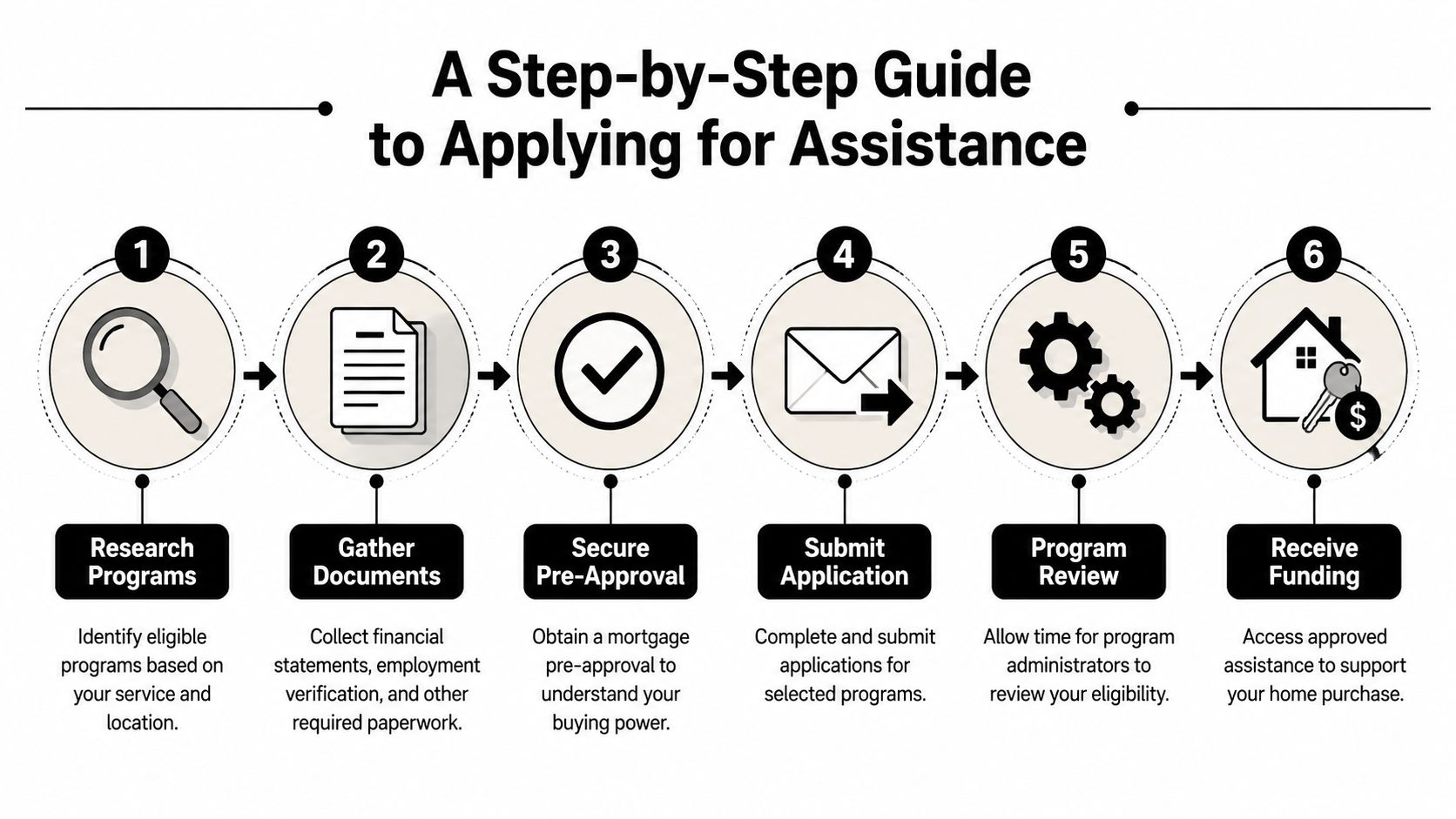
Step 1 Research the right programs
Don't apply everywhere blindly. Narrow your list based on profession, location, occupancy plans, and whether you need help with down payment, closing costs, or both.
If you're buying your first place, this kind of step-by-step home buying guide helps you keep the process in order instead of bouncing between listings and lenders.
Step 2 Get pre-approved before you shop
Pre-approval tells you what a lender is willing to support and what payment range makes sense. For officers, this matters even more because income documentation can get messy if overtime or special assignment pay enters the picture.
Bring clarity to the front end. Don't wait for underwriting to discover issues that should have been handled on day one.
Advisor note: The best pre-approval isn't the fastest one. It's the one that survives scrutiny once your file gets fully reviewed.
Step 3 Gather documents early
Most buyers scramble here. You shouldn't.
Have these ready:
- Income records: Recent pay stubs, W-2s, and any documents that help explain your compensation structure.
- Asset documents: Bank statements and records showing where your available funds are coming from.
- Employment proof: Agency employment verification if requested.
- Identification paperwork: Government-issued ID and any additional items the lender needs for compliance.
If part of your qualifying strength comes from recurring overtime or specialty pay, ask upfront how the lender wants that documented.
Step 4 Shop for a home that fits the program
Not every property works with every assistance setup. Some programs have occupancy rules. Some have property-type limits. Some work better with standard owner-occupied purchases than with edge-case properties.
Buyers waste energy when they fall in love with a home before checking whether the program allows it.
Step 5 Submit the mortgage and assistance application together
Coordination matters. Your mortgage file and assistance request can't move like they belong to separate transactions. They need to line up on timing, documentation, and property details.
That means your lender, real estate agent, and any program administrator need clean communication. Sloppy coordination is how closings get delayed.
Step 6 Stay responsive through underwriting and closing
Underwriting is where buyers disappear for a few days and create their own problems. Don't do that.
Reply fast. Upload documents cleanly. Ask direct questions when something is unclear. Closing goes far smoother when you treat lender requests like part of the job, not background noise.
A simple rule works well here:
- Respond the same day when possible
- Don't change jobs, accounts, or major spending habits mid-transaction
- Keep your paperwork trail clean until keys are in hand
You don't need a perfect file. You need an organized one.
How California Loans for Heroes Serves You
A generic lender sees a file. A specialist sees a police officer's real pay structure and knows where the friction points are likely to show up.
That distinction matters. Officers don't get paid in tidy, always-identical patterns. Income can include overtime, shift differentials, holiday pay, and special assignments. If the loan team doesn't understand how to evaluate that correctly, the process gets slower, more confusing, and less strategic than it needs to be.
Why specialization matters for officers
California Loans for Heroes is built around service professionals, and that focus is the advantage. The team works with California HEROES, including law enforcement, and understands the parts of qualification that often get misunderstood by standard lenders.
That matters in a few specific ways:
- They understand officer compensation: That helps when your income picture goes beyond base pay.
- They offer the HERO Home Loan & Buyer Rewards Program: That creates a more personalized path than a one-size-fits-all mortgage conversation.
- They provide one-on-one support: Buyers don't need a maze. They need direct guidance from application through closing.
My view as an advisor
If you're an officer buying in California, I think using a specialist is the smart move. Not because every statewide or federal option is bad. They're not. But because most officers benefit from a guide who can compare those options while also understanding the profession-specific details that shape approval, affordability, and timing.
A lender who knows law enforcement doesn't just talk about rates. They help you build a purchase strategy that actually survives underwriting.
That's the core service. Less confusion. Better fit. Fewer avoidable mistakes.
Frequently Asked Questions About Police Home Loans
Can I combine different assistance programs
Sometimes, yes. The key issue is compatibility. Some programs can be layered, while others restrict how assistance can be combined. You need to check occupancy rules, repayment structure, and whether the first mortgage program allows subordinate assistance.
Are there strict income limits I need to worry about
In some programs, absolutely. State and local assistance often comes with income-based eligibility rules. Profession-focused options may be more flexible, but you still need a full qualification review. Don't assume you make too much or too little until someone checks the actual program guidelines.
Do I have to be a first-time home buyer to qualify
Not always. Some programs are aimed at first-time buyers, but not every law enforcement home buying program uses that rule the same way. Repeat buyers may still have options, especially if they meet occupancy and loan requirements.
What happens if I change careers after using one of these programs
It depends on the program terms you agreed to at closing. Some assistance programs care mainly about your status at the time of purchase. Others may impose occupancy or compliance requirements that continue after closing. If you think a career move is possible, raise that issue before you commit.
The wrong time to read the fine print is after you've signed it.
If you're a California police officer and want a clearer path to buying, talk with California Loans for Heroes. Their team focuses on California HEROES, understands law enforcement income, and can help you compare the HERO program with other options so you can move forward with a plan that fits your job, your budget, and your timeline.