
You're probably looking at listings in your county, running numbers after shift, and wondering how people on a public salary are still buying in California. Maybe you're a police officer with strong overtime that doesn't show cleanly on an online mortgage calculator. Maybe you're a firefighter working a schedule that makes your income look uneven on paper even though it's solid in real life.
That's exactly where a lot of first responders get stuck. Not because they can't afford a home, but because they're trying to fit a police or fire pay structure into a generic lending process built for salaried office jobs. That's a mistake.
If you're searching for police and fire mortgage rates, you need to stop thinking only about the headline rate and start looking at the full loan package, the way your income is evaluated, and which California-specific programs help at closing. In this market, shaving cash due at signing can matter just as much as a slightly lower note rate. Sometimes more.
Your Guide to California First Responder Home Loans
A California firefighter I talk to often follows the same pattern. Good job. Stable career. Pension. Overtime available. Strong work history. Then he starts house hunting and gets hit with reality. Home prices feel detached from public servant income, especially in coastal counties and major metro areas.
Police officers deal with the same thing. Base pay may look modest compared with local home prices, but total compensation can be much stronger once overtime, special assignment pay, and consistent shift differentials are counted correctly. The problem is that many lenders don't understand how to read that income properly. They see complexity and slow the file down, or they undercount qualifying income.
That's why first responder mortgage planning in California has to be specialized. You don't need a lender who says “thank you for your service” and then underwrites you like everyone else. You need a lender who understands a pay stub from a city department, a county agency, or a fire district and knows how to present that income clearly.
Practical rule: If your loan officer can't explain how overtime, specialty pay, and pension deductions affect qualification, keep shopping.
The right program can change the deal structure, reduce cash needed at closing, and make a purchase more realistic without forcing you into a sloppy financial decision. That matters if you're trying to buy your first place, move closer to the station, or get your family out of a rental that keeps getting more expensive.
California first responder home loans aren't magic. They are useful. Used correctly, they can turn a frustrating search into a workable plan.
What Are Police and Fire Mortgage Programs
Police and fire mortgage rates aren't one official rate set aside by the government for every officer or firefighter. That's the first misconception to kill. What people usually mean is a group of lender benefits, discounts, credits, and underwriting advantages designed for first responders.
Think of it less like a single discount and more like a benefits package for your mortgage.
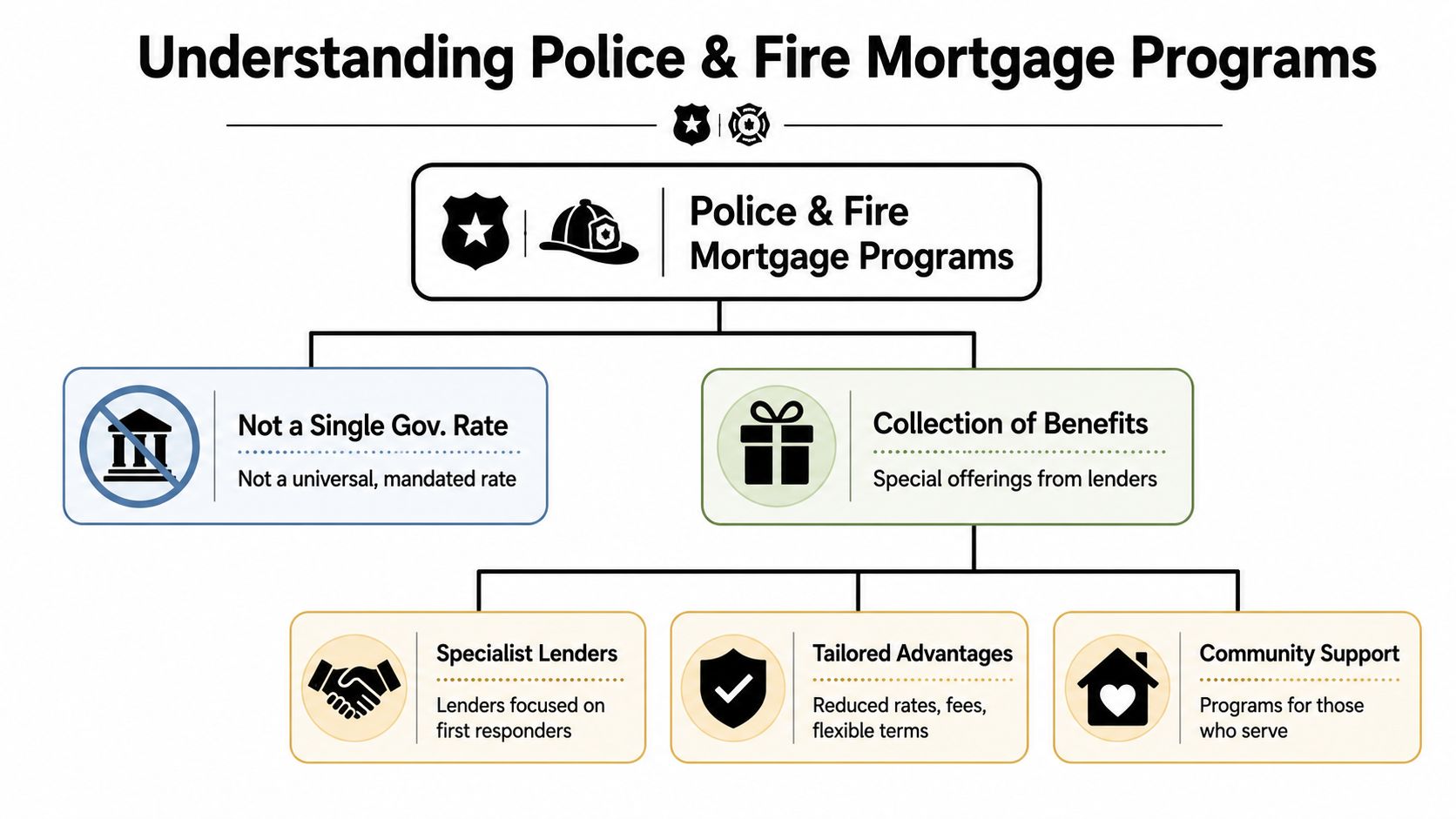
It's not just about the interest rate
A lot of borrowers fixate on rate and ignore everything else. That's lazy analysis. A slightly better package can beat a slightly lower rate if it cuts upfront expenses, waives junk fees, or gives you more flexibility on how your income is documented.
These programs may include:
- Lender credits: Money applied toward eligible closing costs.
- Reduced lender fees: Some lenders trim or waive certain processing costs.
- Specialized underwriting support: A loan team that understands public safety pay structures.
- Program access: Guidance toward compatible first-time buyer or assistance options.
That's why the phrase “police and fire mortgage rates” can be misleading. The value isn't always sitting in one line on page one of the estimate. Sometimes it shows up in lower cash-to-close, fewer lender charges, or a smoother approval because the loan officer knows what they're doing.
Why specialist lenders matter
Police officers and firefighters often have income that's stable but not simple. A generic retail lender may struggle with overtime history, extra duty, holiday pay, acting assignments, or pension deductions. A specialist sees those items every week.
That changes the experience in practical ways:
- Your application gets structured correctly early.
- Your pay documents get reviewed with context.
- You avoid a lot of bad advice from call-center loan officers.
A good first responder mortgage program should make your file easier to approve, not just cheaper to close.
What you should actually compare
When you're shopping, compare the total package, not just the rate quote on a phone call.
Look at:
- Rate structure: Fixed or adjustable, and how competitive it is.
- Cash needed at closing: Many first responders feel the most pressure concerning this.
- Lender fees: Application, origination, processing, underwriting.
- Income treatment: Whether the lender understands your earnings profile.
- Program fit: Conventional, FHA, or VA compatibility based on your situation.
That's how smart borrowers evaluate police and fire mortgage rates in California. Not as a headline. As a full financing strategy.
Special Loan Programs for California First Responders
California has several lanes for first responders. Some are statewide housing programs. Some are federal. Some are lender-based. The mistake is assuming they all do the same thing. They don't.
The strongest option for many police officers and firefighters is often a specialized lender program that directly addresses closing costs, rate competitiveness, and hands-on support. That's where many buyers get the most immediate benefit.

HERO Home Loan and Buyer Rewards
For California first responders, lender-based hero programs deserve serious attention because they're practical. They're not theoretical benefits that only work in narrow situations. They're built around the main obstacle many buyers face, which is getting through closing without draining reserves.
Specialized lender programs in California, like the HERO Home Loan, can provide first responders with lender credits averaging $2,500 to $5,000, significantly reducing the cash needed at closing according to California Loans for Heroes.
That's meaningful. If you're a police officer or firefighter trying to preserve emergency savings after down payment, inspections, moving costs, and initial repairs, lender credits can do more for your real-life affordability than a flashy marketing promise.
If your employment falls under broader public service categories, it's also worth reviewing government employee home loan options in California to see how profession-specific benefits may overlap.
Other California and federal paths worth checking
Not every borrower should use the same route. Sometimes the best move is pairing a strong first responder lender program with a broader housing option that fits your profile.
A few examples:
- CalHFA loans: These can be useful for buyers who need structured state-level assistance or who fit first-time buyer guidelines.
- VA loans: If you're law enforcement or fire service and also eligible through military service, VA financing can be powerful.
- Good Neighbor Next Door: This is niche, location-dependent, and property-specific, but it's still worth checking if the property and eligibility line up.
My opinion on stacking programs
Here's the honest view. Don't chase every possible assistance program at once. Chasing too many moving parts can complicate underwriting, contract timelines, and your own decision-making.
Instead, do this:
- Start with your loan type: Conventional, FHA, or VA.
- Add the best profession-based benefit: This is often where hero lender programs shine.
- Layer in assistance selectively: Only if it clearly improves the transaction without creating avoidable friction.
The best California first responder financing isn't the one with the longest list of benefits. It's the one that closes cleanly, protects your cash, and fits your actual income.
Rate Differences and Potential Savings Explained
A lot of buyers want a simple answer to this question: how much difference can a specialized first responder loan package really make?
The honest answer is that the exact result depends on your file, the market, the day you lock, your down payment, and your loan type. There is no universal police and fire rate sheet that guarantees one borrower a better interest rate than another. Anyone selling it that way is oversimplifying the process.
What the comparison should focus on
For a hypothetical $700,000 California home purchase, the right comparison isn't just standard loan versus hero loan by interest rate alone. You should compare the full structure:
| Metric | Standard Conventional Loan | HERO Program Loan |
|---|---|---|
| Interest rate | Varies by borrower and market | Varies by borrower, market, and program benefits |
| Monthly payment | Depends on final loan terms | Depends on final loan terms and any rate advantage |
| Upfront lender fees | Standard lender-specific fees may apply | Program-specific fee reductions may apply |
| Application or origination costs | Varies by lender | May be reduced or offset depending on lender program |
| Lender credits | Often limited or standard | May include profession-focused lender credits |
| Cash needed at closing | Typically higher without targeted credits | Can be lower when credits and fee savings apply |
That's the comparison that matters. If your goal is to preserve cash and still get into the right home, upfront savings can carry as much weight as rate.
For a practical framework on evaluating offers, review how to compare mortgage rates the right way.
Don't let a headline quote fool you
A “better” mortgage rate can still be a worse loan if it comes with higher fees, weak lender credits, or a loan team that doesn't know how to handle your income. Police officers and firefighters often lose money by picking the lender with the slickest ad instead of the best total package.
If two loan estimates are close on rate, the tie usually goes to the lender who lowers your cash-to-close and understands your pay structure.
Where the real savings often show up
For many California first responders, the immediate financial win comes from these areas:
- Closing cost relief: Lower cash out of pocket leaves more room for reserves.
- Fee reduction: Less money lost to lender charges.
- Cleaner underwriting: Fewer surprises, fewer delays, fewer rushed fixes.
- Better fit for income: Correct treatment of overtime and specialty pay can improve loan options.
The point isn't that every hero program beats every standard mortgage on every line item. The point is that first responders should compare mortgages like professionals, not like rate shoppers scrolling ads at midnight.
Factors That Determine Your Final Mortgage Rate
Being a first responder can open doors. It doesn't erase underwriting. Your final mortgage rate still comes down to the basics, and you need to understand them clearly if you want the best outcome.
Credit score still matters
No lender gives out great terms just because you wear a uniform. Your credit profile still drives pricing, approval options, and whether you can stay in the loan type you want.
If your credit needs work, fix that before you stretch your budget on a purchase. Pay on time. Reduce revolving balances where possible. Don't open random accounts before applying. And don't let five different lenders pull your file over a long, messy shopping period.
A specialist lender can tell you whether a small score improvement is worth waiting for or whether your current profile is already strong enough to move forward.
Income and DTI are where first responders get misunderstood
This is the big one for police and fire borrowers. Debt-to-income ratio matters, but the main issue is how income gets counted. Overtime, holiday pay, acting pay, shift differentials, and special assignment income may help, but they have to be documented and evaluated properly.
Lenders usually want income that is stable, likely to continue, and well documented. That's why your pay history matters. Consistency matters. The way your employer structures compensation matters too.
Watch these details closely:
- Overtime history: Consistent overtime is more useful than sporadic bursts.
- Special duty or assignment pay: It may count if it's documented and likely to continue.
- Pension deductions: These don't automatically hurt your file, but they do affect how your paycheck looks.
- Secondary income: Some officers and firefighters have side income, and that needs careful review.
Bring pay stubs that clearly show base pay separate from overtime and premium pay. Clean documentation solves a lot of problems.
Loan type changes the outcome
The best loan type depends on your full profile, not your job title.
Conventional
Often a strong fit for borrowers with solid credit, stable income, and enough cash to handle the transaction cleanly.
FHA
Can be useful if your credit or down payment profile needs more flexibility.
VA
If you're eligible through military service, VA financing deserves a serious look. Don't ignore it just because your current career is law enforcement or fire service.
Other pricing factors that move the needle
A few more variables can shape your final offer:
- Down payment size: More money down can improve options.
- Discount points: You may be able to buy down the rate, but it has to make financial sense.
- Property type: Condo, single-family, and multi-unit properties don't always price the same.
- Market conditions: Rates move. Lock strategy matters.
You can't control the whole market. You can control how prepared your file is when you apply.
Your Action Plan to Secure the Best Rate
Most first responders don't need more theory. They need a clean plan. Here's the one I recommend.

Start with a specialist pre-approval
Get pre-approved by a lender who knows first responder files. Not someone who “also does” first responder loans. Someone who sees police and firefighter income every day.
That matters because your pre-approval is only useful if it's based on the right income calculation. If overtime or assignment pay is handled badly upfront, everything after that gets shaky.
Organize documents before you shop seriously
Don't wait until you're under contract to gather paperwork. That creates stress and weakens your negotiating position.
Bring these items early:
- Recent pay stubs: Especially ones that separate base from overtime or specialty pay.
- Tax returns and W-2s: If required for your file.
- Bank statements: To document reserves and funds for closing.
- Employment documents: Award letters, contract details, or employment verification when relevant.
- Pension or retirement statements: Helpful when your compensation structure needs context.
Lock your rate with intent
A rate lock is a decision, not a guess. Once you have an accepted offer and a lender you trust, talk through your lock timing clearly. Don't treat it like background paperwork.
Ask direct questions. What triggers the lock? How long is it good for? What happens if closing shifts? If your lender can't answer those cleanly, that's a red flag.
For buyers trying to preserve cash at settlement, it also helps to study practical ways of reducing closing costs in California.
Don't ignore refinance opportunities
These programs aren't only for purchases. If you already own and your current loan is expensive, poorly structured, or carrying fees that no longer make sense, refinancing may be worth a look.
That's especially true if your income has improved, your credit has strengthened, or your original lender never gave you a first responder-friendly package in the first place.
- Get pre-approved with a specialist
- Build your document file
- Review the full loan estimate
- Lock with a clear strategy
- Revisit options later if refinancing becomes smart
That's the path. Simple, disciplined, effective.
California First Responder Home Loan FAQs
How is my shift-based overtime and special assignment pay calculated for my loan application
Lenders usually look for income that is documented, consistent, and likely to continue. For police officers and firefighters, that means overtime can help, but random spikes usually carry less weight than a steady pattern. Special assignment pay can also matter if your records support it clearly. In these situations, a specialist lender demonstrates their value.
I'm a new police academy graduate with limited work history. Can I still qualify
You can still qualify, but your file may need a tighter review. A stable job offer, current employment status, reserves, and overall credit picture matter a lot. If you're early in your career, don't assume you're locked out. It may mean choosing the right loan type and keeping your budget realistic.
Are there different programs for city police versus county sheriffs or state firefighters
Sometimes yes, sometimes no. Some programs focus broadly on first responders across agencies. Others may define eligibility by employer category, licensing, or public service status. The job title alone doesn't tell the whole story. Agency structure and program rules matter.
Can I combine a HERO program with other California down payment assistance
In some cases, yes, but the right answer depends on program rules, loan type, timing, and how much complexity you want in the transaction. Stacking programs can help, but only when the benefits are clear and the structure stays manageable. If layering assistance creates delays or underwriting friction, it may not be worth it.
What's the biggest mistake first responders make when shopping mortgage rates
They shop like civilians with simple salaried income. They compare ads, not loan structures. They look at the note rate and ignore credits, fees, cash-to-close, and whether the loan officer understands the file. That's how good borrowers end up with mediocre loans.
If you're a police officer, firefighter, or other California public servant and you want a loan strategy built around your real income and real costs, take a serious look at California Loans for Heroes. Their team focuses on California HEROES, including first responders, and offers access to the HERO Home Loan & Buyer Rewards Program, lender credits, purchase support, refinance options, and one-on-one guidance that fits the way public service professionals get paid.