
You're probably staring at a pre-approval that feels too high, a payment that looks too tight, and a California market that makes every small mistake expensive. That's reality for a lot of buyers right now, especially public servants trying to buy in counties where the loan amount, taxes, and closing costs stack up fast. If you want to know how to get lower mortgage in California, stop focusing on the headline rate alone and start attacking the full monthly payment, the upfront cash to close, and the loan structure that sets your pricing in the first place.
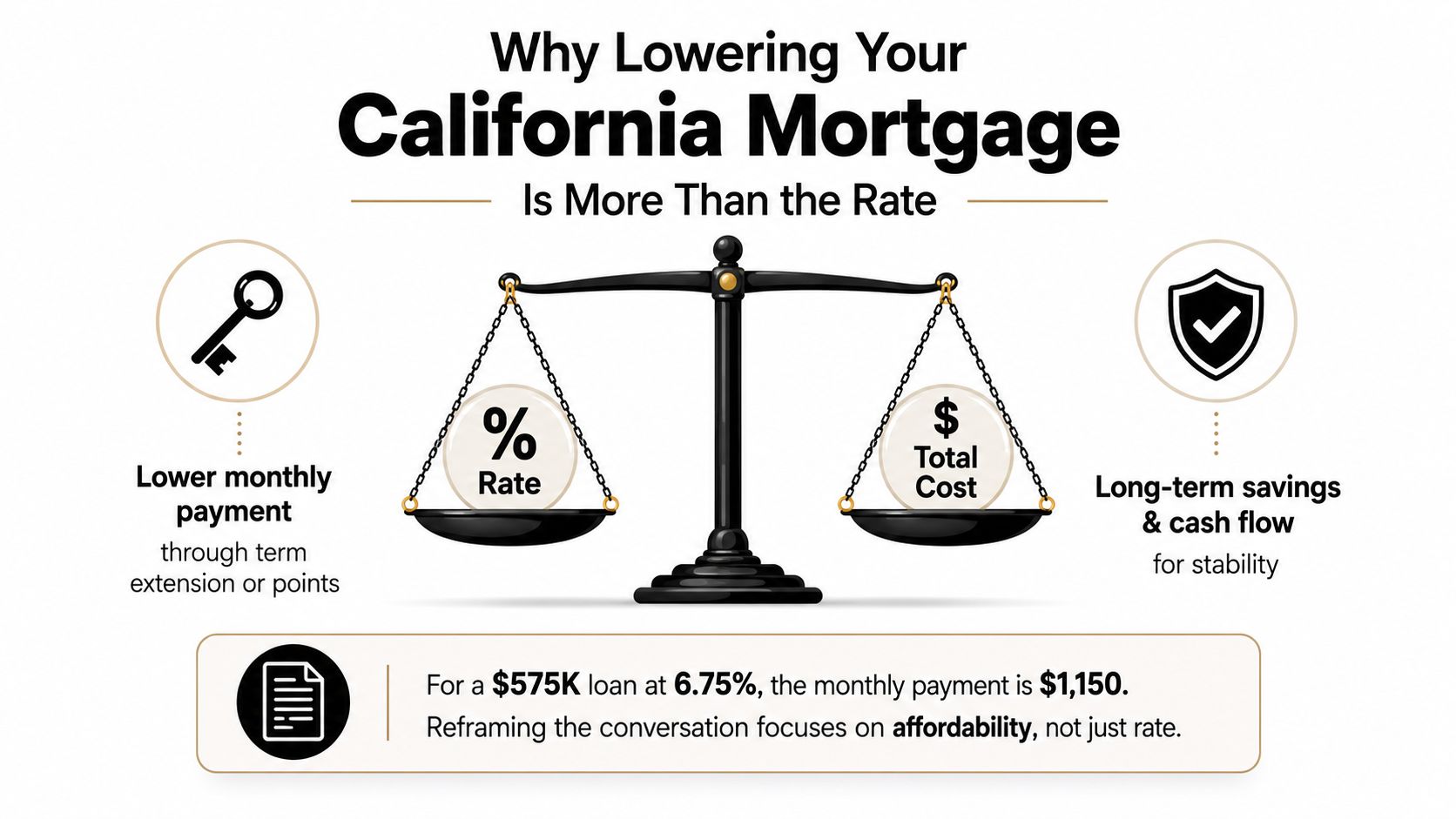
Why Lowering Your California Mortgage Is About More Than the Rate
A San Diego teacher and single mom can get pre-approved at 6.75% and still feel boxed out because the payment on a $575,000 condo looks overwhelming. That reaction is normal, but it's also incomplete. In California, the mortgage rate is only one slice of the housing-cost pie, and the rest of the pie can be just as painful.
Budget killers are usually the things buyers don't negotiate hard enough. Property taxes, homeowners insurance, and HOA dues can push a payment far beyond what the loan rate alone suggests. In high-cost counties, the monthly total can feel unmanageable even when the rate itself looks “good” on paper.
A rate cut helps, but only to a point. On a $600,000 loan, dropping the rate from 6.75% to 6.25% saves about $135 per month, while reducing the purchase price by $25,000 through closing-cost credits can save $200. That's why I tell buyers to think like operators, not shoppers. The cheapest-looking rate is not always the lowest-cost loan.
Practical rule: If the lender quotes you a lower rate but strips out credits, assistance, or flexibility, compare the full cash-to-close and the first year of payments, not just the rate line.
For California buyers, especially HERO professionals, the smarter question is not “What's the lowest rate?” It's “What combination of rate, assistance, loan type, and closing-cost strategy gets me the lowest monthly obligation without draining my reserves?” That's the mindset that wins in this state.
The Four Levers That Actually Move Your Mortgage Rate
Every mortgage quote in California is built from a few pricing levers, and lenders don't treat them equally. If you want a lower mortgage, you need to know which levers change the rate sheet and which ones just make you feel busy. This is math, not magic.
Credit, LTV, loan size, and points
Credit score is the first lever. The CFPB notes that sample rate quotes generally assume a 700 credit score, 10% down, a conventional 30-year fixed loan, and about -0.5 to 0.5 points, which tells you how heavily those factors are baked into pricing benchmarks CFPB mortgage rate guidance. In plain English, better credit usually means cleaner pricing.
Loan-to-value matters just as much. A bigger down payment lowers the lender's risk, and in conventional lending, crossing the 80% LTV mark can also eliminate mortgage insurance, which improves the effective cost of the loan CFPB mortgage rate guidance. That's why a borrower with extra cash often gets a better offer than someone stretching every dollar into the down payment.
Loan size changes the game too. Staying within conforming limits helps preserve agency pricing. For 2026, the FHFA baseline conforming limit for a one-unit property is $832,750, while high-cost counties such as Los Angeles, Orange, San Francisco, Santa Clara, San Mateo, Alameda, Contra Costa, and Marin can go up to $1,249,125 2026 California conforming loan limits. Once you slip into jumbo territory, the pricing stack usually gets worse.
Discount points are the most misunderstood lever. A common California benchmark is that 1 point costs 1% of the loan amount upfront and can lower the rate by about 0.25% Alpine Banker mortgage rates CA. On a large California balance, that can matter a lot, but only if you'll keep the loan long enough for the buy-down to pay back.
| Lever | Movement | Approx. Rate Impact | California Note |
|---|---|---|---|
| Credit score | Higher score | Better pricing at stronger tiers | Stronger credit improves lender risk profile |
| Loan-to-value ratio | Lower LTV | Better pricing, often less mortgage insurance cost | Crossing 80% LTV is a major threshold |
| Loan size | Smaller loan | Better pricing when staying conforming | Staying under $832,750 or the high-cost ceiling preserves agency execution 2026 California conforming loan limits |
| Discount points | Pay upfront | About 0.25% lower rate per point | Works best when you'll hold the loan long enough Alpine Banker mortgage rates CA |
If you're comparing offers, use this internal guide on how to compare mortgage rates. The point is not to chase the prettiest quote, it's to see which lever the lender used to get there.
Loan Types That Accept Lower Credit and Lower Down Payments
A California buyer with strong income can still lose money by picking the wrong loan structure. The right move is to choose the product that protects cash, fits the credit file, and keeps the monthly payment under control.
Conventional, FHA, VA, and CalHFA side by side
Conventional loans work best when the borrower has cleaner credit and enough savings to keep the file simple. They usually want stronger credit and at least 3% down, but that structure can reward borrowers who qualify cleanly and want a straightforward first mortgage Alpine Banker mortgage rates CA.
FHA is the safer lane for many California public servants. It accepts lower credit, can go down to 3.5% down with qualifying scores, and is more forgiving on debt ratios than conventional underwriting Experian mortgage rate and credit score overview. For a firefighter, teacher, deputy, or nurse who has stable income but a thinner credit profile, FHA often gets the loan done with less cash out of pocket.
VA is the first stop for eligible military borrowers and veterans. The big advantage is simple, zero down is on the table, and the program does not set a minimum score requirement the way many conventional loans do. Lenders can still add their own overlays, but VA usually gives the strongest monthly-payment advantage when the borrower qualifies.
CalHFA is built for California buyers who need help closing the gap between savings and a high-cost purchase. Its homebuyer programs can be layered with first-mortgage financing and assistance, which matters when the problem is cash, not income CalHFA homebuyer programs. For a HERO buyer trying to stay liquid after closing, that structure can make the deal workable.
| Loan Type | Min. Credit Score | Min. Down Payment | Mortgage Insurance | Best Fit for HERO Buyers |
|---|---|---|---|---|
| Conventional | Generally around 620 | 3% | Required if the down payment is under 20% | Buyers with cleaner credit and enough reserves |
| FHA | Lower credit may qualify, depending on the file | 3.5% or more | FHA mortgage insurance applies | Buyers who need more flexible underwriting |
| VA | No program minimum, lender overlays may apply | 0% | VA funding structure differs from standard PMI | Eligible veterans, active-duty service members, and some surviving spouses |
| CalHFA | Program-specific | Varies by program | Depends on the paired loan | Buyers who need assistance with upfront cash |
The decision is about trade-offs. If your credit is borderline, a conventional quote can look cheaper on paper and cost more in practice once pricing tightens or mortgage insurance shows up. If you have VA eligibility, start there first. If you need help with cash in a high-cost California market, CalHFA deserves a hard look before you burn savings just to close.
Documentation and Underwriting in a High-Cost State
California underwriting tightens the moment the loan amount gets larger. Lenders are not being picky for sport, they are checking whether the file can pass agency review, income verification, and reserve rules. In expensive counties, weak documentation is one of the fastest ways to lose the rate you were first quoted.
What lenders want to see
A standard file usually includes 2 years of W-2s, recent pay stubs, 2 months of bank statements, and a 4506-C transcript pull so the lender can match tax data to what you reported. That part is routine. The pressure rises in California because larger loans get reviewed more closely.
Once a loan pushes beyond local conforming limits, pricing and underwriting can change fast. Reserve requirements get tighter, deposits get questioned more often, and the lender may want a cleaner explanation of how your income is set up. Large balances do more than change the rate sheet, they change how the file is judged.
Self-employed HERO buyers need preparation, not hope. Bring 2 years of personal and business tax returns plus a year-to-date profit and loss statement. If your income comes from commissions, overtime, or variable shifts, expect a more detailed review than a straight salary file.
Practical rule: If a deposit looks unusual, explain it before underwriting asks. A clean letter and paper trail beat a last-minute scramble every time.
Gift funds, divorce decrees, and student loan IBR payments also get flagged often. Handle those early and document them cleanly before you make an offer. If you are building your file step by step, start by downloading our home-buying checklist and use it to keep your paperwork in order. A tidy file does not just close faster, it usually prices better because underwriters trust it more.
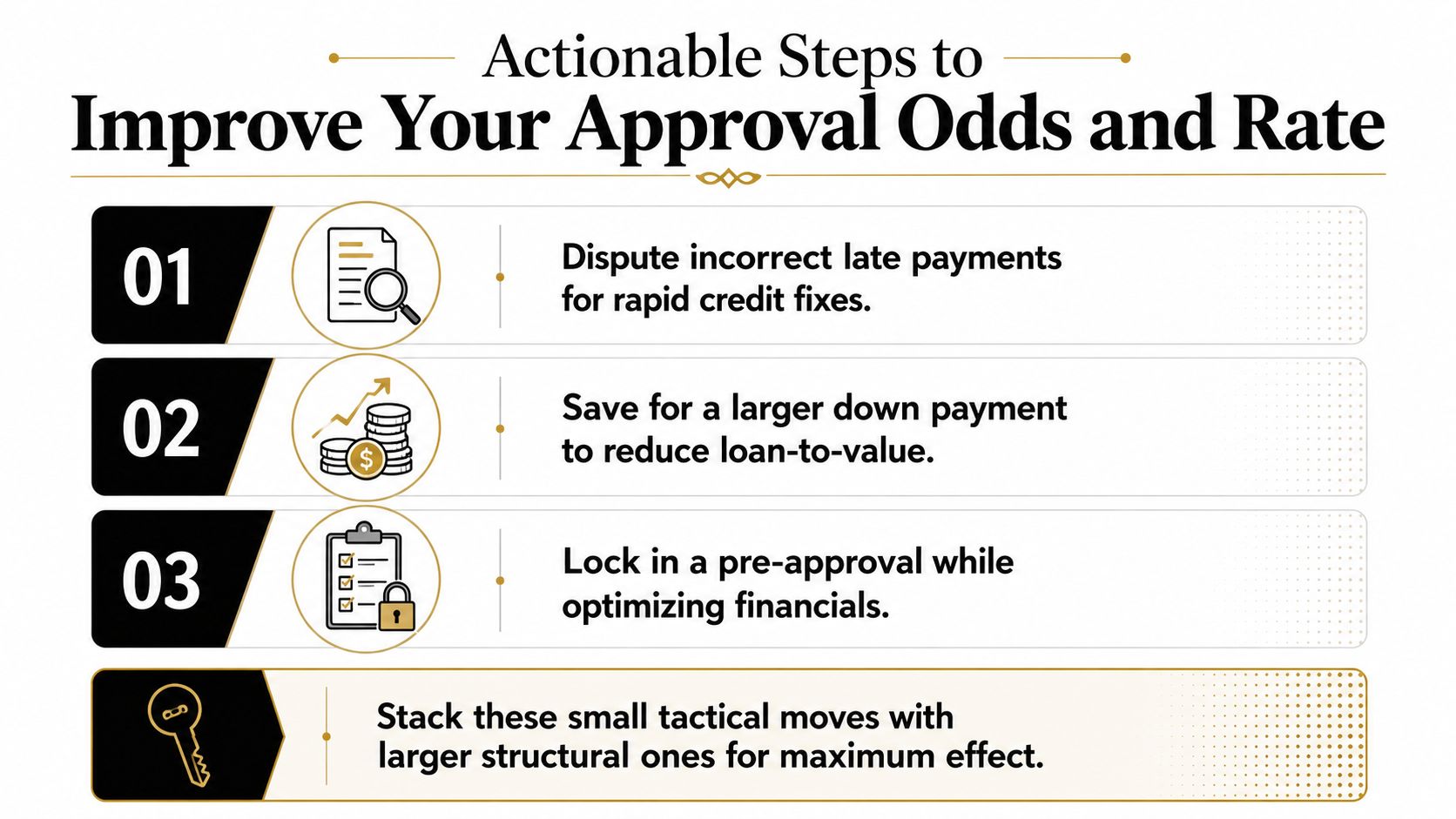
Actionable Steps to Improve Your Approval Odds and Rate
A lower mortgage payment in California usually comes from a clean file, a better structure, and a loan choice that fits your timeline. Rate shopping matters, but it does not beat bad credit, high utilization, or a weak loan setup. I tell public servants to fix the file first, then choose the loan that lowers the total monthly payment.
Fix what's fast, then change what's structural
Start with credit cleanup. Correct reporting errors, pay revolving balances down, and keep utilization low. Those moves can improve how your file prices before the lender finishes the full review.
Stop adding noise. Avoid new credit inquiries for 90 days before you buy, because fresh debt can drag down your score and push up your debt-to-income ratio. If your file is thin, being added as an authorized user on a seasoned account can help presentation, but only when the account is clean and well managed.
Then move to the structural levers. A larger down payment lowers LTV, and once you get under 80%, you remove one of the biggest pricing penalties on a conventional loan CFPB mortgage rate guidance. If you plan to stay in the home long enough to recover the upfront cost, buying discount points can reduce the rate and monthly payment.
ARM pricing deserves a hard look too. The CFPB explains that fixed and adjustable structures are both part of rate shopping, and buyers who expect to move or refinance sooner may do better with an ARM than with a long-term fixed loan CFPB pre-approval guidance. In California, that matters because monthly payment relief often matters more than chasing the lowest headline rate.
California buyers usually get the best result by combining two or three moves at once.
- Clean the file first: Fix reporting mistakes, lower balances, and stop new credit activity before lock.
- Move the LTV: Put more cash in if it gets you past a pricing threshold.
- Choose the right structure: Use points, lender credits, or a shorter-hold ARM only when the numbers justify it.
If your lender is not modeling both monthly payment and cash to close, you are not getting a real recommendation. You are getting a quote.
California Down Payment Assistance Programs Worth Knowing
A lower California mortgage usually comes from the payment stack, not the rate alone. Down payment assistance can cut the cash needed at closing, protect reserves, and make the file easier to approve.
MyHome, Dream For All, and HERO rewards
CalHFA's MyHome Assistance Program offers a deferred-payment junior loan of up to 3.5% of the purchase price or appraised value, whichever is less, for government loans, and up to 3% for conventional loans. That kind of help matters because less money coming out of pocket can keep the deal intact and leave room for closing costs and reserves. A buyer of a $700,000 home could potentially access about $24,500 under the 3.5% structure, but eligibility still depends on program rules and lender approval CalHFA homebuyer programs.
CalHFA's Dream For All Shared Appreciation Loan is stronger assistance. It can provide first-generation homebuyers up to 20% of the home purchase price or appraised value, capped at $150,000, and applicants must meet county-specific income limits CalHFA Dream For All press release. CalHFA also used a random selection process in the 2026 round to distribute funds equitably CalHFA Dream For All press release. If you want that program, you have to be ready when the window opens.
For HERO buyers, the practical move is stacking the right tools. Public-service programs can combine closing-cost credits, rate buydowns, and assistance so the buyer lowers the monthly payment without draining cash. If you are comparing structures, start with this California down payment assistance guide and match the program to the problem you are trying to solve.
| Program | Max Assistance | Repayment Type | HERO Eligibility |
|---|---|---|---|
| MyHome Assistance | Up to 3.5% or 3% depending on loan type | Deferred-payment junior loan | Available through CalHFA lending channels |
| Dream For All Shared Appreciation Loan | Up to 20%, capped at $150,000 | Shared appreciation at resale | First-generation buyers who meet income limits |
| HERO Home Loan & Buyer Rewards Program | Varies by file | Credits and reward structure | Designed for California public servants |
The right assistance program fits the file without creating a future payment problem. Some buyers need down payment help. Others need closing-cost relief more than extra cash at closing. Pick the tool that lowers the monthly payment and keeps the loan workable.
Putting It Together and How California Loans for Heroes Can Help
Marco is a 34-year-old Cal Fire engineer in Riverside, and his file is the kind I see all the time. He raised his score from 612 to 678, used a CalHFA MyHome assistance loan for 3.5% down, bought down his FHA rate by one point, and combined a HERO Buyer Rewards credit with seller concessions. The result was a $485,000 home with a monthly payment $312 lower than the first pre-qualification suggested.
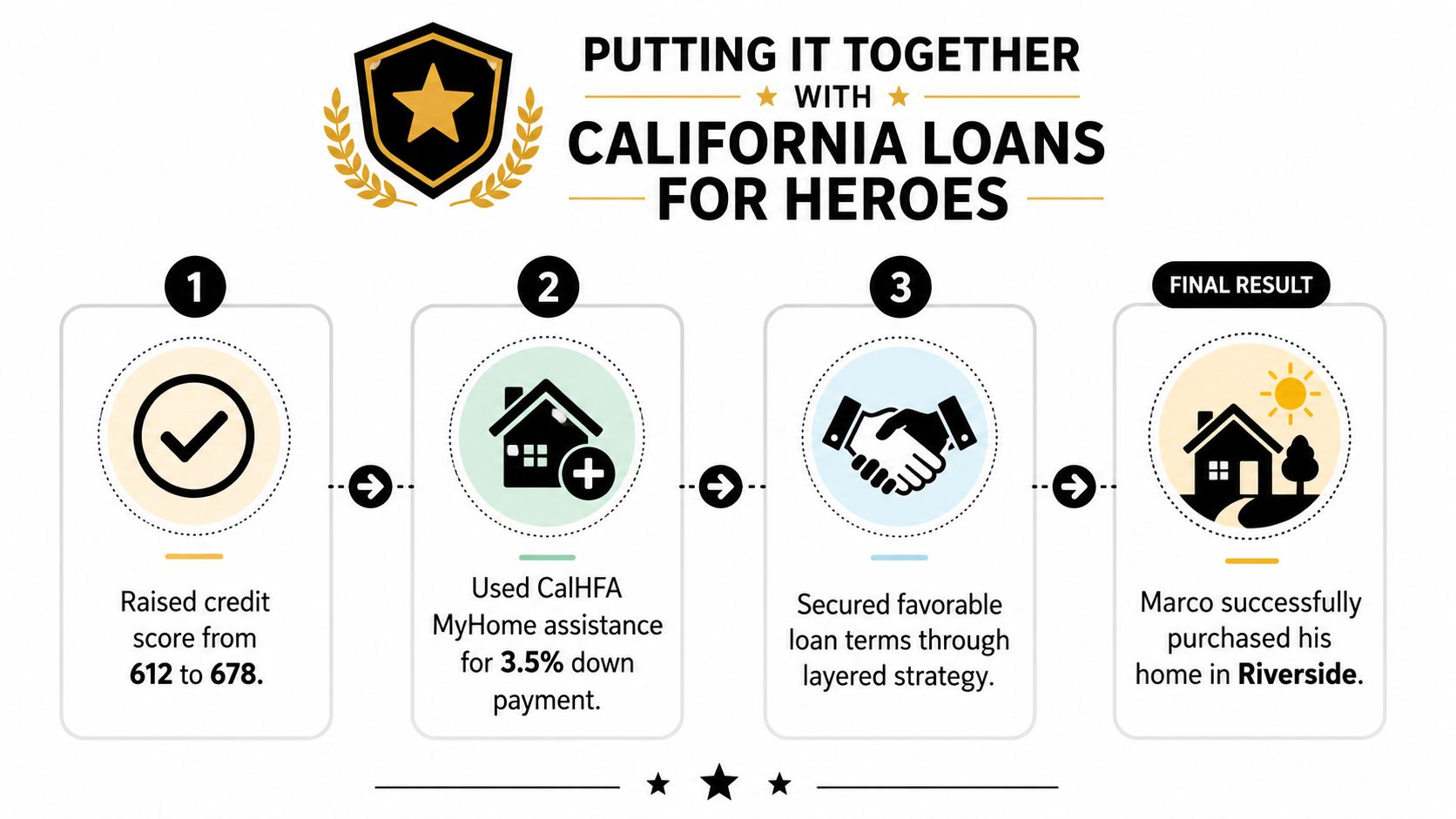
His stack worked because each piece solved a different problem
The credit improvement changed his pricing bucket. The down payment assistance preserved cash. The point buy-down lowered the rate enough to matter. None of those moves alone would have done the full job, but together they produced a payment he could live with.
That's the model I want California buyers to copy. Pull your tri-merge credit reports, get a CalHFA prequalification through a participating lender, compare FHA and conventional side by side, model point buy-downs against your break-even horizon, and reserve HERO funds before county allocations run thin. Don't wait until you've already found the house to learn what your file can support.
California Loans for Heroes works with borrowers who need this kind of layered file handled correctly. It connects eligible police, firefighters, teachers, nurses, veterans, and other service professionals with assistance options, lender credits, and mortgage structures that reduce both upfront costs and monthly payment pressure.
If you're serious about lowering your mortgage in California, stop guessing and get a file built around your actual numbers. Visit California Loans for Heroes to compare assistance options, rate strategies, and lender programs that fit public servants who need real payment relief, not just a lower quoted rate.