
You've got an offer accepted on a California home. You're juggling inspections, loan documents, your deposit, work shifts, and a closing date that suddenly feels very close. Then a new batch of terms shows up: title search, preliminary report, lender's policy, owner's policy, escrow, recording fees.
Most buyers know these items matter. Fewer know what each one does.
That gap can get expensive. A home isn't just walls, a roof, and a mortgage. It's also a legal ownership record. If that record has problems, the problem can become yours unless it's found and handled correctly. That's why title search and insurance deserve more attention than they usually get, especially for California buyers dealing with local cost quirks and issues like HERO or PACE liens.
For veterans, first responders, teachers, nurses, law enforcement, and other public servants, the goal is simple: protect the home, avoid surprise costs, and keep closing on track.
Title Search vs Title Insurance Understanding the Difference
The easiest way to understand this is to compare a home title to a car's paperwork.
A title search is like pulling a vehicle history report before you buy. It looks backward. It tries to uncover what happened in the property's past, including ownership transfers, liens, easements, judgments, and other claims that may affect your rights.
Title insurance is different. It's more like a financial warranty against title problems that already existed but weren't discovered before closing.
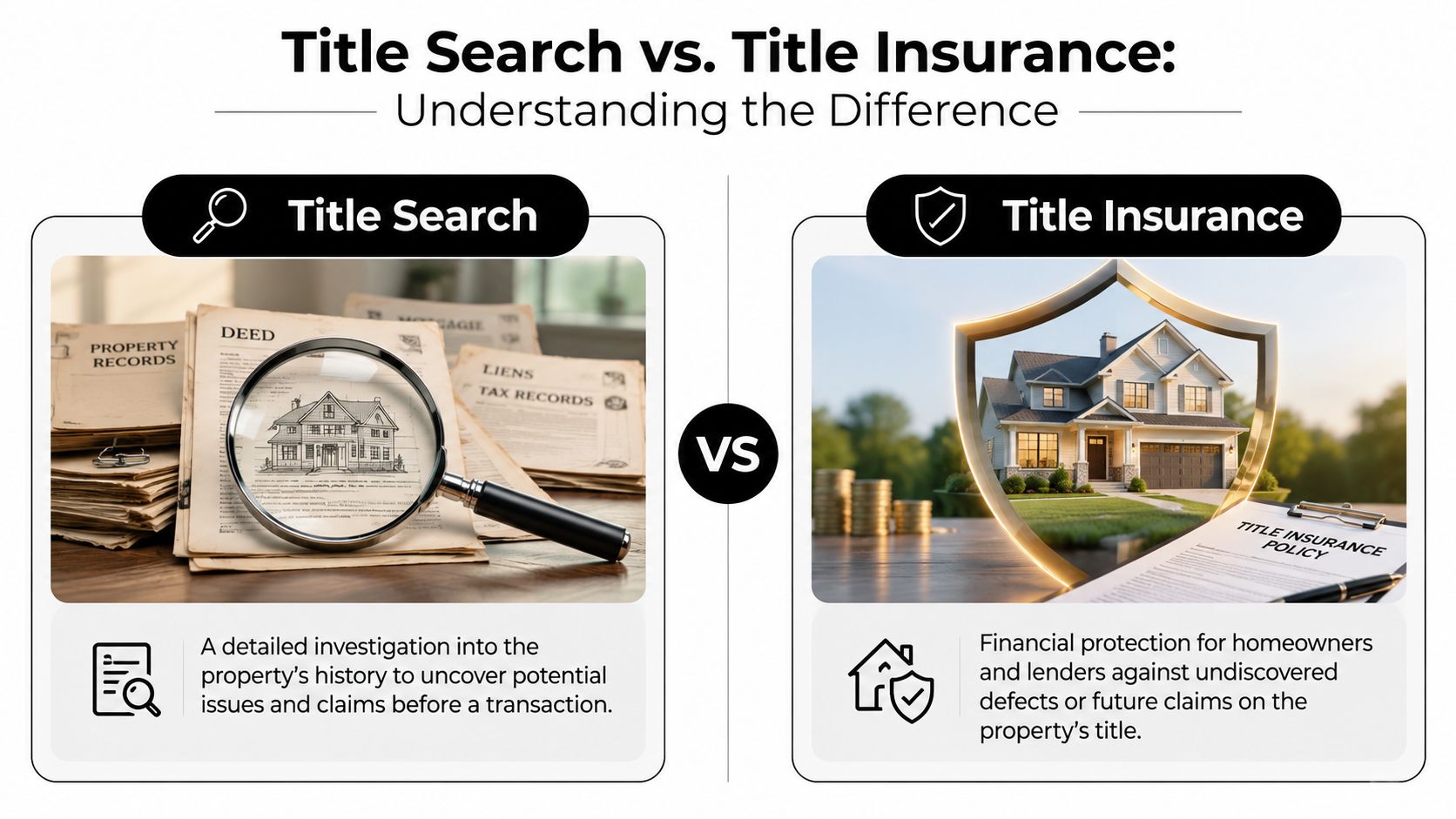
What the search does
A title search reviews the public record and builds a picture of legal ownership. The point is to answer a basic question: Does the seller have the right to transfer clean ownership to you?
Think of “clear title” as clean relay-baton handoffs in a race. If every handoff was valid, the baton reaches you properly. If one handoff was flawed, such as a missing signature or an unresolved lien, the chain can break.
What the insurance does
Title insurance steps in where the search has limits. The California Department of Insurance explains title insurance as protection against unknown defects. That same guidance highlights the key point many buyers miss: the title search reviews history up to a point, while title insurance protects against unknown pre-closing defects the search didn't catch, such as forged deeds or undisclosed heirs.
Practical rule: A search helps you find known problems. Insurance helps pay for covered losses from hidden problems.
That's why lenders typically require a lender's policy. The lender wants protection for its loan position. But that policy protects the lender, not your equity.
Why buyers get confused
Buyers often hear, “The title company already checked everything.” That sounds like full protection, but it isn't.
A search is an investigation. Insurance is a contract.
Here's the clean comparison:
| Item | Main job | Protects whom | Timing |
|---|---|---|---|
| Title search | Reviews recorded history and flags issues | The transaction process | Before closing |
| Lender's title insurance | Protects the mortgage lender's interest | The lender | After closing, for covered claims |
| Owner's title insurance | Protects your ownership interest | You, the buyer | After closing, for covered claims |
If you remember one thing, remember this: a title search and insurance work together, not interchangeably.
The California Title Check Process Step by Step
When escrow opens, the title process starts moving in the background even though you may not see much at first. In California, that behind-the-scenes work matters because title review is often what reveals legal issues before money changes hands for good.
This isn't just someone typing an address into a website.
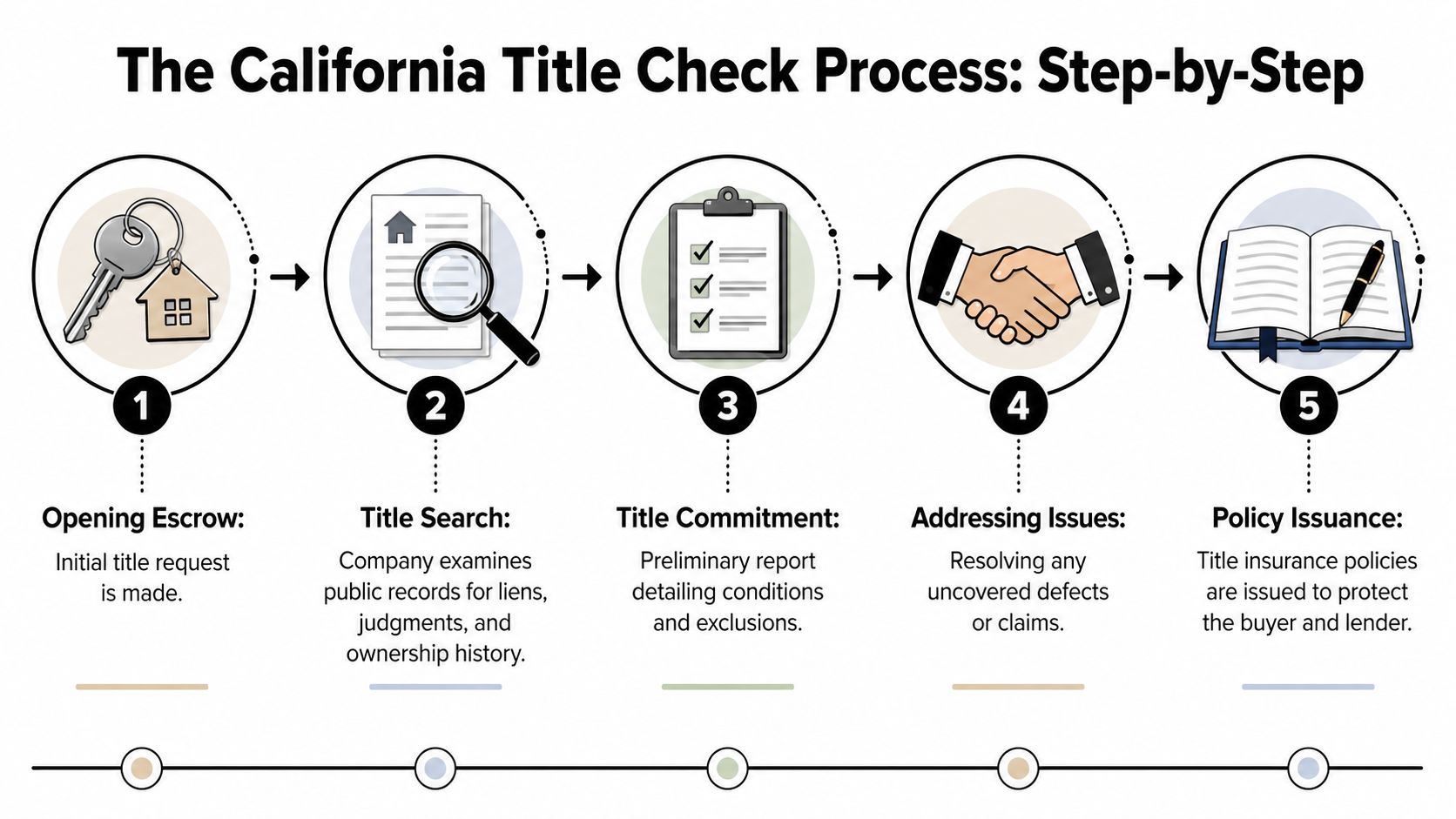
What actually happens during the search
A professional title search is a manual process. According to this explanation of the title abstraction process, it can involve 10 to 15 forensic steps, retrieval of hard-copy county records, and an average execution time of 10 to 14 days. Older properties can take longer because some records may be fragmented or stored in non-digitized archives.
That timing matters if your contract has tight deadlines or if you've already wired your good faith deposit.
The usual sequence in a California transaction
Escrow opens
The escrow officer orders title work. This starts the record review and sets the title side of the file in motion.The title company searches public records
The search looks for items attached to the property or prior owners that could affect ownership. That may include deeds, liens, judgments, easements, and recorded claims.You receive a Preliminary Title Report
In California, buyers often call this the “prelim.” It isn't the final policy. It's the early roadmap showing what must be addressed and what exceptions may remain.Issues get cleared
If the report shows a payoff requirement, an old lien, or another defect, escrow and title work with the parties to resolve it before closing.Closing and recording happen
Once conditions are met, the deed and loan documents record.Policies are issued
After recording, the final title insurance policies are issued based on the completed transaction.
What to review in the prelim
Don't skim the Preliminary Title Report. Focus on what affects your actual use and ownership.
- Ownership vesting checks how title is currently held.
- Recorded liens can signal debts that must be paid through escrow.
- Easements may allow utilities or others to use part of the property.
- Exceptions describe matters the final policy may not cover.
Review the prelim like you'd review a medical chart before surgery. You want to know what's routine, what needs correction, and what needs a direct question before you sign anything.
A good title process feels uneventful on closing day because the hard work happened earlier.
Decoding the Costs Who Pays for Title Services
By the time buyers see title fees on a closing statement, the numbers can feel blended together. They aren't. Title-related charges usually fall into three separate buckets: the search and settlement work, the lender's title policy, and the owner's title policy.
That distinction matters because some fees are standard, some are negotiable, and one often hides a money-saving opportunity.

What the costs can look like
The CFPB and Fannie Mae summary of title insurance and settlement services states that the median all-in cost paid by homebuyers at closing is $1,901, or 0.67% of the purchase price. The same material notes that title insurance premiums typically range from 0.5% to 1.0% of the purchase price and that this is a one-time premium, not an annual bill.
For a $400,000 property, buyers generally pay $2,000 to $4,000 for title insurance under that same source. In California, the same source notes that standard residential title searches run $150 to $250, lender's title insurance can reach $2,400, and owner's title insurance may add about $1,600 with bundled discounts. It also lists total title-related closing costs in a typical transaction as high as $4,775, including a $150 title search fee, $200 title examination and abstract, $300 settlement fee, and $125 recording fees.
A California HERO program handbook gives another local frame: a title search in California often takes 10 to 15 business days, with basic search fees typically ranging from $250 to $400, while deeper reviews can cost $500 to $750 depending on county complexity and property history depth.
The discount many buyers never hear about
The biggest cost question isn't only “How much?” It's also “Am I paying twice for similar coverage work?”
The simultaneous issue explanation matters here. When an owner's and lender's policy are issued together, the second policy can cost as little as $25. Some companies charge $250 to $500 for that same item without clearly explaining the pricing structure.
Money-saving move: Ask for the simultaneous issue charge in writing and make sure it's separated from other title fees.
Who usually pays
Who pays for title services often depends on the county, local custom, and negotiation written into the purchase contract. California doesn't follow one single pattern statewide.
Use your closing costs breakdown to match each fee to a real service. If a line item is unclear, ask whether it is:
- A search fee
- A settlement or escrow fee
- A lender policy premium
- An owner policy premium
- A simultaneous issue charge
That simple breakdown makes it much easier to compare offers and spot avoidable costs.
Common Title Problems and How They Are Solved
Most title problems aren't dramatic. They're paperwork problems, payoff problems, or missing-link problems. But if they aren't fixed before closing, they can turn into legal and financial headaches afterward.
The value of title search and insurance becomes easier to see through examples.
The old lien that never got cleared
A seller refinanced years ago, but one old mortgage release was never properly recorded. On paper, it looks like the old loan might still be attached to the property.
The title company traces the prior loan, gets payoff or release documentation, and works with escrow to make sure the record is corrected before the sale closes.
The surprise heir problem
A previous owner passed away, and an estate transfer left room for a claim from a family member who wasn't properly included.
That doesn't always kill the transaction. It usually means the title company needs probate documents, affidavits, or other legal proof showing who had authority to transfer the property. If the issue can't be fully cleared before closing, the transaction may pause until it can.
Clerical errors and recording mistakes
Some issues are painfully ordinary. A deed may have the wrong legal description. A name may be misspelled. A document may have been recorded in a way that creates confusion about the chain of title.
These problems get resolved through corrective documents and updated recording. It's detail work, but it protects your ownership.
If the title chain reads like a family tree with one missing branch, the title company's job is to find the branch before you buy the house.
Fraud and forgery are real risks
Not every problem is a typo. Some are serious.
According to AmeriSave's market summary on title search risks, title insurance companies paid $596 million in claims in 2022, and 21% of claims were tied to fraud or forgery. The same source states that the average cost of a title defect discovered after closing can range from $4,000 to $10,000.
That's why buyers should understand their ownership interest before closing. You're not just buying access to a property. You're buying a legal position that needs to be defensible.
How problems usually get solved before closing
Here's the reassuring part. The process is built to catch and clear many issues before the deed records.
- Payoff through escrow handles unpaid loans, tax issues, or other recorded debts.
- Corrective recording fixes deed mistakes, missing releases, or legal description errors.
- Supporting legal documents address inheritance, trust, or authority questions.
- Insurance coverage stands behind certain hidden defects that weren't discoverable in the public record.
A smooth closing often means someone solved several title problems behind the scenes before you ever sat down to sign.
Why Title Insurance Is Critical for HERO Borrowers
For California buyers who serve the public, the biggest risk isn't always the monthly payment. It's the expensive surprise that shows up after you've moved in, furnished the house, and started building equity.
That's where an owner's title policy earns its keep. A lender's policy protects the bank's stake. An owner's policy protects yours.
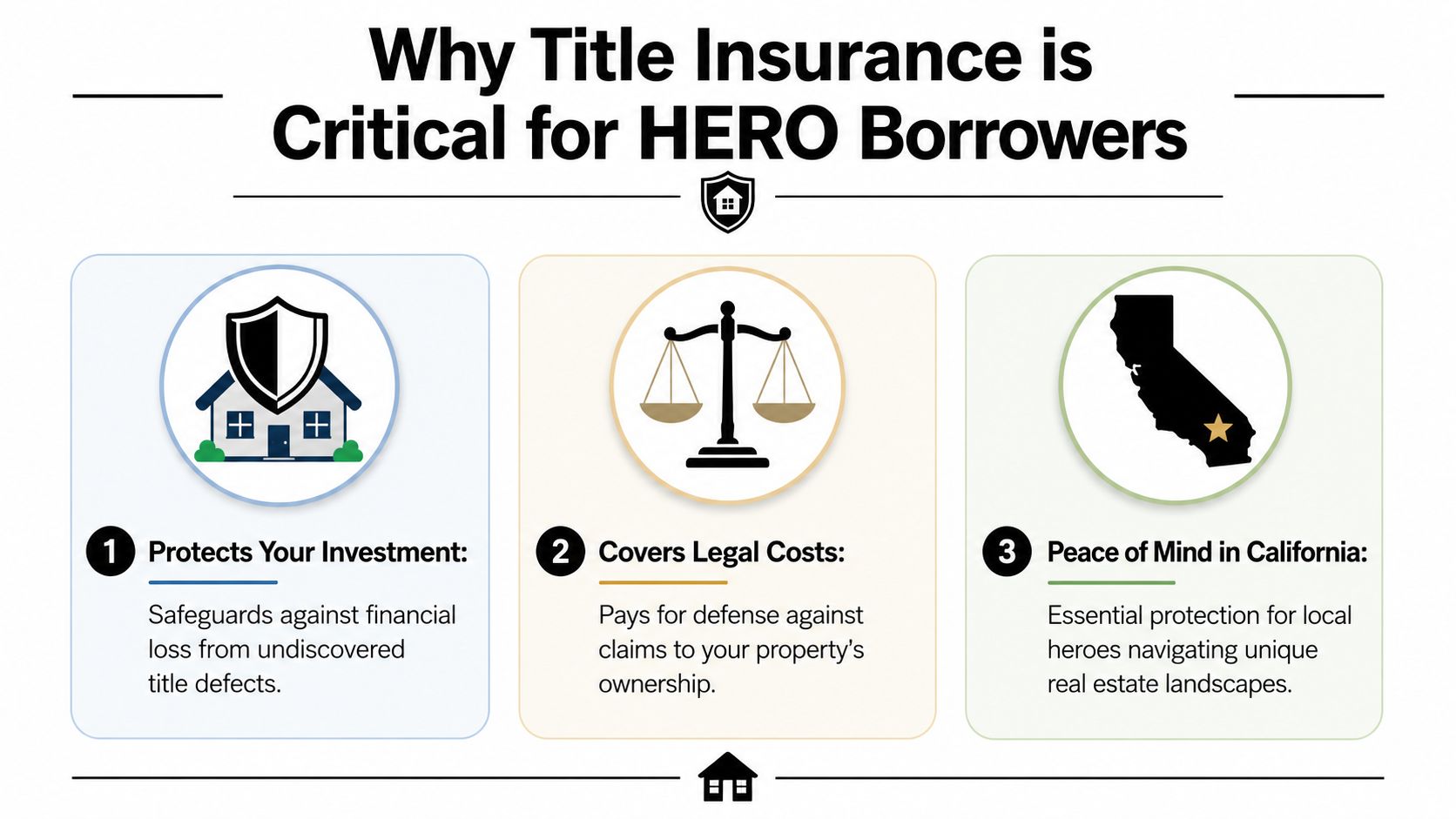
Why this matters more than it first appears
If you're a firefighter, deputy, nurse, teacher, veteran, or pilot, your time is limited and your margin for a preventable legal mess may be even tighter. You probably don't want to spend months fighting over a pre-existing title problem that should have been addressed before closing.
Title insurance works as a contract of indemnity tied to problems arising from past events. This description of the title insurance process explains that the title commitment lists defects that must be cleared before the final policy is issued, such as unpaid mortgages or tax liens, and that the insurer then indemnifies the insured for covered losses up to the policy amount for defects that survived the search.
That's a technical way of saying this: the policy is your financial backstop if a covered title problem slips through.
The California issue many buyers overlook
One issue deserves special attention in California: HERO or PACE liens.
These aren't ordinary credit card debts or personal loans. They're property-assessed obligations tied to the home itself. If a property has one, it can complicate both purchase and refinance planning.
The California HERO and PACE lien explanation states that when a HERO or PACE lien exists, it is repaid through the property tax bill over 5 to 25 years. It also notes that lenders often can't refinance unless the total loan-to-value, including all liens, stays under 125% of the appraised value.
That makes title review critical. If the lien is missed early, a buyer can be blindsided later when the numbers no longer work.
Three reasons an owner's policy matters for HERO borrowers
Your equity needs protection
You may spend years building ownership value. A covered title claim can threaten that value if you only rely on the lender's protection.Legal cleanup can get expensive fast
Even a title issue that looks small at first can require attorneys, recorded corrections, and time away from work.California property records can carry local complications
HERO and PACE liens are one example. The title process isn't just abstract paperwork. It's where those local risks get identified.
Buy the owner's policy with the same mindset you use for safety gear. You hope you never need it, but you don't want to be without it when the hidden risk shows up.
Title Insurance FAQs for Veterans and First Responders
Does my VA loan cover title insurance costs
A VA loan can help with financing, but it doesn't mean title charges disappear. Title-related costs still show up as part of your closing costs, and whether the seller pays, you pay, or the cost is split depends on the contract and local custom.
The better question is whether you understand each line item before closing. Ask which charges apply to the lender's policy, which apply to the owner's policy, and whether the simultaneous issue discount was applied.
Are there special title insurance discounts for heroes
There usually isn't a universal title insurance discount that applies automatically just because you're a veteran or first responder. What you can do, though, is look for savings through the structure of the transaction.
Start with these questions:
- Was the simultaneous issue rate applied if both policies are being issued together?
- Are title and settlement fees bundled clearly or padded with vague charges?
- Has anyone compared providers when comparison shopping is allowed?
That approach saves more money than assuming a special hero discount will appear on its own.
What is the single most important thing to do in this process
Review the Preliminary Title Report carefully and don't waive your questions just to move faster.
If something looks unfamiliar, ask what it means in plain language. You want to know:
- Who currently holds title
- Which liens must be paid off
- Whether any easement affects your use of the property
- What exceptions will remain on the final policy
Do I need an owner's policy if the lender already has one
If you want protection for your own ownership interest, yes.
The lender's policy protects the lender's loan balance and lien position. It doesn't insure your equity, your down payment, or your legal defense in the same way an owner's policy is designed to protect your interest under its terms.
What if I'm buying with cash
Cash buyers sometimes assume they can skip title work because no lender is involved. That removes a lender requirement, but it doesn't remove title risk.
A title search can still reveal liens, ownership defects, or recorded issues tied to the property. An owner's policy still matters because hidden defects don't care whether you financed the purchase.
What should I ask before I sign
Use this short checklist:
- Ask for the title fees line by line so you know what each charge covers.
- Ask whether an owner's policy is included or optional and what protection it gives you.
- Ask whether any recorded lien, easement, or exception needs follow-up before closing.
- Ask whether the property has any California-specific assessments or liens that could affect future refinance plans.
The buyers who handle title search and insurance well usually aren't lawyers. They're the ones who slow down long enough to ask direct questions.
California heroes deserve clear answers, strong loan guidance, and real savings throughout the homebuying process. California Loans for Heroes helps veterans, active-duty military, first responders, nurses, teachers, law enforcement, and other public service professionals manage California home loans with one-on-one support, homebuyer assistance options, lender credits, and programs built to protect your budget. If you're buying or refinancing in California, connect with their team and move forward with confidence.