You've got your VA eligibility. You may even have a pre-approval in hand. Then the California reality check hits: the loan can be zero down, but the transaction still isn't zero cash.
That's where many veterans stall out. They can afford the monthly payment, but they're short on closing costs, prepaid items, reserves, or the extra funds that make an offer workable in a high-cost market. In California, that gap is often the difference between continuing to rent and getting keys.
VA home loan down payment assistance can solve that gap, but only if you understand how the pieces fit together in California. The generic answer is yes, you can combine VA financing with assistance. The useful answer is which programs work, what the money can be used for, where income caps shut people out, and how to structure the file so the assistance helps instead of slowing the deal down.
The Veteran's Dilemma in California Homebuying
A situation I see often looks like this. A veteran has strong income, solid VA eligibility, and enough confidence to start house hunting. Then the final worksheet shows they still need cash for closing costs and prepaid expenses, and the whole plan starts to feel out of reach.
That frustration is understandable. The VA home loan benefit was built to remove the biggest obstacle in homebuying, the down payment itself. It's one of the most durable housing benefits in the country. The program was created in 1944 and has helped more than 24 million Veterans and service members become homeowners, according to Veterans United's VA loan statistics page.
Why this problem shows up so often in California
California magnifies the gap between “approved” and “ready to close.” A buyer may not need a down payment under VA rules, but they still need a plan for lender fees, title charges, escrow costs, prepaid taxes or insurance, and any repairs or reserves they want after move-in.
In practice, the conversation pivots from the loan to strategy.
Practical rule: A zero-down VA loan doesn't mean a zero-cash transaction.
That's why veterans start looking for help that can be layered onto the VA benefit. Some buyers use seller credits. Some receive family gift funds. Others combine the VA loan with targeted assistance intended to reduce the upfront cash burden. If you're trying to bridge that gap, closing cost assistance for veterans in California is often the more relevant question than “Do I need a down payment?”
The missing piece is usually assistance, not eligibility
Most buyers who ask about VA home loan down payment assistance are not confused about whether the VA loan works. They're trying to solve a much narrower problem: how to get from approval to closing without draining every dollar they have.
That's an important distinction. In California, preserving cash matters. Buyers often need flexibility for inspections, repairs, moving costs, and normal life after closing. Tying up every available dollar just to get through settlement can create stress even when the loan itself is strong.
Understanding VA Loan Rules on Down Payments and Gifts
The cleanest way to think about a VA loan is this: the VA stands behind part of the mortgage, which reduces the lender's risk. That's why eligible borrowers can buy with zero down in many purchase situations. The U.S. Department of Veterans Affairs also confirms that the benefit is a lifetime benefit and that eligible borrowers don't have to pay private mortgage insurance, as explained on the VA home loan benefit overview.
What the VA loan covers and what it doesn't
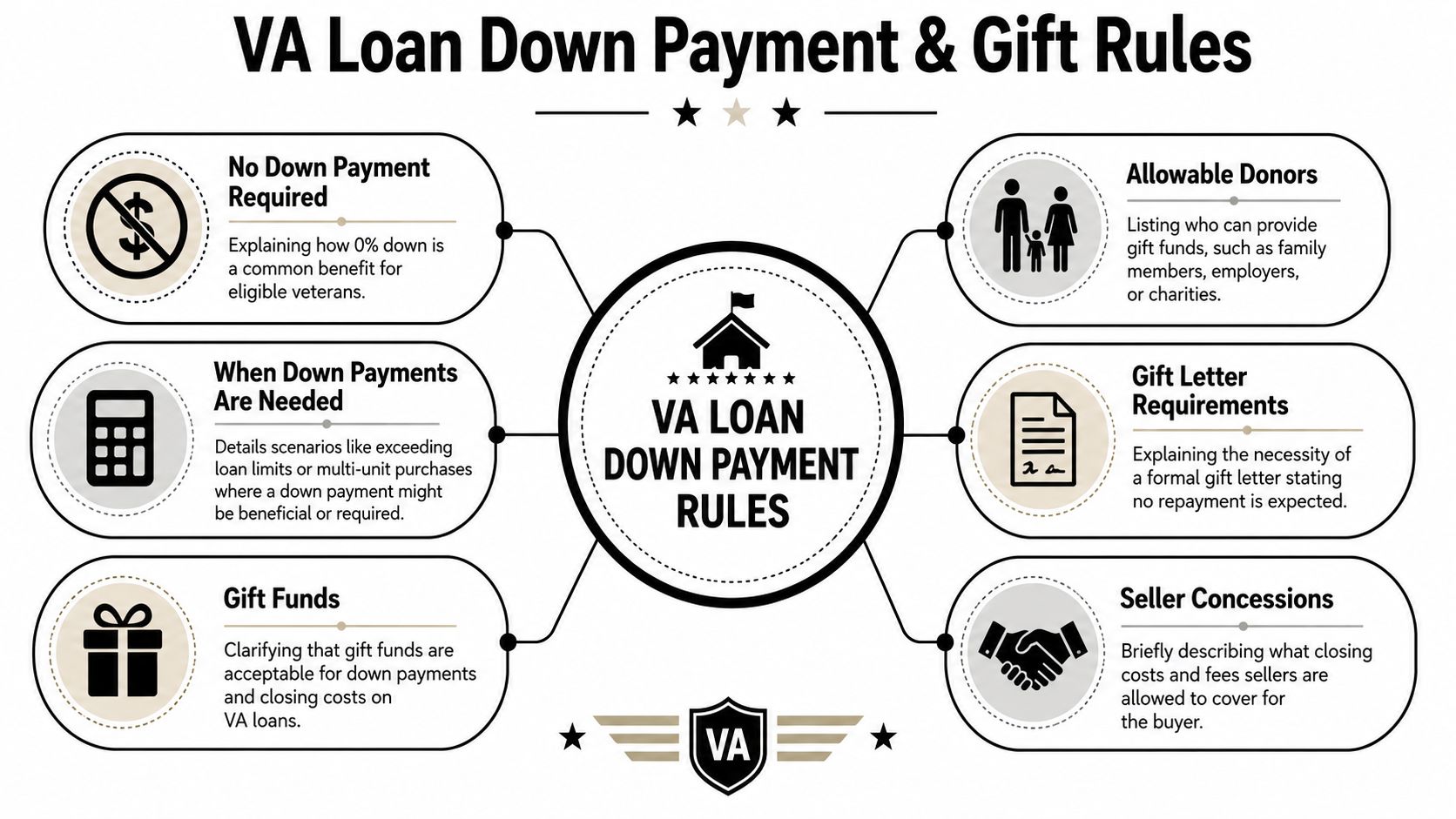
The biggest misunderstanding I hear is this: if the loan is zero down, buyers assume the whole purchase is zero out of pocket. That's not how the transaction works.
The VA loan solves the equity contribution side when the sales price doesn't exceed the appraised value. It doesn't automatically erase every other closing expense. If there's a cash shortfall, assistance is usually aimed at those remaining costs, not at replacing a down payment the VA already waived.
Gifts and structured assistance are not the same thing
A family gift is one bucket. A formal assistance program is another.
Gift funds generally come from an allowable donor and need proper documentation. Assistance programs come with their own rules, approval flow, and repayment structure. The important point for a veteran is that outside help can be acceptable, but it has to match lender and program guidelines.
Here's the practical breakdown:
- Gift funds can help when a family member or another acceptable source wants to contribute to your transaction.
- Program-based assistance is organized through a state, local, employer-linked, or nonprofit structure and usually comes with eligibility tests.
- Seller help may also reduce what you need to bring in, depending on how the contract is structured and what your lender approves.
If you treat all incoming funds the same, the file gets messy fast. Underwriting won't.
Why this matters before you shop
Before you start targeting assistance, separate your costs into categories:
- Down payment need under the VA loan itself
- Closing costs and prepaid items
- Cash reserves you want to keep after closing
- Any gap caused by appraisal or contract structure
That framework matters because the right source of funds depends on the problem you're solving. A veteran with zero down but limited closing cash needs a different strategy than a buyer trying to offset a pricing gap or preserve liquidity in a competitive market.
Decoding the Types of Down Payment Assistance
“Down payment assistance” sounds like one product. It isn't. It's a category.
The most common structures are grants, forgivable loans, and deferred loans, according to Down Payment Resource's guidance on using assistance with a VA loan. For a California veteran, the key question isn't whether assistance exists. It's whether the repayment terms fit your plans for the home.
The three structures that matter most
Think of these as three very different kinds of help.
A grant is the cleanest form. It's assistance that doesn't need to be repaid. If you qualify and close under the program rules, the money reduces your cash burden without adding a later payoff obligation.
A forgivable loan looks more generous than it first appears, but the timeline matters. You receive assistance now, and the balance is forgiven later if you meet occupancy or time requirements.
A deferred loan postpones repayment instead of erasing it. You may not make monthly payments right away, but the amount can come due when you sell or refinance.
| Assistance Type | Repayment Required? | Best For… |
|---|---|---|
| Grant | No | Buyers who want the simplest structure and no future payoff tied to the assistance |
| Forgivable loan | Only if program conditions aren't met | Buyers who expect to stay put long enough to satisfy occupancy or time rules |
| Deferred loan | Yes, later | Buyers who need upfront relief now and are comfortable carrying a future repayment event |
Which type works best on a VA file
For veterans using VA financing, grants are usually the easiest to like. There's no second layer to remember years later. But many viable programs in practice are structured as forgivable or deferred assistance, so it's important not to dismiss them too quickly.
What matters is fit.
- If you may transfer or move again soon, a forgivable structure may be less attractive.
- If you expect to refinance when rates or life circumstances change, a deferred loan needs close review.
- If your goal is to preserve cash at closing, any of the three may work if the terms are manageable.
A program can help you close and still be the wrong program if it creates a repayment surprise later.
The California lens on program structure
In high-cost markets, buyers often ask how much help they'll receive. The answer depends on the specific program. Some assistance is percentage-based, and some is capped. For a practical discussion of those mechanics, this breakdown of how much down payment assistance can cover is useful because it frames the core issue buyers face: not all assistance scales well with California prices.
That's why reviewing only the headline benefit is a mistake. You need to know whether the assistance is repayable, when repayment is triggered, whether it affects your future refinance plans, and whether it's meaningful relative to your actual cash need.
Finding California Down Payment Assistance for VA Loans
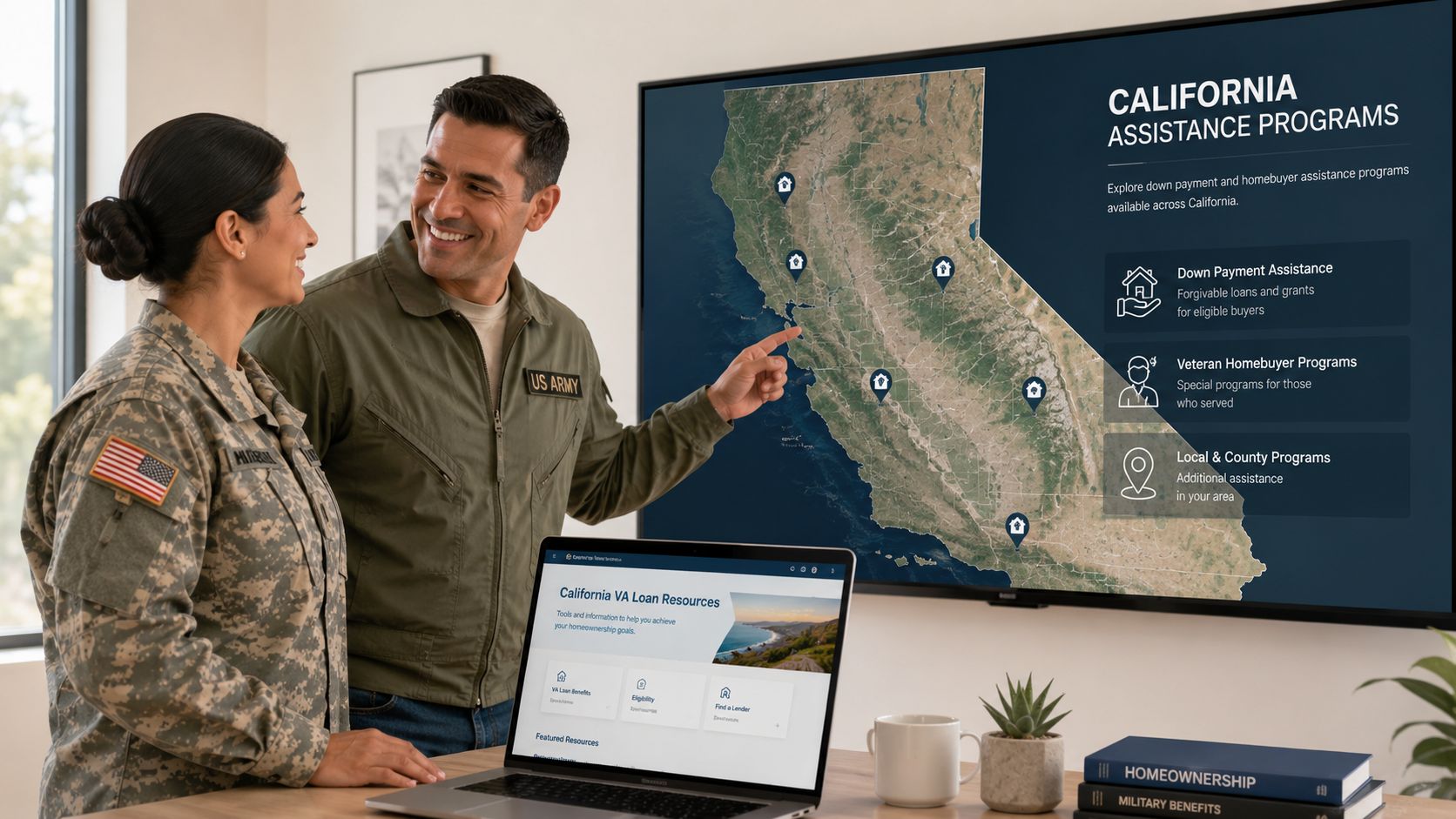
California buyers usually start with the wrong assumption. They think there must be one statewide veteran down payment program that works everywhere. In reality, the assistance scene is patchwork.
Some options are statewide. Others are county-specific, city-specific, employer-linked, or tied to a targeted housing initiative. Availability depends on geography, property type, income, occupancy rules, and whether the program permits VA financing.
Start with statewide options, then go local
A practical California search usually moves in layers:
- State programs first because they're easier to identify and may have broader lender participation
- County housing agencies next because some of the strongest options are local
- City programs after that for buyers in major metro areas
- Profession-specific or employer-linked programs where available
For veterans, this matters because the VA loan itself is national, but assistance is not. The closer you get to the city or county level, the more variation you'll find in eligibility and program design.
The eligibility cliff is real
High-cost markets create a strange mismatch. A service member or veteran may qualify for a substantial VA purchase, have stable income, and still miss the cut for assistance because the local program is aimed at lower-income households.
That's not a niche issue. As noted by Virginia Housing's DPA eligibility framework, many state assistance programs use income caps such as 80% of Area Median Income, and some pilot designs can be tighter. The broader lesson applies directly to California: in expensive markets, buyers can be financially solid for VA financing and still be over-income for meaningful assistance.
In California, the hardest part often isn't finding a DPA program. It's finding one your income and ZIP code still fit.
What to look for in Los Angeles, San Diego, and the Bay Area
In major California metros, local research matters more than generic blog answers. Buyers should ask:
- Does the program allow VA financing at all
- Is it limited to first-time buyers
- Are there purchase price limits
- Is the assistance a grant, forgivable second, or deferred second
- Can it be combined with seller credits or other support
- How long does approval take relative to a normal escrow
Programs can exist on paper and still be poor fits for an active purchase contract if timelines are too slow or funds are exhausted.
Where specialized programs fit
This is also where specialized offerings such as the HERO Home Loan can make sense in the conversation. Some California-focused hero programs are designed to work with VA financing and direct the benefit toward closing costs rather than a down payment need. That's often more useful for veterans because it aligns with the actual shortfall on a zero-down structure.
The best approach is usually layered: identify any state or local assistance first, then evaluate whether a profession-based or lender-linked program can reduce the remaining cash burden.
How to Qualify and Prepare Your Documentation
Assistance programs don't just ask whether you're VA-eligible. They ask whether you fit their own box.
That box can include geography, income, occupancy, homebuyer education, and first-time buyer status. Some programs are flexible. Others are rigid enough that one pay raise, one property boundary, or one prior ownership history changes the answer.
The most common qualification filters
Start with these checkpoints before you chase any program too hard:
- Income limits often decide the file before anything else. A buyer can be well-qualified for a VA loan and still be over the cap for assistance.
- First-time buyer rules can matter even when the applicant is a veteran. Some assistance programs care more about recent ownership history than military status.
- Property location is frequently a strict requirement. City and county lines matter.
- Program design matters because the same dollar figure doesn't mean the same value if one option is a grant and another is a repayable second.
A useful reality check comes from examples outside California. The Homes for Texas Heroes program advertises assistance of 3% to 5% of the loan amount, while some programs in other markets use fixed caps such as $10,000 or $15,000. That comparison shows why structure matters in California. A percentage-based benefit and a fixed-dollar benefit don't stretch the same way in a high-cost purchase.
Documents to gather before you apply
A clean file moves faster. For most VA plus assistance scenarios, gather these early:
- Certificate of Eligibility so the lender can confirm your VA entitlement position
- Service documentation, often including a DD-214 when applicable
- Income records such as pay stubs and tax returns
- Asset statements for checking, savings, or other available funds
- Identification and residency documents
- Homebuyer education certificate if the specific assistance program requires it
What helps and what usually causes delays
The buyers who move cleanly through this process usually do three things well.
First, they verify the assistance rules before writing offers. Second, they keep paperwork current and readable. Third, they avoid making assumptions about what a program “should” allow.
What usually slows things down is simpler:
- Applying for a program that doesn't permit VA financing
- Missing the income cap by a narrow margin
- Assuming a local program covers any property in the metro area
- Not realizing assistance approval has its own timing requirements
If you're buying in California, the file should be built around the program from day one, not retrofitted halfway through escrow.
Your Step-by-Step Application Guide
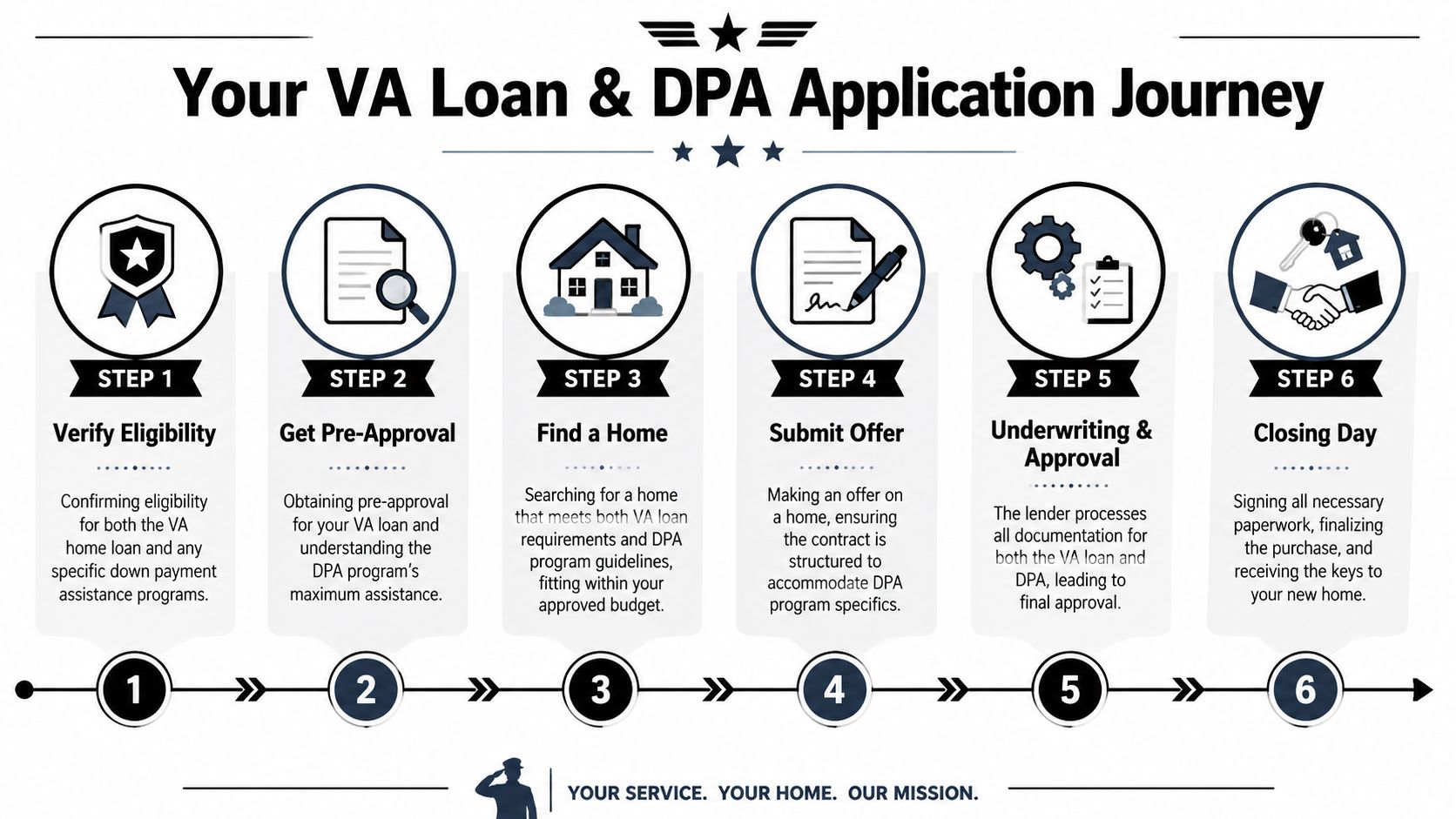
The actual process is less mysterious when you see the order clearly. Veterans get into trouble when they shop for homes first and ask about assistance second. With VA home loan down payment assistance, sequence matters.
The workflow that tends to work best
Verify VA eligibility early
Confirm your Certificate of Eligibility status and basic borrower profile before anything else. You want clarity on the loan side before matching it with assistance.Screen assistance options before active shopping
Don't wait until you're in contract. Review which California state, county, city, or specialized programs allow VA financing and whether you fit the income and occupancy rules.Get pre-approved with the assistance strategy in mind
A normal pre-approval isn't enough if it ignores the DPA layer. The lender should understand how the assistance affects cash to close, documentation, and timeline.
The cleanest transactions are usually the ones where the lender underwrites the strategy, not just the loan.
What happens once you're in contract
After you find a property and get an offer accepted, the file becomes a coordination exercise.
- The lender handles the VA first mortgage
- The assistance provider reviews its own application and conditions
- The title and escrow team coordinates the flow of funds to closing
If any one of those parties is working from outdated assumptions, the closing can drift. That's why communication matters more here than on a plain VA purchase.
The last stage before closing
As the file moves through underwriting, the details get more technical. The property has to satisfy VA standards, the assistance provider has to issue final approval, and the funding timeline has to line up with your escrow calendar.
The most practical borrower move at this stage is simple: respond quickly and don't change your finances unless your lender approves it first. New debt, unexplained deposits, or last-minute document gaps can complicate both approvals at once.
By closing day, the goal is straightforward. The VA first mortgage and the assistance funds are both cleared, the settlement statement reflects the proper credits and cash requirements, and you sign once with no surprises.
How California Loans for Heroes Can Help You Succeed
California buyers don't need more generic VA advice. They need someone who understands how a VA file interacts with California pricing, local assistance rules, timing pressure, and the practical cash problems that show up near closing.

A specialist can help in three ways that matter. First, by screening whether a program works with VA financing. Second, by identifying whether the assistance is best used for closing costs, prepaid items, or another borrower contribution. Third, by structuring the timeline so the assistance approval doesn't become the reason the deal slips.
For buyers who want a California-specific option, California Loans for Heroes down payment assistance information outlines a path for qualified borrowers, including those using VA financing. The company's HERO Home Loan and Buyer Rewards approach is relevant when a veteran needs help reducing upfront closing cash rather than solving for a traditional down payment.
That kind of support matters because California homebuying is rarely about one program in isolation. It's about stacking the right pieces without creating a future problem on title, refinance, or repayment.
If you're a veteran or active-duty buyer trying to make a California purchase work with less cash out of pocket, talk with California Loans for Heroes about how VA financing, local assistance, and closing-cost strategies may fit your situation.