Buying a home in California after military service can feel like a second deployment into paperwork, pricing pressure, and mixed advice. You've earned a serious benefit, but that doesn't mean every lender, every program, or every loan officer will make it simple.
A lot of veterans start in the same place. You want a stable home, you want to use the benefit you earned, and you want a straight answer on what works in California. That's the right mindset. California gives you two real paths to consider: the federal VA home loan and the CalVet Home Loan offered through the state.
Most articles stop at “VA loans are zero down.” That's incomplete, and in California, incomplete advice costs people time. In higher-cost markets, the better question isn't just whether a program allows zero down. It's whether the lender, your file, and the property all line up in practice.
This guide is built for that reality. If you're comparing home loans for veterans, you need more than a benefits summary. You need to know how the federal VA loan works, how CalVet differs, where veterans get blindsided in California, and which option fits your situation instead of somebody else's sales pitch.
Your Next Mission Homeownership in California
You might be at the point where renting feels like wasted money, your family needs more space, or you're finally ready to put roots down after years of moving. That's common for veterans in California. The mission changes, but the objective is still clear: secure the right position, protect your budget, and make a smart long-term move.
For many veterans, the confusion starts because both the federal VA loan and CalVet get described as “veteran home loans,” as if they're interchangeable. They aren't. One is a federal guaranty program used through private lenders. The other is a California state-run loan program with its own structure and rules.
That distinction matters fast when you're comparing monthly cost, control over insurance, property location, and how much flexibility you want later.
What California veterans usually need most
Some buyers care most about low cash to close. Others care about monthly payment stability. Others need a loan that can handle a more expensive California market without creating surprises halfway through escrow.
The right choice usually comes down to three practical questions:
- How strong is your file right now. Credit profile, debt load, reserves, and consistency matter.
- Where are you buying. California market conditions change the conversation quickly.
- How much control do you want. Especially over lender choice, insurance structure, and future options.
Homeownership isn't just a purchase. For many veterans, it's the first stable platform for the next phase of life.
You don't need a generic explanation. You need a decision framework that respects how California works.
Understanding the Federal VA Home Loan Program
You find a house in California, your offer is ready, and the listing agent asks one question that changes everything. “Are you fully approved, or just prequalified?” That moment is where a VA loan either works for you or slows you down.
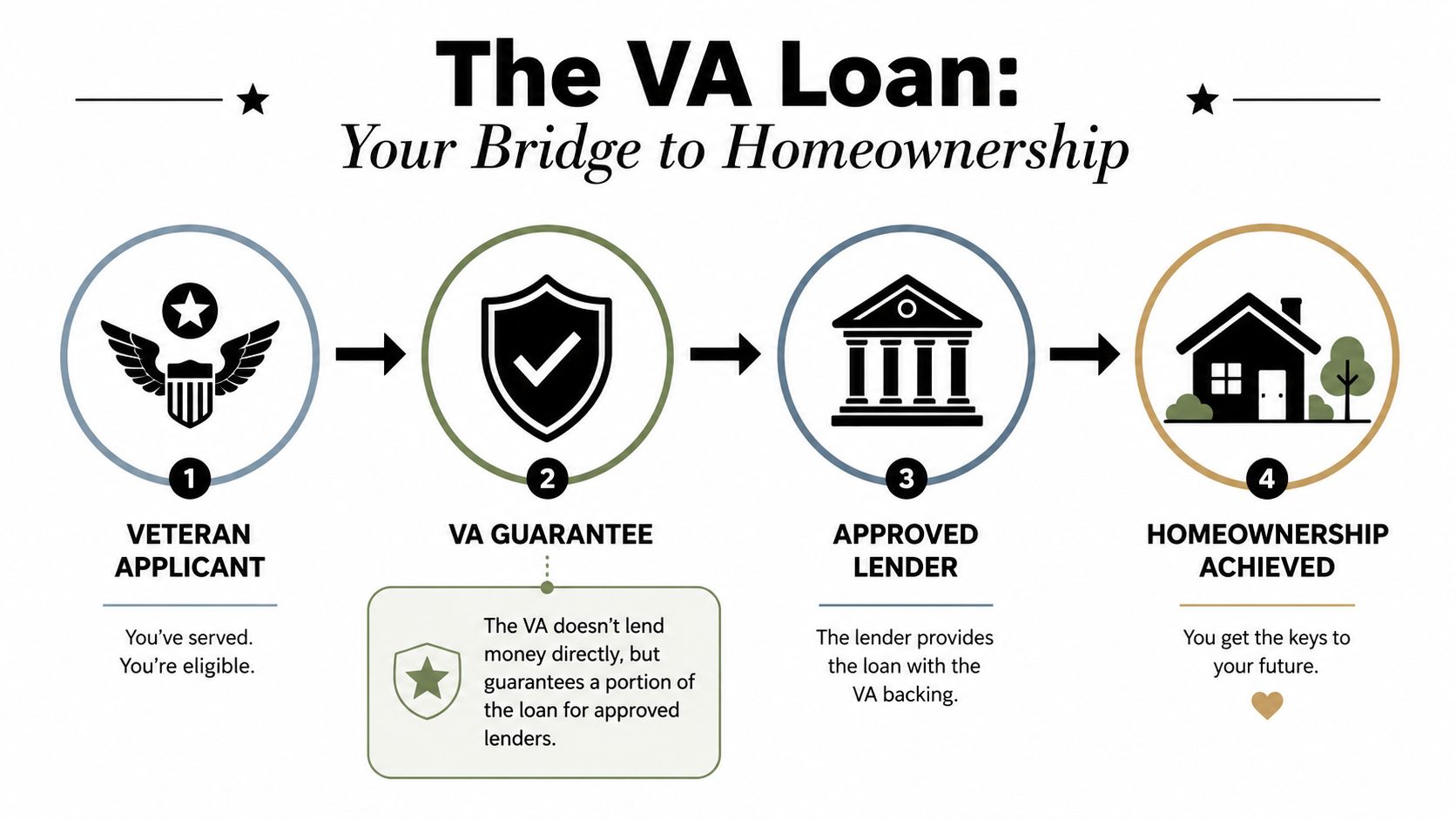
The federal VA home loan program is a mortgage benefit backed by the Department of Veterans Affairs and issued by private lenders. The VA does not hand you the money. It guarantees part of the loan, which lowers lender risk and gives eligible veterans access to financing that is often more favorable than a standard conventional loan. Since 1944, the program has supported millions of veterans and service members seeking homeownership, according to this review of the VA home loan program.
How the VA guarantee actually works
A private mortgage lender underwrites and funds the loan. The VA guarantees a portion of it. That guarantee is the reason VA financing can offer terms many buyers cannot get through other loan types.
That does not mean every lender treats a VA file the same way. One lender may be efficient and practical. Another may pile on extra credit, reserve, or documentation requirements that the VA itself does not require. In California, that difference shows up fast, especially when you are buying in a competitive market or at a higher price point.
If you want a clear overview of the program's structure and borrower advantages, review these VA loan benefits for veterans in California.
Who can qualify
Eligibility starts with military service, but the cleanest answer comes from your Certificate of Eligibility, or COE. That document confirms whether you meet the VA's service requirements for the home loan benefit.
Many veterans also miss an important point. VA eligibility is not a one-time coupon. In many cases, you can use the benefit again after selling a home and restoring entitlement, or even keep part of your benefit available depending on the situation. That matters in California, where your first purchase may be a starter home, not your long-term home.
What the process looks like
A strong VA purchase usually follows this sequence:
- Get your COE early. Do not wait until you are writing offers.
- Choose a lender with real VA volume. Ask how often they close VA loans in California, not just whether they offer them.
- Get underwritten, not casually prequalified. In a competitive market, that difference matters.
- Match the property to the loan. The home still has to meet lender and VA standards for condition, occupancy, and value.
- Review the lender's overlays before escrow gets serious. Hidden problems often become apparent at this point.
The California issue generic VA guides miss
The VA program itself is flexible. Your lender may not be.
That distinction matters most in high-cost California markets. A veteran may hear “VA means zero down” and assume the deal is settled. Then the lender applies its own rules on credit score, reserves, jumbo pricing, or loan size and starts talking about a down payment. The problem is not always VA eligibility. The problem is lender policy.
Treat the federal VA loan as a framework, then examine the lender sitting inside that framework.
Practical rule: Ask every lender two direct questions. “What overlays do you apply to VA loans?” and “At what loan amount do you start requiring money down in California?”
That is how you avoid wasted time, weak offers, and ugly surprises halfway through escrow.
Key Financial Advantages of Using a VA Loan
A California buyer with solid income can still get boxed in fast by a mortgage that demands too much cash upfront and too much payment every month. That is why I tell eligible veterans to put the federal VA loan at the top of the list before they spend time on conventional options.
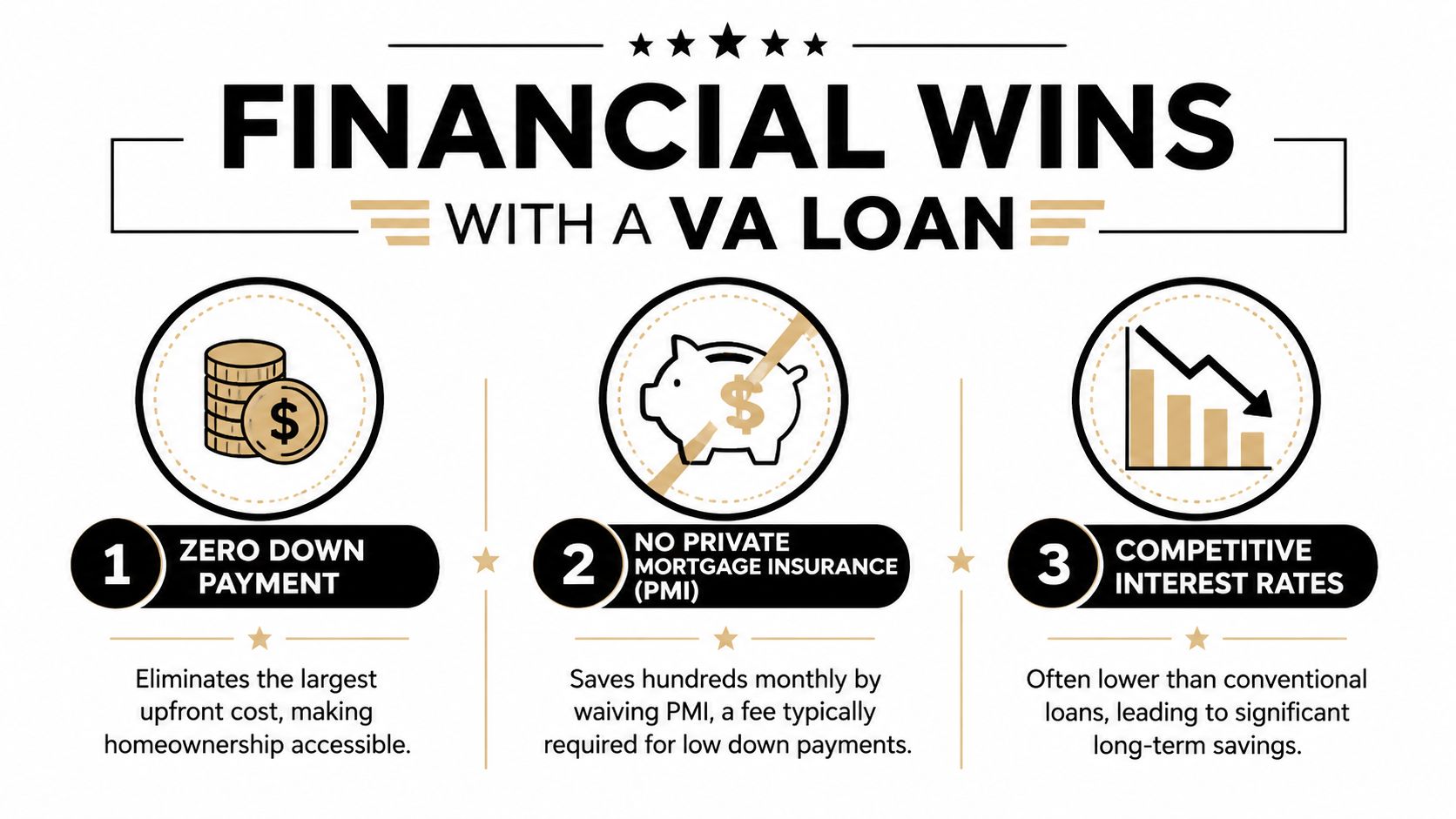
The biggest advantage is simple. A VA loan can protect your cash.
In California, that matters more than generic mortgage advice admits. Even if you qualify for zero down under VA rules, you still need money for appraisal gaps, inspections, escrow costs, moving expenses, and post-close repairs. Keeping your down payment low gives you room to handle the actual costs of buying in this state instead of draining your savings just to get the keys.
The second advantage is monthly payment relief. VA loans do not charge monthly private mortgage insurance, which is one of the cleanest cost advantages in the market. On a conventional loan with a small down payment, PMI can add a real monthly burden without building a dollar of equity. You pay it only because the lender wants extra protection.
That is why the VA loan often beats conventional financing even before you compare rates.
Rates are commonly competitive, and many veterans end up with a lower payment because they avoid both a large down payment and PMI at the same time. If you want a clearer breakdown of how these savings show up over the life of the loan, review the benefits of a VA loan before you choose a lender.
Here is the practical summary:
| Cost category | VA loan advantage | Why it matters in California |
|---|---|---|
| Upfront cash | Often allows little or no down payment | Preserves savings for closing costs, reserves, and repairs |
| Monthly payment | No monthly PMI | Reduces payment strain in high-cost markets |
| Interest cost | Often priced competitively | Helps offset California home prices over time |
The catch is California-specific. The VA benefit is strong, but the final numbers still depend on the lender, the loan size, and the county you are buying in. In higher-priced areas, some lenders tighten their own terms and the payment can rise quickly if pricing worsens or cash is required above a certain loan amount.
So use the VA loan for what it does best. Lower your cash burden, cut avoidable monthly costs, and keep more flexibility in reserve. Then compare that federal option against CalVet with the same discipline, because in California the better veteran loan is the one that still works cleanly at your actual price point.
Introducing Californias CalVet Home Loan Program
You find a home in California, line up your VA benefit, and then hear about CalVet from a county office, another veteran, or a lender late in the process. That is backwards. You should size up CalVet early, because it is a separate loan path with different rules, a different structure, and a different monthly payment setup.
CalVet is California's own veteran home loan program. The state lends the money directly and keeps legal title under a land contract until the loan is paid off. That is a real difference, not a branding tweak. If you like dealing with one state-run program instead of a private lender using a federal guaranty, CalVet deserves a hard look.
Eligibility is narrower than many veterans expect. CalVet is for qualified veterans buying an owner-occupied property in California, and the program has its own service and discharge requirements, as noted earlier in the article. It also does not fit a veteran who expects the next purchase to be outside California.
The insurance setup is where CalVet starts to feel very different in practice.
Instead of sending you out to shop for standard homeowners coverage on your own, CalVet folds required disaster coverage into the payment structure. That can make budgeting simpler. It also gives you less control, so do not assume the cleaner setup automatically means the cheaper setup.
This matters more in California than generic veteran loan guides admit. In a high-cost market, your decision is rarely just about rate. It is about total monthly housing cost, cash needed to close, and how each program behaves at your target price point. A CalVet payment can look straightforward on paper while a federal VA loan may offer more flexibility, especially if you are comparing lender overlays, seller credits, and reserve requirements.
My advice is simple. Do not treat CalVet as a backup option and do not treat it as automatically better because it is state-run. Price it side by side against a federal VA loan using the same purchase price, the same expected close date, and the full monthly cost. That is the only comparison that matters.
VA Loan vs CalVet Loan A California Comparison
You are buying in California, not in a generic VA-loan market. That changes the decision.
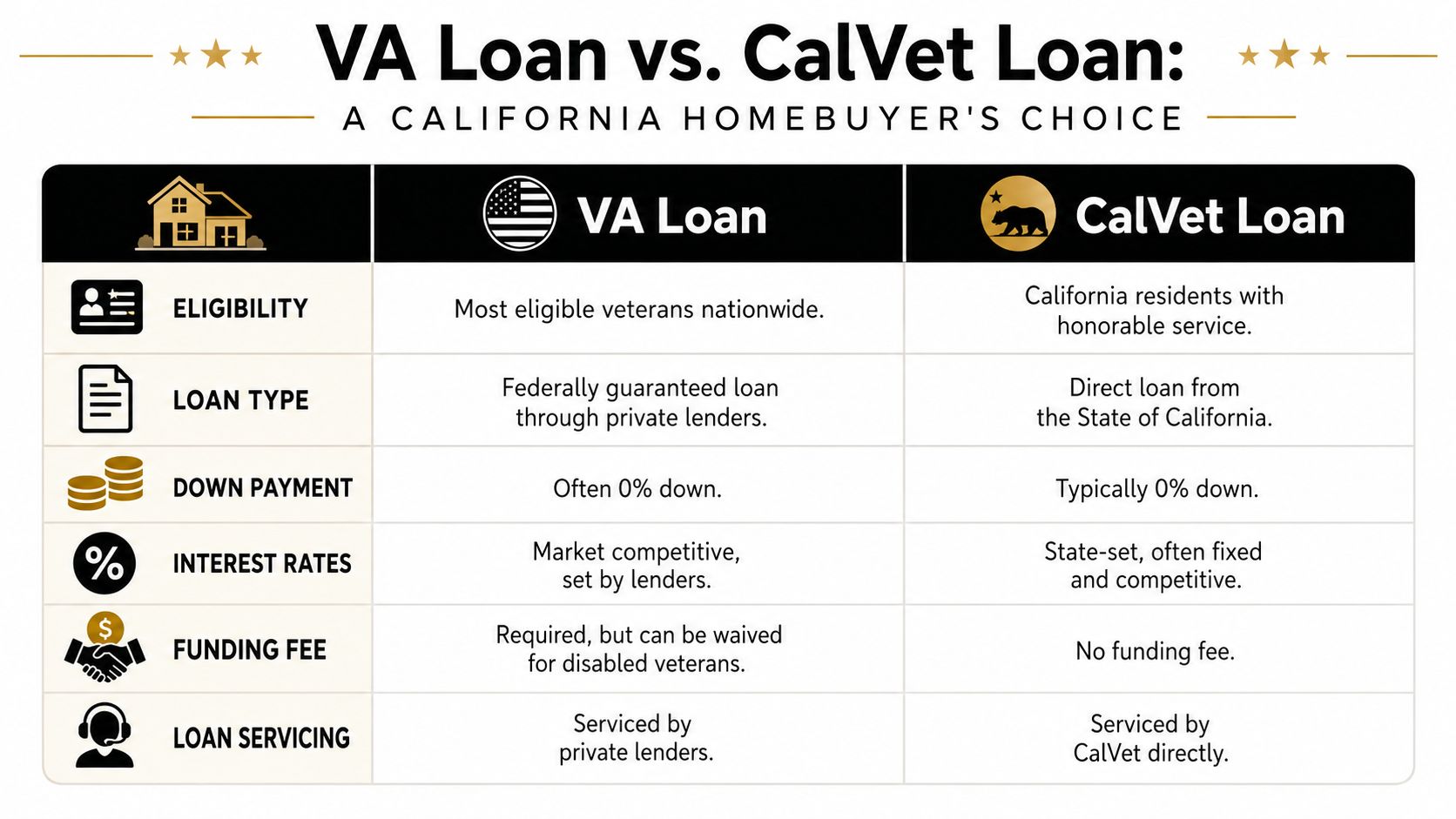
The crucial question is not which program sounds more veteran-friendly. The pivotal question is which loan gives you the better outcome at your price point, with your credit profile, in the county where you plan to buy. In California, that comparison gets serious fast because high home prices can expose lender rules, insurance costs, and cash-to-close issues that national guides barely mention.
The side by side view
| Decision factor | Federal VA loan | CalVet loan |
|---|---|---|
| Core structure | VA-backed mortgage issued by a private lender | State-run loan program for California veterans |
| Where you can buy | Eligible properties in many markets, subject to lender and property approval | California only |
| Monthly cost design | Mortgage payment plus separate homeowners insurance and other housing costs | Different payment structure, with disaster coverage built into the obligation |
| Future flexibility | Usually the stronger option if you may buy again later or leave California | Built around an in-state purchase and state program rules |
| Shopping power | You can compare lenders, fees, overlays, and service levels | You are comparing against a single state-run structure |
Here is the practical difference. A federal VA loan usually gives you more room to shop and more control over how the loan is structured. CalVet usually gives you a more packaged setup, but less flexibility. Neither is automatically cheaper. Neither is automatically safer. You have to compare the full payment and the cash needed to close.
When the federal VA loan is usually the better call
Start with the federal VA loan unless CalVet clearly beats it on total cost.
That recommendation gets stronger if any of these apply to you:
- You want lender competition. In California, rate, fees, overlays, and reserve requirements can vary by lender.
- You may move again. If this may not be your last home, the broader federal framework is usually the smarter base plan.
- You are buying near the upper end of your budget. High-cost areas punish bad assumptions. A standard VA comparison gives you a clearer way to test options, including jumbo VA loan options for higher-priced California homes.
- You want maximum control over insurance and closing strategy. That matters when you are negotiating seller credits or trying to manage monthly payment tightly.
When CalVet deserves real consideration
CalVet is worth serious attention if you want predictability more than flexibility.
That usually means:
- You prefer a state-run program.
- You like the simpler payment structure.
- You are committed to an owner-occupied home in California and want to compare every veteran-specific path available to you.
CalVet can work well for the right borrower. It can also look cleaner on paper than it feels in practice if the bundled costs push the monthly payment higher than expected. Run the numbers, not the branding.
My recommendation
Use the federal VA loan as your benchmark. Make CalVet beat it.
Compare both options on the same purchase price, with the same estimated close date, and the same realistic assumptions for insurance, fees, and cash to close. If a lender adds conditions that make the federal VA option less attractive on your file, you will see it quickly. If CalVet produces a lower total monthly cost and a better closing position, take it seriously.
Choose the loan that leaves you stronger after closing, not the one with the better sales pitch.
Navigating High-Cost California Real Estate Markets
However, generic advice often falls apart. A lot of veterans hear “zero down” and assume that means they can walk into any California market with no cash requirement beyond standard closing costs. That's not how it always plays out.
The official program can allow one thing while the lender demands another.
The zero-down myth in expensive markets
A key issue that many mainstream guides miss is this: lenders in major markets like California often require down payments for borrowers with lower credit scores or higher debt-to-income ratios, even though VA rules themselves don't require a down payment, as noted in this discussion of lender overlays and veteran borrowing realities.
That's the hidden down payment problem. The VA benefit may still be excellent. Your lender may still say no to true zero-down execution on your file.

What to do instead of assuming
If you're buying in a higher-cost area, prepare like a buyer who may need options. That doesn't mean you'll definitely need a down payment. It means you shouldn't build your whole plan around the most optimistic version of the rules.
Use this approach:
- Build reserves on purpose. Even if the final loan closes with little down, reserves strengthen your file and your negotiation position.
- Pressure-test your approval early. Don't settle for a casual preapproval. Ask whether the lender has reviewed the risk factors that trigger overlays.
- Compare more than one VA-capable lender. Lender overlays are not always identical.
- Know whether you need jumbo financing. In expensive parts of California, loan size changes the conversation quickly. Review how a jumbo VA loan works before you start shopping at the top of your budget.
The California reality
California punishes vague planning. If your debt is stretched, your scores are thinner, or the home price pushes the edge of lender comfort, the promise of “no down payment required” can turn into “down payment required by this lender.”
That doesn't mean the VA loan failed you. It means you need a lender strategy, not just a program name.
In California, the veteran who wins isn't always the one with the biggest budget. It's usually the one who got real underwriting answers before making offers.
Your Action Plan to Secure a Veteran Home Loan
Don't leave this at research. Turn it into a checklist and move.
Start with eligibility and documents
Get your Certificate of Eligibility lined up first. Confirm your service history, discharge status, and any details that affect federal VA or CalVet qualification. If paperwork is messy, fix that before you start home shopping.
Stress-test your budget like a buyer, not a browser
Look at the payment you can live with after taxes, insurance, maintenance, and normal life expenses. California buyers get into trouble when they qualify for one number and can comfortably live at another.
Use a stricter standard for yourself than the lender uses.
Compare the two veteran paths directly
Don't ask, “Which one is better?” Ask:
- What is the full monthly cost under each option?
- How much cash do I need if a lender adds overlays?
- How much flexibility do I want later?
If you may need help bridging cash needs, review VA home loan down payment assistance options as part of your planning.
Choose specialist guidance
Work with an advisor who understands both federal VA loans and CalVet, and who knows how California underwriting behaves. That's the difference between reading about home loans for veterans and closing one successfully.
The goal isn't just approval. It's getting into the right home with a loan structure that still makes sense a year from now.
If you're ready to compare the federal VA loan against CalVet with real California guidance, talk with California Loans for Heroes. Their team helps veterans and other California HEROES manage purchase loans, refinance options, assistance programs, and one-on-one mortgage planning built for the realities of this market.