
A shared appreciation mortgage is a home loan or assistance loan where a lender gives you funds, often for a down payment or lower-cost financing, in exchange for a share of your home's future increase in value. In the early 1980s, lenders used SAMs to help buyers qualify during very high rate periods, sometimes offering mortgage rates as much as 2% below market in exchange for 30% to 50% of future appreciation.
If you're a California nurse, firefighter, teacher, veteran, deputy, or other public servant, you may be looking at home prices and wondering whether the math will ever work. You've done the responsible things. You've built a career, kept your bills in line, and maybe even saved some money. But in many California markets, the down payment gap still feels huge.
That's where people start searching for answers like what is Shared Appreciation Mortgage, and why does it keep showing up in conversations about first-time buyer help. The short version is simple. A SAM can make homeownership possible sooner, but it changes what happens to your equity later.
That trade-off matters more in California than in many other places because future appreciation can become a large part of your wealth. For public heroes, that means a SAM isn't just a way to get into a home. It's also a decision about how much of tomorrow's value you may be giving up to solve today's affordability problem.
Your Path to Homeownership in a Tough Market
California buyers in public service often run into the same wall. Income is steady, job history is strong, and the desire to own is real. The problem is getting from “I can probably handle a mortgage payment” to “I have enough cash to close.”
A shared appreciation mortgage can bridge that gap. Instead of requiring you to bring all the needed funds on your own, the program or lender contributes money up front and waits to be repaid later. In return, you agree to share some of the home's future appreciation.
Why this catches so many first-time buyers off guard
Most buyers are trained to think about two things only. Monthly payment and down payment. A SAM adds a third piece, which is future equity sharing.
That's why this product can feel easier at the beginning and more expensive at the end. You may get into the home with less strain today, but you're making a deal about value that doesn't show up in your normal monthly budget.
For many public heroes, the appeal is obvious:
- Lower entry hurdle: You may be able to buy sooner instead of waiting years to save more cash.
- Less pressure on monthly cash flow: Some SAM structures reduce the burden at the start.
- Access in expensive areas: In high-cost parts of California, that can be the difference between owning and staying on the sidelines.
Why California buyers need extra caution
In a slower-growth market, sharing appreciation might feel manageable. In California, the stakes can be much bigger because any future price growth can translate into a meaningful transfer of equity.
Practical rule: If a loan helps you buy now by claiming part of your future upside, you need to understand the exit math before you sign.
A SAM isn't automatically good or bad. It's a tool. For some buyers, it's the path that finally opens the front door. For others, it's too costly once they look beyond the first few years.
If you're still working through the basics of timing, budgeting, and sequence, this guide to steps to buying your first home in California helps frame where a shared appreciation option might fit.
How a Shared Appreciation Mortgage Actually Works
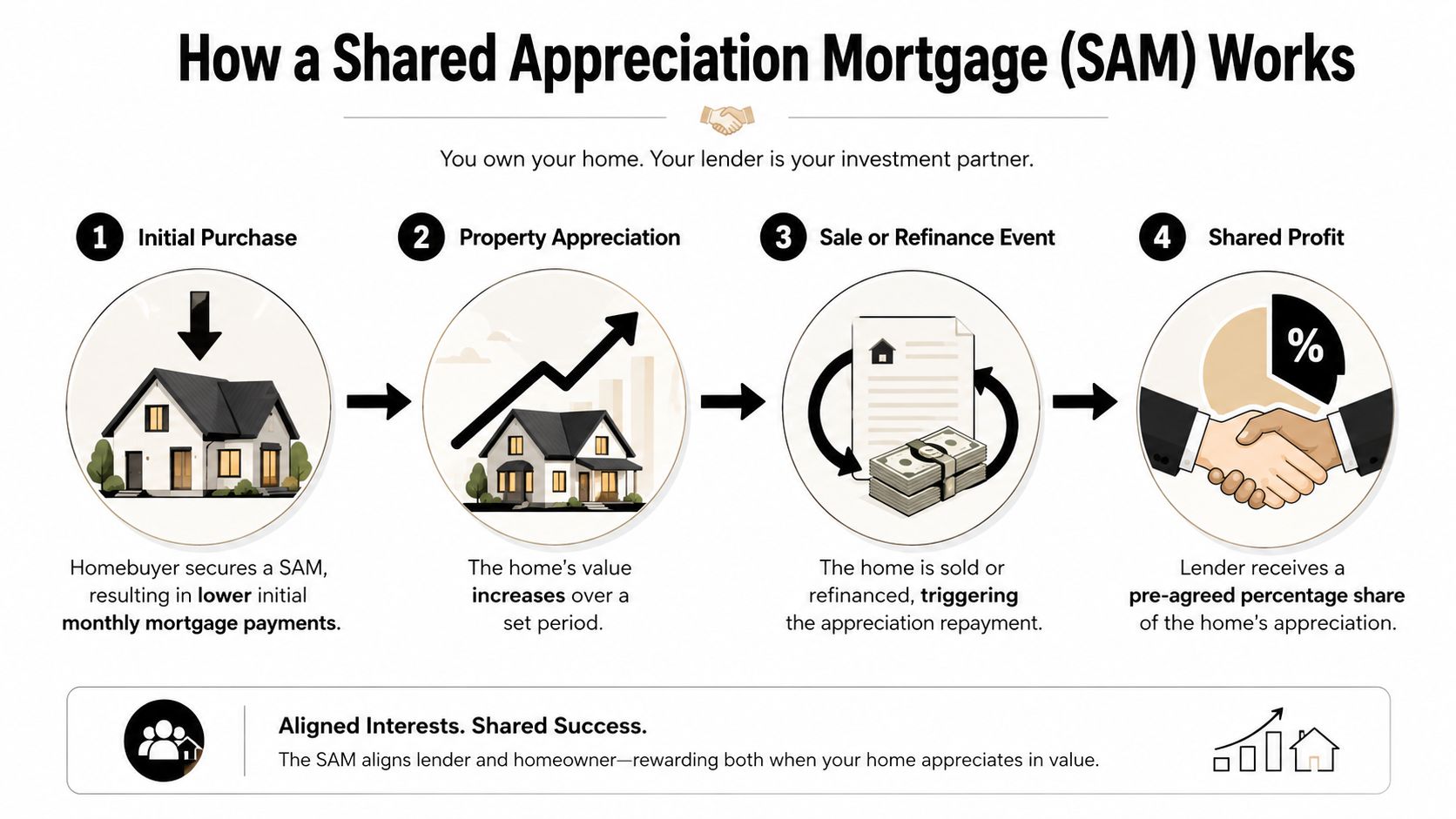
Think of a SAM as a silent partner arrangement tied to your home.
You buy the property and live in it as the owner, but another party helps with financing under special terms. In exchange, that party gets a pre-agreed share of the home's appreciation when a trigger event happens.
The basic moving parts
Here's the simplest way to understand it:
You receive help upfront.
That help might come as down payment assistance or below-market financing.You usually don't make monthly payments on the SAM portion.
Modern SAMs are often structured as zero-interest, deferred-principal loans, sometimes called silent second mortgages, with repayment delayed until the home is sold, the first mortgage is refinanced, or the loan reaches its maturity date, as described in Fannie Mae's Community Seconds guidance.Your home may rise in value over time.
If it does, the SAM provider shares in that gain based on the agreement.You repay in a lump sum at the trigger event.
That repayment usually includes the original SAM amount plus the agreed appreciation share.
Where SAMs came from
The original version of this idea became popular during a difficult lending period. The shared appreciation mortgage emerged in the early 1980s during extremely high interest rates, and lenders offered rates as much as 2% below market in exchange for 30% to 50% of the home's future appreciation on loans that could run up to 30 years, according to research on the early history of SAMs.
That older form was built around rate relief. Today, many buyers see SAMs through housing assistance programs instead.
The lender isn't becoming your co-owner in the day-to-day sense. But they are claiming a contractual piece of the future value increase.
The repayment triggers that matter
Readers often get confused here because a SAM can feel invisible while you own the home. Nothing dramatic happens month to month. Then a major event activates the obligation.
Common triggers include:
- Selling the property: The shared appreciation amount is settled when the transaction closes.
- Refinancing your first mortgage: Some programs require payoff at refinance.
- Reaching the maturity date: Certain assistance programs have a set end date even if you stay put.
The important takeaway is that the SAM cost often shows up later, not monthly. That's why the product can look friendlier than it really is if you only focus on the payment you make today.
SAMs vs Standard and Shared Equity Mortgages
A lot of buyers mix up three very different ideas. A standard mortgage, a shared appreciation mortgage, and a shared equity agreement can all affect affordability, but they don't work the same way.
One of the easiest ways to sort them out is to compare who pays what now, who owns what later, and what happens when you sell.
Loan Comparison SAM vs Standard vs Shared Equity
| Feature | Shared Appreciation Mortgage (SAM) | Standard Mortgage | Shared Equity Agreement |
|---|---|---|---|
| Upfront help | Often includes assistance that reduces cash needed at purchase | Usually depends on your own down payment and standard financing | May provide cash based on a future equity claim |
| Monthly payments | Often no monthly payment on the SAM portion when structured as a silent second | Regular monthly principal and interest payments | Structure varies by agreement |
| Ownership rights | You typically own the home, but you owe a share of future appreciation under the contract | You own the home subject to the mortgage lien | Some arrangements are described more like investment participation than plain financing |
| What happens at sale | You repay the original assistance amount plus the agreed appreciation share | You repay the remaining loan balance and keep the rest of your equity after costs | Provider usually receives its contractually defined share |
| Common use case | Affordability support for qualified buyers in high-cost markets | Traditional home purchase financing | Alternative cash-access or affordability structure |
The clearest distinction for most buyers
A standard fixed-rate mortgage is straightforward. You borrow money, make monthly payments, and if the home gains value, that appreciation belongs to you after paying off the loan and selling costs.
A SAM changes only one piece of that picture. You still own the home, but you've agreed to give up part of the future upside.
Modern versions are often public or community-based assistance loans. According to Local Housing Solutions' overview of shared appreciation mortgages, these are commonly structured as zero-interest, silent second mortgages, and programs such as San Francisco may offer up to $375,000 in down payment assistance with repayment of principal and the appreciation share deferred until the home is sold.
Why “shared equity” can confuse people
People often use “shared equity” as a catch-all phrase, but not every shared equity arrangement is a SAM. Some deals feel more like an investor relationship. Others are public assistance loans with repayment rules tied to appreciation. The wording can sound similar even when the legal and financial details are not.
If you're comparing options, don't stop at the product name. Read how repayment works, when it's due, and whether the provider claims appreciation, ownership rights, or both.
When you're evaluating the cost side of different loans, it also helps to review a broader framework for how to compare mortgage rates and loan structures, because the cheapest monthly payment isn't always the least expensive path over time.
The Pros and Cons for California Homebuyers
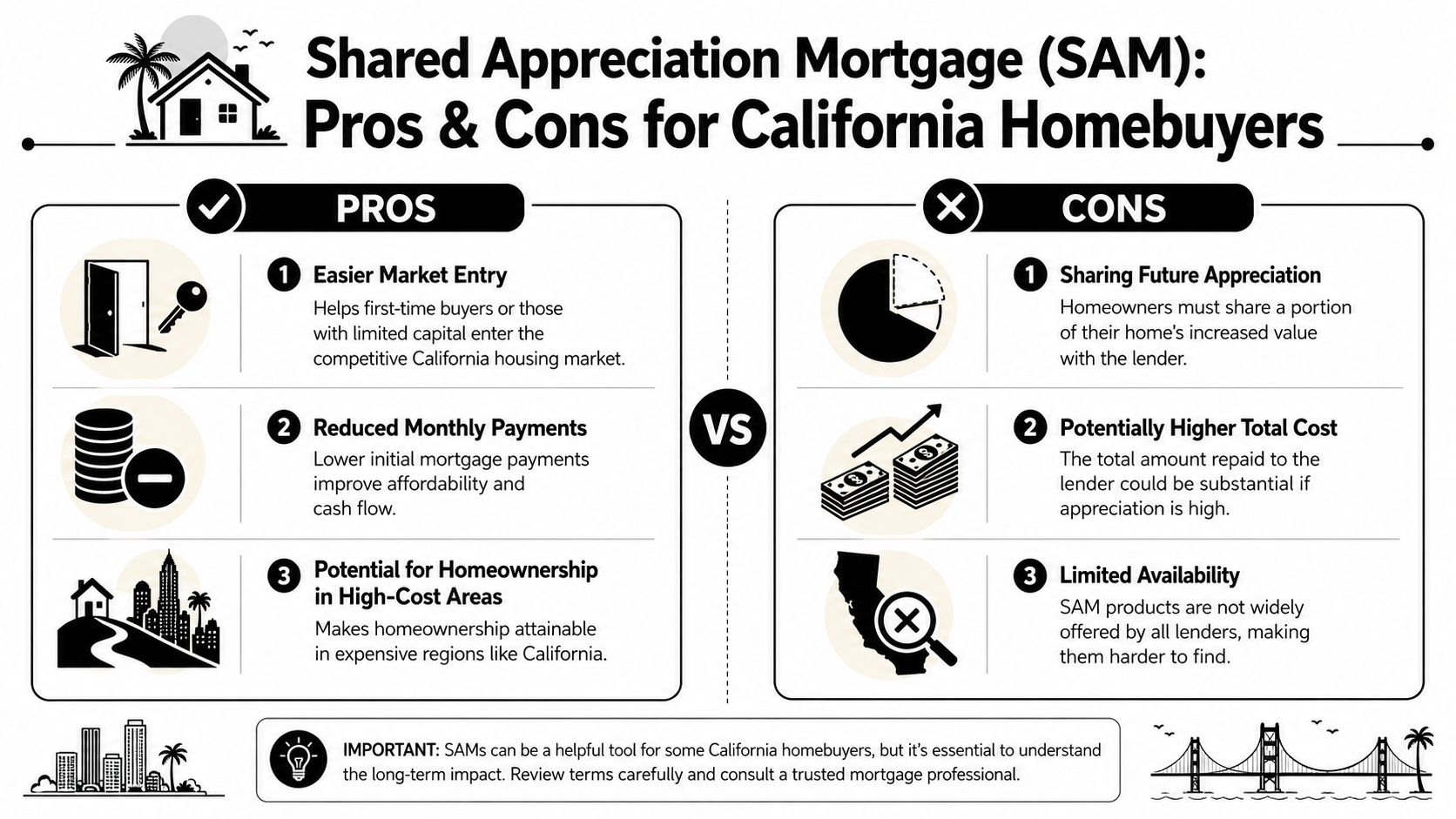
The strongest argument for a SAM is immediate affordability. The strongest argument against it is long-term equity loss. In California, both sides of that trade-off are sharper.
Why buyers say yes
For a first responder or teacher trying to buy near work, the benefit is easy to see. A SAM can reduce the amount of cash needed up front or lower the cost structure enough to help you qualify.
That matters when rent is already high, commuting is long, and saving for a large down payment keeps getting pushed back by life. A buyer may decide that owning now, even with future sharing, is better than waiting indefinitely.
The practical advantages usually look like this:
- Earlier entry: You don't have to save the full gap alone.
- Better cash flow at the start: Some structures leave more room in the monthly budget.
- Access to high-cost communities: Buyers can compete in places that may otherwise stay out of reach.
Why the downside can be bigger in California
The problem is that appreciation sharing sounds abstract when you sign the papers. It becomes very real when values rise.
The Consumer Financial Protection Bureau notes that borrowers often underestimate the total cost of a SAM. A borrower might save 1% to 2% on interest, but 5% annual appreciation over 10 years could leave the lender with more in shared equity than the borrower saved in interest, according to the CFPB's explanation of shared appreciation mortgage trade-offs.
The emotional trap
A lot of buyers evaluate the decision at closing, when relief is the dominant feeling. They finally have keys. They solved the affordability problem. The appreciation clause feels distant.
Then years later, the home has become a major source of wealth, and part of that wealth belongs to the SAM provider under the contract.
A SAM can solve a cash problem today by creating an equity problem later. Whether that's acceptable depends on how badly you need the help and how long you expect to own the home.
A balanced way to judge it
Ask yourself these questions before you get attached to the lower upfront cost:
- Would I still buy if the home appreciates meaningfully and I have to share that gain?
- Am I using this because it's my best option, or because it feels easier than waiting and saving more?
- If I refinance or move sooner than expected, am I prepared for the payoff event?
For some California buyers, a SAM is a practical bridge into ownership. For others, it's a costly surrender of future equity in a state where that equity may become one of their most valuable assets.
A Real-World SAM Calculation Example
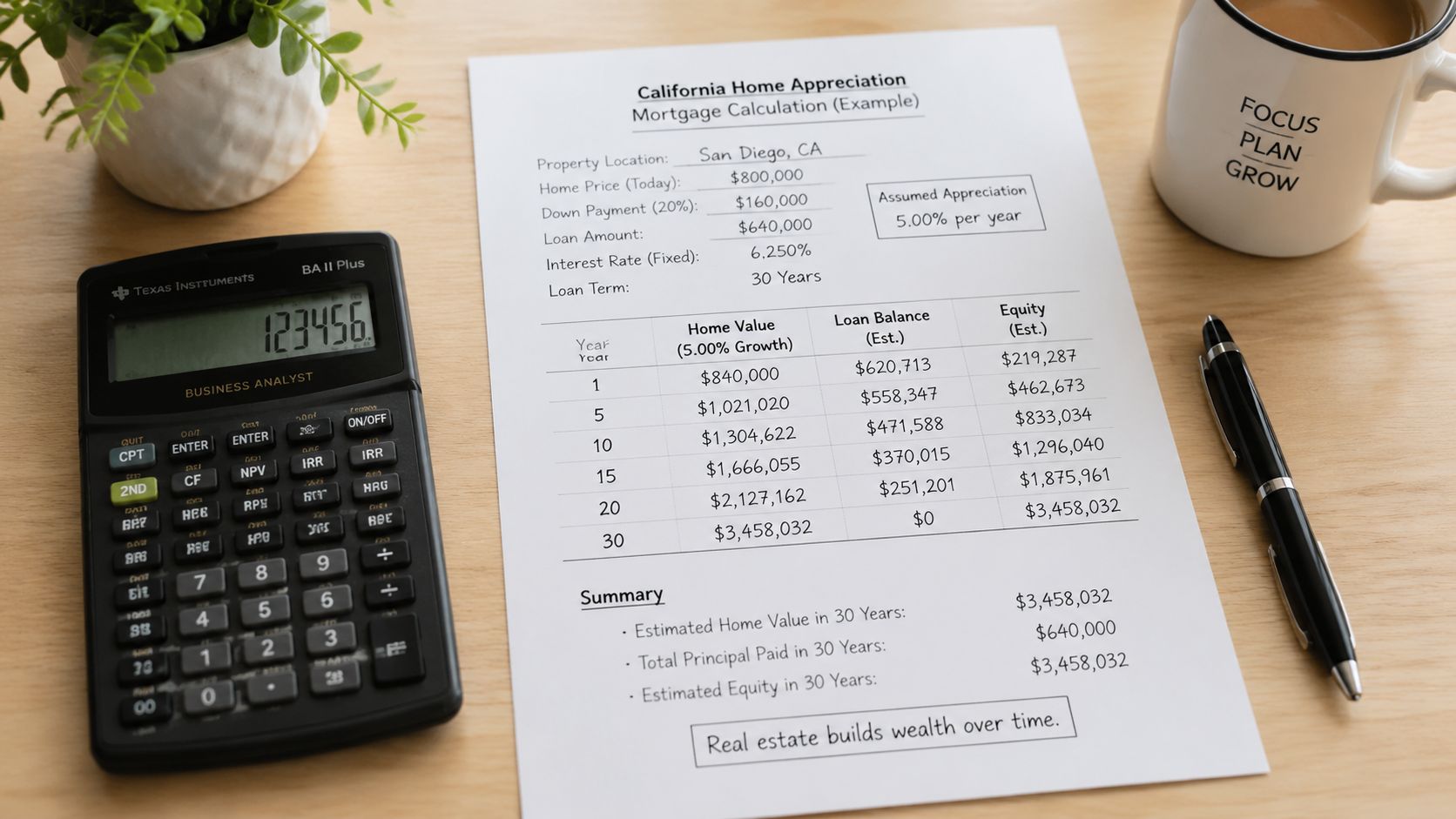
The best way to understand a shared appreciation mortgage is to run the math in plain English.
A simple California-style example
Let's use a home purchased for $750,000.
Assume a shared appreciation assistance loan covers 20% of the purchase price. That means the assistance amount is $150,000. This fits the general range seen in state and local programs, where shared appreciation percentages often fall between 15% and 25%, and some programs offer up to 25% of the purchase price as assistance with repayment of up to 25% of the home's capital growth, as outlined by Kentucky Housing's shared appreciation mortgage program summary.
Now assume you sell the home later for $950,000.
Your appreciation is:
- Original purchase price: $750,000
- Later sale price: $950,000
- Total appreciation: $200,000
If your agreement requires you to repay the original SAM amount plus 20% of the appreciation, the shared appreciation portion would be:
- 20% of $200,000 = $40,000
So the total owed to the SAM provider would be:
- Original assistance: $150,000
- Shared appreciation amount: $40,000
- Total repayment: $190,000
What this example teaches
The part that surprises buyers isn't the original loan amount. It's the extra amount tied to appreciation.
You may have experienced the loan as “quiet” while owning the home because there were no monthly payments on that piece. But once you sell or trigger payoff, the silent second becomes very loud.
Here's the key lesson:
- If the home rises in value, your SAM cost rises too.
- If appreciation is modest, the trade-off may feel manageable.
- If appreciation is strong, the equity you give up can feel much larger than expected.
The right time to calculate a SAM isn't after your home value has gone up. It's before you accept the help.
This is why buyers should ask for payoff illustrations under multiple future outcomes, including a slow-growth scenario and a stronger-growth scenario. A SAM isn't just a financing product. It's a claim on part of your future wealth.
Special Considerations for California Heroes and Veterans
California public heroes often have more moving parts in their financing than the average buyer. A veteran may be comparing a VA loan with down payment help. A firefighter might be weighing local assistance against cash reserves. A teacher may qualify for a state program but still wonder what happens later if they refinance.
That's where generic SAM articles usually fall short. They explain the concept but not the interaction with hero-focused benefits and California-specific programs.
How Dream For All works at a high level
California's Dream For All program is one of the best-known examples of a shared appreciation loan in the state. The program caps the shared appreciation loan at 20% of the home's price or appraised value, but cannot exceed $150,000, whichever is less. Borrowers can use it for down payment and closing costs, and must maintain a minimum CLTV of 95%, which means they can bring as little as 5% of their own money toward the down payment, according to this overview of California Dream For All program limits.
That structure can be powerful for a buyer who has stable income but not enough cash saved to bridge the purchase gap alone.
What veterans should watch when using a VA loan
The open question for veterans isn't whether shared appreciation exists. It's how it interacts with the rules around second liens, layered financing, and future payoff obligations.
The verified background on this topic points to an important coverage gap. Many guides don't clearly explain how shared appreciation loans may interact with VA loan benefits, including issues such as limits on second liens or what happens if the shared appreciation loan is repaid early. That same gap applies to tax treatment questions, which many mainstream explainers leave unanswered.
In practical terms, veterans and active-duty buyers should be asking:
- Is this shared appreciation loan permitted alongside my VA first mortgage under the program guidelines involved?
- Will refinancing my VA loan trigger repayment of the SAM?
- Does this assistance affect my flexibility later if I want to streamline or restructure the first mortgage?
These are not minor details. They affect your exit strategy from day one.
The tax and payoff questions many buyers miss
Another point of confusion is whether the appreciation share has any tax consequence when repaid. The available source material highlights that this question comes up often, but many public-facing guides don't answer it clearly. That means buyers shouldn't assume the tax result on their own.
If you're combining a SAM with veteran or public-employee benefits, ask for written clarification on lien position, refinance triggers, and whether a tax professional should review the payoff terms.
If you're a veteran weighing grant-like aid against a deferred shared-appreciation loan, this resource on closing cost assistance for veterans in California can help you sort out which kinds of assistance behave very differently at payoff.
Is a SAM the Right Move for Your Future
A shared appreciation mortgage is usually the right fit only when the benefit of buying now clearly outweighs the equity you may give up later.
It can make sense if you have strong income, limited liquid savings, and a realistic reason that buying now matters. Maybe you need housing stability for your family, want to stop chasing rent increases, or need to live closer to your station, classroom, hospital, or base. In that situation, a SAM may be the bridge that gets you into a home you otherwise couldn't buy.
It may be a poor fit if you could reach the same goal by waiting, saving more, or choosing a less costly structure. It's also harder to justify if you expect to buy in an area where appreciation could materially increase the amount you owe later, or if you're likely to refinance and trigger repayment sooner than planned.
A simple self-check
A SAM deserves serious consideration when:
- You can't buy without meaningful assistance
- You understand the appreciation-sharing formula
- You've stress-tested the payoff under different future values
A SAM deserves caution when:
- You're focused only on today's payment
- You haven't reviewed the exit triggers
- You're combining multiple programs and haven't confirmed how they interact
The smartest move isn't chasing the lowest upfront number. It's choosing the option that still feels sound years from now, when you look back at what your home added to your financial life.
If you're a veteran, nurse, teacher, firefighter, law enforcement officer, pilot, or other California public hero trying to decide whether a shared appreciation mortgage fits your goals, talk with California Loans for Heroes. Their team assists California HEROES with down payment assistance, mortgage options, and program trade-offs with one-on-one guidance aligned with your path to homeownership.