
You're at the point in the homebuying process where the paperwork suddenly gets more serious. You've found a house. Your lender is asking for documents. Then your agent or escrow officer asks a question that sounds small but isn't: How do you want to hold title?
For a firefighter buying with a teacher spouse, a nurse helping a parent, or a veteran purchasing with a partner, that choice can shape who owns what, who inherits what, and who has to sign off when life changes. It also affects how underwriters, title companies, and future heirs look at your property.
That's what ownership interest really is. It's not legal fluff. It's the set of rights attached to your home and your share of it.
What Is Ownership Interest and Why It Matters for You
A simple way to think about ownership interest is this: if a home is a pizza, ownership interest answers three questions. Who gets slices, how big each slice is, and who gets a slice if one owner is gone.
Say a California firefighter and a public school teacher are buying together. They've saved for years, compared neighborhoods, and finally have an accepted offer. Then they see title language that mentions sole ownership, joint tenancy, tenancy in common, and community property. Most buyers pause here because those labels sound technical, but they carry real consequences.
The plain-English meaning
Ownership interest means your legal and financial stake in the property. It affects:
- Control rights like whether one person can sell or refinance their share
- Inheritance outcomes like whether a surviving spouse gets the home automatically
- Mortgage questions like whose credit, income, and obligations matter to the lender
- Family wealth planning like what passes through an estate versus outside it
Some people confuse ownership interest with just “being on title.” They overlap, but the practical issue is bigger than a name on paper. The real concern is what rights come with that ownership and whether those rights are clear enough to protect your family.
Ownership interest is the rulebook behind the deed. If the rulebook is vague, people end up arguing about rights at the worst possible time.
Why California families should pay close attention
California buyers often purchase with a spouse, partner, sibling, or parent because that's what it takes to make a deal work. That can be smart. It can also create trouble if no one clearly defines the shares and the plan for the future.
For public service families, the stakes are even higher. Shift work, deployments, line-of-duty risk, transfers, retirement, and blended family planning all make title decisions more than a closing-day checkbox. If one owner dies, becomes disabled, wants out, or needs to refinance, the ownership structure starts doing real work.
That's why it helps to settle this early. Before you sign, you want to know whether your ownership interest supports your goals or undercuts them.
The 5 Common Ways to Hold Title in California
California buyers usually hear a short list of title options. Some apply often. Some get mentioned even though they don't apply in this state. The key is to match the form of ownership to your family, your financing, and your long-term plan.
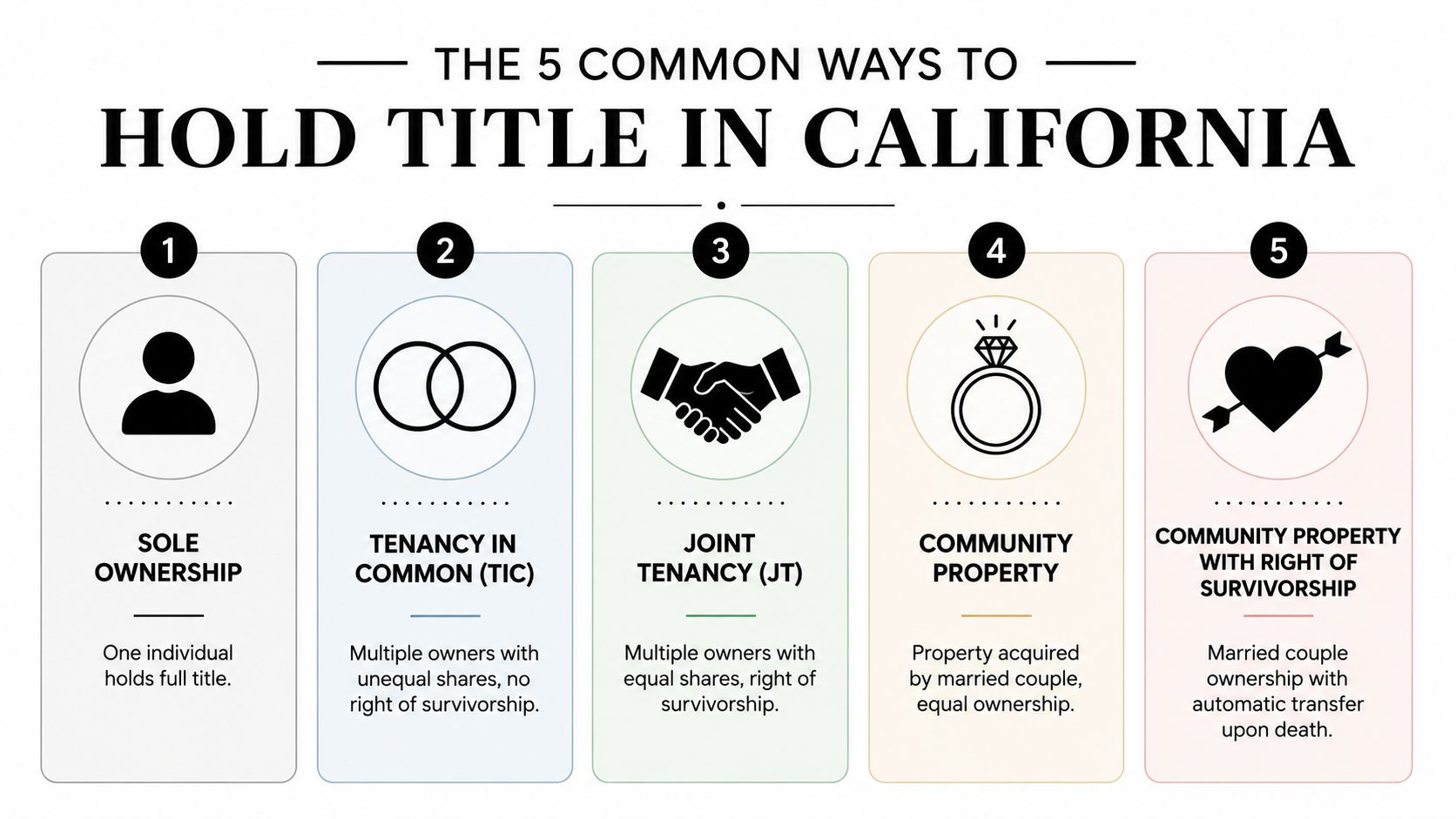
Sole ownership
This is the simplest version. One person holds title alone.
It's common when a single buyer purchases a home, or when one spouse buys a property in a way that stays separate from the other spouse's ownership. The advantage is control. One owner makes the major decisions, subject to loan and legal limits.
Best fit: a single buyer who wants clear control and a straightforward title record.
Joint tenancy
Joint tenancy is like naming co-captains with the same-sized share and a built-in last-owner-standing rule. If one joint tenant dies, the surviving joint tenant usually receives that interest automatically.
That automatic transfer feature is why many people like it. But joint tenancy also assumes equal shares. It's often used when the owners want a clean survivorship path and are comfortable owning equally.
Best fit: co-owners who want equal shares and automatic transfer to the survivor.
Tenancy in common
Tenancy in common works more like separate slices on the same tray. Two or more people can own different shares, and each owner's share can usually pass to heirs instead of automatically going to the other owners.
This structure often makes sense for unmarried buyers, siblings, or friends who contribute different amounts and want those differences recognized. It offers flexibility, but it also demands documentation. If the deed is sloppy, disputes get expensive fast.
Default Equality Trap: When deeds with multiple co-owners omit explicit share percentages, California courts automatically presume equal ownership shares, 50/50 for two owners, even if one person paid far more toward the purchase, according to Talkov Law's discussion of unclear co-owner deed interests.
That rule catches families off guard. A parent and adult child may “understand” that one paid more, but an undocumented understanding can be hard to prove later.
Community property
For married couples in California, community property is a major title category. In broad practical terms, it reflects equal ownership between spouses for property acquired during marriage.
People often choose it because it matches how many married couples already think about the home. It can also fit couples who want title to reflect shared ownership during marriage without using the survivorship feature described below.
Best fit: married couples who want title to reflect shared marital ownership.
Community property with right of survivorship
This option combines marital ownership with automatic transfer to the surviving spouse. It appeals to couples who want both shared ownership during life and a smoother path for the surviving spouse at death.
For many married hero families, this is the title form that feels most aligned with the goal of keeping the home secure for the surviving partner.
Why tenancy by the entirety gets mentioned
You may hear about tenancy by the entirety online. It's often discussed in general articles about real estate ownership, but it isn't the standard California title form buyers rely on here. That's why most California conversations focus on the other options above.
Comparing California ownership interest types
| Ownership Type | Parties | Right of Survivorship | Best For |
|---|---|---|---|
| Sole Ownership | One owner | No automatic survivorship feature | Single buyers who want control |
| Joint Tenancy | Two or more owners | Yes | Co-owners wanting equal shares and automatic transfer |
| Tenancy in Common | Two or more owners | No | Unmarried buyers, unequal contributions, inheritance planning |
| Community Property | Married spouses | Not automatic in the same way as survivorship forms | Married couples wanting shared marital ownership |
| Community Property with Right of Survivorship | Married spouses | Yes | Married couples wanting automatic transfer to a surviving spouse |
How Ownership Interest Impacts Your Home Loan and Title
Lenders don't treat title as background paperwork. They use it to judge risk, confirm who has authority over the property, and decide who must be involved in the transaction.
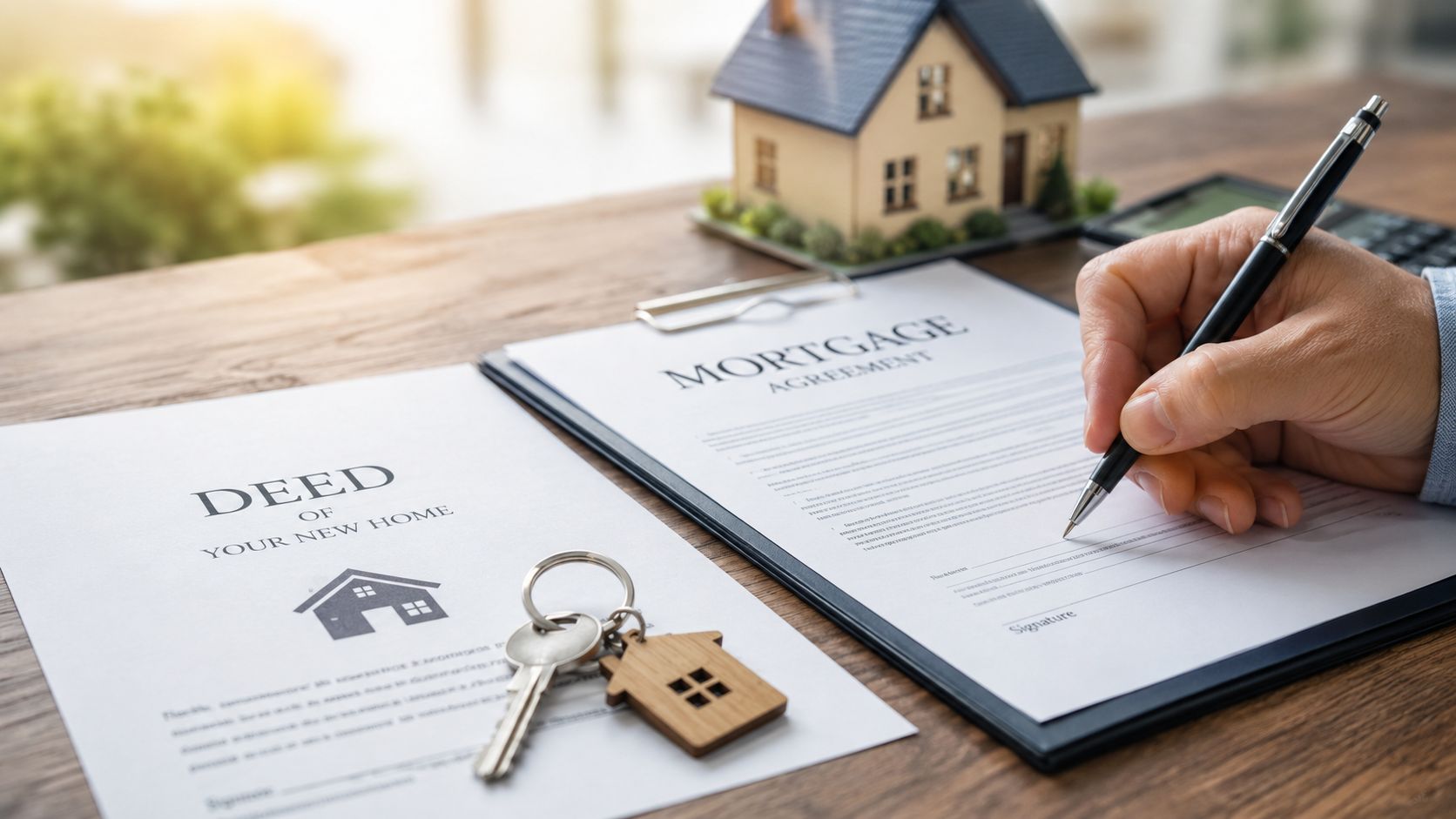
Why underwriters care
If you and another person both hold ownership interest, the lender wants to know whether both of you must sign the deed of trust, whether both of you need to be on the note, and whether one person can create problems later by claiming rights that weren't fully disclosed.
In business lending and reporting rules, ownership interest is also treated as a specific threshold concept. Under FinCEN's BOI framework, an individual with 25% or more of equity interests is treated as a beneficial owner, and in related underwriting discussion, a person receiving more than 10% of gross or net sales can also be classified as having an ownership interest, as described in BOI Labs' explanation of ownership interest rules. That's business-focused, but the lesson carries over to real estate lending: lenders care about who really has a stake and how much control that stake creates.
The practical mortgage effect
A clean title setup usually helps the loan process move more smoothly. A messy one doesn't.
Here's where buyers get tripped up:
- Unclear shares: If co-owners never spelled out percentages, underwriting may pause while title gets clarified.
- Inherited interests: A partial inherited stake can make refinance or sale decisions much harder.
- Mismatch between intent and paperwork: If the deed says one thing and the family believes another, the lender follows the documents.
If you're shopping financing, it helps to understand how the title decision and the loan decision connect. A good starting point is learning how to compare mortgage rates alongside the title structure you plan to use, because the cheapest-looking loan isn't always the easiest one to close if ownership is complicated.
Practical rule: The more people involved in title, the more important it is to define who owns what before underwriting starts.
Title companies have a different job
The title company isn't judging your budget. It's checking whether the ownership chain is clear enough to insure. If there's an unresolved co-owner issue, an old inheritance problem, or a deed that doesn't reflect the actual agreement, title may require cleanup before closing.
That's why ownership interest affects both sides of the transaction. The lender looks at qualification and collateral. The title company looks at legal clarity. You need both.
Ownership Scenarios for California's First Responders and Veterans
The easiest way to understand ownership interest is to see how it plays out in real life. These are the situations that come up all the time for California hero families.
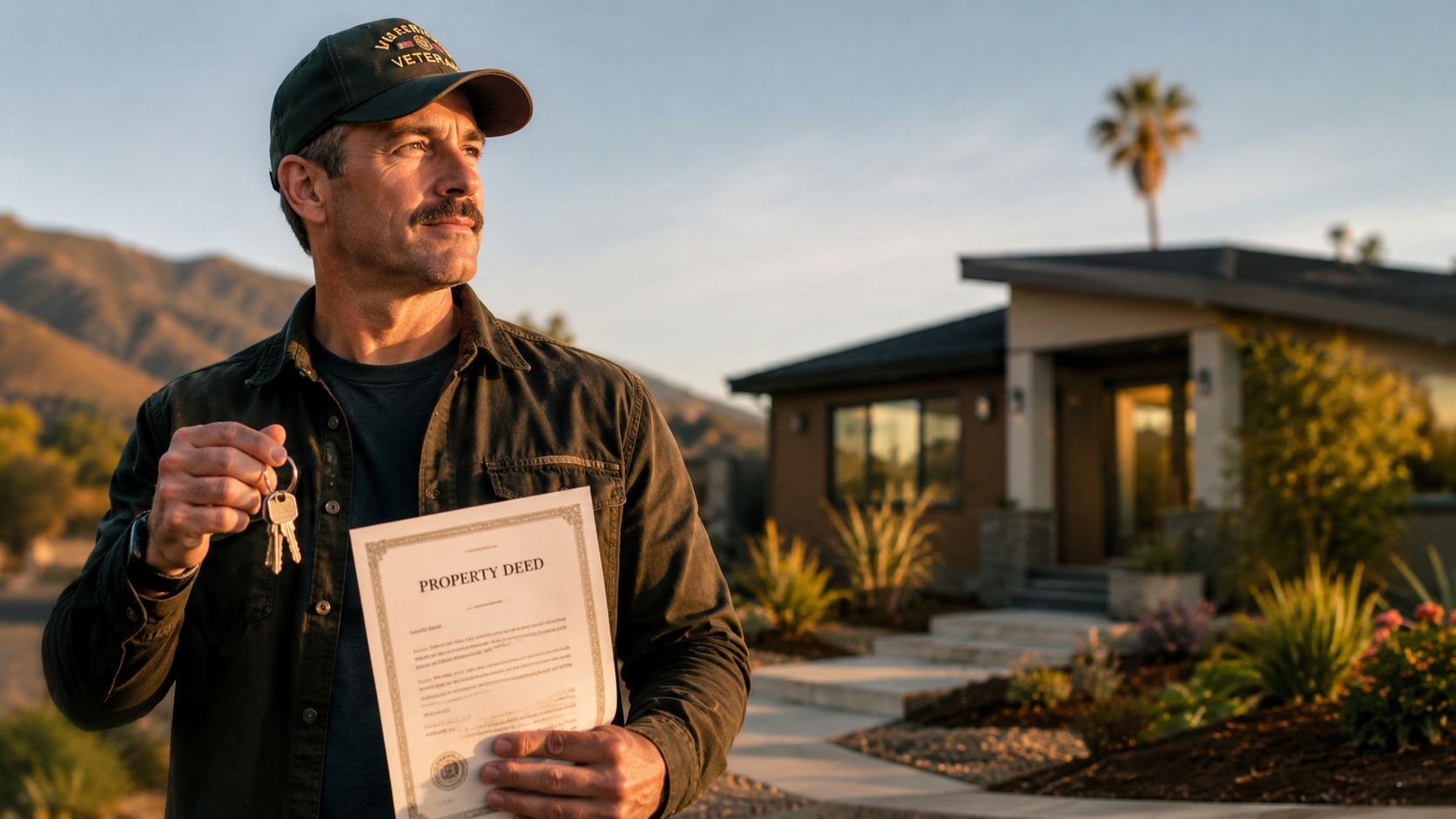
A veteran couple who want the home to stay with the survivor
A veteran and a teacher buy a home after years of renting near base and commuting to work. Their biggest concern isn't abstract legal theory. It's whether the surviving spouse can stay in the home without friction if one of them dies.
For that couple, community property with right of survivorship may line up with their goal. It reflects married ownership and adds automatic transfer to the surviving spouse. That can reduce uncertainty at a painful time and make the title choice match the family's real priority, which is continuity.
Two unmarried officers buying together
Two police officers buy a duplex as a long-term investment. One contributes more cash up front, while the other expects to handle more of the property management.
Joint tenancy might sound attractive because it's simple. But if they don't want equal shares, it may not fit. Tenancy in common often makes more sense here because it can reflect different ownership shares and allow each owner's interest to pass according to their estate plan rather than automatically to the other co-owner.
If unmarried buyers contribute different amounts, equal title can create unequal consequences later.
A written co-ownership agreement matters. The deed may say how title is held, but it often doesn't answer the practical questions. Who pays for repairs? What happens if one owner wants to sell? Who gets reimbursed first if one person fronted more cash? Buyers need those answers in writing.
A nurse inheriting part of a family home
A nurse inherits an undivided interest in a family property with siblings. At first, that sounds like good news. Then reality arrives. She cannot carve out “her part” of the house and act alone.
An undivided interest means each co-owner has rights in the whole property, not a physically separated section of it. That creates friction when one person wants to refinance, another wants to keep the house, and another wants cash now. Recent California developments showed a 35% increase in partition lawsuits involving undivided interests among military veterans and first responders inheriting family property, according to this Tax Notes discussion of undivided fractional interests and related ownership issues.
That same ownership form can still carry planning opportunities. The same Tax Notes material notes that undivided fractional interests can qualify as eligible replacement property under IRS §1031(a). But for many families, the immediate issue isn't tax strategy. It's that major decisions require consensus, and one holdout can block progress.
The takeaway from all three
The “best” ownership interest depends on the problem you're trying to solve.
- Protect a spouse quickly: survivorship matters
- Reflect unequal contributions: separate shares matter
- Manage inherited property without conflict: written agreements and legal cleanup matter
That's why the title question should be handled before emotions, family assumptions, or urgency take over.
Using Hero Loan Programs to Build Your Ownership Stake
A lot of buyers think of down payment help as just a way to get through closing. That's too narrow. These programs shape your ownership interest from day one because they affect how much cash you bring in, whether another lien sits behind your first mortgage, and whether someone else shares in future value.

Programs that strengthen your starting position
The CalHERO Home Loan program provides a 2% forgivable down payment assistance grant for eligible essential workers, and it does not require repayment if the borrower maintains ownership. It's also not limited to first-time buyers, so repeat buyers and even retired heroes may qualify, as explained in this overview of the CalHERO Home Loan assistance structure.
That matters because forgivable assistance can reduce the cash strain of closing without adding the same type of future repayment pressure as a traditional second loan.
Another example is the CalHFA MyHome Assistance Program, which offers a 3.5% deferred-payment junior loan for eligible teachers and first responders, with repayment deferred until the home is sold, transferred, or refinanced, according to this review of California teacher and first responder down payment programs. In high-cost counties like San Francisco, that assistance can be stacked with local programs for combined help of up to $500,000, as noted in the same source.
Fixed caps versus shared appreciation
Not all assistance works the same way.
San Francisco's First Responders Downpayment Assistance Loan Program offers up to $500,000 for eligible first responders purchasing market-rate property, and applicants must contribute at least 5 percent of the down payment, based on the city's FRDALP program rules. That's a major ownership tool in a very expensive market.
Los Angeles County and San Diego County offer grants up to $15,000, while Orange County and Riverside County have HERO programs capped at $7,500, according to this roundup of California first responder home loan assistance options. Those are simpler fixed-dollar benefits. They don't scale with price, but they can still bridge a meaningful gap in cash to close.
Then there's Dream For All, which offers a lottery-based shared appreciation loan with a maximum cap of $150,000 and requires 8-hour homebuyer education costing $100, according to this summary of California homebuyer assistance programs including Dream For All. That program changes the ownership conversation because the state shares in future appreciation instead of charging fixed interest in the usual way.
A grant, a deferred junior loan, and a shared appreciation loan can all help you buy the same house. They do not create the same long-term ownership result.
Why strategy matters more than the headline benefit
The smart question isn't just “How much help can I get?” It's “What kind of ownership position will I have after I get it?”
That's especially important if you're comparing military, veteran, or first responder options through home loans for heroes in California. The best fit depends on whether you want lower cash needed today, less repayment pressure later, or more freedom when you eventually sell or refinance.
How to Verify and Protect Your Ownership Interest
After closing, many owners never look at their deed again. That's a mistake. If you want to protect your ownership interest, check it while everyone is cooperative and the paperwork is easier to fix.
A practical review checklist
Get your grant deed
Ask your escrow officer, county recorder, or title company for a copy. Read the vesting language carefully. You're looking for exactly how title is held, not how you remember discussing it.Review your title report
Confirm the names, vesting, and any recorded liens or restrictions. If you're unsure what a line means, ask for a plain-English explanation before a future refinance or sale turns that confusion into a delay.Match title to your real agreement
If one person contributed more, inherited rights are supposed to pass a certain way, or an unmarried couple has side arrangements, make sure the documents support that reality.
Protection steps that save families grief
- Write a co-ownership agreement: Unmarried partners, siblings, and friends should spell out contributions, repair costs, buyout rights, and exit rules.
- Coordinate with your estate plan: A will or trust should complement the vesting choice, not contradict it.
- Ask for help early: A real estate attorney can be worth it when inherited property, multiple owners, or family money are involved.
If you're still early in the purchase process, even your earnest money planning matters because it affects who is financially committed and how the transaction is structured. It helps to understand the role of a good faith deposit in a California home purchase.
Clear title documents are cheaper than family litigation.
One more advanced issue to know
In broader ownership reporting, regulators increasingly focus on identifying the actual people behind property and entity ownership. As of February 2026, 117 countries require mandatory registration of beneficial ownership interests in real estate, according to the Tax Justice Network report on global beneficial ownership of real estate. Even if you're just buying a California home, the bigger trend is clear. Ownership transparency matters more than it used to.
Securing Your Home and Future in California
Ownership interest shapes more than a line on closing documents. It affects your control, your inheritance plan, your refinance options, and your family's ability to keep or transfer the property without conflict.
For California first responders, veterans, teachers, nurses, and other public servants, the stakes are personal. The wrong title choice can create confusion for heirs, friction between co-owners, or obstacles when you need loan flexibility. The right one can support stability and protect the people you're buying for.
That's why this decision deserves the same attention you give your rate, your monthly payment, and your down payment strategy. Joint tenancy, tenancy in common, community property, and survivorship options all solve different problems. None of them should be selected on autopilot.
If you're buying in California, slow down long enough to make sure your ownership interest matches your goals, your relationships, and your future plans.
If you want help sorting through title choices, loan options, and down payment assistance as a California hero, talk with California Loans for Heroes. Their team helps veterans, active-duty military, first responders, nurses, teachers, and public service professionals understand the home loan process clearly so you can buy with more confidence and protect your family's future.