
You're probably doing the math right now.
You love teaching in California, but your rent keeps rising, your savings account never seems to move fast enough, and every open house makes homeownership feel like something built for someone else. That frustration is real. I talk to teachers all the time who can comfortably afford a monthly payment, but can't bridge the gap on the upfront cash needed to buy.
That's exactly why housing grants for teachers matter. In California, the right program can change the conversation from “I'm priced out” to “I need a smart plan.” The catch is that most guides lump everything together, call it all assistance, and leave out the part that matters when you're making a major financial decision.
The California Dream on a Teacher's Salary
You find a condo you could see yourself living in. The payment looks manageable. Then the upfront cash hits you all at once. Down payment, closing costs, reserves, and a market that does not give teachers much room for error.
That is the main problem for many California educators.
A typical California teacher is trying to buy in one of the hardest housing markets in the country while working in a profession that is indispensable and often underpaid relative to local housing costs. The proposed federal Educator Downpayment Assistance Act exists because that pressure is obvious. It would authorize competitive federal grants of up to $25,000 for eligible full-time public-school educators who are first-time buyers, including teachers, principals, librarians, and counselors, with income limits tied to area median income. It also requires a six-year service obligation, with three years before receiving the grant and three years after, and notes that the average 2025 annual salary was approximately $48,112, according to the U.S. Senate one-pager for the Educator Downpayment Assistance Act.
Policymakers are acknowledging a structural affordability problem. California teachers should read that as confirmation, not comfort. You still need a plan that works in the market you are buying in.

Why teachers feel stuck
I see the same pattern over and over with California teachers.
Some earn enough to support the monthly payment but cannot build savings fast enough because rent, student loans, and basic living costs keep eating the down payment fund. Others have stable employment and good credit, but get buried in program names and marketing language that make every option sound like free money. And plenty are ready to buy right now, but hold back because nobody has clearly explained what happens if they move, refinance, or leave a district.
That hesitation is reasonable.
Homeownership for teachers in California usually gets blocked by several smaller issues at the same time. A limited cash cushion. Confusing assistance rules. Tight debt ratios. High closing costs. None of those problems is unusual on its own. Together, they stop good buyers from acting.
A better way to think about assistance
Treat teacher homebuyer assistance as part of your financing strategy, not as a lucky break.
Start with the question that gets skipped in too many general guides. Are you looking at a true grant, or a forgivable loan with strings attached? That distinction matters more in California because many buyers need layered help, and repayment risk can undo the benefit if your job or housing plans change.
Before you apply, check four things. Is the money non-repayable? Does it require you to stay in the home or in a qualifying job for a set number of years? Does repayment trigger if you sell or refinance? Can you combine it with other California down payment assistance programs for teachers and other homebuyers?
That is how experienced buyers protect themselves.
The best program is not the one with the biggest number on a flyer. It is the one that still makes sense if life changes two years after closing.
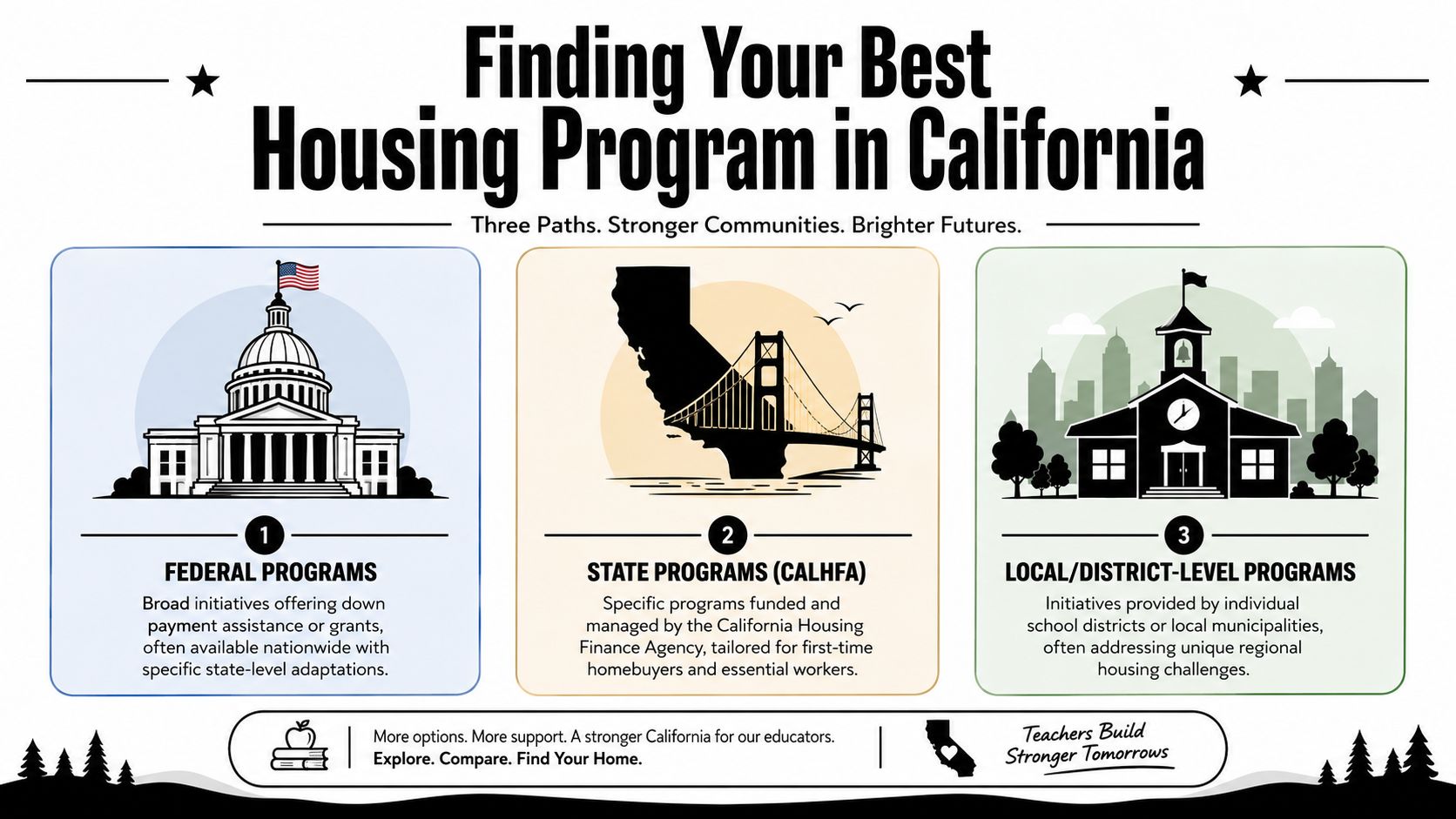
Finding Your Best Housing Program in California
You find a home you can see yourself buying. Then the assistance options start piling up. One program says grant. Another says deferred loan. A third is tied to your district, your income, or the property address. That is where California teachers lose time and make expensive mistakes.
Start by sorting programs into three buckets: national teacher programs, California statewide programs, and local city or district programs. If you mix them together, the differences that matter get buried.
The programs worth your attention
Here are the California options I would put at the top of the list first.
| Program | Best fit | What it offers | What to watch |
|---|---|---|---|
| Teacher Next Door Program | Teachers, administrators, and school staff who want broad eligibility | California educators can access a non-repayable housing grant of up to $9,000, with a minimum of at least $1,000 subject to availability, plus extra down payment assistance of up to $24,000, according to Teacher Next Door California Housing Grants | Verify occupancy rules, participating loan options, and current availability before you start making offers |
| CalHFA Forgivable Equity Builder | Buyers with lower household income compared with county limits | State assistance can be substantial for buyers who meet CalHFA income rules | The income cap is tight, so many married or dual-income teacher households will not qualify |
| Extra Credit Teacher Home Purchase Program | Teachers working in qualifying high-need schools | This can provide meaningful down payment help for eligible educators | Eligibility is narrow, and the school assignment matters as much as your job title |
| Local district programs | Educators in districts or cities trying to retain school staff | Local assistance can outperform statewide options in expensive markets | These programs often tie the benefit to continued employment, owner occupancy, or both |
My recommendation on search order
Start with the programs that give you the widest path to approval. Then narrow down.
- Check national teacher programs first. They usually have simpler entry points and fewer location-specific restrictions.
- Review California statewide options next. These can be strong, but income and program caps eliminate a lot of applicants fast.
- Search city and district programs last. These are often the most attractive on paper, but they also carry the most conditions.
If you want to compare what can and cannot be combined, review these California down payment assistance options for teachers and other buyers before you apply. Layering help the right way can lower your cash to close. Layering it the wrong way can waste weeks.
Each bucket solves a different problem
National teacher programs are usually the easiest place to start if you need broad eligibility and a faster yes or no.
California statewide programs are more targeted. They are built around income limits, county rules, approved loan structures, and first-time buyer definitions. That makes them useful, but less forgiving.
Local and district programs deserve the closest review. In high-cost parts of California, they can offer the best dollar amount. They also tend to come with the strictest fine print. If a program expects you to stay in a district for years, treat that as a career decision, not just a mortgage benefit.
My advice is simple. Do not chase the biggest headline number first. Chase the program you are likely to keep, qualify for, and still feel good about if your plans change.
Grants vs Forgivable Loans The Critical Difference
You buy a home in California with teacher assistance, settle in, and then life changes. A better district opens up across the county. Your spouse gets a new job. Rates drop and refinancing makes sense. This is the moment where the fine print matters.
Too many teachers are told that grants and forgivable loans are basically the same. They are not. A true grant is money you keep if you follow the program rules. A forgivable loan is still a loan first, and it can turn into a repayment obligation if you sell, refinance, move out, or miss another condition during the forgiveness period.
What a True Grant Means
A true grant gives you cleaner math and fewer future surprises. If the assistance is structured as non-repayable funds, you do not carry a second lien waiting in the background or wonder whether a refinance will trigger a payoff.
That distinction matters more in California than in cheaper markets. Teachers here often need flexibility because commute times, district changes, and household budgets change fast.
Why forgivable loans catch teachers off guard
Forgivable loans can still be useful. I recommend them only after you know the exact repayment triggers and you are confident you can stay put long enough to satisfy the term.
Here is the practical problem. A forgivable loan often looks generous at closing, but the risk shows up later. If you leave the home before the forgiveness clock runs out, some or all of that assistance may have to be repaid. In California, where career moves and housing costs push families to rethink plans quickly, that is not a small detail. It is a real financial risk.
Simple rule: If the assistance can become debt because you sell, refinance, or move, treat it differently from a grant.
A lot of buyers miss this because the program summary highlights the dollar amount, not the exit terms. I tell teachers to read the repayment section before they get excited about the benefit.
The question to ask before you apply
Ask this directly: What events trigger repayment, and how is the amount calculated?
Do not stop at “Is it forgivable?” That question is too soft. Get specific. Ask whether repayment is triggered by:
- Selling the home
- Refinancing the mortgage
- Moving out of the property
- Changing employers or districts
- Falling out of program compliance during the term
Then ask one more question that California teachers often forget: Is the forgiveness prorated, or does repayment stay full until the end of the term? That answer tells you how painful a mid-term move could be.
If you want to see how these structures affect your real cash to close, review how much down payment assistance can cover in California before you commit to a program.
My advice is blunt. If you may need career flexibility, favor simpler assistance with fewer strings. Bigger headline numbers do not help if they turn into debt the minute your plans change.
Are You Eligible for Teacher Homebuyer Assistance
You find a condo near your school, the payment looks manageable, and then the assistance program knocks you out for one reason you could have checked on day one. Income too high for that county. Property type not allowed. Employment category doesn't match the program rules.
That is why I tell California teachers to screen eligibility before they fall in love with a home.
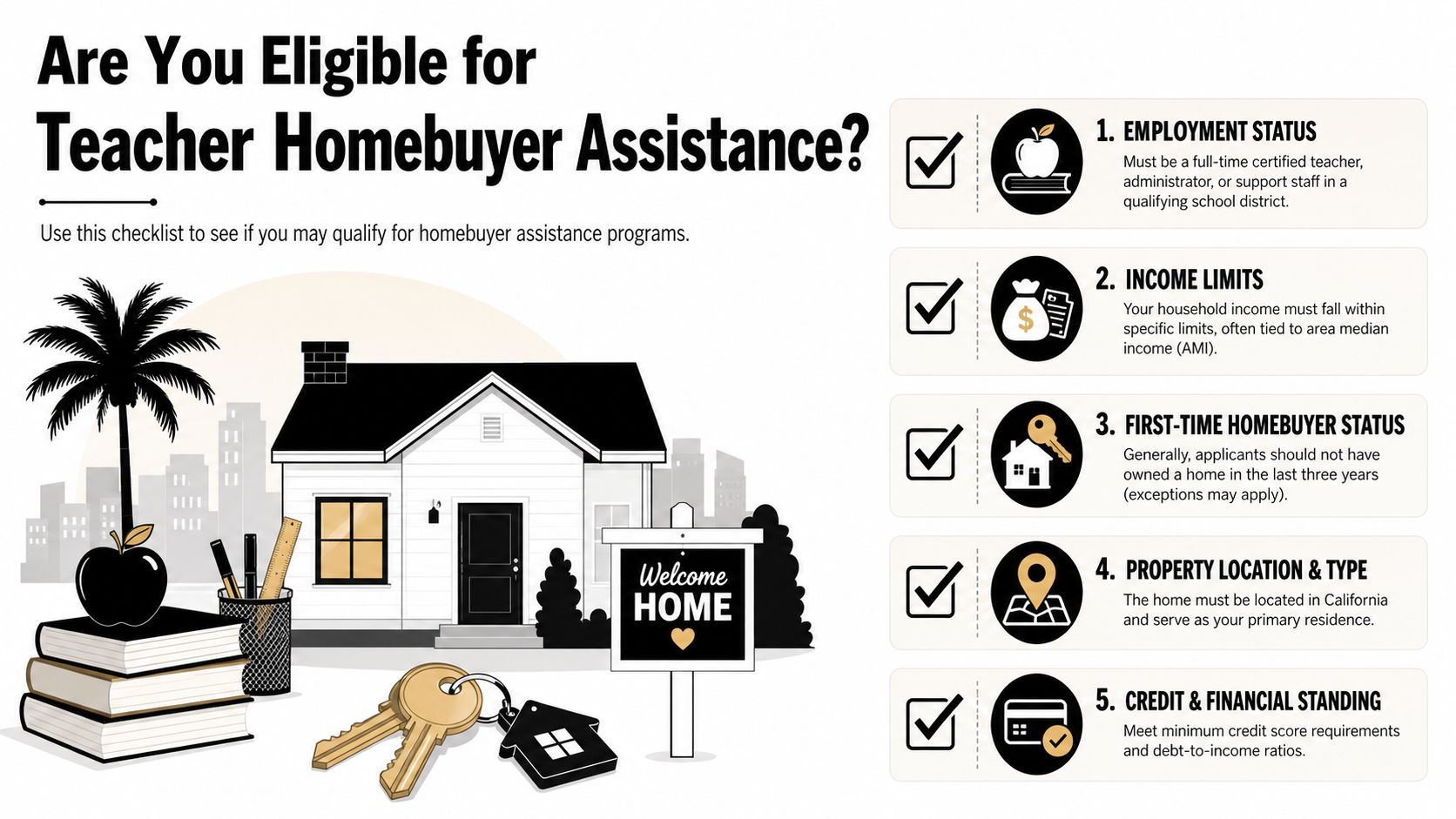
Start with the filters that eliminate people fast
Programs vary, but the same trouble spots come up again and again in California:
- Eligible job role: Some programs are limited to full-time teachers. Others include administrators or classified school staff.
- Buyer status: Many programs target first-time buyers, which usually means you have not owned a primary residence in the recent lookback period.
- Primary residence requirement: You typically must live in the home yourself, not rent it out or use it as a second home.
- Income rules: Your household income may need to stay under a county-specific limit.
- Mortgage readiness: Assistance does not erase lender standards. Credit, debt-to-income ratio, cash reserves, and documentation still matter.
If one of these does not fit, stop and confirm the rule before you spend time on paperwork.
Income limits cut out more teachers than they expect
The hardest part for many California educators is not job eligibility. It is income eligibility.
Most assistance programs use AMI, or Area Median Income, to set household income caps by county. That matters because the same salary can qualify in one county and miss the cutoff in another. A teacher in Riverside may fit a program that a teacher in Orange County does not, even with similar pay.
Do not guess here. Use your gross household income, include any co-borrower income the program counts, and check the county limit tied to the exact program. "Close enough" is how buyers waste weeks.
The question that matters after basic approval
Eligibility is not only about getting through underwriting. It is also about whether you can keep the benefit after closing.
That is where California teachers need to stay sharp on the grant versus forgivable loan issue discussed earlier. If the program has occupancy rules, employment rules, or a forgiveness timeline, your real question is simple: can you realistically follow those terms for the full period?
A buyer who may transfer districts, relocate for family, or refinance soon should treat that as part of eligibility, not as an afterthought.
Run this self-check before you apply
Answer these honestly:
- Do you meet the program's educator or school employee definition?
- Will this property be your full-time primary residence?
- Is your household income under the limit for that county and program?
- Can you document your income, assets, and employment cleanly?
- Can you live with the post-closing rules if the assistance is forgivable over time instead of a true grant?
If you cannot answer yes to all five, pause and fix the weak spot first.
For a practical overview of the full buying process, review these steps to buying your first home in California before you apply. That will help you separate a real eligibility problem from a paperwork problem.
My advice is simple. Pre-screen yourself early, and be tougher on the rules than the marketing page is. That is how you avoid chasing assistance you were never going to keep.
Your Application Action Plan and Timeline
The application process feels easier when you stop treating it like one giant event. It's a sequence. Handle it that way and you'll make better decisions.
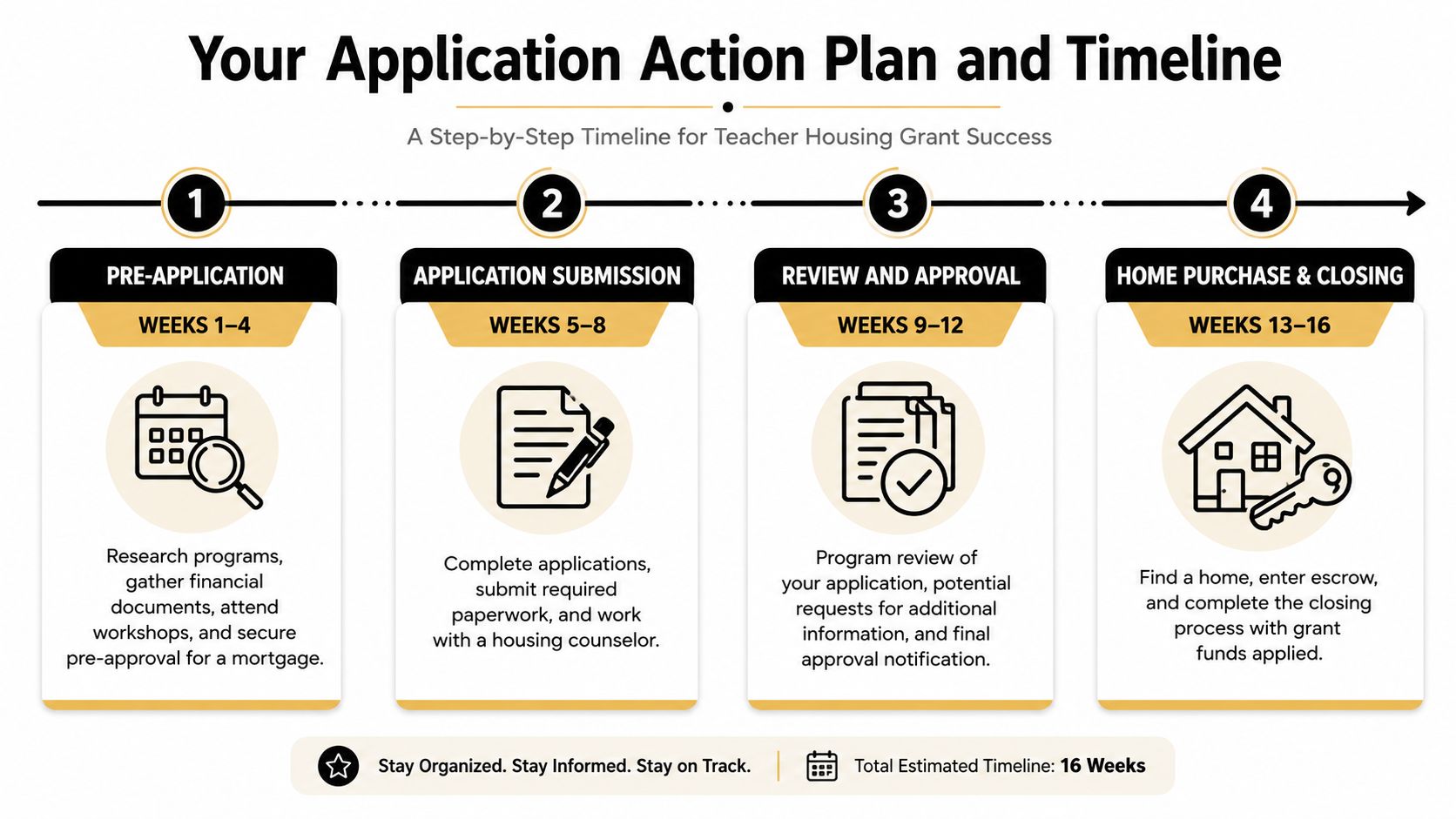
Phase one gets overlooked most
Most teachers jump straight to house hunting. That's backwards.
Start with your file. Gather pay stubs, W-2s or tax returns, bank statements, ID, teaching credentials if needed, and any program-specific employment verification. If a local program requires workshops or counseling, complete those early instead of waiting for escrow pressure.
Then get pre-approved with a lender who already understands teacher assistance programs. A regular pre-approval is helpful. A pre-approval built around the assistance you're using is better.
Use local programs carefully
San Francisco is a good example of why details matter. The SFUSD Teacher Next Door program offers a $40,000 grant for market-rate units and the loan term is 10 years, with the grant becoming due if the borrower doesn't remain an SFUSD educator throughout that term, according to the SF.gov report on the Teacher Next Door program.
That can be excellent assistance for the right borrower. It can also be the wrong fit if you're not sure you'll stay in the district.
Bigger assistance isn't automatically better assistance. The best program is the one you can realistically keep.
A timeline that keeps you organized
Use a simple working timeline instead of trying to predict an exact closing date.
| Phase | What you should be doing |
|---|---|
| Pre-application | Research programs, gather documents, review income and employment requirements, and get pre-approved |
| Application submission | Submit program paperwork, respond quickly to requests, and align the assistance timeline with your mortgage file |
| Approval review | Stay available, avoid major financial changes, and keep documentation current |
| Purchase and closing | Write offers, enter escrow, satisfy final conditions, and confirm how assistance funds will be applied |
If you want a broader homebuying roadmap while you line up grants and mortgage approval, this guide on the steps to buying your first home in California is a practical companion.
My advice on timing
Don't wait until you've found the perfect house to start asking about teacher housing programs. By then, you're on the clock. Some assistance programs move smoothly. Others require coordination that can slow down a rushed transaction.
The teachers who have the calmest closings usually do one thing right. They start with the financing strategy and only then shop for the property.
Tips to Boost Your Approval and Other Options
You found a house in Riverside County on Sunday, got pre-approved on Monday, and then learned on Tuesday that the assistance program you wanted needed extra review, tighter paperwork, and a cleaner cash-to-close plan. That is how good deals fall apart for teachers. Approval usually comes down to preparation, not luck.
Start by making your file easy to underwrite. Keep deposits easy to explain. Avoid new car loans, new credit cards, and large unexplained transfers. Make sure your paystubs, W-2s, and school employment documents are current and consistent. If your approval is close, give yourself time to improve the file before you write offers.
What improves your odds
- Treat documentation like part of the down payment: Incomplete files slow approvals and create avoidable conditions.
- Calculate household income correctly: Many California assistance programs look at everyone who will occupy or purchase, not just the teacher's base salary.
- Check property and occupancy rules early: Some programs sound flexible in the marketing, then limit who can live in the home, how long you must occupy it, or what property types qualify.
- Keep extra funds available for closing: A teacher grant or assistance program may help with down payment costs but still leave you responsible for appraisal gaps, inspections, prepaid taxes, insurance, or lender fees.
One more point matters more than buyers expect. Underwriters do not like surprises. If your bank statements, job history, or gift funds need a long explanation, fix that before escrow, not during it.
If one program does not fit, use a layered strategy
A lot of California teachers focus on finding one big program. That is often the wrong approach. The better strategy is combining compatible help, keeping the payment manageable, and avoiding assistance with repayment terms that could become a problem if you sell, refinance, or move sooner than planned.
As noted earlier, some teachers can pair education-specific assistance with broader statewide or local programs. The exact mix depends on county rules, income limits, lender overlays, and whether the aid is a true grant, a deferred second, or a forgivable loan. That distinction matters. A stacked plan that looks generous upfront can become expensive if one piece has repayment triggers you missed.
Smart buyers focus on usable assistance, not just the largest headline amount.
If you do not qualify for the teacher program you wanted, you still have options. Look at local housing finance agencies, city down payment programs, MCC tax benefits where available, and seller credits negotiated through the purchase contract. Those alternatives can be more flexible than a program with strict occupancy periods or repayment risk.
Housing grants for teachers help most when they fit the rest of your mortgage plan. The right setup is the one you can qualify for, close on time, and keep without creating future repayment trouble.
If you're a California teacher and want help sorting through grants, forgivable loans, and down payment assistance without getting buried in confusing fine print, California Loans for Heroes is built for that. Their team helps California educators understand available homebuyer assistance, compare financing options, and move through the mortgage process with clear one-on-one support.