You're doing public service work in California, paying California prices, and staring at a student loan balance that keeps crowding out everything else. Maybe you're a teacher in the Inland Empire, a nurse in Sacramento, or a firefighter in Los Angeles. Your paycheck covers life, but it doesn't leave much room for a down payment, a stronger savings cushion, or the kind of mortgage payment that would let you stop renting.
That's exactly why a Public Service Loan Forgiveness calculator matters. Not because it's another government form to wrestle with, but because it helps you turn a vague hope into a real number, a timeline, and a plan. If you know what your monthly payment should be, what balance may be forgiven, and when that forgiveness could happen, you can make better decisions about everything else, especially buying a home in California.
Your PSLF Journey Starts Here
Maria is a public school counselor in California. She's done what people told her to do. She got the degree, took the service job, and kept making payments. Now she wants a house, not a luxury house, just a stable place with a yard and a fixed payment. But every time she looks at her student loans, she freezes. She doesn't know whether to pay them down aggressively, switch repayment plans, or wait for forgiveness.
That's where a Public Service Loan Forgiveness calculator changes the conversation. It gives structure to the chaos. Instead of asking, “Will this ever work?” you start asking, “How many qualifying payments do I have, what plan fits, and what does that free up for my homebuying timeline?”
Historically, PSLF earned its bad reputation. Only 5.48% of PSLF applications were approved due to early issues, but the program changed significantly, and the average forgiven amount under the expanded program reached $74,100 per borrower according to Education Data's student loan forgiveness statistics. That should get your attention. This isn't a fringe benefit. It can be a major financial turning point.
Why this matters beyond debt relief
If you're serious about owning a home, your student loan strategy can't sit in a separate box. Lenders care about your monthly obligations. You care about cash flow, emergency savings, and whether you can qualify without stretching yourself too thin.
A good PSLF estimate helps you answer practical questions:
- Can you lower your monthly payment legally and strategically by using the right repayment plan?
- Should you stop overpaying federal loans if forgiveness is realistically on the table?
- How soon can you redirect money toward a down payment fund?
- What kind of housing budget makes sense once your loan plan is stable?
A PSLF calculator doesn't just estimate forgiveness. It tells you how much financial room you may be able to reclaim.
If you're a California government employee and homeownership feels delayed by debt, it's worth seeing how loan planning and mortgage planning fit together through government employee home loan options in California. You need both sides of the picture, not one.
What to Collect Before You Calculate
Don't open a calculator and start guessing. That's how people get garbage results and walk away more confused than when they started.
Before you run any estimate, gather the documents that control eligibility, payment amount, and forgiveness timing.

Your must-have checklist
Your Federal Student Aid login. This is the fastest way to confirm what loan types you have. That matters because only federal loans from the William D. Ford Federal Direct Loan Program qualify for PSLF, and private loans, FFEL loans, and Perkins loans don't qualify unless eligible federal loans are consolidated into a Direct Consolidation Loan, as explained in this PSLF loan eligibility overview.
Your latest tax return. You need your Adjusted Gross Income, because income-driven repayment estimates are built around income. If you can't put your hands on your tax return quickly, fix that first.
Recent pay stubs. These help you compare your current earnings with the income shown on your last filed tax return. If your income changed, that may affect how you think about your repayment strategy.
Your employer information. Have the exact legal name of your employer, your hire date, and your employment status ready. PSLF depends on qualifying employment, and small date mistakes create big tracking problems later.
Your family size details. This affects income-driven repayment calculations. Don't wing it.
Why each item matters
A calculator is only as good as the data you feed it. If you misidentify your loan type, you may assume forgiveness is available when it isn't. If you use the wrong income number, your projected monthly payment can be way off. If you enter sloppy employment dates, your qualifying payment estimate won't be reliable.
Practical rule: Gather your documents first, then calculate once with clean information instead of recalculating five times with guesses.
One more thing to verify early
Check whether your records are organized enough to support a real plan. If they aren't, pause and clean them up before you do anything else. Borrowers who stay organized make better decisions because they know what they're working with.
If you want to get a broader sense of where you stand before moving into mortgage planning, use a simple California hero eligibility check as a separate step. It helps frame the larger financial picture without replacing your PSLF work.
Inputting Your Data for an Accurate Estimate
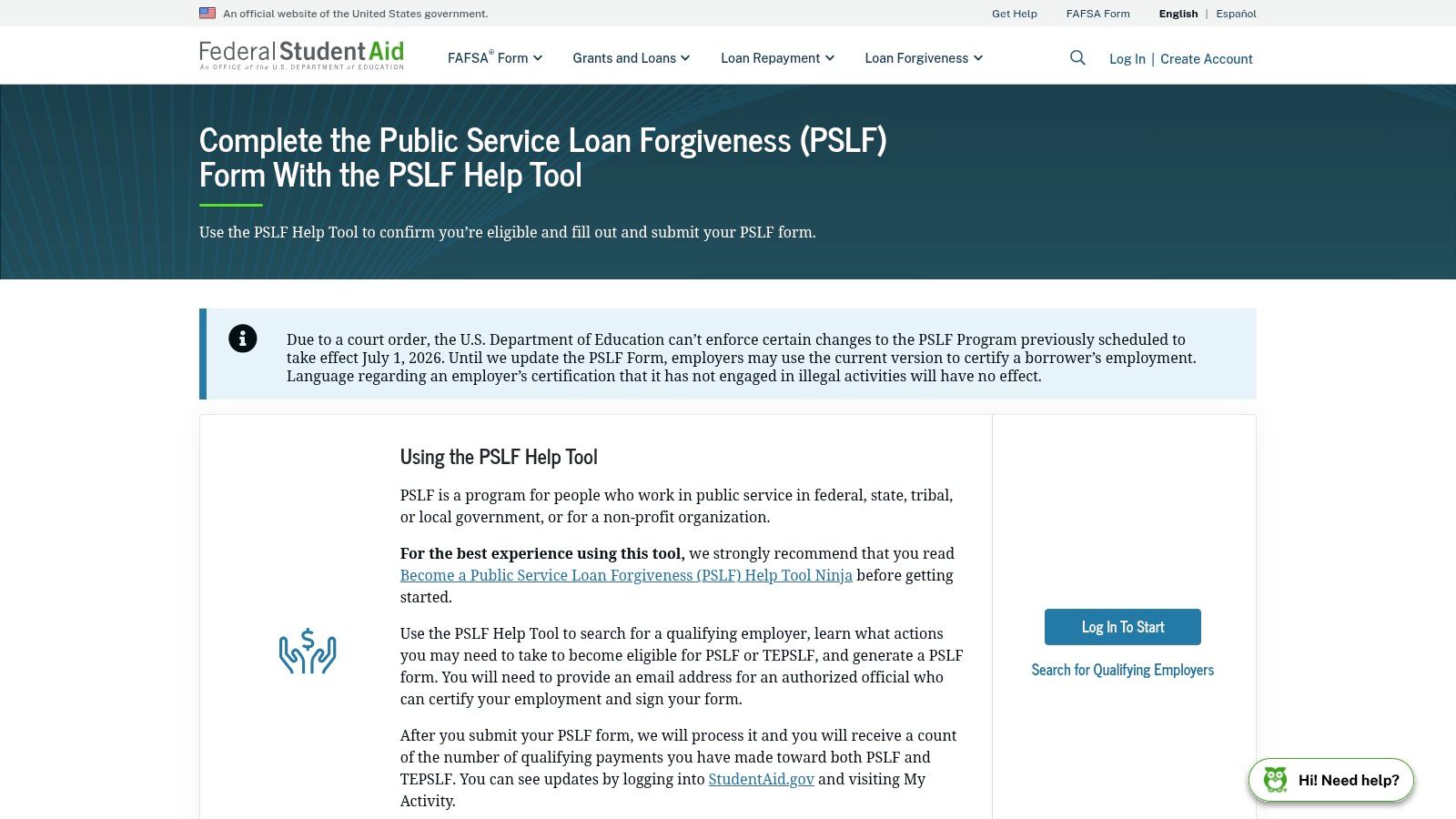
Once your documents are in front of you, the next move is using the official PSLF Help Tool with precision. Don't rush through it. Every field exists for a reason.
This is the point where a lot of borrowers sabotage themselves by clicking fast and assuming the system will sort out the details. It won't. You need to enter your information carefully so the estimate reflects your real path, not a fantasy version of it.
Start with loan type and repayment status
The tool first needs to know whether your debt is eligible. This is essential. An accurate PSLF calculator uses a specific algorithm: it verifies your loans are Federal Direct Loans, confirms your employment is with a qualifying entity, and ensures you're on an Income-Driven or 10-Year Standard plan. It must exclude payments from Graduated or Extended plans to give a correct estimate, as outlined in this PSLF calculator methodology guide.
If your loans include ineligible types, the estimate can only be trusted after you account for that reality. Don't pretend old FFEL or Perkins balances are PSLF-ready if they aren't.
Enter your employer details carefully
The employment section matters just as much as the loan section. Use your employer's official name. Don't abbreviate unless the system clearly recognizes it. Enter your start date accurately, and if you changed agencies, districts, hospitals, or departments, track each period separately.
The key issue isn't just where you work. It's whether that employer qualifies and whether your service dates line up with repayment periods.
Use this standard when reviewing your work history:
- Government employment counts if it's with a federal, state, local, or tribal government entity.
- Nonprofit employment may count if the employer is a qualifying organization.
- Dates have to match reality because PSLF is earned month by month, not by good intentions.
Use the right income figure
When the tool asks for income, stay disciplined. If you're working from your latest federal tax return, use your AGI from that filing. If your current income is materially different, recognize that your future payment may shift when you recertify.
Borrowers often make a bad planning decision regarding estimated payments. They see one estimated payment, assume it will stay flat forever, and build a budget around that assumption. Don't do that. Treat the estimate as a strong working model, then stress-test it against likely pay increases, overtime variability, or household income changes.
If your salary is likely to rise steadily, your future PSLF payment may rise too. That doesn't kill the strategy. It just means your calculator result is a starting point, not a permanent promise.
Don't gloss over family size
Family size affects income-driven repayment calculations. Enter it carefully and update it when your household changes. A calculator can't reflect your actual payment path if this number is stale or incorrect.
For California public servants, this is more than paperwork. A lower student loan payment can improve your monthly cash flow in a way that directly affects savings goals, reserve planning, and mortgage readiness.
Review the repayment plan assumptions
Before you accept the estimate, check which repayment plan the tool assumes. If it defaults to a plan that doesn't align with your PSLF strategy, the result may still be mathematically correct and practically useless.
Look for these warning signs:
- The plan shown isn't income-driven, even though you're pursuing PSLF aggressively.
- You previously used Graduated or Extended repayment, which can distort your expectations if you assume those months count.
- Your payment count appears too generous, usually because you're mentally counting non-qualifying periods.
The smart move is to review the result with skepticism. If the estimate seems better than expected, verify why. If it seems worse, verify that too. Borrowers lose years by assuming the calculator is wrong, then doing nothing.
How Different Repayment Plans Affect Forgiveness
Choosing a repayment plan is where strategy starts. The calculator gives you outputs, but the plan you select shapes those outputs. If you're aiming for PSLF, the goal usually isn't to pay the loan off fast. The goal is to keep payments qualifying and manageable while maximizing the benefit of forgiveness.
That means your monthly payment and your future forgiven balance pull in opposite directions. Lower monthly payments can leave more balance to forgive. Higher monthly payments can reduce what's left at the end.
What to compare
For PSLF purposes, borrowers usually focus on SAVE, PAYE, and IBR, along with the 10-Year Standard Plan as a qualifying but often less strategic option. The right fit depends on your income, family size, tax filing choices, and how aggressively you want to preserve cash flow for other goals like buying a home.
Here's the comparison you should make inside any public service loan calculator.
| Repayment Plan | Monthly Payment Formula (% of Discretionary Income) | Interest Subsidy | Best For |
|---|---|---|---|
| SAVE | Varies by current program rules and your borrower profile | Includes interest benefits under current program structure | Borrowers focused on the lowest sustainable payment and larger projected forgiveness |
| PAYE | Based on discretionary income under plan rules | More limited than SAVE | Borrowers who qualify for PAYE and want payment caps tied to plan design |
| IBR | Based on discretionary income under IBR rules | Different from SAVE | Borrowers who need a durable IDR option and qualify under IBR terms |
| 10-Year Standard Plan | Fixed payment rather than IDR percentage | No IDR-style interest feature | Borrowers who need qualifying payments but may not benefit as much from forgiveness |
The real trade-off
A California teacher with a modest salary relative to housing costs may prefer the lowest qualifying payment possible. A nurse with a rising income might still use an IDR plan if that keeps room in the budget for emergency savings and a down payment. A firefighter with overtime needs to be careful because income swings can change future payments after recertification.
The mistake is thinking the “best” plan is always the one with the smallest monthly payment. Sometimes it is. Sometimes a different qualifying plan creates a better long-term fit because of how your income is likely to change.
Consider these decision filters:
- Cash flow first if housing, childcare, or other fixed California expenses already strain your budget.
- Forgiveness value matters if your balance is large enough that paying aggressively would undermine other goals.
- Stability matters if you want predictable planning around mortgage readiness.
A strong PSLF strategy often means paying less now on purpose, not because you're falling behind, but because the program rewards disciplined long-term positioning.
What I recommend
If you're pursuing PSLF seriously, compare plans through the lens of monthly affordability, qualifying status, and how much balance is likely to remain at forgiveness. Don't choose a plan just because it feels morally satisfying to pay more. That instinct hurts borrowers all the time.
The right plan is the one that keeps you on a valid PSLF path while protecting your ability to build the rest of your financial life. In California, that includes homeownership. If a repayment plan frees up cash for reserves and a future down payment without sacrificing forgiveness, that's a smart move.
Interpreting Your PSLF Calculator Results
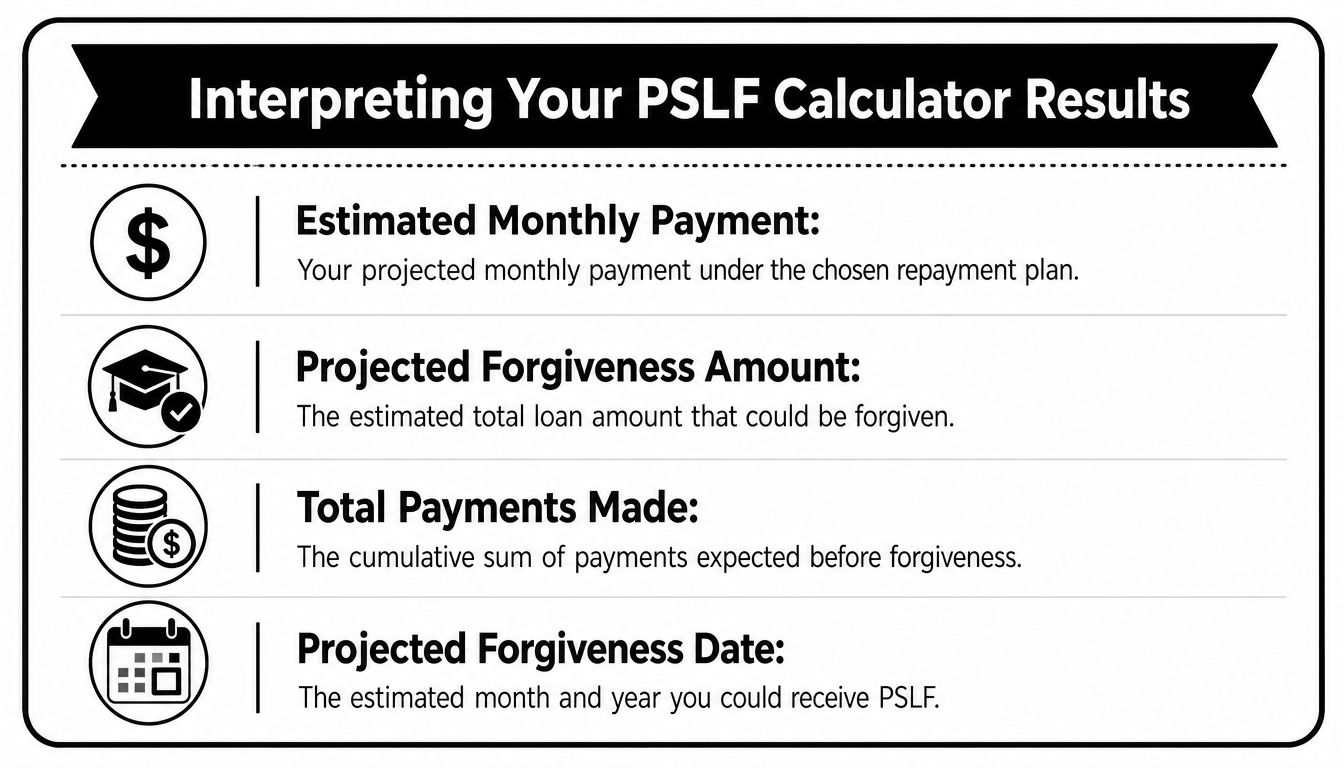
Once the calculator gives you results, slow down and read them like a planner, not like a panicked borrower. The output usually includes your projected monthly payment, estimated forgiveness amount, total expected payments, and a likely forgiveness date. Each one tells you something different.
The four outputs that matter most
- Estimated monthly payment tells you what your chosen repayment plan is expected to require right now, based on the information entered.
- Projected forgiveness amount shows how much balance could remain when you reach PSLF eligibility.
- Total payments made gives you the cumulative amount you're likely to pay before forgiveness happens.
- Projected forgiveness date gives you a target month and year to organize around.
What the numbers really mean
The monthly payment number matters for your current budget. The forgiveness amount matters for long-term strategy. The total paid matters because it lets you compare PSLF against other approaches. The date matters because timelines drive life planning, especially if you're deciding when to buy a home, save more aggressively, or avoid throwing extra money at federal loans that may be forgiven.
Don't treat any one number in isolation. A lower monthly payment may be a win even if it means a larger balance remains at forgiveness. For PSLF borrowers, that can be exactly the point.
Any month where your income-driven payment is calculated to be $0 still counts as one of your 120 qualifying payments, as long as you are working full-time for a qualifying employer. You do not need to make an actual cash payment for that month to count, according to the zero-payment PSLF guidance document.
The rule many borrowers miss
That zero-payment rule changes the math for a lot of public servants, especially early-career workers or borrowers whose income drops temporarily. If your scheduled payment is $0 under an income-driven plan, that month can still move you closer to forgiveness. Many generic calculators and casual online discussions miss this completely.
What should you do with your result?
- Check whether the payment feels sustainable in your real California budget.
- Ask whether the forgiveness date matches your work history and expectations.
- Review whether future raises could change the estimate enough to affect your homebuying timeline.
If your result gives you a workable payment and a credible forgiveness path, that's not just student loan relief. That's planning clarity.
From PSLF Estimate to California Homeownership
A PSLF estimate is useful only if you turn it into action. Plenty of public servants run the numbers, feel briefly encouraged, and then never certify employment, never verify payment counts, and never connect the strategy to bigger goals. That's a mistake.
If you want your student loans to stop blocking homeownership, you need a simple system.
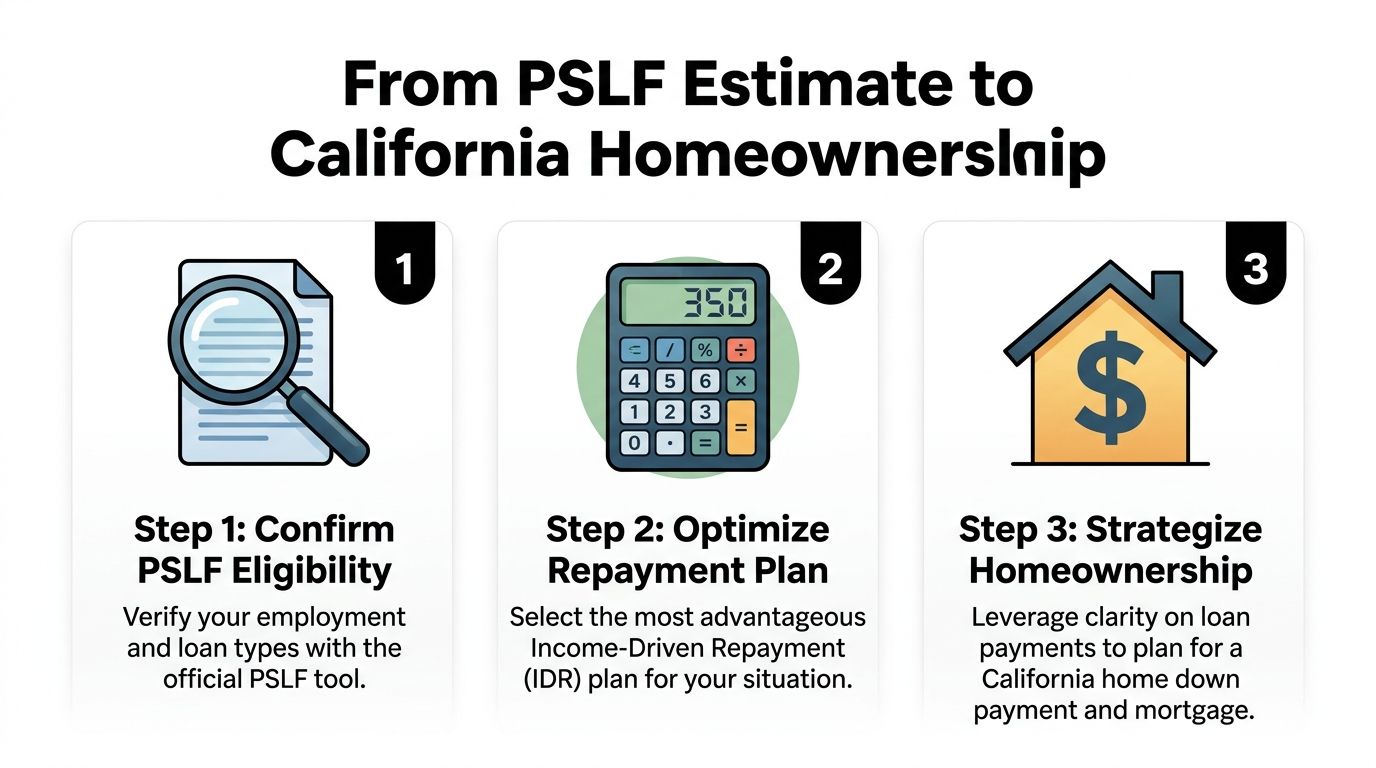
Step one, certify your employment every year
This is the most overlooked action in the whole PSLF process. Despite over 9 million public service workers being eligible for PSLF, fewer than 15% have filed the necessary Annual Certification of Public Service Employment paperwork, according to Student Loan Planner's PSLF statistics page. That's unacceptable.
If you're serious about forgiveness, annual certification is not optional. It's how you create a paper trail and force the system to track your qualifying work.
Step two, make your servicer prove the count is right
Don't assume your qualifying payments are being tracked correctly. Review them. If something looks off, challenge it early while records are easier to gather.
Use a repeatable checklist:
- Submit the employment certification form regularly so your timeline stays current.
- Review payment counts after processing instead of trusting that everything was posted correctly.
- Keep your own records including employer dates, plan changes, and confirmation notices.
The borrower who keeps records usually wins the dispute. The borrower who assumes the servicer got it right usually doesn't.
Step three, use the payment stability to plan for a home
The calculator's role extends beyond typical debt management. If your repayment plan produces a stable, affordable monthly obligation, you can start building a homeownership strategy around it. That affects savings rate, debt-to-income posture, and the confidence to shop within a realistic price range.
For California public servants, that can mean shifting from survival mode to deliberate planning:
- Build a down payment fund once your federal loan payment is optimized.
- Protect emergency savings instead of draining cash to make unnecessary extra loan payments.
- Prepare for underwriting with a cleaner monthly budget and documented payment history.
A predictable student loan plan can strengthen your mortgage readiness because uncertainty is expensive. When borrowers don't know whether their payment will spike or whether forgiveness is realistic, they hesitate on everything else.
If you're a nurse balancing PSLF strategy with future homeownership, it helps to review California home loan options for nurses once your repayment plan is under control. That's the right order. Debt strategy first, housing strategy second.
Your PSLF Questions Answered
What if I have FFEL, Perkins, or private loans
Private loans don't qualify for PSLF. Older federal loan types may also be ineligible unless they're consolidated into a qualifying Direct Consolidation Loan when allowed. Don't assume all federal debt is PSLF-eligible just because it's federal. Check each loan type individually before building your plan.
Will PSLF hurt my chances of getting a mortgage
The program itself doesn't hurt your mortgage chances. Sloppy repayment records and unmanaged debt do. If PSLF gives you a lower, sustainable monthly payment and a clearer long-term debt strategy, that can improve your overall financial position. Forgiven debt also removes future obligations rather than adding them.
Do I need to make actual payments every month for PSLF credit
Not always. As covered earlier, a scheduled $0 payment under a qualifying income-driven plan can still count if you're working full-time for an eligible employer. That's one of the most misunderstood parts of the program.
Is there a California option besides PSLF for healthcare workers
Yes, for some borrowers. The California State Loan Repayment Program can be a strong alternative for certain healthcare professionals. It offers up to $50,000 in loan forgiveness for a two-year service commitment in a Health Professional Shortage Area, as described in this California student loan forgiveness overview. If you work in healthcare, you should evaluate both tracks instead of assuming PSLF is the only path.
What should I do first if I'm overwhelmed
Pull your loan records, confirm your loan types, verify your employer qualifies, and run a clean estimate. Don't start by throwing extra money at federal loans. Start by finding out whether forgiveness is within reach.
If you're a California public servant working toward loan forgiveness and homeownership at the same time, California Loans for Heroes can help you connect those two goals. Their team supports teachers, nurses, firefighters, law enforcement, government employees, veterans, and other HEROES across California with home loan guidance, buyer rewards, and one-on-one support designed for real-world affordability.