
You're probably in the same spot as a lot of California veterans I talk to. You've done the math on rent, watched home prices stay stubbornly high, and wondered whether buying is realistic without draining your savings. Then you hear about VA loans, CalVet, down payment help, appraisal rules, and lender jargon, and the whole thing starts to feel harder than it should.
It doesn't have to be.
California gives veterans access to some of the strongest home financing options in the country. The problem isn't lack of benefits. The problem is choosing the right benefit and using it the right way in a state where every mistake costs time, money, and advantage.
Your Path to Homeownership in California
A veteran in California usually starts with the same two fears. First, “I can't save enough for a down payment.” Second, “Even if I can qualify, I won't be competitive.” Both fears are understandable. California is expensive, fast-moving, and unforgiving when you use the wrong loan strategy.
But you're not trying to do something unusual. Veterans buy homes across this state every year using benefits they earned through service. In 2013, California issued 45,262 VA home loan guarantees, and in the third quarter of 2022, the state held the third-highest volume of VA home loans in the U.S., according to the California VA lending state sheet. That volume exists for a reason. California has a large military population, and the 100% financing option matters in a housing market where cash to close can block otherwise qualified buyers.
That changes the conversation.
Instead of asking whether you can buy, the better question is which path gives you the best mix of low cash out of pocket, manageable monthly cost, and long-term flexibility.
Practical rule: Don't start with the house. Start with the loan structure. In California, the wrong structure can cost you more than the wrong paint color, wrong floor plan, or wrong commute.
Some veterans should go straight to a federal VA loan. Others should take a close look at CalVet. A few should compare both side by side before they ever talk price range with an agent. If you skip that decision and go straight into preapproval, you risk building your whole purchase around a loan that doesn't fit your service history, title preferences, or future plans.
That's why California veteran home loans deserve a decision framework, not a generic list of programs.
Understanding Your Core Loan Options
You find a home in Riverside County. The payment looks workable. The seller accepts your offer. Then you learn the loan you picked does not match how you want to hold title, what insurance costs you can tolerate, or whether you may move out of California later.
That mistake is avoidable.
Your two core options are the federal VA loan and the CalVet Home Loan. Start there before you shop lenders too aggressively, before you lock onto a price point, and definitely before you waive contingencies. In California, the right loan choice shapes your cash to close, your monthly payment, your ownership structure, and your flexibility later.
Federal VA loan
A federal VA loan is a mortgage from a private lender backed by the U.S. Department of Veterans Affairs. It follows standard mortgage rules in the ways most buyers expect. You hold title in the usual way, you can use the benefit outside California, and you have broad lender choice.
For many California veterans, this is the first option to review because it usually gives you the cleanest path. If you care about flexibility, plan to relocate someday, or want the most lender competition on rates and fees, start with the federal VA loan.
CalVet Home Loan
CalVet is California's state-run veteran home loan program. It is only for California properties, and it is not built like a standard mortgage.
The biggest difference is ownership structure. CalVet uses a land contract model, so the state keeps legal title until the loan is paid off. That design changes more than paperwork. It can affect insurance requirements, fee structure, and how comfortable you feel with the transaction itself.
That point matters more than many buyers realize.
Some veterans like CalVet because it is California-specific and may fit their situation well. Others should avoid it because they want straightforward title ownership from day one and fewer moving parts. If you want a practical overview of how these options show up in real purchase scenarios, review these home loans for heroes programs in California.
Use this filter before you compare rates
Do not start with rate shopping alone. Start with fit.
Ask yourself:
- Will you stay in California long term? If not, the federal VA loan usually makes more sense.
- Do you want standard title ownership from day one? If yes, lean toward the federal VA loan.
- Are you open to a state-run structure with different title handling and bundled protections? If yes, CalVet deserves a closer look.
- Do you want the widest lender selection? Federal VA wins there.
- Do you want to compare every veteran-specific path available for a California primary residence? Put both on the table before choosing.
My advice
For most buyers, the federal VA loan should be the default starting point. It is simpler, more familiar to lenders and agents, and usually easier to fit into a long-term plan.
CalVet is the option to examine only after you confirm that its structure works for you, not because the name sounds similar to VA. That is the trap. Veterans hear “CalVet” and assume it is basically the same benefit with a California label. It is a different product with different tradeoffs.
Choose the loan that fits your life, not the one that sounds familiar.
VA Loans vs CalVet Loans A Detailed Comparison
Two buyers can have the same military background, similar credit, and the same target home in California, then make very different loan choices for good reasons. The right answer depends on how long you plan to stay, how you want ownership structured, and whether lower payment or California specific features matter more to you.
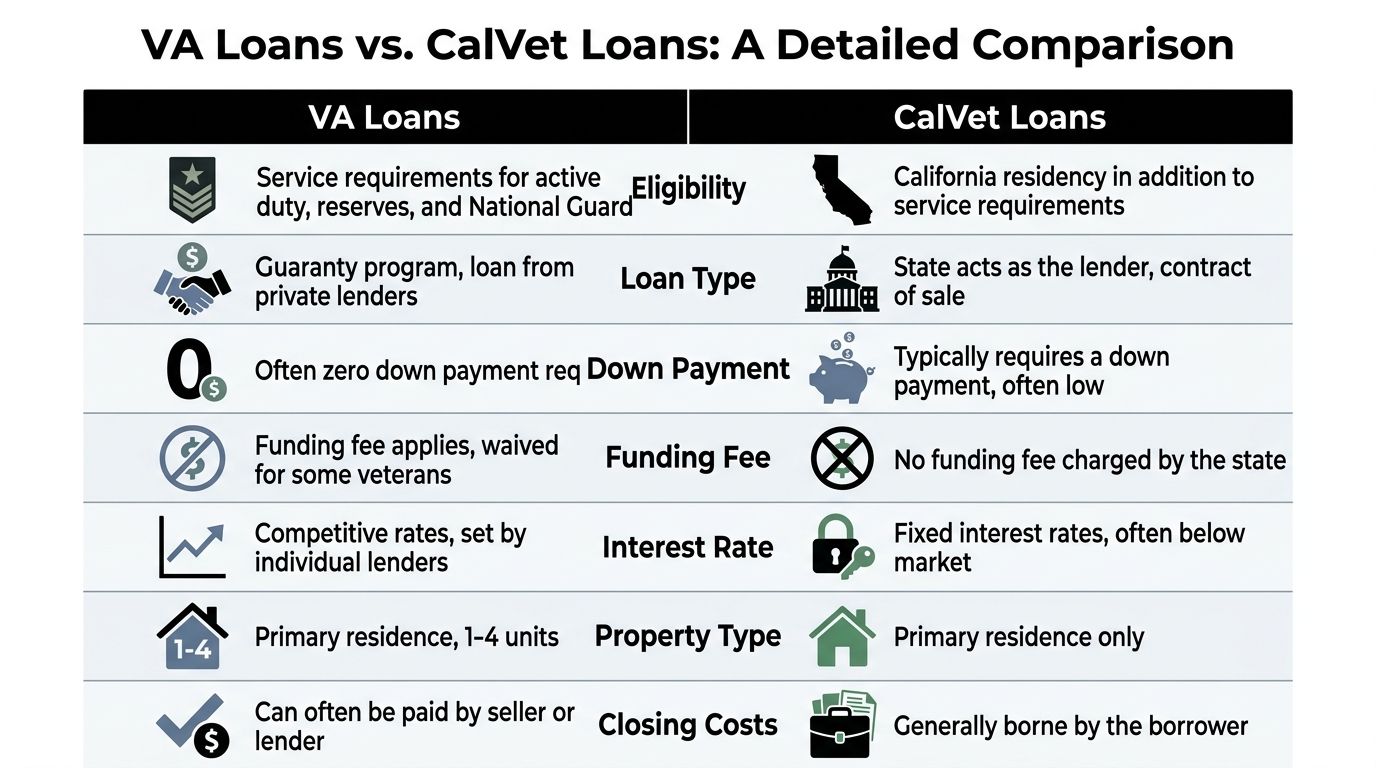
Start with the decision, not the brand name. If you treat VA and CalVet as interchangeable, you can end up with the wrong structure for your plans.
VA Loan vs. CalVet Loan at a Glance
| Feature | Federal VA Loan | CalVet Loan |
|---|---|---|
| Geographic use | Available nationwide | Restricted to California properties |
| Title ownership | Borrower holds standard title from day one | CalVet retains legal title until the loan is paid off |
| Interest rate tendency | Often lower than comparable CalVet pricing | Can be higher than many federal VA options |
| Program structure | VA guaranty with private lender funding | State-run loan program |
| Insurance setup | No CalVet-style bundled state package | Bundled insurance tied to the land contract structure |
| Best fit | Veterans who want flexibility and immediate title | Veterans who want California-specific program features |
The biggest mistake I see is buyers focusing on a headline rate before they decide which ownership model fits their life. In California, that shortcut gets expensive fast. A lower payment matters, but so do resale plans, relocation risk, and whether you are comfortable with CalVet holding legal title during repayment.
Choose a federal VA loan if flexibility matters most
For many California veterans, the federal VA loan is still the better first option.
Pick it first if you want:
- Standard title ownership from day one
- The freedom to move out of California later without feeling tied to a state specific product
- A wider lender pool and a process that listing agents usually understand immediately
- The strongest chance at a lower monthly payment when compared side by side with CalVet
- A simpler long term strategy for refinancing, selling, or keeping future options open
This is the cleaner fit for service members who may transfer, veterans who expect career changes, and buyers who do not want extra explanation around title structure during escrow.
Give CalVet real consideration if its structure solves a specific problem
CalVet is not a backup plan. It is a different tool.
Take a hard look at CalVet if these points line up with your situation:
- You know the property will be in California
- You are comfortable with CalVet retaining legal title until payoff
- You want the program's bundled insurance features and you have priced their value against the total loan cost
- You prefer working within a California run veteran housing program
- You are choosing based on total fit, not just the lowest advertised rate
That last point matters. A veteran planning to stay in the same California home for years may judge this choice differently than a buyer who expects another PCS, job move, or family relocation.
My recommendation for making the call
Use this framework.
Start with a federal VA loan quote. That gives you the baseline for payment, fees, and ease of ownership.
Then price CalVet against it only if you are a serious California long term buyer. Compare the full monthly cost, the title structure, and how each option fits your exit plan.
Choose based on your next five to ten years, not just this month's payment. In California, the wrong loan fit creates stress later when you need to sell, refinance, or move quickly.
If you want the shortest version, here it is.
Federal VA fits more buyers. CalVet fits a narrower group well.
Make the decision the same way an experienced advisor would. Match the loan to your service history, ownership preference, and long term plan in California. That is how you save money and avoid regret.
Confirming Your Eligibility And Getting Started
Before you shop homes, prove eligibility. This is your first mission, and it's not optional.
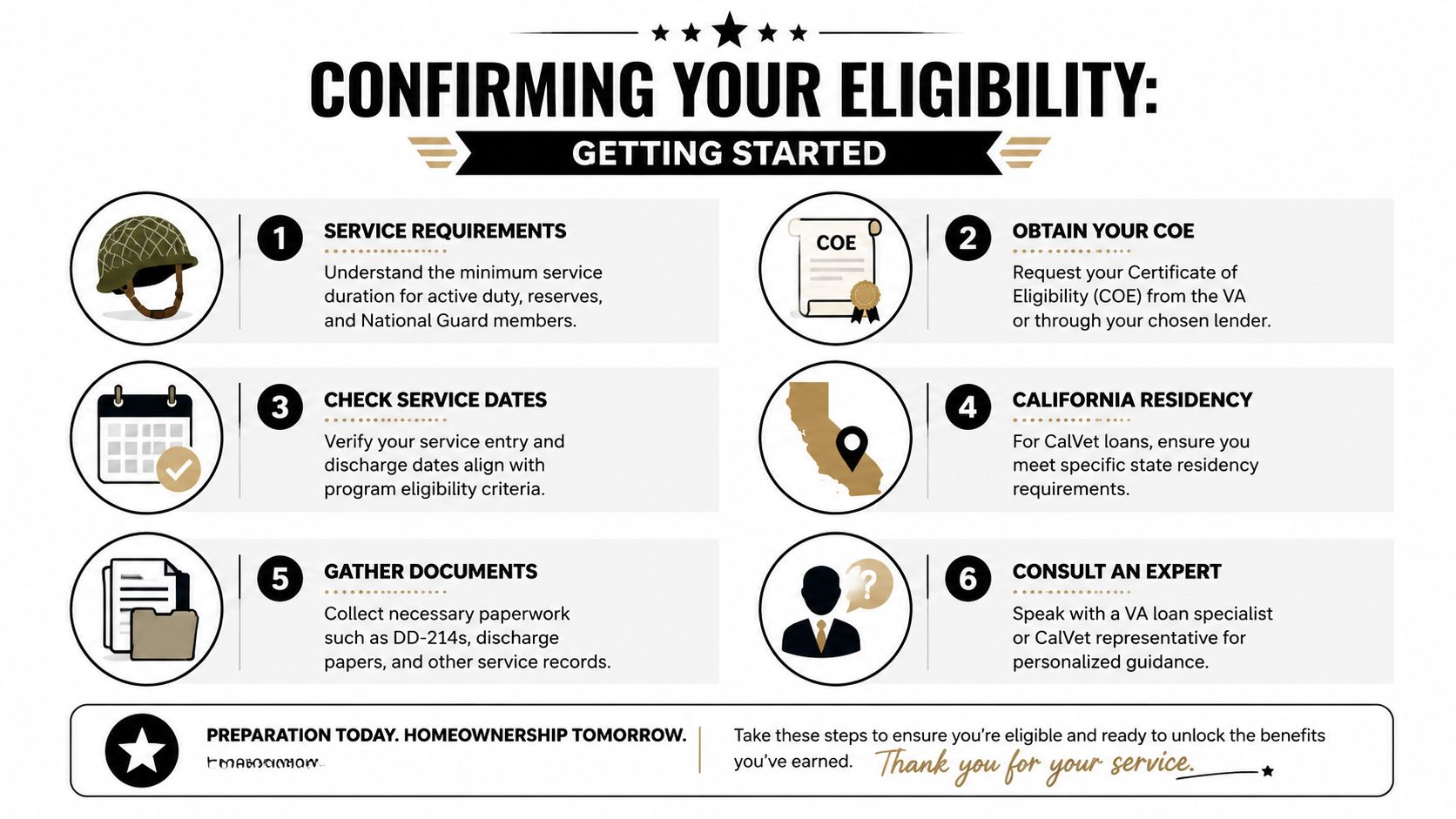
CalVet eligibility is broader than many veterans think
A lot of veterans wrongly assume they don't qualify because they didn't serve in combat or didn't stay in for a long stretch. CalVet is often more accessible than people expect.
Per the San Bernardino County Welcome Home program page, CalVet eligibility requires 90 consecutive days of active duty service, excluding training, with an Honorable discharge. That lower service threshold expands the pool of eligible borrowers in a meaningful way.
The same source states that veterans with a 10% or greater disability rating are exempt from the funding fee, which can lower the overall cost of the loan.
The documents that actually matter
For a federal VA loan, the key document is your Certificate of Eligibility, usually called a COE.
For CalVet, your DD Form 214 is central because it verifies service and discharge status. If you're still on active duty, you may need service documentation that confirms current status and dates.
Get these in hand before you talk yourself into a specific property. That single move prevents delays later, especially when a seller wants a clean, fast offer.
Your fastest path forward
Use this checklist:
- Pull your discharge records early: If your DD-214 is missing, fix that now, not in escrow.
- Request your COE before house hunting gets serious: Many lenders can help retrieve it, but don't wait until you're writing offers.
- Verify service dates carefully: Small errors in records can create needless back-and-forth.
- Check disability documentation if applicable: If you qualify for a fee exemption, make sure the paperwork supports it.
- Ask program-specific questions up front: A generic lender often misses details that matter to veterans.
Get your paperwork squared away before your home search becomes emotional. Buyers who wait on eligibility documents usually lose time at the worst possible moment.
If you're unsure whether you qualify, don't guess. Confirm it first, then build your purchase plan around facts.
Navigating The Home Loan Application Process Step By Step
Once eligibility is confirmed, the process gets simpler. Not easy, but simpler. The veterans who have the least stress are the ones who follow the steps in order and don't skip ahead.
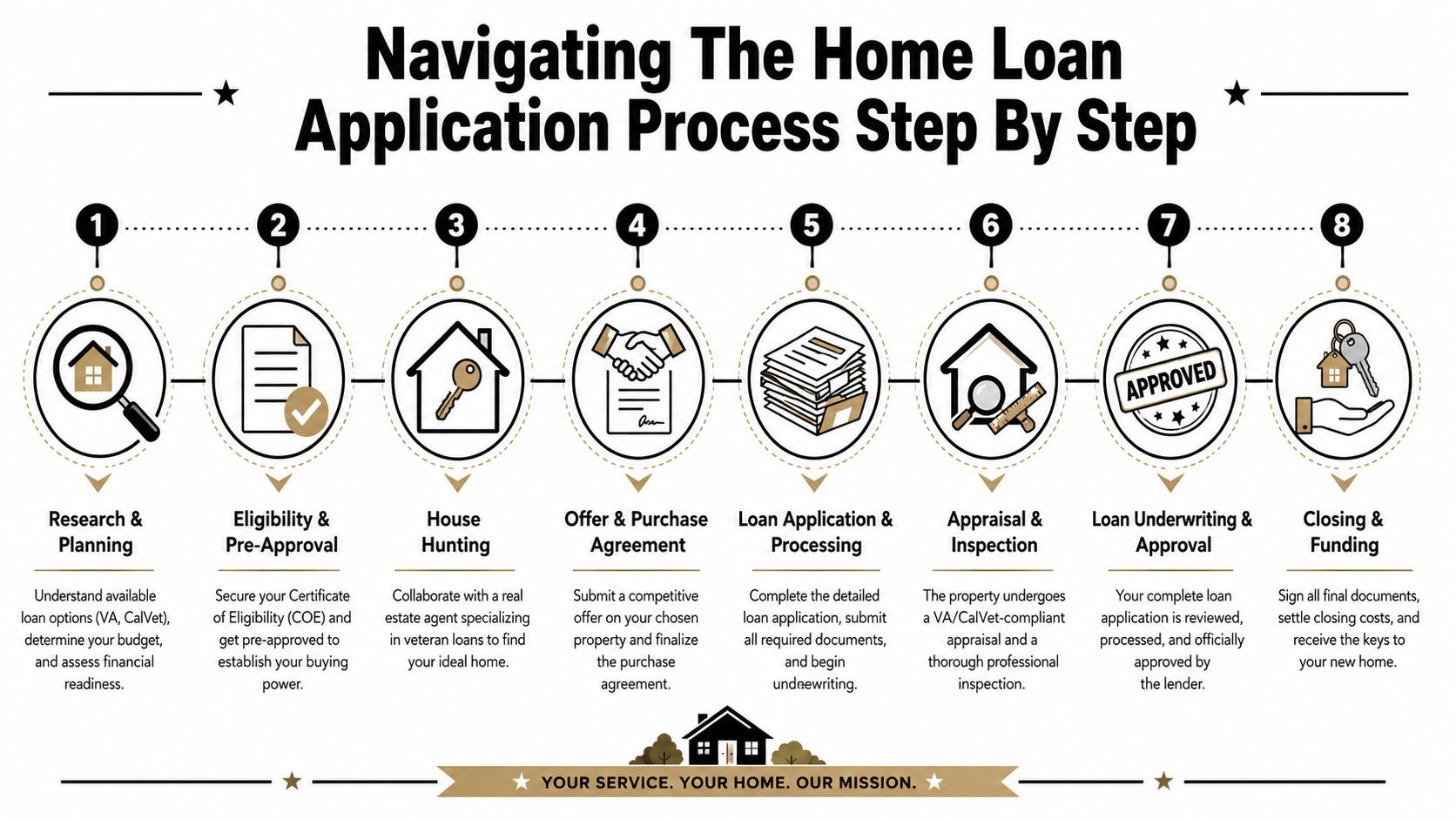
Start with planning and preapproval
Preapproval is where your strategy becomes real. Here, a lender reviews income, assets, debts, and eligibility documents, then informs you of a suitable range.
Don't treat preapproval as a formality. In California, it shapes your offer strength and keeps you from wasting time on homes that don't fit your actual payment comfort zone.
A smart early move is to understand property condition expectations and buyer due diligence through a focused VA home loan inspection guide. Inspection problems don't usually get better with time. They get more expensive and more annoying.
Build the right team
Your loan doesn't operate in a vacuum. You need an agent who understands veteran transactions, seller objections, and California escrow pressure.
A weak agent can make a good loan look risky. A strong agent can position that same loan as organized, serious, and ready to close.
Use this standard:
- Choose a veteran-savvy lender: Not a lender who “also does VA.”
- Choose an agent who won't apologize for your financing: Confidence matters.
- Choose an inspector who writes clear reports: Ambiguity creates friction fast.
Offer, appraisal, underwriting, closing
Once you find the home, the transaction moves through several pressure points.
Offer submission
Your offer needs to be competitive and realistic. Strong terms matter, but so does choosing a property that fits the loan program.Loan application and processing
You'll submit updated documents, explanations if needed, and property details. At this stage, slow borrowers create their own delays.Appraisal and inspection
The appraisal confirms value and checks that the property meets program standards. The inspection protects you from buying hidden trouble.Underwriting
Underwriting reviews the whole file. If you've been sloppy with documents, this stage gets painful.Closing
You sign final documents, pay what's due, and get your keys once funding and recording are complete.
Field advice: Reply to document requests the same day. Most “lender delays” are really borrower delays.
Where California buyers get tripped up
The biggest problems aren't mysterious.
- Incomplete paperwork: Missing statements, unclear deposits, or outdated pay records slow everything down.
- Property issues: Homes with condition problems can trigger repair demands.
- Last-minute financial changes: Don't open new credit, move money around casually, or quit your job mid-escrow.
- Bad communication: If your lender, agent, and escrow officer aren't aligned, the file gets messy fast.
You don't need to obsess over every stage. You do need to stay responsive and disciplined. California veteran home loans work best when the buyer treats the process like a mission with deadlines, not a casual side project.
Finding Extra Support And Down Payment Assistance
A lot of veterans think the main loan is the whole strategy. It isn't. The strongest buyers often stack benefits.

Even if you're using a VA loan and taking advantage of zero-down financing, you may still face closing costs, prepaid items, reserves, or seller negotiation gaps. That's where additional support matters. In California, some buyers combine their primary mortgage plan with down payment assistance or homebuyer support programs to reduce cash pressure at the front end.
Why stacking benefits matters
The point isn't just “get more help.” The point is preserving your cash.
Cash on hand gives you options after closing. It helps with repairs, moving costs, furniture, emergency reserves, and the hundred little expenses that show up once you own the place. Draining your accounts just to get in the door is a bad plan.
That's why veterans should ask early whether any assistance can work alongside their main loan structure.
What to ask about before you write offers
Bring these questions into your first serious loan conversation:
- Can I combine this loan with assistance programs? Some structures work better than others.
- What costs will still come out of pocket? Zero down doesn't mean zero cash needed.
- Are there lender credits or buyer reward options available? Those can change your total cash-to-close picture.
- How will assistance affect timing? Extra layers can help, but they need to be managed correctly.
A practical next step is reviewing California-specific VA home loan down payment assistance options so you understand what kinds of support may be available and how they fit into a real purchase.
My recommendation
Don't assume help will appear automatically. Ask for a full benefit review. A veteran who only asks, “What rate can I get?” usually leaves money on the table. A veteran who asks, “What can I combine, what can be credited, and what can reduce cash to close?” makes sharper decisions.
That's the difference between getting approved and getting positioned well.
Common Questions About California Veteran Loans
Does the new appraisal legislation matter in California
You find a home in San Diego, write a strong offer, and then the appraisal comes in low or gets delayed. In California, that is how a good deal turns into a stressful escrow fast.
Yes, the new appraisal legislation matters here. California prices move quickly, and that creates more appraisal friction than veterans see in slower markets. According to the California Legion article on the VA Appraisal Modernization Act, the 2024-2025 VA Appraisal Modernization Act is aimed at reducing delays and appraisal problems that can block approvals. The same article says appraisal issues were tied to a large share of California VA loan denials in 2023, and it notes that 2026 California VA loan limits exceed $1M in most metro counties. In plain terms, appraisal rules matter more when you are buying in a high-cost market and trying to keep your zero-down advantage.
My advice is simple. If you are shopping in a competitive California county, ask your lender and agent how they handle low appraisals before you submit offers. That is not a side issue. It is part of choosing the right loan structure.
Can you use your veteran home loan benefit more than once
Yes, many veterans can.
The answer depends on your remaining entitlement, your prior VA loan history, whether the old loan was paid off, and whether that property was sold or refinanced into another loan type. Veterans in California often assume they got one shot and missed it. That is a mistake.
Get your entitlement reviewed early. If you have used a VA loan before, do not guess. A clean entitlement review can tell you whether a new purchase, a second use, or a restoration strategy gives you the best path.
Should you refinance later if rates improve
Refinancing only makes sense when the numbers improve your position.
If you already own with a VA loan, a refinance can lower your payment, shorten your term, or help you meet a specific financial goal. If it adds closing costs without a clear payoff, skip it. California veterans get pitched refinances all the time. Ignore the sales pitch and run the math on monthly savings, total loan cost, and how long you plan to keep the property.
Buy smart first. Then revisit refinance options if the market gives you a real benefit.
Is CalVet always better because it's built for California
No.
CalVet is not automatically the better loan because it is state-specific. In plenty of cases, the federal VA loan is simpler, cheaper, and easier to use in a competitive California purchase. CalVet can still be the better fit for some veterans, especially if its terms line up with your credit profile, property type, cash reserves, or long-term plans.
That is the framework I recommend. Do not ask which program sounds better. Ask which one fits your service history, monthly budget, cash-to-close, and how long you expect to keep the home. That is how California veterans choose the right loan instead of the most familiar one.
If you want help sorting through California veteran home loans without the usual confusion, talk with California Loans for Heroes. Their team helps veterans and other California HEROES review loan options, homebuyer assistance, down payment assistance possibilities, lender credits, refinance strategies, and one-on-one support so you can move forward with more confidence and less stress.