
California teachers' pay has not kept pace with housing. In a 2025 analysis of 72 large U.S. urban districts, teacher salaries rose 24% since 2019, while apartment rents rose 51% and home prices rose 47%. The same analysis found 39 of those 72 districts were already unaffordable for early-career teachers with bachelor's degrees. National Low Income Housing Coalition coverage of the analysis makes the central point clear: a teacher-branded mortgage can help, but the label alone doesn't make a California home affordable.
The useful question isn't just “What home loan deals for teachers are available?” It's, “Which benefit lowers the payment, reduces cash needed at closing, or improves qualifying income enough to change the purchase decision?” Rate discounts, grants, deferred second liens, tax benefits, and local housing programs can all matter. Small lender credits often don't.
Why Home Loan Deals for Teachers Matter in California
California's affordability problem is structural. Teachers compete for homes in the same markets as higher-paid professionals, while their income often includes contracts, stipends, summer-pay arrangements, and school-year employment patterns that require careful underwriting. A standard mortgage may approve the borrower, yet still leave the teacher far below the price range needed near the school where they work.
The gap is especially severe in urban districts. In the analysis cited above, housing costs outpaced teacher compensation by a wide margin, and more than half of the districts reviewed were already unaffordable for early-career educators. That means a conventional loan with an ordinary rate and ordinary down payment requirement may not address the core issue. It may just confirm that the buyer's income doesn't support the local inventory.
Why public-purpose programs exist
Teacher housing assistance is a policy response to recruitment and retention pressure. Connecticut created its Teachers Mortgage Assistance Program through Public Act 2000-187, and participating lenders began offering it on October 23, 2000. The program targeted certified public school teachers who were first-time buyers, or who hadn't owned a home during the prior three years, and who worked in priority or transitional districts or shortage subject areas. By 2012, it had produced 18 loans totaling $3.2 million, with an average loan amount of $175,264, average borrower income of $62,427, and average home price of $185,471. The Connecticut program circular shows that targeted support can produce actual lending activity rather than merely symbolic recognition.
California has also seen long-running teacher housing initiatives. A 2000 Los Angeles Times report said CalSTRS had made $3 billion in home loans, mostly to public school teachers, since 1986, and had begun offering no-down-payment loans the prior year. The report also described a separate initiative that could provide 4,000 teachers with a mortgage-interest tax credit equal to 15% of interest paid, worth up to $1,800 per year, while a federal teacher homebuyer discount program had about 120 homes in escrow across 14 states, including about 34 homes in California. The Los Angeles Times report illustrates how teacher financing has historically combined public policy, retirement systems, and lender participation.
What actually deserves attention
A serious California buyer should compare:
- Rate reductions, which lower the payment and lifetime interest.
- Down payment assistance, which reduces cash-to-close.
- Forgivable or deferred liens, which may preserve savings while creating future obligations.
- Tax credits, which can improve after-tax ownership costs without changing the initial loan balance.
- Profession-neutral programs, which may beat teacher-branded products when their underwriting or assistance rules are more favorable.
Use the California homebuyer grants resource as one starting point, then verify current availability, occupancy rules, income limits, and lender participation before relying on any benefit.
Types of Teacher Home Loan Programs Explained
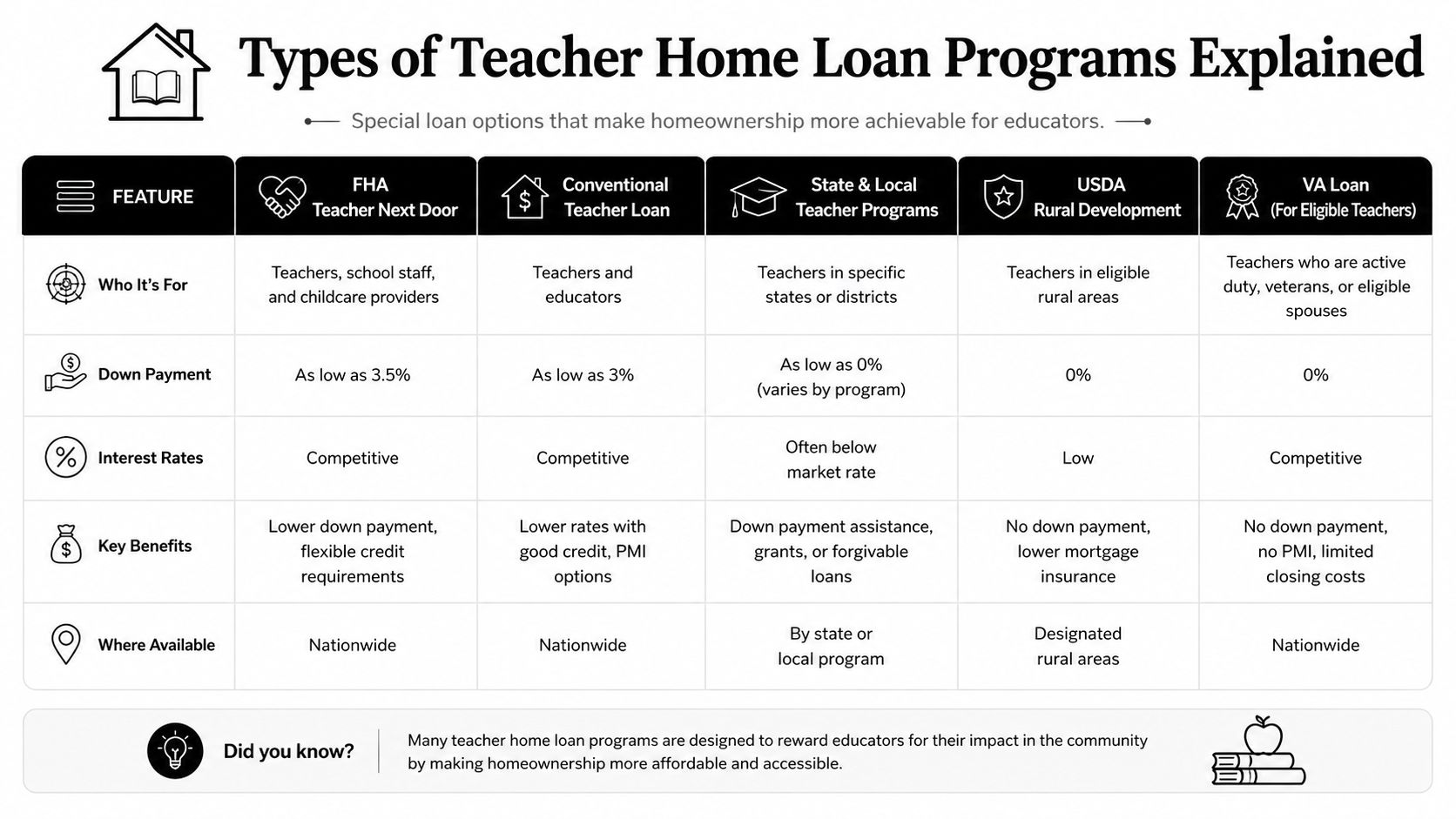
Teacher loan deals generally use four tools: a lower interest rate, upfront assistance, delayed repayment, or a mortgage credit certificate. They reduce different parts of the affordability problem. A rate cut helps with the monthly payment and total interest. Assistance preserves cash for closing. Deferred or forgivable debt reduces the initial burden but can create obligations later. An MCC may reduce federal tax liability without changing the loan balance.
Rate discounts
Credit unions, housing agencies, and mission-driven lenders may offer teacher-specific pricing. The California Credit Union educator mortgage gives eligible California public and private school employees a 0.25% discount on a first mortgage for a purchase. This California educator mortgage reference describes it as a lender-specific purchase benefit, not a universal California entitlement.
A rate reduction changes both payment and qualification. Even a small cut can reduce lifetime interest and create additional debt-to-income room, although the monthly difference may look modest on one loan estimate. The teacher mortgage program overview describes a 0.125% reduction through the Connecticut Housing Finance Authority's teacher program, rising to 0.25% for qualifying Recruit and Retain Teachers. The concession generally depends on primary-residence occupancy and service in priority districts.
Compare the actual annual percentage rate, lender fees, points, mortgage insurance, and combination rules. A headline discount can disappear through charges elsewhere in the loan.
Grants and deferred assistance
Down payment assistance can arrive as a grant or a deferred second lien. Texas' Homes for Texas Heroes program offers 3% to 5% of the loan amount as assistance, either through a grant with no repayment requirement or a 3-year deferred forgivable second lien that becomes repayable if the borrower sells or refinances during the forgiveness period. The teacher program information shows why the legal structure matters as much as the advertised amount.
A grant directly reduces cash needed at closing. A second lien can preserve the same cash, but the buyer must identify its repayment trigger, lien position, interest rate, occupancy condition, and forgiveness schedule. Independent program summaries often place teacher assistance in a broad range, with forgiveness periods that also vary. Treat those figures as examples, not promised California terms.
Forgivable second mortgages
A forgivable second mortgage can carry more practical value than a small closing-cost credit because it may fund the down payment or reduce the amount needed from the first mortgage. San Francisco's Teacher Next Door program offers qualified San Francisco Unified School District teachers loans of up to $20,000 toward a down payment. The loan is forgiven after 10 years when requirements are met, with no interest and no shared appreciation, according to The San Francisco teacher housing resources.
The assistance still needs underwriting review. Ask whether the second lien counts in the housing ratio, whether refinancing triggers repayment, and whether the home must remain the borrower's primary residence. A benefit that preserves savings today can become expensive if those conditions are missed.
Mortgage credit certificates
A mortgage credit certificate, or MCC, converts an eligible portion of mortgage interest into a federal tax credit. A credit directly reduces tax liability, unlike a deduction, but eligibility and tax rules control the result. Confirm the annual limit, certificate approval, income requirements, first-time-buyer rules, and possible recapture if the home is sold under specified conditions.
An MCC can improve the household's after-tax ownership cost, yet it will not repair a large gap between the buyer's budget and the purchase price. Compare its tax value with a lower-rate mortgage and upfront assistance. Review mortgage rates for teachers beside the complete loan estimate, because fees and repayment restrictions can outweigh a teacher-branded benefit.
California Teacher Homebuyer Programs Worth Knowing
California teachers should separate programs with defined benefits from marketing labels that sound better than they work. Funding, lender participation, income limits, occupancy rules, and application windows can change. Get the current terms in writing before making an offer, then have the lender confirm how each benefit affects qualification and closing.
Programs and benefits
Teacher Next Door California grants are one of the more visible teacher-specific options. The program states that California teachers and school staff may receive exclusive grants of up to $9,000. It also describes a non-repayable grant of at least $1,000 for every Pre-K through 12th-grade teacher, administrator, and school staff member, subject to availability. Applicants may qualify for additional down payment assistance of up to $24,000. Review California housing grants for teachers for current eligibility and funding status. These grants can protect cash reserves, but they do not by themselves solve a large price-to-income gap.
San Francisco's Teacher Next Door assistance targets qualified teachers employed by the San Francisco Unified School District. It may provide a loan of up to $20,000 toward the down payment. The loan is forgiven after 10 years if requirements are met, carries no interest, and has no shared appreciation. Confirm current district rules, primary-residence requirements, repayment triggers, and the treatment of the second lien before relying on the funds.
The California Credit Union educator mortgage offers a 0.25% first-mortgage rate discount for eligible California public and private school employees on purchases. This can reduce principal-and-interest payments and may help a borrower meet underwriting limits. It does not provide cash for closing and may be less valuable than a competing loan with a lower rate, smaller fees, or stronger down payment assistance. Compare the complete loan estimates, not just the advertised discount.
CHFA's Teachers Mortgage Assistance Program is a Connecticut example, not a California option. Keep it as a comparison point, not part of a California purchase strategy. The program offers an additional 0.125% rate reduction on an already below-market loan, increasing to 0.25% for qualifying Recruit and Retain Teachers. Its brochure describes eligibility for teachers in certain priority or transitional districts and states that borrowers putting down 20% or more may not need mortgage insurance. The CHFA teacher program brochure illustrates the service, occupancy, and underwriting restrictions targeted programs often impose.
| Program Name | Max Benefit | Eligibility | Forgiveness Term | Stackable |
|---|---|---|---|---|
| Teacher Next Door California grants | Up to $9,000 grant, with possible additional assistance up to $24,000 | California Pre-K through 12th-grade teachers, administrators, and school staff, subject to availability | Grant is described as non-repayable | Must be confirmed with the lender and other program administrators |
| San Francisco Teacher Next Door | Up to $20,000 down payment loan | Qualified San Francisco Unified School District teachers | Forgiven after 10 years if requirements are met | Confirm with the city and first-mortgage lender |
| California Credit Union educator mortgage | 0.25% first-mortgage rate discount | Eligible California public and private school employees on purchases | Not a forgiveness program | Compare and confirm with other assistance |
For California buyers, review down payment assistance for teachers and request the full program terms. An online application does not reserve funds. Do not assume two benefits can be layered until the lender confirms lien priority, repayment obligations, and program rules.
Do Teacher Loan Deals Actually Close the Affordability Gap
Most teacher programs help with transaction friction, not the full California price-to-income mismatch. A rate discount can improve the payment. A grant can preserve emergency savings. Neither one changes the fact that a teacher may be shopping in a market priced far above what the household income supports.
The best way to test a deal is to place each benefit against the actual obstacle. If cash is the problem, assistance for the down payment may move the purchase forward. If the monthly payment is the problem, a small lender credit won't help much. If mortgage insurance is the obstacle, a larger down payment or a structure that changes the first-lien loan-to-value ratio may matter more.
Compare the mechanism, not the label
The table below uses qualitative impact descriptions because a precise monthly payment requires the loan amount, rate, term, property taxes, insurance, mortgage insurance, and borrower credit profile.
| Program Type | Typical Benefit Amount | Monthly Payment Reduction | Upfront Cost Coverage | Affordability Gap Closed |
|---|---|---|---|---|
| Rate discount | Lender- and program-specific | Directly lowers principal and interest payment | None unless paired with a credit | Usually limited, but useful for qualifying |
| Non-repayable grant | Teacher Next Door describes at least $1,000 and up to $9,000 in California, subject to availability | No direct payment reduction unless it reduces the first mortgage | Strongest benefit is cash-to-close relief | Can help a buyer purchase sooner, but may not fix income limits |
| Additional down payment assistance | Teacher Next Door describes possible assistance up to $24,000 | May reduce the first mortgage or mortgage insurance exposure | Can materially reduce funds required | Depends on home price and underwriting |
| Forgivable second lien | San Francisco program provides up to $20,000 for qualified teachers | May reduce first-lien size, but second-lien terms matter | Can cover part of the down payment | Meaningful when repayment is deferred and the buyer stays long enough |
| Small closing-cost credit | Varies by lender | Usually none | Covers selected settlement costs | Mostly symbolic if payment qualification is the barrier |
| MCC tax credit | Program-specific | Improves after-tax ownership cost | Usually doesn't fund closing | Helpful over time, but doesn't replace income qualification |
The evidence from teacher housing programs supports a practical conclusion. Public subsidies have produced measurable lending outcomes, but the most effective structures target the specific constraint, such as upfront cash, interest rate, or mortgage insurance. A benefit that doesn't affect that constraint may make the application feel better without making the home affordable.
Practical rule: If the assistance doesn't lower the payment, reduce the first mortgage, remove a major cash requirement, or improve underwriting treatment, treat it as a minor benefit.
Calculate the gap before applying. Compare the maximum housing payment you can support with the payment for homes near your workplace, then identify whether the shortfall is cash, income, debt, rate, or inventory. That diagnosis determines whether a teacher program is useful or merely decorative.
Stacking Teacher Deals with HERO and First Buyer Programs
Teachers often qualify for broader assistance based on first-time-buyer status, military service, first-responder work, location, or income, not just occupation. The mistake is assuming every benefit can be stacked. Some programs prohibit another subordinate lien, restrict the source of funds, or require a specific approved lender.
Start with the first mortgage. FHA, VA, and conventional structures have different down payment, mortgage insurance, debt, and property rules. A teacher who is also a veteran may compare a VA loan with a CalHFA second mortgage, but the lender must confirm whether the assistance is permitted and how it affects underwriting. A first-responder educator may also compare a GSFA Platinum grant with municipal down payment assistance, then reject one if the combined lien structure creates repayment risk or violates program rules.
A disciplined stacking sequence
- Build the first-mortgage comparison. Price FHA, VA, and conventional options based on the borrower's actual profile, not on a generic advertised rate.
- Add teacher benefits. Check rate discounts, grants, MCC eligibility, and local educator assistance.
- Add HERO or first-buyer programs. Review municipal, county, and profession-neutral options.
- Confirm lien hierarchy. Ask which assistance is a grant, which is deferred, and which must be repaid at sale or refinance.
- Compare the combined loan estimate. Evaluate payment, cash-to-close, mortgage insurance, fees, and future repayment obligations.
- Choose the cleanest structure. The largest headline benefit isn't always the lowest-cost financing.
A National Board Certified teacher may also have income changes or salary documentation that affect qualifying, but certification alone doesn't guarantee a particular mortgage benefit. Ask the lender how stipends, advanced certifications, summer pay, and contract income will be documented and averaged.
The right stack is the one that improves the complete loan estimate, not the one with the most programs attached.
Compare teacher-branded options with ordinary first-buyer financing. Standard FHA or conventional programs may offer simpler underwriting, broader lender availability, or better pricing for a particular borrower. A teacher deal wins only when its rate, assistance, repayment terms, and eligibility rules outperform those alternatives.
Your Action Plan for Securing a Teacher Home Loan
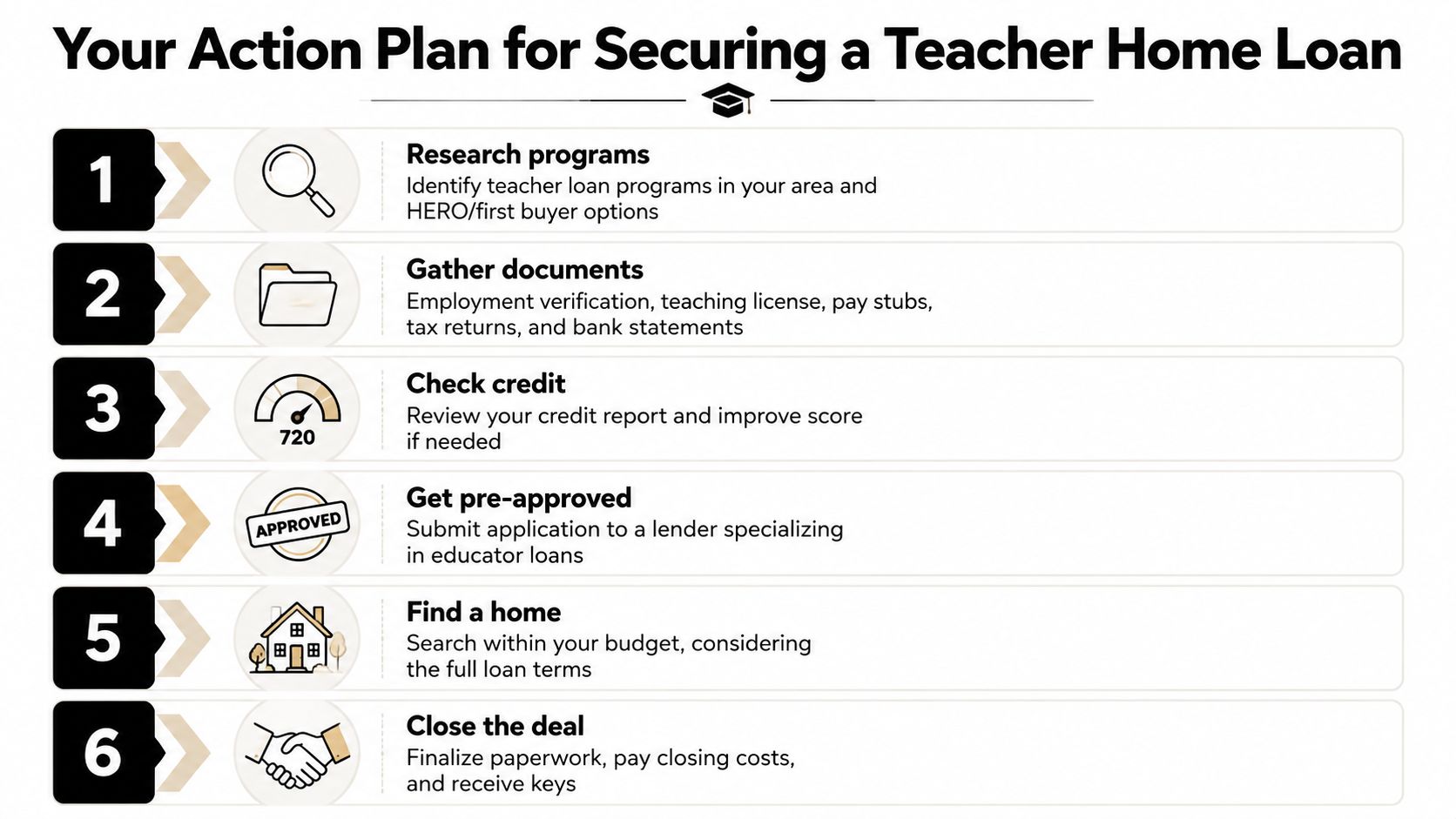
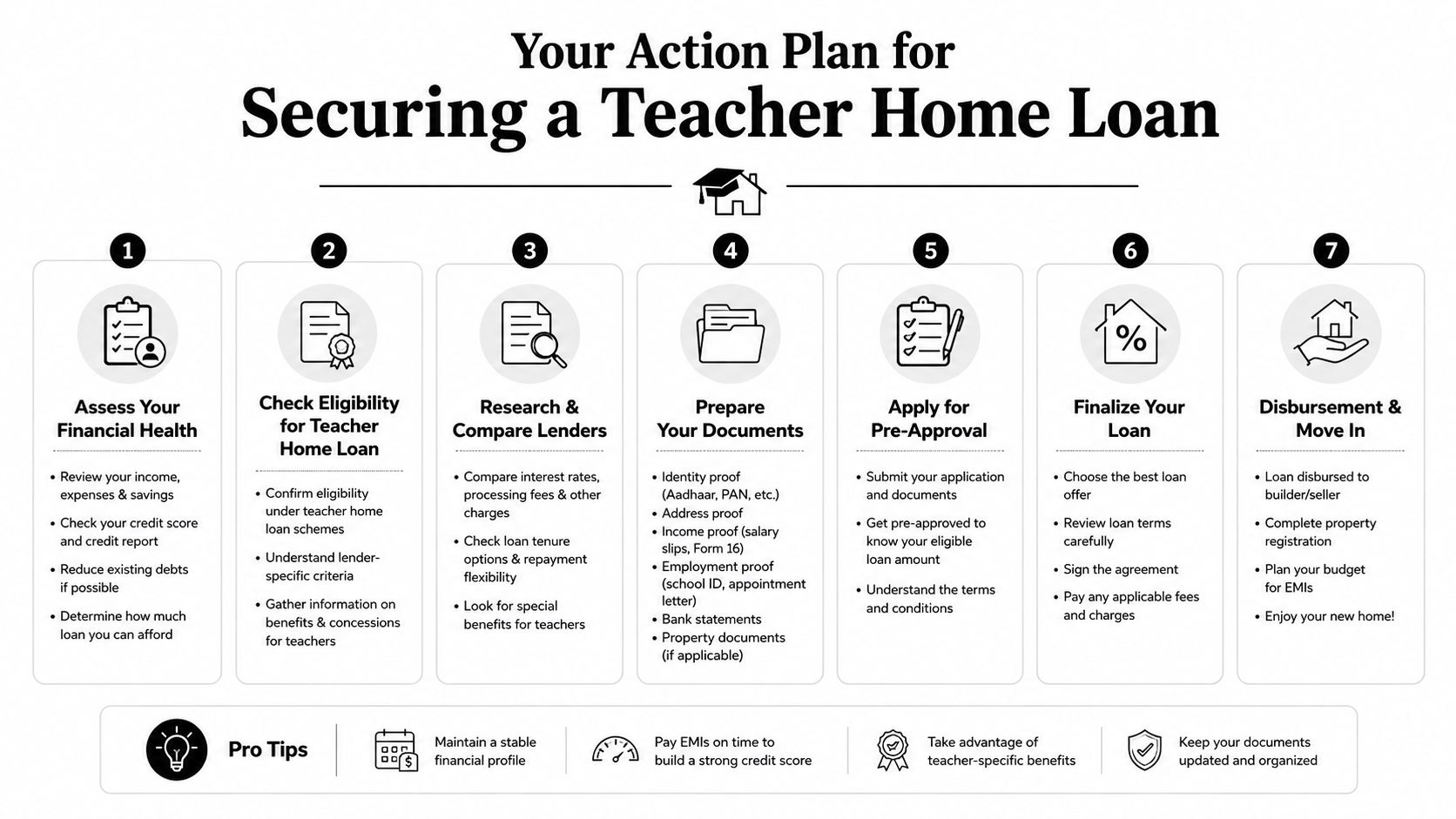
Begin with documents, not house tours. Get an employment verification letter from the school district, teaching credential information, recent pay stubs, tax returns, bank statements, and records for stipends, summer pay, advanced certifications, or National Board status. Teachers with contract-based income should ask how the lender will document continuity and average earnings.
Ask lenders these questions
- Program access: Are you an approved CalHFA originator?
- Processing scope: Which teacher, city, county, and first-buyer assistance programs do you process?
- Income treatment: How do you calculate contract income, summer pay, stipends, and certification compensation?
- Rate comparison: What is the final rate and annual percentage rate after discounts, points, and lender fees?
- Repayment risk: Is the assistance a grant, deferred loan, or forgivable second lien, and what triggers repayment?
- Timing: When must the application, education course, appraisal, and assistance approval be completed?
Don't wait until escrow to discover that a program has limited funding, a lender restriction, or an occupancy deadline. Stacking assistance sources can also extend the closing process, so your purchase contract and lender timeline must account for every approval.
The strongest application is organized before the offer is accepted.
Prioritize the work in this order: get pre-approved with a lender experienced in down payment assistance, compare the complete rate structure, verify program funds and eligibility, apply for assistance immediately after contract acceptance, and schedule homebuyer education early. Then shop within the payment you can sustain, not the maximum number a pre-approval letter displays.
California Loans for Heroes helps California teachers and other public-service professionals compare homebuyer assistance, down payment assistance options, mortgage rates, lender credits, and refinance solutions. Visit California Loans for Heroes to discuss your teacher home loan options with a team that works with California HERO borrowers and can help you evaluate the full cost of each program.