
Nearly 90% of VA borrowers used the no-down-payment benefit as of 2019, according to the Consumer Financial Protection Bureau's first-time homebuyer market snapshot. That fact changes how military households should approach a California purchase. The primary question isn't whether you can scrape together a conventional down payment. It's whether a VA loan, a conventional loan, FHA financing, or a California assistance program gives you the strongest combination of cash preservation, monthly payment, flexibility, and long-term risk.
A VA loan remains the natural starting point for an eligible first time home buyer for military households, but zero down doesn't mean zero cost. The funding fee, residual income review, appraisal requirements, property eligibility, condo approval, insurance, taxes, and local California fees all matter. A lender who talks only about the down payment isn't giving you a complete loan strategy.
Why the VA Loan Matters for First Time Military Buyers
The VA loan was created by the Servicemen's Readjustment Act of 1944 and has become a major entry point for military households buying their first home. In CFPB and Urban Institute analysis, the share of first-time homebuying servicemembers using VA mortgages rose from 30% before 2007 to 63% in 2009 and 78% in 2016, according to VA loan statistics and historical data. The shift is clear. For an eligible buyer, VA financing deserves a serious comparison before any other loan is selected.
The core advantages are straightforward: 0% down, no private mortgage insurance, and loan pricing that can be competitive with other government-backed options. Full entitlement can also support high-balance financing in California, subject to lender approval and the borrower's financial profile. The VA buyer guide explains that borrowers with full entitlement aren't constrained by county loan limits or down-payment requirements, while partial entitlement requires a calculation based on remaining entitlement and 25% of the FHFA conforming loan limit for the county. Review the VA loan-limit and entitlement rules before writing an offer on an expensive California property.
Start with eligibility, then calculate the cost
Eligibility generally begins with qualifying military service. Active-duty service members may qualify after the applicable service period, veterans qualify under length-of-service rules, certain Guard and Reserve members qualify through qualifying Title 10 service, and eligible un-remarried surviving spouses may qualify. A first-time buyer designation isn't required. The VA benefit can be used repeatedly when entitlement is restored or when sufficient remaining entitlement is available.
The funding fee is the major technical cost lever. It can often be financed into the loan, which means it may not appear as a large cash requirement at closing, but it increases the balance and affects the payment. Borrowers with qualifying service-connected disabilities may be exempt.
| Down Payment | First-Time Use | Subsequent Use | Exemption Trigger |
|---|---|---|---|
| Less than 5% | 2.15% | 3.3% | Qualifying VA exemption may remove the fee |
| 5% to less than 10% | 1.5% | 1.5% | Qualifying VA exemption may remove the fee |
| 10% or more | 1.25% | 1.25% | Qualifying VA exemption may remove the fee |
California's high home prices make this structure especially relevant. A buyer may be shopping in conforming jumbo territory, dealing with Mello-Roos taxes, HOA dues, earthquake insurance questions, or older housing stock. VA financing solves the down-payment problem. It doesn't solve property condition, condo approval, appraisal gaps, or the need to layer assistance intelligently. For a practical overview of the benefit itself, review the benefits of a VA loan.
How VA Eligibility and Residual Income Underwriting Work
A conventional approval often gets reduced to one number, the debt-to-income ratio. VA underwriting doesn't work that way. The lender still reviews income, debts, credit, assets, and payment history, but the VA also requires a residual income test. Residual income measures the money left each month after taxes, housing costs, and recurring debts. The lender compares that remaining cash against the VA's regional requirements and household size.
That distinction matters in California. A borrower with a higher DTI may still present a workable file if the household retains enough monthly income after obligations. The opposite is also true. A buyer can look acceptable on paper but fail the practical affordability test if taxes, HOA dues, childcare, transportation, or other recurring expenses leave too little cash.

The approval process has several moving parts
Start with the Certificate of Eligibility, or COE. The VA may issue it through its online portal, a lender's automated system, or the VA office in St. Louis. The COE shows the service history and entitlement position, but the lender still has to verify income, credit, occupancy, assets, and the property.
Ask the lender to explain the entitlement notation in plain English. Full entitlement generally provides the most flexibility. Partial entitlement means the lender must compare remaining entitlement with the applicable county limit calculation. That can affect the amount you can borrow without a down payment and may require a larger contribution for a higher-priced home.
Practical rule: Don't ask only, “What payment do I qualify for?” Ask, “How much residual income will remain after every housing and debt obligation?”
The lender's underwriting system and the VA's requirements aren't the whole story. Lenders can impose overlays, and many still look closely at DTI, employment stability, reserves, credit patterns, and compensating factors. A stable job, strong residual income cushion, and liquid reserves can strengthen a file, but they don't excuse undisclosed debt or unexplained deposits.
For help documenting military service before you apply, use this guide to verify veteran status. Do it early. Entitlement problems, prior VA loans, divorce-related obligations, and missing service records are easier to address before you find a property than after your offer is accepted.
VA Versus Conventional Versus FHA at California Prices
At California prices, the comparison isn't just “zero down versus three percent down.” The right analysis includes the upfront fee, recurring mortgage insurance, property taxes, HOA dues, insurance, cash reserves, and the effect of keeping money available after closing. VA financing is often the strongest structure for an eligible first time home buyer for military households, but it isn't automatically the cheapest in every situation.
Consider a $700,000 Riverside County purchase and a $1,050,000 San Diego County purchase. A VA structure can use 0% down, with the applicable funding fee financed when permitted. Conventional financing may use a down payment ranging from 5% to 20%, with PMI generally applying below 20% down. FHA financing can use 3.5% down, but it includes a 1.75% upfront mortgage insurance premium and ongoing MIP for most borrowers.
The exact monthly payment can't be stated responsibly without an actual interest rate, term, taxes, insurance, HOA dues, and insurance assumptions. A lender who gives you a precise payment without showing those inputs is selling a headline, not a comparison.
| Loan Type | Down Payment | Upfront Fee | Monthly Payment, Riverside | Monthly Payment, San Diego |
|---|---|---|---|---|
| VA | 0% possible for eligible borrowers | Funding fee may apply and may be financed | Depends on rate, taxes, insurance, HOA, and financed fee | Depends on rate, taxes, insurance, HOA, and financed fee |
| Conventional | Often 5% to 20% in this comparison | No VA funding fee, PMI may apply below 20% down | Depends on rate, PMI, taxes, insurance, and HOA | Depends on rate, PMI, taxes, insurance, and HOA |
| FHA | 3.5% possible | 1.75% upfront MIP plus ongoing MIP for most buyers | Depends on rate, MIP, taxes, insurance, and HOA | Depends on rate, MIP, taxes, insurance, and HOA |
Choose the structure that fits the file
FHA can make sense for buyers with weaker credit profiles or substantial gift-fund support. Conventional financing can be attractive when the borrower has enough cash, wants to avoid a VA funding fee, and expects to cancel PMI after reaching the applicable equity position. VA financing stands out when preserving cash matters, when the borrower wants to avoid PMI, or when California's purchase price makes a traditional down payment burdensome.
Don't ignore California overlays. A condo may need VA approval. A property may carry Mello-Roos taxes, an HOA with restrictive rules, or an earthquake insurance issue. An ADU or unpermitted addition can create appraisal and underwriting complications under any loan type. Compare the full property and loan file, not just the advertised rate.
California Assistance Programs Stacked on a VA Loan
California assistance requires careful coordination. Some programs are designed for specific loan types, income limits, occupations, property types, or geographic areas. A military buyer should never assume that a program advertised to first-time buyers automatically works with a VA loan.
CalHFA offers programs that may include VA rate-advantage options, while the MyHome Assistance Program can provide down-payment assistance for eligible buyers under its current rules. The School Facility Fee Assistance Program addresses qualifying new-construction purchases. These programs can change, and availability depends on the approved lender, household income, purchase price, and property location.
Build the assistance stack in the right order
First, confirm the base mortgage. Ask whether the assistance program permits a VA first mortgage and whether the subordinate financing changes the cash-to-close calculation. A second lien may reduce the buyer's required cash, but it can also add repayment terms, affect the combined loan structure, and require additional underwriting.
Second, ask about programs that sound relevant but may not fit your transaction. CalVet home loans operate alongside federal VA benefits in some situations, but they aren't interchangeable with a VA-backed mortgage. The Income Property Loan Pilot may matter only when the property and occupancy meet its rules. The Extra Credit Teacher Home Purchase Program is occupation-specific, so it intersects with a military buyer only when that buyer also satisfies the teacher eligibility requirements.
Third, investigate local resources. Cities and counties, including San Diego, Sacramento, and Riverside, may operate silent-second loans, grants, or other assistance programs. Funding pools and eligibility rules differ. Check both the California Housing Finance Agency and the relevant county or city housing authority before signing a contract.
A key question is how the subordinate loan affects the VA funding fee. The funding fee is tied to the VA loan's use and down-payment structure, not to whether another program helps with cash. Have the lender calculate the fee using the actual final structure rather than an informal estimate.
For a focused starting point, review VA home loan down payment assistance, then confirm each program directly with an approved lender or housing agency. Assistance can be valuable, but a deferred or forgivable second lien still has terms you need to understand.
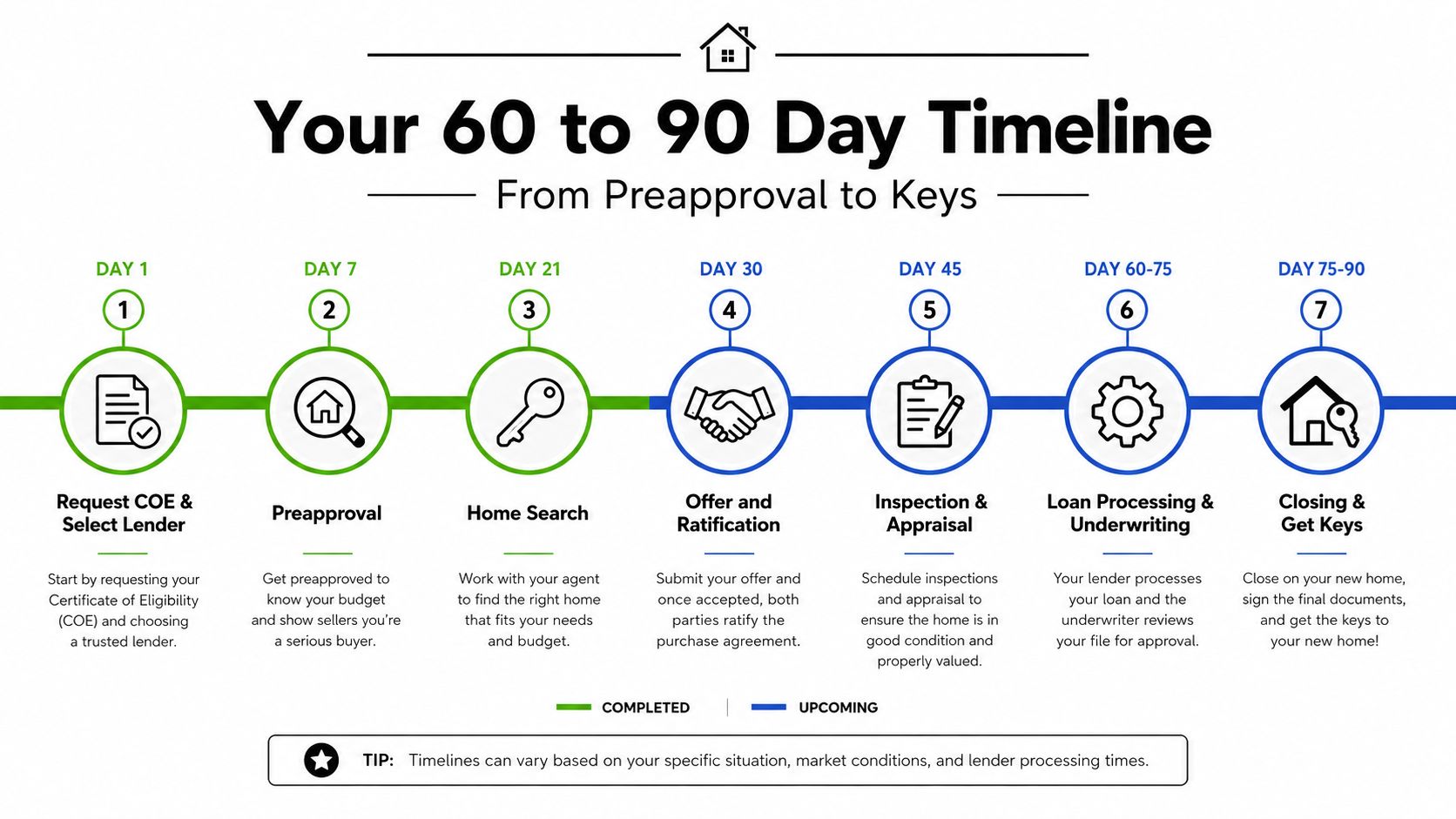
Your 60 to 90 Day Timeline From Preapproval to Keys
A California VA purchase commonly requires coordination among the lender, buyer, agent, escrow holder, appraiser, VA systems, title company, and seller. A realistic transaction may take 60 to 90 days, especially when the property needs condo review, repairs, additional documentation, or assistance-program approval.

Organize documents before the offer
At the beginning, request the COE and select a lender. Gather your government-issued identification, DD-214 if applicable, current orders, recent pay statements, prior two years of W-2 forms, federal tax returns when requested, bank statements, investment statements, debt information, and documentation for any VA disability income. If you're active duty, include your leave and earnings statement and verify how projected relocation affects occupancy.
After preapproval, the lender reviews the property and the purchase contract. Once the offer is ratified, order the inspection immediately. The lender orders the VA appraisal through the VA process, and the appraiser evaluates value and minimum property requirements. Condos not already approved by the VA can create a separate approval track and extend the schedule substantially.
California escrow often runs longer than buyers expect. During processing and underwriting, respond to conditions with complete documents, not partial screenshots. Typical requests may include explanations for deposits, updated bank statements, employment verification, divorce decrees, bankruptcy papers, child-support records, or proof that a disputed account has been resolved.
Track the closing documents precisely
After conditional approval, the lender clears remaining conditions and prepares the Closing Disclosure. Federal timing rules require the borrower to receive the CD before closing, and the buyer should review the three-business-day period carefully. The right of rescission associated with some refinance transactions doesn't apply to a standard purchase.
Keep your wire instructions in one verified channel. Call the escrow company using a trusted phone number before sending funds. Don't rely on an email that changes wiring details.
At funding, escrow confirms signed documents, lender funds the loan, and the deed records. Keep your homeowner's insurance binder, final inspection notes, cashier's check or verified wire confirmation, and any assistance-program documents organized until the transaction is complete.
The First Time Buyer Myth and Repeat Use Strategy
A VA loan isn't a first-home-only product. The program is available to eligible borrowers whether they're buying a first residence, replacing a prior home, or using remaining entitlement for another qualifying purchase. The VA's 2025 loan guaranty report shows that 130,238 VA loans went to first-time buyers, while first-time buyers represented 8% of first-time buyers' loan usage compared with 13% for repeat buyers, according to the VA 2025 loan guaranty report. The larger point is that most VA purchase activity came from non-first-time buyers.
Understand entitlement before planning the next move
The basic entitlement figure is $36,000, with bonus entitlement calculations that can support larger loans under applicable county rules. A borrower who sells a VA-financed home may request restoration of entitlement. A borrower who keeps the first property may still use remaining entitlement for another purchase, but the lender must calculate the available guaranty and required down payment.
| Scenario | Prior VA Loan Status | Available Entitlement | Funding Fee Tier | Estimated VA-Backed Amount |
|---|---|---|---|---|
| First purchase with full entitlement | No prior entitlement used | Full entitlement | First-use tier, based on down payment | Determined by income, credit, property, and entitlement |
| Prior loan sold and entitlement restored | Prior VA loan paid off | Restored entitlement | First-use treatment may apply when rules permit | Determined by restored entitlement and underwriting |
| Existing VA loan retained | Entitlement remains tied to prior loan | Partial entitlement | Subsequent-use tier | Determined by remaining entitlement and county calculation |
| Qualifying disability exemption | Prior use doesn't control fee exemption | Based on entitlement record | Funding fee may be waived | Determined by entitlement and underwriting |
The funding fee can rise from the first-use rate to the subsequent-use rate when the borrower has prior use and doesn't qualify for an exemption. A qualifying service-connected disability can remove the fee entirely. Don't assume the lender's first worksheet has the correct tier. Review the COE and the final entitlement calculation.
Keep, sell, or rent requires California analysis
If you keep the first property as a rental, evaluate actual rent, vacancy risk, repairs, property management, taxes, insurance, HOA rules, and the loan's occupancy history. California tenant protections, including rules associated with AB 1482, can affect the decision. Compare the property's expected net operating income with its value and financing costs, rather than relying on gross rent alone.
Sell when restoring entitlement and reducing debt improves the next purchase. Keep when the property has durable cash flow and the remaining entitlement supports the next home without excessive financing. Rent only after reviewing the legal and financial consequences with qualified professionals.
Common Pitfalls That Delay or Derail VA Closings
Most failed or delayed California VA transactions don't collapse because the borrower can't use the benefit. They stall because someone ignored the property, the condo documents, the appraisal, or the entitlement paperwork.
Property approval comes before emotional commitment
A desirable condo in San Diego, San Francisco, or Los Angeles may not be on the VA-approved list. The lender may need a project review or a permitted one-unit approval before proceeding. If the building isn't eligible, the buyer may face a long delay or need to change loan types.
Properties with ADUs, converted garages, additions, or questionable permits deserve early review. VA appraisers identify condition and documentation issues, and the lender can't override a material problem because the buyer loves the house. Ask the listing agent for permits, plans, HOA information, insurance details, and recent repair records before submitting an offer.
Protect the contract and the entitlement record
- Condo approval: Confirm the project's VA status before removing contingencies. If approval is required, build realistic time into the contract.
- Appraisal timing: Coastal markets can have limited comparable sales, especially for unusual homes. Price support must come from credible evidence, not optimism.
- Unpermitted work: Ask for permits and disclose additions. Missing documentation can affect value, safety, and lender approval.
- Entitlement restoration: If you're selling a prior VA-financed property, begin restoration paperwork early. Waiting until underwriting can threaten the purchase timeline.
- Seller concessions: Have the lender review every credit. Some charges may not be allowable under VA rules, even when the seller is willing to pay.
- Repair escrow: Don't let the contract improperly shift repair obligations to the veteran. The lender must approve the structure.
- Termite and condition items: Don't casually waive required inspections or clearances. A cheap shortcut can become a financing problem or a costly post-closing repair.
Ask for a property screen before you spend money on inspections. The address, property type, HOA status, and known additions can reveal problems before they become contract disputes.
An assumption clause creates another trap. If you inherit or acquire a property tied to a non-VA assumption, the paperwork may not restore or release entitlement the way you expect. Have the lender and title company review the prior loan, vesting, payoff, and release documents before you plan a subsequent purchase.
Next Steps and California Resources Worth Calling
Start with the facts that control the transaction. Confirm your COE through the VA portal or an approved lender, then review whether you have full or partial entitlement. Pull all three credit reports and resolve dispute items before underwriting. A lender can explain qualification, but you should know what appears in your file before the lender has to explain it under deadline pressure.
Next, seek preapproval from two California lenders with real VA experience. Compare the funding fee calculation, lender fees, credits, appraisal process, condo review, and underwriting model. Don't compare rate alone. One lender may quote a lower rate but charge more in points or take longer to clear conditions.
Use California resources strategically
Ask each lender to review your eligibility for CalHFA programs, including any VA-compatible rate-advantage option, and ask whether MyHome or another subordinate-assistance program fits your file. If your purchase exceeds the amount supported by your VA entitlement calculation, ask about the CalVet Home Loan program and conventional financing as alternatives. CalVet and federal VA benefits aren't identical, so compare their costs, underwriting, and property requirements directly.
Call the county housing authority where you intend to buy. San Diego, Sacramento, Riverside, and other jurisdictions may have separate silent-second or grant programs. Also review the California Housing Finance Agency's current program information and rate sheets. Funding, income limits, approved lenders, and property rules can change.
Before locking, ask every lender these three questions:
- How many VA loans did you close in the last 12 months?
- Do you underwrite VA loans in-house?
- What is your average time to close for a California VA purchase?
The answers tell you more about execution than a headline rate. You need a lender who can calculate entitlement correctly, explain residual income, identify condo and property risks, and coordinate escrow without leaving you to manage the file alone.
California Loans for Heroes offers military borrowers access to a CalHERO home loan path, assistance options, competitive mortgage rates, refinance solutions, lender credits, and one-on-one guidance. Visit California Loans for Heroes to discuss your COE, funding fee, entitlement position, and California purchase strategy with a team serving military households.