
You're in a tense moment most California buyers know too well. The offer looks strong, the seller wants speed, and your agent is asking whether you're ready to remove the inspection contingency before the clock runs out. For public service heroes working with tight schedules and real financial stakes, that decision can feel like a test of nerve, not just paperwork.
The right answer usually isn't a simple yes or no. In California, inspection contingency removal is one of the clearest places where speed, influence, and risk collide. If you handle it well, you can stay competitive without walking blind into a bad house. If you handle it poorly, you can lock yourself into a property with expensive problems and little room to negotiate.
Understanding the Inspection Contingency in California
A buyer who has already lost a house in a multiple-offer situation knows the pressure. The seller says they want a cleaner offer. The agent says the market is hot. Your lender says the file is moving, but the property still hasn't been fully checked. That's the exact moment the inspection contingency becomes the most important protection in the deal.
An inspection contingency is the contract term that gives the buyer time to inspect the home and decide whether to proceed, renegotiate, or cancel. A widely used market guide says that window is often 7 to 10 days from seller acceptance, though the exact terms can vary by contract (TurboHome's inspection contingency glossary). In plain terms, it's the period that lets you find out whether the house is really worth what you're agreeing to pay.
For California buyers, the contingency matters because it protects the buyer from having to commit before the condition of the property is reasonably understood. That's why it shows up in so many negotiations. It's also why sellers often push back on it in competitive markets. A seller sees a shorter path to closing, while a buyer sees the chance to avoid a costly mistake.
Practical rule: If you wouldn't buy the house without knowing what the inspector might find, don't remove the contingency before you've done the work.
That's especially true for the buyers we serve in California who use FHA or VA financing, because the loan file and the property condition can become intertwined later in the process. A clean offer can help you win, but a clean offer without due diligence can create a bigger problem than losing a bidding war.
A useful starting point is to think of the inspection contingency as a decision window, not a formality. It gives you room to check the roof, structure, drainage, electrical, plumbing, and anything else that could change your view of the deal. If you're mapping out the offer strategy alongside your deposit planning, it can also help to review the basics of your good-faith deposit options before you get too far down the path.
Evaluating the High-Stakes Risks of Removal
The biggest mistake buyers make is assuming the only risk is finding a bad house. A more significant risk shows up when the inspection contingency is removed, then a serious defect appears before closing. At that point, you may no longer have the same negotiating power, and in many cases the buyer is carrying the risk once the contingency is gone (California Lawyers Association on contingencies).
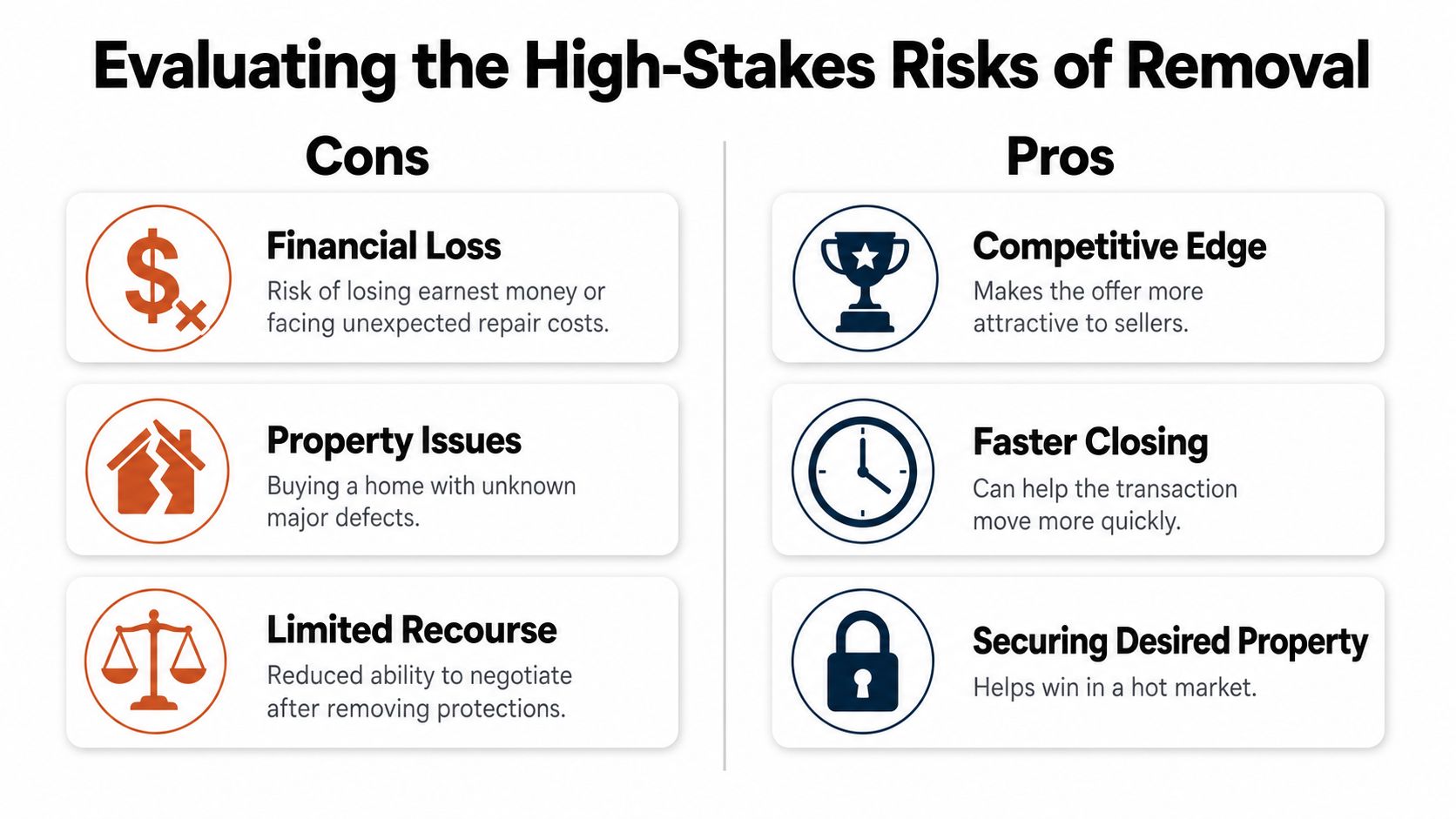
What can go wrong after removal
A cracked foundation found after removal is not just an inconvenience. A failing roof discovered a week before closing can become a direct cost issue, and a major plumbing problem can turn a manageable purchase into a hard financial choice. The buyer may still be able to ask for help, but the bargaining position is much weaker once the contingency has been formally removed.
The key issue is timing. California-style transactions don't treat removal as an informal suggestion. The buyer has to act in writing, and once that happens the contract posture changes. That's why post-removal discoveries are such a frequent concern. The legal and financial consequences are real, but many consumer guides stop talking once the form is signed (California Lawyers Association on contingencies).
A buyer also needs to think about the type of property. A newer home usually has a different risk profile than an older or historic one. New construction can still have defects, but historic homes often carry more unknowns, more deferred maintenance, and more system age. If you're trying to decide whether the risk matches the reward, the home's age and maintenance history matter more than the listing photos.
A seller may still talk after a bad inspection post-removal, but the buyer's leverage usually isn't what it was during the contingency period.
The risk framework that actually helps
Use three questions:
- How serious is the defect? Safety and structural issues deserve more caution than cosmetic ones.
- How much cash buffer do you have? If the answer is thin, a removal decision should be tighter.
- How replaceable is the home? In a hot market, some buyers stretch farther. That doesn't erase the risk, it just changes the trade-off.
For Hero buyers, emotion can easily distort judgment. You may feel pressure to “do what it takes” to win, but the right answer is tied to your finances and your tolerance for surprise repairs, not the seller's timeline.
Navigating California's Forms and Timelines
The paperwork matters as much as the inspection itself. In California, the buyer must deliver a written contingency-removal form by the deadline. Contingency removal is not automatic when the date passes, and that's where a lot of avoidable mistakes happen (Mashvisor contingency removal guide).
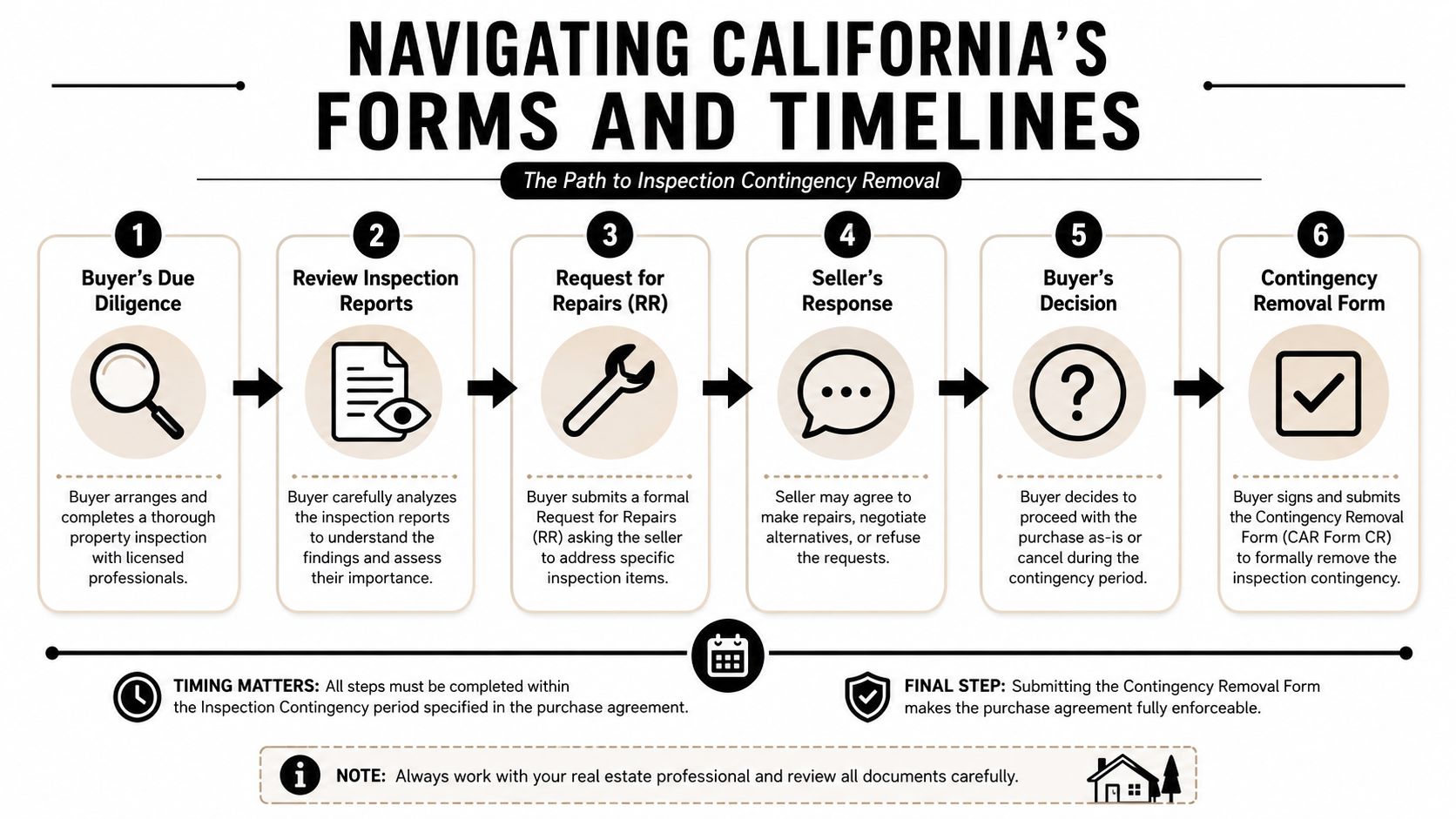
The California process in plain English
The usual sequence starts with the inspection, then moves to review, repair requests, and a written decision. Buyers often use the California Association of Realtors CR form, the Contingency Removal form, to document that decision. If the buyer misses the deadline, the seller can issue a Notice to Perform, which is the formal push to act (Mashvisor contingency removal guide).
That notice matters because it changes the pace. Standard guidance describes a 48-hour cure window after a Notice to Perform. If the buyer still doesn't act, the seller can move toward cancellation. The point isn't that the inspection itself disappears. The operational risk is the timing of the signed form and whether the right box gets checked at the right time (Mashvisor contingency removal guide).
The best practice is simple: keep your dates organized from day one and treat every form like it controls the deal, because it does. A missed signature can keep contingencies alive when you thought they were gone, and that can delay closing or create an avoidable dispute.
What buyers should confirm before signing
- Inspection deadline: Make sure the inspection period lines up with your actual schedule.
- Form delivery: Don't assume verbal agreement is enough.
- Repair language: If repairs were negotiated, confirm the wording before removing anything.
- Deadline reminders: Build reminders around the deadline, not the day after.
You don't want to discover that the contingency is still open because a form sat in someone's inbox. That kind of paperwork mistake is more common than most buyers expect, and it can be more damaging than the inspection report itself.
Strategic Alternatives to a Full Contingency Removal
A full waiver isn't the only way to make a strong offer. In many hot-market negotiations, the more efficient move is to do a pre-inspection before you submit the offer, then write the contract with the inspection language narrowed to informational purposes only or a tightly capped repair threshold (Reddit discussion on inspection contingency strategy). That keeps the offer cleaner without pretending the property is risk-free.
The logic is straightforward. If you've already inspected the home, you can shorten the contingency period or limit what you'll ask for later. That can strengthen your bid while preserving some risk control. It's a common tactic because sellers like certainty, and buyers still get a chance to see what they're buying before the final commitment.
Best use case: If you're competing hard, a pre-inspection can help you stay aggressive without completely giving up your ability to walk away.
Practical alternatives that keep you in the game
You can use a few different approaches depending on the property and your risk tolerance:
- Informational-only language: This signals that you've done your homework and are not using the inspection to reopen everything.
- Tight repair cap: This keeps requests focused on major items or a per-item limit rather than a full price reset.
- Shortened window: This can make the offer more appealing while still preserving some due diligence time.
- Targeted ask list: Focus on safety, structural, or major mechanical items instead of every cosmetic issue.
For Hero buyers, this strategy can be the middle ground between caution and competitiveness. It's also where a home warranty conversation becomes relevant, because buyers sometimes want a backstop for the first year after closing. If that's part of your plan, review the idea of home warranty coverage before you decide how much risk you're keeping versus pushing back on the seller.
The important thing is not to confuse a strategic compromise with a blind waiver. A short contingency is still a contingency. An informational-only clause is still a written choice. Both can be smart if they match the home and your budget.
How Removal Impacts VA FHA and Conventional Loans
For Hero clients, the loan type changes how risky removal feels. VA, FHA, and conventional loans don't treat property condition the same way, and that matters when an issue appears after the inspection contingency is gone. A lender may still fund a file cleanly, but major defects discovered before closing can trigger new scrutiny, especially with government-backed financing.
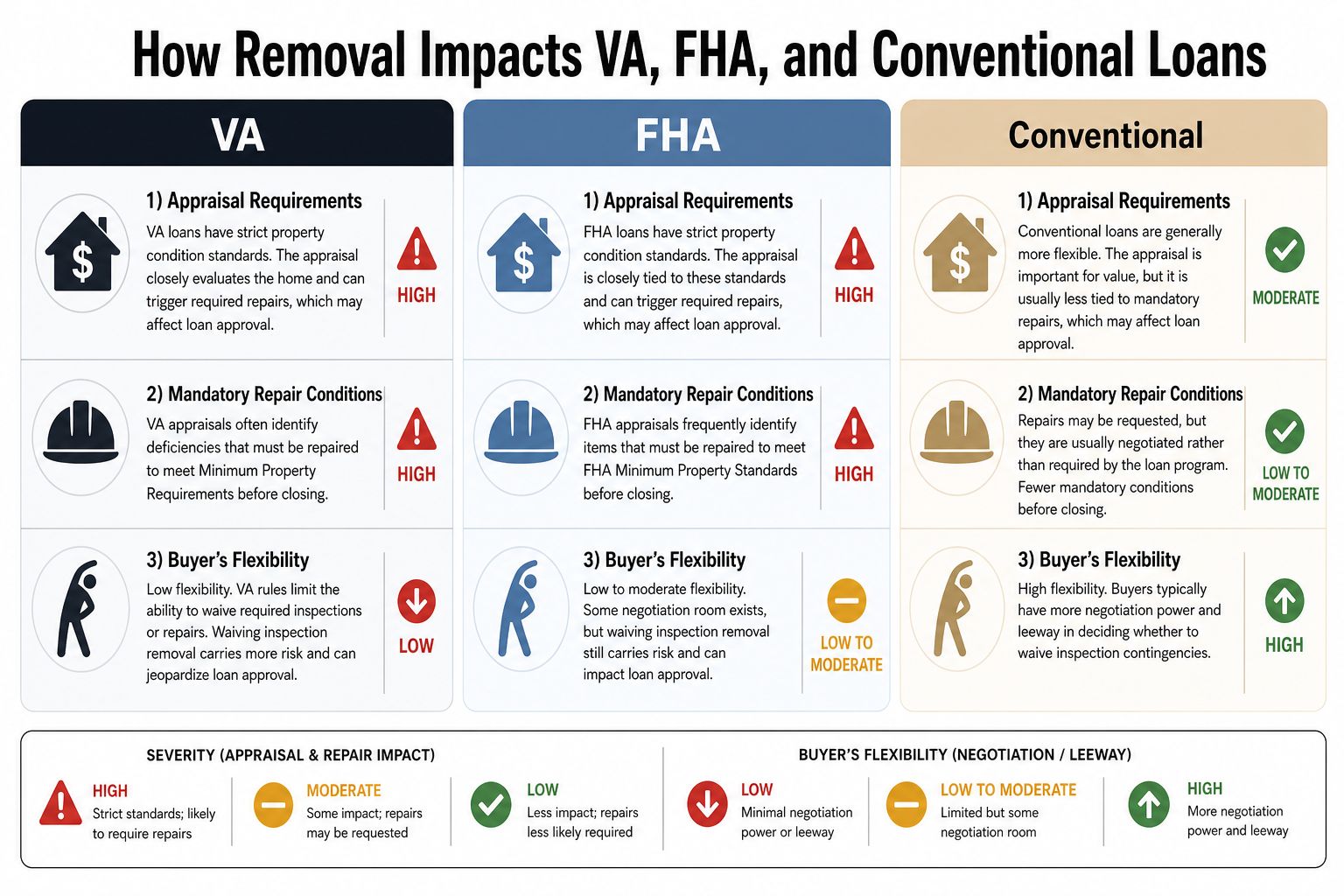
VA and FHA need extra care
A VA appraisal includes Minimum Property Requirements, but that isn't the same thing as a full inspection. The appraisal is tied to loan eligibility and property condition, while the inspection is your chance to dig deeper into the home's systems and structure. That distinction matters because a property can look acceptable for financing purposes and still hide problems a buyer should know about.
The same caution applies to FHA. If a serious defect comes up after removal, the lender may care because the property still has to support the loan decision. That's one reason it's dangerous to assume the appraisal replaces your own due diligence. It doesn't.
If you're using a VA loan, ensure the inspection contingency and the appraisal conversation remain distinct in your thinking. You can review more about the VA home loan home inspection connection and keep in mind that the financing review and the home-condition review are not identical.
Conventional loans are usually more flexible, but not risk-free
Conventional loans often give borrowers more flexibility on property condition because the loan rules can be less rigid than FHA or VA in practice. That doesn't mean the buyer should get casual. It means the lender may be less likely to flag the same kind of issue as a hard stop, while the buyer still has to live with the repair cost.
Borrower caution: A smoother underwriting path doesn't make a bad roof cheaper.
This shows the comparison across the three loan types. VA and FHA buyers need to be more alert to property-condition issues that could affect funding or closing. Conventional buyers may have more room to move, but they still own the risk once the contingency is removed. For all three, the smart move is to coordinate the inspection report, lender timeline, and repair strategy before you give up your last easy exit.
A Hero's Checklist for Contingency Removal
The safest decision usually comes from slowing down just enough to ask the right questions. Public service professionals often buy in demanding markets, but pressure doesn't change the basic rule. Once the contingency is removed, the burden shifts, and the home becomes much harder to renegotiate.
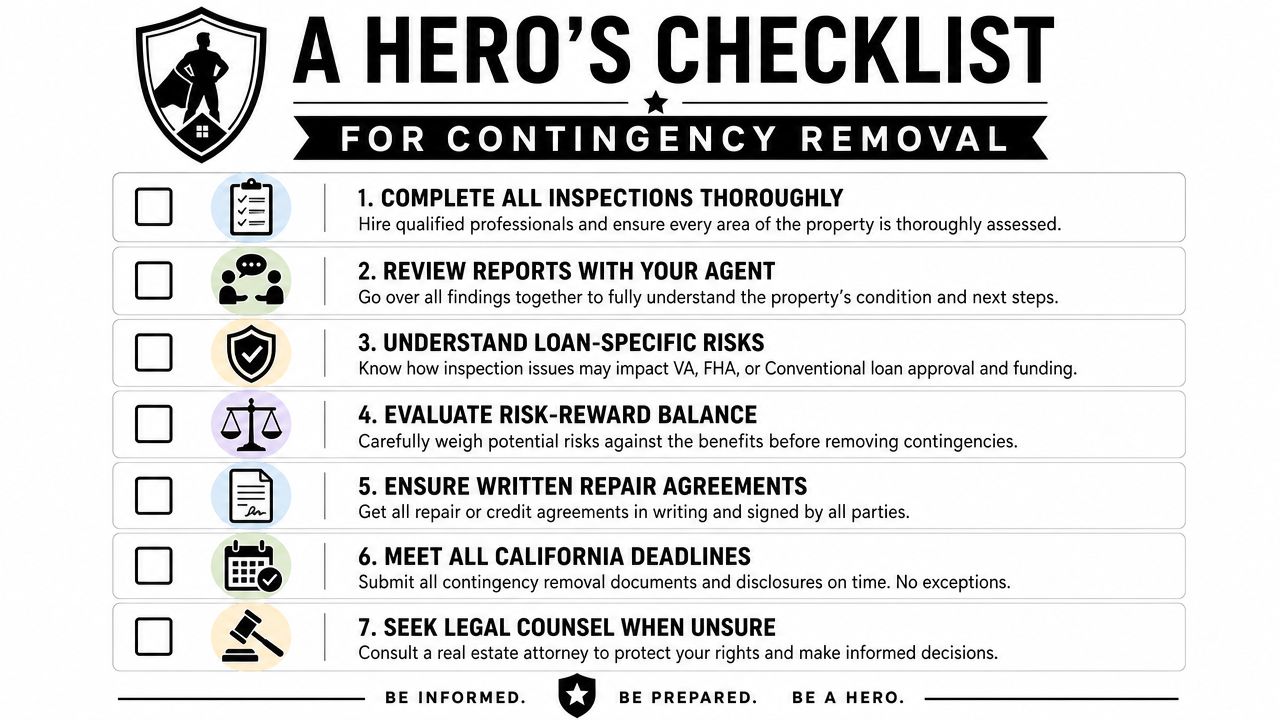
Use this checklist before you sign
- Complete all inspections thoroughly: Don't stop at the basic walk-through if the home needs deeper review.
- Review reports with your agent: Make sure every major concern is understood before the deadline.
- Understand loan-specific risks: VA, FHA, and conventional financing don't carry the same property-condition exposure.
- Evaluate risk-reward balance: A winning offer that breaks your budget isn't a win.
- Ensure written repair agreements: If repairs matter, get them in writing before removal.
- Meet all California deadlines: The form, the timing, and the delivery all matter.
- Seek legal counsel when unsure: If the issue is big enough to create doubt, get real legal advice before you act.
The best buyers don't remove contingencies because they're rushed. They remove them because the facts are clear enough to support the choice. That difference can save you from a costly surprise later.
For California Hero buyers, the right path is the one that protects your household, your loan, and your long-term stability. If you're deciding whether to remove an inspection contingency on a home in California, reach out to California Loans for Heroes for clear guidance that fits your loan type, your timeline, and your budget.