
You're probably staring at your mortgage statement, your credit score app, and the cost of everything else in California, wondering if refinancing is smart or just another hassle.
If you're a veteran, teacher, nurse, firefighter, law enforcement officer, or other public service professional, that question hits differently. You already carry enough responsibility. You don't need vague mortgage advice. You need a straight answer about your refinance mortgage credit score, what lenders want, and what to do next if your score isn't where you want it to be.
A lot of HERO homeowners get stuck in the same spot. They've paid on time, built equity, and want a better monthly payment or a cleaner loan structure. Then they hear mixed messages. One lender says 620. Another talks about FHA flexibility. A veteran hears the VA has no official minimum score, then gets declined because the lender uses its own standard. That confusion costs people time and money.
This guide is built for California homeowners who serve their communities and want clarity. No fluff. Just the credit score rules that matter, the California details that affect approval, and the moves that improve your position before you apply.
Is It the Right Time to Refinance in California
A California HERO homeowner usually starts here. The payment feels high. Credit card balances may have crept up during a tough stretch. Maybe you want to stop guessing about your budget every month, or you want to pull cash out for repairs, debt consolidation, or family needs. Then the doubts show up fast. Is your score high enough? Will refinancing hurt your credit? Will the savings be worth the closing costs?
Those are the right questions.
The real issue isn't just rates
Solely focusing on rate is an error. In California, the stronger question is whether your refinance mortgage credit score, your equity position, and your monthly debt picture line up well enough to make refinancing useful.
If they do, refinancing can clean up a messy financial picture. If they don't, applying too early can waste a credit pull and put you in a weaker negotiating position.
Practical rule: Don't refinance because you're anxious. Refinance because the numbers and your credit profile support a better outcome.
A veteran in San Diego might be trying to lower a payment and expects the VA label to make approval easy. A teacher in Sacramento may have decent income but worries a mid-range score won't qualify. A firefighter in Riverside might have enough equity for a cash-out refinance but isn't sure how lenders will view other monthly debts. These are common California situations, not edge cases.
What you should look at first
Before you talk to a lender, get clear on four things:
- Your current score range. You don't need perfection, but you do need to know whether you're near common lender cutoffs.
- Your loan goal. A rate-and-term refinance is different from a cash-out refinance.
- Your equity. Equity affects which options stay open.
- Your monthly debt load. Car loans, credit cards, student loans, and other recurring obligations matter.
If you're comparing options, use a practical rate-shopping process instead of guessing. This guide on how to compare mortgage rates in California is a smart place to tighten up your approach.
The right time to refinance isn't when social media says rates moved. It's when your credit, equity, and loan purpose line up well enough to produce a better loan than the one you have now.
Why Your Credit Score Is the Key to Your Refinance
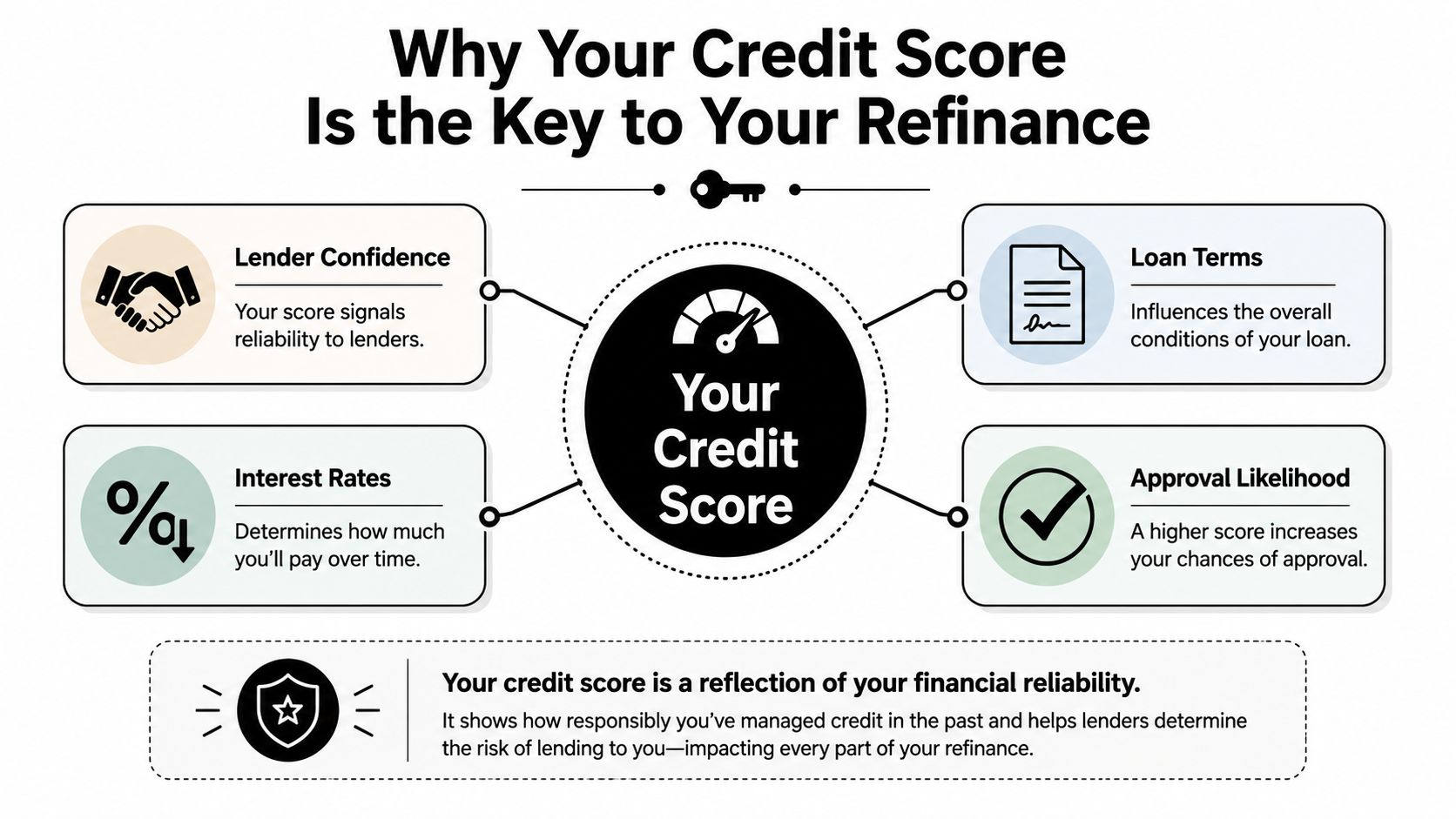
A paramedic in Fresno can have solid income, years on the job, and plenty of home equity, then still get quoted a worse refinance because of a mid-range credit score. That is how lenders make decisions. For California HEROES, your score often decides whether you get the best option on the table or a more expensive version of it.
Your credit score sets the tone for the entire refinance file. It affects approval, interest rate, lender fees, reserve requirements, and how much room a lender gives you when another part of the file is imperfect. That last point matters in California, where veterans, teachers, first responders, and healthcare workers often run into lender overlays that go beyond the basic program rules.
What your score actually changes
Lenders use your score as a fast risk filter. A stronger score usually leads to better pricing and more choices. A weaker score can shrink your options even if your income is steady and your payment history looks decent.
That is especially true if you are comparing conventional, FHA, and VA refinance paths. A veteran may hear that the VA does not set an official minimum score, then find out the lender does. A teacher or other public employee may qualify on paper and still get pushed into a pricier loan because the lender's internal rules are tighter than the program itself. If you work for the state, county, city, or a school district, review these California government employee home loan options with that issue in mind.
A refinance can cause a short-term credit dip
Do not let that scare you off if the loan saves real money.
According to VantageScore's explanation of how credit plays into mortgage refinancing, a refinance can lower your score for a short period because the lender pulls your credit, a new loan account opens, and a cash-out refinance may increase your debt. The same source explains that the drop is often temporary and that refinancing does not automatically hurt your credit. It also notes that closing costs matter, because a refinance that strains your cash position can create problems even if the new rate looks better on paper.
Here is the practical advice:
- Expect a temporary dip from the credit pull and new account.
- Treat cash-out carefully, because more debt changes the file.
- Judge the refinance by total savings after costs, not by rate alone.
Rate-and-term and cash-out are not viewed the same way
A rate-and-term refinance is usually the cleaner file. You replace the existing mortgage without adding new debt against the house. That tends to be easier for both underwriting and long-term budgeting.
Cash-out deserves more scrutiny. It can still be the right move, especially if you are paying off expensive debt or funding a necessary repair, but the lender is evaluating more than your rate request. They are looking at how much debt you are adding, how much equity remains, and whether the new payment still makes sense for your monthly budget.
Your credit score is the first filter. In California, it also affects how much trouble lender overlays can cause. If you want a strong refinance outcome, protect your score before you apply and shop with lenders who know how to work with HERO borrowers instead of forcing them into generic rules.
Credit Score Minimums for Your Refinance Loan
You served, taught, protected, or cared for your community. You should know the specific credit target before you hand over pay stubs, tax returns, and bank statements.
For many California refinance borrowers, 620 is the working cutoff. That is the score where more doors usually open. Below that, options narrow fast, and lender overlays become a bigger problem.
Minimum credit score to refinance by loan type 2026
| Loan Type | Typical Minimum Score | Notes for California HEROES |
|---|---|---|
| Conventional refinance | 620 | A common floor for many lenders on standard refinance files |
| FHA refinance | 500–580 | Lower scores can work, but equity and loan-to-value drive the decision |
| VA refinance | 620 or higher with many lenders | The VA does not set a formal minimum, but lender overlays often control approval |
| Jumbo refinance | 680–700 | Higher balances in expensive California markets usually mean stricter credit rules |
LendingTree's refinance credit score guide lists these common ranges and explains an important detail for FHA refinances. Lower score approvals depend heavily on equity and loan-to-value, not just the score itself.
That matters in California, where home values, loan sizes, and county-level pricing can push you into tighter underwriting even if your file looks solid on the surface.
Veterans need to watch for lender overlays
Here is the rule that frustrates a lot of VA borrowers. The Department of Veterans Affairs does not set an official minimum credit score for VA loans. Individual lenders set their own standards.
That is the overlay problem.
One lender may want 620. Another may review the same veteran more fairly because the rest of the file is strong. If you are a California veteran with steady income, clean recent housing history, and manageable debt, do not let one lender's overlay convince you that you cannot refinance.
Shop VA lenders that know HERO files. Generic mortgage call centers often force veterans into rules that are stricter than they need to be.
FHA can be the right backup plan
FHA works best when your score is lower but your equity position still gives the lender room to approve the loan.
LendingTree notes that FHA cash-out refinances may allow scores as low as 500 when the borrower has 10% equity and stays at 90% loan-to-value or below. A 580 score may work with less equity if the loan remains within FHA loan-to-value limits. That is a real option for some California HEROES, especially borrowers who have built equity over time but do not meet conventional pricing standards.
Your score is not the only filter. Your equity can change the answer.
If you work for a school district, city, county, state agency, or another public employer, review these government employee home loan options in California before you apply. It will help you choose the right refinance lane instead of wasting time on the wrong one.
How a Higher Credit Score Saves You Thousands
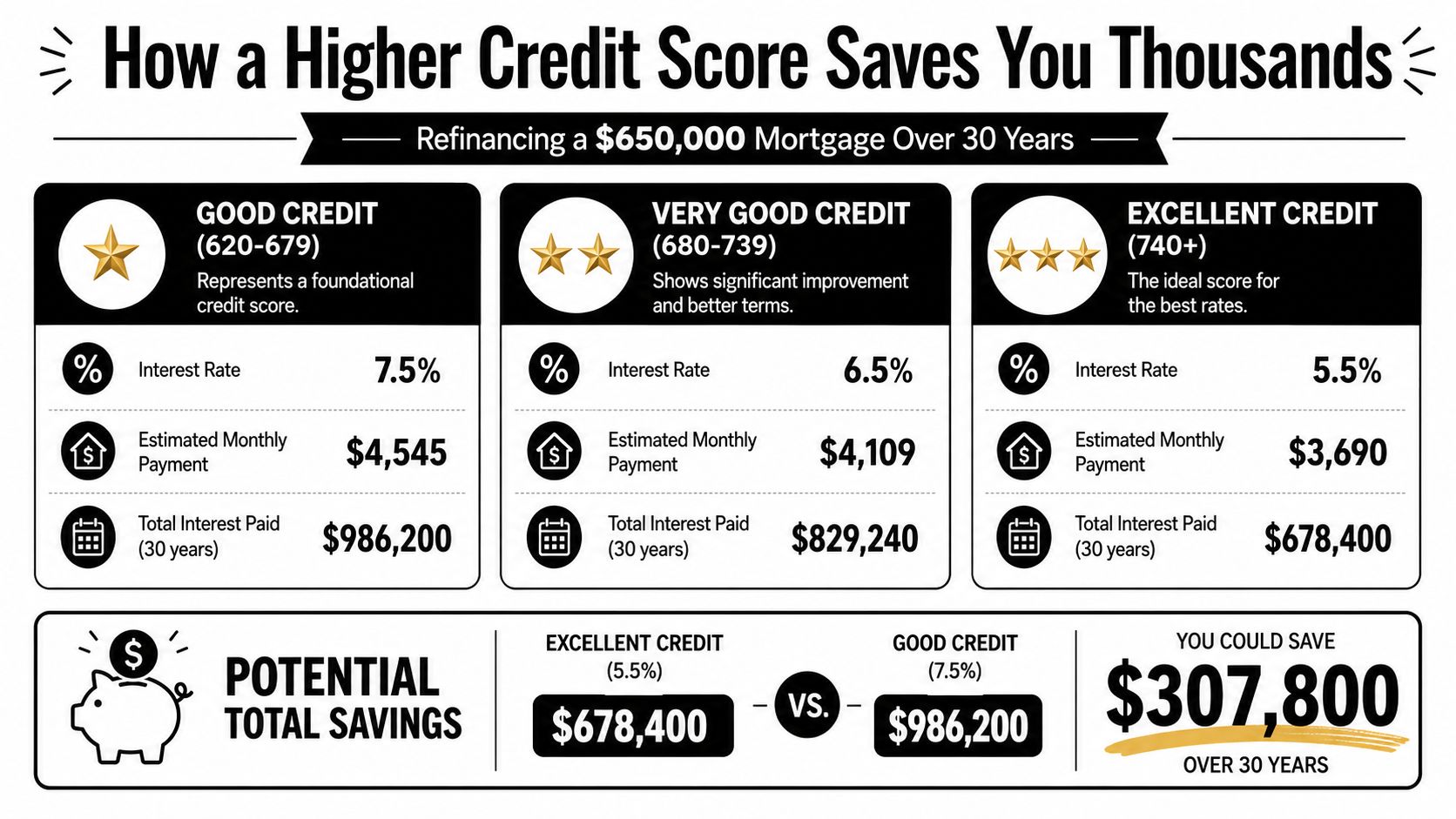
A higher score doesn't just help you qualify. It changes how expensive your refinance becomes over time.
That's the part many homeowners miss. They focus on getting approved and stop there. Approval matters, but pricing matters more. A refinance that clears underwriting but comes with a weaker rate can cost you far more than expected over the life of the loan.
Small score gaps can create big pricing changes
This isn't a straight-line system where every point changes pricing the same way. Mortgage pricing is tiered. Certain score bands offer better terms, and certain loan types punish borderline credit more aggressively.
According to AmeriSave's refinance requirements guide, the impact of credit score on refinance interest rates is non-linear, and for jumbo refinances lenders often require 740 on 15-year fixed terms to secure the lowest available rates. That source also notes that a 20-point difference between 720 and 740 can significantly alter APR.
That's why I tell California borrowers not to shrug off a score that's “close enough.” Close enough often isn't good enough.
What this means in real life
If you own in a California market where loan balances run high, a better score provides you with a stronger position. More lender confidence usually means stronger pricing options. On a jumbo refinance, that strong position becomes even more important because lenders already view the balance as carrying more risk.
Here's the practical takeaway:
- Borderline credit narrows your menu. You may still get approved, but with fewer attractive options.
- Strong credit improves negotiating power. Lenders compete harder for cleaner files.
- Jumbo borrowers need to care more, not less. In higher-balance California loans, score quality can matter sharply.
The best refinance isn't the one you can get today. It's the one that costs you the least over time.
This is especially important for police officers, firefighters, and EMS professionals who may have strong income but little time to shop multiple lenders carefully. If that's you, watch the score bands closely before you lock anything in. This page on mortgage rates for police and fire professionals is useful for seeing how rate shopping should be approached in the HERO market.
Don't confuse urgency with savings
A lot of homeowners refinance too soon because they want relief now. I get it. But if your score is on the edge of a better pricing tier, waiting long enough to improve it can be the smarter financial move.
Not every borrower should delay. Some need immediate payment relief or a loan restructure that makes sense right away. But if your file is close to a stronger score bracket, pausing to improve it can create better long-term savings than rushing into the first approval available.
That's the difference between refinancing as a reaction and refinancing as a strategy.
Your Action Plan to Boost Your Score for a Refinance
If your score isn't where you want it, don't guess. Use a short, disciplined plan and fix the things that move lender decisions the fastest.
The goal isn't to become perfect. The goal is to become easier to approve and cheaper to lend to.
Start with the moves that matter most
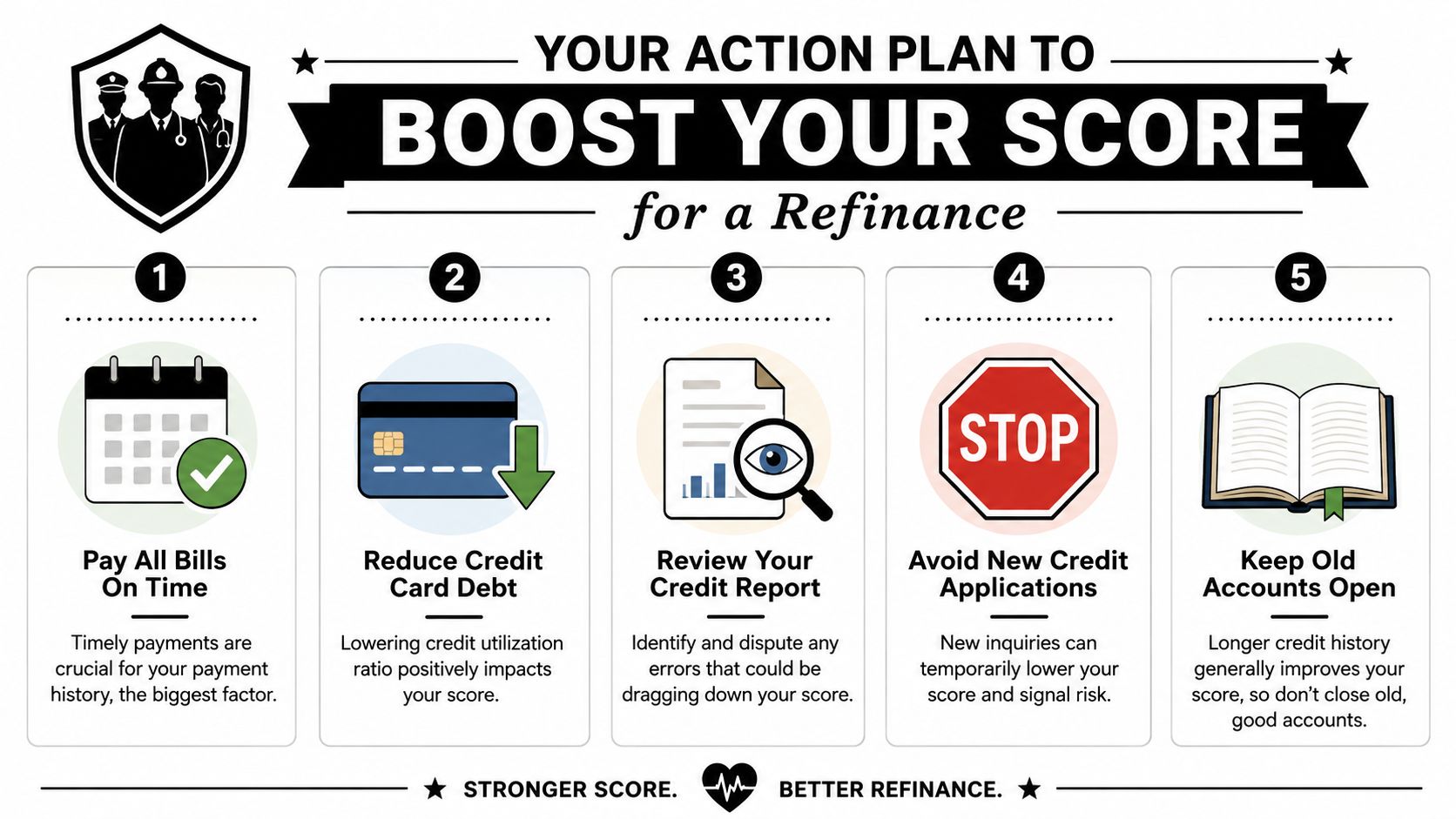
Use this checklist before you apply:
- Pay every bill on time. Late payments tell lenders you're unpredictable. Clean recent payment history helps more than fancy financial hacks.
- Reduce revolving balances. If your credit cards are carrying high balances, attack those first. Lower balances improve your profile quickly and make your monthly obligations look more manageable.
- Review your credit reports carefully. Wrong balances, duplicate accounts, or old derogatory items can drag your score down for no good reason.
- Stop applying for new credit. Don't finance furniture, open a card for points, or take on a new loan right before a refinance.
- Keep seasoned accounts open. Older, positive accounts support a deeper credit history.
Watch your debt-to-income and equity in California
For cash-out refinancing in California, your score alone won't carry the file. You also need the rest of the loan to make sense.
According to Capital Home Mortgage's California cash-out refinance overview, cash-out mortgage refinances in California generally require a 620 minimum credit score, at least 20% equity, and a 43% debt-to-income ratio or less. That DTI includes recurring debts such as the mortgage, car loans, student loans, and credit card payments.
That means two California borrowers with the same score can get very different outcomes. One has manageable debt and strong equity. The other is stretched thin every month. Same score. Different risk profile.
If you want a cash-out refinance, clean up monthly debt before you ask for more borrowed money against your house.
Newer scoring models may help some borrowers
Here's the part most consumer mortgage content skips. Newer credit scoring models can help borrowers whose recent behavior has improved, even if their older profile still looks rough.
The Federal Housing Finance Agency credit score policy page states that, as of late 2022, VantageScore 4.0 and FICO 10T were approved for use by Fannie Mae and Freddie Mac. FHFA also notes that lenders can choose between Classic FICO and VantageScore 4.0 on an interim basis. That matters because these newer models weigh recent credit behavior more heavily.
If you've spent the last stretch paying down debt, catching up accounts, and stabilizing your profile, that change could work in your favor.
A practical sequence that works
Don't try to do everything at once. Use this order:
- Pull your reports and identify errors.
- Bring every account current and keep it current.
- Pay down cards and other revolving balances.
- Avoid new applications while you prepare.
- Ask your lender which scoring model they're using.
That last step matters more than people think. If your classic mortgage score is borderline but your recent behavior is strong, the model used by the lender may shape the outcome.
Your refinance mortgage credit score doesn't improve because you hope it will. It improves because you make your file cleaner, calmer, and easier for an underwriter to trust.
Special Refinance Programs for California HEROES
California HEROES don't always need the same refinance path as everyone else. Veterans have VA options. Borrowers already in FHA loans may have a simpler streamline route. Public service professionals with strong work history but complicated monthly budgets may need a lender who understands program fit instead of forcing them into the first generic box.
That's where specialized refinance strategy matters.

Veterans should pay close attention to lender overlays
If you're eligible for a VA refinance, don't assume every lender interprets your file the same way. Many veterans lose time because of this.
Rocket Mortgage's refinance requirements guide highlights the critical gap between VA policy and lender overlays, noting that while the VA has no minimum credit score requirement, many lenders impose their own standards, typically around 580–620. That gap remains one of the least understood problems in the refinance market for veterans.
For veterans, the message is simple. Ask the lender their actual minimum before you let them pull credit. Don't let anyone hide behind “VA guidelines” if the actual obstacle is the lender's internal overlay.
Streamline options can reduce friction
Some refinance programs are designed to be simpler than a full traditional refinance.
For eligible VA borrowers, the Interest Rate Reduction Refinance Loan, often called the IRRRL, can be an attractive route when the goal is to improve the existing loan rather than reinvent the whole structure. Borrowers with FHA loans may also benefit from an FHA Streamline Refinance when the file fits that program.
These options matter for HERO borrowers because they can reduce paperwork fatigue and simplify the process. That's especially helpful if you're balancing shift work, deployments, school calendars, or irregular overtime schedules.
The best program depends on your real bottleneck
Ask yourself what's stopping progress.
- If score is the issue, FHA flexibility or a lender with a sensible VA overlay may be the answer.
- If documentation is the issue, a streamline option may remove friction.
- If monthly debt is the issue, a cash-out refinance may look tempting, but only if it fixes the budget instead of extending the problem.
- If you're in a high-balance market, score quality becomes even more important because pricing gets tighter.
A good refinance program fits your file. A bad one just sounds good in a sales pitch.
California HEROES do best when they work with someone who understands public service income patterns, VA confusion, cash-out rules, and the challenges of high-cost housing. Generic advice isn't enough when one lender says yes, another says no, and both claim they're following the same guidelines.
If you're ready to see where your credit stands and which refinance path makes sense, talk with California Loans for Heroes. Their team helps veterans, first responders, teachers, healthcare workers, and other California public service professionals sort through refinance options, lender overlays, and savings opportunities with clear one-on-one guidance.