You're probably in the same spot a lot of California HEROES land in. You've done the hard part already. You served, or you're serving your community now as a firefighter, nurse, law enforcement officer, teacher, medic, or veteran. Then you start shopping in places like Los Angeles, Orange County, San Diego, or the Bay Area and the numbers feel absurd.
A lot of buyers assume the answer is simple. Homes are expensive, so they must need a massive down payment. That assumption is wrong more often than people realize.
If you're eligible for a Jumbo VA loan, you may be able to buy far above standard loan limits without bringing the kind of cash a conventional jumbo lender usually wants. That matters in California, where “normal” home prices regularly push buyers into jumbo territory fast. It matters even more if you're trying to keep reserves intact for repairs, moving costs, and plain old life.
This guide is built for ranking in California because that's where the confusion is worst and where the jumbo VA loan matters most. Generic advice misses key issues. California buyers don't just need a definition. They need answers on high-cost counties, partial entitlement, lender overlays, and how to avoid getting blindsided halfway through escrow.
What Is a Jumbo VA Loan
A California HERO can cross into jumbo territory fast. In Los Angeles or San Diego, that can happen while shopping for a normal family home, not a luxury property.
A Jumbo VA loan is a VA-backed mortgage above the standard conforming loan limit for the county where you're buying. For 2026, that means a loan over $832,750 in standard counties or over $1,249,125 in designated high-cost counties, according to 2026 VA jumbo loan limit guidance for standard and high-cost counties.
That definition matters because many buyers hear the word “jumbo” and assume the rules are the same as conventional jumbo financing. They are not. For an eligible Veteran or HERO using VA benefits, jumbo status does not automatically mean a massive down payment.
Why California buyers need a sharper definition
In California, “jumbo” is often just the price of entry in competitive counties. You are not necessarily stretching for a dream estate. You may be trying to buy close to work, cut your commute, or stay in a school district that fits your family.
That is where generic mortgage advice fails California HEROES. It skips the two issues that decide whether the deal works. Partial entitlement and lender overlays.
If you have full entitlement, a jumbo VA loan can still be a zero-down option if the rest of the file is strong. If you have partial entitlement, the math changes, and some lenders get stricter than the VA requires. That is the part borrowers in high-cost counties get blindsided by.
Practical rule: In California, jumbo tells you the loan size. It does not tell you the down payment.
One more point matters here. Zero-down VA financing is common on purchases overall, including many higher-balance deals, based on FY2024 VA purchase loan data showing most borrowers used no down payment. That does not guarantee zero down on your file. It does mean you should stop assuming a high purchase price forces you into conventional jumbo terms.
Use this framework instead:
- Below the county limit: standard conforming territory
- Above the county limit: jumbo VA territory
- Full entitlement: zero down may still be available
- Partial entitlement: down payment depends on remaining entitlement and the lender's overlay rules
That last line is the one that matters most in California. A jumbo VA loan is not just a bigger VA loan. In high-cost counties, it is often the difference between buying with a smart cash position and draining savings just to satisfy a lender that does not understand VA financing well enough.
How VA Entitlement Unlocks Your Buying Power
In Los Angeles or San Diego, this is the question that decides whether your offer is realistic. How much of your VA entitlement is still available, and how strict is the lender going to be once the loan size moves into jumbo territory?
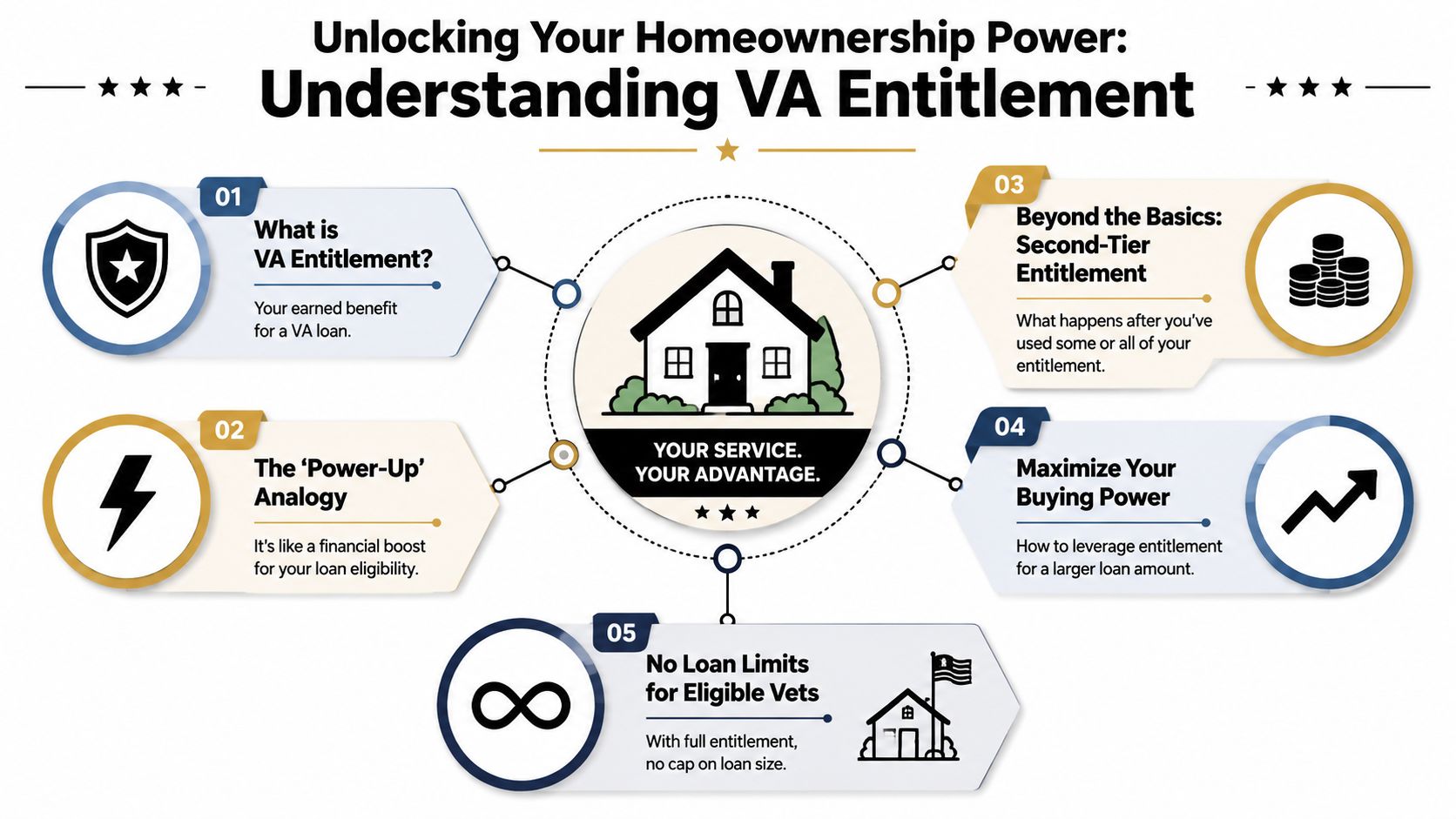
VA entitlement is the portion of your loan the VA guarantees to the lender. That guarantee is the reason a qualified California HERO can buy far above conforming limits without being pushed straight into conventional jumbo rules.
Full entitlement gives you the most room
With full entitlement, the path is usually straightforward. The VA guaranty can support a jumbo purchase with no down payment if your credit, income, residual income, and overall file are strong enough.
That is the advantage California buyers need to understand clearly. A $1.3 million purchase does not automatically mean a jumbo down payment. If your entitlement is fully restored and the lender understands VA jumbo lending, zero down can still be on the table.
In high-cost counties, that matters. Keeping cash in reserve instead of pouring it into a down payment gives you more flexibility for appraisal gaps, repairs, rate buydowns, and post-closing reserves.
Partial entitlement changes the math fast
Partial entitlement is where many California HEROES get bad advice.
If you still own a home with a VA loan, have used entitlement that has not been restored, or had a prior loss tied to the benefit, your remaining entitlement sets a ceiling on how much loan amount can be supported before a down payment is required. As noted earlier, the standard calculation is based on 25% of the county loan limit, minus the entitlement already used.
Here is the practical version:
- Find your county loan limit.
- Take 25% of that amount.
- Subtract the entitlement already tied up.
- Multiply the remaining guaranty amount by four.
- Compare that result to the loan amount you want.
If your target loan amount is higher than that supported figure, the shortfall usually has to be covered with a down payment.
Why this hits harder in California
In lower-cost areas, the gap may be manageable. In Los Angeles, Orange County, or San Diego, the gap can get expensive very quickly because home prices move faster than the remaining entitlement on file.
Here is the mistake I see all the time. A HERO hears “VA has no loan limit,” assumes zero down still applies, and starts shopping at the top of the budget. Then the lender reviews the certificate, sees partial entitlement, adds its own overlay, and the borrower suddenly needs far more cash than expected.
That is not a VA problem. It is a planning problem, and sometimes a lender problem.
The lender matters as much as the entitlement
Two lenders can look at the same veteran and structure the deal very differently. One knows how to calculate the file correctly and gives you a clean answer early. Another applies extra restrictions, gets nervous above the county limit, and treats the loan more like conventional jumbo.
For California HEROES, that distinction matters. Partial entitlement does not kill the deal. It means you need the math done before you write offers, and you need a lender that does not add unnecessary friction on a high-balance VA file.
If you are buying in a high-cost county and you have used VA eligibility before, do not rely on generic preapproval language. Ask for the entitlement calculation in writing. Ask whether the lender has stricter jumbo overlays above its internal limit. That is how you protect your cash and avoid chasing homes you cannot buy.
Qualifying for a Jumbo VA Loan in California
You're buying in San Diego at a price point that would be routine for a conventional jumbo borrower, but you want to keep your cash for reserves, repairs, and closing. Then the file hits a lender that barely understands partial entitlement, adds its own jumbo cap, and suddenly your “VA zero down” plan changes. That happens all the time in California.
Qualification on a jumbo VA loan comes down to two things. Your file strength, and the lender's appetite for high-balance VA business in counties like Los Angeles, Orange County, and San Diego. If either one is weak, the deal gets expensive fast.
Overlays decide whether the deal stays attractive
The VA program gives you a strong financing option. The lender decides how far it is willing to go with that option.
Some lenders set internal caps on jumbo VA loan amounts. Some tighten debt-to-income standards once the balance climbs. Some require down payment contributions on the gap above remaining entitlement. The practical result is simple. Two lenders can review the same HERO, same income, same property, same county, and issue very different approvals.
That is why a generic preapproval is not enough in California high-cost counties.
If you have partial entitlement, ask direct questions before you shop:
- What is your internal jumbo VA cap?
- At what loan amount do extra overlays start?
- Do you require money down above a certain balance, even if the file is otherwise strong?
- How do you handle partial entitlement in Los Angeles or San Diego County?
- Do you require reserves on high-balance VA loans?
If the loan officer dodges those questions, find a better lender.
What lenders actually review on a California jumbo VA file
The VA does not set a universal minimum credit score. Lenders typically look for credit scores of 620 or higher, and many jumbo VA lenders want a stronger overall file once the loan amount gets large.
Here's what usually drives the decision:
- Credit profile: Recent late payments, high revolving debt, and major derogatory events carry more weight than chasing a small score increase.
- Income consistency: California HEROES often use overtime, special pay, shift differential, BAH, or bonus income. That income must be documented clearly and shown as stable.
- Debt-to-income ratio: High balances create high payments. Even strong earners can run into ratio pressure if taxes, insurance, and other debts are already heavy.
- Cash reserves: Zero down does not mean zero cash. On jumbo files, reserves help calm lender risk concerns and can keep your options open.
- Property fit: A clean owner-occupied single-family home is usually the easiest approval. Mixed-use, unique properties, and condition issues create more friction.
One more point. Closing funds still matter. If preserving cash is part of your strategy, review your options for veteran closing cost assistance programs in California before you write offers.
A practical standard for preapproval
Do not ask whether a jumbo VA loan is possible in general. Ask whether your lender can approve your exact scenario, with your entitlement status, in your county, at your target price.
A real preapproval for a California jumbo VA purchase should answer these questions in writing:
| Issue | What you need to know |
|---|---|
| Entitlement status | Full or partial, and how that affects cash needed |
| County profile | Whether you are buying in a standard or high-cost county |
| Lender overlay | Internal cap, reserve requirement, and any jumbo-specific restrictions |
| File strength | Credit, income history, debt ratios, and assets |
| Property type | Whether the home fits standard VA occupancy and condition expectations |
A lender who cannot explain its jumbo VA overlays clearly is telling you something. Believe them early, not after the appraisal is in and your deposit is on the line.
Weighing the Pros and Cons of a Jumbo VA Loan
A Jumbo VA loan is one of the strongest products in the market for qualified California buyers. It is not perfect. You should still understand the trade-offs before you commit.
Where the Jumbo VA loan shines
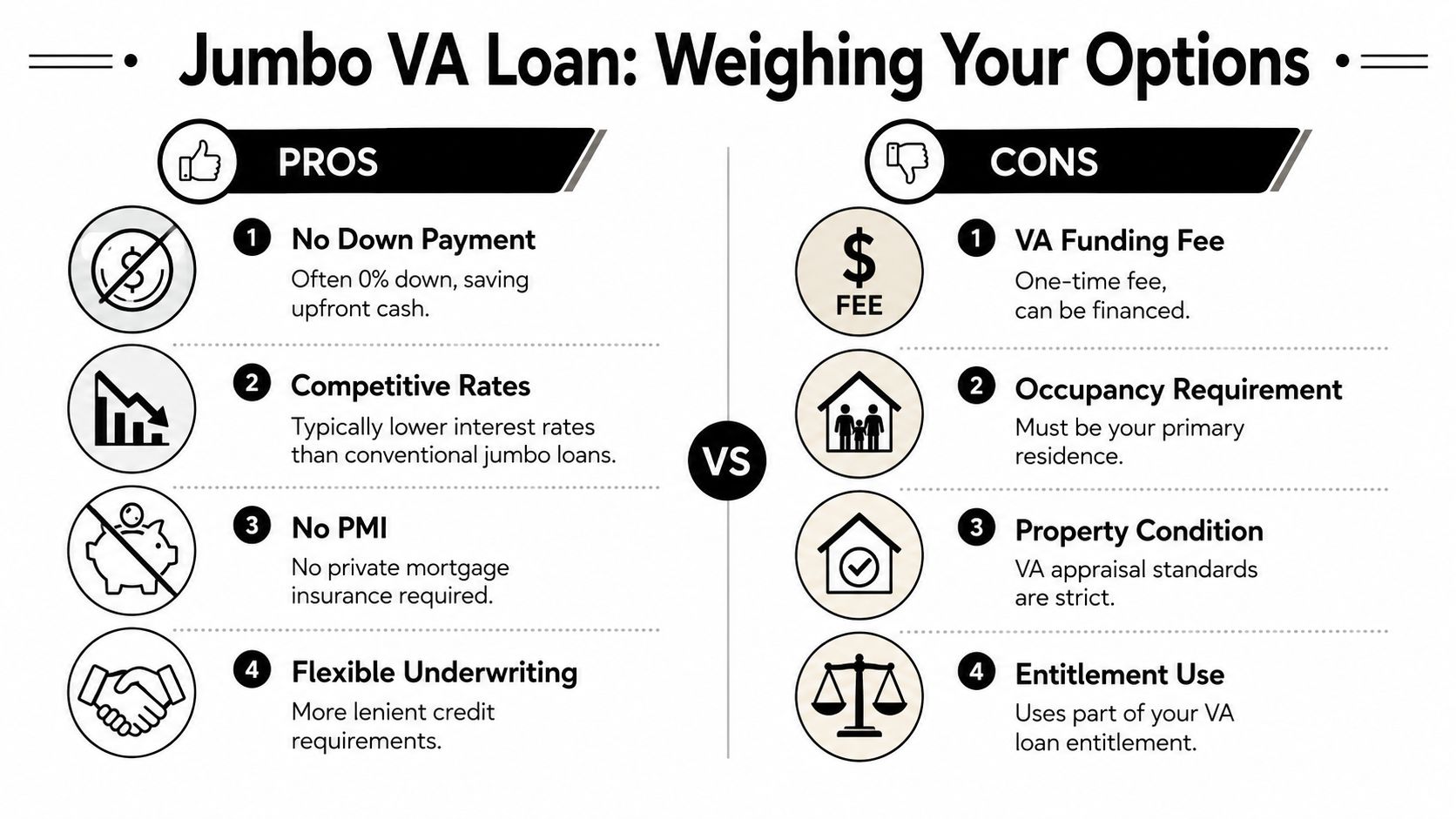
The headline advantage is obvious. A qualified buyer may be able to buy above conforming limits without the giant down payment conventional jumbo lenders often expect.
The rate advantage is also real. Verified HMDA-based guidance shows VA mortgage rates consistently run 0.25% to 0.50% below comparable conventional mortgage rates, and on a $1,500,000 jumbo loan, a 0.50% rate reduction saves about $7,500 annually in interest, according to the verified rate comparison source.
That's not a small edge. On a large balance, a modest rate gap matters fast.
The other major positive is structural. VA loans don't require private mortgage insurance. That helps preserve monthly affordability even when the loan amount is large.
The costs and limits you shouldn't ignore
The biggest cost to understand is the VA funding fee. Verified guidance states that in 2026, the funding fee is 2.15% for first use with $0 down, and that fee structure stays constant regardless of loan size, based on the cited verified summary of VA funding fee treatment.
That's important because jumbo buyers often assume costs scale badly with loan size. On the VA side, the funding fee structure is more predictable than private mortgage insurance in the conventional jumbo world. The fee can also be financed into the loan in many cases, which protects your liquidity.
You should also weigh these practical drawbacks:
- Occupancy requirement: This must be your primary residence.
- Property condition rules: VA appraisal standards are not optional.
- Lender overlays: A lender can still impose extra requirements on high loan amounts.
- Entitlement usage: Reusing the benefit later gets more complicated if you don't plan ahead.
A simple decision test
A Jumbo VA loan usually makes sense if these points line up:
- You want to preserve cash: Keeping reserves often matters more than making a huge down payment.
- You qualify cleanly: Strong income and manageable obligations make the file smoother.
- You're buying a primary home: This is a homeownership tool, not an investor shortcut.
- You compare total cost, not just fees: Rate savings can outweigh upfront friction.
If closing costs are the piece you're trying to solve, review closing cost assistance options for veterans before you default to bringing more cash than necessary.
A Step-by-Step Guide to Your Jumbo VA Loan
You found a home in Los Angeles or San Diego that fits your family, your commute, and your budget on paper. Then the file hits underwriting, and the deal gets harder than it should because nobody checked your entitlement early or explained the lender's jumbo overlay. That mistake is common in California, and it is avoidable.
The strongest jumbo VA purchases start with file prep. California HEROES buying in high-cost counties need a lender who can clear the numbers, review entitlement, and spot overlay problems before the first offer goes out.
Step 1 and Step 2
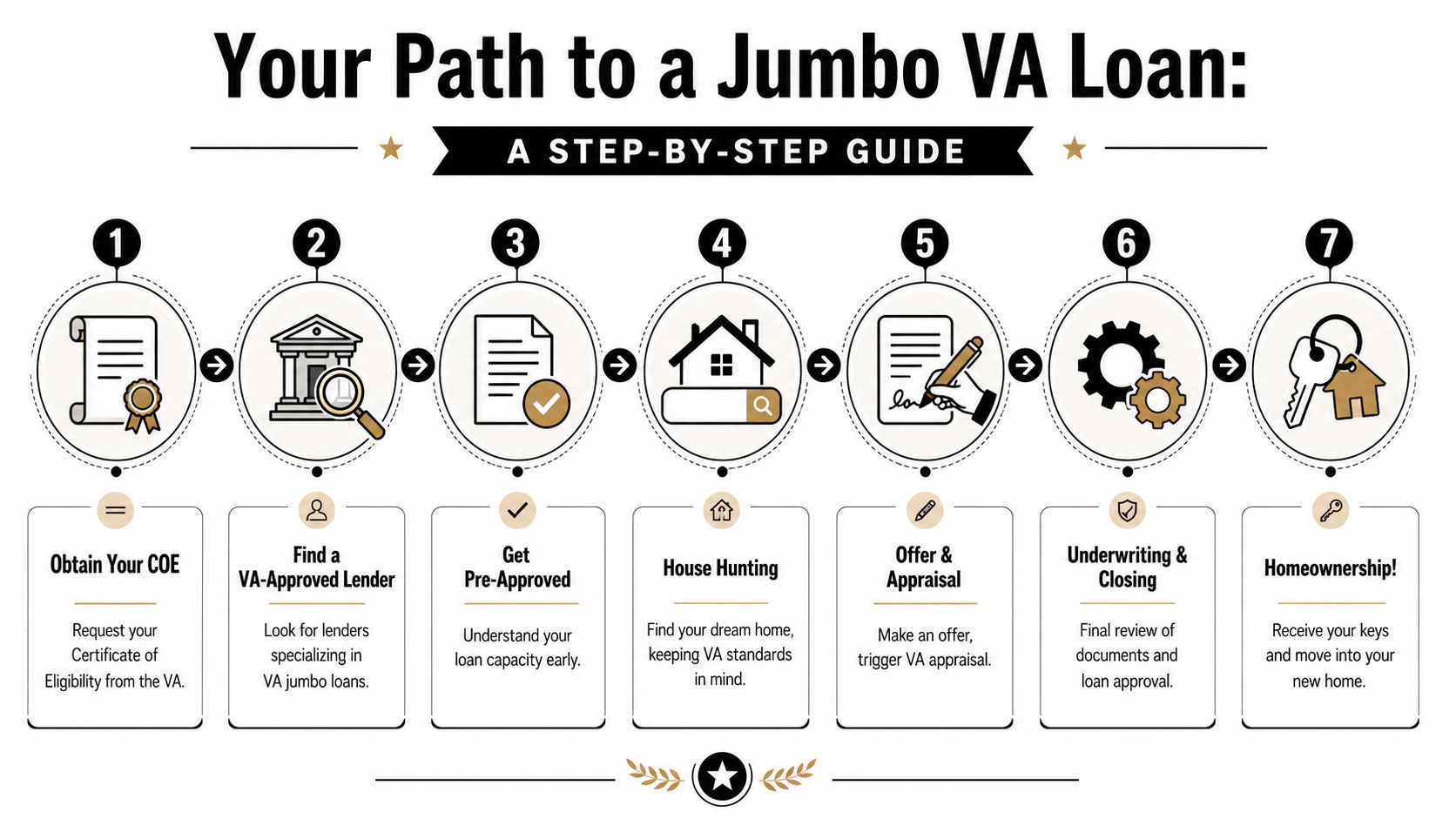
Get your COE first. Do not shop blind. Your Certificate of Eligibility tells your lender how much entitlement is available and whether a prior VA loan is still affecting this purchase. In California jumbo price ranges, that answer changes your strategy fast.
Choose a lender that does California jumbo VA well. A lender can be good at standard VA loans and still be weak on jumbo files in high-cost counties. Ask direct questions. How do they handle partial entitlement? What are their loan amount caps? What reserve requirements show up on larger balances? If the answers are vague, move on.
Step 3 and Step 4
Get fully pre-approved. That means income, assets, debts, and entitlement have already been reviewed. In competitive markets, a casual prequalification is close to useless. Sellers and agents want to know your financing is real.
Set your payment ceiling before your shopping ceiling. Plenty of California buyers can qualify for more than they should spend. Property taxes, insurance, HOA dues, and daily life in high-cost counties add up quickly. Buy at a payment you can carry comfortably, not at the top edge of an approval.
Property condition matters, too. Before you fall in love with a house that needs work, review these VA home loan home inspection considerations. It will save you time and bad offers.
Step 5 through closing
Once you are in contract, speed and documentation decide whether the file stays clean.
- Offer accepted: Your lender updates the file, issues disclosures, and starts the loan process.
- Appraisal ordered: The VA appraisal checks value and property standards.
- Underwriting review: Income, assets, title, insurance, appraisal, and source of funds all get reviewed.
- Conditions cleared: Organized borrowers excel at this stage. Send documents quickly and completely.
- Closing: Final loan documents are signed, funds are released, and you get the keys.
What wins in jumbo underwriting? Clean bank statements, stable income, documented assets, and no last-minute surprises.
Mistakes that slow down a California jumbo deal
Some errors are expensive because they hit harder on jumbo files than on smaller loans.
- Using a lender who misses overlays: This is the biggest one. A bad read on reserves, credit standards, or partial entitlement can blow up the deal late.
- Changing jobs during escrow: That can create extra review, especially if overtime, bonus, or variable pay is part of the file.
- Opening new debt: A new car payment or credit line can damage DTI right before final approval.
- Moving large amounts of money without a clear trail: Underwriters need to source funds cleanly.
- Assuming every county and every lender works the same way: They do not. California jumbo VA lending is full of lender-specific rules.
The process is straightforward if the setup is right. For California HEROES, the real work happens before the offer, especially if entitlement is partially tied up or the purchase is in a high-cost county where overlays get stricter.
Special Guidance for California HEROES
If you're a California HERO, the advice gets personal.
A generic national VA article won't help much if you're buying in Los Angeles, Orange, San Diego, San Francisco, or Santa Clara County and trying to make sense of high-cost pricing with an existing VA loan on another property. Those buyers don't need slogans. They need math, strategy, and a lender who won't oversimplify the file.

The partial entitlement problem is bigger in California
This is the issue most buyers underestimate.
Verified guidance points out that for a borrower with $50k remaining entitlement, the zero-down ceiling is only $200k, because the supported loan amount is 4x the remaining entitlement, as explained in this VA jumbo entitlement breakdown.
In California, that can be a brutal wake-up call. A nurse relocating within Southern California, a firefighter keeping a prior home as a rental, or a veteran buying again after PCS may assume “I still have VA, so I'm good.” Not necessarily. If your entitlement is partially tied up, your zero-down capacity may be nowhere near the purchase price you're targeting.
Who needs extra caution
Some California buyers should slow down and run the file early:
- Veterans with an active VA loan elsewhere: This is the classic partial entitlement scenario.
- First responders moving across counties: Your county limit and your entitlement math both matter.
- Nurses and healthcare professionals with variable income: Shift pay and overtime can help, but only if documented well.
- Teachers and public employees with tight DTI: A strong benefit doesn't erase payment reality.
California-specific advice: Before you tour homes in a high-cost county, confirm whether your entitlement is full, partial, or restorable. That answer changes everything.
The best move for a California HERO
Use the VA benefit aggressively, but don't use it blindly.
If you have full entitlement and a strong file, a Jumbo VA loan can be one of the best financing tools available in California. If you have partial entitlement, don't panic. Just get the actual calculation done before you build your budget around bad assumptions.
If down payment pressure or cash-to-close is your biggest concern, review VA home loan down payment assistance options and combine that planning with your entitlement review. That's how smart buyers stay in the game instead of backing out late.
The California buyer who wins with a jumbo VA strategy is usually not the one with the fanciest file. It's the one who understands the rules before writing the offer.
California HEROES deserve straight answers and a loan strategy built for California's real prices, not generic national advice. If you want help sorting out entitlement, lender overlays, pre-approval strength, or the smartest path into a high-cost market, talk with California Loans for Heroes. Their team helps veterans, active-duty military, first responders, nurses, teachers, and public service professionals manage home financing across California with one-on-one support and HERO-focused savings options.